
Neem Extracts Market Size & Share Growth Forecast Report (2026-2035)
Industry Insight by Type (Fruit and Seed Extract, Leaf Extract, Bark Extract), by Application (Agrochemicals, Pharmaceuticals and Nutraceuticals, Personal Care and Cosmetics, Food and Beverage Additives, Animal Feed and Veterinary, Other Industrial Uses), by Formulation (Liquid, Powder, Granules / Pellets), by End Use (Agriculture and Farming, Personal Care and Cosmetics, Pharmaceutical Manufacturing, Animal Nutrition, Other Industrial Applications)
| Status : Published | Published On : Oct, 2026 | Report Code : VRFB11052 | Industry : Food & Beverage | Available Format :

|
Page : 167 |
Neem Extracts Market Overview
The neem extracts market size was estimated at about USD 2.56 billion in 2025 and is expected to reach around USD 2.83 billion in 2026 rising up to roughly USD 7.07 billion in 2035, growing at approximately 10.7% CAGR from 2026 to 2035.
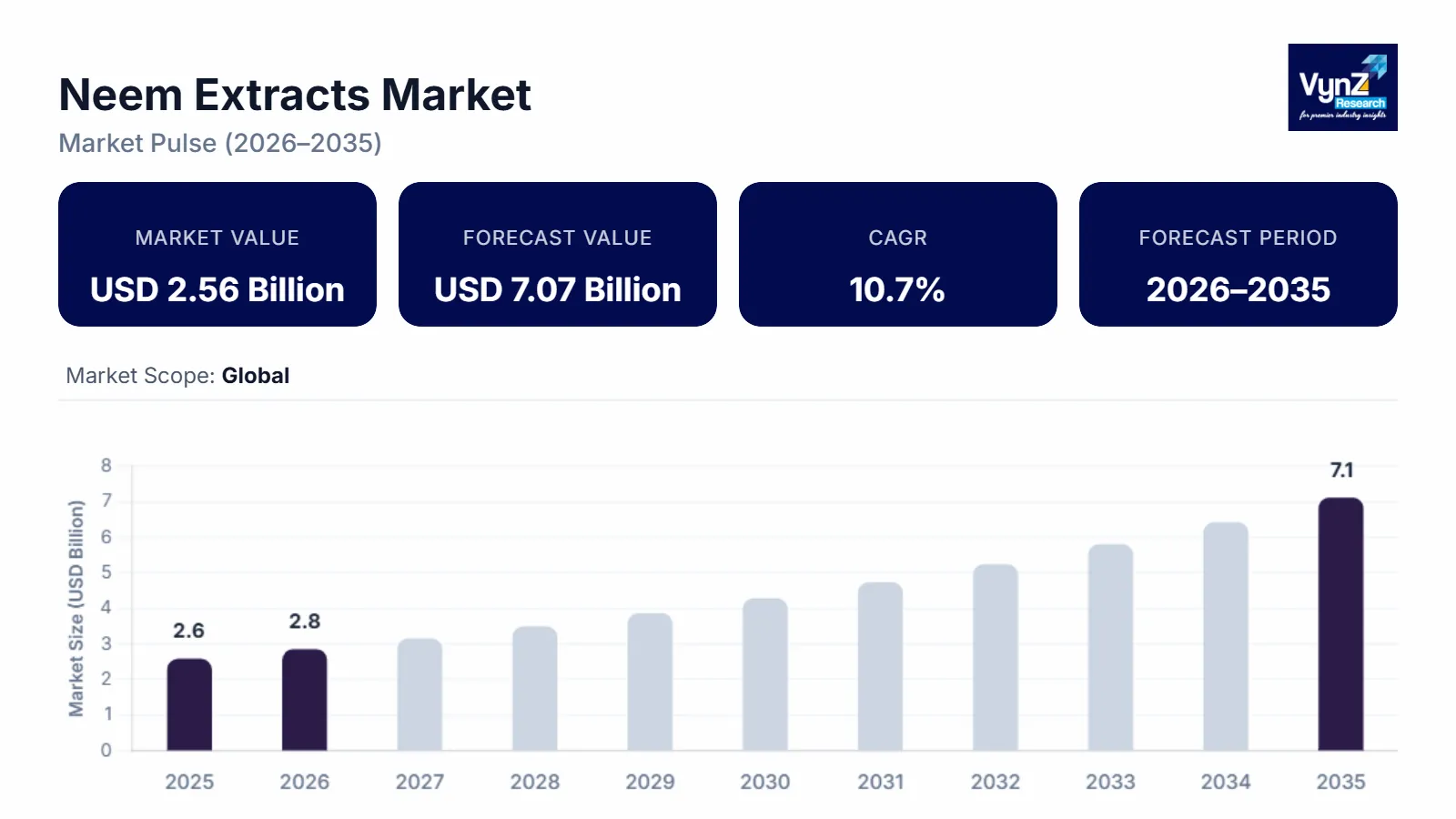
The industry is supported by the increasing usage of botanical crop protection, natural individual care ingredients, herbal formulations and neem-based agricultural inputs. Demand is also propelled by the government’s support for sustainable agriculture, including India’s mandatory neem coating of domestically produced urea. The Department of Fertilizers has reported improvement in soil condition, crop production and pest management through the use of neem coated urea, while ICAR is promoting neem based inputs as a part of balanced fertilizer management practice.
Market growth is also driven by sustainable agriculture, rising demand for botanical pesticides and increased utilization of natural ingredients in personal care and pharmaceutical formulations, apart from extensive neem based crop protection adoption. India’s Department of Fertilizers has mandated 100% neem coating of domestically produced urea, while recent policy updates by the government have reported improved nutrient utilization and lesser fertilizer wastage with neem coated urea. In addition, ICAR has been promoting neem coated urea and biofertilizers as a part of balanced fertilizer management. These factors are expected to benefit the market in India and the Asia Pacific region, while EPA registration facilitates the commercial sales of neem based pesticide products in the North American region.
Research Methodology
VynZ Research has estimated this market using secondary research, company insights, government reports, agricultural research, regulatory guidelines and comparative analysis of historical data of the market. The analysts at VynZ Research have evaluated factors such as availability of raw materials, extraction technologies, product type, application, formulation, end use and regional demand to formulate the forecast for the market. The performance of the market from 2020 to 2024 is compared to the base year 2025, while the growth outlook for 2026 to 2035 is estimated based on the adoption rate of biopesticides and organic farming, personal care and pharmaceutical applications, neem-coated fertilizer demand, formulation trends and the rising regulatory approvals of botanical crop protection products across the globe.
Research Highlights
- Fruit and seed extract accounted for an estimated 51.1% share in 2025, supported by high azadirachtin content and extensive use in agricultural and industrial formulations.
- Pharmaceuticals and nutraceuticals represented an estimated 40.2% share in 2025, due to the established use of neem-derived bioactive compounds in herbal and traditional medicine formulations.
- Powder formulation captured an estimated 39.5% share in 2025, driven by comparatively convenient storage, transportation and incorporation into dry agricultural and industrial preparations.
- Bark extract is projected to register approximately 11.3% CAGR from 2026 to 2035, for increasing interest in specialized botanical ingredients and higher value personal care applications.
- Asia Pacific accounted for an estimated 54.2% share in 2025, supported by India's neem-coatedurea policy, extensive agricultural applications and established neem processing infrastructure.
Neem Extracts Market Dynamics
Market Trends
The industry is witnessing notable shifts toward standardized botanical ingredients, higher active compound concentrations and application-specific extraction processes. One of the key trends shaping the market is the movement toward standardized neem extracts for agricultural, personal care and pharmaceutical formulations, reflecting greater emphasis on consistency, purity and predictable performance. The U.S. Environmental Protection Agency also recognizes azadirachtin and neem oil extracts as biochemical pesticide active ingredients used against a broad range of pests. Another emerging trend is the development of improved formulations designed to enhance stability, handling and field performance.
Growth Drivers
The growth of the market is largely supported by increasing demand for botanical crop protection products, which continues to generate consistent demand across organic farming, horticulture and conventional integrated pest management systems. India's Department of Fertilizers has reported that neem coated urea improves soil quality, reduces pest and disease control costs and improves crop yields. Government policy requiring neem coating for domestic urea has therefore created a structural source of demand for neem oil and related processing capacity. The Indian Council of Agricultural Research also continues to promote neem-coated urea alongside soil testing, balanced fertilization and other sustainable agricultural practices. Additionally, rising consumer interest in plant based personal care and traditional botanical ingredients is playing a crucial role in boosting adoption.
Market Restraints / Challenges
Despite favorable growth prospects, the market faces certain challenges that may limit its expansion. Raw material availability and quality consistency remain important constraints because neem extracts depend on seed, fruit, leaf and bark supply with variable active compound concentrations. Variations in seed maturity, extraction yield and storage conditions can affect the concentration of azadirachtin and other bioactive compounds, increasing the importance of standardized procurement and quality control for commercial manufacturers. Furthermore, regulatory requirements and competition from synthetic alternatives pose operational challenges for manufacturers and suppliers.
Market Opportunities
The market presents significant opportunities in sustainable crop protection, organic agriculture and standardised high-active neem formulations, particularly as farmers and food producers seek alternatives that support residue management and integrated pest management. India's continued use of neem-coated urea provides a large established agricultural application, while ICAR's work on sustainable nutrient management creates additional awareness around neem-based inputs. Companies offering standardized extracts, higher azadirachtin concentrations, improved formulation stability and reliable technical support can capture incremental demand from agricultural input manufacturers, organic growers, horticultural operators and fertilizer producers. Another key opportunity lies in personal care, pharmaceutical and nutraceutical formulations, where increasing interest in botanical ingredients is creating avenues for higher value applications.
Global Neem Extracts Market Report Coverage
|
Report Metric |
Details |
|
Historical Period |
2020 - 2024 |
|
Base Year Considered |
2025 |
|
Forecast Period |
2026 - 2035 |
|
Market Size in 2025 |
USD 2.56 Billion |
|
Revenue Forecast in 2035 |
USD 7.07 Billion |
|
Growth Rate |
10.7% |
|
Segments Covered in the Report |
Type, Application, Formulation, End Use |
|
Report Scope |
Market Trends, Drivers, and Restraints; Revenue Estimation and Forecast; Segmentation Analysis; Companies’ Strategic Developments; Market Share Analysis of Key Players; Company Profiling |
|
Regions Covered in the Report |
North America, Europe, Asia Pacific, Rest of the World |
|
Key Companies |
Agro Extracts Limited, Bros India Group, Certis USA LLC, Dhanuka Agritech Limited, Fortune Biotech Ltd, GreeNeem Agri Pvt Ltd, Gramin India Agri BusiNest, Neeming Australia, Ozone Biotech, PJ Margo Pvt Ltd. |
|
Customization |
Available upon request |
Neem Extracts Market Segmentation
By Type
Fruit and seed extract accounted for an estimated 51.1% share in 2025, supported by its importance as a source of azadirachtin and other limonoids used in agricultural formulations.
Bark extract is expected to record approximately 11.3% CAGR from 2026 to 2035, representing the fastest-growing type category in the published benchmark. Its growth is supported by increasing research interest in nimbidin and other bark-derived compounds, particularly for specialized personal care and pharmaceutical applications.
By Application
Pharmaceuticals and nutraceuticals accounted for an estimated 40.2% share in 2025, supported by long-established use of neem-derived ingredients in herbal formulations. Personal care and cosmetics represented another important demand area, where neem is incorporated into cleansing, skin care and hair care formulations.
Personal care and cosmetics are projected to expand at approximately 11.9% CAGR from 2026 to 2035, exceeding the broader market rate in the published benchmark. Growth is supported by demand for botanical ingredients in cleansing, scalp care and skin care formulations, together with increasing product development around natural origin ingredients.
By Formulation
Powder captured an estimated 39.5% share in 2025, supported by comparatively convenient storage, transportation and incorporation into agricultural, nutraceutical and industrial preparations.
Powder formulation is projected to register approximately 11.5% CAGR from 2026 to 2035, driven by improved processing, handling advantages and growing demand for shelf stable botanical ingredients.
By End Use
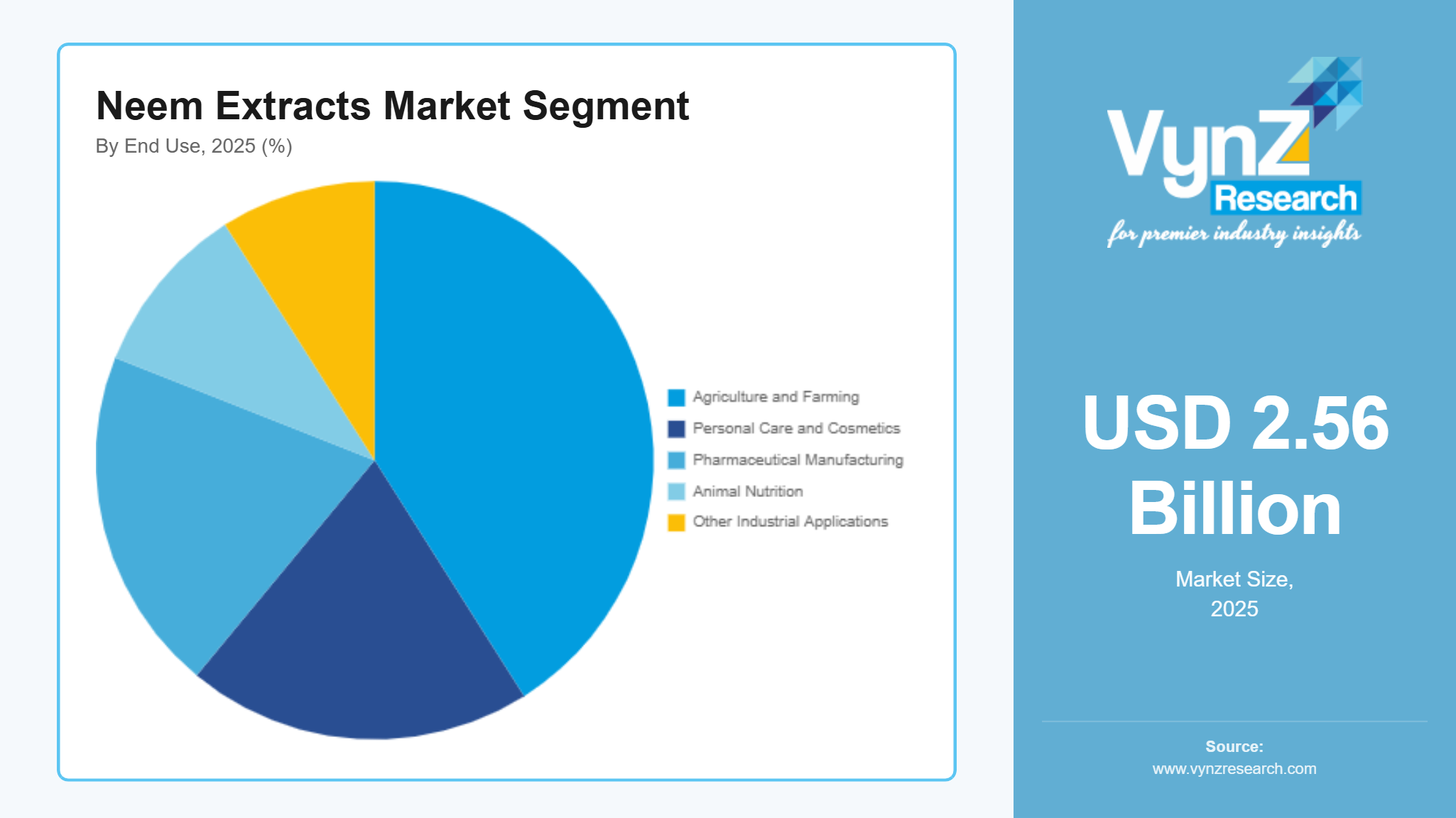
Agriculture and farming accounted for an estimated 41% share in 2025, supported by widespread use of neem oil, azadirachtin, neem cake and related products in crop protection and soil management.
Organic farming and sustainable crop production are projected to record approximately 11.6% CAGR from 2026 to 2035, supported by increasing adoption of botanical crop protection and balanced nutrient management.
Regional Insights
North America
North America accounted for approximately 15% of the market in 2025, supported by established organic agriculture, horticulture, natural personal care demand and regulatory acceptance of neem- based pesticide products. The U.S. Environmental Protection Agency maintains registrations for neem oil products and identifies azadirachtin and clarified hydrophobic neem oil extracts as biochemical pesticide active ingredients. This regulatory infrastructure supports commercial use across crops, ornamentals and residential applications. Demand is concentrated around professional crop production, organic growers and specialty horticulture, where botanical crop protection products can complement integrated pest management programs.
Europe
The Europe market accounted for approximately 18% of global revenue in 2025 and is projected to record approximately 11.8% CAGR from 2026 to 2035, making it one of the fastest-growing regions. Growth is supported by demand for biological crop protection and increased attention to reducing reliance on conventional synthetic pesticides. European demand is also supported by organic farming, horticulture and specialized botanical formulations. Trifolio M has continued obtaining registration extensions and emergency authorizations for NeemAzal products in countries including France, Austria, Hungary and other European markets.
Asia Pacific
Asia Pacific accounted for approximately 54.2% of the market in 2025, making it the largest regional market, supported by India's extensive neem resource base, agricultural applications and mandatory neem coated urea policy. India represents a major demand and processing center, while China and Southeast Asian markets add demand through agriculture, personal care and botanical product manufacturing. India's Department of Fertilizers has documented the agricultural benefits of neem coated urea, while ICAR continues to promote neem based inputs within sustainable farming practices. These factors provide a substantial structural foundation for regional demand.
Rest of the World
The Rest of the World accounted for the remaining estimated 12.8% of global revenue in 2025, covering Latin America, the Middle East and Africa. Demand is supported by agriculture, horticulture, organic crop production and growing interest in botanical crop protection, although adoption differs significantly between individual countries. Neem based products are particularly relevant where growers seek biological pest management solutions for export crops and where climate conditions support pest pressure. The region also provides raw material and market opportunities for international neem processors, with suppliers increasingly expanding distribution beyond traditional South Asian markets.
Competitive Landscape / Company Insights
The market is moderately competitive, with global and regional players focusing on extraction quality, azadirachtin concentration, formulation development, regulatory registration and geographic expansion. Companies are increasingly investing in integrated seed sourcing, laboratory testing and sustainable agricultural solutions to strengthen their market position. Agro Extracts has developed integrated neem processing capabilities, while PJ Margo operates across neem-based biopesticides, biofertilizers and biostimulants. Ozone Biotech and Fortune Biotech are also expanding botanical agricultural portfolios, increasing competitive emphasis on standardized inputs, organic certifications and international market access.
Mini Profiles
Agro Extracts Limited focuses on neem oil, neem extracts and related agricultural products, supported by integrated processing capabilities covering seed cleaning, kernel separation, extraction, oil production and neem cake processing.
Bros India Group operates across neem based agricultural products and botanical inputs, serving customers seeking plant derived crop protection and related natural product applications.
Certis USA LLC supplies biological crop protection products including registered neem oil solutions, supported by established regulatory experience and distribution across North American agricultural markets.
Dhanuka Agritech Limited provides crop protection and agricultural input products across India, with its broader biological and crop care portfolio supporting demand for sustainable farming solutions.
Fortune Biotech Ltd specializes in azadirachtin based biopesticides and neem derived agricultural products, with an international customer base and extensive experience in organic crop protection.
Key Players
- Agro Extracts Limited
- Bros India Group
- Certis USA LLC
- Dhanuka Agritech Limited
- Fortune Biotech Ltd
- GreeNeem Agri Pvt Ltd
- Gramin India Agri BusiNest
- Neeming Australia
- Ozone Biotech
- PJ Margo Pvt Ltd
Recent Developments
Fortune Biotech Ltd continues to expand its azadirachtin-based biopesticide platform and maintains organic approvals for its neem-based products. Its products have been tested across multiple international markets, supporting the company's focus on biological crop protection and sustainable agriculture.
GreeNeem Agri Pvt Ltd strengthened the regulatory positioning of its neem oil portfolio through active U.S. EPA registrations covering GreeNeem neem oil products. The portfolio includes cold-pressed neem oil and emulsifiable formulations for agricultural and horticultural pest management.
Ozone Biotech expanded its neem-focused agricultural communication and product portfolio around azadirachtin technical powder, neem oil, neem cake and formulated biological crop protection products. Its recent product communication also highlights applications spanning crop protection, horticulture, veterinary products and cosmeceuticals.
PJ Margo Pvt Ltd expanded its international focus on neem-based biocontrol and sustainable crop biosolutions, including participation in the Latin American biocontrol and biostimulant market. The company continues to position neem oil formulations alongside biostimulants, biofertilizers and other biological agricultural products.
Global Neem Extracts Market Coverage
Type Insight and Forecast 2026 - 2035
- Fruit and Seed Extract
- Leaf Extract
- Bark Extract
Application Insight and Forecast 2026 - 2035
- Agrochemicals
- Pharmaceuticals and Nutraceuticals
- Personal Care and Cosmetics
- Food and Beverage Additives
- Animal Feed and Veterinary
- Other Industrial Uses
Formulation Insight and Forecast 2026 - 2035
- Liquid
- Powder
- Granules / Pellets
End Use Insight and Forecast 2026 - 2035
- Agriculture and Farming
- Personal Care and Cosmetics
- Pharmaceutical Manufacturing
- Animal Nutrition
- Other Industrial Applications
Global Neem Extracts Market by Region
- North America
- By Type
- By Application
- By Formulation
- By End Use
- By Country - U.S., Canada, Mexico
- Europe
- By Type
- By Application
- By Formulation
- By End Use
- By Country - Germany, U.K., France, Italy, Spain, Russia, Rest of Europe
- Asia-Pacific (APAC)
- By Type
- By Application
- By Formulation
- By End Use
- By Country - China, Japan, India, South Korea, Vietnam, Thailand, Malaysia, Rest of Asia-Pacific
- Rest of the World (RoW)
- By Type
- By Application
- By Formulation
- By End Use
- By Country - Brazil, Saudi Arabia, South Africa, U.A.E., Other Countries
Table of Contents for Neem Extracts Market Report
1. Research Overview
1.1. The Report Offers
1.2. Market Coverage
1.2.1. By
Type
1.2.2. By
Application
1.2.3. By
Formulation
1.2.4. By
End Use
1.3. Research Phases
1.4. Limitations
1.5. Market Methodology
1.5.1. Data Sources
1.5.1.1.
Primary Research
1.5.1.2.
Secondary Research
1.5.2. Methodology
1.5.2.1.
Data Exploration
1.5.2.2.
Forecast Parameters
1.5.2.3.
Data Validation
1.5.2.4.
Assumptions
1.5.3. Study Period & Data Reporting Unit
2. Executive Summary
3. Industry Overview
3.1. Industry Dynamics
3.1.1. Market Growth Drivers
3.1.2. Market Restraints
3.1.3. Key Market Trends
3.1.4. Major Opportunities
3.2. Industry Ecosystem
3.2.1. Porter’s Five Forces Analysis
3.2.2. Recent Development Analysis
3.2.3. Value Chain Analysis
3.3. Competitive Insight
3.3.1. Competitive Position of Industry
Players
3.3.2. Market Attractive Analysis
3.3.3. Market Share Analysis
4. Global Market Estimate and Forecast
4.1. Global Market Overview
4.2. Global Market Estimate and Forecast to 2035
5. Market Segmentation Estimate and Forecast
5.1. By Type
5.1.1. Fruit and Seed Extract
5.1.1.1. Market Definition
5.1.1.2. Market Estimation and Forecast to 2035
5.1.2. Leaf Extract
5.1.2.1. Market Definition
5.1.2.2. Market Estimation and Forecast to 2035
5.1.3. Bark Extract
5.1.3.1. Market Definition
5.1.3.2. Market Estimation and Forecast to 2035
5.2. By Application
5.2.1. Agrochemicals
5.2.1.1. Market Definition
5.2.1.2. Market Estimation and Forecast to 2035
5.2.2. Pharmaceuticals and Nutraceuticals
5.2.2.1. Market Definition
5.2.2.2. Market Estimation and Forecast to 2035
5.2.3. Personal Care and Cosmetics
5.2.3.1. Market Definition
5.2.3.2. Market Estimation and Forecast to 2035
5.2.4. Food and Beverage Additives
5.2.4.1. Market Definition
5.2.4.2. Market Estimation and Forecast to 2035
5.2.5. Animal Feed and Veterinary
5.2.5.1. Market Definition
5.2.5.2. Market Estimation and Forecast to 2035
5.2.6. Other Industrial Uses
5.2.6.1. Market Definition
5.2.6.2. Market Estimation and Forecast to 2035
5.3. By Formulation
5.3.1. Liquid
5.3.1.1. Market Definition
5.3.1.2. Market Estimation and Forecast to 2035
5.3.2. Powder
5.3.2.1. Market Definition
5.3.2.2. Market Estimation and Forecast to 2035
5.3.3. Granules / Pellets
5.3.3.1. Market Definition
5.3.3.2. Market Estimation and Forecast to 2035
5.4. By End Use
5.4.1. Agriculture and Farming
5.4.1.1. Market Definition
5.4.1.2. Market Estimation and Forecast to 2035
5.4.2. Personal Care and Cosmetics
5.4.2.1. Market Definition
5.4.2.2. Market Estimation and Forecast to 2035
5.4.3. Pharmaceutical Manufacturing
5.4.3.1. Market Definition
5.4.3.2. Market Estimation and Forecast to 2035
5.4.4. Animal Nutrition
5.4.4.1. Market Definition
5.4.4.2. Market Estimation and Forecast to 2035
5.4.5. Other Industrial Applications
5.4.5.1. Market Definition
5.4.5.2. Market Estimation and Forecast to 2035
6. North America Market Estimate and Forecast
6.1. By
Type
6.2. By
Application
6.3. By
Formulation
6.4. By
End Use
6.4.1.
U.S. Market Estimate and Forecast
6.4.2.
Canada Market Estimate and Forecast
6.4.3.
Mexico Market Estimate and Forecast
7. Europe Market Estimate and Forecast
7.1. By
Type
7.2. By
Application
7.3. By
Formulation
7.4. By
End Use
7.4.1.
Germany Market Estimate and Forecast
7.4.2.
France Market Estimate and Forecast
7.4.3.
U.K. Market Estimate and Forecast
7.4.4.
Italy Market Estimate and Forecast
7.4.5.
Spain Market Estimate and Forecast
7.4.6.
Russia Market Estimate and Forecast
7.4.7.
Rest of Europe Market Estimate and Forecast
8. Asia-Pacific (APAC) Market Estimate and Forecast
8.1. By
Type
8.2. By
Application
8.3. By
Formulation
8.4. By
End Use
8.4.1.
China Market Estimate and Forecast
8.4.2.
Japan Market Estimate and Forecast
8.4.3.
India Market Estimate and Forecast
8.4.4.
South Korea Market Estimate and Forecast
8.4.5.
Rest of Asia-Pacific Market Estimate and Forecast
9. Rest of the World (RoW) Market Estimate and Forecast
9.1. By
Type
9.2. By
Application
9.3. By
Formulation
9.4. By
End Use
9.4.1.
Brazil Market Estimate and Forecast
9.4.2.
Saudi Arabia Market Estimate and Forecast
9.4.3.
South Africa Market Estimate and Forecast
9.4.4.
U.A.E. Market Estimate and Forecast
9.4.5.
Other Countries Market Estimate and Forecast
10. Company Profiles
10.1.
Agro Extracts Limited
10.1.1.
Snapshot
10.1.2.
Overview
10.1.3.
Offerings
10.1.4.
Financial
Insight
10.1.5.
Recent
Developments
10.2.
Bros India Group
10.2.1.
Snapshot
10.2.2.
Overview
10.2.3.
Offerings
10.2.4.
Financial
Insight
10.2.5.
Recent
Developments
10.3.
Certis USA LLC
10.3.1.
Snapshot
10.3.2.
Overview
10.3.3.
Offerings
10.3.4.
Financial
Insight
10.3.5.
Recent
Developments
10.4.
Dhanuka Agritech Limited
10.4.1.
Snapshot
10.4.2.
Overview
10.4.3.
Offerings
10.4.4.
Financial
Insight
10.4.5.
Recent
Developments
10.5.
Fortune Biotech Ltd.
10.5.1.
Snapshot
10.5.2.
Overview
10.5.3.
Offerings
10.5.4.
Financial
Insight
10.5.5.
Recent
Developments
10.6.
GreeNeem Agri Pvt Ltd.
10.6.1.
Snapshot
10.6.2.
Overview
10.6.3.
Offerings
10.6.4.
Financial
Insight
10.6.5.
Recent
Developments
10.7.
Gramin India Agri BusiNest
10.7.1.
Snapshot
10.7.2.
Overview
10.7.3.
Offerings
10.7.4.
Financial
Insight
10.7.5.
Recent
Developments
10.8.
Neeming Australia
10.8.1.
Snapshot
10.8.2.
Overview
10.8.3.
Offerings
10.8.4.
Financial
Insight
10.8.5.
Recent
Developments
10.9.
Ozone Biotech
10.9.1.
Snapshot
10.9.2.
Overview
10.9.3.
Offerings
10.9.4.
Financial
Insight
10.9.5.
Recent
Developments
10.10.
PJ Margo Pvt Ltd.
10.10.1.
Snapshot
10.10.2.
Overview
10.10.3.
Offerings
10.10.4.
Financial
Insight
10.10.5.
Recent
Developments
11. Appendix
11.1. Exchange Rates
11.2. Abbreviations
Note: Financial insight and recent developments of different companies are subject to the availability of information in the secondary domain.
Frequently Asked Questions
Purchase Options
Latest Report
Research Methodology
- Desk Research / Pilot Interviews
- Build Market Size Model
- Research and Analysis
- Final Deliverable
Connect With Our Sales Team
- Toll-Free: +1-888-253-3960
- Phone: +91 9960 288 381
- Email: enquiry@vynzresearch.com
Neem Extracts Market