
North America Sports Nutrition Market Size & Share Growth Forecast Report (2026-2035)
Industry Insight by Product Type (Sports Supplements, Sports Drinks, Sports Foods, Meal Replacement Products), by Distribution Channel (Supermarkets and Hypermarkets, Specialty Stores, Online Retail, Pharmacies and Drug Stores, Others), by Source (Animal Based, Plant Based, Mixed Sources), by End User (Athletes, Bodybuilders, Recreational Users, Lifestyle Consumers)
| Status : Published | Published On : Jul, 2026 | Report Code : VRFB11041 | Industry : Food & Beverage | Available Format :

|
Page : 134 |
North America Sports Nutrition Market Overview
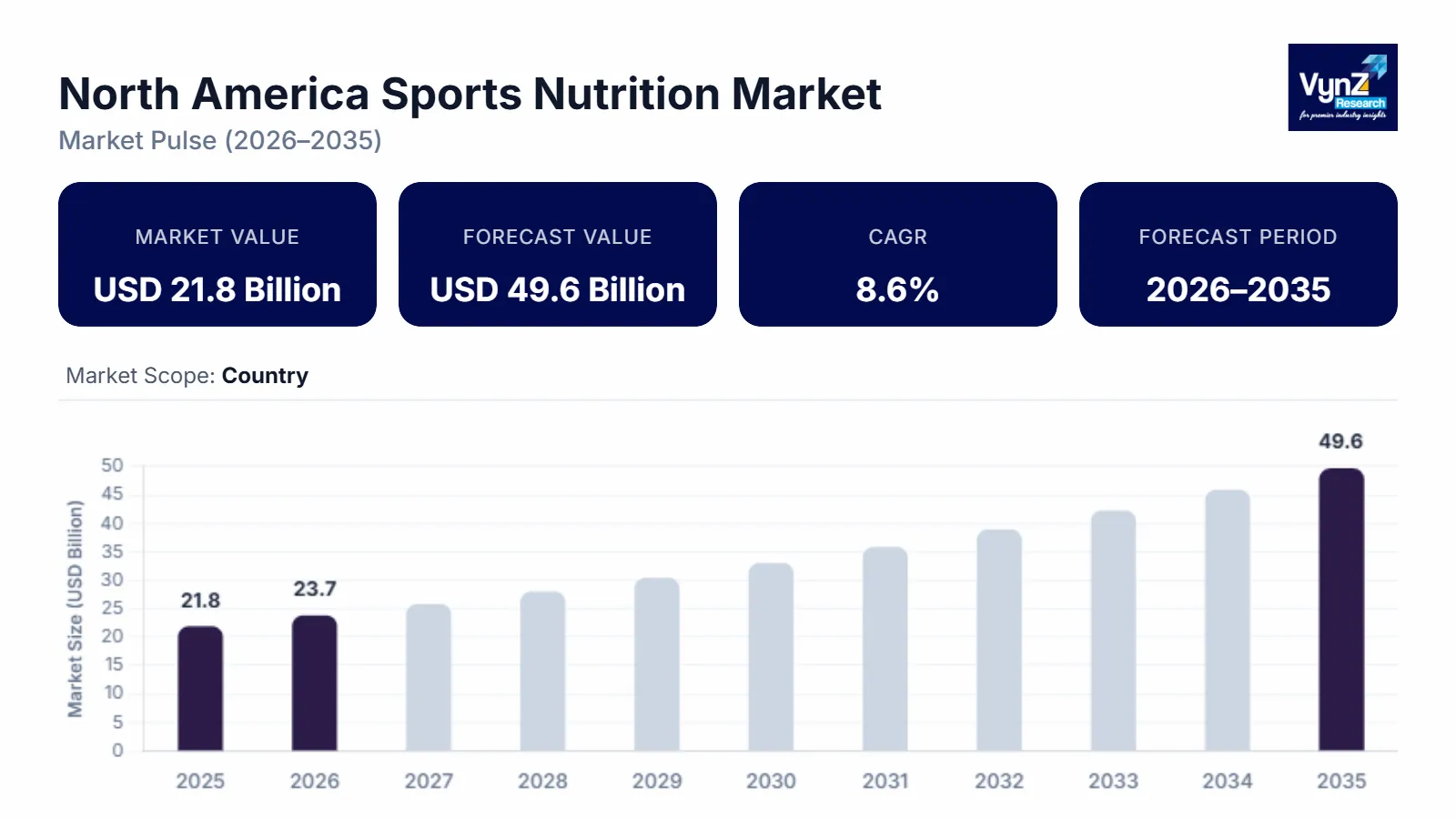
The North America sports nutrition market size was estimated at about USD 21.8 billion in 2025 and is expected to reach around USD 23.7 billion in 2026, rising to roughly USD 49.6 billion by 2035, growing at approximately 8.6% CAGR from 2026 to 2035.
Research Highlights
- In 2025, sports supplements held 41.8% market share due to growing demand for protein and performance nutrition.
- Supermarkets and hypermarkets captured 37.5% market share in 2025 supported by extensive retail accessibility and consumer trust.
- In 2025, animal-based products accounted for 56.7% market share owing to strong whey protein consumption.
- Lifestyle consumers are projected to grow at 9.6% CAGR supported by increasing wellness and preventive healthcare awareness.
- The United States held 63.2% market share in 2025 due to advanced supplement manufacturing and strong fitness participation.
Market growth is pushed by increasing health and fitness awareness, increasing participation in recreational and professional sports and growing demand for functional nutritional products along with expanding adoption of clean label and high protein formulations. Growing consumer spending on preventive healthcare and ongoing investments in nutrition research are further supporting market expansion across the United States, Canada, and Mexico. The U.S. Food and Drug Administration (FDA) continues to regulate dietary supplements and nutrition labeling while the National Institutes of Health (NIH) supports nutrition and performance research, and Health Canada strengthens oversight of natural health products and dietary supplements across the region.
North America Sports Nutrition Market Dynamics
Market Trends
The industry is witnessing notable shifts in clean label formulations, personalized nutrition and digital health integration. One of the key trends shaping the market is the growing preference for plant-based protein products reflecting increasing consumer demand for sustainable, allergen friendly, and naturally sourced ingredients. Another emerging trend is personalized sports nutrition supported by digital health platforms, wearable technologies and data driven wellness programs. The FDA continues to strengthen dietary supplement regulations and nutrition labeling requirements while the NIH supports research on nutrition and physical performance encouraging manufacturers to develop innovative and scientifically supported product portfolios.
Growth Drivers
The growth of the market is largely supported by increasing participation in fitness activities and greater awareness of healthy lifestyles, generating consistent demand across athletes, fitness enthusiasts and recreational consumers. Increasing investments in product innovation, advanced ingredient technologies and functional nutrition manufacturing are further accelerating market expansion. Additionally, increasing consumer preference for protein rich diets and performance enhancing nutritional products continues to strengthen product adoption. The Centers for Disease Control and Prevention (CDC) promotes physical activity as part of healthy living initiatives while the NIH supports research into nutrition, metabolism and exercise performance reinforcing long term industry growth.
Market Restraints / Challenges
Despite favorable growth prospects, the market faces certain challenges that may limit expansion. Stringent regulatory requirements governing dietary supplements, ingredient claims and product labeling continue to increase compliance costs for manufacturers. Furthermore, fluctuating prices of whey protein, plant proteins, vitamins and specialty ingredients create cost pressures across the supply chain. The FDA continues to monitor dietary supplement manufacturing and labeling compliance while Health Canada maintains strict approval and safety requirements for natural health products requiring continuous investment in quality assurance and regulatory compliance.
Market Opportunities
The market presents significant opportunities in personalized sports nutrition and functional wellness products particularly driven by increasing consumer demand for customized dietary solutions and preventive healthcare. Companies offering clean label, science backed and premium nutritional products are well positioned to capture growing demand from professional athletes, fitness consumers and ageing populations. Another key opportunity lies in digital nutrition platforms and smart health ecosystems where investments in artificial intelligence, wearable devices and nutrition tracking technologies are improving consumer engagement. The NIH continues to support nutrition science research while the FDA encourages transparent labeling and product quality creating favorable conditions for long term market expansion.
North America Sports Nutrition Market Report Coverage
|
Report Metric |
Details |
|
Historical Period |
2020 - 2024 |
|
Base Year Considered |
2025 |
|
Forecast Period |
2026 - 2035 |
|
Market Size in 2025 |
USD 21.8 Billion |
|
Revenue Forecast in 2035 |
USD 49.6 Billion |
|
Growth Rate |
8.6% |
|
Segments Covered in the Report |
Product Type, Distribution Channel, Source, End User |
|
Report Scope |
Market Trends, Drivers, and Restraints; Revenue Estimation and Forecast; Segmentation Analysis; Companies’ Strategic Developments; Market Share Analysis of Key Players; Company Profiling |
|
Regions Covered in the Report |
United States, Canada, Mexico, Rest of North America |
|
Key Companies |
Abbott Laboratories, Amway Corporation, Clif Bar & Company, Glanbia PLC, GNC Holdings, LLC, Herbalife Ltd., MusclePharm Corporation, Nestlé Health Science, PepsiCo, Inc., The Coca-Cola Company |
|
Customization |
Available upon request |
North America Sports Nutrition Market Segmentation
By Product Type
The sports supplements segment accounted for the largest market share of approximately 41.8% in 2025 and is projected to expand at an estimated 8.4% CAGR through 2035 as strong demand for protein powders, amino acids, creatine and performance enhancing supplements continues to support segment leadership.
The sports foods segment is expected to register the fastest growth at approximately 9.2% CAGR supported by increasing demand for convenient high protein nutrition.
By Distribution Channel
Supermarkets and hypermarkets represented nearly 37.5% of the market in 2025 supported by broad product availability, consumer trust and extensive retail networks.
The online retail segment is projected to witness the fastest growth at around 9.4% CAGR due to digital commerce expansion, subscription-based nutrition services and improved product accessibility.
By Source
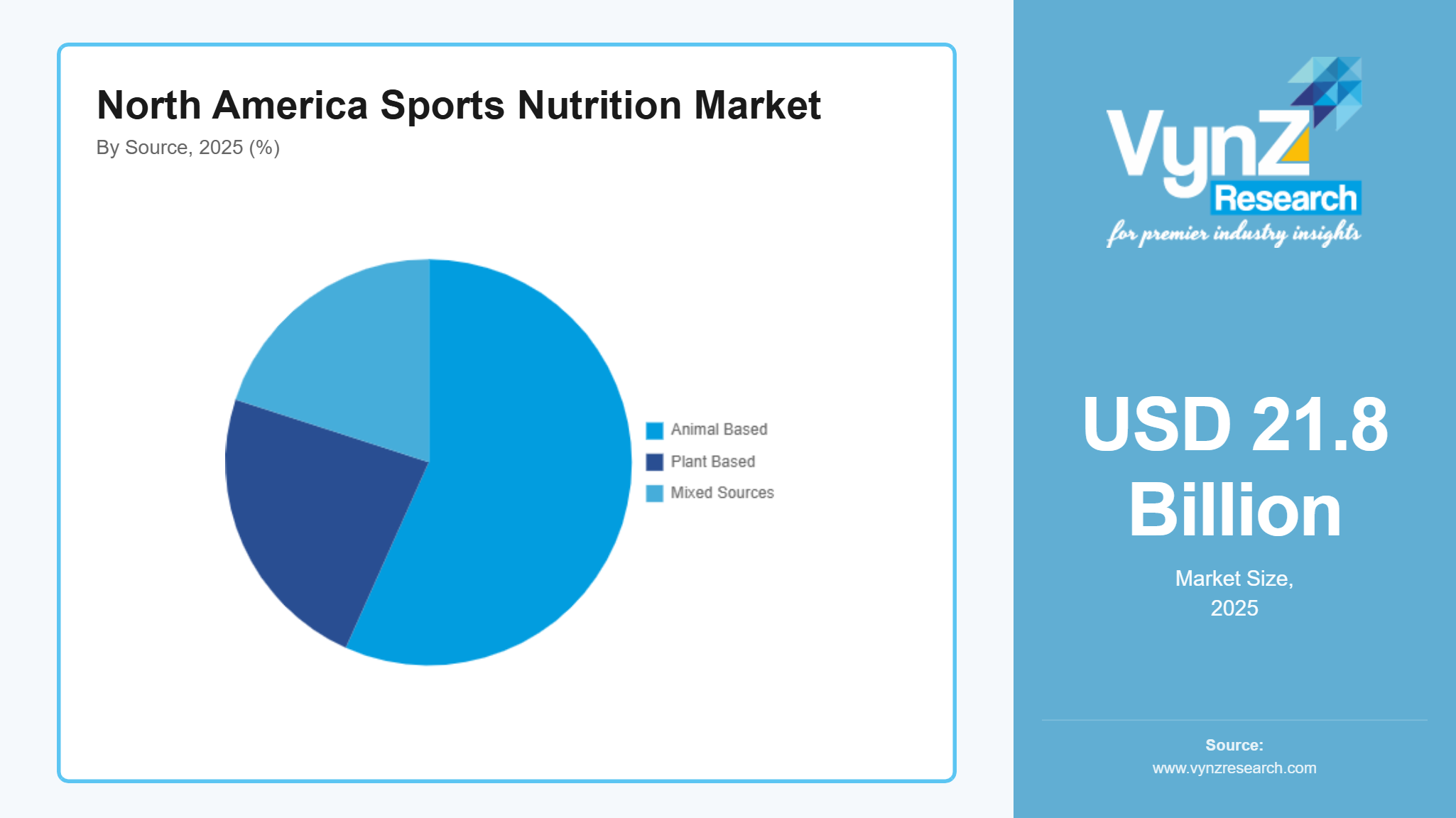
The animal-based segment held the largest market share of approximately 56.7% in 2025 supported by widespread consumption of whey, casein and dairy derived proteins among athletes and fitness enthusiasts.
The plant-based segment is expected to record the fastest growth at approximately 9.5% CAGR due to increasing vegan adoption, sustainability concerns and demand for allergen friendly nutritional products.
By End User
Recreational users accounted for the largest market share of approximately 45.9% in 2025 supported by growing fitness participation, preventive healthcare awareness and increasing gym memberships across North America.
Lifestyle consumers are projected to register the fastest growth at an estimated 9.6% CAGR owing to increasing focus on daily wellness, healthy ageing and balanced nutrition.
Regional Insights
United States
The United States accounted for approximately 64% of the market in 2025 supported by high health awareness, strong participation in fitness activities and a well-established dietary supplement industry. Major consumer markets including California, Texas, Florida and New York continue to drive demand for protein supplements, sports beverages and functional nutrition products. The U.S. Food and Drug Administration (FDA) regulates dietary supplements through the Dietary Supplement Health and Education Act, while the National Institutes of Health (NIH) supports extensive nutrition and exercise research.
Canada
Canada represented about 13% of the regional market in 2025 due to growing consumer interest in active lifestyles, preventive healthcare and premium nutritional products. Increasing participation in recreational sports and rising demand for clean label supplements continue to strengthen market expansion. Health Canada regulates natural health products through stringent quality and safety standards, while the Canadian Institutes of Health Research (CIHR) supports research on nutrition, health, and physical performance.
Mexico
Mexico accounted for nearly 9% of the market in 2025 supported by increasing urbanization, expanding fitness centers and increasing consumer awareness regarding sports nutrition. Demand for protein supplements, ready to drink beverages, and performance nutrition products continues to grow among younger consumers. The Federal Commission for the Protection against Sanitary Risks (COFEPRIS) oversees dietary supplement safety and product compliance, encouraging higher manufacturing standards across the industry.
Rest of North America
The Rest of North America contributed around 14% of the regional market in 2025 supported by expanding health awareness, improving retail access to sports nutrition products and growing investments in wellness focused consumer goods. Increasing adoption of functional nutrition and premium dietary supplements continues to create opportunities across smaller regional markets.
Competitive Landscape / Company Insights
The market is highly competitive with leading manufacturers focusing on product innovation, clean label formulations, strategic acquisitions and digital marketing to strengthen market presence. Companies continue investing in research and development, premium ingredient sourcing and manufacturing expansion to meet evolving consumer preferences. The FDA regulates dietary supplement quality and labeling while the NIH supports scientific research on nutrition and exercise, encouraging innovation and evidence-based product development across the regional market.
Mini Profiles
Abbott Laboratories focuses on clinical and performance nutrition products, supported by strong research capabilities, global distribution networks, and a trusted healthcare brand serving athletes and active consumers.
Clif Bar & Company operates in the premium sports nutrition segment, emphasizing organic ingredients, clean label formulations, and convenient energy products designed for endurance and active lifestyles.
Glanbia PLC leverages advanced nutrition research, global manufacturing capabilities, and strategic brand expansion to strengthen its presence across protein supplements and sports performance nutrition.
Herbalife Ltd. specializes in personalized nutrition and wellness products, supported by an extensive direct selling network, continuous product innovation, and science backed nutritional solutions.
MusclePharm Corporation develops sports performance supplements, supported by athlete focused branding, innovative formulations, and products designed to enhance strength, endurance, and post workout recovery.
Key Players
- Abbott Laboratories
- Amway Corporation
- Clif Bar & Company
- Glanbia PLC
- GNC Holdings, LLC
- Herbalife Ltd.
- MusclePharm Corporation
- Nestlé Health Science
- PepsiCo, Inc.
- The Coca-Cola Company
Recent Developments
In January 2025, Amway Corporation expanded its Nutrilite sports nutrition portfolio with new plant-based performance products targeting active lifestyle consumers. The launch strengthened the company's clean label nutrition strategy across North America.
In March 2025, Nestlé Health Science expanded its protein nutrition portfolio through new product innovations designed to support active adults and healthy ageing. The initiative reinforced the company's focus on science backed nutritional solutions.
In May 2025, PepsiCo, Inc. continued expanding its Gatorade performance nutrition range with functional hydration and recovery products developed for athletes and fitness enthusiasts. The expansion strengthened its sports nutrition presence across retail channels.
In August 2025, The Coca-Cola Company enhanced its BodyArmor sports drink portfolio with new functional hydration offerings and wider North American distribution. The development supported growing consumer demand for premium sports beverages.
In February 2026, GNC Holdings, LLC introduced additional clinically supported sports nutrition supplements featuring transparent ingredient labeling and premium formulations. The launch strengthened its position within the high-performance nutrition segment.
North America Sports Nutrition Market Coverage
Product Type Insight and Forecast 2026 - 2035
- Sports Supplements
- Sports Drinks
- Sports Foods
- Meal Replacement Products
Distribution Channel Insight and Forecast 2026 - 2035
- Supermarkets and Hypermarkets
- Specialty Stores
- Online Retail
- Pharmacies and Drug Stores
- Others
Source Insight and Forecast 2026 - 2035
- Animal Based
- Plant Based
- Mixed Sources
End User Insight and Forecast 2026 - 2035
- Athletes
- Bodybuilders
- Recreational Users
- Lifestyle Consumers
North America Sports Nutrition Market by Region
- U.S.
- By Product Type
- By Distribution Channel
- By Source
- By End User
- Canada
- By Product Type
- By Distribution Channel
- By Source
- By End User
- Mexico
- By Product Type
- By Distribution Channel
- By Source
- By End User
Table of Contents for North America Sports Nutrition Market Report
1. Research Overview
1.1. The Report Offers
1.2. Market Coverage
1.2.1. By
Product Type
1.2.2. By
Distribution Channel
1.2.3. By
Source
1.2.4. By
End User
1.3. Research Phases
1.4. Limitations
1.5. Market Methodology
1.5.1. Data Sources
1.5.1.1.
Primary Research
1.5.1.2.
Secondary Research
1.5.2. Methodology
1.5.2.1.
Data Exploration
1.5.2.2.
Forecast Parameters
1.5.2.3.
Data Validation
1.5.2.4.
Assumptions
1.5.3. Study Period & Data Reporting Unit
2. Executive Summary
3. Industry Overview
3.1. Industry Dynamics
3.1.1. Market Growth Drivers
3.1.2. Market Restraints
3.1.3. Key Market Trends
3.1.4. Major Opportunities
3.2. Industry Ecosystem
3.2.1. Porter’s Five Forces Analysis
3.2.2. Recent Development Analysis
3.2.3. Value Chain Analysis
3.3. Competitive Insight
3.3.1. Competitive Position of Industry
Players
3.3.2. Market Attractive Analysis
3.3.3. Market Share Analysis
4. North Market Estimate and Forecast
4.1. North Market Overview
4.2. North Market Estimate and Forecast to 2035
5. Market Segmentation Estimate and Forecast
5.1. By Product Type
5.1.1. Sports Supplements
5.1.1.1. Market Definition
5.1.1.2. Market Estimation and Forecast to 2035
5.1.2. Sports Drinks
5.1.2.1. Market Definition
5.1.2.2. Market Estimation and Forecast to 2035
5.1.3. Sports Foods
5.1.3.1. Market Definition
5.1.3.2. Market Estimation and Forecast to 2035
5.1.4. Meal Replacement Products
5.1.4.1. Market Definition
5.1.4.2. Market Estimation and Forecast to 2035
5.2. By Distribution Channel
5.2.1. Supermarkets and Hypermarkets
5.2.1.1. Market Definition
5.2.1.2. Market Estimation and Forecast to 2035
5.2.2. Specialty Stores
5.2.2.1. Market Definition
5.2.2.2. Market Estimation and Forecast to 2035
5.2.3. Online Retail
5.2.3.1. Market Definition
5.2.3.2. Market Estimation and Forecast to 2035
5.2.4. Pharmacies and Drug Stores
5.2.4.1. Market Definition
5.2.4.2. Market Estimation and Forecast to 2035
5.2.5. Others
5.2.5.1. Market Definition
5.2.5.2. Market Estimation and Forecast to 2035
5.3. By Source
5.3.1. Animal Based
5.3.1.1. Market Definition
5.3.1.2. Market Estimation and Forecast to 2035
5.3.2. Plant Based
5.3.2.1. Market Definition
5.3.2.2. Market Estimation and Forecast to 2035
5.3.3. Mixed Sources
5.3.3.1. Market Definition
5.3.3.2. Market Estimation and Forecast to 2035
5.4. By End User
5.4.1. Athletes
5.4.1.1. Market Definition
5.4.1.2. Market Estimation and Forecast to 2035
5.4.2. Bodybuilders
5.4.2.1. Market Definition
5.4.2.2. Market Estimation and Forecast to 2035
5.4.3. Recreational Users
5.4.3.1. Market Definition
5.4.3.2. Market Estimation and Forecast to 2035
5.4.4. Lifestyle Consumers
5.4.4.1. Market Definition
5.4.4.2. Market Estimation and Forecast to 2035
6. U.S. Market Estimate and Forecast
6.1. By
Product Type
6.2. By
Distribution Channel
6.3. By
Source
6.4. By
End User
7. Canada Market Estimate and Forecast
7.1. By
Product Type
7.2. By
Distribution Channel
7.3. By
Source
7.4. By
End User
8. Mexico Market Estimate and Forecast
8.1. By
Product Type
8.2. By
Distribution Channel
8.3. By
Source
8.4. By
End User
9. Company Profiles
9.1.
Abbott Laboratories
9.1.1.
Snapshot
9.1.2.
Overview
9.1.3.
Offerings
9.1.4.
Financial
Insight
9.1.5.
Recent
Developments
9.2.
Amway Corporation
9.2.1.
Snapshot
9.2.2.
Overview
9.2.3.
Offerings
9.2.4.
Financial
Insight
9.2.5.
Recent
Developments
9.3.
Clif Bar & Company
9.3.1.
Snapshot
9.3.2.
Overview
9.3.3.
Offerings
9.3.4.
Financial
Insight
9.3.5.
Recent
Developments
9.4.
Glanbia PLC
9.4.1.
Snapshot
9.4.2.
Overview
9.4.3.
Offerings
9.4.4.
Financial
Insight
9.4.5.
Recent
Developments
9.5.
GNC Holdings, LLC
9.5.1.
Snapshot
9.5.2.
Overview
9.5.3.
Offerings
9.5.4.
Financial
Insight
9.5.5.
Recent
Developments
9.6.
Herbalife Ltd.
9.6.1.
Snapshot
9.6.2.
Overview
9.6.3.
Offerings
9.6.4.
Financial
Insight
9.6.5.
Recent
Developments
9.7.
MusclePharm Corporation
9.7.1.
Snapshot
9.7.2.
Overview
9.7.3.
Offerings
9.7.4.
Financial
Insight
9.7.5.
Recent
Developments
9.8.
Nestl‚ Health Science
9.8.1.
Snapshot
9.8.2.
Overview
9.8.3.
Offerings
9.8.4.
Financial
Insight
9.8.5.
Recent
Developments
9.9.
PepsiCo, Inc.
9.9.1.
Snapshot
9.9.2.
Overview
9.9.3.
Offerings
9.9.4.
Financial
Insight
9.9.5.
Recent
Developments
9.10.
The Coca-Cola Company
9.10.1.
Snapshot
9.10.2.
Overview
9.10.3.
Offerings
9.10.4.
Financial
Insight
9.10.5.
Recent
Developments
10. Appendix
10.1. Exchange Rates
10.2. Abbreviations
Note: Financial insight and recent developments of different companies are subject to the availability of information in the secondary domain.
Frequently Asked Questions
Purchase Options
Latest Report
Research Methodology
- Desk Research / Pilot Interviews
- Build Market Size Model
- Research and Analysis
- Final Deliverable
Connect With Our Sales Team
- Toll-Free: +1-888-253-3960
- Phone: +91 9960 288 381
- Email: enquiry@vynzresearch.com
North America Sports Nutrition Market