
Feed Anticoccidials Market Size & Share Growth Forecast Report (2026-2035)
Industry Insight by Type (Monensin, Diclazuril and other), by Livestock (Poultry, Ruminants), by Formulation (Dry Formulations, Liquid Formulations), by Source(Chemical Product, Natural Products)by Regions Covered (North America, Europe, Asia Pacific, South America, Middle East and Africa )
| Status : Published | Published On : Sep, 2026 | Report Code : VRFB11047 | Industry : Food & Beverage | Available Format :

|
Page : 154 |
Feed Anticoccidials Market Overview
The global feed anticoccidials market was estimated at USD 450 million in 2025 and is projected to reach USD 480 million in 2026 and USD 820 billion by 2035, expanding at a 6.1% CAGR from 2026 to 2035.
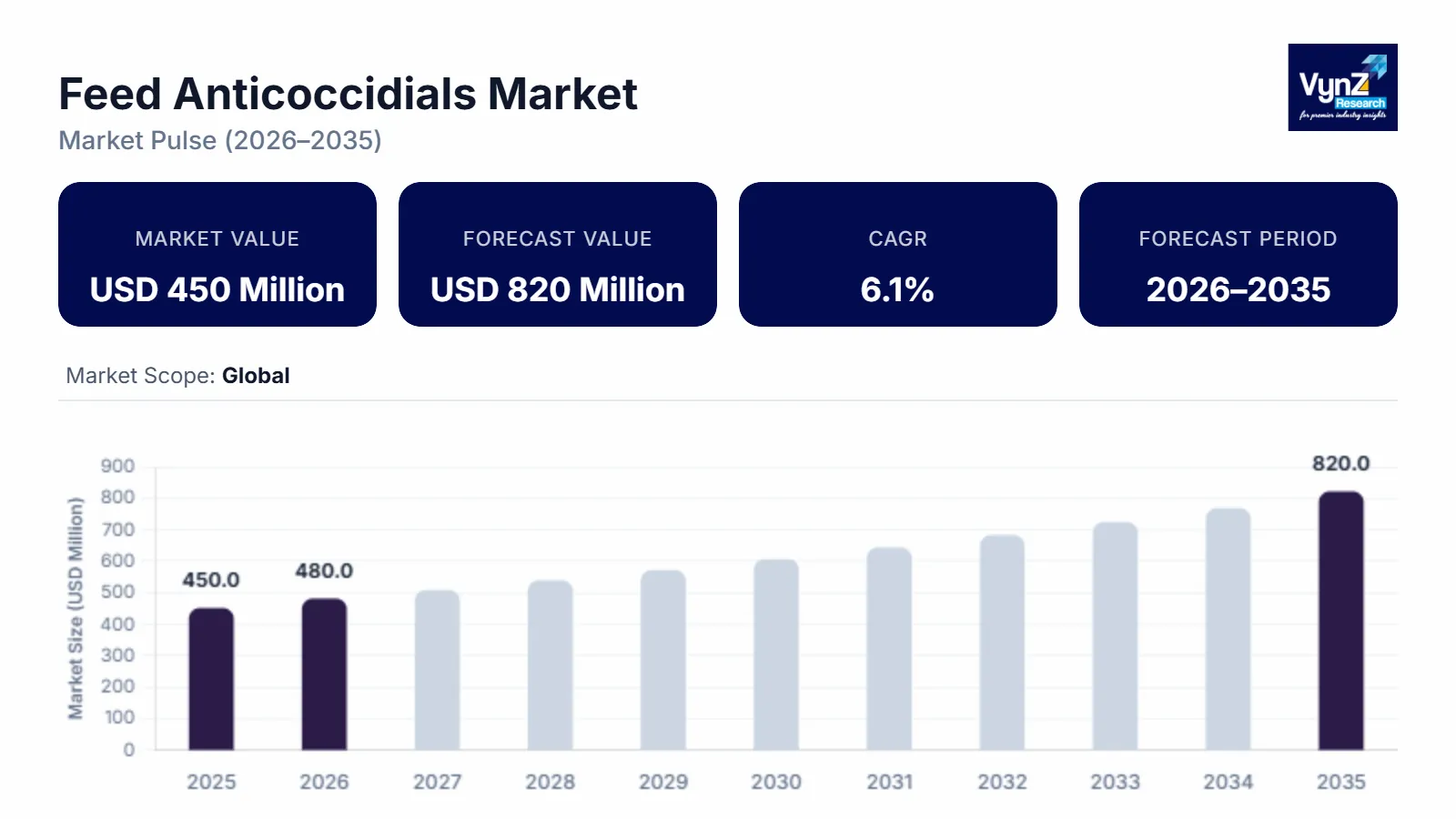
Feed anticoccidials are additives used in animal feed to prevent or treat coccidiosis, an intestinal disease caused by coccidian parasites. They are primarily used in commercial poultry production and feeding selected animals. Among the most common anticoccidials are ionophore, chemical, combination, and emerging alternatives anticoccidials. Their use in feed, in accordance with the manufacturer’s instructions and within the framework of appropriate animal husbandry technologies, makes it possible to prevent coccidiosis, thereby improving the health of animals and reducing feed costs.
The feed anticoccidials market is a part of the industry that is involved in the prevention of diseases among livestock. In addition, this is a critical component for the manufacturing of poultry meat and eggs, since poultry farming is considered the type of animal husbandry that involves the most labor. The major factors behind the development of this market are the necessity to prevent coccidiosis, the rising demand for poultry meat and eggs, the expanding number of poultry farms, and the invention of new methods preventing and curing the disease.
Research Methodology
VynZ Research uses a combination of secondary sources, primary industry assessment, animal-health data, livestock-production indicators, feed-industry developments, regulatory publications, company disclosures, and technical literature. An analysis of the global feed anticoccidials market has been made here, taking into account factors such as poultry and livestock populations, feed production on commercial scale, the way that coccidiosis is managed, categories of products that are approved, demand for formulations, trends in regional production, and requirements of regulation. Data from different periods as well as prevailing industry indicators have been brought together to create a 2025 base year while level-specific demand, livestock production, technological developments, and local growth factors are all factors in making 2026 to 2035 forecast.
Research Highlights
- Ionophore anticoccidials accounted for approximately 59% of the market in 2025, supported by the established use of monensin, salinomycin, narasin, and related products in commercial poultry feed programs.
- Poultry accounted for approximately 77% of the market in 2025, supported by high disease exposure in intensive broiler and other commercial poultry production systems.
- Dry formulations accounted for approximately 74% of the market in 2025, supported by compatibility with large-scale feed manufacturing, storage, transportation, and uniform feed mixing.
- Natural anticoccidial solutions are expected to register approximately 8.4% CAGR from 2026 to 2035, driven by increasing interest in alternative disease-management approaches and diversification beyond conventional products.
- Asia Pacific accounted for approximately 33% of the market in 2025, equivalent to about USD 0.15 billion, supported by large poultry populations, expanding commercial feed production, and increasing animal protein consumption.
Feed Anticoccidials Market Dynamics
Market Trends
The feed anticoccidials market is slowly shifting towards diversified coccidiosis-control programs incorporating conventional products, rotation strategies, vaccination, improved farm management, and alternative feed ingredients. Ionophores continue to play an important role due to their proven efficacy and integration into commercial feed systems, while resistance concerns drive increased interest in product rotation and combination programs. Natural and phytogenic options are seeing increased investment as producers seek to limit their reliance on conventional anticoccidials. Continued expansion in the sector of intensive poultry production is also driving demand for products that can be effectively incorporated into feed and utilized within large-scale production systems.
Growth Drivers
The rising trend in poultry production is the main driver for this market due to the considerable disease-management requirements for coccidiosis in high-intensity commercial production environments. Feed anticoccidials enable producers to manage intestinal disease pressure prior to major production losses occurring, supporting flock health, feed conversion, growth, and mortality management. Demand is also being driven by the rising consumption of poultry meat and eggs in developing economies. Government veterinary guidance in major livestock-producing countries continues to acknowledge the value of preventive anticoccidial programs, vaccination, and controlled therapeutic interventions as key approaches to disease management in commercial poultry and livestock production systems.
Market Restraints / Challenges
Regulatory controls represent an important challenge for the management of anticoccidial use in medicated feed. Products used in medicated feed require appropriate species, dosage, formulation, labeling, and withdrawal requirements for compliance. Manufacturers and feed mills also need to limit risks from incorrect dosing and potential cross-contamination. Resistance development represents another significant concern, particularly when consistent anticoccidial programs have been implemented repeatedly over an extended period. This has increased the importance of rotation, shuttle programs, combination products, and integrated disease-management practices. Product developers are also under pressure to maintain efficacy while adapting to changing regulatory requirements and responding to a growing need for residue-conscious livestock production.
Market Opportunities
Natural, phytogenic, and other alternative anticoccidial approaches represent a significant opportunity as producers diversify their integrated coccidiosis-control strategies. These products can be utilized alongside improved nutrition, biosecurity, vaccination, and conventional products with carefully managed programs. Asia Pacific and other rapidly developing livestock regions also represent important opportunities as commercial poultry and feed production continues to grow. Manufacturers with the capacity to develop products for large-scale feed mills, livestock systems, and localized disease-pressure management are likely to benefit from the growing demand throughout the forecast period.
Global Feed Anticoccidials Market Report Coverage
|
Report Metric |
Details |
|
Historical Period |
2020 - 2024 |
|
Base Year Considered |
2025 |
|
Forecast Period |
2026 - 2035 |
|
Market Size in 2025 |
USD 450 Million |
|
Revenue Forecast in 2035 |
USD 820 Million |
|
Growth Rate |
6.1% |
|
Segments Covered in the Report |
Type, Livestock, Formulation, Source |
|
Report Scope |
Market Trends, Drivers, and Restraints; Revenue Estimation and Forecast; Segmentation Analysis; Companies’ Strategic Developments; Market Share Analysis of Key Players; Company Profiling |
|
Regions Covered in the Report |
North America, Europe, Asia Pacific, South America, Middle East and Africa |
|
Key Companies |
Ceva Animal Health, Elanco Animal Health Incorporated, Huvepharma, Impextraco NV, Kemin Industries, Merck Animal Health, Pathway Intermediates, Phibro Animal Health Corporation, Qilu Animal Health Products, Zoetis Inc |
|
Customization |
Available upon request |
Feed Anticoccidials Market Segmentation
By Type
Monensin accounted for the largest market share in 2025 at approximately 27%, supported by its long-established use in commercial poultry and other approved livestock applications. Its availability across established feed programs and compatibility with preventive disease-management strategies continue to support demand, while salinomycin and narasin also maintain significant positions across poultry production.
Diclazuril and other advanced anticoccidial formulations are expected to register the highest growth rate during the forecast period at approximately 7.3% CAGR from 2026 to 2035, driven by increasing interest in diversified control programs and the need for products with different modes of action. Increasing adoption across poultry, ruminant, and selected other livestock applications continues to support segment-level expansion.
By Livestock
Poultry accounted for the largest market share in 2025 at approximately 77%, supported by the high susceptibility of broilers and other commercially raised birds to coccidiosis under intensive production conditions. Large feed volumes, high production density, rapid growth cycles, and the economic importance of maintaining flock performance continue to support extensive anticoccidial use within commercial poultry systems.
Ruminants are expected to register the highest growth rate during the forecast period at approximately 6.8% CAGR from 2026 to 2035, driven by increasing commercial cattle production and greater emphasis on preventive animal-health management. Increasing adoption across confined cattle operations, calves, and other susceptible livestock continues to support segment-level expansion, while producers increasingly evaluate feed-based and integrated disease-control programs.
By Formulation
Dry formulations accounted for the largest market share in 2025 at approximately 74%, supported by their compatibility with commercial feed manufacturing and established systems for storage, transportation, premixing, and uniform incorporation into complete feed.
Liquid formulations are expected to register the highest growth rate during the forecast period at approximately 7.0% CAGR from 2026 to 2035, driven by demand for flexible administration and specialized livestock-management applications. Increasing adoption across selected poultry and livestock operations continues to support segment-level expansion.
By Source
Chemical products accounted for the largest market share in 2025 at approximately 87%, supported by the established commercial use of ionophores, synthetic compounds, and other approved anticoccidial products. Their long history in feed programs, defined dosage practices, and broad availability across commercial livestock systems continue to support market leadership.
Natural products are expected to register the highest growth rate during the forecast period at approximately 8.4% CAGR from 2026 to 2035, driven by increasing interest in phytogenic ingredients, herbal compounds, essential oils, and other alternative approaches. Increasing adoption within poultry production and integrated disease-management programs continues to support segment-level expansion as producers seek greater diversification in anticoccidial strategies.
Regional Insights
Asia Pacific
Asia Pacific accounted for approximately 33% of the global feed anticoccidials market in 2025, equivalent to about USD 0.15 billion. The region represented the largest market, supported by extensive poultry production, growing commercial feed manufacturing, rising meat and egg consumption, and increasing adoption of intensive livestock systems. China and India are important demand centers, while expanding broiler production and increasing investment in organized livestock farming continue to support regional market development.
North America
North America accounted for approximately 25% of the market in 2025, representing about USD 0.11 billion. Demand is supported by large-scale commercial poultry and cattle production, established medicated-feed infrastructure, and stringent regulatory requirements governing approved feed uses. The region also has a mature veterinary and animal-health industry, supporting continued demand for established anticoccidial programs and alternative disease-management approaches.
Europe
Europe accounted for approximately 24% of the market in 2025, equivalent to about USD 0.11 billion. The regional industry is supported by advanced poultry production, strict animal-health and food-safety requirements, and increasing focus on responsible use of veterinary products. Product rotation, vaccination, biosecurity, and alternative coccidiosis-control strategies are particularly relevant as producers manage resistance concerns and evolving regulatory requirements.
South America
South America accounted for approximately 13% of the market in 2025, representing about USD 0.06 billion. Brazil and Argentina provide significant demand because of their large poultry-production industries and expanding animal-protein exports. Commercial feed production and intensive livestock systems continue to create demand for preventive disease-control products, while increasing investment in poultry productivity supports further market expansion.
Middle East and Africa
The Middle East and Africa accounted for the remaining approximately 5% of the market in 2025, equivalent to about USD 0.02 billion. Demand is supported by expanding commercial poultry production, increasing consumption of animal protein, and gradual modernization of livestock and feed-management systems. Growth opportunities are particularly relevant in countries investing in domestic food production and more organized poultry and animal-health infrastructure.
Competitive Landscape / Company Insights
The global feed anticoccidials market includes animal-health companies, feed-additive manufacturers, veterinary pharmaceutical suppliers, and specialized anticoccidial producers. Competition is centered on product efficacy, approved livestock applications, formulation quality, feed-mill compatibility, technical support, and the ability to address changing resistance and regulatory requirements. Established companies maintain broad portfolios of conventional anticoccidial products, while newer development is increasingly directed toward combination formulations, alternative ingredients, and integrated disease-management approaches. Poultry remains the most important competitive application area because of its large feed volumes and continuing need for effective coccidiosis control.
Mini Profiles
Ceva Animal Health develops veterinary medicines, vaccines, and animal-health solutions for livestock and companion animals. Its livestock portfolio supports disease prevention and management across poultry and other commercial production systems.
Elanco Animal Health Incorporated supplies animal-health products for livestock and companion animals, including products used to support disease prevention and productivity. Its livestock business has established capabilities across poultry, cattle, swine, and other food-producing animals.
Huvepharma develops veterinary pharmaceutical and animal-health products, with significant capabilities in coccidiosis management. Its portfolio includes anticoccidial products and combination approaches designed for commercial poultry production.
Kemin Industries develops specialty ingredients and technologies for human and animal nutrition. Its animal-nutrition activities include solutions designed to support feed quality, livestock health, and production efficiency.
Phibro Animal Health Corporation supplies animal-health products, nutritional specialties, and related solutions for food-producing animals. Its portfolio serves poultry, cattle, swine, and aquaculture production systems through veterinary and nutritional technologies.
Key Players
- Ceva Animal Health
- Elanco Animal Health Incorporated
- Huvepharma
- Impextraco NV
- Kemin Industries
- Merck Animal Health
- Pathway Intermediates
- Phibro Animal Health Corporation
- Qilu Animal Health Products
- Zoetis Inc
Recent Developments
Ceva highlighted updated vaccination strategies for poultry coccidiosis, positioning vaccination as an important approach for reducing dependence on anticoccidial drugs amid resistance and regulatory pressures.
Elanco published updated guidance on coccidiosis intervention, emphasizing integrated control programs that combine different approaches according to bird type, production objectives, coccidia pressure, and resistance history.
Huvepharma released a coccidiosis prevalence study using data from its Aviapp platform to assess coccidiosis pressure in commercial broilers and support more informed disease-management decisions.
Kemin continues to expand its poultry gut-health solutions, with its recent technical work emphasizing vaccination strategies and alternative approaches as producers address declining sensitivity to conventional anticoccidials and increasing antibiotic-free production.
Phibro continues to strengthen its anticoccidial portfolio for poultry, including nicarbazin-based solutions, while supporting coccidiosis-control programs designed to maintain intestinal health and flock productivity.
Global Feed Anticoccidials Market Coverage
Global Feed Anticoccidials Market by Region
- North America
- Europe
- Asia-Pacific (APAC)
- Rest of the World (RoW)
Table of Contents for Feed Anticoccidials Market Report
1. Research Overview
1.1. The Report Offers
1.2. Market Coverage
1.3. Research Phases
1.4. Limitations
1.5. Market Methodology
1.5.1. Data Sources
1.5.1.1.
Primary Research
1.5.1.2.
Secondary Research
1.5.2. Methodology
1.5.2.1.
Data Exploration
1.5.2.2.
Forecast Parameters
1.5.2.3.
Data Validation
1.5.2.4.
Assumptions
1.5.3. Study Period & Data Reporting Unit
2. Executive Summary
3. Industry Overview
3.1. Industry Dynamics
3.1.1. Market Growth Drivers
3.1.2. Market Restraints
3.1.3. Key Market Trends
3.1.4. Major Opportunities
3.2. Industry Ecosystem
3.2.1. Porter’s Five Forces Analysis
3.2.2. Recent Development Analysis
3.2.3. Value Chain Analysis
3.3. Competitive Insight
3.3.1. Competitive Position of Industry
Players
3.3.2. Market Attractive Analysis
3.3.3. Market Share Analysis
4. Global Market Estimate and Forecast
4.1. Global Market Overview
4.2. Global Market Estimate and Forecast to 2035
5. Market Segmentation Estimate and Forecast
6. North America Market Estimate and Forecast
A PHP Error was encountered
Severity: Warning
Message: Undefined variable $l
Filename: Frontend/toc.php
Line Number: 154
Backtrace:
File: /home/vynzrese/public_html/application/views/Frontend/toc.php
Line: 154
Function: _error_handler
File: /home/vynzrese/public_html/application/views/Frontend/product_page_test.php
Line: 452
Function: view
File: /home/vynzrese/public_html/application/views/Frontend/Layout/product_layout.php
Line: 8
Function: view
File: /home/vynzrese/public_html/application/controllers/ProductPage.php
Line: 86
Function: view
File: /home/vynzrese/public_html/index.php
Line: 300
Function: require_once
A PHP Error was encountered
Severity: Warning
Message: Undefined variable $l
Filename: Frontend/toc.php
Line Number: 156
Backtrace:
File: /home/vynzrese/public_html/application/views/Frontend/toc.php
Line: 156
Function: _error_handler
File: /home/vynzrese/public_html/application/views/Frontend/product_page_test.php
Line: 452
Function: view
File: /home/vynzrese/public_html/application/views/Frontend/Layout/product_layout.php
Line: 8
Function: view
File: /home/vynzrese/public_html/application/controllers/ProductPage.php
Line: 86
Function: view
File: /home/vynzrese/public_html/index.php
Line: 300
Function: require_once
6.0.2. Mexico Market Estimate and Forecast
7. Europe Market Estimate and Forecast
7.0.3.
Germany Market Estimate and Forecast
7.0.4.
France Market Estimate and Forecast
7.0.5.
U.K. Market Estimate and Forecast
7.0.6.
Italy Market Estimate and Forecast
7.0.7.
Spain Market Estimate and Forecast
7.0.8.
Russia Market Estimate and Forecast
7.0.9.
Rest of Europe Market Estimate and Forecast
8. Asia-Pacific (APAC) Market Estimate and Forecast
8.0.10.
China Market Estimate and Forecast
8.0.11.
Japan Market Estimate and Forecast
8.0.12.
India Market Estimate and Forecast
8.0.13.
South Korea Market Estimate and Forecast
8.0.14.
Rest of Asia-Pacific Market Estimate and Forecast
9. Rest of the World (RoW) Market Estimate and Forecast
9.0.15.
Brazil Market Estimate and Forecast
9.0.16.
Saudi Arabia Market Estimate and Forecast
9.0.17.
South Africa Market Estimate and Forecast
9.0.18.
U.A.E. Market Estimate and Forecast
9.0.19.
Other Countries Market Estimate and Forecast
10. Company Profiles
10.1.
Ceva Animal Health
10.1.1.
Snapshot
10.1.2.
Overview
10.1.3.
Offerings
10.1.4.
Financial
Insight
10.1.5.
Recent
Developments
10.2.
Elanco Animal Health Incorporated
10.2.1.
Snapshot
10.2.2.
Overview
10.2.3.
Offerings
10.2.4.
Financial
Insight
10.2.5.
Recent
Developments
10.3.
Huvepharma
10.3.1.
Snapshot
10.3.2.
Overview
10.3.3.
Offerings
10.3.4.
Financial
Insight
10.3.5.
Recent
Developments
10.4.
Impextraco NV
10.4.1.
Snapshot
10.4.2.
Overview
10.4.3.
Offerings
10.4.4.
Financial
Insight
10.4.5.
Recent
Developments
10.5.
Kemin Industries
10.5.1.
Snapshot
10.5.2.
Overview
10.5.3.
Offerings
10.5.4.
Financial
Insight
10.5.5.
Recent
Developments
10.6.
Merck Animal Health
10.6.1.
Snapshot
10.6.2.
Overview
10.6.3.
Offerings
10.6.4.
Financial
Insight
10.6.5.
Recent
Developments
10.7.
Pathway Intermediates
10.7.1.
Snapshot
10.7.2.
Overview
10.7.3.
Offerings
10.7.4.
Financial
Insight
10.7.5.
Recent
Developments
10.8.
Phibro Animal Health Corporation
10.8.1.
Snapshot
10.8.2.
Overview
10.8.3.
Offerings
10.8.4.
Financial
Insight
10.8.5.
Recent
Developments
10.9.
Qilu Animal Health Products
10.9.1.
Snapshot
10.9.2.
Overview
10.9.3.
Offerings
10.9.4.
Financial
Insight
10.9.5.
Recent
Developments
10.10.
Zoetis Inc.
10.10.1.
Snapshot
10.10.2.
Overview
10.10.3.
Offerings
10.10.4.
Financial
Insight
10.10.5.
Recent
Developments
11. Appendix
11.1. Exchange Rates
11.2. Abbreviations
Note: Financial insight and recent developments of different companies are subject to the availability of information in the secondary domain.
Frequently Asked Questions
Purchase Options
Research Methodology
- Desk Research / Pilot Interviews
- Build Market Size Model
- Research and Analysis
- Final Deliverable
Connect With Our Sales Team
- Toll-Free: +1-888-253-3960
- Phone: +91 9960 288 381
- Email: enquiry@vynzresearch.com
Feed Anticoccidials Market