
Infant Milk Powders Market Size & Share Growth Forecast Report (2026-2035)
Industry Insight by Formula Type (Cow’s Milk-Based Formula, Soy-Based Formula, Protein Hydrolysate-Based Formula, Specialty Formula), by Formula Form (Powder, Liquid Concentrate, Ready-to-Feed), by Age Group (0–6 Months, 6–12 Months, 12–36 Months), by Distribution Channel (Supermarkets and Hypermarkets, Pharmacies and Specialty Stores, Maternal and Infant Stores, Online Retail, Other Retail Channels)
| Status : Published | Published On : Sep, 2026 | Report Code : VRFB11048 | Industry : Food & Beverage | Available Format :

|
Page : 134 |
Infant Milk Powders Market Overview
The infant milk powders market size was estimated at about USD 30.46 billion in 2025 and is expected to reach around USD 31.47 billion in 2026, rising up to roughly USD 41.02 billion in 2035, growing at approximately 3.3% CAGR from 2026 to 2035.
The market includes powdered infant formula based on cow’s milk, soy, hydrolyzed proteins, and specialized nutritional formulations. Demand is supported by urbanization, maternal employment, premium infant nutrition, expanding retail access, and product innovation. The market estimate is aligned with the available infant milk powder market assessment, while the broader infant nutrition and baby food reports are used only for relevant segment and channel context.
Market growth is driven by urbanization, increasing maternal workforce participation, and demand for convenient infant feeding products, along with increasing adoption of premium and specialized formulas. Rising demand for stage-based, hypoallergenic, fortified, and digitally purchased products is supporting market expansion across China, India, Southeast Asia, North America, and Europe. WHO and UNICEF continue to recommend breastfeeding where possible, while the FDA and HHS are strengthening infant-formula safety, nutrient review, supply resilience, and contamination oversight through initiatives such as Operation Stork Speed.
Research Methodology
The research methodology used by VynZ Research combines secondary research, company disclosures, regulatory publications, government data, industry reports, product information, and market-level analysis. The study reviews product formulation, age group, distribution channel, regional demand, pricing, competitive activity, and regulatory developments. Government-backed sources include the World Health Organization, UNICEF, the U.S. Food and Drug Administration, the U.S. Department of Health and Human Services, and relevant national food-safety authorities. Market figures are estimates because public reports differ in scope, particularly regarding follow-on formula, growing-up milk, liquid formula, and the wider infant nutrition market.
Research Highlights
- Cow’s milk-based formula accounted for approximately 72% of the market in 2025, supported by broad consumer familiarity, established manufacturing capacity, and extensive retail availability.
- Powder format represented approximately 68.11% of the broader infant nutrition market in 2025, supported by longer shelf life, lower transportation costs, and convenient storage.
- The 0–6 months age group accounted for approximately 39.41% of broader infant nutrition revenue in 2025, reflecting the importance of first-stage infant feeding products.
- Online retail in the broader infant nutrition market is projected to grow at approximately 11.63% CAGR through 2035,due to home delivery, product comparison, and repeat purchasing.
- Asia Pacific accounted for approximately 43% of broader infant nutrition value in 2025, driven by its large infant population, urbanization, and rising household income.
Infant Milk Powders Market Dynamics
Market Trends
The infant milk powders market is witnessing notable shifts toward premium, specialized, and scientifically differentiated formulations. One key trend is the increased use of DHA, ARA, prebiotics, probiotics, nucleotides, and human-milk-oligosaccharide-related positioning. These developments reflect parental demand for products associated with digestive, immune, and developmental support, although product claims remain subject to regulatory requirements. Organic and clean-label positioning is also influencing premium product development.
Growth Drivers
The growth of the market is largely supported by urbanization and changing household structures, which continue to generate demand for convenient, shelf-stable feeding products. Powdered formula offers storage and transportation advantages, particularly in markets where families purchase products in larger quantities or have limited access to specialized retail. The broader infant nutrition market identifies Asia Pacific as a major growth region, supported by rising incomes and urban lifestyles. Additionally, premiumization and specialized infant nutrition are boosting adoption. Parents increasingly seek products with targeted protein structures, hypoallergenic positioning, organic ingredients, and fortified nutritional profiles.
Market Restraints / Challenges
Despite favorable growth prospects, the market faces challenges related to strict safety requirements, contamination risks, product recalls, and regulatory complexity. Powdered infant formula requires careful preparation and can present microbiological risks when manufacturing, storage, or preparation controls are inadequate. The FDA reported investigations involving powdered infant formula and supply-chain contamination, while WHO identified an international contamination event affecting products distributed across multiple countries. These events can reduce consumer confidence and increase testing, recall, insurance, and compliance costs.
Market Opportunities
The market presents significant opportunities in specialty formulas, including products for premature infants, cow’s-milk-protein allergy, hydrolyzed-protein requirements, and other medically supervised nutritional needs. These products can generate higher-value demand because they require specialized formulation, professional guidance, and stronger quality assurance. Growth opportunities are also available in emerging markets where modern retail, pharmacies, and online purchasing are expanding. Smaller pack sizes and value-oriented premium products may improve affordability and market access. Another key opportunity lies in digital distribution and supply-chain modernization. Online retail, subscription purchasing, product authentication, and direct consumer education can improve repeat sales and product availability.
Global Infant Milk Powders Market Report Coverage
|
Report Metric |
Details |
|
Historical Period |
2020 - 2024 |
|
Base Year Considered |
2025 |
|
Forecast Period |
2026 - 2035 |
|
Market Size in 2025 |
USD 30.46 Billion |
|
Revenue Forecast in 2035 |
USD 41.02 Billion |
|
Growth Rate |
3.3% |
|
Segments Covered in the Report |
By Formula Type, By Formula Form, By Age Group, By Distribution Channel |
|
Report Scope |
Market Trends, Drivers, and Restraints; Revenue Estimation and Forecast; Segmentation Analysis; Companies’ Strategic Developments; Market Share Analysis of Key Players; Company Profiling |
|
Regions Covered in the Report |
North America, Europe, Asia Pacific, Latin America, Middle East and Africa |
|
Key Companies |
Abbott Laboratories, Ausnutria Dairy Corporation, Danone, Fonterra Co-operative Group, FrieslandCampina, Nestlé SA, Reckitt Benckiser Group plc, Synutra International Inc, Yili Group |
|
Customization |
Available upon request |
Infant Milk Powders Market Segmentation
By Formula Type
Cow’s milk-based formula accounted for approximately 72% of the market in 2025, supported by broad consumer familiarity, established dairy-processing infrastructure, and extensive availability through supermarkets, pharmacies, and online retailers.
The specialty formula segment is expected to grow at approximately 5.2% CAGR from 2026 to 2035, exceeding the overall market growth rate of 3.3%. Expansion is supported by increasing demand for hypoallergenic, premature-infant, lactose-sensitive, and medically supervised formulas.
By Formula Form
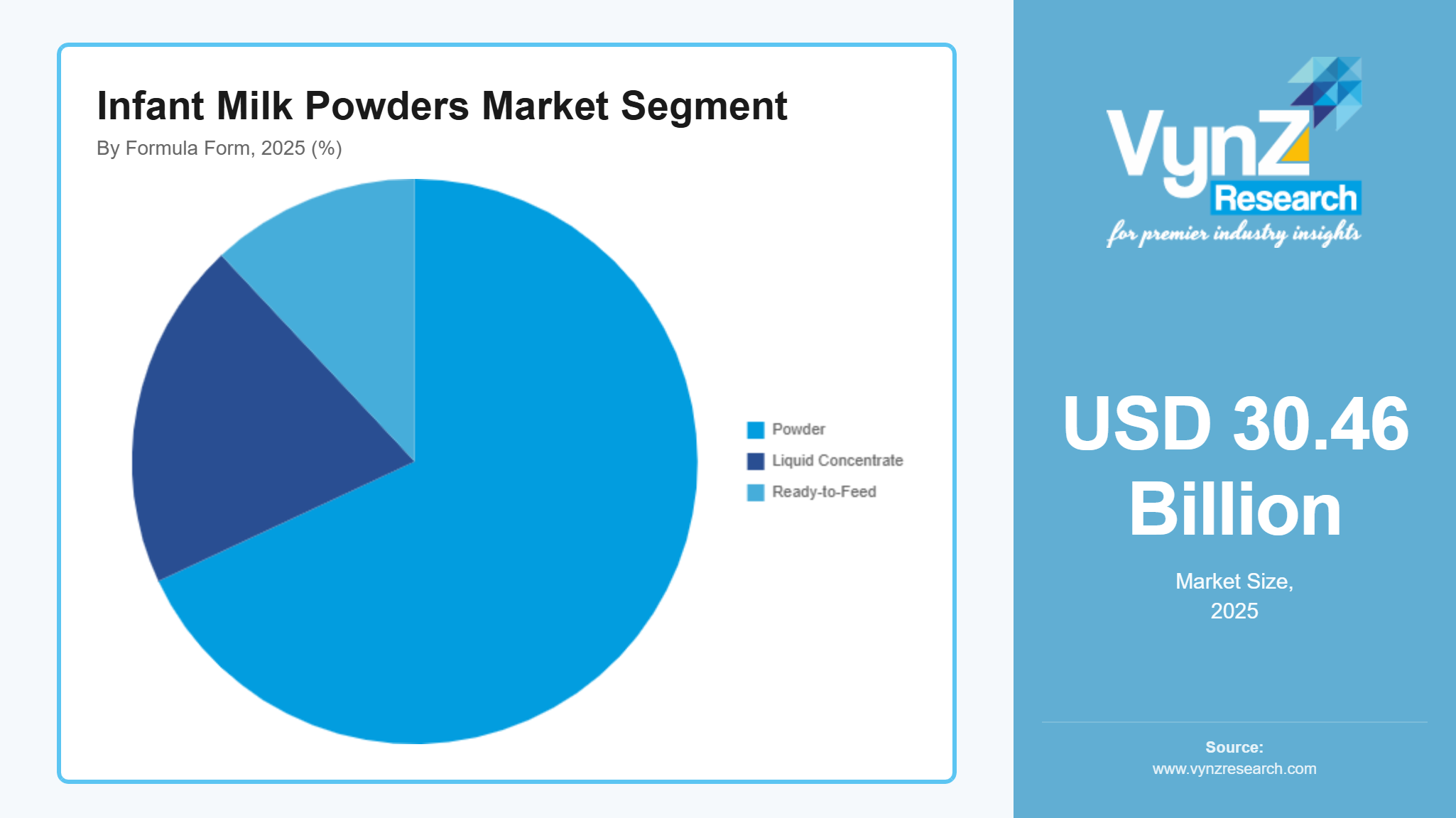
Powdered formula accounted for approximately 68.11% of the market in 2025, due to longer shelf life, lower transportation costs, convenient storage, and relatively lower unit costs. These advantages are particularly relevant in emerging markets and households purchasing infant formula regularly.
The ready-to-feed segment is projected to grow at approximately 10.03% CAGR through 2035 in the market, driven by convenience, reduced preparation requirements, and demand from working parents and caregivers.
By Age Group
Products for infants aged 0–6 months accounted for approximately 39.41% of the revenue in 2025, owing to the importance of first-stage feeding and the nutritional requirements of early infancy.
The 12–36 months segment is projected to grow at approximately 8.34% CAGR through 2035 in the market, supported by demand for follow-on and growing-up milk products.
By Distribution Channel
Supermarkets and hypermarkets accounted for approximately 37.24% of market in 2025, supported by product visibility, broad brand choice, promotional activity, and convenient household purchasing.
The online retail segment is projected to grow at approximately 11.63% CAGR through the forecast period driven by home delivery, subscription purchasing, product comparison, and wider access to specialized brands.
Regional Insights
Asia Pacific
Asia Pacific accounted for approximately 43% of the market in 2025, supported by its large infant population, urbanization, rising household income, and increasing demand for branded infant nutrition products. The region is projected to expand at approximately 9.24% CAGR through 2031 in the broader infant nutrition market. China, India, Japan, South Korea, and Southeast Asia remain important demand centers, although birth-rate patterns differ significantly across countries. Government nutrition programs, expanding pharmacy networks, modern retail, and e-commerce are improving access to packaged infant nutrition.
North America
North America held around 22% of the global market in 2025, due to developed healthcare infrastructure, established supermarket and pharmacy networks, premium product demand, and high online-retail penetration. The region is expected to grow at approximately 2.8% CAGR from 2026 to 2035, with value growth supported more by specialty formulas and premium products than by a significant increase in infant numbers. The U.S. Food and Drug Administration regulates infant-formula composition, manufacturing, labeling, safety, and recalls.
Europe
Europe represented about 18% of the market in 2025, owing to the mature infant nutrition consumption, strong food-safety systems, established retail networks, and demand for organic and specialty formulas. The regional market is projected to grow at approximately 2.6% CAGR from 2026 to 2035. Growth is expected to be driven primarily by premiumization, product differentiation, and specialized formulations rather than by rising birth rates. European manufacturers are focusing on organic ingredients, hydrolyzed proteins, probiotics, and stage-based products.
Latin America
Latin America accounted for approximately 9% of the global market in 2025, because of urbanization, expanding modern retail, rising awareness of packaged infant nutrition, and demand for convenient feeding products. The regional market is expected to grow at approximately 3.8% CAGR from 2026 to 2035, supported by improving distribution networks and increasing access to pharmacies, supermarkets, and online channels. Brazil and Mexico represent important consumption centers, while other countries provide opportunities for value-oriented products and smaller pack sizes.
Middle East and Africa
The Middle East and Africa contributed to nearly 8% of the market share in 2025, supported by population growth, urbanization, improving retail infrastructure, and increasing awareness of packaged infant nutrition. The region is projected to grow at approximately 4.1% CAGR from 2026 to 2035, supported by demand from urban households and higher-income consumers. Market expansion is constrained by affordability, import dependence, currency fluctuations, uneven healthcare access, and differences in regulatory enforcement.
Competitive Landscape / Company Insights
The infant milk powders market is moderately to highly competitive, with global and regional players focusing on formulation innovation, safety, premiumization, and geographic expansion. Companies are investing in research and development, specialty nutrition, digital distribution, supplier oversight, and supply-chain resilience. FDA and WHO safety communications have increased industry attention to ingredient traceability, contamination prevention, and recall readiness. Competitive differentiation is also based on brand trust, healthcare relationships, product affordability, organic positioning, and access to supermarkets, pharmacies, and online platforms.
Mini Profiles
Abbott Laboratories focuses on infant formula and specialized nutrition through its Similac portfolio, supported by research capabilities, broad distribution, and strong brand recognition.
Danone operates across standard, premium, and specialized infant nutrition, emphasizing scientific formulation, stage-based products, and international brand distribution.
Fonterra Co-operative Group leverages dairy expertise, milk ingredients, manufacturing capabilities, and international partnerships to serve infant nutrition and specialty formula markets.
Nestlé SA competes through its NAN and related infant nutrition products, supported by global research, manufacturing scale, and extensive geographic reach.
Reckitt Benckiser Group plc participates through Mead Johnson and Enfamil products, emphasizing infant nutrition research, brand recognition, and healthcare-linked distribution.
Key Players
- Abbott Laboratories
- Ausnutria Dairy Corporation
- Danone
- Fonterra Co-operative Group
- FrieslandCampina
- Nestlé S.A.
- Reckitt Benckiser Group plc
- Synutra International Inc.
- Yili Group
Recent Developments
Abbott Laboratories agreed to a settlement connected with claims arising from the closure and contamination investigation involving its Sturgis infant-formula facility. The development has increased attention to manufacturing controls, product safety, and supply resilience.
Danone continued focusing on specialized and premium infant nutrition products, including formulations positioned around digestive health and targeted nutritional requirements. The company’s strategy remains linked to scientific research, brand differentiation, and international distribution.
Nestlé SA continued expanding research-led infant nutrition and premium formula development, including products positioned around advanced nutritional ingredients. The company remains active across developed and emerging infant nutrition markets.
Reckitt Benckiser Group plc continued strengthening its infant nutrition business through Enfamil product development, distribution, and safety-related quality systems. The company remains exposed to heightened regulatory and consumer scrutiny surrounding powdered infant formula.
Yili Group continued expanding its dairy and infant nutrition capabilities through product development and geographic market participation. Its strategy includes strengthening domestic brand presence and competing in premium and specialized infant nutrition categories.
Global Infant Milk Powders Market Coverage
Formula Type Insight and Forecast 2026 - 2035
- Cow’s Milk-Based Formula
- Soy-Based Formula
- Protein Hydrolysate-Based Formula
- Specialty Formula
Formula Form Insight and Forecast 2026 - 2035
- Powder
- Liquid Concentrate
- Ready-to-Feed
Age Group Insight and Forecast 2026 - 2035
- 0–6 Months
- 6–12 Months
- 12–36 Months
Distribution Channel Insight and Forecast 2026 - 2035
- Supermarkets and Hypermarkets
- Pharmacies and Specialty Stores
- Maternal and Infant Stores
- Online Retail
- Other Retail Channels
Global Infant Milk Powders Market by Region
- North America
- By Formula Type
- By Formula Form
- By Age Group
- By Distribution Channel
- By Country - U.S., Canada, Mexico
- Europe
- By Formula Type
- By Formula Form
- By Age Group
- By Distribution Channel
- By Country - Germany, U.K., France, Italy, Spain, Russia, Rest of Europe
- Asia-Pacific (APAC)
- By Formula Type
- By Formula Form
- By Age Group
- By Distribution Channel
- By Country - China, Japan, India, South Korea, Vietnam, Thailand, Malaysia, Rest of Asia-Pacific
- Rest of the World (RoW)
- By Formula Type
- By Formula Form
- By Age Group
- By Distribution Channel
- By Country - Brazil, Saudi Arabia, South Africa, U.A.E., Other Countries
Table of Contents for Infant Milk Powders Market Report
1. Research Overview
1.1. The Report Offers
1.2. Market Coverage
1.2.1. By
Formula Type
1.2.2. By
Formula Form
1.2.3. By
Age Group
1.2.4. By
Distribution Channel
1.3. Research Phases
1.4. Limitations
1.5. Market Methodology
1.5.1. Data Sources
1.5.1.1.
Primary Research
1.5.1.2.
Secondary Research
1.5.2. Methodology
1.5.2.1.
Data Exploration
1.5.2.2.
Forecast Parameters
1.5.2.3.
Data Validation
1.5.2.4.
Assumptions
1.5.3. Study Period & Data Reporting Unit
2. Executive Summary
3. Industry Overview
3.1. Industry Dynamics
3.1.1. Market Growth Drivers
3.1.2. Market Restraints
3.1.3. Key Market Trends
3.1.4. Major Opportunities
3.2. Industry Ecosystem
3.2.1. Porter’s Five Forces Analysis
3.2.2. Recent Development Analysis
3.2.3. Value Chain Analysis
3.3. Competitive Insight
3.3.1. Competitive Position of Industry
Players
3.3.2. Market Attractive Analysis
3.3.3. Market Share Analysis
4. Global Market Estimate and Forecast
4.1. Global Market Overview
4.2. Global Market Estimate and Forecast to 2035
5. Market Segmentation Estimate and Forecast
5.1. By Formula Type
5.1.1. Cow’s Milk-Based Formula
5.1.1.1. Market Definition
5.1.1.2. Market Estimation and Forecast to 2035
5.1.2. Soy-Based Formula
5.1.2.1. Market Definition
5.1.2.2. Market Estimation and Forecast to 2035
5.1.3. Protein Hydrolysate-Based Formula
5.1.3.1. Market Definition
5.1.3.2. Market Estimation and Forecast to 2035
5.1.4. Specialty Formula
5.1.4.1. Market Definition
5.1.4.2. Market Estimation and Forecast to 2035
5.2. By Formula Form
5.2.1. Powder
5.2.1.1. Market Definition
5.2.1.2. Market Estimation and Forecast to 2035
5.2.2. Liquid Concentrate
5.2.2.1. Market Definition
5.2.2.2. Market Estimation and Forecast to 2035
5.2.3. Ready-to-Feed
5.2.3.1. Market Definition
5.2.3.2. Market Estimation and Forecast to 2035
5.3. By Age Group
5.3.1. 0–6 Months
5.3.1.1. Market Definition
5.3.1.2. Market Estimation and Forecast to 2035
5.3.2. 6–12 Months
5.3.2.1. Market Definition
5.3.2.2. Market Estimation and Forecast to 2035
5.3.3. 12–36 Months
5.3.3.1. Market Definition
5.3.3.2. Market Estimation and Forecast to 2035
5.4. By Distribution Channel
5.4.1. Supermarkets and Hypermarkets
5.4.1.1. Market Definition
5.4.1.2. Market Estimation and Forecast to 2035
5.4.2. Pharmacies and Specialty Stores
5.4.2.1. Market Definition
5.4.2.2. Market Estimation and Forecast to 2035
5.4.3. Maternal and Infant Stores
5.4.3.1. Market Definition
5.4.3.2. Market Estimation and Forecast to 2035
5.4.4. Online Retail
5.4.4.1. Market Definition
5.4.4.2. Market Estimation and Forecast to 2035
5.4.5. Other Retail Channels
5.4.5.1. Market Definition
5.4.5.2. Market Estimation and Forecast to 2035
6. North America Market Estimate and Forecast
6.1. By
Formula Type
6.2. By
Formula Form
6.3. By
Age Group
6.4. By
Distribution Channel
6.4.1.
U.S. Market Estimate and Forecast
6.4.2.
Canada Market Estimate and Forecast
6.4.3.
Mexico Market Estimate and Forecast
7. Europe Market Estimate and Forecast
7.1. By
Formula Type
7.2. By
Formula Form
7.3. By
Age Group
7.4. By
Distribution Channel
7.4.1.
Germany Market Estimate and Forecast
7.4.2.
France Market Estimate and Forecast
7.4.3.
U.K. Market Estimate and Forecast
7.4.4.
Italy Market Estimate and Forecast
7.4.5.
Spain Market Estimate and Forecast
7.4.6.
Russia Market Estimate and Forecast
7.4.7.
Rest of Europe Market Estimate and Forecast
8. Asia-Pacific (APAC) Market Estimate and Forecast
8.1. By
Formula Type
8.2. By
Formula Form
8.3. By
Age Group
8.4. By
Distribution Channel
8.4.1.
China Market Estimate and Forecast
8.4.2.
Japan Market Estimate and Forecast
8.4.3.
India Market Estimate and Forecast
8.4.4.
South Korea Market Estimate and Forecast
8.4.5.
Rest of Asia-Pacific Market Estimate and Forecast
9. Rest of the World (RoW) Market Estimate and Forecast
9.1. By
Formula Type
9.2. By
Formula Form
9.3. By
Age Group
9.4. By
Distribution Channel
9.4.1.
Brazil Market Estimate and Forecast
9.4.2.
Saudi Arabia Market Estimate and Forecast
9.4.3.
South Africa Market Estimate and Forecast
9.4.4.
U.A.E. Market Estimate and Forecast
9.4.5.
Other Countries Market Estimate and Forecast
10. Company Profiles
10.1.
Abbott Laboratories
10.1.1.
Snapshot
10.1.2.
Overview
10.1.3.
Offerings
10.1.4.
Financial
Insight
10.1.5.
Recent
Developments
10.2.
Ausnutria Dairy Corporation
10.2.1.
Snapshot
10.2.2.
Overview
10.2.3.
Offerings
10.2.4.
Financial
Insight
10.2.5.
Recent
Developments
10.3.
Danone
10.3.1.
Snapshot
10.3.2.
Overview
10.3.3.
Offerings
10.3.4.
Financial
Insight
10.3.5.
Recent
Developments
10.4.
Fonterra Co-operative Group
10.4.1.
Snapshot
10.4.2.
Overview
10.4.3.
Offerings
10.4.4.
Financial
Insight
10.4.5.
Recent
Developments
10.5.
FrieslandCampina
10.5.1.
Snapshot
10.5.2.
Overview
10.5.3.
Offerings
10.5.4.
Financial
Insight
10.5.5.
Recent
Developments
10.6.
Nestlé S.A.
10.6.1.
Snapshot
10.6.2.
Overview
10.6.3.
Offerings
10.6.4.
Financial
Insight
10.6.5.
Recent
Developments
10.7.
Reckitt Benckiser Group plc
10.7.1.
Snapshot
10.7.2.
Overview
10.7.3.
Offerings
10.7.4.
Financial
Insight
10.7.5.
Recent
Developments
10.8.
Synutra International Inc.
10.8.1.
Snapshot
10.8.2.
Overview
10.8.3.
Offerings
10.8.4.
Financial
Insight
10.8.5.
Recent
Developments
10.9.
Yili Group
10.9.1.
Snapshot
10.9.2.
Overview
10.9.3.
Offerings
10.9.4.
Financial
Insight
10.9.5.
Recent
Developments
11. Appendix
11.1. Exchange Rates
11.2. Abbreviations
Note: Financial insight and recent developments of different companies are subject to the availability of information in the secondary domain.
Frequently Asked Questions
Purchase Options
Latest Report
Research Methodology
- Desk Research / Pilot Interviews
- Build Market Size Model
- Research and Analysis
- Final Deliverable
Connect With Our Sales Team
- Toll-Free: +1-888-253-3960
- Phone: +91 9960 288 381
- Email: enquiry@vynzresearch.com
Infant Milk Powders Market