
AI Agents in Healthcare Market Size & Share - Growth Forecast Report (2026-2035)
Industry Insight by Agent System (Single Agent Systems, Multi Agent Systems), by Deployment Mode (Cloud Based, On Premises), by Application (Medical Imaging, Virtual Nursing Assistants, Remote Patient Monitoring, Clinical Workflow Automation, Drug Discovery, Personalized Treatment Recommendation, Healthcare Fraud Detection, Others), by End User (Hospitals and Healthcare Providers, Pharmaceutical and Biotechnology Companies, Patients, Payers and Insurance Companies, Research Organizations, Others)
| Status : Published | Published On : May, 2026 | Report Code : VRHC1338 | Industry : Healthcare | Available Format :

|
Page : 148 |
AI Agents in Healthcare Market Overview
The global AI agents in healthcare market which was valued at approximately USD 1.12 billion in 2025 and is estimated to reach around USD 1.62 billion in 2026, is projected to reach approximately USD 43.53 billion by 2035, expanding at a CAGR of about 44.2% during the forecast period from 2026 to 2035.
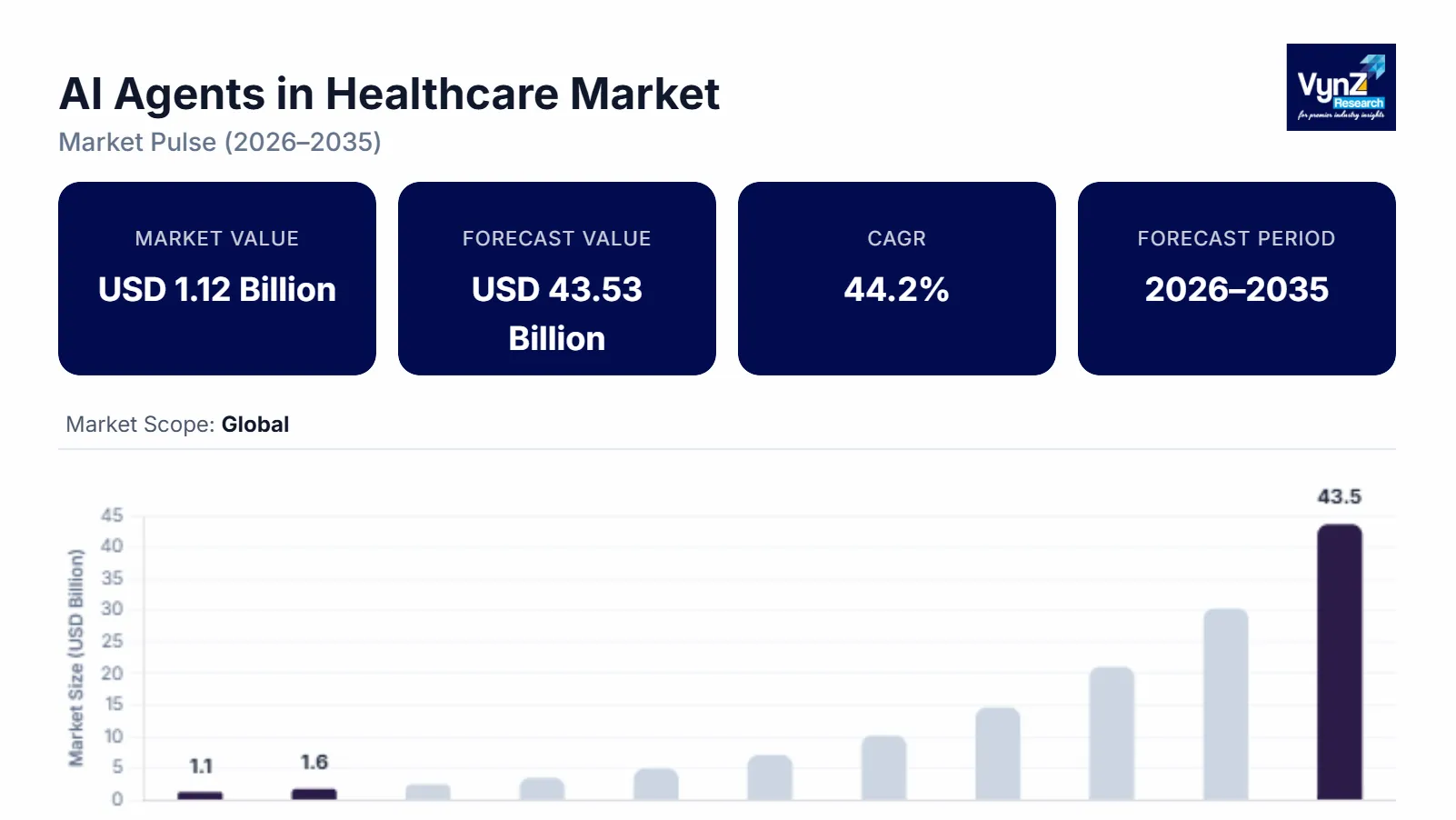
Market growth is pushed along by a steady increase in people adopting generative AI plus more intelligent workflow automation and AI assisted clinical decision support systems in hospitals and healthcare organizations. Also, AI agents combined into electronic health records, telehealth platforms and patient engagement tools are accelerating growth.
Government backed healthcare digitalization programs and rising spending on healthcare IT infrastructure are helping the market demand strengthen across major economies. Public health bodies and healthcare authorities keep encouraging the acceptance of AI enabled healthcare solutions so they can boost operational efficiency, better patient outcomes and widen healthcare accessibility. More rollouts of remote patient monitoring, predictive analytics and AI powered healthcare automation platforms are continuing to open up solid growth chances across North America, Europe, and Asia Pacific.
AI Agents in Healthcare Market Dynamics
Market Trends
The industry is seeing shifts in clinical automation, intelligent patient engagement and AI assisted decision support. One major trend is the growing blending of generative AI and autonomous agent-based platforms inside hospital workflows, showing a growing preference toward operational efficiency, predictive diagnostics and personalized treatment kind of support. Healthcare providers are rolling out AI powered virtual assistants and automated documentation systems to cut down admin load and boost patient management efficiency.
Another trend is the expansion of cloud-based AI healthcare platforms. This is backed by rising digital health investments and regulatory support for healthcare data interoperability. Public healthcare organizations plus national digital health programs are encouraging adoption of AI enabled telehealth and remote monitoring systems in major economies. Because of this, solution providers are leaning toward integrated analytics, real time clinical insights and scalable healthcare automation platforms. So, competition differentiation gets stronger across the market.
Growth Drivers
The growth of the market is largely supported by more healthcare data generation and higher demand for automated clinical workflow management across hospitals, laboratories, and diagnostic centers. Investments in healthcare digital infrastructure, electronic health records integration, and AI assisted patient care systems are also speeding up market expansion globally. In line with healthcare modernization initiatives backed by public health authorities and international healthcare organizations, adoption of AI driven healthcare technologies keeps climbing steadily in developed as well as emerging regions.
Also, as healthcare providers keep prioritizing operational efficiency, early disease detection, and treatment accuracy, the demand for AI powered diagnostic support and intelligent healthcare automation solutions is expected to stay strong during the forecast period. Government supported telehealth expansion efforts, plus rising healthcare AI research funding, are helping the industry keep its long-term momentum.
Market Restraints / Challenges
Even with promising growth, the market has hurdles that could slow things down. Data privacy worries and regulatory compliance headaches tied to healthcare AI systems keep influencing deployment across many healthcare institutions, especially in cost sensitive and developing markets. Strict patient data protection rules and evolving AI governance standards are raising implementation difficulty for healthcare providers and technology vendors.
Reliance on advanced computing infrastructure and skilled AI professionals brings real operational challenges. There is limited availability of specialized healthcare AI expertise and the need for high-cost digital infrastructure can push operational spending higher. That may also create delayed implementation timelines, and scalability constraints, especially when healthcare budgets get tight or when economic uncertainty makes planning harder.
Market Opportunities
The market offers real opportunities in AI assisted remote healthcare delivery and predictive patient management solutions. This is fueled by the growing aging population, chronic disease burden, and the rising need for healthcare accessibility. Companies offering scalable intelligent healthcare automation platforms can capture increasing demand from hospitals, telemedicine providers, and outpatient care facilities looking for efficient patient management solutions.
Another strong opportunity is in precision medicine and AI enabled drug discovery applications. With more investments in advanced analytics, genomic research, and digital therapeutics, there are openings for long-term clinical partnerships and higher value healthcare solutions. Progress in machine learning, cloud computing, and healthcare data analytics should also help with patient engagement, improve treatment planning, and boost overall healthcare system efficiency across major regions.
Global AI Agents in Healthcare Market Report Coverage
|
Report Metric |
Details |
|
Historical Period |
2020 - 2024 |
|
Base Year Considered |
2025 |
|
Forecast Period |
2026 - 2035 |
|
Market Size in 2025 |
USD 1.12 Billion |
|
Revenue Forecast in 2035 |
USD 43.53 Billion |
|
Growth Rate |
44.2% |
|
Segments Covered in the Report |
Agent System, Deployment Mode, Application, End User |
|
Report Scope |
Market Trends, Drivers, and Restraints; Revenue Estimation and Forecast; Segmentation Analysis; Companies’ Strategic Developments; Market Share Analysis of Key Players; Company Profiling |
|
Regions Covered in the Report |
North America, Europe, Asia Pacific, Rest of the World |
|
Key Companies |
Amazon Web Services, Inc., Automation Anywhere, Inc., CitiusTech Inc., Databricks, Google, IBM, Innovaccer, Microsoft, NVIDIA Corporation, Oracle |
|
Customization |
Available upon request |
AI Agents in Healthcare Market Segmentation
By Agent System
Single agent systems brought in roughly 58% of overall revenue due to more rollouts in hospital workflow automation, patient interaction spaces, and clinical documentation systems. Plus, the whole healthcare digitalization push keeps going along with expansion of AI enabled healthcare infrastructure So, adoption keeps getting stronger at many big healthcare institutions.
Multi agent systems are expected to grow with an estimated CAGR around 46.1% from 2026 to 2035. This boost is mainly because people want collaborative AI setups that can do advanced clinical decision support plus predictive analytics. More funding for intelligent healthcare automation and connected healthcare ecosystems is also helping the segment widen.
By Deployment Mode
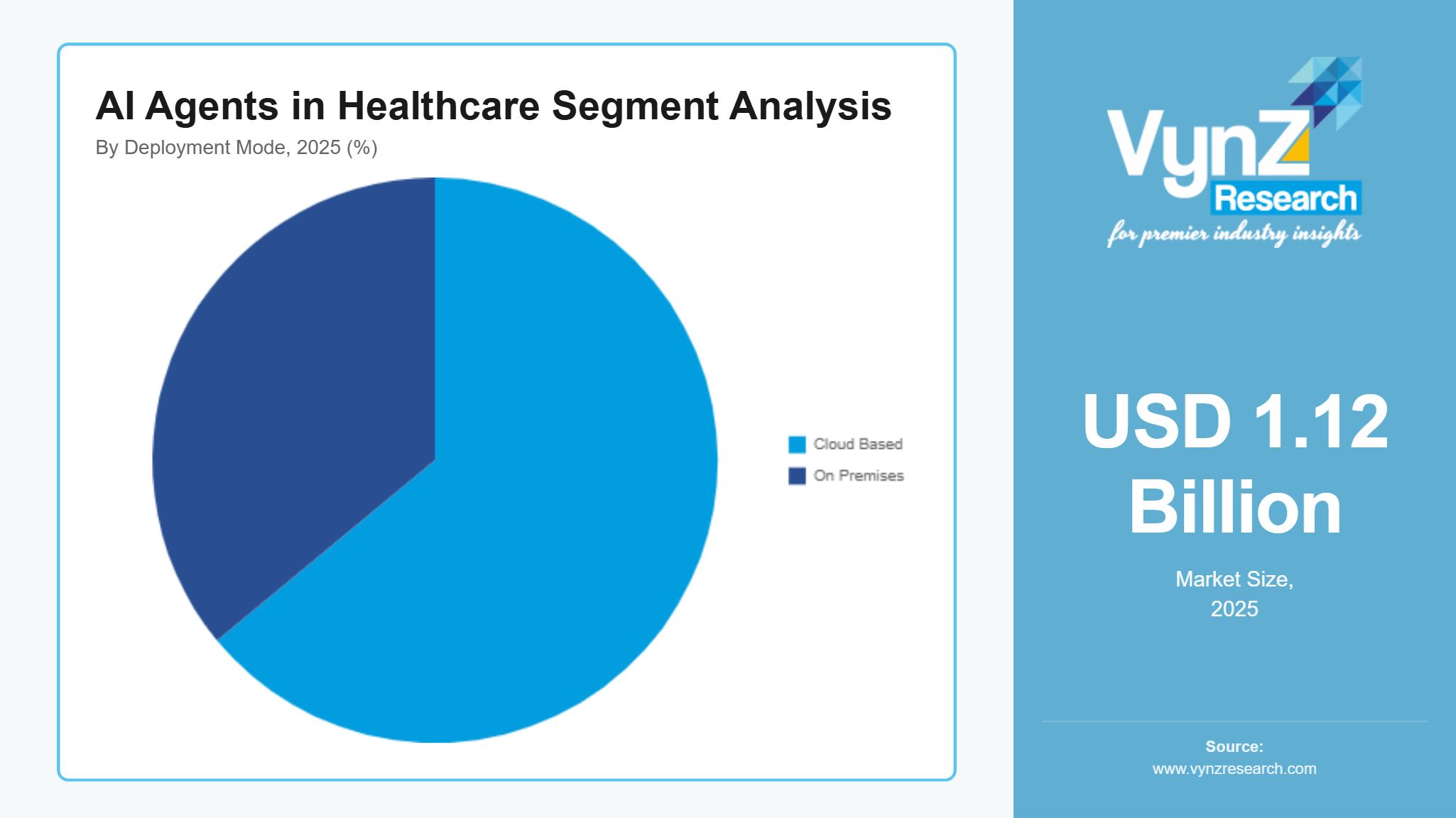
Cloud based deployment was leading in 2025, taking nearly 64% of segment revenue. It benefits from scalability, less spending on infrastructure and telehealth style services are getting more common. Remote healthcare management platforms are also spreading and government supported digital healthcare programs are giving the cloud even more momentum across hospitals and healthcare providers.
Meanwhile on premises deployment is projected to grow fairly steady, with a CAGR of about 41.8% during the forecast period. Concerns about healthcare data privacy, cybersecurity and regulatory compliance are still pretty high. Because of that, large healthcare institutions plus government affiliated organizations keep showing demand for local deployment.
By Application
Clinical workflow automation made up the largest portion in 2025, at roughly 27% of segment revenue. More facilities are adopting AI powered scheduling, documentation handling and patient management options, and that keeps feeding segment growth. Healthcare modernization programs and the push for operational efficiency are also making adoption stronger worldwide.
Drug discovery and personalized treatment recommendation applications are expected to grow fastest, with an estimated CAGR of 47.4% between 2026 and 2035. More money is going into precision medicine, AI assisted pharmaceutical research and predictive analytics platforms which is supporting quick expansion across healthcare as well as biotechnology circles.
By End User
Hospitals and healthcare providers held the biggest market share in 2025, about 61% of total revenue. Patient volumes are rising, healthcare data keeps getting generated at a higher pace, and investments in AI assisted clinical workflow systems are increasing. Government backed healthcare digitalization programs are also adding weight, especially in major healthcare markets.
Pharmaceutical and biotechnology companies are anticipated to see the fastest growth, with a CAGR close to 45.6% through the forecast period. The drivers are basically broader use of AI agents in drug discovery, clinical trials and precision medicine development. This is supported by rising spending on healthcare AI research and broader innovation.
Regional Insights
North America
In 2025, North America held around 34% of the market, mostly because it has advanced healthcare infrastructure, big healthcare IT spending, and hospitals plus research institutions are really leaning into artificial intelligence pretty quickly. Cities like New York, Boston, and Toronto are still seeing more AI powered clinical workflow and patient monitoring solutions being deployed. Also, government-backed digital healthcare initiatives, a wider telehealth infrastructure rollout, and regulatory backing for healthcare AI integration are all making the regional market look stronger. On top of that, more money going into precision medicine, healthcare analytics, and electronic health record modernization is keeping long term adoption in motion across the region.
Europe
Europe contributed nearly 23% in 2025. The region’s momentum is supported by healthcare digitalization going up, more people adopting AI aided diagnostics and regulatory frameworks that push secure healthcare data integration. Germany, the UK, and France are seeing growing use of intelligent healthcare automation platforms in hospitals and clinical networks. Meanwhile public healthcare modernization programs are moving along and regional healthcare authorities are increasing investments into AI research which is speeding up the need for AI enabled healthcare technologies.
Asia Pacific
Asia Pacific represented about 19% of the market in 2025 and it is expected to show the fastest growth through the forecast period. This is due to healthcare infrastructure expanding, healthcare spending increasing and governments putting more money into healthcare AI technologies across China, India, Japan and South Korea. Big urban areas like Beijing, Tokyo, Mumbai and Seoul are the major hubs for AI based healthcare innovation and digital health deployment. Government supported healthcare digital transformation initiatives, telemedicine services expanding and cloud-based healthcare system adoption also help the region’s performance hold up. Plus, higher patient volumes, along with a stronger focus on healthcare accessibility, is further encouraging hospitals and healthcare providers to integrate AI.
Rest of the World
Latin America, the Middle East, and Africa, accounted for roughly 24% in 2025. Growth here is supported by healthcare infrastructure modernization moving forward slowly, rising awareness about AI assisted healthcare delivery and more investments in digital healthcare systems overall. Emerging economies are adopting telehealth and remote patient monitoring technologies more often, aiming to improve healthcare accessibility and day-to-day operational efficiency. Government supported healthcare development programs, along with expansions in digital health initiatives, keep opening long term chances in underserved healthcare markets.
Competitive Landscape / Company Insights
The market is moderately competitive with major global technology providers, health AI developers, and cloud computing firms trying to push innovation forward. They tend to focus on strategic partnerships, healthcare platform expansion, and aggressive product updates. Companies are increasing investment in artificial intelligence research, predictive analytics, and clinical automation abilities, which is meant to help them hold a stronger market place. Also, government supported healthcare digitalization efforts plus regulatory frameworks that promote safe AI integration are adding fuel.
Mini Profiles
Amazon Web Services Inc. focuses on cloud-based healthcare AI infrastructure and intelligent data analytics solutions, supported by strong global cloud distribution capabilities, enterprise partnerships, and scalable healthcare computing platforms.
CitiusTech Inc. operates in healthcare technology and digital transformation segments, emphasizing clinical data integration, AI enabled analytics, and customized healthcare workflow optimization solutions for providers and payers.
Databricks leverages advanced data engineering platforms, strategic healthcare collaborations, and cloud-based AI deployment capabilities to strengthen market presence across healthcare analytics and predictive intelligence applications.
Google focuses on AI powered healthcare analytics, medical imaging support, and cloud computing services, supported by extensive digital ecosystem integration, strong brand recognition, and continuous artificial intelligence innovation.
IBM operates in enterprise healthcare AI and automation segments, emphasizing clinical decision support, hybrid cloud infrastructure, and advanced analytics capabilities for hospitals, research organizations, and healthcare providers.
Key Players
- Amazon Web Services, Inc.
- Automation Anywhere, Inc.
- CitiusTech Inc.
- Databricks
- IBM
- Innovaccer
- Microsoft
- NVIDIA Corporation
- Oracle
Recent Developments
In February 2026, Oracle introduced advanced order creation capabilities within Oracle Health Clinical AI Agent to support automated clinical documentation and workflow management. The company expanded ambient AI integration to reduce physician administrative burden and improve healthcare efficiency.
In March 2026, Innovaccer received industry recognition for its AI driven patient access and workflow optimization solutions across healthcare systems. The company strengthened its healthcare AI portfolio through expanded omnichannel engagement and intelligent patient management capabilities.
In September 2025, Automation Anywhere announced a strategic alliance focused on expanding generative AI and intelligent automation solutions across healthcare operations. The collaboration aimed to improve process efficiency, healthcare analytics, and enterprise workflow automation capabilities.
In March 2025, Microsoft launched Dragon Copilot, an AI powered healthcare assistant designed for clinical documentation and workflow automation. The platform integrates ambient listening and generative AI capabilities to improve physician productivity and patient interaction efficiency.
In January 2026, NVIDIA expanded healthcare AI initiatives supporting genomics, drug discovery, and clinical research acceleration through advanced AI infrastructure solutions. The company increased focus on agentic AI deployment and predictive healthcare analytics across healthcare and life sciences organizations.
Global AI Agents in Healthcare Market Coverage
Agent System Insight and Forecast 2026 - 2035
- Single Agent Systems
- Multi Agent Systems
Deployment Mode Insight and Forecast 2026 - 2035
- Cloud Based
- On Premises
Application Insight and Forecast 2026 - 2035
- Medical Imaging
- Virtual Nursing Assistants
- Remote Patient Monitoring
- Clinical Workflow Automation
- Drug Discovery
- Personalized Treatment Recommendation
- Healthcare Fraud Detection
- Others
End User Insight and Forecast 2026 - 2035
- Hospitals and Healthcare Providers
- Pharmaceutical and Biotechnology Companies
- Patients
- Payers and Insurance Companies
- Research Organizations
- Others
Global AI Agents in Healthcare Market by Region
- North America
- By Agent System
- By Deployment Mode
- By Application
- By End User
- By Country - U.S., Canada, Mexico
- Europe
- By Agent System
- By Deployment Mode
- By Application
- By End User
- By Country - Germany, U.K., France, Italy, Spain, Russia, Rest of Europe
- Asia-Pacific (APAC)
- By Agent System
- By Deployment Mode
- By Application
- By End User
- By Country - China, Japan, India, South Korea, Vietnam, Thailand, Malaysia, Rest of Asia-Pacific
- Rest of the World (RoW)
- By Agent System
- By Deployment Mode
- By Application
- By End User
- By Country - Brazil, Saudi Arabia, South Africa, U.A.E., Other Countries
Table of Contents for AI Agents in Healthcare Market Report
1. Research Overview
1.1. The Report Offers
1.2. Market Coverage
1.2.1. By
Agent System
1.2.2. By
Deployment Mode
1.2.3. By
Application
1.2.4. By
End User
1.3. Research Phases
1.4. Limitations
1.5. Market Methodology
1.5.1. Data Sources
1.5.1.1.
Primary Research
1.5.1.2.
Secondary Research
1.5.2. Methodology
1.5.2.1.
Data Exploration
1.5.2.2.
Forecast Parameters
1.5.2.3.
Data Validation
1.5.2.4.
Assumptions
1.5.3. Study Period & Data Reporting Unit
2. Executive Summary
3. Industry Overview
3.1. Industry Dynamics
3.1.1. Market Growth Drivers
3.1.2. Market Restraints
3.1.3. Key Market Trends
3.1.4. Major Opportunities
3.2. Industry Ecosystem
3.2.1. Porter’s Five Forces Analysis
3.2.2. Recent Development Analysis
3.2.3. Value Chain Analysis
3.3. Competitive Insight
3.3.1. Competitive Position of Industry
Players
3.3.2. Market Attractive Analysis
3.3.3. Market Share Analysis
4. Global Market Estimate and Forecast
4.1. Global Market Overview
4.2. Global Market Estimate and Forecast to 2035
5. Market Segmentation Estimate and Forecast
5.1. By Agent System
5.1.1. Single Agent Systems
5.1.1.1. Market Definition
5.1.1.2. Market Estimation and Forecast to 2035
5.1.2. Multi Agent Systems
5.1.2.1. Market Definition
5.1.2.2. Market Estimation and Forecast to 2035
5.2. By Deployment Mode
5.2.1. Cloud Based
5.2.1.1. Market Definition
5.2.1.2. Market Estimation and Forecast to 2035
5.2.2. On Premises
5.2.2.1. Market Definition
5.2.2.2. Market Estimation and Forecast to 2035
5.3. By Application
5.3.1. Medical Imaging
5.3.1.1. Market Definition
5.3.1.2. Market Estimation and Forecast to 2035
5.3.2. Virtual Nursing Assistants
5.3.2.1. Market Definition
5.3.2.2. Market Estimation and Forecast to 2035
5.3.3. Remote Patient Monitoring
5.3.3.1. Market Definition
5.3.3.2. Market Estimation and Forecast to 2035
5.3.4. Clinical Workflow Automation
5.3.4.1. Market Definition
5.3.4.2. Market Estimation and Forecast to 2035
5.3.5. Drug Discovery
5.3.5.1. Market Definition
5.3.5.2. Market Estimation and Forecast to 2035
5.3.6. Personalized Treatment Recommendation
5.3.6.1. Market Definition
5.3.6.2. Market Estimation and Forecast to 2035
5.3.7. Healthcare Fraud Detection
5.3.7.1. Market Definition
5.3.7.2. Market Estimation and Forecast to 2035
5.3.8. Others
5.3.8.1. Market Definition
5.3.8.2. Market Estimation and Forecast to 2035
5.4. By End User
5.4.1. Hospitals and Healthcare Providers
5.4.1.1. Market Definition
5.4.1.2. Market Estimation and Forecast to 2035
5.4.2. Pharmaceutical and Biotechnology Companies
5.4.2.1. Market Definition
5.4.2.2. Market Estimation and Forecast to 2035
5.4.3. Patients
5.4.3.1. Market Definition
5.4.3.2. Market Estimation and Forecast to 2035
5.4.4. Payers and Insurance Companies
5.4.4.1. Market Definition
5.4.4.2. Market Estimation and Forecast to 2035
5.4.5. Research Organizations
5.4.5.1. Market Definition
5.4.5.2. Market Estimation and Forecast to 2035
5.4.6. Others
5.4.6.1. Market Definition
5.4.6.2. Market Estimation and Forecast to 2035
6. North America Market Estimate and Forecast
6.1. By
Agent System
6.2. By
Deployment Mode
6.3. By
Application
6.4. By
End User
6.4.1.
U.S. Market Estimate and Forecast
6.4.2.
Canada Market Estimate and Forecast
6.4.3.
Mexico Market Estimate and Forecast
7. Europe Market Estimate and Forecast
7.1. By
Agent System
7.2. By
Deployment Mode
7.3. By
Application
7.4. By
End User
7.4.1.
Germany Market Estimate and Forecast
7.4.2.
France Market Estimate and Forecast
7.4.3.
U.K. Market Estimate and Forecast
7.4.4.
Italy Market Estimate and Forecast
7.4.5.
Spain Market Estimate and Forecast
7.4.6.
Russia Market Estimate and Forecast
7.4.7.
Rest of Europe Market Estimate and Forecast
8. Asia-Pacific (APAC) Market Estimate and Forecast
8.1. By
Agent System
8.2. By
Deployment Mode
8.3. By
Application
8.4. By
End User
8.4.1.
China Market Estimate and Forecast
8.4.2.
Japan Market Estimate and Forecast
8.4.3.
India Market Estimate and Forecast
8.4.4.
South Korea Market Estimate and Forecast
8.4.5.
Rest of Asia-Pacific Market Estimate and Forecast
9. Rest of the World (RoW) Market Estimate and Forecast
9.1. By
Agent System
9.2. By
Deployment Mode
9.3. By
Application
9.4. By
End User
9.4.1.
Brazil Market Estimate and Forecast
9.4.2.
Saudi Arabia Market Estimate and Forecast
9.4.3.
South Africa Market Estimate and Forecast
9.4.4.
U.A.E. Market Estimate and Forecast
9.4.5.
Other Countries Market Estimate and Forecast
10. Company Profiles
10.1.
Amazon Web Services, Inc.
10.1.1.
Snapshot
10.1.2.
Overview
10.1.3.
Offerings
10.1.4.
Financial
Insight
10.1.5.
Recent
Developments
10.2.
Automation Anywhere, Inc.
10.2.1.
Snapshot
10.2.2.
Overview
10.2.3.
Offerings
10.2.4.
Financial
Insight
10.2.5.
Recent
Developments
10.3.
CitiusTech Inc.
10.3.1.
Snapshot
10.3.2.
Overview
10.3.3.
Offerings
10.3.4.
Financial
Insight
10.3.5.
Recent
Developments
10.4.
Databricks
10.4.1.
Snapshot
10.4.2.
Overview
10.4.3.
Offerings
10.4.4.
Financial
Insight
10.4.5.
Recent
Developments
10.5.
Google
10.5.1.
Snapshot
10.5.2.
Overview
10.5.3.
Offerings
10.5.4.
Financial
Insight
10.5.5.
Recent
Developments
10.6.
IBM
10.6.1.
Snapshot
10.6.2.
Overview
10.6.3.
Offerings
10.6.4.
Financial
Insight
10.6.5.
Recent
Developments
10.7.
Innovaccer
10.7.1.
Snapshot
10.7.2.
Overview
10.7.3.
Offerings
10.7.4.
Financial
Insight
10.7.5.
Recent
Developments
10.8.
Microsoft
10.8.1.
Snapshot
10.8.2.
Overview
10.8.3.
Offerings
10.8.4.
Financial
Insight
10.8.5.
Recent
Developments
10.9.
NVIDIA Corporation
10.9.1.
Snapshot
10.9.2.
Overview
10.9.3.
Offerings
10.9.4.
Financial
Insight
10.9.5.
Recent
Developments
10.10.
Oracle
10.10.1.
Snapshot
10.10.2.
Overview
10.10.3.
Offerings
10.10.4.
Financial
Insight
10.10.5.
Recent
Developments
11. Appendix
11.1. Exchange Rates
11.2. Abbreviations
Note: Financial insight and recent developments of different companies are subject to the availability of information in the secondary domain.
Frequently Asked Questions
Purchase Options
Latest Report
Research Methodology
- Desk Research / Pilot Interviews
- Build Market Size Model
- Research and Analysis
- Final Deliverable
Connect With Our Sales Team
- Toll-Free: +1-888-253-3960
- Phone: +91 9960 288 381
- Email: enquiry@vynzresearch.com
AI Agents in Healthcare Market