
Bioinformatics Services Market Size & Share Growth Forecast Report (2026-2035)
Industry Insight by Type (NGS, Chemoinformatics, Microarray data analysis, Biological data curation, Scientific software testing, Other services), by Application (Genomics, Transcriptomics, Proteomics, Metabolomics, Drug discovery, Others), by Sector (Medical, Animal, Agricultural, Academics), by End User (Pharmaceutical and biotechnology companies, Academic and research institutions, Clinical and diagnostic laboratories, Contract research organizations, Agricultural research organizations)
| Status : Published | Published On : Nov, 2026 | Report Code : VRHC1357 | Industry : Healthcare | Available Format :

|
Page : 143 |
Bioinformatics Services Market Overview
The standalone services market size was estimated at about USD 3.5 billion in 2025 and is expected to reach around USD 4.2 billion in 2026 rising up to roughly USD 11.4 billion in 2035, growing at approximately 15.4% CAGR from 2026 to 2035.
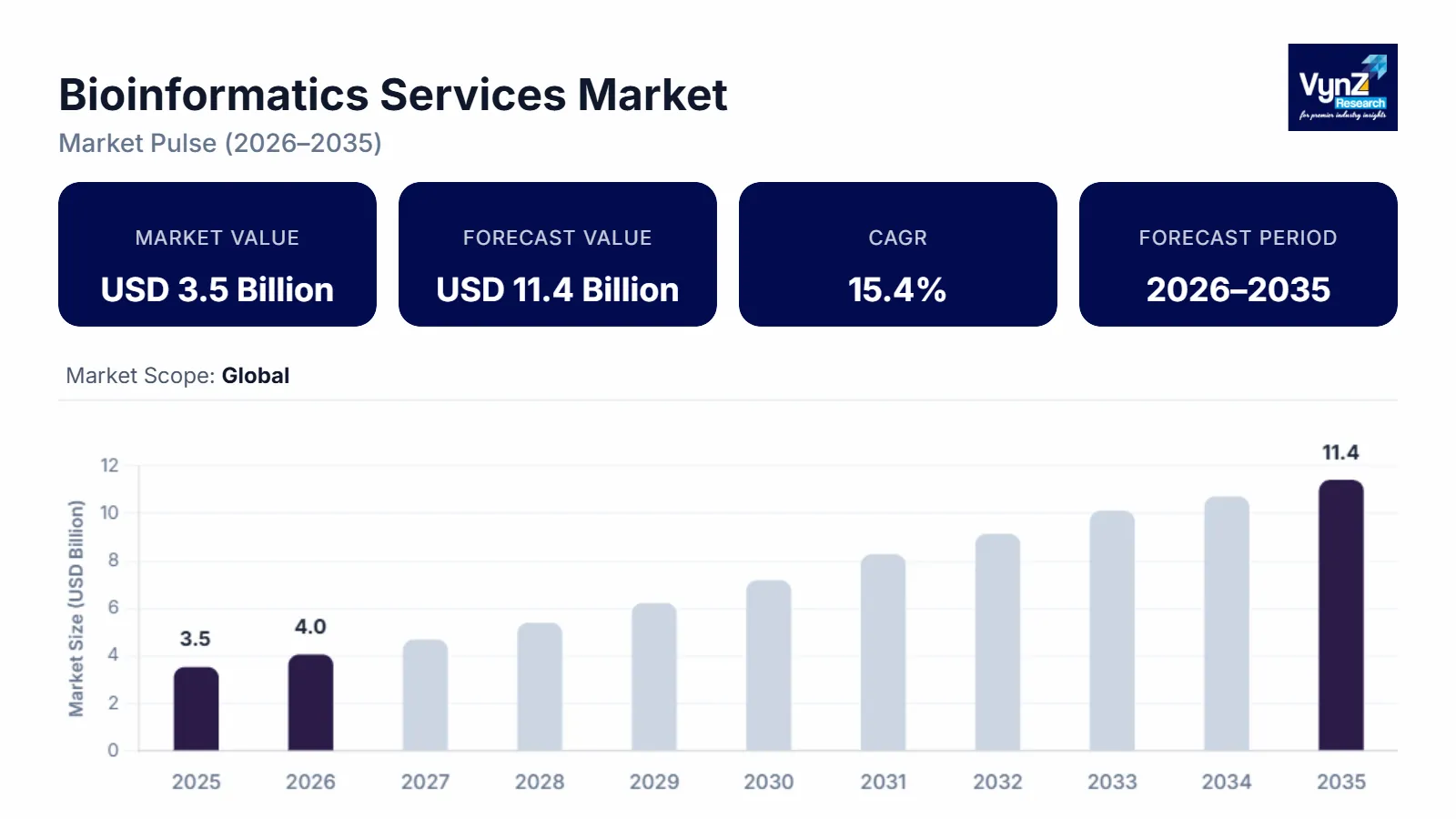
Market growth is driven by wider adoption of next-generation sequencing, increasing investment in genomics and proteomics research, and demand for computational support in drug discovery and precision medicine. The National Institutes of Health (NIH) supports large-scale biomedical data infrastructure through its data science programs, while the National Human Genome Research Institute (NHGRI) identifies the growing volume and complexity of genomic data as a continuing challenge for researchers. The FDA's guidance on next-generation sequencing-based tests also emphasizes the importance of documented and validated bioinformatics pipelines in clinical applications.
Research Methodology
VynZ team evaluates the bioinformatics services market through published market research, service-type and application-level analysis, sector-level demand, regional market indicators, and company disclosures. It considers next-generation sequencing activity, genomic and proteomic research, drug discovery requirements, and the adoption of computational analysis across medical, academic, animal, and agricultural research. Government-backed information from the NIH, NHGRI, and FDA is used to assess genomic data infrastructure, research priorities, and analytical validation requirements. The 2026 and 2035 market values are calculated using the published 2025 baseline and reported CAGR, with the 2035 estimate extrapolated beyond the source forecast period.
Research Highlights
- Next-generation sequencing (NGS) services accounted for approximately 34.85% of the type segment in 2025, supported by growing demand for sequence alignment, variant analysis, and interpretation of high-throughput sequencing data.
- Drug discovery held the largest application share at 24.68% in 2025, reflecting the use of bioinformatics in target identification, molecular modelling, and compound screening.
- Academic institutions represented 38.67% in 2025, supported by genomic research programs, university sequencing projects, and collaborative biomedical studies.
- The proteomics application is estimated to grow at a CAGR of 16.8% through 2026 to 2035, reflecting increasing analysis of protein expression, structure, and function.
- North America accounted for 45.70% of the bioinformatics services market in 2025, supported by established biotechnology clusters, research institutions, and pharmaceutical R&D activity.
Bioinformatics Services Market Dynamics
Market Trends
The bioinformatics services industry is witnessing increasing adoption of cloud-based genomic analysis, AI-assisted data interpretation, and integrated multi-omics workflows. Research organizations and pharmaceutical companies are using specialized service providers to process complex DNA, RNA, and protein datasets, particularly where internal computational infrastructure and skilled personnel are limited. Another important trend is the growing emphasis on reproducible and validated analytical pipelines. The FDA guidance for next-generation sequencing-based tests highlights the importance of documenting software versions, reference databases, and bioinformatics procedures, encouraging service providers to strengthen quality control and analytical traceability.
Growth Drivers
The increasing adoption of next-generation sequencing is a major driver, as high-throughput DNA and RNA analysis generates substantial datasets that require sequence alignment, variant identification, annotation, and interpretation. The NHGRI highlights the growing scale of genomic data generation and the need for computational methods capable of converting these datasets into useful biological findings. Growing investment in drug discovery and precision medicine is further supporting demand. Bioinformatics services assist pharmaceutical and biotechnology companies with target identification, molecular modelling, biomarker discovery, and the interpretation of multi-omics datasets. The NIH Strategic Plan for Data Science 2025–2030 also identifies biomedical data integration, computational methods, and AI as important areas for research infrastructure development.
Market Restraints / Challenges
High implementation costs and data security requirements continue to restrict adoption, particularly among smaller research institutions and biotechnology companies. Advanced genomic analysis requires specialized software, high-performance computing resources, secure data storage, and trained personnel, increasing the cost of outsourced and in-house analytical workflows. Furthermore, the handling of human genomic information creates privacy and regulatory challenges. The NIH Genomic Data Sharing Policy establishes requirements for responsible sharing and management of large-scale genomic data, while the FDA expects appropriate documentation and validation of bioinformatics pipelines used in sequencing-based tests. These requirements increase compliance and operational responsibilities for service providers.
Market Opportunities
Cloud-based bioinformatics outsourcing presents opportunities among academic institutions, biotechnology start-ups, and pharmaceutical companies seeking scalable computing resources without substantial infrastructure investments. Providers offering secure data processing, pipeline development, biological data curation, and interpretation services can address the growing need for specialized analytical support. AI-enabled multi-omics analysis is another important opportunity, particularly in precision medicine, biomarker discovery, and drug development. The NIH Strategic Plan for Data Science 2025–2030 highlights the importance of improving biomedical data integration and computational capabilities, creating opportunities for providers with expertise in advanced biological data analysis.
Global Bioinformatics Services Market Report Coverage
|
Report Metric |
Details |
|
Historical Period |
2020 - 2024 |
|
Base Year Considered |
2025 |
|
Forecast Period |
2026 - 2035 |
|
Market Size in 2025 |
USD 3.5 Billion |
|
Revenue Forecast in 2035 |
USD 11.4 Billion |
|
Growth Rate |
15.4% |
|
Segments Covered in the Report |
Type, Application, Sector, End User |
|
Report Scope |
Market Trends, Drivers, and Restraints; Revenue Estimation and Forecast; Segmentation Analysis; Companies’ Strategic Developments; Market Share Analysis of Key Players; Company Profiling |
|
Regions Covered in the Report |
North America, Europe, Asia-Pacific, Rest of the World |
|
Key Companies |
Agilent Technologies, BGI Group, CD Genomics, DNAnexus, DNASTAR, Dotmatics, Fios Genomics, Illumina, QIAGEN, Thermo Fisher Scientific |
|
Customization |
Available upon request |
Bioinformatics Services Market Segmentation
By Type
NGS services accounted for approximately 34.85% of the type segment in 2025, reflecting the widespread use of sequencing technologies across genomic research, molecular diagnostics, and drug development. Demand is supported by the need for targeted sequencing analysis, transcriptome analysis, whole-genome analysis, and de novo assembly.
Scientific software testing is identified as a high-growth service area, with an estimated CAGR of 16.6% from 2026 to 2035 in this report model, supported by the need for software validation, reproducibility, and quality assurance in complex research environments.
By Application
Drug discovery accounted for the largest application share at 24.68% in 2025, supported by the use of computational analysis for target identification, molecular modelling, docking, and the evaluation of biological pathways.
Proteomics segment is estimated to expand at a CAGR of 16.8% from 2026 to 2035, as pharmaceutical researchers increasingly integrate proteomic information with genomic and transcriptomic datasets to identify biomarkers and evaluate disease mechanisms.
By Sector
The medical sector represented 46.81% of the revenue in 2025. Demand is reinforced by the growing use of computational analysis in oncology, inherited disease research, and infectious disease studies. The animal sector is expected to record faster growth at a CAGR of 16.2% from 2026 to 2035, supported by the use of genomic information in animal health and agricultural productivity programs.
By End User
Academic and research institutions accounted for 38.67% share in 2025, reflecting the extensive use of bioinformatics in university-led genomics, proteomics, and molecular biology projects.
Pharmaceutical and biotechnology companies are estimated to expand at a CAGR of 16.4% from 2026 to 2035, supported by biomarker research, target validation, and increasing integration of multi-omics information into drug development.
Regional Insights
North America
North America accounted for 45.7% of the global bioinformatics services market in 2025, supported by its established pharmaceutical industry, biotechnology companies, genomic research centers, and academic institutions. The United States remains the primary contributor, supported by NIH-funded research, genomic medicine programs, and strong demand for sequencing data analysis. Government-backed research infrastructure and investments in biomedical data science continue to support regional demand. The NHGRI and NIH initiatives encourage the development of genomic data resources and computational research capabilities, creating opportunities for specialized service providers.
Europe
Europe contributed 23.3% of the global market in 2025. Demand is supported by pharmaceutical R&D, academic genomics programs, and the adoption of precision medicine across Germany, the United Kingdom, France, Switzerland, and the Nordic countries. The region's established research institutions and biotechnology clusters create demand for genomic analysis, biological data curation, and computational drug discovery services. The European Commission's Horizon Europe program supports collaborative research and innovation in health and life sciences, encouraging the development of advanced research infrastructure and data-driven scientific capabilities. Data protection requirements under the General Data Protection Regulation (GDPR) also increase the importance of secure genomic data processing and controlled access.
Asia Pacific
Asia Pacific represented 21% of the global market in 2025. Expansion is supported by increasing biotechnology investments, genomic research programs, pharmaceutical manufacturing, and the development of precision medicine capabilities across China, India, Japan, South Korea, and Australia. Government-backed initiatives are strengthening the regional research ecosystem. India's Department of Biotechnology supports genomics and biotechnology research through national programs, while China's investments in life sciences and Japan's genomic medicine initiatives are increasing demand for advanced biological data analysis and interpretation services.
Rest of the World
Rest of the World, including Latin America, the Middle East and Africa, collectively held the remaining 10% of the global market in 2025. Brazil, Mexico, Saudi Arabia, the UAE, and South Africa are developing research capabilities through investments in healthcare, biotechnology, academic institutions, and genomic medicine. Demand is gradually expanding for sequencing analysis, molecular research, and biological data management services. Government-supported healthcare research programs and international academic collaborations are helping strengthen regional capabilities.
Competitive Landscape / Company Insights
The bioinformatics services market is competitive, with global life sciences companies and specialist providers offering sequencing analysis, biological data curation, chemoinformatic, and computational research support. Key participants include Agilent Technologies, BGI Group, CD Genomics, DNAnexus, Illumina, QIAGEN, and Thermo Fisher Scientific. Competition is shaped by analytical accuracy, scientific expertise, secure data management, workflow integration, and the ability to process complex multi-omics datasets. FDA guidance on sequencing-based tests further increases the importance of validated analytical procedures and reliable data interpretation.
Mini Profiles
Agilent Technologies provides life sciences and analytical technologies, supporting genomics research, molecular analysis, and laboratory workflows through integrated research solutions.
BGI Group offers genomic sequencing, bioinformatics, and multi-omics research services, supporting applications across healthcare, agriculture, and life sciences.
CD Genomics provides sequencing and genomics research services, including next-generation sequencing, microarray analysis, and associated bioinformatics support.
DNAnexus offers cloud-based genomic data management and analysis capabilities, supporting secure collaboration and large-scale multi-omics research.
Fios Genomics provides bioinformatics and statistical analysis services for life sciences research, supporting the interpretation of complex biological datasets.
Key Players
- Agilent Technologies
- BGI Group
- CD Genomics
- DNAnexus
- DNASTAR
- Dotmatics
- Fios Genomics
- Illumina
- QIAGEN
- Thermo Fisher Scientific
Recent Developments
Illumina advanced its multi-omics software and informatics portfolio, including Connected Analytics, Connected Insights, DRAGEN, and Partek, to support integrated genomic and proteomic analysis. The company also outlined plans for expanded proteomics solutions and additional data-analysis capabilities.
QIAGEN strengthened its bioinformatics portfolio through QIAGEN Digital Insights, which combines curated biological knowledge bases, AI, and advanced analytics for disease research, drug development, and precision medicine. Its 2025 annual report also highlighted the use of its software for single-cell, multi-omics, and clinical NGS analysis.
Thermo Fisher Scientific continued to position its genomic analysis and informatics solutions within its life sciences portfolio, supporting sequencing workflows and molecular research applications. Its bioinformatics-related offerings address data interpretation and analysis requirements across research and clinical settings.
BGI Group continued to provide sequencing and bioinformatics capabilities for multi-omics research, including genomic data analysis and interpretation services for healthcare, agriculture, and scientific research applications.
Agilent Technologies continued to develop its genomics and analytical research portfolio, supporting molecular analysis and laboratory workflows used by biotechnology and pharmaceutical researchers.
Global Bioinformatics Services Market Coverage
Type Insight and Forecast 2026 - 2035
- NGS
- Chemoinformatics
- Microarray data analysis
- Biological data curation
- Scientific software testing
- Other services
Application Insight and Forecast 2026 - 2035
- Genomics
- Transcriptomics
- Proteomics
- Metabolomics
- Drug discovery
- Others
Sector Insight and Forecast 2026 - 2035
- Medical
- Animal
- Agricultural
- Academics
End User Insight and Forecast 2026 - 2035
- Pharmaceutical and biotechnology companies
- Academic and research institutions
- Clinical and diagnostic laboratories
- Contract research organizations
- Agricultural research organizations
Global Bioinformatics Services Market by Region
- North America
- By Type
- By Application
- By Sector
- By End User
- By Country - U.S., Canada, Mexico
- Europe
- By Type
- By Application
- By Sector
- By End User
- By Country - Germany, U.K., France, Italy, Spain, Russia, Rest of Europe
- Asia-Pacific (APAC)
- By Type
- By Application
- By Sector
- By End User
- By Country - China, Japan, India, South Korea, Vietnam, Thailand, Malaysia, Rest of Asia-Pacific
- Rest of the World (RoW)
- By Type
- By Application
- By Sector
- By End User
- By Country - Brazil, Saudi Arabia, South Africa, U.A.E., Other Countries
Table of Contents for Bioinformatics Services Market Report
1. Research Overview
1.1. The Report Offers
1.2. Market Coverage
1.2.1. By
Type
1.2.2. By
Application
1.2.3. By
Sector
1.2.4. By
End User
1.3. Research Phases
1.4. Limitations
1.5. Market Methodology
1.5.1. Data Sources
1.5.1.1.
Primary Research
1.5.1.2.
Secondary Research
1.5.2. Methodology
1.5.2.1.
Data Exploration
1.5.2.2.
Forecast Parameters
1.5.2.3.
Data Validation
1.5.2.4.
Assumptions
1.5.3. Study Period & Data Reporting Unit
2. Executive Summary
3. Industry Overview
3.1. Industry Dynamics
3.1.1. Market Growth Drivers
3.1.2. Market Restraints
3.1.3. Key Market Trends
3.1.4. Major Opportunities
3.2. Industry Ecosystem
3.2.1. Porter’s Five Forces Analysis
3.2.2. Recent Development Analysis
3.2.3. Value Chain Analysis
3.3. Competitive Insight
3.3.1. Competitive Position of Industry
Players
3.3.2. Market Attractive Analysis
3.3.3. Market Share Analysis
4. Global Market Estimate and Forecast
4.1. Global Market Overview
4.2. Global Market Estimate and Forecast to 2035
5. Market Segmentation Estimate and Forecast
5.1. By Type
5.1.1. NGS
5.1.1.1. Market Definition
5.1.1.2. Market Estimation and Forecast to 2035
5.1.2. Chemoinformatics
5.1.2.1. Market Definition
5.1.2.2. Market Estimation and Forecast to 2035
5.1.3. Microarray data analysis
5.1.3.1. Market Definition
5.1.3.2. Market Estimation and Forecast to 2035
5.1.4. Biological data curation
5.1.4.1. Market Definition
5.1.4.2. Market Estimation and Forecast to 2035
5.1.5. Scientific software testing
5.1.5.1. Market Definition
5.1.5.2. Market Estimation and Forecast to 2035
5.1.6. Other services
5.1.6.1. Market Definition
5.1.6.2. Market Estimation and Forecast to 2035
5.2. By Application
5.2.1. Genomics
5.2.1.1. Market Definition
5.2.1.2. Market Estimation and Forecast to 2035
5.2.2. Transcriptomics
5.2.2.1. Market Definition
5.2.2.2. Market Estimation and Forecast to 2035
5.2.3. Proteomics
5.2.3.1. Market Definition
5.2.3.2. Market Estimation and Forecast to 2035
5.2.4. Metabolomics
5.2.4.1. Market Definition
5.2.4.2. Market Estimation and Forecast to 2035
5.2.5. Drug discovery
5.2.5.1. Market Definition
5.2.5.2. Market Estimation and Forecast to 2035
5.2.6. Others
5.2.6.1. Market Definition
5.2.6.2. Market Estimation and Forecast to 2035
5.3. By Sector
5.3.1. Medical
5.3.1.1. Market Definition
5.3.1.2. Market Estimation and Forecast to 2035
5.3.2. Animal
5.3.2.1. Market Definition
5.3.2.2. Market Estimation and Forecast to 2035
5.3.3. Agricultural
5.3.3.1. Market Definition
5.3.3.2. Market Estimation and Forecast to 2035
5.3.4. Academics
5.3.4.1. Market Definition
5.3.4.2. Market Estimation and Forecast to 2035
5.4. By End User
5.4.1. Pharmaceutical and biotechnology companies
5.4.1.1. Market Definition
5.4.1.2. Market Estimation and Forecast to 2035
5.4.2. Academic and research institutions
5.4.2.1. Market Definition
5.4.2.2. Market Estimation and Forecast to 2035
5.4.3. Clinical and diagnostic laboratories
5.4.3.1. Market Definition
5.4.3.2. Market Estimation and Forecast to 2035
5.4.4. Contract research organizations
5.4.4.1. Market Definition
5.4.4.2. Market Estimation and Forecast to 2035
5.4.5. Agricultural research organizations
5.4.5.1. Market Definition
5.4.5.2. Market Estimation and Forecast to 2035
6. North America Market Estimate and Forecast
6.1. By
Type
6.2. By
Application
6.3. By
Sector
6.4. By
End User
6.4.1.
U.S. Market Estimate and Forecast
6.4.2.
Canada Market Estimate and Forecast
6.4.3.
Mexico Market Estimate and Forecast
7. Europe Market Estimate and Forecast
7.1. By
Type
7.2. By
Application
7.3. By
Sector
7.4. By
End User
7.4.1.
Germany Market Estimate and Forecast
7.4.2.
France Market Estimate and Forecast
7.4.3.
U.K. Market Estimate and Forecast
7.4.4.
Italy Market Estimate and Forecast
7.4.5.
Spain Market Estimate and Forecast
7.4.6.
Russia Market Estimate and Forecast
7.4.7.
Rest of Europe Market Estimate and Forecast
8. Asia-Pacific (APAC) Market Estimate and Forecast
8.1. By
Type
8.2. By
Application
8.3. By
Sector
8.4. By
End User
8.4.1.
China Market Estimate and Forecast
8.4.2.
Japan Market Estimate and Forecast
8.4.3.
India Market Estimate and Forecast
8.4.4.
South Korea Market Estimate and Forecast
8.4.5.
Rest of Asia-Pacific Market Estimate and Forecast
9. Rest of the World (RoW) Market Estimate and Forecast
9.1. By
Type
9.2. By
Application
9.3. By
Sector
9.4. By
End User
9.4.1.
Brazil Market Estimate and Forecast
9.4.2.
Saudi Arabia Market Estimate and Forecast
9.4.3.
South Africa Market Estimate and Forecast
9.4.4.
U.A.E. Market Estimate and Forecast
9.4.5.
Other Countries Market Estimate and Forecast
10. Company Profiles
10.1.
Agilent Technologies
10.1.1.
Snapshot
10.1.2.
Overview
10.1.3.
Offerings
10.1.4.
Financial
Insight
10.1.5.
Recent
Developments
10.2.
BGI Group
10.2.1.
Snapshot
10.2.2.
Overview
10.2.3.
Offerings
10.2.4.
Financial
Insight
10.2.5.
Recent
Developments
10.3.
CD Genomics
10.3.1.
Snapshot
10.3.2.
Overview
10.3.3.
Offerings
10.3.4.
Financial
Insight
10.3.5.
Recent
Developments
10.4.
DNAnexus
10.4.1.
Snapshot
10.4.2.
Overview
10.4.3.
Offerings
10.4.4.
Financial
Insight
10.4.5.
Recent
Developments
10.5.
DNASTAR
10.5.1.
Snapshot
10.5.2.
Overview
10.5.3.
Offerings
10.5.4.
Financial
Insight
10.5.5.
Recent
Developments
10.6.
Dotmatics
10.6.1.
Snapshot
10.6.2.
Overview
10.6.3.
Offerings
10.6.4.
Financial
Insight
10.6.5.
Recent
Developments
10.7.
Fios Genomics
10.7.1.
Snapshot
10.7.2.
Overview
10.7.3.
Offerings
10.7.4.
Financial
Insight
10.7.5.
Recent
Developments
10.8.
Illumina
10.8.1.
Snapshot
10.8.2.
Overview
10.8.3.
Offerings
10.8.4.
Financial
Insight
10.8.5.
Recent
Developments
10.9.
QIAGEN
10.9.1.
Snapshot
10.9.2.
Overview
10.9.3.
Offerings
10.9.4.
Financial
Insight
10.9.5.
Recent
Developments
10.10.
Thermo Fisher Scientific
10.10.1.
Snapshot
10.10.2.
Overview
10.10.3.
Offerings
10.10.4.
Financial
Insight
10.10.5.
Recent
Developments
11. Appendix
11.1. Exchange Rates
11.2. Abbreviations
Note: Financial insight and recent developments of different companies are subject to the availability of information in the secondary domain.
Frequently Asked Questions
Purchase Options
Latest Report
Research Methodology
- Desk Research / Pilot Interviews
- Build Market Size Model
- Research and Analysis
- Final Deliverable
Connect With Our Sales Team
- Toll-Free: +1-888-253-3960
- Phone: +91 9960 288 381
- Email: enquiry@vynzresearch.com
Bioinformatics Services Market