
Bladder Cancer Diagnostic Market - Size & Share Growth Forecast Report (2026-2035)
Industry Insight by Test Type (Cystoscopy, Urine Cytology, Urine Biomarker Tests, Imaging Tests, Biopsy), by Diagnostic Setting (Hospitals, Diagnostic Laboratories, Specialty Clinics, Academic Research Institutes), by Technology (Conventional Diagnostics, Molecular Diagnostics, Immunoassays, Next Generation Sequencing Based Diagnostics), by End User (Hospitals, Diagnostic Centers, Cancer Research Institutes, Ambulatory Surgical Centers)
| Status : Published | Published On : Jul, 2026 | Report Code : VRHC1346 | Industry : Healthcare | Available Format :

|
Page : 144 |
Bladder Cancer Diagnostic Market Overview
The bladder cancer diagnostic market size was estimated at about USD 3.2 billion in 2025 and is expected to reach around USD 3.5 billion in 2026, rising to roughly USD 7.8 billion by 2035, growing at approximately 9.4% CAGR from 2026 to 2035.
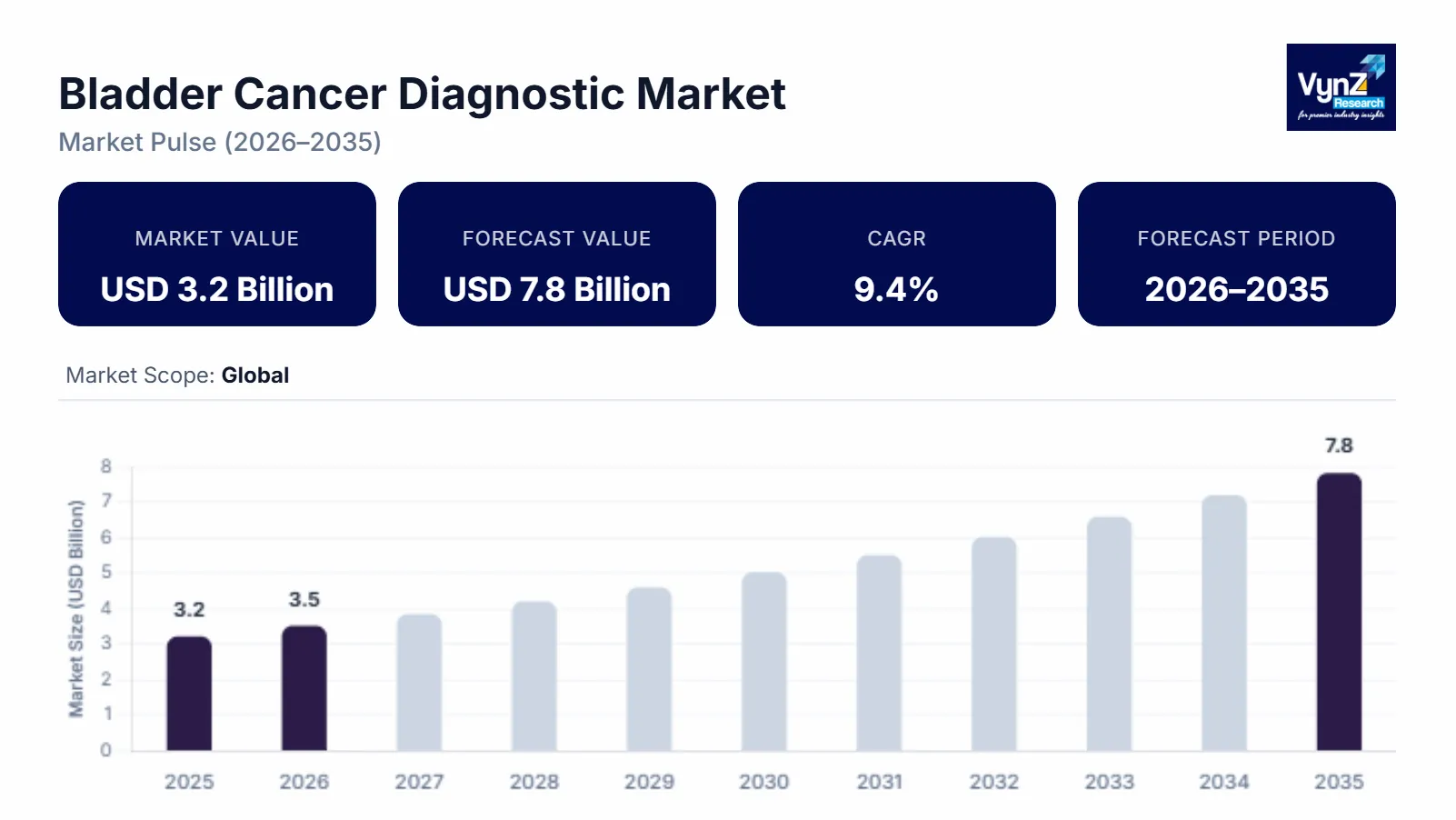
Research Highlights
- Cystoscopy captured 43% market share due to its established role in accurate bladder cancer diagnosis.
- Hospitals held 52% diagnostic setting share supported by advanced oncology infrastructure and comprehensive diagnostic services.
- Conventional diagnostics accounted for 56% market share due to widespread clinical adoption and standardized diagnostic protocols.
- Diagnostic laboratories are projected to grow at 9.8% CAGR through 2035 due to expanding molecular testing and laboratory automation.
- North America accounted for 36% market share in 2025 supported by advanced healthcare infrastructure and strong cancer screening programs.
Market growth is supported by the increasing global incidence of bladder cancer, growing adoption of noninvasive diagnostic technologies and expanding cancer screening initiatives along with growing use of molecular diagnostics and urine-based biomarker testing. Growing demand for early disease detection and ongoing investments in oncology research and precision medicine programs are further supporting market expansion across major regions including North America, Europe, and Asia Pacific. According to the World Health Organization (WHO) bladder cancer remains one of the most frequently diagnosed urological cancers worldwide highlighting the importance of early diagnosis for improving treatment outcomes. In addition, the International Agency for Research on Cancer (IARC) reports a substantial global burden of bladder cancer supporting increased investment in advanced diagnostic technologies and screening programs.
Bladder Cancer Diagnostic Market Dynamics
Market Trends
The market is witnessing notable shifts in diagnostic technology adoption, precision medicine and molecular testing practices. One of the key trends shaping the market is the increasing use of noninvasive urine-based biomarker tests reflecting growing preference for accurate, patient friendly and early detection solutions. Another emerging trend is the integration of molecular diagnostics and artificial intelligence assisted pathology supported by technological innovation and expanding precision oncology programs. These developments are influencing product offerings and encouraging companies to focus on multiplex biomarker assays, digital pathology platforms and integrated diagnostic solutions, thereby strengthening competitive differentiation.
Growth Drivers
The growth of the market is largely supported by the increasing global burden of bladder cancer which continues to generate consistent demand across hospitals, diagnostic laboratories and specialized cancer centers. Increasing investments in healthcare infrastructure, oncology services and national cancer control programs are further accelerating market expansion. Additionally, growing awareness regarding routine cancer screening and advancements in molecular diagnostic technologies are playing a crucial role in boosting adoption. As healthcare providers prioritize early detection, diagnostic accuracy and personalized treatment planning, demand for cystoscopy, urine cytology and biomarker based diagnostic tests is expected to remain strong throughout the forecast period.
Market Restraints / Challenges
Despite favorable growth prospects, the market faces certain challenges to its growth. High diagnostic costs and limited accessibility to advanced molecular testing continue to affect market penetration particularly across low- and middle-income countries. According to the World Health Organization (WHO), disparities in diagnostic infrastructure and healthcare access remain significant barriers to timely cancer diagnosis in many healthcare systems. Furthermore, regulatory requirements for diagnostic validation and dependence on specialized laboratory infrastructure pose operational challenges for manufacturers and healthcare providers. Limited availability of skilled pathology professionals and advanced testing facilities can increase operational costs and delay diagnosis, affecting broader adoption.
Market Opportunities
The market presents significant opportunities in noninvasive molecular diagnostics particularly driven by growing demand for precision oncology and personalized cancer management. Companies offering highly sensitive biomarker assays, liquid biopsy technologies and automated diagnostic platforms are well positioned to capture increasing demand from hospitals, oncology centers and diagnostic laboratories. Another key opportunity lies in artificial intelligence enabled diagnostic platforms where growing investments in digital pathology and precision diagnostics are creating avenues for improved clinical decision making and long-term healthcare partnerships. Advancements in automation, image analysis and integrated laboratory solutions are expected to improve diagnostic efficiency and patient outcomes.
Global Bladder Cancer Diagnostic Market Report Coverage
|
Report Metric |
Details |
|
Historical Period |
2020 - 2024 |
|
Base Year Considered |
2025 |
|
Forecast Period |
2026 - 2035 |
|
Market Size in 2025 |
USD 3.2 Billion |
|
Revenue Forecast in 2035 |
USD 7.8 Billion |
|
Growth Rate |
9.4% |
|
Segments Covered in the Report |
Test Type, Diagnostic Setting, Technology, End User |
|
Report Scope |
Market Trends, Drivers, and Restraints; Revenue Estimation and Forecast; Segmentation Analysis; Companies’ Strategic Developments; Market Share Analysis of Key Players; Company Profiling |
|
Regions Covered in the Report |
North America, Europe, Asia Pacific, Rest of the World |
|
Key Companies |
Abbott Laboratories, Bio-Rad Laboratories, Inc., Danaher Corporation, F. Hoffmann-La Roche Ltd., Hologic, Inc., Illumina, Inc., QIAGEN N.V., Siemens Healthineers AG, Sysmex Corporation, Thermo Fisher Scientific Inc. |
|
Customization |
Available upon request |
Bladder Cancer Diagnostic Market Segmentation
By Test Type
Cystoscopy accounted for the largest market share of approximately 43% in 2025 and is projected to grow at an estimated 9.1% CAGR through 2035 supported by its status as the clinical standard for bladder cancer detection, diagnosis and disease monitoring offering high diagnostic accuracy and direct visualization of bladder abnormalities.
Urine biomarker tests are expected to register the fastest growth at around 10.1% CAGR during the forecast period because growing preference for noninvasive diagnostic approaches, continuous biomarker research and expanding precision oncology programs are accelerating adoption across hospitals and diagnostic laboratories.
By Diagnostic Setting
Hospitals held the largest market share of approximately 52% in 2025 and are expected to expand at nearly 9.2% CAGR through 2035 due to comprehensive diagnostic infrastructure, multidisciplinary oncology services and greater availability of advanced imaging and cystoscopy procedures.
Diagnostic laboratories are anticipated to witness the fastest growth at an estimated 9.8% CAGR during the forecast period as increasing outsourcing of specialized molecular testing, wider adoption of automated laboratory platforms and expanding biomarker analysis services continue to strengthen segment growth.
By Technology
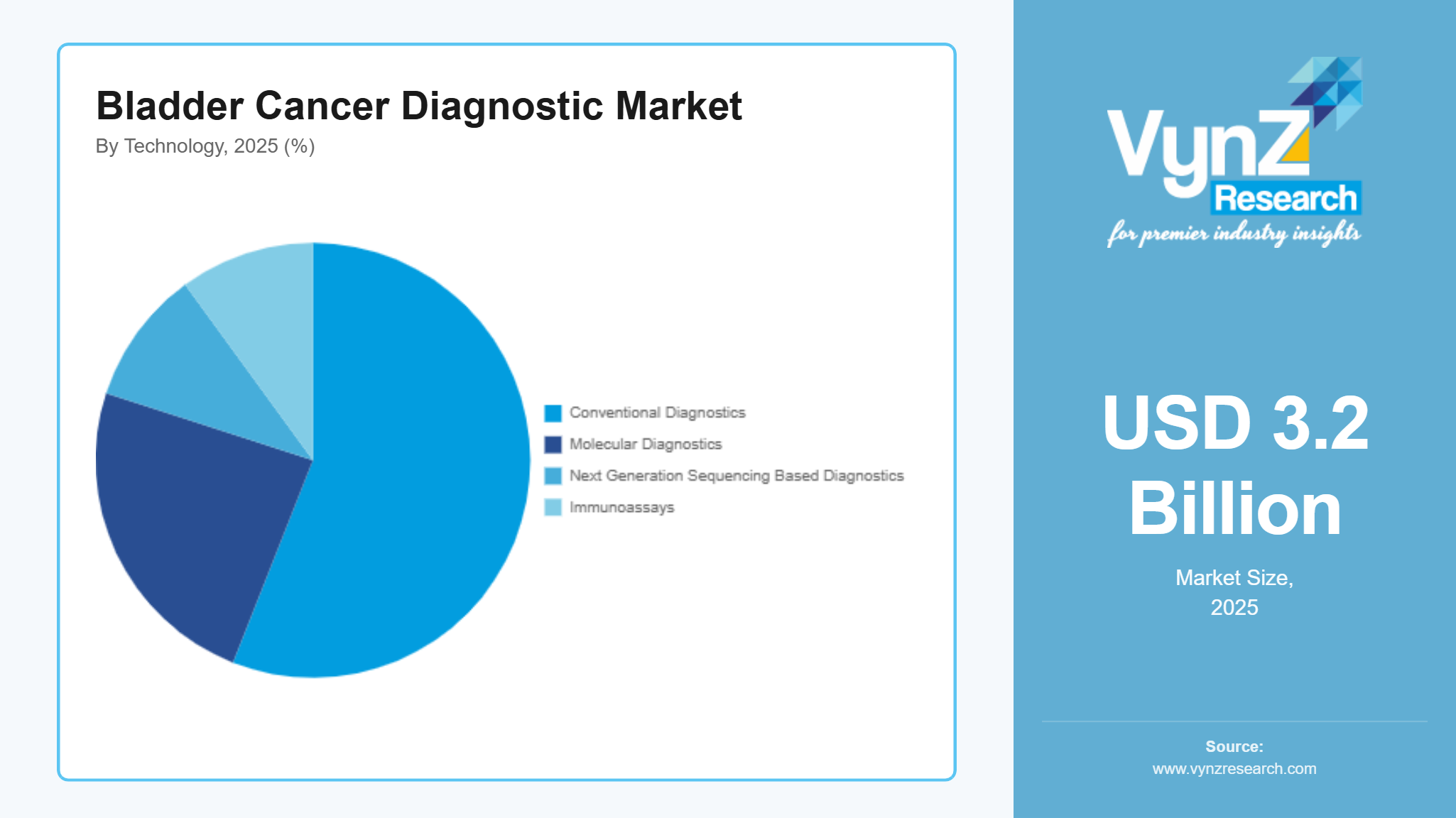
Conventional diagnostics accounted for the largest market share of approximately 56% in 2025 and are projected to grow at around 8.9% CAGR through 2035 supported by widespread clinical acceptance, established diagnostic guidelines, and broad availability across healthcare facilities worldwide.
Molecular diagnostics are projected to record the fastest growth at nearly 10.3% CAGR during the forecast period. Increasing demand for precision oncology, genomic biomarker identification and personalized treatment planning continues to drive adoption across advanced healthcare systems.
By End User
Hospitals accounted for the highest revenue share of approximately 49% in 2025 and are expected to grow at an estimated 9.2% CAGR through 2035. Strong patient inflow, availability of comprehensive oncology services and integration of advanced diagnostic technologies continue to support sustained market leadership.
Diagnostic centers are expected to register the fastest growth at around 9.9% CAGR during the forecast period due to increasing demand for specialized diagnostic services, faster turnaround times, and expanding access to molecular testing.
Regional Insights
North America
North America accounted for approximately 36% of the market in 2025 and is projected to grow at an estimated 9.2% CAGR through 2035 due to advanced healthcare infrastructure, high cancer screening rates and rapid adoption of molecular diagnostics across the United States and Canada. Strong demand from leading oncology centers and specialized diagnostic laboratories continues to support regional market growth. Government initiatives supporting cancer research, combined with increasing adoption of precision medicine and biomarker-based diagnostics are encouraging investments in innovative diagnostic platforms.
Europe
Europe represented about 24% of the global market in 2025 and is expected to register nearly 9.0% CAGR during the forecast period due to expanding cancer screening programs, favorable healthcare policies and increasing investments in diagnostic innovation. According to the European Commission Europe's Cancer Beating Plan continues to strengthen early diagnosis and equitable access to advanced cancer diagnostics across member states, supporting sustained market expansion.
Asia Pacific
Asia Pacific held nearly 18% of the market in 2025 and is anticipated to expand at around 10.0% CAGR through 2035 supported by improving healthcare infrastructure, increasing cancer awareness and expanding access to diagnostic services across China, India, Japan and South Korea. The World Health Organization (WHO) continues to encourage early cancer diagnosis and stronger healthcare systems, supporting greater adoption of bladder cancer diagnostic technologies throughout the region.
Rest of the World
The Rest of the World comprising Latin America, the Middle East, and Africa accounted for approximately 22% of the market in 2025 and is projected to grow at nearly 9.6% CAGR through 2035 as increasing investments in healthcare infrastructure, expanding oncology services and improving access to diagnostic technologies continue to create long term opportunities across emerging economies. According to the International Agency for Research on Cancer (IARC), strengthening cancer diagnosis and surveillance remains a priority for reducing the global burden of cancer supporting future market growth across these regions.
Competitive Landscape / Company Insights
The market is highly competitive with global and regional companies focusing on molecular diagnostics, biomarker development, product innovation and strategic collaborations to strengthen their market position. Manufacturers continue to invest in research and development, automation and precision diagnostic technologies to improve clinical outcomes and expand their geographic presence. The World Health Organization (WHO) and the National Cancer Institute (NCI) continue to emphasize the importance of early cancer detection and innovation in diagnostic technologies supporting ongoing advancements across the market.
Mini Profiles
Abbott Laboratories focuses on diagnostic instruments, immunoassays, and molecular testing solutions, supported by strong global distribution capabilities, extensive healthcare partnerships, and continuous investment in clinical research and innovation.
Bio-Rad Laboratories Inc. operates in specialized diagnostic and life science segments, emphasizing molecular diagnostics, high analytical performance, and advanced laboratory technologies for oncology research and clinical testing.
Danaher Corporation leverages strategic acquisitions, advanced diagnostic platforms, and global commercial operations to expand its presence across molecular diagnostics, clinical laboratories, and precision medicine applications.
Hologic Inc. specializes in molecular diagnostic solutions for cancer detection, supported by innovative assay development, strong healthcare relationships, and expanding diagnostic capabilities across global clinical laboratories.
QIAGEN N.V. focuses on molecular diagnostics and biomarker technologies, supported by advanced sample preparation solutions, strong research collaborations, and extensive global distribution serving hospitals and diagnostic laboratories.
Key Players
- Abbott Laboratories
- Bio-Rad Laboratories, Inc.
- Danaher Corporation
- F. Hoffmann-La Roche Ltd.
- Hologic, Inc.
- Illumina, Inc.
- QIAGEN N.V.
- Siemens Healthineers AG
- Sysmex Corporation
- Thermo Fisher Scientific Inc.
Recent Developments
In January 2025, F. Hoffmann-La Roche Ltd. received expanded regulatory recognition for additional companion diagnostic applications supporting precision oncology. The development strengthened the company's molecular diagnostics portfolio for personalized cancer management.
In February 2025, Illumina Inc. introduced new workflow enhancements for its sequencing platforms to improve oncology research and biomarker discovery. The upgrades were designed to accelerate genomic analysis and support broader adoption of precision diagnostics.
In July 2025, Siemens Healthineers AG reported continued growth in its diagnostics business while expanding investments in imaging, laboratory diagnostics, and digital healthcare solutions. The company also reaffirmed its focus on AI enabled diagnostic technologies for precision medicine.
In September 2025, Sysmex Corporation expanded collaborations supporting advanced cancer testing and laboratory automation across international healthcare markets. The initiative strengthened the company's diagnostic capabilities for oncology and precision medicine applications.
In November 2025, Thermo Fisher Scientific Inc. expanded its precision medicine portfolio by strengthening genomic analysis and molecular testing capabilities for oncology research. The initiative supported faster biomarker identification and broader adoption of personalized cancer diagnostics.
Global Bladder Cancer Diagnostic Market Coverage
Test Type Insight and Forecast 2026 - 2035
- Cystoscopy
- Urine Cytology
- Urine Biomarker Tests
- Imaging Tests
- Biopsy
Diagnostic Setting Insight and Forecast 2026 - 2035
- Hospitals
- Diagnostic Laboratories
- Specialty Clinics
- Academic Research Institutes
Technology Insight and Forecast 2026 - 2035
- Conventional Diagnostics
- Molecular Diagnostics
- Immunoassays
- Next Generation Sequencing Based Diagnostics
End User Insight and Forecast 2026 - 2035
- Hospitals
- Diagnostic Centers
- Cancer Research Institutes
- Ambulatory Surgical Centers
Global Bladder Cancer Diagnostic Market by Region
- North America
- By Test Type
- By Diagnostic Setting
- By Technology
- By End User
- By Country - U.S., Canada, Mexico
- Europe
- By Test Type
- By Diagnostic Setting
- By Technology
- By End User
- By Country - Germany, U.K., France, Italy, Spain, Russia, Rest of Europe
- Asia-Pacific (APAC)
- By Test Type
- By Diagnostic Setting
- By Technology
- By End User
- By Country - China, Japan, India, South Korea, Vietnam, Thailand, Malaysia, Rest of Asia-Pacific
- Rest of the World (RoW)
- By Test Type
- By Diagnostic Setting
- By Technology
- By End User
- By Country - Brazil, Saudi Arabia, South Africa, U.A.E., Other Countries
Table of Contents for Bladder Cancer Diagnostic Market Report
1. Research Overview
1.1. The Report Offers
1.2. Market Coverage
1.2.1. By
Test Type
1.2.2. By
Diagnostic Setting
1.2.3. By
Technology
1.2.4. By
End User
1.3. Research Phases
1.4. Limitations
1.5. Market Methodology
1.5.1. Data Sources
1.5.1.1.
Primary Research
1.5.1.2.
Secondary Research
1.5.2. Methodology
1.5.2.1.
Data Exploration
1.5.2.2.
Forecast Parameters
1.5.2.3.
Data Validation
1.5.2.4.
Assumptions
1.5.3. Study Period & Data Reporting Unit
2. Executive Summary
3. Industry Overview
3.1. Industry Dynamics
3.1.1. Market Growth Drivers
3.1.2. Market Restraints
3.1.3. Key Market Trends
3.1.4. Major Opportunities
3.2. Industry Ecosystem
3.2.1. Porter’s Five Forces Analysis
3.2.2. Recent Development Analysis
3.2.3. Value Chain Analysis
3.3. Competitive Insight
3.3.1. Competitive Position of Industry
Players
3.3.2. Market Attractive Analysis
3.3.3. Market Share Analysis
4. Global Market Estimate and Forecast
4.1. Global Market Overview
4.2. Global Market Estimate and Forecast to 2035
5. Market Segmentation Estimate and Forecast
5.1. By Test Type
5.1.1. Cystoscopy
5.1.1.1. Market Definition
5.1.1.2. Market Estimation and Forecast to 2035
5.1.2. Urine Cytology
5.1.2.1. Market Definition
5.1.2.2. Market Estimation and Forecast to 2035
5.1.3. Urine Biomarker Tests
5.1.3.1. Market Definition
5.1.3.2. Market Estimation and Forecast to 2035
5.1.4. Imaging Tests
5.1.4.1. Market Definition
5.1.4.2. Market Estimation and Forecast to 2035
5.1.5. Biopsy
5.1.5.1. Market Definition
5.1.5.2. Market Estimation and Forecast to 2035
5.2. By Diagnostic Setting
5.2.1. Hospitals
5.2.1.1. Market Definition
5.2.1.2. Market Estimation and Forecast to 2035
5.2.2. Diagnostic Laboratories
5.2.2.1. Market Definition
5.2.2.2. Market Estimation and Forecast to 2035
5.2.3. Specialty Clinics
5.2.3.1. Market Definition
5.2.3.2. Market Estimation and Forecast to 2035
5.2.4. Academic Research Institutes
5.2.4.1. Market Definition
5.2.4.2. Market Estimation and Forecast to 2035
5.3. By Technology
5.3.1. Conventional Diagnostics
5.3.1.1. Market Definition
5.3.1.2. Market Estimation and Forecast to 2035
5.3.2. Molecular Diagnostics
5.3.2.1. Market Definition
5.3.2.2. Market Estimation and Forecast to 2035
5.3.3. Immunoassays
5.3.3.1. Market Definition
5.3.3.2. Market Estimation and Forecast to 2035
5.3.4. Next Generation Sequencing Based Diagnostics
5.3.4.1. Market Definition
5.3.4.2. Market Estimation and Forecast to 2035
5.4. By End User
5.4.1. Hospitals
5.4.1.1. Market Definition
5.4.1.2. Market Estimation and Forecast to 2035
5.4.2. Diagnostic Centers
5.4.2.1. Market Definition
5.4.2.2. Market Estimation and Forecast to 2035
5.4.3. Cancer Research Institutes
5.4.3.1. Market Definition
5.4.3.2. Market Estimation and Forecast to 2035
5.4.4. Ambulatory Surgical Centers
5.4.4.1. Market Definition
5.4.4.2. Market Estimation and Forecast to 2035
6. North America Market Estimate and Forecast
6.1. By
Test Type
6.2. By
Diagnostic Setting
6.3. By
Technology
6.4. By
End User
6.4.1.
U.S. Market Estimate and Forecast
6.4.2.
Canada Market Estimate and Forecast
6.4.3.
Mexico Market Estimate and Forecast
7. Europe Market Estimate and Forecast
7.1. By
Test Type
7.2. By
Diagnostic Setting
7.3. By
Technology
7.4. By
End User
7.4.1.
Germany Market Estimate and Forecast
7.4.2.
France Market Estimate and Forecast
7.4.3.
U.K. Market Estimate and Forecast
7.4.4.
Italy Market Estimate and Forecast
7.4.5.
Spain Market Estimate and Forecast
7.4.6.
Russia Market Estimate and Forecast
7.4.7.
Rest of Europe Market Estimate and Forecast
8. Asia-Pacific (APAC) Market Estimate and Forecast
8.1. By
Test Type
8.2. By
Diagnostic Setting
8.3. By
Technology
8.4. By
End User
8.4.1.
China Market Estimate and Forecast
8.4.2.
Japan Market Estimate and Forecast
8.4.3.
India Market Estimate and Forecast
8.4.4.
South Korea Market Estimate and Forecast
8.4.5.
Rest of Asia-Pacific Market Estimate and Forecast
9. Rest of the World (RoW) Market Estimate and Forecast
9.1. By
Test Type
9.2. By
Diagnostic Setting
9.3. By
Technology
9.4. By
End User
9.4.1.
Brazil Market Estimate and Forecast
9.4.2.
Saudi Arabia Market Estimate and Forecast
9.4.3.
South Africa Market Estimate and Forecast
9.4.4.
U.A.E. Market Estimate and Forecast
9.4.5.
Other Countries Market Estimate and Forecast
10. Company Profiles
10.1.
Abbott Laboratories
10.1.1.
Snapshot
10.1.2.
Overview
10.1.3.
Offerings
10.1.4.
Financial
Insight
10.1.5.
Recent
Developments
10.2.
Bio-Rad Laboratories, Inc.
10.2.1.
Snapshot
10.2.2.
Overview
10.2.3.
Offerings
10.2.4.
Financial
Insight
10.2.5.
Recent
Developments
10.3.
Danaher Corporation
10.3.1.
Snapshot
10.3.2.
Overview
10.3.3.
Offerings
10.3.4.
Financial
Insight
10.3.5.
Recent
Developments
10.4.
F. Hoffmann-La Roche Ltd.
10.4.1.
Snapshot
10.4.2.
Overview
10.4.3.
Offerings
10.4.4.
Financial
Insight
10.4.5.
Recent
Developments
10.5.
Hologic, Inc.
10.5.1.
Snapshot
10.5.2.
Overview
10.5.3.
Offerings
10.5.4.
Financial
Insight
10.5.5.
Recent
Developments
10.6.
Illumina, Inc.
10.6.1.
Snapshot
10.6.2.
Overview
10.6.3.
Offerings
10.6.4.
Financial
Insight
10.6.5.
Recent
Developments
10.7.
QIAGEN N.V.
10.7.1.
Snapshot
10.7.2.
Overview
10.7.3.
Offerings
10.7.4.
Financial
Insight
10.7.5.
Recent
Developments
10.8.
Siemens Healthineers AG
10.8.1.
Snapshot
10.8.2.
Overview
10.8.3.
Offerings
10.8.4.
Financial
Insight
10.8.5.
Recent
Developments
10.9.
Sysmex Corporation
10.9.1.
Snapshot
10.9.2.
Overview
10.9.3.
Offerings
10.9.4.
Financial
Insight
10.9.5.
Recent
Developments
10.10.
Thermo Fisher Scientific Inc.
10.10.1.
Snapshot
10.10.2.
Overview
10.10.3.
Offerings
10.10.4.
Financial
Insight
10.10.5.
Recent
Developments
11. Appendix
11.1. Exchange Rates
11.2. Abbreviations
Note: Financial insight and recent developments of different companies are subject to the availability of information in the secondary domain.
Frequently Asked Questions
Purchase Options
Latest Report
Research Methodology
- Desk Research / Pilot Interviews
- Build Market Size Model
- Research and Analysis
- Final Deliverable
Connect With Our Sales Team
- Toll-Free: +1-888-253-3960
- Phone: +91 9960 288 381
- Email: enquiry@vynzresearch.com
Bladder Cancer Diagnostic Market