
Brain PET-MRI Imaging Systems Market Size & Share Growth Forecast Report (2026-2035)
Industry Insight by Product Type (Traditional PET-MRI Systems, Helium-free PET-MRI Systems), by Phase (Clinical, Preclinical), by Application (Oncology, Neurology, Cardiology, Psychiatry), by End User (Hospitals, Diagnostic Imaging Centers, Academic and Research Institutes)
| Status : Published | Published On : Nov, 2026 | Report Code : VRHC1358 | Industry : Healthcare | Available Format :

|
Page : 123 |
Brain PET-MRI Imaging Systems Market Overview
The brain PET-MRI imaging systems Market was estimated at approximately USD 376 million in 2025 and is expected to reach around USD 401 million in 2026, rising to approximately USD 702 million by 2035, growing at an estimated 6.42% CAGR from 2026 to 2035.
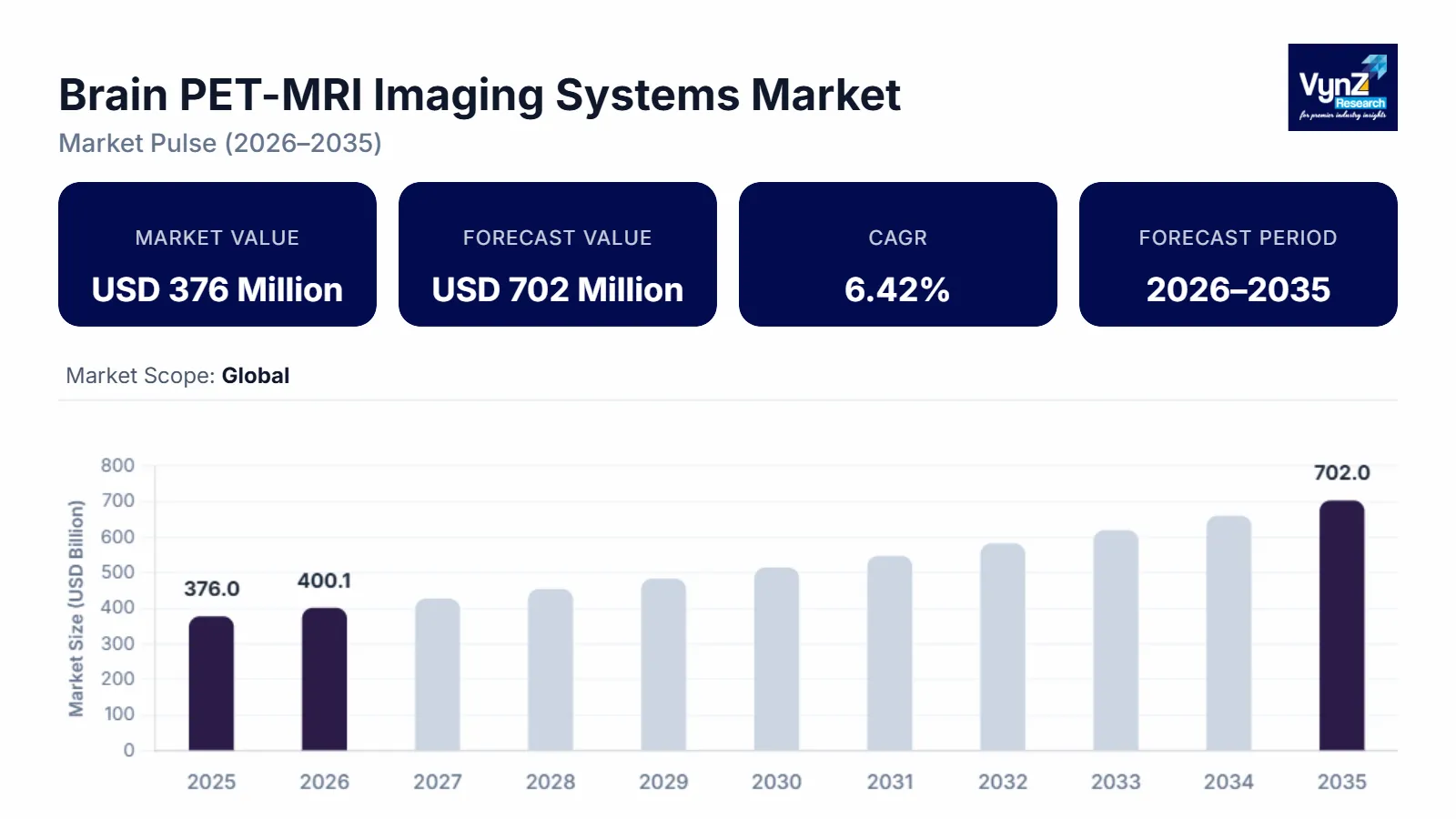
The brain PET-MRI imaging systems industry is gaining importance as hospitals and research institutions increasingly combine molecular imaging with detailed anatomical assessment to investigate neurological conditions. Growing interest in Alzheimer's disease research, brain tumor assessment and precision neuroimaging is supporting demand for integrated imaging platforms across clinical and research environments.
Market growth is driven by increasing neurological disease research, improvements in hybrid imaging technology and expanding investment in advanced diagnostic infrastructure. The World Health Organization's Global Status Report on Neurology, published in 2025, identifies neurological conditions as a major global health challenge, affecting more than 3 billion people worldwide. The report highlights gaps in access to neurological services, technologies and research, supporting the importance of improved diagnostic capabilities. Growing neuroscience research activity across the United States, Germany and Japan is also contributing to demand for advanced imaging systems.
Research Methodology
The VynZ Research team conducted a structured assessment of the brain PET-MRI imaging systems market using secondary research, company information, regulatory records and published medical research. The assessment covered product configurations, clinical and preclinical applications, end-user demand, regional adoption and competitive developments. Government publications from the World Health Organization, the US Food and Drug Administration and the National Institutes of Health were reviewed to understand neurological disease burdens, medical imaging requirements and regulatory developments. Market estimates were developed through data triangulation, reference comparison and forecast modelling, followed by internal consistency checks.
Research Highlights
- Traditional PET-MRI systems accounted for an estimated 77% of the product market in 2025, supported by established clinical installations and familiarity among healthcare providers.
- Clinical applications represented approximately 60% of the phase segment in 2025, reflecting demand for advanced imaging in patient diagnosis and treatment assessment.
- Hospitals held an estimated 53% of the end-user market in 2025, supported by their diagnostic infrastructure and ability to accommodate high-value imaging equipment.
- Helium-free PET-MRI systems are projected to record an estimated 7% CAGR during 2026–2035, driven by growing interest in reducing cryogen dependence and operating requirements.
- North America accounted for approximately 42% of global revenue in 2025, due to established medical imaging infrastructure, research funding and advanced neurological care facilities.
Brain PET-MRI Imaging Systems Market Dynamics
Market Trends
The industry is witnessing increasing interest in simultaneous imaging, advanced detector technology and integrated image reconstruction. One important trend is the development of systems that combine high-resolution anatomical information with molecular and metabolic imaging, allowing researchers and clinicians to examine multiple aspects of brain activity within a coordinated examination. Improvements in time-of-flight technology, detector sensitivity and motion correction are also supporting more detailed image acquisition, particularly in neurological and neurodegenerative disease research. Another emerging trend is the integration of artificial intelligence into medical imaging workflows.
Growth Drivers
The growth of the market is largely supported by the rising need for advanced neurological diagnosis and research. Alzheimer's disease, Parkinson's disease, epilepsy and brain tumors require detailed assessment of anatomical and metabolic changes, creating demand for complementary imaging technologies. The WHO's 2025 neurological health report highlights the substantial global burden of neurological conditions and the need to strengthen diagnostic services, research and access to medical technologies. Additionally, improvements in hybrid imaging technology are playing an important role in boosting adoption. PET and MRI provide complementary information, with PET evaluating molecular and metabolic activity while MRI supplies detailed anatomical and physiological information. Research published through the National Library of Medicine identifies applications in dementia, epilepsy, neuro-oncology and cerebrovascular disease.
Market Restraints / Challenges
Despite favorable growth prospects, the market faces challenges associated with high equipment costs and installation requirements. Integrated platforms require substantial capital expenditure, specialized infrastructure and trained technical personnel, restricting adoption among smaller hospitals and diagnostic facilities. Additional expenses associated with maintenance, radiotracers, service contracts and software upgrades can further increase the overall cost of ownership. Furthermore, technical complexity and the availability of specialized expertise can affect market penetration. PET and MRI operate through different physical principles, requiring accurate image registration, attenuation correction and coordinated data reconstruction. Research published through the National Library of Medicine identifies MR-based attenuation correction, image standardization and the need for multidisciplinary expertise as important technical challenges.
Market Opportunities
The market presents significant opportunities in the development of cost-efficient and modular brain imaging platforms, particularly for hospitals and research institutions seeking to expand advanced imaging capabilities without installing an entirely new hybrid scanner. Removable PET inserts and compatible MRI configurations offer an alternative approach to conventional integrated systems. Another opportunity lies in the expansion of molecular imaging for neurodegenerative disease assessment and treatment monitoring. Increasing research into amyloid and tau biomarkers is creating demand for imaging platforms capable of evaluating molecular changes alongside structural abnormalities. The development of disease-modifying Alzheimer's treatments is also increasing the importance of advanced imaging in clinical assessment and research. The NIH-supported medical literature identifies hybrid PET-MRI as a useful approach for examining molecular and anatomical abnormalities associated with neurodegenerative disorders.
Global Brain PET-MRI Imaging Systems Market Report Coverage
|
Report Metric |
Details |
|
Historical Period |
2020 - 2024 |
|
Base Year Considered |
2025 |
|
Forecast Period |
2026 - 2035 |
|
Market Size in 2025 |
USD 376 Million |
|
Revenue Forecast in 2035 |
USD 702 Million |
|
Growth Rate |
6.42% |
|
Segments Covered in the Report |
Product Type, Phase, Application, End User |
|
Report Scope |
Market Trends, Drivers, and Restraints; Revenue Estimation and Forecast; Segmentation Analysis; Companies’ Strategic Developments; Market Share Analysis of Key Players; Company Profiling |
|
Regions Covered in the Report |
North America, Europe, Asia-Pacific, Rest of the World |
|
Key Companies |
Aspect Imaging Ltd, Bruker Corporation, Canon Medical Systems Corporation, Cubresa Inc, GE HealthCare Technologies Inc, Hitachi Ltd, Koninklijke Philips N.V., Mediso Ltd, Siemens Healthineers AG, United Imaging Healthcare Co Ltd |
|
Customization |
Available upon request |
Available upon request
Brain PET-MRI Imaging Systems Market Segmentation
By Product Type
Traditional PET-MRI systems accounted for the largest estimated share of 77% in 2025, supported by their established installation base, existing clinical experience and compatibility with established imaging workflows.
Helium-free PET-MRI systems are expected to register faster growth, with an estimated CAGR of 7% during 2026–2035. Their adoption is supported by the development of magnet technologies designed to reduce dependence on conventional cryogenic cooling arrangements.
By Phase
Clinical systems held an estimated 60% share in 2025, supported by their use in patient diagnosis, disease assessment and treatment monitoring.
Preclinical systems are projected to expand at an estimated CAGR of 8% during 2026–2035, supported by increasing neuroscience research, pharmaceutical development and investigations into neurological disease mechanisms.
By Application
Oncology contributed an estimated 45% share in 2025, supported by the use of PET imaging to examine metabolic activity in brain tumors and MRI to provide detailed anatomical information.
Neurology is expected to register faster growth, with an estimated CAGR of 8% during 2026–2035, driven by increasing research into Alzheimer's disease, Parkinson's disease, epilepsy and other neurological conditions.
By End User
Hospitals held the largest estimated revenue share of 53% in 2025, due to their established radiology departments, specialist neurological services and capacity to invest in advanced imaging infrastructure.
Diagnostic imaging centers are expected to record faster growth, with an estimated CAGR of 7% during 2026–2035. Increasing demand for specialist imaging services and the gradual expansion of advanced diagnostic infrastructure are supporting this segment.
Regional Insights
North America
North America accounted for approximately 42% of the market in 2025, supported by advanced medical imaging infrastructure, strong research capabilities and established neurological care facilities. The United States represents the largest contributor within the region, with hospitals and academic institutions investing in molecular imaging and advanced diagnostic technologies. Research funding from the National Institutes of Health and clinical innovation supported by the US healthcare sector continue to encourage the adoption of specialized imaging platforms.
Europe
Europe held an estimated 28% share of the global market in 2025, supported by established healthcare systems, neuroscience research institutions and increasing investments in advanced diagnostic technologies. Germany, the United Kingdom, France and Italy represent important markets because of their medical research infrastructure and specialist neurological services. The European Commission identifies brain disorders as a major healthcare challenge, with approximately 165 million Europeans living with a brain disorder, strengthening the importance of research and improved diagnostic capabilities.
Asia Pacific
Asia Pacific represented approximately 22% of the global market in 2025 . China, Japan, India, South Korea and Australia are important markets, supported by expanding healthcare infrastructure, growing medical research expenditure and increasing investment in advanced diagnostic equipment. China's medical equipment market has experienced substantial expansion, while government initiatives are encouraging the development of high-end medical imaging technologies and domestic manufacturing capabilities.
Rest of the World
Rest of the World contributed the remaining estimated 8% of global revenue in 2025, covering Latin America, the Middle East and Africa. The region is supported by gradual modernization of healthcare facilities, increasing investment in specialist diagnostic services and improving access to advanced medical technologies. Brazil, Saudi Arabia, the United Arab Emirates and South Africa represent important developing markets for advanced imaging infrastructure.
Competitive Landscape / Company Insights
The brain PET-MRI imaging systems market is moderately competitive, with established medical imaging manufacturers and specialized molecular imaging companies focusing on technological development, detector performance and system integration. Siemens Healthineers, GE HealthCare and Koninklijke Philips maintain established imaging portfolios, while Bruker, Mediso and Cubresa address specialized research and clinical requirements. Companies are increasingly emphasizing AI-supported imaging, modular configurations and improved PET sensitivity to strengthen their market positions. FDA regulatory records and recent product developments demonstrate continued innovation across the competitive landscape.
Mini Profiles
Aspect Imaging Ltd develops specialized MRI technologies and imaging solutions, supporting advanced applications across medical and research environments.
Bruker Corporation provides preclinical molecular imaging technologies, including PET-based platforms used in neuroscience and biomedical research.
Cubresa Inc develops clinical and preclinical PET inserts for MRI systems, with its BrainPET platform targeting specialized brain imaging applications.
Hitachi Ltd operates across advanced medical imaging technologies, including MRI solutions supporting diagnostic and research applications.
Mediso Ltd specializes in nuclear medicine and molecular imaging equipment, offering PET-based technologies for clinical and preclinical research.
Key Players
- Aspect Imaging Ltd
- Bruker Corporation
- Canon Medical Systems Corporation
- Cubresa Inc
- GE HealthCare Technologies Inc
- Hitach, Ltd
- Koninklijke Philips N.V.
- Mediso Ltd
- Siemens Healthineers AG
- United Imaging Healthcare Co Ltd
Recent Developments
GE HealthCare introduced its next-generation SIGNA MRI technologies, including SIGNA Bolt and SIGNA Sprint with Freelium, featuring advanced gradient performance and AI-supported workflows. These developments strengthen its MRI portfolio and support growing requirements for advanced neurological imaging.
Koninklijke Philips N.V. expanded its partnership with Cortechs.ai to integrate AI-enabled quantitative neuroimaging analytics into its MRI systems. The collaboration focuses on brain volumetrics, lesion quantification and tumor tracking to improve neurological assessment and imaging workflows.
Siemens Healthineers AG advanced its Biograph One PET-MRI platform, with clinical research evaluating its performance across whole-body and brain imaging applications. Published clinical findings reported favorable image quality and diagnostic concordance, supporting further evaluation of next-generation hybrid imaging capabilities.
United Imaging Healthcare Co Ltd introduced its uMR Ultra MRI system with advanced gradient performance, expanded radiofrequency channels and AI-supported imaging capabilities. The platform also incorporates real-time visualization technology designed to support advanced neurological and other clinical applications.
Canon Medical Systems Corporation highlighted the vertical integration of its MRI portfolio, including in-house development and manufacturing of magnets and radiofrequency coils. Its focus on integrated AI-supported workflows is intended to improve system performance and operational efficiency across advanced imaging applications.
Global Brain PET-MRI Imaging Systems Market Coverage
Product Type Insight and Forecast 2026 - 2035
- Traditional PET-MRI Systems
- Helium-free PET-MRI Systems
Phase Insight and Forecast 2026 - 2035
- Clinical
- Preclinical
Application Insight and Forecast 2026 - 2035
- Oncology
- Neurology
- Cardiology
- Psychiatry
End User Insight and Forecast 2026 - 2035
- Hospitals
- Diagnostic Imaging Centers
- Academic and Research Institutes
Global Brain PET-MRI Imaging Systems Market by Region
- North America
- By Product Type
- By Phase
- By Application
- By End User
- By Country - U.S., Canada, Mexico
- Europe
- By Product Type
- By Phase
- By Application
- By End User
- By Country - Germany, U.K., France, Italy, Spain, Russia, Rest of Europe
- Asia-Pacific (APAC)
- By Product Type
- By Phase
- By Application
- By End User
- By Country - China, Japan, India, South Korea, Vietnam, Thailand, Malaysia, Rest of Asia-Pacific
- Rest of the World (RoW)
- By Product Type
- By Phase
- By Application
- By End User
- By Country - Brazil, Saudi Arabia, South Africa, U.A.E., Other Countries
Table of Contents for Brain PET-MRI Imaging Systems Market Report
1. Research Overview
1.1. The Report Offers
1.2. Market Coverage
1.2.1. By
Product Type
1.2.2. By
Phase
1.2.3. By
Application
1.2.4. By
End User
1.3. Research Phases
1.4. Limitations
1.5. Market Methodology
1.5.1. Data Sources
1.5.1.1.
Primary Research
1.5.1.2.
Secondary Research
1.5.2. Methodology
1.5.2.1.
Data Exploration
1.5.2.2.
Forecast Parameters
1.5.2.3.
Data Validation
1.5.2.4.
Assumptions
1.5.3. Study Period & Data Reporting Unit
2. Executive Summary
3. Industry Overview
3.1. Industry Dynamics
3.1.1. Market Growth Drivers
3.1.2. Market Restraints
3.1.3. Key Market Trends
3.1.4. Major Opportunities
3.2. Industry Ecosystem
3.2.1. Porter’s Five Forces Analysis
3.2.2. Recent Development Analysis
3.2.3. Value Chain Analysis
3.3. Competitive Insight
3.3.1. Competitive Position of Industry
Players
3.3.2. Market Attractive Analysis
3.3.3. Market Share Analysis
4. Global Market Estimate and Forecast
4.1. Global Market Overview
4.2. Global Market Estimate and Forecast to 2035
5. Market Segmentation Estimate and Forecast
5.1. By Product Type
5.1.1. Traditional PET-MRI Systems
5.1.1.1. Market Definition
5.1.1.2. Market Estimation and Forecast to 2035
5.1.2. Helium-free PET-MRI Systems
5.1.2.1. Market Definition
5.1.2.2. Market Estimation and Forecast to 2035
5.2. By Phase
5.2.1. Clinical
5.2.1.1. Market Definition
5.2.1.2. Market Estimation and Forecast to 2035
5.2.2. Preclinical
5.2.2.1. Market Definition
5.2.2.2. Market Estimation and Forecast to 2035
5.3. By Application
5.3.1. Oncology
5.3.1.1. Market Definition
5.3.1.2. Market Estimation and Forecast to 2035
5.3.2. Neurology
5.3.2.1. Market Definition
5.3.2.2. Market Estimation and Forecast to 2035
5.3.3. Cardiology
5.3.3.1. Market Definition
5.3.3.2. Market Estimation and Forecast to 2035
5.3.4. Psychiatry
5.3.4.1. Market Definition
5.3.4.2. Market Estimation and Forecast to 2035
5.4. By End User
5.4.1. Hospitals
5.4.1.1. Market Definition
5.4.1.2. Market Estimation and Forecast to 2035
5.4.2. Diagnostic Imaging Centers
5.4.2.1. Market Definition
5.4.2.2. Market Estimation and Forecast to 2035
5.4.3. Academic and Research Institutes
5.4.3.1. Market Definition
5.4.3.2. Market Estimation and Forecast to 2035
6. North America Market Estimate and Forecast
6.1. By
Product Type
6.2. By
Phase
6.3. By
Application
6.4. By
End User
6.4.1.
U.S. Market Estimate and Forecast
6.4.2.
Canada Market Estimate and Forecast
6.4.3.
Mexico Market Estimate and Forecast
7. Europe Market Estimate and Forecast
7.1. By
Product Type
7.2. By
Phase
7.3. By
Application
7.4. By
End User
7.4.1.
Germany Market Estimate and Forecast
7.4.2.
France Market Estimate and Forecast
7.4.3.
U.K. Market Estimate and Forecast
7.4.4.
Italy Market Estimate and Forecast
7.4.5.
Spain Market Estimate and Forecast
7.4.6.
Russia Market Estimate and Forecast
7.4.7.
Rest of Europe Market Estimate and Forecast
8. Asia-Pacific (APAC) Market Estimate and Forecast
8.1. By
Product Type
8.2. By
Phase
8.3. By
Application
8.4. By
End User
8.4.1.
China Market Estimate and Forecast
8.4.2.
Japan Market Estimate and Forecast
8.4.3.
India Market Estimate and Forecast
8.4.4.
South Korea Market Estimate and Forecast
8.4.5.
Rest of Asia-Pacific Market Estimate and Forecast
9. Rest of the World (RoW) Market Estimate and Forecast
9.1. By
Product Type
9.2. By
Phase
9.3. By
Application
9.4. By
End User
9.4.1.
Brazil Market Estimate and Forecast
9.4.2.
Saudi Arabia Market Estimate and Forecast
9.4.3.
South Africa Market Estimate and Forecast
9.4.4.
U.A.E. Market Estimate and Forecast
9.4.5.
Other Countries Market Estimate and Forecast
10. Company Profiles
10.1.
Aspect Imaging Ltd.
10.1.1.
Snapshot
10.1.2.
Overview
10.1.3.
Offerings
10.1.4.
Financial
Insight
10.1.5.
Recent
Developments
10.2.
Bruker Corporation
10.2.1.
Snapshot
10.2.2.
Overview
10.2.3.
Offerings
10.2.4.
Financial
Insight
10.2.5.
Recent
Developments
10.3.
Canon Medical Systems Corporation
10.3.1.
Snapshot
10.3.2.
Overview
10.3.3.
Offerings
10.3.4.
Financial
Insight
10.3.5.
Recent
Developments
10.4.
Cubresa Inc.
10.4.1.
Snapshot
10.4.2.
Overview
10.4.3.
Offerings
10.4.4.
Financial
Insight
10.4.5.
Recent
Developments
10.5.
GE HealthCare Technologies Inc.
10.5.1.
Snapshot
10.5.2.
Overview
10.5.3.
Offerings
10.5.4.
Financial
Insight
10.5.5.
Recent
Developments
10.6.
Hitachi, Ltd.
10.6.1.
Snapshot
10.6.2.
Overview
10.6.3.
Offerings
10.6.4.
Financial
Insight
10.6.5.
Recent
Developments
10.7.
Koninklijke Philips N.V.
10.7.1.
Snapshot
10.7.2.
Overview
10.7.3.
Offerings
10.7.4.
Financial
Insight
10.7.5.
Recent
Developments
10.8.
Mediso Ltd.
10.8.1.
Snapshot
10.8.2.
Overview
10.8.3.
Offerings
10.8.4.
Financial
Insight
10.8.5.
Recent
Developments
10.9.
Siemens Healthineers AG
10.9.1.
Snapshot
10.9.2.
Overview
10.9.3.
Offerings
10.9.4.
Financial
Insight
10.9.5.
Recent
Developments
10.10.
United Imaging Healthcare Co., Ltd.
10.10.1.
Snapshot
10.10.2.
Overview
10.10.3.
Offerings
10.10.4.
Financial
Insight
10.10.5.
Recent
Developments
11. Appendix
11.1. Exchange Rates
11.2. Abbreviations
Note: Financial insight and recent developments of different companies are subject to the availability of information in the secondary domain.
Frequently Asked Questions
Purchase Options
Latest Report
Research Methodology
- Desk Research / Pilot Interviews
- Build Market Size Model
- Research and Analysis
- Final Deliverable
Connect With Our Sales Team
- Toll-Free: +1-888-253-3960
- Phone: +91 9960 288 381
- Email: enquiry@vynzresearch.com
Brain PET-MRI Imaging Systems Market