
Germany Disposable Gloves Market Size & Share - Growth Forecast Report (2026-2035)
Industry Insight by Product (Powder-Free, Powdered), by Material (Neoprene, Nitrile, Polyethylene, Natural Rubber, Vinyl), by Application (Non-Medical, Medical & Healthcare)
| Status : Published | Published On : Jun, 2026 | Report Code : VRHC1341 | Industry : Healthcare | Available Format :

|
Page : 110 |
Germany Disposable Gloves Market Overview
The Germany disposable gloves market size was estimated at about USD 1.05 billion in 2025 and is expected to reach around USD 1.19 billion in 2026 rising up to roughly USD 2.52 billion in 2035, growing at approximately 9.35% CAGR from 2026 to 2035.
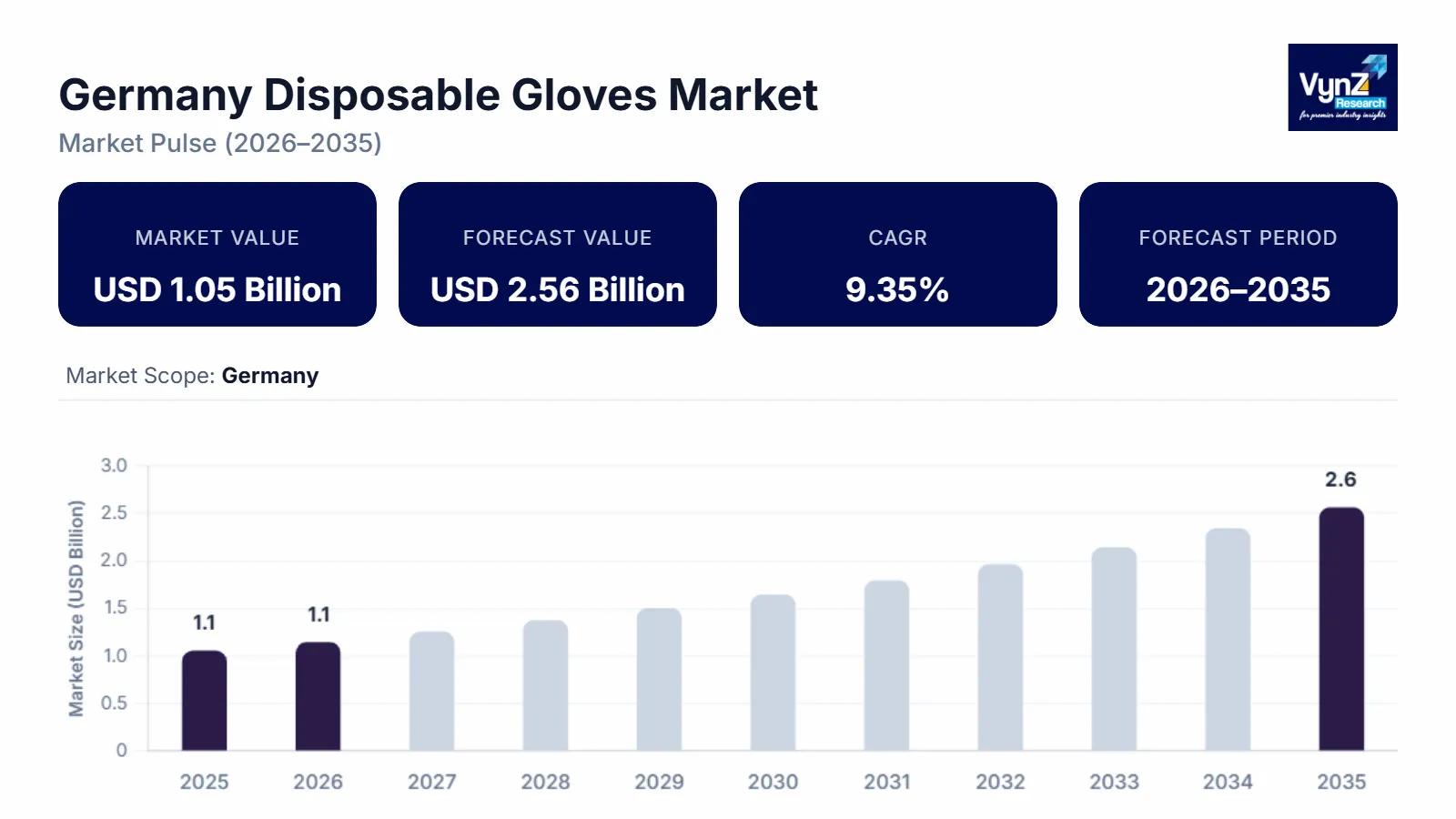
Research Highlights
- Nitrile gloves led with 46% share in 2025 due to high barrier protection demand
- Healthcare application dominated with 52% share in 2025 driven by infection control needs
- Southern region held 29% share in 2025 supported by pharma and biotech clusters
- Laboratory and research applications are fastest growing at 9.4% CAGR through 2035
- Neoprene gloves material segment is fastest growing at 9.6% CAGR due to chemical resistance needs
The market for gloves is moving forward because the healthcare procedures and stricter rules about hygiene are helping it along with the growing use of them in both industrial and laboratory settings maintaining a steady high demand. The need to prevent infection do surgery and tests and the need to follow stringent safety rules is encouraging consumers to buy more gloves in healthcare and industry. Hospitals, labs and food places need to control infection and governments are spending money on hygiene programs based on the guidelines laid by the World Health Organization, the European Agency for Safety and Health at Work and the Germany Federal Institute for Occupational Safety and Health.
Germany Disposable Gloves Market Dynamics
Market Trends
The market is moving towards powder nitrile gloves due to the growing demand among consumers, long lasting features and the safety aspect. One big trend is that people want gloves made from materials that are safe and do not cause allergies and also help keep hospitals clean. Companies are using technology to make gloves because they need to follow the strict rules and make sure their products are of the quality standard specified by the European Agency for Safety and Health at Work.
Growth Drivers
The market is growing due to the strict rules and growing need to prevent infection in healthcare centers and more money is being spent on healthcare and hospitals to ensure infection-free surgeries. Higher demand and adoption of these gloves are also pushing the market forward due to the strict necessity of the World Health Organization and the Robert Koch Institute that mandate higher use of these gloves in hospitals.
Market Restraints / Challenges
The market faces significant expansion hurdles as companies find it very hard to buy the expensive materials like rubber and nitrile to make these gloves since they need to import them. Additionally, they must also follow the stringent rules for manufacturing them making it very difficult for them to expand their market and distribution.
Market Opportunities
The market offers a lot of opportunity for growth supported by the growing need for these gloves in the healthcare sector to prevent infection. Companies that make quality latex free gloves that are affordable will be able to sell more gloves to hospitals and labs. Another good opportunity is to make gloves from materials that are safe for the environment. Higher investment by companies in making durable and affordable and environmentally friendly gloves will also provide significant growth opportunities in the long run.
Germany Disposable Gloves Market Report Coverage
|
Report Metric |
Details |
|
Historical Period |
2020 - 2024 |
|
Base Year Considered |
2025 |
|
Forecast Period |
2026 - 2035 |
|
Market Size in 2025 |
USD 1.05 Billion |
|
Revenue Forecast in 2035 |
USD 2.52 Billion |
|
Growth Rate |
9.35% |
|
Segments Covered in the Report |
Product, Material, Application |
|
Report Scope |
Market Trends, Drivers, and Restraints; Revenue Estimation and Forecast; Segmentation Analysis; Companies’ Strategic Developments; Market Share Analysis of Key Players; Company Profiling |
|
Regions Covered in the Report |
Southern region, Western region, Northern region, Rest of Germany |
|
Key Companies |
Ansell Limited, B. Braun Melsungen AG, Hartalega Holdings Berhad, Kimberly Clark, Molnlycke Health Care AB, Paul Hartmann AG, Semperit AG Holding, Top Glove Corporation Berhad |
|
Customization |
Available upon request |
Germany Disposable Gloves Market Segmentation
By Product
In 2025 nitrile gloves took the lead making up around 46% of the market revenue due to their ability to resist chemicals and punctures, higher acceptance in healthcare and lab settings and the growing infection prevention requirements and workplace protection rules from European Agency for Safety and Health at Work, EU OSHA and Federal Institute for Occupational Safety and Health BAuA.
Neoprene gloves are expected to grow with an estimated growth rate of about 9.8% from 2026 to 2035 because labs and industries need chemical resistant solutions and there are stricter workplace safety rules.
By Material
Nitrile based materials dominated the market in 2025 making up about 48% of the share because these are good in resisting chemicals and prevent allergies, extremely durable in both medical and industrial uses and are manufactured following the infection control protocols and safety guidance from World Health Organization WHO and national healthcare quality standards from Robert Koch Institute RKI.
Neoprene based materials are expected to grow with an estimated growth rate of nearly 9.6% from 2026 to 2035 due to the growing demand in chemical handling and specialized medical procedures that need extra protection.
By Application
In 2025 healthcare held around 52% of total revenue of the market due to growing need to prevent infection in surgical procedures, strict hygiene rules to follow in hospitals and clinics, stringent public health guidelines and higher demand propelled by the safety guidance from World Health Organization WHO and German national healthcare bodies like Federal Ministry of Health.
Laboratory and research applications are expected to grow with an estimated growth rate of approximately 9.4% from 2026 to 2035 backed by growing pharmaceutical research, biotechnology and diagnostic testing.
Regional Insights
Southern region
In 2025 the Southern region held 29% of the market share due to stronger healthcare support and a large number of pharmaceutical manufacturers and advanced biotechnology ecosystems. Major industrial and medical centers create demand, especially from hospitals, labs and production plants. Government enforced safety standards under BAuA guidelines and infection prevention frameworks backed by Federal Ministry of Health help make disposable gloves usage more structured.
Western region
The Western region contributed about 25% market share in 2025mainly because the region experiences higher industrial activity, has strong healthcare networks and higher acceptance across chemical, automotive and logistics sectors. Strict enforcement of workplace safety rules and continuous monitoring under occupational health frameworks push stable buying routines.
Northern region
In 2025 the Northern region accounted for about 18% of the market share backed by large number of industries, more healthcare services and growth in food processing and export-oriented sectors. Public health initiatives by government and workplace safety compliance programs reinforce adoption in non-clinical settings.
Rest of Germany
The rest of Germany represented about 28% of the market in 2025 due to expansion of healthcare sector and easy access, better awareness of infection control practices and more penetration of standardized occupational safety regulations and government supported healthcare development and decentralized procurement models improve product availability.
Competitive Landscape / Company Insights
The market is moderately competitive with a combination of global manufacturers and regional suppliers focused on product innovation, cost optimization and supply chain resilience. These companies are investing a lot of money in material research, automation in production and compliance aligned manufacturing. Regulatory frameworks under Federal Institute for Occupational Safety and Health BAuA and European Agency for Safety and Health at Work EU OSHA influence quality standards and increasing demand from healthcare and industrial sectors supported by infection prevention guidelines from World Health Organization WHO and national health authorities promotes concentration.
Mini Profiles
Ansell Limited focuses on advanced protective solutions including disposable gloves, supported by strong global distribution networks and established brand recognition across healthcare and industrial safety markets worldwide.
B. Braun Melsungen AG operates in premium healthcare and medical supply segments, emphasizing high performance medical consumables, clinical reliability, and integrated hospital solutions across global healthcare systems.
Hartalega Holdings Berhad focuses on nitrile glove manufacturing, leveraging large scale automated production facilities and cost efficient manufacturing capabilities to strengthen its presence in global healthcare and industrial markets.
Kimberly Clark operates in mass market hygiene and medical consumables segments, emphasizing strong consumer brand equity, wide distribution reach, and consistent product quality across healthcare and institutional users.
Molnlycke Health Care AB focuses on advanced wound care and surgical solutions, supported by strong clinical expertise, innovation driven product development, and established healthcare provider partnerships globally.
Key Players
Recent Developments
In January 2026, Semperit AG Holding expanded its production capacity for nitrile and specialty disposable gloves to meet rising healthcare and industrial demand across Europe. The company also strengthened its automation systems to improve efficiency and maintain compliance with stringent EU quality and safety standards.
In March 2025, Paul Hartmann AG introduced enhanced single use protective glove solutions targeting hospital and clinical applications across Germany. The development focused on improving barrier protection performance and supporting infection prevention requirements in line with European healthcare regulations.
In November 2025, Top Glove Corporation Berhad optimized its export supply chain to European markets, including Germany, to address rising demand for medical grade disposable gloves. The company also invested in sustainability initiatives aimed at reducing carbon intensity in its manufacturing operations.
Germany Disposable Gloves Market Coverage
Product Insight and Forecast 2026 - 2035
- Powder-Free
- Powdered
Material Insight and Forecast 2026 - 2035
- Neoprene
- Nitrile
- Polyethylene
- Natural Rubber
- Vinyl
Application Insight and Forecast 2026 - 2035
- Non-Medical
- Medical & Healthcare
Germany Disposable Gloves Market by Region
- Southern region
- By Product
- By Material
- By Application
- Western region
- By Product
- By Material
- By Application
- Northern region
- By Product
- By Material
- By Application
- Rest of Germany
- By Product
- By Material
- By Application
Table of Contents for Germany Disposable Gloves Market Report
1. Research Overview
1.1. The Report Offers
1.2. Market Coverage
1.2.1. By
Product
1.2.2. By
Material
1.2.3. By
Application
1.3. Research Phases
1.4. Limitations
1.5. Market Methodology
1.5.1. Data Sources
1.5.1.1.
Primary Research
1.5.1.2.
Secondary Research
1.5.2. Methodology
1.5.2.1.
Data Exploration
1.5.2.2.
Forecast Parameters
1.5.2.3.
Data Validation
1.5.2.4.
Assumptions
1.5.3. Study Period & Data Reporting Unit
2. Executive Summary
3. Industry Overview
3.1. Industry Dynamics
3.1.1. Market Growth Drivers
3.1.2. Market Restraints
3.1.3. Key Market Trends
3.1.4. Major Opportunities
3.2. Industry Ecosystem
3.2.1. Porter’s Five Forces Analysis
3.2.2. Recent Development Analysis
3.2.3. Value Chain Analysis
3.3. Competitive Insight
3.3.1. Competitive Position of Industry
Players
3.3.2. Market Attractive Analysis
3.3.3. Market Share Analysis
4. Germany Market Estimate and Forecast
4.1. Germany Market Overview
4.2. Germany Market Estimate and Forecast to 2035
5. Market Segmentation Estimate and Forecast
5.1. By Product
5.1.1. Powder-Free
5.1.1.1. Market Definition
5.1.1.2. Market Estimation and Forecast to 2035
5.1.2. Powdered
5.1.2.1. Market Definition
5.1.2.2. Market Estimation and Forecast to 2035
5.2. By Material
5.2.1. Neoprene
5.2.1.1. Market Definition
5.2.1.2. Market Estimation and Forecast to 2035
5.2.2. Nitrile
5.2.2.1. Market Definition
5.2.2.2. Market Estimation and Forecast to 2035
5.2.3. Polyethylene
5.2.3.1. Market Definition
5.2.3.2. Market Estimation and Forecast to 2035
5.2.4. Natural Rubber
5.2.4.1. Market Definition
5.2.4.2. Market Estimation and Forecast to 2035
5.2.5. Vinyl
5.2.5.1. Market Definition
5.2.5.2. Market Estimation and Forecast to 2035
5.3. By Application
5.3.1. Non-Medical
5.3.1.1. Market Definition
5.3.1.2. Market Estimation and Forecast to 2035
5.3.2. Medical & Healthcare
5.3.2.1. Market Definition
5.3.2.2. Market Estimation and Forecast to 2035
6. Southern region Market Estimate and Forecast
6.1. By
Product
6.2. By
Material
6.3. By
Application
7. Western region Market Estimate and Forecast
7.1. By
Product
7.2. By
Material
7.3. By
Application
8. Northern region Market Estimate and Forecast
8.1. By
Product
8.2. By
Material
8.3. By
Application
9. Rest of Germany Market Estimate and Forecast
9.1. By
Product
9.2. By
Material
9.3. By
Application
10. Company Profiles
10.1.
Ansell Limited
10.1.1.
Snapshot
10.1.2.
Overview
10.1.3.
Offerings
10.1.4.
Financial
Insight
10.1.5.
Recent
Developments
10.2.
B. Braun
10.2.1.
Snapshot
10.2.2.
Overview
10.2.3.
Offerings
10.2.4.
Financial
Insight
10.2.5.
Recent
Developments
10.3.
Melsungen AG
10.3.1.
Snapshot
10.3.2.
Overview
10.3.3.
Offerings
10.3.4.
Financial
Insight
10.3.5.
Recent
Developments
10.4.
Hartalega Holdings Berhad
10.4.1.
Snapshot
10.4.2.
Overview
10.4.3.
Offerings
10.4.4.
Financial
Insight
10.4.5.
Recent
Developments
10.5.
Kimberly Clark
10.5.1.
Snapshot
10.5.2.
Overview
10.5.3.
Offerings
10.5.4.
Financial
Insight
10.5.5.
Recent
Developments
10.6.
Molnlycke Health Care AB
10.6.1.
Snapshot
10.6.2.
Overview
10.6.3.
Offerings
10.6.4.
Financial
Insight
10.6.5.
Recent
Developments
10.7.
Paul Hartmann AG
10.7.1.
Snapshot
10.7.2.
Overview
10.7.3.
Offerings
10.7.4.
Financial
Insight
10.7.5.
Recent
Developments
10.8.
Semperit AG Holding
10.8.1.
Snapshot
10.8.2.
Overview
10.8.3.
Offerings
10.8.4.
Financial
Insight
10.8.5.
Recent
Developments
10.9.
Top Glove Corporation Berhad
10.9.1.
Snapshot
10.9.2.
Overview
10.9.3.
Offerings
10.9.4.
Financial
Insight
10.9.5.
Recent
Developments
11. Appendix
11.1. Exchange Rates
11.2. Abbreviations
Note: Financial insight and recent developments of different companies are subject to the availability of information in the secondary domain.
Frequently Asked Questions
Purchase Options
Latest Report
Research Methodology
- Desk Research / Pilot Interviews
- Build Market Size Model
- Research and Analysis
- Final Deliverable
Connect With Our Sales Team
- Toll-Free: +1-888-253-3960
- Phone: +91 9960 288 381
- Email: enquiry@vynzresearch.com
Germany Disposable Gloves Market