
Organoids Market Size & Share Growth Forecast Report (2026-2035)
Industry Insight by Type (Liver Organoids, Intestinal Organoids, Brain Organoids, Other Organoid Models), by Application (Drug Discovery, Disease Modeling, Personalized Medicine, Toxicology Testing), by End Use (Pharmaceutical & Biotechnology Companies, Academic & Research Institutes, Contract Research Organizations (CROs)), by Technology (3D Cell Culture, Organs-on-Chip, Bioprinting-Based Models, Stem Cell–Derived Platforms)
| Status : Published | Published On : Jun, 2026 | Report Code : VRHC1343 | Industry : Healthcare | Available Format :

|
Page : 145 |
Organoids Market Overview
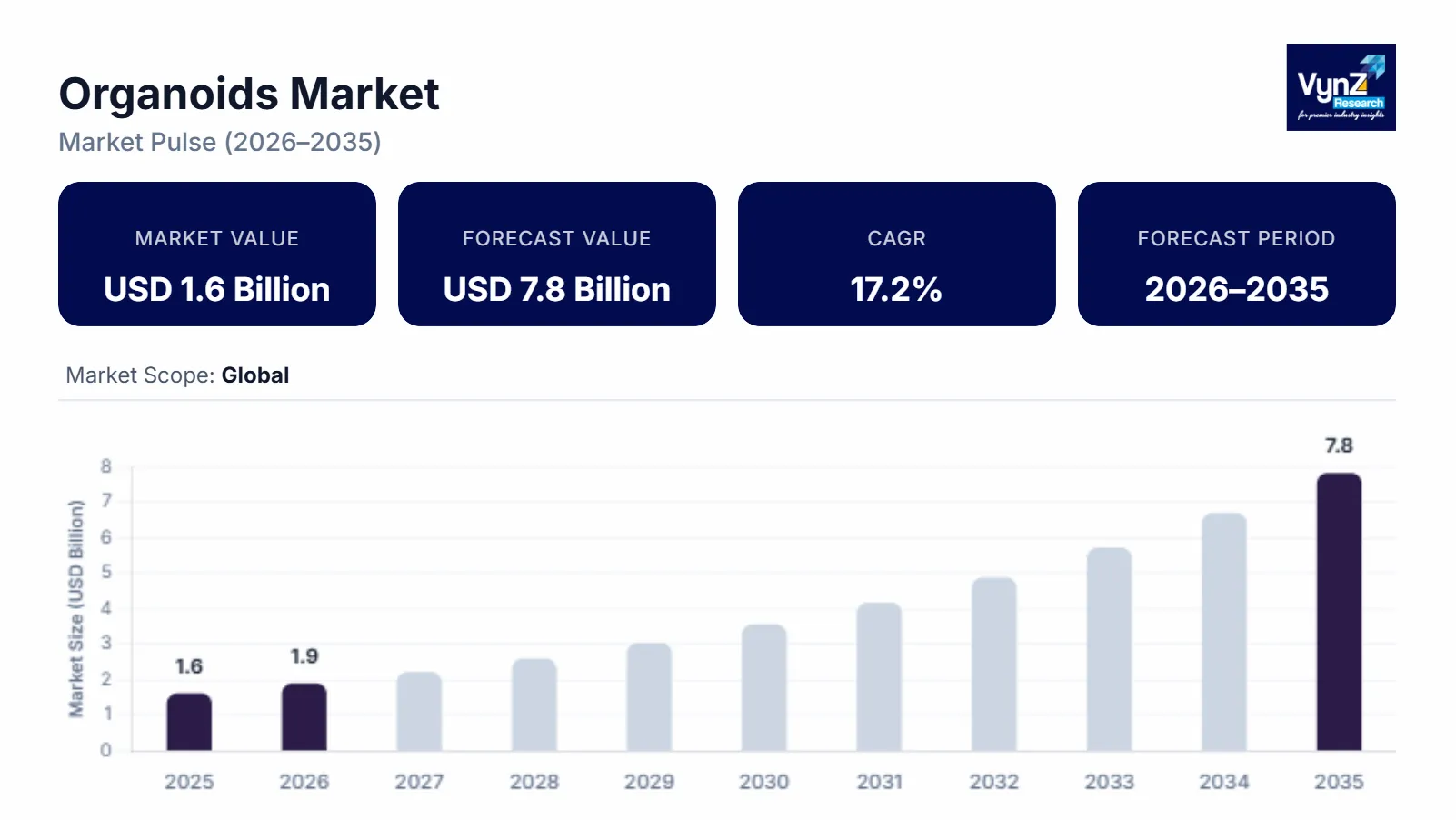
The Organoids market size was estimated at about USD 1.6 billion in 2025 and is expected to reach around USD 1.9 billion in 2026, rising up to roughly USD 7.8 billion in 2035, growing at approximately 17.2% CAGR from 2026 to 2035.
Research Highlights
- Liver organoids led 2025 with 32% share due to high adoption in drug toxicity and hepatology research models.
- Brain organoids fastest growth at 18.6% CAGR supported by neurological disease modeling and neurodegenerative research demand.
- Drug discovery segment dominated 2025 with 38% share for strong pharmaceutical R&D and preclinical testing reliance.
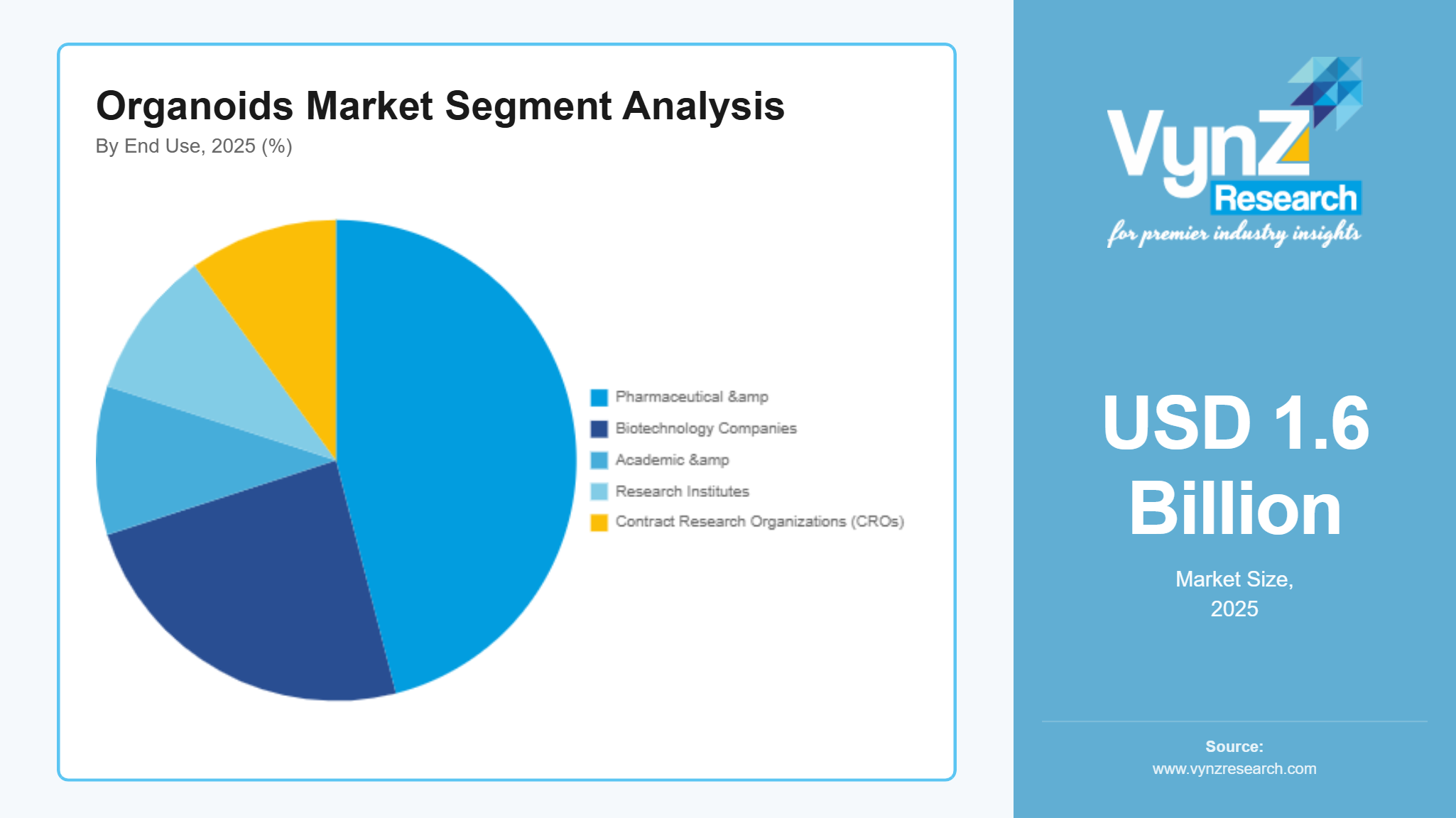
- Pharmaceutical & biotechnology companies led 2025 with 46% share due to large-scale investment in drug development pipelines.
- North America led 2025 with 41% share backed by strong NIH funding and advanced biotech infrastructure.
The market is getting bigger because more people are using them to find drugs that are just right for humans and the growing awareness of diseases and testing in a better way. Some new tools like stem cell machines and tiny organs in a lab are being used more often to test things before trying them on people. The government and other groups are putting money into medical research and trying to make medicine more precise especially in places like North America, Europe and Asia Pacific. The U.S. National Institutes of Health the European Medicines Agency and Japan’s Ministry of Health Labor and Welfare are giving money to help learn about regenerative medicine and make new discoveries. The 3D cell culture models and organoids are really important for this kind of research.
Organoids Market Dynamics
Market Trends
The industry is seeing changes in how people do research and find new medicines. One significant trend is that more people are using 3D cell culture and organ-on-chip technologies because they want to be more accurate and efficient. The U.S. National Institutes of Health says that people are using organoids more and more in their research. Another thing that is happening is that people are using artificial intelligence and automation in cell culture systems because technology is getting better and the rules for testing medicines are changing.
Growth Drivers
The market is growing because people want medicine that is tailored to them which is promoting research on cancer and genetic diseases and on how to make medicines safer. People are also investing money in biotechnology research and life sciences. The European Medicines Agency says that using biological models is helping to make medicines safer and more effective. Pharmaceutical companies are also doing research and development to ensure more efficiency and accuracy and follow the set rules.
Market Restraints / Challenges
Even though the market is growing there are some challenges that might slow it down. One of the challenges is that it is expensive to develop and use organoids and needs equipment and skilled professionals which can be hard for smaller research institutes to afford. The U.S. National Institutes of Health says that one of the challenges is making sure that organoids are consistent. Another challenge is that the rules and regulations can be complex which can make it hard for companies to operate and depending too much on supply chain can create disruptions and can be expensive causing delay in development of medicines especially when funding is uncertain.
Market Opportunities
The market has a lot of opportunities in personalized medicine and disease modeling and companies that can make high-throughput organoid platforms are in a good position to grow as pharmaceutical companies and research institutes want to use these platforms to develop medicines. Another opportunity is in medicine and cancer research and people are investing money in advanced biological modeling which is creating new opportunities for research and development. New technologies, like automation and artificial intelligence are also helping to make research more accurate and efficient helping to speed up the development of medicines.
Global Organoids Market Report Coverage
|
Report Metric |
Details |
|
Historical Period |
2020 - 2024 |
|
Base Year Considered |
2025 |
|
Forecast Period |
2026 - 2035 |
|
Market Size in 2025 |
USD 1.6 Billion |
|
Revenue Forecast in 2035 |
USD 7.8 Billion |
|
Growth Rate |
17.2% |
|
Segments Covered in the Report |
By Type, By Application, By End Use, By Technology |
|
Report Scope |
Market Trends, Drivers, and Restraints; Revenue Estimation and Forecast; Segmentation Analysis; Companies’ Strategic Developments; Market Share Analysis of Key Players; Company Profiling |
|
Regions Covered in the Report |
North America, Europe, Asia Pacific, Rest of the World, Latin America |
|
Key Companies |
3D BioMatrix Ltd., Agilent Technologies Inc., BGI Genomics Co. Ltd., Charles River Laboratories International Inc., Corning Incorporated, Crown Bioscience Inc., Danaher Corporation, Merck KGaA, Organovo Holdings Inc., Thermo Fisher Scientific Inc. |
|
Customization |
Available upon request |
Organoids Market Segmentation
By Type
Liver organoids made up about 32% of the market in 2025 because these are used a lot in testing how toxic drugs are safe for studying liver damage. The U.S. National Institutes of Health says that using liver organoids to model diseases is one of the common ways to do research before clinical trials.
Brain organoids are expected to grow the fastest at 18.6% CAGR from 2026 to 2035 due to higher usage to study brain diseases and disorders that affect the system.
By Application
Drug discovery contributed the largest market share in 2025 of about 38% due to higher investment by pharmaceutical companies in researching and developing drugs and they need good models to test them. The European Medicines Agency says that using biological models like organoids helps make sure drugs are safe and work well.
Personalized medicine will grow at about 19.2% from 2026 to 2035 because more people want treatments that are tailored to their needs and organoids can help make that happen. Combining genetics and organoid technology is becoming more popular in healthcare and biotechnology which helps the market grow.
By End Use
Pharmaceutical and biotechnology companies represented about 46% of the market due to higher investment in developing drugs and use of more advanced ways to test them. The U.S. National Institutes of Health and the European Medicines Agency support research that uses organoids to validate drugs.
Contract research organizations are likely to grow the fastest at 18.9% each year from 2026 to 2035 because pharmaceutical companies are outsourcing more of their research for cost-effectiveness and accuracy.
Regional Insights
North America
North America contributed about 41% of the market in 2025 due to a lot of biomedical research facilities and higher spending on pharmaceutical research and development especially in places like Boston, California and Texas. The U.S. National Institutes of Health is investing a lot of money in medicine and translational research and the government is also helping to create precision medicine. Private companies are investing a lot in biotechnology helping the market to grow even bigger.
Europe
The market in Europe contributed about 29% of the total revenue in 2025 due to the presence of a lot of universities and research centers. The government is also helping by making rules that support research in places like Germany, the United Kingdom, France and the Netherlands. The European Medicines Agency is using biological models to test if drugs are safe and if they work and the government is putting in effort to help medicine discovery and reduce the number of animals used in testing.
Asia Pacific
The Asia Pacific market accounted for about 23% of the market in 2025 because countries like China, Japan, India and South Korea are investing in biomedical research and are using more advanced cell culture technologies. The government in Japan is providing financial aid to medicine and clinical research to make drugs. Also, biotech companies from around the world are working with companies in Asia Pacific which is making the market in this region even stronger.
Rest of the World
The rest of the World which includes Latin America, the Middle East and Africa made up about 7% of the market in 2025 due to growing research activities by universities and research centers in these regions with the help of the World Health Organization. Governments in these regions are trying to support life sciences research by working with other countries.
Competitive Landscape / Company Insights
The market is moderately competitive with big and smaller companies from around the world working on technology to better 3D cell culture platforms and expanding to new markets. These companies are spending money on research, automation and computer tools to make themselves stronger in the market. The U.S. National Institutes of Health the European Medicines Agency and Ministry of Health Labor and Welfare in Japan are promoting new ways to test medicines before they get to humans which is making companies in the global organoid ecosystem come up with new ideas.
Mini Profiles
Agilent Technologies focuses on analytical and life sciences research solutions, including cell analysis platforms, supported by strong global distribution networks and established brand recognition in biotechnology and pharmaceutical sectors.
BGI Genomics operates in premium genomics and biomedical research segments, emphasizing high-throughput sequencing, advanced molecular analysis, and customized research solutions for precision medicine and organoid-based studies.
Corning Incorporated focuses on advanced cell culture consumables and laboratory materials, supported by strong manufacturing capabilities, material science expertise, and global supply chain strength across life sciences markets.
Danaher Corporation leverages strategic acquisitions, life sciences instrumentation, and digital research technologies to expand its presence in biomedical research tools and organoid-based experimental platforms globally.
Thermo Fisher Scientific focuses on life sciences tools, reagents, and laboratory technologies, supported by extensive global distribution, strong R&D capabilities, and a broad customer base in pharmaceutical and academic research.
Key Players
- 3D BioMatrix Ltd.
- Agilent Technologies Inc.
- BGI Genomics Co. Ltd.
- Charles River Laboratories International Inc.
- Corning Incorporated
- Crown Bioscience Inc.
- Danaher Corporation
- Merck KGaA
- Organovo Holdings Inc.
- Thermo Fisher Scientific Inc.
Recent Developments
In February 2025, Merck KGaA expanded its life sciences portfolio by enhancing advanced cell culture and organoid research reagents. The development strengthens its position in supporting drug discovery and translational biomedical research workflows.
In April 2025, Charles River Laboratories International Inc. expanded its preclinical research services with increased focus on organoid-based testing platforms. The initiative improves predictive toxicology capabilities for pharmaceutical and biotech clients.
In March 2026, Crown Bioscience Inc. upgraded its oncology-focused organoid screening models to improve drug response prediction accuracy. The company is strengthening its precision medicine research offerings for global pharmaceutical partners.
In January 2025, Organovo Holdings Inc. advanced its 3D bioprinting technologies to support more complex organoid tissue modeling. The update aims to improve disease modeling accuracy and regenerative medicine applications.
In May 2025, Agilent Technologies Inc. introduced enhancements to its cell analysis systems to better support organoid research workflows. The upgrade focuses on improving experimental efficiency and data precision in biomedical research.
Global Organoids Market Coverage
Type Insight and Forecast 2026 - 2035
- Liver Organoids
- Intestinal Organoids
- Brain Organoids
- Other Organoid Models
Application Insight and Forecast 2026 - 2035
- Drug Discovery
- Disease Modeling
- Personalized Medicine
- Toxicology Testing
End Use Insight and Forecast 2026 - 2035
- Pharmaceutical & Biotechnology Companies
- Academic & Research Institutes
- Contract Research Organizations (CROs)
Technology Insight and Forecast 2026 - 2035
- 3D Cell Culture
- Organs-on-Chip
- Bioprinting-Based Models
- Stem Cell–Derived Platforms
Global Organoids Market by Region
- North America
- By Type
- By Application
- By End Use
- By Technology
- By Country - U.S., Canada, Mexico
- Europe
- By Type
- By Application
- By End Use
- By Technology
- By Country - Germany, U.K., France, Italy, Spain, Russia, Rest of Europe
- Asia-Pacific (APAC)
- By Type
- By Application
- By End Use
- By Technology
- By Country - China, Japan, India, South Korea, Vietnam, Thailand, Malaysia, Rest of Asia-Pacific
- Rest of the World (RoW)
- By Type
- By Application
- By End Use
- By Technology
- By Country - Brazil, Saudi Arabia, South Africa, U.A.E., Other Countries
Table of Contents for Organoids Market Report
1. Research Overview
1.1. The Report Offers
1.2. Market Coverage
1.2.1. By
Type
1.2.2. By
Application
1.2.3. By
End Use
1.2.4. By
Technology
1.3. Research Phases
1.4. Limitations
1.5. Market Methodology
1.5.1. Data Sources
1.5.1.1.
Primary Research
1.5.1.2.
Secondary Research
1.5.2. Methodology
1.5.2.1.
Data Exploration
1.5.2.2.
Forecast Parameters
1.5.2.3.
Data Validation
1.5.2.4.
Assumptions
1.5.3. Study Period & Data Reporting Unit
2. Executive Summary
3. Industry Overview
3.1. Industry Dynamics
3.1.1. Market Growth Drivers
3.1.2. Market Restraints
3.1.3. Key Market Trends
3.1.4. Major Opportunities
3.2. Industry Ecosystem
3.2.1. Porter’s Five Forces Analysis
3.2.2. Recent Development Analysis
3.2.3. Value Chain Analysis
3.3. Competitive Insight
3.3.1. Competitive Position of Industry
Players
3.3.2. Market Attractive Analysis
3.3.3. Market Share Analysis
4. Global Market Estimate and Forecast
4.1. Global Market Overview
4.2. Global Market Estimate and Forecast to 2035
5. Market Segmentation Estimate and Forecast
5.1. By Type
5.1.1. Liver Organoids
5.1.1.1. Market Definition
5.1.1.2. Market Estimation and Forecast to 2035
5.1.2. Intestinal Organoids
5.1.2.1. Market Definition
5.1.2.2. Market Estimation and Forecast to 2035
5.1.3. Brain Organoids
5.1.3.1. Market Definition
5.1.3.2. Market Estimation and Forecast to 2035
5.1.4. Other Organoid Models
5.1.4.1. Market Definition
5.1.4.2. Market Estimation and Forecast to 2035
5.2. By Application
5.2.1. Drug Discovery
5.2.1.1. Market Definition
5.2.1.2. Market Estimation and Forecast to 2035
5.2.2. Disease Modeling
5.2.2.1. Market Definition
5.2.2.2. Market Estimation and Forecast to 2035
5.2.3. Personalized Medicine
5.2.3.1. Market Definition
5.2.3.2. Market Estimation and Forecast to 2035
5.2.4. Toxicology Testing
5.2.4.1. Market Definition
5.2.4.2. Market Estimation and Forecast to 2035
5.3. By End Use
5.3.1. Pharmaceutical & Biotechnology Companies
5.3.1.1. Market Definition
5.3.1.2. Market Estimation and Forecast to 2035
5.3.2. Academic & Research Institutes
5.3.2.1. Market Definition
5.3.2.2. Market Estimation and Forecast to 2035
5.3.3. Contract Research Organizations (CROs)
5.3.3.1. Market Definition
5.3.3.2. Market Estimation and Forecast to 2035
5.4. By Technology
5.4.1. 3D Cell Culture
5.4.1.1. Market Definition
5.4.1.2. Market Estimation and Forecast to 2035
5.4.2. Organs-on-Chip
5.4.2.1. Market Definition
5.4.2.2. Market Estimation and Forecast to 2035
5.4.3. Bioprinting-Based Models
5.4.3.1. Market Definition
5.4.3.2. Market Estimation and Forecast to 2035
5.4.4. Stem Cell–Derived Platforms
5.4.4.1. Market Definition
5.4.4.2. Market Estimation and Forecast to 2035
6. North America Market Estimate and Forecast
6.1. By
Type
6.2. By
Application
6.3. By
End Use
6.4. By
Technology
6.4.1.
U.S. Market Estimate and Forecast
6.4.2.
Canada Market Estimate and Forecast
6.4.3.
Mexico Market Estimate and Forecast
7. Europe Market Estimate and Forecast
7.1. By
Type
7.2. By
Application
7.3. By
End Use
7.4. By
Technology
7.4.1.
Germany Market Estimate and Forecast
7.4.2.
France Market Estimate and Forecast
7.4.3.
U.K. Market Estimate and Forecast
7.4.4.
Italy Market Estimate and Forecast
7.4.5.
Spain Market Estimate and Forecast
7.4.6.
Russia Market Estimate and Forecast
7.4.7.
Rest of Europe Market Estimate and Forecast
8. Asia-Pacific (APAC) Market Estimate and Forecast
8.1. By
Type
8.2. By
Application
8.3. By
End Use
8.4. By
Technology
8.4.1.
China Market Estimate and Forecast
8.4.2.
Japan Market Estimate and Forecast
8.4.3.
India Market Estimate and Forecast
8.4.4.
South Korea Market Estimate and Forecast
8.4.5.
Rest of Asia-Pacific Market Estimate and Forecast
9. Rest of the World (RoW) Market Estimate and Forecast
9.1. By
Type
9.2. By
Application
9.3. By
End Use
9.4. By
Technology
9.4.1.
Brazil Market Estimate and Forecast
9.4.2.
Saudi Arabia Market Estimate and Forecast
9.4.3.
South Africa Market Estimate and Forecast
9.4.4.
U.A.E. Market Estimate and Forecast
9.4.5.
Other Countries Market Estimate and Forecast
10. Company Profiles
10.1.
3D BioMatrix Ltd.
10.1.1.
Snapshot
10.1.2.
Overview
10.1.3.
Offerings
10.1.4.
Financial
Insight
10.1.5.
Recent
Developments
10.2.
Agilent Technologies Inc.
10.2.1.
Snapshot
10.2.2.
Overview
10.2.3.
Offerings
10.2.4.
Financial
Insight
10.2.5.
Recent
Developments
10.3.
BGI Genomics Co. Ltd.
10.3.1.
Snapshot
10.3.2.
Overview
10.3.3.
Offerings
10.3.4.
Financial
Insight
10.3.5.
Recent
Developments
10.4.
Charles River Laboratories International Inc.
10.4.1.
Snapshot
10.4.2.
Overview
10.4.3.
Offerings
10.4.4.
Financial
Insight
10.4.5.
Recent
Developments
10.5.
Corning Incorporated
10.5.1.
Snapshot
10.5.2.
Overview
10.5.3.
Offerings
10.5.4.
Financial
Insight
10.5.5.
Recent
Developments
10.6.
Crown Bioscience Inc.
10.6.1.
Snapshot
10.6.2.
Overview
10.6.3.
Offerings
10.6.4.
Financial
Insight
10.6.5.
Recent
Developments
10.7.
Danaher Corporation
10.7.1.
Snapshot
10.7.2.
Overview
10.7.3.
Offerings
10.7.4.
Financial
Insight
10.7.5.
Recent
Developments
10.8.
Merck KGaA
10.8.1.
Snapshot
10.8.2.
Overview
10.8.3.
Offerings
10.8.4.
Financial
Insight
10.8.5.
Recent
Developments
10.9.
Organovo Holdings Inc.
10.9.1.
Snapshot
10.9.2.
Overview
10.9.3.
Offerings
10.9.4.
Financial
Insight
10.9.5.
Recent
Developments
10.10.
Thermo Fisher Scientific Inc.
10.10.1.
Snapshot
10.10.2.
Overview
10.10.3.
Offerings
10.10.4.
Financial
Insight
10.10.5.
Recent
Developments
11. Appendix
11.1. Exchange Rates
11.2. Abbreviations
Note: Financial insight and recent developments of different companies are subject to the availability of information in the secondary domain.
Frequently Asked Questions
Purchase Options
Latest Report
Research Methodology
- Desk Research / Pilot Interviews
- Build Market Size Model
- Research and Analysis
- Final Deliverable
Connect With Our Sales Team
- Toll-Free: +1-888-253-3960
- Phone: +91 9960 288 381
- Email: enquiry@vynzresearch.com
Organoids Market