
Pharma Grade Probiotic Market Size & Share | Growth Forecast Report (2026-2035)
Industry Insight by Product (Capsules, Powders) By Distribution Channel (Physician Prescriptions,Inpatient Treatment, Clinical Supervision) By Therapeutic Application (Prevalence of Irritable Bowel Syndrome, Inflammatory Bowel Disease, Antibiotic-Associated Diarrhea and Clostridioides Difficile Infections) By End User (Hospital Admissions for Gastrointestinal Diseases, Growing Physician Recommendations and Greater Adoption of Evidence-Based Probiotic Therapies)
| Status : Published | Published On : Jul, 2026 | Report Code : VRHC1347 | Industry : Healthcare | Available Format :

|
Page : 164 |
Pharma Grade Probiotic Market Overview
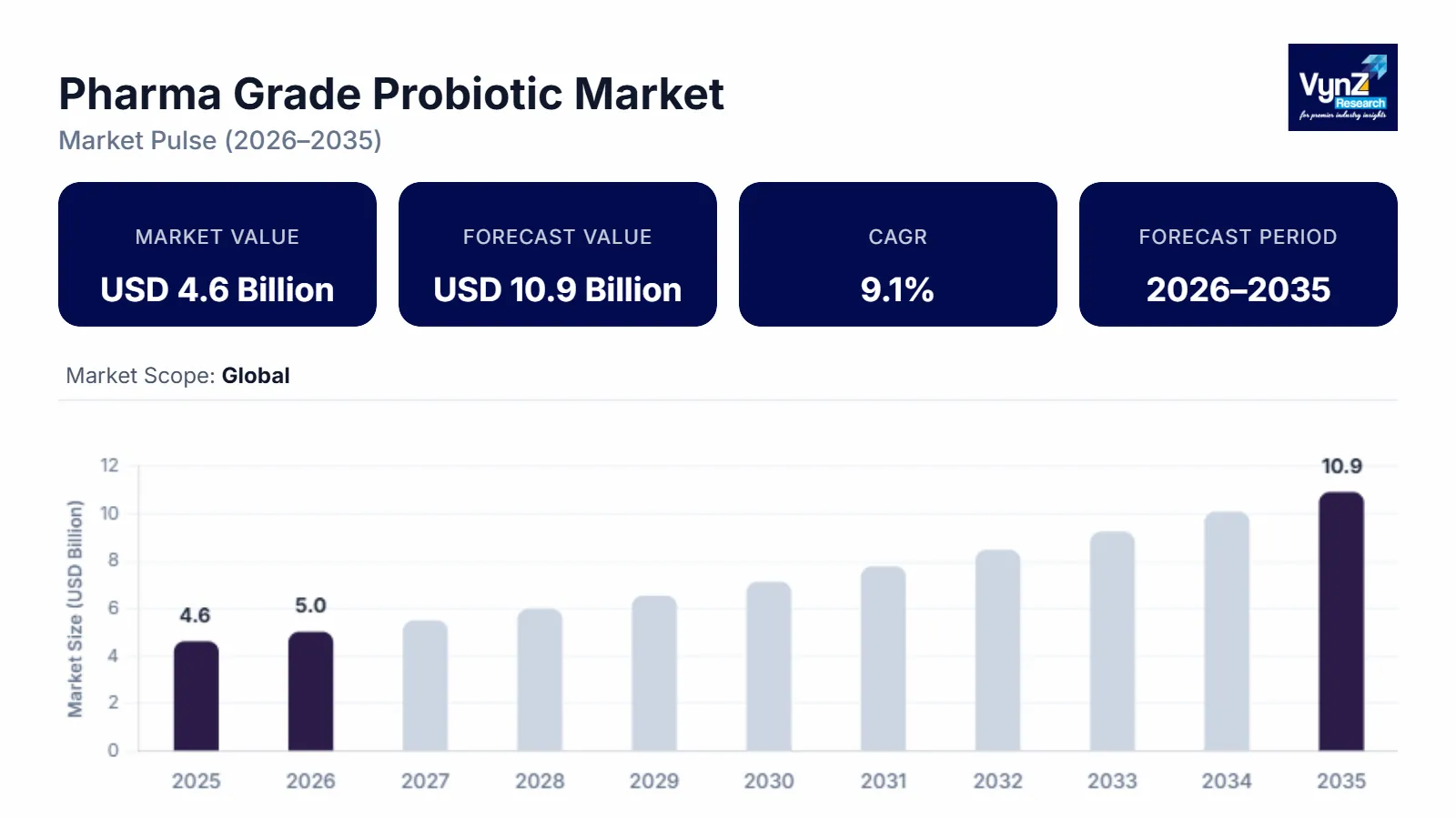
The pharma grade probiotic market size was estimated at approximately USD 4.6 billion in 2025 and is expected to reach around USD 5.0 billion in 2026, rising to roughly USD 10.9 billion by 2035, growing at approximately a 9.1% CAGR from 2026 to 2035.
Research Highlights
- Capsules accounted for approximately 42% market share in 2025 supported by superior stability and convenient pharmaceutical dosing.
- Hospital pharmacies captured about 47% market share in 2025 due to physician prescriptions and regulated therapeutic distribution.
- Gastrointestinal disorders represented nearly 51% market share in 2025 owing to increasing digestive disease prevalence and clinical validation.
- Pharmaceutical companies are projected to expand at around 10.2% CAGR supported by microbiome therapeutics and precision medicine investments.
- North America held approximately 38% market share in 2025 due to driven by advanced healthcare infrastructure and strong NIH-backed microbiome research.
Market growth is influenced by the increasing prevalence of gastrointestinal disorders, growing clinical evidence supporting probiotic therapies and increasing consumer awareness regarding preventive healthcare along with expanding adoption of strain-specific pharmaceutical probiotics. Growing demand from hospitals, specialty clinics and pharmacies coupled with investments in microbiome research and precision medicine initiatives is further supporting market expansion across North America, Europe and Asia Pacific. The World Health Organization (WHO), U.S. National Institutes of Health (NIH) and the European Medicines Agency (EMA) continue supporting microbiome research, antimicrobial stewardship and evidence-based therapeutic development that encourage pharmaceutical probiotic innovation.
Pharma Grade Probiotic Market Dynamics
Market Trends
The market is witnessing notable shifts toward clinically validated probiotic strains, microbiome-based therapeutics and precision healthcare. One of the key trends shaping the market is the growing development of pharmaceutical-grade formulations supported by randomized clinical studies reflecting increasing preference for standardized efficacy, quality assurance, and regulatory compliance. Another emerging trend is the integration of genomics, microbiome sequencing and personalized medicine into probiotic development due to advances in biotechnology and pharmaceutical research.
Growth Drivers
The growth of the market is largely supported by the increasing incidence of digestive disorders, inflammatory bowel disease, antibiotic-associated diarrhea and immune-related conditions generating sustained demand across hospitals, specialty clinics and pharmaceutical companies. Increasing investments in microbiome therapeutics, biotechnology research and clinical development are further accelerating market expansion. Additionally, increasing scientific validation of probiotic efficacy is playing a crucial role in boosting adoption.
Market Restraints / Challenges
Despite favorable growth prospects, the market faces challenges related to stringent regulatory approval processes, clinical validation requirements and strain-specific efficacy. Regulatory complexity continues affecting commercialization timelines and product approvals particularly for emerging biotechnology companies. The European Medicines Agency (EMA) and national regulatory agencies maintain rigorous standards for pharmaceutical products to ensure safety and efficacy. Furthermore, manufacturing complexity and stability requirements pose operational challenges for producers. Dependence on specialized fermentation technologies, cold-chain logistics and quality-controlled production can increase manufacturing costs and limit scalability during periods of supply chain disruption.
Market Opportunities
The market presents significant opportunities in microbiome therapeutics and personalized medicine particularly supported by increasing investments in precision healthcare and biotechnology innovation. Companies developing clinically validated, strain-specific and disease-targeted probiotic formulations are well positioned to capture incremental demand from hospitals, specialty healthcare providers and pharmaceutical manufacturers. The National Institutes of Health (NIH) continues supporting translational microbiome research through multiple funding programs. Another key opportunity lies in expanding pharmaceutical probiotics for metabolic disorders, oncology supportive care, women's health and pediatric medicine where growing investments in advanced therapeutics are creating opportunities for premium pharmaceutical products. Advancements in microbial genomics, artificial intelligence-assisted drug discovery and precision diagnostics are also expected to enhance product development and commercialization.
RD_TABLE
Pharma Grade Probiotic Market Segmentation
By Product
Capsules accounted for the principal market share of almost 42% in 2025 and are projected to grow at an estimated 8.9% CAGR through 2035 supported by superior strain stability, convenient dosage, improved shelf life and widespread prescription in gastrointestinal and immune health therapies.
Powders are expected to register the fastest growth at approximately 9.8% CAGR during the forecast period as increasing use in pediatric formulations, personalized nutrition, hospital care and sachet-based therapeutic products continues supporting segment expansion.
By Distribution Channel
Hospital pharmacies held the major market share of nearly 47% in 2025 and are projected to grow at approximately 8.8% CAGR through 2035 supported by increasing physician prescriptions, inpatient treatment, clinical supervision and the use of pharmaceutical-grade probiotics for gastrointestinal and immune-related disorders.
Online pharmacies are anticipated to witness the fastest growth at roughly 10.1% CAGR during the forecast period as digital healthcare expansion, improved patient accessibility, prescription fulfillment services and increasing adoption of e-pharmacy platforms continue supporting market growth.
By Therapeutic Application
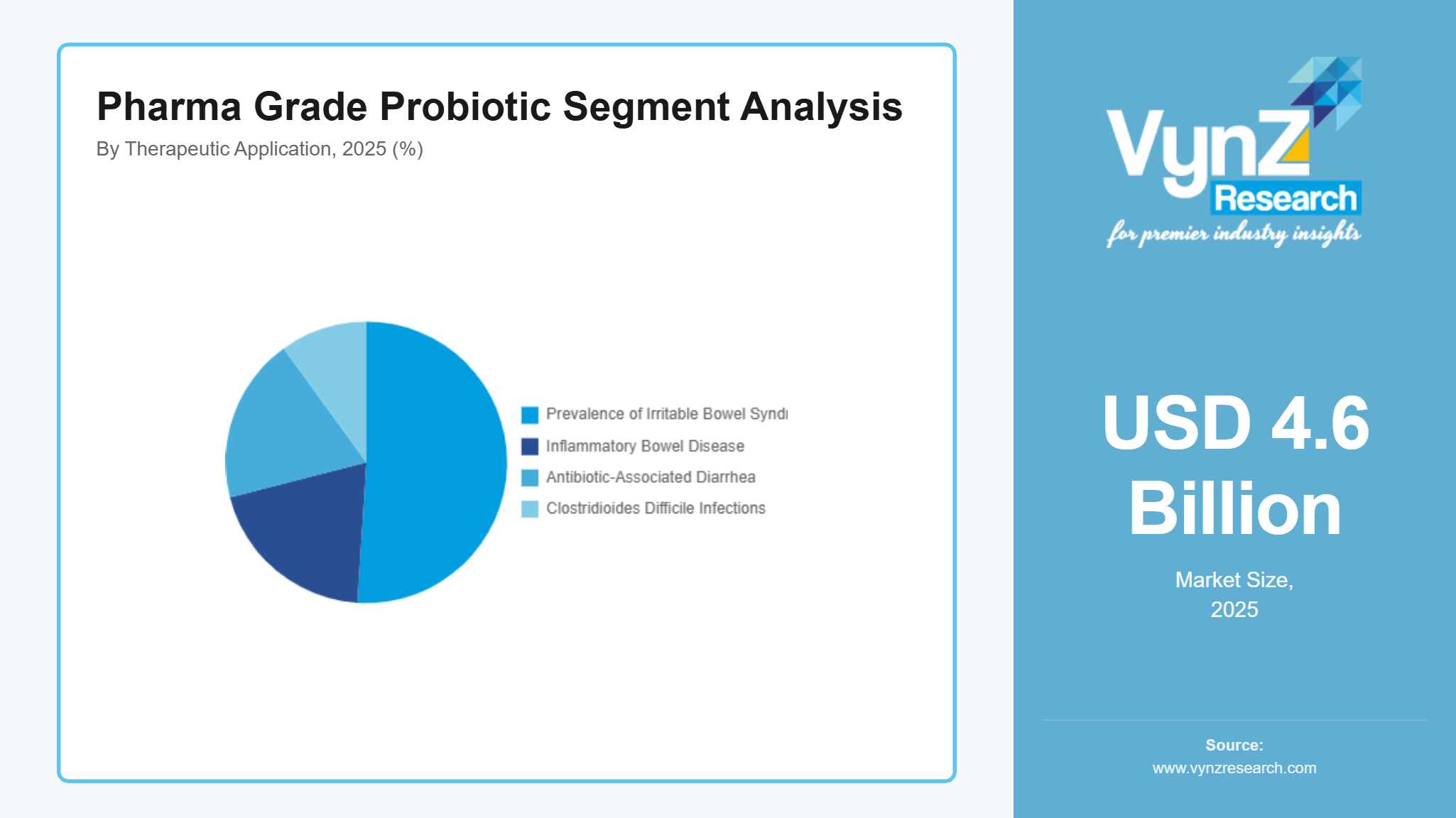
Gastrointestinal disorders represented the highest market share of almost 51% in 2025 and are projected to expand at about 9.0% CAGR throughout the forecast period due to increasing prevalence of irritable bowel syndrome, inflammatory bowel disease, antibiotic-associated diarrhea and Clostridioides difficile infections.
Women's health is expected to register the fastest growth at approximately 9.9% CAGR through 2035 as increasing awareness regarding vaginal microbiome health, pregnancy-related probiotic use and urinary tract health continues supporting demand for clinically validated probiotic formulations.
By End User
Hospitals accounted for the largest revenue share of approximately 45% in 2025 and are expected to grow at nearly 8.9% CAGR during the forecast period due to increasing hospital admissions for gastrointestinal diseases, growing physician recommendations and greater adoption of evidence-based probiotic therapies.
Pharmaceutical companies are projected to witness the fastest growth at about 10.2% CAGR through 2035 owing to increasing investments in microbiome therapeutics, precision medicine, clinical trials and next-generation live biotherapeutic products that continue expanding commercial opportunities.
Regional Insights
North America
North America accounted for approximately 38% of the market in 2025 and is projected to grow at almost 8.9% CAGR through 2035 supported by advanced healthcare infrastructure, increasing microbiome research, high prescription rates for probiotic therapeutics and significant biotechnology investments across the United States and Canada. The U.S. National Institutes of Health (NIH) continues funding microbiome research while the U.S. Food and Drug Administration (FDA) maintains quality standards for pharmaceutical manufacturing and biologic products. Government-backed research initiatives together with growing physician awareness and expanding clinical trials continue encouraging adoption of pharmaceutical-grade probiotic therapies across hospitals and specialty healthcare centers.
Europe
Europe represented about 24% of the global market in 2025 and is expected to expand at nearly 9.3% CAGR during the forecast period due to increasing investments in microbiome therapeutics, growing prevalence of gastrointestinal disorders and favorable research collaborations between pharmaceutical companies and academic institutions. The European Medicines Agency (EMA) continues providing regulatory guidance for biological medicines and advanced therapeutic products supporting innovation across the region.
Asia Pacific
Asia Pacific accounted for nearly 18% of the global market in 2025 and is projected to register approximately 9.8% CAGR through 2035 as increasing healthcare expenditure, expanding pharmaceutical manufacturing, growing digestive health awareness and improving access to prescription therapeutics continue driving regional growth. Government healthcare modernization programs and biotechnology investments further strengthen market opportunities. The World Health Organization (WHO) supports initiatives promoting preventive healthcare and antimicrobial stewardship across the region.
Rest of the World
The Rest of the World, including Latin America, the Middle East, and Africa, accounted for about 17% of the global market in 2025 and is expected to grow steadily during the forecast period because improving healthcare infrastructure, expanding pharmaceutical distribution and growing awareness of microbiome-based therapies continue supporting market development. The remaining market is distributed across smaller economies not analyzed separately. The World Health Organization (WHO) continues supporting healthcare capacity building and access to quality medicines in emerging economies.
Competitive Landscape / Company Insights
The pharma grade probiotic market is moderately competitive with global pharmaceutical, biotechnology and probiotic manufacturers emphasizing clinical research, strain-specific product development, regulatory compliance and strategic collaborations. Companies continue investing in microbiome research, advanced manufacturing technologies and geographic expansion to strengthen market position. The U.S. National Institutes of Health (NIH), European Medicines Agency (EMA), U.S. Food and Drug Administration (FDA) and the World Health Organization (WHO) continue supporting evidence-based therapeutic innovation and high pharmaceutical quality standards.
Mini Profiles
ADM (Archer Daniels Midland Company) focuses on pharmaceutical-grade probiotic ingredients and specialty nutrition solutions, supported by extensive global manufacturing capabilities, integrated supply chains, and strong research expertise.
BioGaia AB operates in premium probiotic healthcare segments, emphasizing clinically documented probiotic strains, scientific validation, and evidence-based formulations for gastrointestinal and immune health applications.
Danone S.A. leverages extensive microbiome research, global distribution networks, and strategic healthcare partnerships to expand pharmaceutical and clinically supported probiotic product offerings worldwide.
Kerry Group plc focuses on advanced probiotic formulation technologies, supported by robust innovation capabilities, global production facilities, and customized solutions for pharmaceutical and nutraceutical manufacturers.
Yakult Honsha Co., Ltd. specializes in scientifically validated probiotic products, supported by decades of microbiology research, strong brand recognition, and an extensive international distribution network.
Key Players
- ADM (Archer Daniels Midland Company)
- BioGaia
- AB Chr. Hansen Holding A/S
- Danone S.A.
- DuPont de Nemours, Inc.
- Kerry Group plc
- Lallemand Inc.
- Probi AB
- Probiotical S.p.A.
- Yakult Honsha Co., Ltd.
Recent Developments
In April 2026, Chr. Hansen Holding A/S expanded its clinically documented probiotic portfolio following continued integration with Novonesis, strengthening microbiome innovation for pharmaceutical and healthcare applications. The company also increased investment in next-generation strain discovery and precision fermentation technologies.
In February 2026, DuPont de Nemours, Inc. announced further investments in microbiome research collaborations to accelerate development of clinically validated health solutions. The initiative supports advanced probiotic ingredients for pharmaceutical and medical nutrition applications.
In March 2026, Lallemand Inc. introduced new pharmaceutical-grade probiotic formulations targeting gastrointestinal and immune health applications. The launch expanded its portfolio of clinically supported microbial solutions for healthcare providers.
In January 2026, Probi AB announced positive clinical findings for its proprietary probiotic strains supporting metabolic and digestive health. The results strengthened the company's scientific portfolio and expanded commercialization opportunities in pharmaceutical markets.
In May 2025, Probiotical S.p.A. expanded its manufacturing capabilities in Italy to meet increasing global demand for pharmaceutical-grade probiotic formulations. The investment enhanced production capacity while supporting high-quality, clinically validated probiotic products.
Global Pharma Grade Probiotic Market Coverage
Product Insight and Forecast 2026 - 2035
- Capsules
- Powders
Global Pharma Grade Probiotic Market by Region
- North America
- By Product
- By Country - U.S., Canada, Mexico
- Europe
- By Product
- By Country - Germany, U.K., France, Italy, Spain, Russia, Rest of Europe
- Asia-Pacific (APAC)
- By Product
- By Country - China, Japan, India, South Korea, Vietnam, Thailand, Malaysia, Rest of Asia-Pacific
- Rest of the World (RoW)
- By Product
- By Country - Brazil, Saudi Arabia, South Africa, U.A.E., Other Countries
Table of Contents for Pharma Grade Probiotic Market Report
1. Research Overview
1.1. The Report Offers
1.2. Market Coverage
1.2.1. By
Product
1.3. Research Phases
1.4. Limitations
1.5. Market Methodology
1.5.1. Data Sources
1.5.1.1.
Primary Research
1.5.1.2.
Secondary Research
1.5.2. Methodology
1.5.2.1.
Data Exploration
1.5.2.2.
Forecast Parameters
1.5.2.3.
Data Validation
1.5.2.4.
Assumptions
1.5.3. Study Period & Data Reporting Unit
2. Executive Summary
3. Industry Overview
3.1. Industry Dynamics
3.1.1. Market Growth Drivers
3.1.2. Market Restraints
3.1.3. Key Market Trends
3.1.4. Major Opportunities
3.2. Industry Ecosystem
3.2.1. Porter’s Five Forces Analysis
3.2.2. Recent Development Analysis
3.2.3. Value Chain Analysis
3.3. Competitive Insight
3.3.1. Competitive Position of Industry
Players
3.3.2. Market Attractive Analysis
3.3.3. Market Share Analysis
4. Global Market Estimate and Forecast
4.1. Global Market Overview
4.2. Global Market Estimate and Forecast to 2035
5. Market Segmentation Estimate and Forecast
5.1. By Product
5.1.1. Capsules
5.1.1.1. Market Definition
5.1.1.2. Market Estimation and Forecast to 2035
5.1.2. Powders
5.1.2.1. Market Definition
5.1.2.2. Market Estimation and Forecast to 2035
6. North America Market Estimate and Forecast
6.1. By
Product
6.1.1.
U.S. Market Estimate and Forecast
6.1.2.
Canada Market Estimate and Forecast
6.1.3.
Mexico Market Estimate and Forecast
7. Europe Market Estimate and Forecast
7.1. By
Product
7.1.1.
Germany Market Estimate and Forecast
7.1.2.
France Market Estimate and Forecast
7.1.3.
U.K. Market Estimate and Forecast
7.1.4.
Italy Market Estimate and Forecast
7.1.5.
Spain Market Estimate and Forecast
7.1.6.
Russia Market Estimate and Forecast
7.1.7.
Rest of Europe Market Estimate and Forecast
8. Asia-Pacific (APAC) Market Estimate and Forecast
8.1. By
Product
8.1.1.
China Market Estimate and Forecast
8.1.2.
Japan Market Estimate and Forecast
8.1.3.
India Market Estimate and Forecast
8.1.4.
South Korea Market Estimate and Forecast
8.1.5.
Rest of Asia-Pacific Market Estimate and Forecast
9. Rest of the World (RoW) Market Estimate and Forecast
9.1. By
Product
9.1.1.
Brazil Market Estimate and Forecast
9.1.2.
Saudi Arabia Market Estimate and Forecast
9.1.3.
South Africa Market Estimate and Forecast
9.1.4.
U.A.E. Market Estimate and Forecast
9.1.5.
Other Countries Market Estimate and Forecast
10. Company Profiles
10.1.
ADM (Archer Daniels Midland Company)
10.1.1.
Snapshot
10.1.2.
Overview
10.1.3.
Offerings
10.1.4.
Financial
Insight
10.1.5.
Recent
Developments
10.2.
BioGaia AB
10.2.1.
Snapshot
10.2.2.
Overview
10.2.3.
Offerings
10.2.4.
Financial
Insight
10.2.5.
Recent
Developments
10.3.
Chr. Hansen Holding A/S
10.3.1.
Snapshot
10.3.2.
Overview
10.3.3.
Offerings
10.3.4.
Financial
Insight
10.3.5.
Recent
Developments
10.4.
Danone S.A.
10.4.1.
Snapshot
10.4.2.
Overview
10.4.3.
Offerings
10.4.4.
Financial
Insight
10.4.5.
Recent
Developments
10.5.
DuPont de Nemours, Inc.
10.5.1.
Snapshot
10.5.2.
Overview
10.5.3.
Offerings
10.5.4.
Financial
Insight
10.5.5.
Recent
Developments
10.6.
Kerry Group plc
10.6.1.
Snapshot
10.6.2.
Overview
10.6.3.
Offerings
10.6.4.
Financial
Insight
10.6.5.
Recent
Developments
10.7.
Lallemand Inc.
10.7.1.
Snapshot
10.7.2.
Overview
10.7.3.
Offerings
10.7.4.
Financial
Insight
10.7.5.
Recent
Developments
10.8.
Probi AB
10.8.1.
Snapshot
10.8.2.
Overview
10.8.3.
Offerings
10.8.4.
Financial
Insight
10.8.5.
Recent
Developments
10.9.
Probiotical S.p.A.
10.9.1.
Snapshot
10.9.2.
Overview
10.9.3.
Offerings
10.9.4.
Financial
Insight
10.9.5.
Recent
Developments
10.10.
Yakult Honsha Co., Ltd.
10.10.1.
Snapshot
10.10.2.
Overview
10.10.3.
Offerings
10.10.4.
Financial
Insight
10.10.5.
Recent
Developments
11. Appendix
11.1. Exchange Rates
11.2. Abbreviations
Note: Financial insight and recent developments of different companies are subject to the availability of information in the secondary domain.
Frequently Asked Questions
Purchase Options
Latest Report
Research Methodology
- Desk Research / Pilot Interviews
- Build Market Size Model
- Research and Analysis
- Final Deliverable
Connect With Our Sales Team
- Toll-Free: +1-888-253-3960
- Phone: +91 9960 288 381
- Email: enquiry@vynzresearch.com
Pharma Grade Probiotic Market