
U.S. Hand Sanitizer Market Size & Share - Growth Forecast Report (2026-2035)
Industry Insight by Product Type (Gel, Liquid, Foam, Spray), by Distribution Channel (Supermarkets and Hypermarkets, Pharmacies, Online Retail, Convenience Stores), by Packaging Type (Bottles, Pump Dispensers, Sachets, Refill Packs), by End Use (Healthcare Facilities, Households, Commercial Establishments, Educational Institutions, Industrial Facilities)
| Status : Published | Published On : Aug, 2026 | Report Code : VRHC1347 | Industry : Healthcare | Available Format :

|
Page : 135 |
U.S. Hand Sanitizer Market Overview
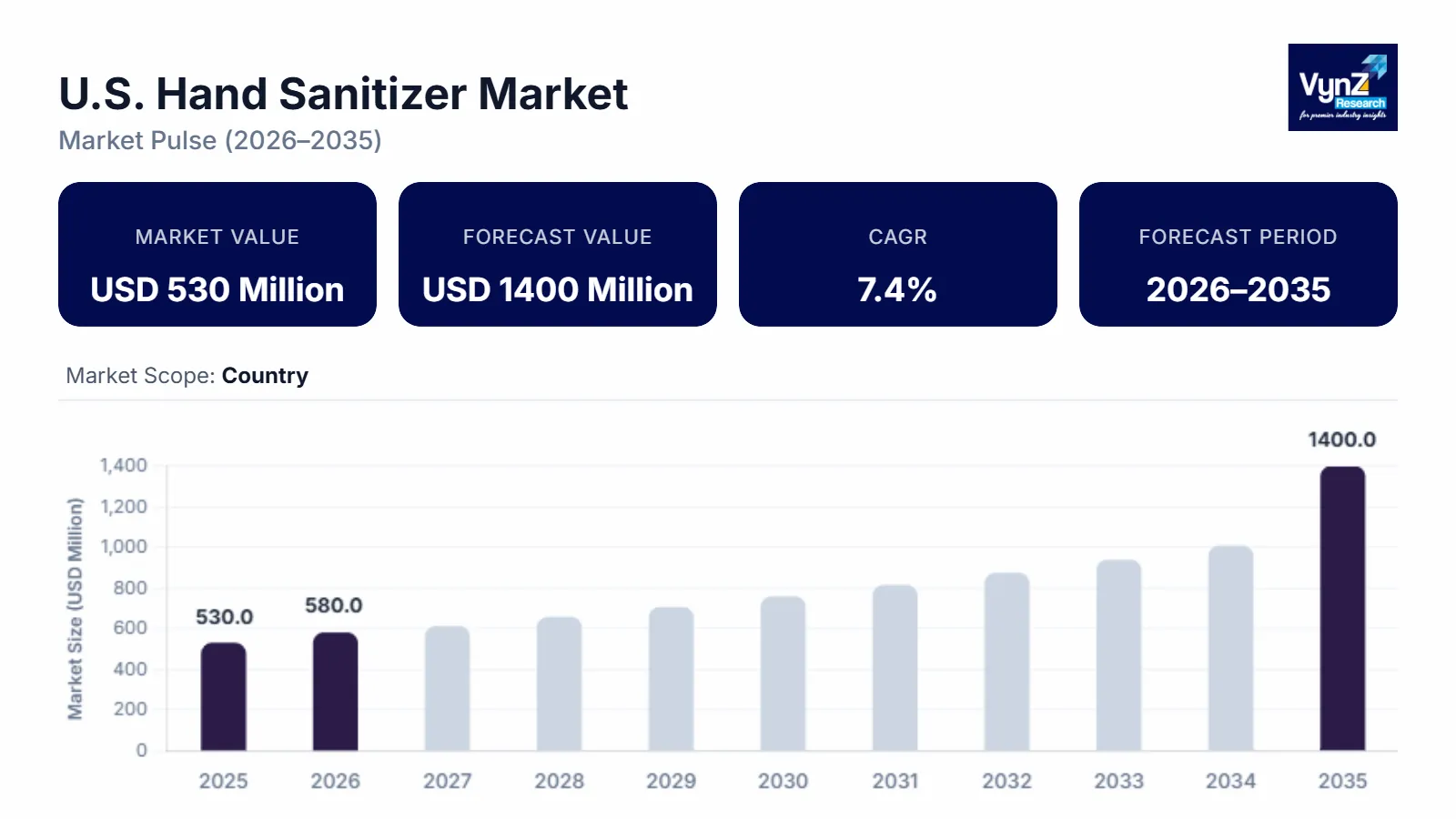
The U.S. hand sanitizer market size was estimated at approximately USD 530 million in 2025 and is expected to reach around USD 580 million in 2026, rising to nearly USD 1400 million by 2035, growing at an estimated 7.4% CAGR from 2026 to 2035.
Research Highlights
Gel sanitizers held 48.2% share in 2025, driven by widespread consumer preference.
Supermarkets captured 36.9% share in 2025, supported by extensive retail availability.
Healthcare facilities generated 38.6% revenue in 2025, owing to infection control.
Online retail is projected at 9.2% CAGR during 2026–2035, driven by e-commerce.
Southern U.S. represented 30.4% market share in 2025, supported by healthcare demand.
Market growth is promoted by heightened awareness about infection prevention. This is also complemented by the growing need for healthcare and commercial hygiene, as well as increased utilization of premium moisturizing. Moreover, the demand for alcohol based and skin friendly sanitizers is also rising. With the rising purchases in hospitals, educational institutes, workplaces and food processing units and the hand-washing guidelines by the Center of Disease Control and Prevention (CDC), Food and Drug Administration (FDA) and infection control initiatives by the U.S Department of Health and Social Services, the market is set to witness growth in the regions including California, Texas, Florida, and New York among others. The CDC recommends use of alcohol-based hand sanitizers with at least 60% alcohol content where washing with soap and water is not feasible.
U.S. Hand Sanitizer Market Dynamics
Market Trends
The U.S. hand sanitizer market is witnessing growth in the variety of products, including variations in packaging, as well as changes in purchase behavior. One of the emerging trends is the growing demand for skin-friendly variants of alcohol-based sanitizers with moisturizing additives such as aloe vera, glycerin, and vitamin E. Producers are responding to the need for fragrance-free, dermatologist-approved, and rapidly drying formulas, which appeal to a broad range of consumers. The increasing popularity of touchless dispensers, refillable packaging, and sustainable formulas makes the market a dynamic one.
Growth Drivers
Hand sanitizer trends and usage are driven by a growing emphasis on infection control and hand hygiene. Consumer awareness of health issues and infection transmission routes contributes to market growth. Hand sanitizers are used in various settings, including healthcare facilities, educational institutions, worksites, and homes. Furthermore, market growth is driven by an increase in the number of healthcare facilities and related purchases, as well as an improvement in institutional sanitation and infection control measures. Hand sanitizers are in demand due to the increased emphasis on cleanliness in healthcare, food processing, retail, and transportation facilities. Moreover, recommendations from the FDA and initiatives undertaken by the U.S. Department of Health and Social Services (HSS) promote and standardize hand hygiene practices across a range of industries.
Market Restraints / Challenges
The market growth is hindered by fluctuations in the prices of raw materials and the rising competition from private-label manufacturers. Moreover, the impact of pandemic on the global supply chains affects the supply of alcohol and other components necessary for hand sanitizer production. Another challenge is changing consumer preferences and their purchasing patterns. The hand sanitizer market was severely affected by the pandemic as demand soared to unprecedented levels. Thus, returning to the previous level of supply-demand relations is a challenge to the market growth.
Market Opportunities
The market offers opportunities with products with innovative, biodegradable, and economical packaging meet the growing consumer demand for sustainability. Producers of hand sanitizers respond to the need for alcohol-based sanitizing products with rapidly drying formulas using eco-friendly packaging. As a result, there is a growing demand for the mentioned products in healthcare, education, commercial, and residential settings. Another opportunity is represented by automated dispensing systems, refillable hygiene products, and institutional programs. The development of advanced technologies and the use of sustainable materials in the production of dispensers and other related equipment contribute to market growth.
U.S. Hand Sanitizer Market Report Coverage
|
Report Metric |
Details |
|
Historical Period |
2020 - 2024 |
|
Base Year Considered |
2025 |
|
Forecast Period |
2026 - 2035 |
|
Market Size in 2025 |
USD 530 Million |
|
Revenue Forecast in 2035 |
USD 1400 Million |
|
Growth Rate |
740% |
|
Segments Covered in the Report |
Product Type, Distribution Channel, Packaging Type, End Use |
|
Report Scope |
Market Trends, Drivers, and Restraints; Revenue Estimation and Forecast; Segmentation Analysis; Companies’ Strategic Developments; Market Share Analysis of Key Players; Company Profiling |
|
Regions Covered in the Report |
Southern U.S., Western U.S., Northeastern U.S., Other U.S. Regions |
|
Key Companies |
3M Company, GOJO Industries, Inc., Henkel AG & Co. KGaA, Johnson & Johnson, Kimberly-Clark Corporation, Procter & Gamble Company, Reckitt Benckiser Group plc, SC Johnson & Son, Inc., The Clorox Company, Unilever PLC |
|
Customization |
Available upon request |
U.S. Hand Sanitizer Market Segmentation
By Product Type
The gel sanitizers dominated the market with a volume share of around 48.2% in 2025. This is mainly because of the high consumer preference, convenient dispensing, and availability in the market. The product’s portability and applicability with alcohol-based sanitizers have increased its demand in residential, healthcare, commercial, and other institutional settings.
Foam sanitizers have emerged as the most growing segment, projected to register a CAGR of 8.6% during the forecast period. These sanitizers have gained popularity due to the comfort offered, proper coverage, and reduced wastage. They are majorly adopted in hospitals, educational institutes, and corporate sectors.
By Distribution Channel
Supermarkets and hypermarkets dominated the market with around 36.9% share in 2025. This segment offers a wide range of sanitizers with competitive pricing and immense accessibility, which has increased their demand among consumers.
Online retails are projected to grow at a healthy rate over the forecast period. This segment is estimated to register a CAGR of 9.2% during 2026 to 2035. The increasing subscription culture and availability of premium hygiene products through e-commerce platforms have propelled the segment’s growth.
By Packaging Type
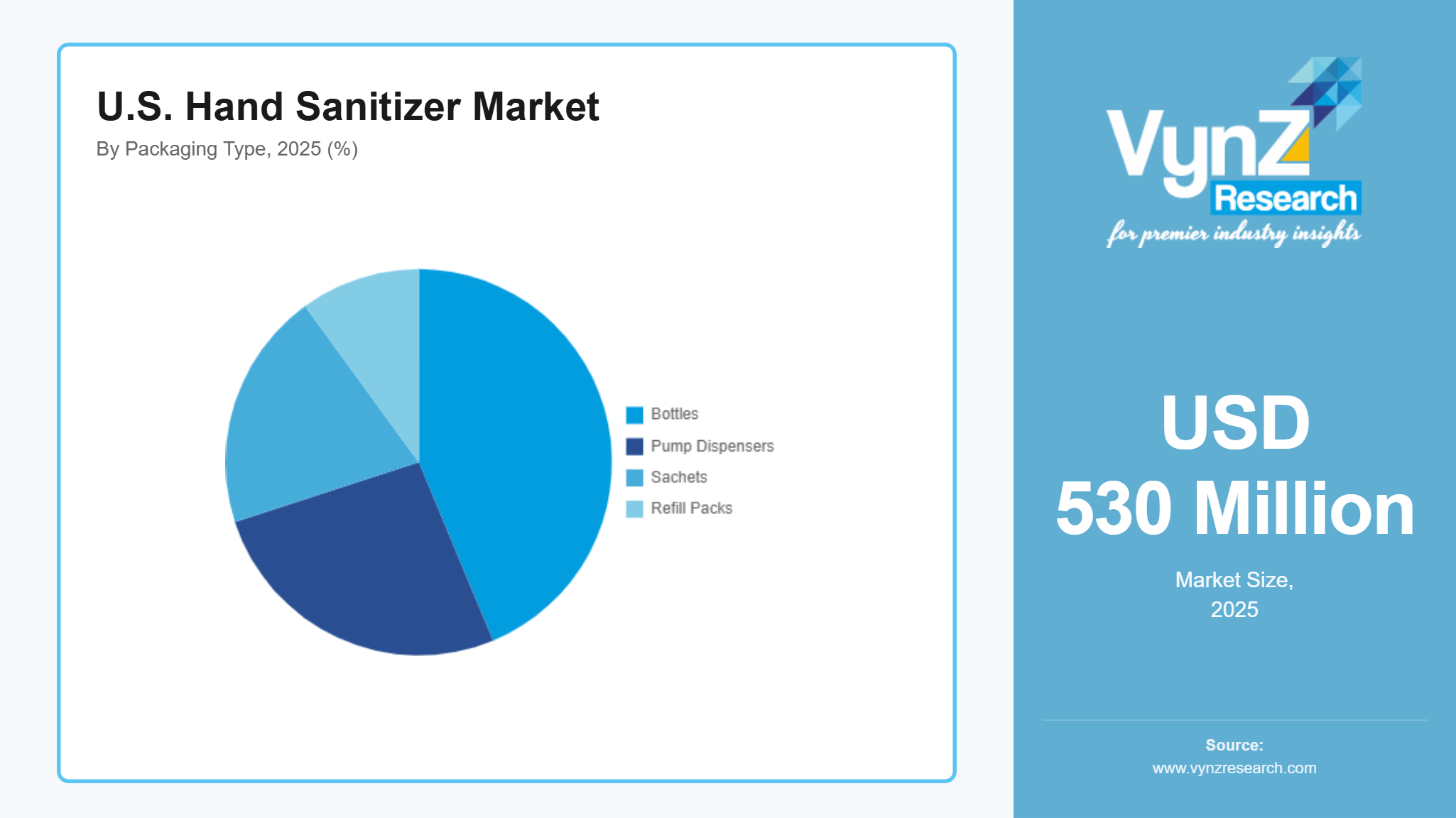
The largest revenue contribution from this segment came from the bottles with around 43.7% share in 2025. These are preferred due to their high convenience, applicability in different settings, and availability in various sizes.
Refill packing is the most growing segment, projected to grow at 8.1%CAGR during the forecast period. This segment provides convenience to users while minimizing waste, thus supporting the need for sustainable development. Refill packs are widely used in offices, hospitals, and other institutional setups while reducing costs.
By End Use
Healthcare facilities account for the largest revenue share of around 38.6% in 2025. This is because of the consistent need for sanitizers in hospitals, nursing homes, clinics, and other healthcare settings. The authorities mandate the usage of sanitizers which has further augmented the demand for these products in these settings.
Commercial establishments are projected to grow at 7.4% during the forecast period. These include offices, restaurants, banks, airports, and other places. These facilities register an immense footfall of customers and visitors thus requiring sanitizers for the wellbeing of everyone.
Regional Insights
Southern U.S.
The Southern U.S. emerged as the most profitable region for the U.S. Hand Sanitizer Market, holding 30.4% of the share in 2025. This can be attributed to the large population base, growing healthcare infrastructure, and increasing institutional demand in the states such as Texas, Florida, Georgia, and North Carolina. The hand sanitizer market in the region is driven by the growing adoption of infection control measures in hospitals, educational institutions, workplaces, and food service organizations. Moreover, government regulations are projected to drive the regional market growth, as several commercial and government organizations are focusing on buying premium sanitizing products, touch free dispensers, and other related products.
Western U.S.
The Western U.S. holds the second position in the market with a share of 24.8% in 2025. The region exhibits high healthcare penetration and has seen an increase in consumer preference for premium hand hygiene products and sustainable packaging. In addition, states such as California, Washington, Oregon, and Arizona have witnessed a surge in demand for touch free dispensers, eco-friendly packaging, and skin-friendly formulas. The U.S. Food and Drug Administration (FDA) has been regulating the approval of over-the-counter anti-septic in the region, which has led to a rise in sales of standardized hand sanitizer products in the U.S. Healthcare infrastructure development and growing commercialization across the states are also anticipated to augment the demand for alcohol-based hand sanitizers in the region. In addition, the adoption of refillable dispensing products is expected to drive the market growth in the region.
Northeastern U.S.
The Northeastern U.S. had the third-largest share, accounting for 20.6% of the market in 2025. The region has been witnessing a growing adoption of infection control measures in hospitals and healthcare facilities. Increasing healthcare expenditures along with rising emphasis on public hygiene has bolstered the demand for hand sanitizers in the past few years. Moreover, regulatory bodies such as the CDC and FDA have been emphasizing proper infection control procedures. As a result, the adoption of alcohol-based hand sanitizers has increased in the region.
The remaining 24.2% is distributed among the Midwestern U.S., Mountain States, and others. Hand sanitizer market growth in the remaining regions is primarily driven by improving healthcare infrastructure, rising commercialization, and increasing institutional purchasing across the states.
Competitive Landscape / Company Insights
The market is moderately competitive with multinational and domestic companies focusing on product development, skin friendliness, sustainable packaging, and market expansion. Manufacturers are developing alcohol-based sanitizers, touchless dispensers, refill systems, and dermatologist-tested options to differentiate themselves. Market growth is driven by hand washing campaigns, CDC recommendations, FDA regulations, and HHS initiatives.
Mini Profiles
3M Company focuses on infection prevention products, healthcare solutions, and hygiene technologies, supported by strong research capabilities and an extensive commercial distribution network.
GOJO Industries, Inc. specializes in hand hygiene products, professional sanitization solutions, and healthcare infection prevention, supported by its well-established PURELL brand.
Henkel AG & Co. KGaA develops consumer and professional hygiene products, emphasizing product innovation, sustainable formulations, and global manufacturing capabilities.
Johnson & Johnson operates across healthcare and consumer wellness segments, supported by strong brand recognition, research expertise, and diversified healthcare solutions.
Kimberly-Clark Corporation focuses on professional hygiene and infection prevention products, supported by institutional distribution channels and long-standing healthcare partnerships.
Key Players
- 3M Company
- GOJO Industries, Inc.
- Henkel AG & Co. KGaA
- Johnson & Johnson
- Kimberly-Clark Corporation
- Procter & Gamble Company
- Reckitt Benckiser Group plc
- SC Johnson & Son, Inc.
- The Clorox Company
- Unilever PLC
Recent Developments
In January 2026, Procter & Gamble Company expanded its hygiene product portfolio through improved skin care formulations and sustainable packaging initiatives. The development strengthened its personal care offerings across retail channels.
In March 2026, Reckitt Benckiser Group plc introduced additional hygiene solutions designed to improve consumer safety and product sustainability. The initiative supported growing demand for premium hand hygiene products.
In February 2025, SC Johnson & Son, Inc. expanded investments in sustainable packaging technologies for its consumer hygiene portfolio. The development aligned with the company's long term environmental commitments.
In April 2025, The Clorox Company strengthened its cleaning and hygiene product portfolio through continued innovation in infection prevention solutions. The initiative supported growing institutional and household demand.
In May 2025, Unilever PLC expanded production of personal hygiene products while increasing investment in environmentally responsible packaging solutions. The development supported rising consumer preference for sustainable hygiene products.
U.S. Hand Sanitizer Market Coverage
Product Type Insight and Forecast 2026 - 2035
- Gel
- Liquid
- Foam
- Spray
Distribution Channel Insight and Forecast 2026 - 2035
- Supermarkets and Hypermarkets
- Pharmacies
- Online Retail
- Convenience Stores
Packaging Type Insight and Forecast 2026 - 2035
- Bottles
- Pump Dispensers
- Sachets
- Refill Packs
End Use Insight and Forecast 2026 - 2035
- Healthcare Facilities
- Households
- Commercial Establishments
- Educational Institutions
- Industrial Facilities
U.S. Hand Sanitizer Market by Region
- Southern U.S.
- By Product Type
- By Distribution Channel
- By Packaging Type
- By End Use
- Western U.S.
- By Product Type
- By Distribution Channel
- By Packaging Type
- By End Use
- Northeastern U.S.
- By Product Type
- By Distribution Channel
- By Packaging Type
- By End Use
- Other U.S. Regions
- By Product Type
- By Distribution Channel
- By Packaging Type
- By End Use
Table of Contents for U.S. Hand Sanitizer Market Report
1. Research Overview
1.1. The Report Offers
1.2. Market Coverage
1.2.1. By
Product Type
1.2.2. By
Distribution Channel
1.2.3. By
Packaging Type
1.2.4. By
End Use
1.3. Research Phases
1.4. Limitations
1.5. Market Methodology
1.5.1. Data Sources
1.5.1.1.
Primary Research
1.5.1.2.
Secondary Research
1.5.2. Methodology
1.5.2.1.
Data Exploration
1.5.2.2.
Forecast Parameters
1.5.2.3.
Data Validation
1.5.2.4.
Assumptions
1.5.3. Study Period & Data Reporting Unit
2. Executive Summary
3. Industry Overview
3.1. Industry Dynamics
3.1.1. Market Growth Drivers
3.1.2. Market Restraints
3.1.3. Key Market Trends
3.1.4. Major Opportunities
3.2. Industry Ecosystem
3.2.1. Porter’s Five Forces Analysis
3.2.2. Recent Development Analysis
3.2.3. Value Chain Analysis
3.3. Competitive Insight
3.3.1. Competitive Position of Industry
Players
3.3.2. Market Attractive Analysis
3.3.3. Market Share Analysis
4. U.S. Market Estimate and Forecast
4.1. U.S. Market Overview
4.2. U.S. Market Estimate and Forecast to 2035
5. Market Segmentation Estimate and Forecast
5.1. By Product Type
5.1.1. Gel
5.1.1.1. Market Definition
5.1.1.2. Market Estimation and Forecast to 2035
5.1.2. Liquid
5.1.2.1. Market Definition
5.1.2.2. Market Estimation and Forecast to 2035
5.1.3. Foam
5.1.3.1. Market Definition
5.1.3.2. Market Estimation and Forecast to 2035
5.1.4. Spray
5.1.4.1. Market Definition
5.1.4.2. Market Estimation and Forecast to 2035
5.2. By Distribution Channel
5.2.1. Supermarkets and Hypermarkets
5.2.1.1. Market Definition
5.2.1.2. Market Estimation and Forecast to 2035
5.2.2. Pharmacies
5.2.2.1. Market Definition
5.2.2.2. Market Estimation and Forecast to 2035
5.2.3. Online Retail
5.2.3.1. Market Definition
5.2.3.2. Market Estimation and Forecast to 2035
5.2.4. Convenience Stores
5.2.4.1. Market Definition
5.2.4.2. Market Estimation and Forecast to 2035
5.3. By Packaging Type
5.3.1. Bottles
5.3.1.1. Market Definition
5.3.1.2. Market Estimation and Forecast to 2035
5.3.2. Pump Dispensers
5.3.2.1. Market Definition
5.3.2.2. Market Estimation and Forecast to 2035
5.3.3. Sachets
5.3.3.1. Market Definition
5.3.3.2. Market Estimation and Forecast to 2035
5.3.4. Refill Packs
5.3.4.1. Market Definition
5.3.4.2. Market Estimation and Forecast to 2035
5.4. By End Use
5.4.1. Healthcare Facilities
5.4.1.1. Market Definition
5.4.1.2. Market Estimation and Forecast to 2035
5.4.2. Households
5.4.2.1. Market Definition
5.4.2.2. Market Estimation and Forecast to 2035
5.4.3. Commercial Establishments
5.4.3.1. Market Definition
5.4.3.2. Market Estimation and Forecast to 2035
5.4.4. Educational Institutions
5.4.4.1. Market Definition
5.4.4.2. Market Estimation and Forecast to 2035
5.4.5. Industrial Facilities
5.4.5.1. Market Definition
5.4.5.2. Market Estimation and Forecast to 2035
6. Southern U.S. Market Estimate and Forecast
6.1. By
Product Type
6.2. By
Distribution Channel
6.3. By
Packaging Type
6.4. By
End Use
7. Western U.S. Market Estimate and Forecast
7.1. By
Product Type
7.2. By
Distribution Channel
7.3. By
Packaging Type
7.4. By
End Use
8. Northeastern U.S. Market Estimate and Forecast
8.1. By
Product Type
8.2. By
Distribution Channel
8.3. By
Packaging Type
8.4. By
End Use
9. Other U.S. Regions Market Estimate and Forecast
9.1. By
Product Type
9.2. By
Distribution Channel
9.3. By
Packaging Type
9.4. By
End Use
10. Company Profiles
10.1.
3M Company
10.1.1.
Snapshot
10.1.2.
Overview
10.1.3.
Offerings
10.1.4.
Financial
Insight
10.1.5.
Recent
Developments
10.2.
GOJO Industries, Inc.
10.2.1.
Snapshot
10.2.2.
Overview
10.2.3.
Offerings
10.2.4.
Financial
Insight
10.2.5.
Recent
Developments
10.3.
Henkel AG & Co. KGaA
10.3.1.
Snapshot
10.3.2.
Overview
10.3.3.
Offerings
10.3.4.
Financial
Insight
10.3.5.
Recent
Developments
10.4.
Johnson & Johnson
10.4.1.
Snapshot
10.4.2.
Overview
10.4.3.
Offerings
10.4.4.
Financial
Insight
10.4.5.
Recent
Developments
10.5.
Kimberly-Clark Corporation
10.5.1.
Snapshot
10.5.2.
Overview
10.5.3.
Offerings
10.5.4.
Financial
Insight
10.5.5.
Recent
Developments
10.6.
Procter & Gamble Company
10.6.1.
Snapshot
10.6.2.
Overview
10.6.3.
Offerings
10.6.4.
Financial
Insight
10.6.5.
Recent
Developments
10.7.
Reckitt Benckiser Group plc
10.7.1.
Snapshot
10.7.2.
Overview
10.7.3.
Offerings
10.7.4.
Financial
Insight
10.7.5.
Recent
Developments
10.8.
SC Johnson & Son, Inc.
10.8.1.
Snapshot
10.8.2.
Overview
10.8.3.
Offerings
10.8.4.
Financial
Insight
10.8.5.
Recent
Developments
10.9.
The Clorox Company
10.9.1.
Snapshot
10.9.2.
Overview
10.9.3.
Offerings
10.9.4.
Financial
Insight
10.9.5.
Recent
Developments
10.10.
Unilever PLC
10.10.1.
Snapshot
10.10.2.
Overview
10.10.3.
Offerings
10.10.4.
Financial
Insight
10.10.5.
Recent
Developments
11. Appendix
11.1. Exchange Rates
11.2. Abbreviations
Note: Financial insight and recent developments of different companies are subject to the availability of information in the secondary domain.
Frequently Asked Questions
Purchase Options
Latest Report
Research Methodology
- Desk Research / Pilot Interviews
- Build Market Size Model
- Research and Analysis
- Final Deliverable
Connect With Our Sales Team
- Toll-Free: +1-888-253-3960
- Phone: +91 9960 288 381
- Email: enquiry@vynzresearch.com
U.S. Hand Sanitizer Market