U.S. Women Health Laboratory Testing Market Overview
The U.S. Women Health Laboratory Testing Market size is expected to reach USD 110.5 billion by 2035 from USD 70.2 billion in 2025, registering a CAGR of 4.5% during the forecast period. The term "U.S. women's health laboratory testing market" refers to the market for testing women's samples in laboratories for conditions like breast cancer, birth control, gynecology disorders, ovarian cancer, and sexually transmitted diseases (STDs) like chlamydia that affect women. The tests that take place throughout prenatal development and those connected to pregnancy are also included. There is an increased number of tests for screening and detection of various diseases so as to avoid complications and enhance the quality of life. Thus, health tests are crucial to improve health and prevent and treat chronic diseases.
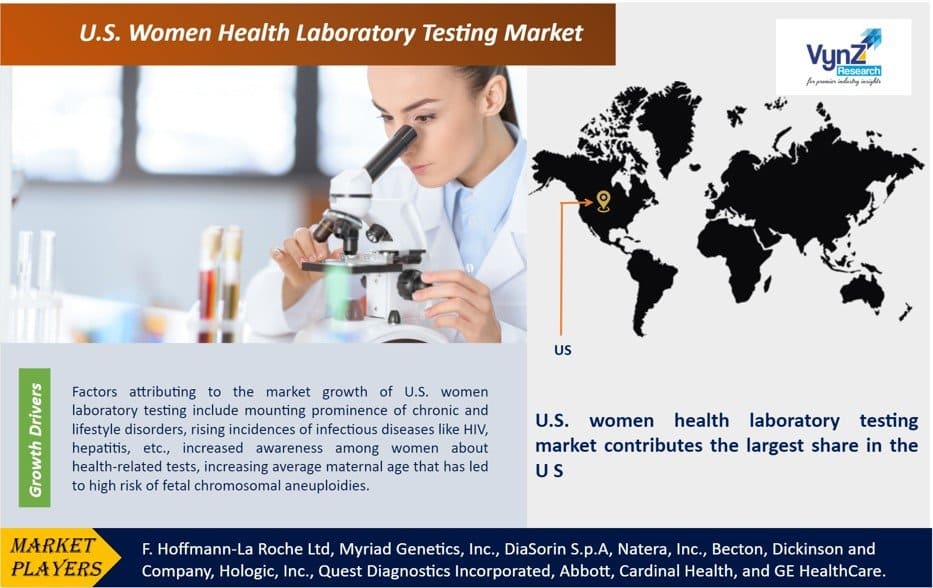
U.S. Women Health Laboratory Testing Market Segmentation
Insight by Cancer
- Cervical Cancer
- Breast Cancer
- Ovarian Cancer.
Based on Cancer, the U.S. Women Health Laboratory Testing Market is segmented into Cervical Cancer, Breast Cancer, and Ovarian Cancer. Breast Cancer is anticipated to grow at a high CAGR during the forecast period owing to rising incidences of breast cancer and increased awareness regarding developed breast cancer diagnostic techniques like ABUS.
Insight by Prenatal Screening and Diagnostic Testing
- Non-Invasive Prenatal Testing (NIPT)
- Maternal Serum Screening (MSS)
- Prenatal Diagnostic Testing
Based on Prenatal Screening and Diagnostic Testing, the U.S. Women Health Laboratory Testing Market is segregated into Non-Invasive Prenatal Testing (NIPT), Maternal Serum Screening (MSS), Prenatal Diagnostic Testing. Non-Invasive Prenatal Testing (NIPT) dominates the market as it reduces the chances of miscarriage. Owing to increased prominence of trisomy-related genetic conditions, NIPT is expected to grow significantly during the forecasted timeframe.
Insight by Reproductive Health and Infectious Diseases
- Pregnancy and Ovulation Testing
- HPV Testing
- PAP Smear Testing
- HIV Testing
- CT/NG Testing
- Preimplantation Genetic Testing (PGT)
- Sexually Transmitted Infections (Syphilis
- Gonorrhea
- Chlamydia)
- Herpes Simplex Virus (HSV)
- Hepatitis
- Vaginal Infections.
Based on Reproductive Health and Infectious Diseases, the U.S. Women Health Laboratory Testing Market is divided into Pregnancy and Ovulation Testing, HPV Testing, PAP Smear Testing, HIV Testing, CT/NG Testing, Preimplantation Genetic Testing (PGT), Sexually Transmitted Infections (Syphilis, Gonorrhea, Chlamydia), Herpes Simplex Virus (HSV), Hepatitis, and Vaginal Infections. HIV Testing contributes the largest share in the market owing to the rising number of blood transfusions and blood donations, advantages provided by POC instruments and kits, and rising initiatives by the government that will propel the market development.
U.S. Women Health Laboratory Testing Market Report Coverage
|
Report Metric
|
Details
|
|
Historical Period
|
2020 - 2024
|
|
Base Year Considered
|
2025
|
|
Forecast Period
|
2026 - 2035
|
|
Market Size in 2025
|
U.S.D. 70.2 Billion
|
|
Revenue Forecast in 2035
|
U.S.D. 110.5 Billion
|
|
Growth Rate
|
4.5%
|
|
Segments Covered in the Report
|
By Cancer, By Prenatal Screening and Diagnostic Testing, By Reproductive Health and Infectious Diseases
|
|
Report Scope
|
Market Trends, Drivers, and Restraints; Revenue Estimation and Forecast; Segmentation Analysis; Companies’ Strategic Developments; Market Share Analysis of Key Players; Company Profiling
|
|
Regions Covered in the Report
|
Northeast Region, Midwest Region, South Region and West Region
|
Industry Dynamics
U.S. Women Health Laboratory Testing Market Growth Drivers
Factors attributing to the market growth of U.S. women laboratory testing include mounting prominence of chronic and lifestyle disorders, rising incidences of infectious diseases like HIV, hepatitis, etc., increased awareness among women about health-related tests, increasing average maternal age that has led to high risk of fetal chromosomal aneuploidies. There is also a rise in reproductive health problems, thereby leading to increased market demand for laboratory testing in women. Moreover, the rising geriatric women population, surge in healthcare expenditure, rising incidences of lifestyle diseases in women, established healthcare industry, the surge in demand for fertility tests in women, rising number of private diagnostic and imaging centers, rising population of women in the workforce, and increased public-private partnership will improve infrastructure, thereby bolstering the market growth in the industry.
U.S. Women Health Laboratory Testing Market Challenges
The stringent regulatory guidelines regarding laboratory testing, high cost of diagnostic imaging devices and procedures, shortage of skilled laboratory technicians, and lack of awareness regarding pregnancy and fertility issues in several regions of US will hamper the market development of U.S. women health laboratory testing industry. Moreover, insufficient reimbursements for diagnostic tests will stymie market expansion.
U.S. Women Health Laboratory Testing Market Opportunities
The industry players offer tremendous market opportunities in the U.S. Health Laboratory testing Industry which includes
- Development in diagnostic technologies like genetic testing and digital and mobile mammography like breast MRI, bone density testing, and ultrasound will propel growth.
- Increased number of Regulatory Approvals for Immunoassay diagnostic techniques
- Healthcare Disparities in Rural Counties in the United States
- Healthcare Gap for Reproductive Age in Women with Psychological Distress
- Significant Mergers and Acquisitions by Companies to Increase Market Share
U.S. Women Health Laboratory Testing Market Geographic Overview
- Northeast Region (Connecticut, Delaware, District of Columbia, Maine, Maryland, Massachusetts, New Hampshire, New Jersey, New York, Pennsylvania, Puerto Rico, Rhode Island, Vermont, Virgin Islands, Virginia and West Virginia)
- Midwest Region (Illinois, Indiana, Iowa, Kansas, Michigan, Minnesota, Missouri, Nebraska, North Dakota, Ohio, South Dakota, and Wisconsin)
- South Region (Alabama, Arkansas, Georgia, Kentucky, Louisiana, Mississippi, Missouri, North Carolina, South Carolina, Tennessee)
- West Region (Alaska, Arizona, California, Hawaii, Idaho, Montana, Nevada, New Mexico, Oregon, Utah, Washington, and Wyoming)
South region contributes the largest share in the U.S. women health laboratory testing market owing to increased incidences of lifestyle disorders. The rising implementation of POC and rapid diagnostic testing and an upsurge in the number of diagnostic and imaging centers will support the market advancement of U.S. women health laboratory testing industry.
U.S. Women Health Laboratory Testing Market Competitive Insight
The market for women's health laboratory testing in the United States is in its advanced stages. Partnerships, business expansion, collaborations, product launch, and M&A, as well as increased regulatory, legal, and funding activities, are some of the key strategies adopted by industry players in the U.S. Women Health Laboratory Testing market. Also, New entrants can emphasize in developing early detection tests for hereditary cancer, prenatal screening and diagnostic testing.
Roche Diagnostics offers medical tests and digital tools that provide information to help healthcare professionals find the best treatment for patients and provide the best patient care in order to improve, prolong, and save lives. Roche Diagnostics currently leads the industry in the development of diagnostic products for cancer, cardiovascular health, infectious diseases, women's health, and diabetes management. Roche Diagnostics is the trusted diagnostic partner that healthcare providers can rely on for everything and includes cervical cancer screening, fertility support, prenatal testing, pregnancy care, breast cancer, ovarian cancer diagnosis, and bone health management.
DIASORIN is a prominent leader in laboratory diagnostics, specializing in immunodiagnostics and molecular diagnostics. The Group has been developing, manufacturing, and commercializing diagnostic tests for over 50 years: supports clinical laboratory needs and activities by providing solutions that are reliant, innovative, fully automated, and standardized. DiaSorin strives to invest in Research and development, enhancing its distinct Immunodiagnostics expertise to deliver high-quality assays and increase laboratory efficiency.
Recent Development by Key Players
Myriad Genetics collaborated with Memorial Sloan Kettering Cancer Center to assess the use of minimal residual disease (MRD) testing in patients with breast cancer. The research project will leverage Myriad’s MRD testing platform, a tumour-informed high-definition assay based on whole-genome sequencing, to attain high sensitivity and specificity for circulating tumour DNA (ctDNA).
The VENTANA FOLR1 (FOLR1-2.1) RxDx Assay, the first immunohistochemistry (IHC) companion diagnostic test to aid in the identification of epithelial ovarian cancer (EOC) patients eligible for targeted treatment with ELAHERETM (mirvetuximab soravtansine-gynx), has been approved by the US Food and Drug Administration (FDA). ELAHERE is a first-in-class antibody-drug conjugate (ADC) therapy approved by the FDA under the Accelerated Approval program for the treatment of FR-positive platinum-resistant ovarian cancer.
Quest Diagnostics, the world's leading provider of diagnostic information services, and Northern Light Health, a large integrated healthcare system in Maine, announced a strategic laboratory collaboration to expand access to innovative, high-quality, and cost-effective laboratory services, enabling communities in Maine to receive affordable care.
Key Players Covered in the Report
Some of the key players operating in the U.S. Women Health Diagnostics Industry include F. Hoffmann-La Roche Ltd, Myriad Genetics, Inc., DiaSorin S.p.A, Natera, Inc., Becton, Dickinson and Company, Hologic, Inc., Quest Diagnostics Incorporated, Abbott, Cardinal Health, and GE HealthCare.
The U.S. Women Health Laboratory Testing Market report offers a comprehensive market segmentation analysis along with an estimation for the forecast period 2025–2030.
Segments Covered in the Report
- By Cancer
- Cervical Cancer
- Breast Cancer
- Ovarian Cancer
- By Prenatal Screening and Diagnostic Testing
- Non-Invasive Prenatal Testing (NIPT)
- Maternal Serum Screening (MSS)
- Prenatal Diagnostic Testing
- By Reproductive Health and Infectious Diseases
- Pregnancy and Ovulation Testing
- HPV Testing
- PAP Smear Testing
- HIV Testing
- CT/NG Testing
- Preimplantation Genetic Testing (PGT)
- Sexually Transmitted Infections
- Herpes Simplex Virus (HSV)
- Hepatitis
- Vaginal Infections
.png "U.S. Women Health Laboratory Testing Market Size and Market Analysis")
To explore more about this report - Request a free sample copy