
U.S. Women Health Laboratory Testing Market Size & Share Growth Forecast Report (2026-2035)
Industry Insight by Test Type (Pregnancy and Prenatal Testing, Fertility Testing, Infectious Disease Testing, Cancer Screening, Hormone Testing, Genetic Testing, Others), by Technology (Clinical Chemistry, Immunoassays, Molecular Diagnostics, Haematology, Microbiology, Others), by Application (Reproductive Health, Oncology, Infectious Diseases, Endocrinology, Others), by End User (Hospitals, Diagnostic Laboratories, Physician Offices, Specialty Women's Health Clinics)
| Status : Published | Published On : Aug, 2026 | Report Code : VRHC1347 | Industry : Healthcare | Available Format :

|
Page : 131 |
U.S. Women Health Laboratory Testing Market Overview
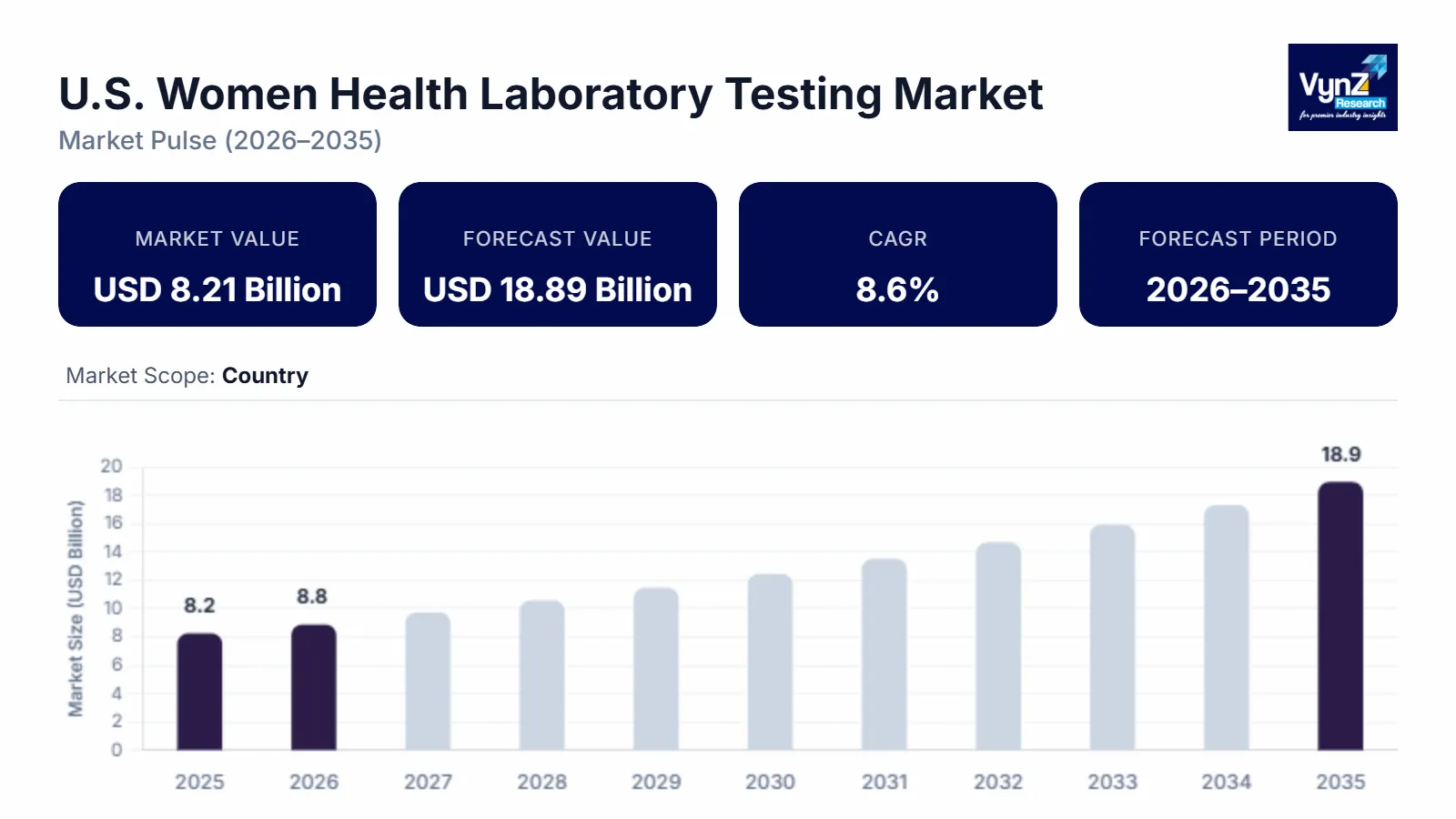
The U.S. women health laboratory testing market size was estimated at approximately USD 8.21 billion in 2025 and is expected to reach around USD 8.83 billion in 2026, rising to nearly USD 18.89 billion by 2035, growing at an estimated 8.6% CAGR during 2026 to 2035.
Research Highlights
- Pregnancy and prenatal testing held 30.8% share in 2025 promoted by prenatal screening.
- Immunoassays captured 34.2% share in 2025 supported by hormone diagnostics.
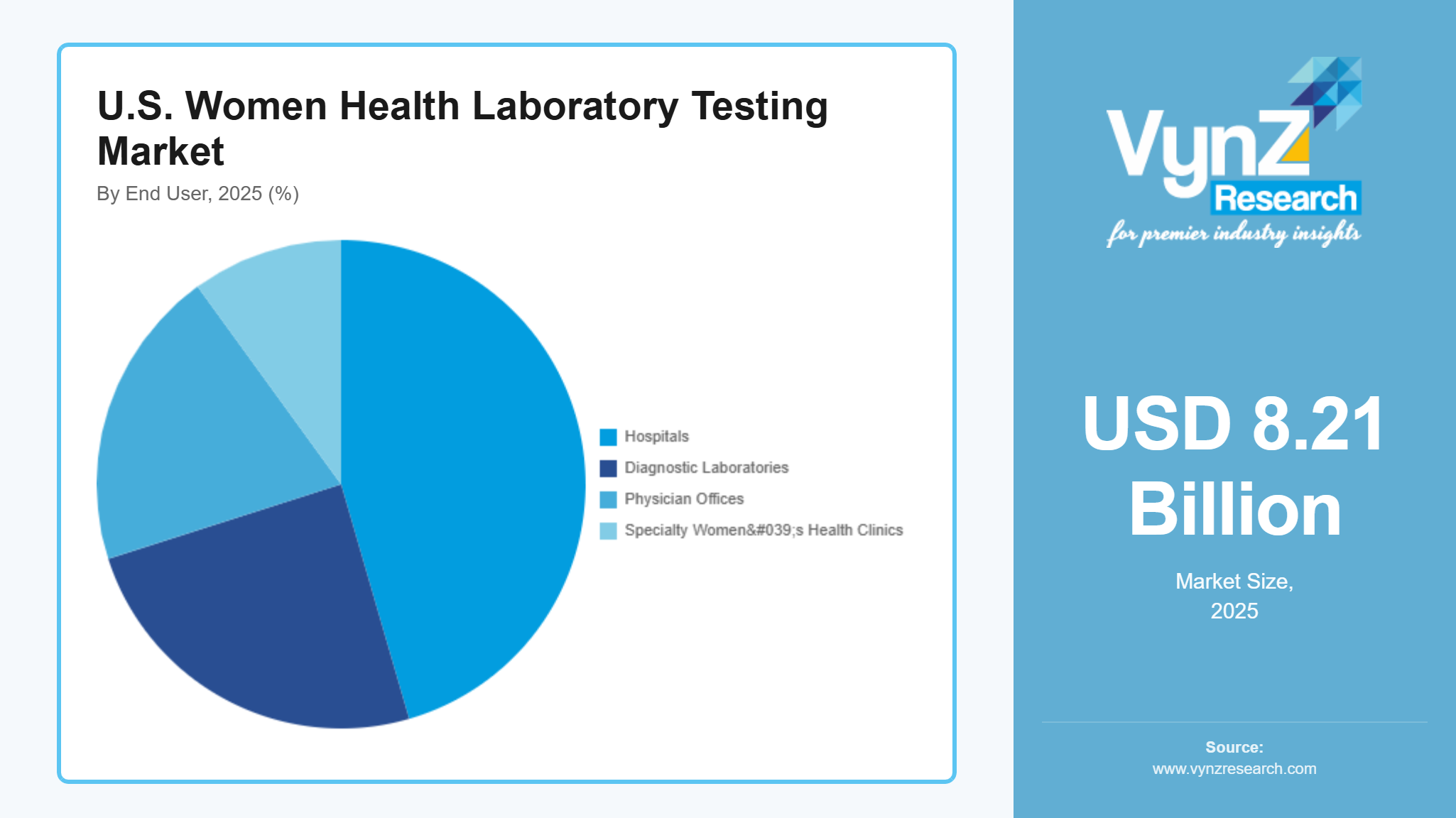
- Diagnostic laboratories generated 45.6% revenue in 2025 owing to higher testing volumes.
- Genetic testing is projected at 10.2% CAGR during 2026 to2035.
- California represented 31.8% market share in 2025 supported by advanced diagnostic infrastructure.
Market growth is supported by the growing use of laboratory tests for prenatal care, infertility detection, cervical cancer screening, sexually transmitted disease detection, hormone analysis, and menopause management. Moreover, the market is increasing due to the continuous development of molecular diagnostic techniques and automation methods. The expansion of diagnostic laboratory infrastructure and women’s health programs in the United States increases the growth rate with the support of the CDC, FDA, NIH, HRSA, and other organizations. Trends in California, Texas, Massachusetts, New York, and other regions also contribute to the development of the women’s health laboratory market in the United States. The rising importance of preventive medicine and personalized healthcare approaches is projected to drive the market growth in the future.
U.S. Women Health Laboratory Testing Market Dynamics
Market Trends
The market is witnessing a paradigm shift driven by the adoption of molecular diagnostic techniques, genetic screening, automation, and personalized healthcare. A major trend involves the adoption of high-throughput laboratory platforms for reproductive health, prenatal, hereditary cancer, hormone, and infectious disease testing. Clinical laboratories are adopting molecular diagnostic tests and next-generation sequencing coupled with artificial intelligence to improve analytical accuracy, speed up reporting processes, and ensure rapid treatment. A significant trend includes the rising adoption of at-home sample collection kits, digital health platforms and telehealth laboratory integrated services to offer better access to women’s health diagnostics and improve screening.
Growth Drivers
The market growth is primarily driven by the increasing awareness about preventive healthcare and the rising prevalence of female-specific diseases like breast cancer, cervical cancer, polycystic ovary syndrome (PCOS), infertility, thyroid problems, osteoporosis, and sexually transmitted diseases (STD). The adoption of screening programs and physician recommendations for disease screening leads to a steady rise in the number of diagnostic tests conducted across hospitals, diagnostic laboratories, and women’s health clinics. Moreover, the adoption of advanced diagnostic techniques such as molecular diagnostics, genetic testing, biomarker analysis and automation in clinical laboratories is projected to propel the growth of the U.S. Women Health Laboratory Testing Market during the forecast period.
Market Restraints / Challenges
Even though the market is poised for exponential growth, it still faces some challenges that hinder its growth trajectory. These include the high cost of genetic and molecular testing, insufficient insurance coverage, and disparity in healthcare access across different populations. Additionally, small diagnostic laboratories face higher risks as compared to large commercial labs due to the increased cost of laboratory automation, quality control measures, and skilled personnel. The changing regulatory landscape and accreditation requirements in laboratory medicine pose a higher risk to laboratory stakeholders. Compliance with laboratory regulations and data privacy policies requires higher expenditures to update digital laboratory information management systems. Maintaining analytical accuracy and test reporting efficiency among diagnostic laboratories is another significant challenge.
Market Opportunities
The market has significant growth opportunities for players willing to invest in molecular diagnostic laboratory testing, liquid biopsy, companion diagnostics, and genetic screening for women’s health conditions. Vendors that offer artificial intelligence-based laboratory platforms, multiple-molecular diagnostic panels, and digital pathology solutions are poised to meet the growing demand for women’s health screening from hospitals, diagnostic laboratories, and women’s clinics. Another lucrative opportunity exists in fertility diagnostics, hereditary cancer testing, prenatal laboratory testing, and menopause laboratory services. The growing adoption of next-generation sequencing and liquid biopsy is expected to transform the women’s health diagnostics space and open new opportunities for pharmaceutical companies, biotech firms, clinical laboratories, and hospital networks.
U.S. Women Health Laboratory Testing Market Report Coverage
|
Report Metric |
Details |
|
Historical Period |
2020 - 2024 |
|
Base Year Considered |
2025 |
|
Forecast Period |
2026 - 2035 |
|
Market Size in 2025 |
USD 8.21 Billion |
|
Revenue Forecast in 2035 |
USD 18.89 Billion |
|
Growth Rate |
8.6% |
|
Segments Covered in the Report |
Test Type, Technology, Application, End User |
|
Report Scope |
Market Trends, Drivers, and Restraints; Revenue Estimation and Forecast; Segmentation Analysis; Companies’ Strategic Developments; Market Share Analysis of Key Players; Company Profiling |
|
Regions Covered in the Report |
California, Texas, Massachusetts, Rest of the U.S. |
|
Key Companies |
Becton, Dickinson and Company, F. Hoffmann-La Roche Ltd., Hologic, Inc., Laboratory Corporation of America Holdings (Labcorp), NeoGenomics Laboratories, Inc., Quest Diagnostics Incorporated, QIAGEN N.V., Siemens Healthineers AG, Thermo Fisher Scientific Inc., BioMérieux SA |
|
Customization |
Available upon request |
U.S. Women Health Laboratory Testing Market Segmentation
By Test Type
Pregnancy and prenatal testing held the largest share of the market with a value of 30.8% in 2025. This is mainly due to the rising emphasis on prenatal screening, the growing awareness of women about maternal health, the increasing adoption of non-invasive prenatal testing (NIPT), and the increasing physician recommendation for early fetal health assessment.
Genetic testing is the fastest-growing segment with an estimated growth rate of 10.2% during the forecast period. This is largely attributed to the rising implementation of hereditary cancer screenings, personalized medicine, reproductive carrier screening, and next-generation sequencing.
By Technology
Immunoassays account for the largest revenue share of 34.2% in 2025. This is due to the significant adoption of immunoassays for hormone analysis, pregnancy detection, fertility evaluation, and infectious disease diagnosis. The segment is projected to dominate the market during the forecast period due to the high accuracy of test results, faster results, and wide-range applications of immunoassays.
Molecular diagnostics is anticipated to grow at the fastest rate of approximately 9.8% during the forecast period. This is due to the rising clinical utility of polymerase chain reaction (PCR), genomic testing, biomarker discovery, and companion diagnostics.
By Application
Reproductive health accounts for the largest revenue share of 41.7% in 2025. This is due to the increasing adoption of fertility screening tests, prenatal diagnostic tests, hormone analysis, and pregnancy-related lab tests.
Oncology is anticipated to grow at the fastest rate of 9.3% during the forecast period. This is due to the increasing utilization of cervical cancer screening, hereditary breast and ovarian cancer screening, diagnostic biomarkers, and precision oncology.
By End User
Diagnostic laboratories account for the largest market share of 45.6% in 2025. This is majorly due to the proliferation of diagnostic laboratories, increased testing volumes, automation, and adoption of women’s health testing panels. In addition, the outsourcing of in-house laboratory tests contributes to the segment growth.
Specialty women’s health clinics are projected to grow at the fastest rate of 9.5% during the forecast period. This can be attributed to the rising demand for fertility testing, prenatal screening, pregnancy care, and menopause management.
Regional Insights
California
California secured an approximate 31.8% share of the U.S. women health laboratory testing market in 2025. The state hosts a wide network of diagnostic labs, academic medical centers, and women’s healthcare facilities in Los Angeles, San Diego, San Francisco, Sacramento, Irvine, and other locations. The market is driven by the adoption of molecular diagnostics, prenatal screening, fertility tests, and genetic analysis. The state witnesses a surge in precision diagnostics, digitalization of laboratories, and the rise of preventive healthcare, which will propel California’s market share in the Women’s Health Laboratory Testing Market.
Texas
Texas booked in an approximate 27.1% share of the market in 2025 due to the development of healthcare infrastructure and a rise in the number of diagnostic labs offering women’s health services. With growing awareness about women’s health, screening tests, hormone analysis, STD screening, and prenatal care are gaining traction in Houston, Dallas, Austin, San Antonio, Fort Worth, and other major cities. Independent diagnostic laboratories and hospital systems offer automation solutions to women’s healthcare labs, which in turn creates growth opportunities in the women’s health lab testing market in Texas.
Massachusetts
Massachusetts recorded an approximate 22.4% share of the market in 2025. The state boasts of an extensive network of academic medical centers and teaching hospitals and has a robust biotechnology ecosystem. It offers premier laboratory facilities and specializes in molecular diagnostics, precision medicine, hereditary cancer screening, and genomic research. Biotech firms and academic medical centers collaborate with diagnostic laboratories to develop cutting-edge women’s health diagnostic tests and technologies, supporting the growth of the women’s health lab testing market.
Rest of the U.S
Rest of the U.S. accounted for an approximate 18.7% share of the market in 2025 and is growing steadily due to rising awareness about preventive healthcare and the availability of diagnostic laboratories offering molecular diagnostic testing. New York, Florida, Illinois, Pennsylvania, Ohio, North Carolina, Georgia, Washington, Arizona, New Jersey, and other states are witnessing increased screening initiatives and investments in women’s health research and development. Various organizations, including the CDC, NIH, FDA, and the State Health Departments, promote and regulate women’s health programs across the country.
Competitive Landscape / Company Insights
The market is highly competitive with key diagnostic labs, molecular diagnostic companies, and life science firms focusing on women’s health testing, lab automation, genomic diagnostics, and partnerships to drive growth. Moreover, to gain a competitive advantage, players are increasingly concentrating on reproductive health care diagnostics, hereditary cancer testing, prenatal diagnostics, artificial intelligence-driven laboratory operations, and precision medicine. Furthermore, the market growth is propelled by regulatory guidelines and frameworks such as those of the U.S. Food and Drug Administration (FDA), Clinical Laboratory Improvement Amendments (CLIA) under the Center for Medicare & Medicaid Services (CMS), and research funding provided by the National Institutes of Health (NIH).
Mini Profiles
Becton, Dickinson and Company develops clinical diagnostic systems and laboratory solutions, supported by broad expertise in specimen management and diagnostic technologies.
F. Hoffmann-La Roche Ltd. provides advanced molecular diagnostics and women's health testing solutions, supported by strong innovation in genomic and companion diagnostics.
Hologic, Inc. specializes in women's health diagnostics, cervical cancer screening, breast health, and molecular testing, supported by a comprehensive diagnostic portfolio.
Laboratory Corporation of America Holdings (Labcorp) offers nationwide laboratory testing services with extensive capabilities in reproductive health, oncology, genetics, and clinical diagnostics.
NeoGenomics Laboratories, Inc. focuses on oncology and genetic laboratory testing, supported by advanced molecular pathology and precision medicine capabilities.
Key Players
- Becton, Dickinson and Company
- F. Hoffmann-La Roche Ltd.
- Hologic, Inc.
- Laboratory Corporation of America Holdings ( Labcorp)
- NeoGenomics
- Laboratories, Inc.
- Quest Diagnostics Incorporated
- QIAGEN N.V.
- Siemens Healthineers AG
- Thermo Fisher Scientific Inc.
- BioMérieux SA
Recent Developments
Quest Diagnostics Incorporated expanded its women's health testing portfolio with enhanced reproductive and hereditary cancer screening services. The expansion improved access to precision diagnostic solutions.
QIAGEN N.V. introduced new molecular diagnostic workflow enhancements supporting faster genetic and infectious disease testing. The development strengthened laboratory efficiency and diagnostic accuracy.
Siemens Healthineers AG expanded its automated immunoassay solutions to improve hormone testing and reproductive health diagnostics. The launch supported higher laboratory productivity.
Thermo Fisher Scientific Inc. introduced advanced molecular diagnostic technologies supporting genomic testing and personalized women's healthcare. The development expanded its precision diagnostics portfolio.
BioMérieux SA enhanced its infectious disease diagnostic solutions with new laboratory automation capabilities. The initiative improved testing efficiency across clinical laboratories.
U.S. Women Health Laboratory Testing Market Coverage
Test Type Insight and Forecast 2026 - 2035
- Pregnancy and Prenatal Testing
- Fertility Testing
- Infectious Disease Testing
- Cancer Screening
- Hormone Testing
- Genetic Testing
- Others
Technology Insight and Forecast 2026 - 2035
- Clinical Chemistry
- Immunoassays
- Molecular Diagnostics
- Haematology
- Microbiology
- Others
Application Insight and Forecast 2026 - 2035
- Reproductive Health
- Oncology
- Infectious Diseases
- Endocrinology
- Others
End User Insight and Forecast 2026 - 2035
- Hospitals
- Diagnostic Laboratories
- Physician Offices
- Specialty Women's Health Clinics
U.S. Women Health Laboratory Testing Market by Region
- California
- By Test Type
- By Technology
- By Application
- By End User
- Texas
- By Test Type
- By Technology
- By Application
- By End User
- Massachusetts
- By Test Type
- By Technology
- By Application
- By End User
- Rest of the U.S.
- By Test Type
- By Technology
- By Application
- By End User
Table of Contents for U.S. Women Health Laboratory Testing Market Report
1. Research Overview
1.1. The Report Offers
1.2. Market Coverage
1.2.1. By
Test Type
1.2.2. By
Technology
1.2.3. By
Application
1.2.4. By
End User
1.3. Research Phases
1.4. Limitations
1.5. Market Methodology
1.5.1. Data Sources
1.5.1.1.
Primary Research
1.5.1.2.
Secondary Research
1.5.2. Methodology
1.5.2.1.
Data Exploration
1.5.2.2.
Forecast Parameters
1.5.2.3.
Data Validation
1.5.2.4.
Assumptions
1.5.3. Study Period & Data Reporting Unit
2. Executive Summary
3. Industry Overview
3.1. Industry Dynamics
3.1.1. Market Growth Drivers
3.1.2. Market Restraints
3.1.3. Key Market Trends
3.1.4. Major Opportunities
3.2. Industry Ecosystem
3.2.1. Porter’s Five Forces Analysis
3.2.2. Recent Development Analysis
3.2.3. Value Chain Analysis
3.3. Competitive Insight
3.3.1. Competitive Position of Industry
Players
3.3.2. Market Attractive Analysis
3.3.3. Market Share Analysis
4. U.S. Market Estimate and Forecast
4.1. U.S. Market Overview
4.2. U.S. Market Estimate and Forecast to 2035
5. Market Segmentation Estimate and Forecast
5.1. By Test Type
5.1.1. Pregnancy and Prenatal Testing
5.1.1.1. Market Definition
5.1.1.2. Market Estimation and Forecast to 2035
5.1.2. Fertility Testing
5.1.2.1. Market Definition
5.1.2.2. Market Estimation and Forecast to 2035
5.1.3. Infectious Disease Testing
5.1.3.1. Market Definition
5.1.3.2. Market Estimation and Forecast to 2035
5.1.4. Cancer Screening
5.1.4.1. Market Definition
5.1.4.2. Market Estimation and Forecast to 2035
5.1.5. Hormone Testing
5.1.5.1. Market Definition
5.1.5.2. Market Estimation and Forecast to 2035
5.1.6. Genetic Testing
5.1.6.1. Market Definition
5.1.6.2. Market Estimation and Forecast to 2035
5.1.7. Others
5.1.7.1. Market Definition
5.1.7.2. Market Estimation and Forecast to 2035
5.2. By Technology
5.2.1. Clinical Chemistry
5.2.1.1. Market Definition
5.2.1.2. Market Estimation and Forecast to 2035
5.2.2. Immunoassays
5.2.2.1. Market Definition
5.2.2.2. Market Estimation and Forecast to 2035
5.2.3. Molecular Diagnostics
5.2.3.1. Market Definition
5.2.3.2. Market Estimation and Forecast to 2035
5.2.4. Haematology
5.2.4.1. Market Definition
5.2.4.2. Market Estimation and Forecast to 2035
5.2.5. Microbiology
5.2.5.1. Market Definition
5.2.5.2. Market Estimation and Forecast to 2035
5.2.6. Others
5.2.6.1. Market Definition
5.2.6.2. Market Estimation and Forecast to 2035
5.3. By Application
5.3.1. Reproductive Health
5.3.1.1. Market Definition
5.3.1.2. Market Estimation and Forecast to 2035
5.3.2. Oncology
5.3.2.1. Market Definition
5.3.2.2. Market Estimation and Forecast to 2035
5.3.3. Infectious Diseases
5.3.3.1. Market Definition
5.3.3.2. Market Estimation and Forecast to 2035
5.3.4. Endocrinology
5.3.4.1. Market Definition
5.3.4.2. Market Estimation and Forecast to 2035
5.3.5. Others
5.3.5.1. Market Definition
5.3.5.2. Market Estimation and Forecast to 2035
5.4. By End User
5.4.1. Hospitals
5.4.1.1. Market Definition
5.4.1.2. Market Estimation and Forecast to 2035
5.4.2. Diagnostic Laboratories
5.4.2.1. Market Definition
5.4.2.2. Market Estimation and Forecast to 2035
5.4.3. Physician Offices
5.4.3.1. Market Definition
5.4.3.2. Market Estimation and Forecast to 2035
5.4.4. Specialty Women's Health Clinics
5.4.4.1. Market Definition
5.4.4.2. Market Estimation and Forecast to 2035
6. California Market Estimate and Forecast
6.1. By
Test Type
6.2. By
Technology
6.3. By
Application
6.4. By
End User
7. Texas Market Estimate and Forecast
7.1. By
Test Type
7.2. By
Technology
7.3. By
Application
7.4. By
End User
8. Massachusetts Market Estimate and Forecast
8.1. By
Test Type
8.2. By
Technology
8.3. By
Application
8.4. By
End User
9. Rest of the U.S. Market Estimate and Forecast
9.1. By
Test Type
9.2. By
Technology
9.3. By
Application
9.4. By
End User
10. Company Profiles
10.1.
Becton, Dickinson and Company
10.1.1.
Snapshot
10.1.2.
Overview
10.1.3.
Offerings
10.1.4.
Financial
Insight
10.1.5.
Recent
Developments
10.2.
F. Hoffmann-La Roche Ltd.
10.2.1.
Snapshot
10.2.2.
Overview
10.2.3.
Offerings
10.2.4.
Financial
Insight
10.2.5.
Recent
Developments
10.3.
Hologic, Inc.
10.3.1.
Snapshot
10.3.2.
Overview
10.3.3.
Offerings
10.3.4.
Financial
Insight
10.3.5.
Recent
Developments
10.4.
Laboratory Corporation of America Holdings (Labcorp)
10.4.1.
Snapshot
10.4.2.
Overview
10.4.3.
Offerings
10.4.4.
Financial
Insight
10.4.5.
Recent
Developments
10.5.
NeoGenomics Laboratories, Inc.
10.5.1.
Snapshot
10.5.2.
Overview
10.5.3.
Offerings
10.5.4.
Financial
Insight
10.5.5.
Recent
Developments
10.6.
Quest Diagnostics Incorporated
10.6.1.
Snapshot
10.6.2.
Overview
10.6.3.
Offerings
10.6.4.
Financial
Insight
10.6.5.
Recent
Developments
10.7.
QIAGEN N.V.
10.7.1.
Snapshot
10.7.2.
Overview
10.7.3.
Offerings
10.7.4.
Financial
Insight
10.7.5.
Recent
Developments
10.8.
Siemens Healthineers AG
10.8.1.
Snapshot
10.8.2.
Overview
10.8.3.
Offerings
10.8.4.
Financial
Insight
10.8.5.
Recent
Developments
10.9.
Thermo Fisher Scientific Inc.
10.9.1.
Snapshot
10.9.2.
Overview
10.9.3.
Offerings
10.9.4.
Financial
Insight
10.9.5.
Recent
Developments
10.10.
bioM‚rieux SA
10.10.1.
Snapshot
10.10.2.
Overview
10.10.3.
Offerings
10.10.4.
Financial
Insight
10.10.5.
Recent
Developments
11. Appendix
11.1. Exchange Rates
11.2. Abbreviations
Note: Financial insight and recent developments of different companies are subject to the availability of information in the secondary domain.
Frequently Asked Questions
Purchase Options
Latest Report
Research Methodology
- Desk Research / Pilot Interviews
- Build Market Size Model
- Research and Analysis
- Final Deliverable
Connect With Our Sales Team
- Toll-Free: +1-888-253-3960
- Phone: +91 9960 288 381
- Email: enquiry@vynzresearch.com
U.S. Women Health Laboratory Testing Market