
Artificial Intelligence (AI) Agents Market Size & Share - Growth Forecast Report (2026-2035)
Industry Insight by Agent Type (Reactive AI Agents, Proactive AI Agents, Autonomous / Multi-Step AI Agents, Collaborative / Multi-Agent Systems), by Technology (Machine Learning (ML), Natural Language Processing (NLP), Deep Learning, Reinforcement Learning, Computer Vision, Multimodal AI), by Deployment Mode (Cloud-Based, On-Premises, Hybrid), by Enterprise Size (Large Enterprises, Small & Medium-Sized Enterprises (SMEs)), by Application (Customer Support & Virtual Assistants, IT Operations & Helpdesk Automation, Sales & Marketing Automation, Human Resource Management, Finance & Accounting Automation, Cybersecurity & Threat Monitoring, Supply Chain & Operations Management), by End-Use Industry (BFSI (Banking, Financial Services & Insurance), Healthcare & Life Sciences, Retail & E-commerce, IT & Telecommunications, Manufacturing, Government & Public Sector, Media & Entertainment, Education)
| Status : Published | Published On : Feb, 2026 | Report Code : VRICT5217 | Industry : ICT & Media | Available Format :

|
Page : 186 |
AI Agents Market Overview
The artificial intelligence (AI) agents market which was valued at approximately USD 7.7 billion in 2025 and is estimated to reach around USD 11.8 billion in 2026, is projected to reach close to USD 222.4 billion by 2035, expanding at a CAGR of about 38.6% during the forecast period from 2026 to 2035.
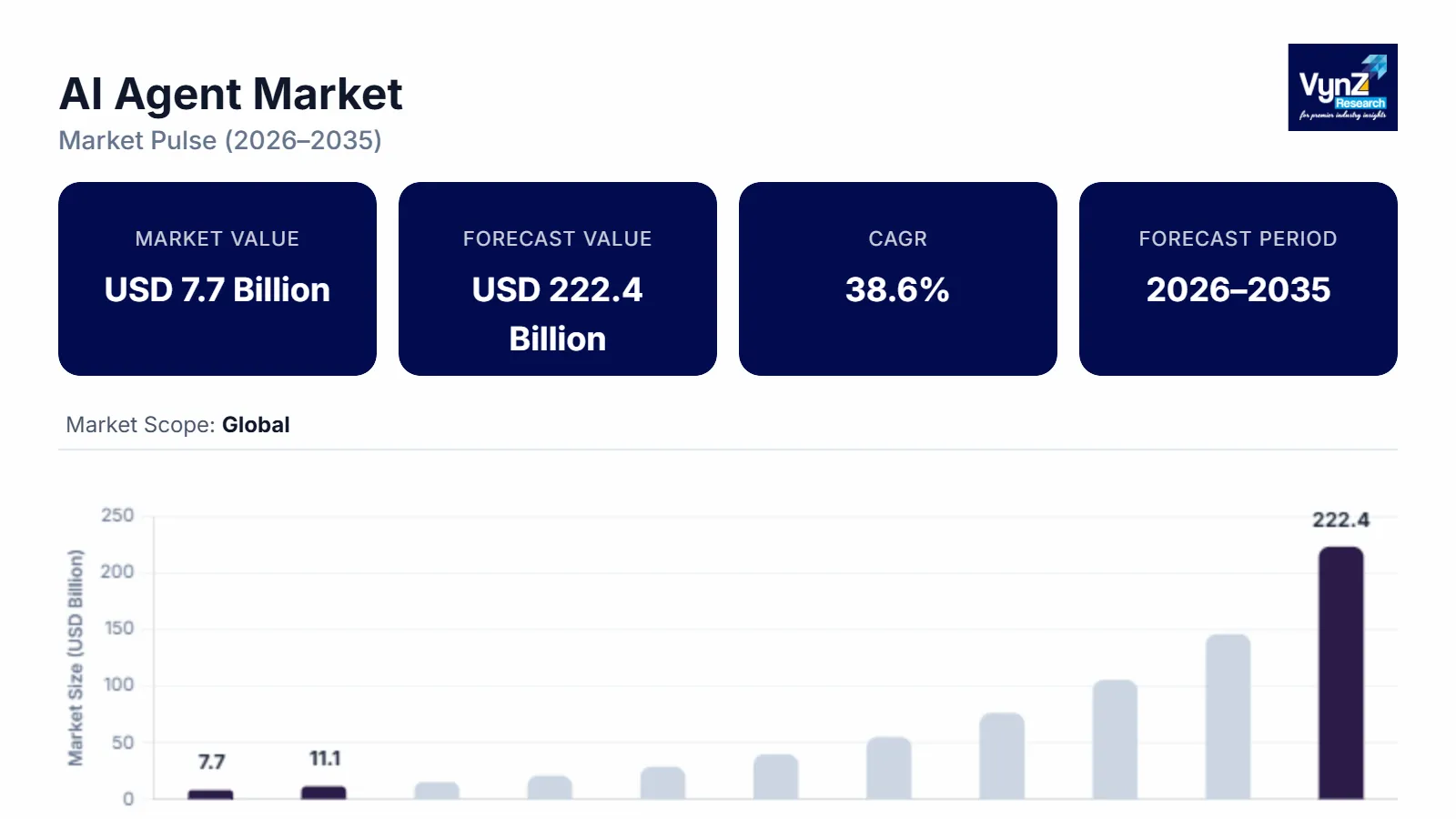
This market is primarily driven by the rapid adoption of generative AI and large language models across enterprises, particularly solutions built on platforms such as OpenAI, Microsoft Corporation, and Google LLC. Organizations are increasingly deploying AI agents to automate complex workflows, enhance customer engagement, and reduce operational costs through intelligent decision-making systems. The rising demand for 24/7 virtual assistance in customer service, IT support, and HR operations is accelerating enterprise investment in autonomous AI agents. Additionally, integration of AI agents with enterprise software ecosystems such as CRM, ERP, and cloud platforms is expanding their scalability and commercial viability. Growing digital transformation initiatives across BFSI, healthcare, retail, and manufacturing sectors further stimulate adoption. The expansion of cloud infrastructure and API-based architectures also enables faster deployment and customization of AI agents. Moreover, advancements in natural language processing, multimodal AI, and reinforcement learning are enhancing agent autonomy, reliability, and enterprise-grade performance, strengthening overall market growth.
Market Dynamics
Market Trends
The rise of autonomous multi-step AI agents marks a significant shift from rule-based chatbots to intelligent systems capable of planning, reasoning, and executing complex workflows independently. Unlike traditional bots that respond to single prompts, modern agents can break down tasks into smaller steps, access external tools, retrieve relevant data, and adapt decisions based on real-time inputs. Powered by advanced models from companies such as OpenAI and Google LLC, these agents demonstrate contextual understanding and long-chain reasoning capabilities. Enterprises are deploying them for functions like automated report generation, IT troubleshooting, financial analysis, and end-to-end customer query resolution. Global VC funding in agentic AI startups hit $2.8 billion in early 2025, driven largely by autonomous workplace AI agent developers, signaling strong investor confidence in agent-led automation technologies. Their ability to integrate with APIs, databases, and enterprise applications enhances operational efficiency and reduces human intervention. Businesses are achieving faster decision-making, improved productivity, and scalable automation.
Growth Drivers
Rapid enterprise adoption of generative AI technologies is a major growth driver for the AI Agent Market, as organizations increasingly integrate advanced AI models into core business operations. Enterprises are leveraging large language models and generative AI platforms developed by companies such as OpenAI, Microsoft Corporation, and Google LLC to enhance productivity and automate knowledge-intensive tasks. These technologies enable AI agents to generate content, analyze data, draft reports, write code, and provide contextual customer responses with high accuracy. Businesses are embedding generative AI into CRM systems, enterprise software, and collaboration tools to streamline workflows and improve decision-making. The scalability of cloud-based AI models further supports widespread enterprise deployment across global operations. Additionally, competitive pressure is pushing organizations to adopt AI-driven automation to remain efficient and innovative. Generative AI capabilities continue to mature, enterprises are expanding AI agent use cases beyond customer service into finance, legal, HR, and strategic planning functions.
Market Restraints / Challenges
Data privacy and security concerns represent one of the most significant challenges for the AI Agent Market, as these systems process vast amounts of sensitive enterprise and customer information. AI agents often access confidential financial records, personal data, intellectual property, and operational databases, increasing the risk of data breaches or unauthorized access. The integration of models developed by companies such as OpenAI and Google LLC into enterprise environments requires strict data governance frameworks to prevent misuse. Regulatory requirements such as GDPR and other regional data protection laws further add compliance complexity for global organizations. Additionally, AI agents connected through APIs and cloud platforms may expand the attack surface for cyber threats. Concerns around data storage, model training transparency, and cross-border data transfer also limit adoption in highly regulated sectors. Enterprises are increasingly investing in encryption, secure cloud infrastructure, and AI governance mechanisms to mitigate privacy and security risks.
Market Opportunities
AI agents for cybersecurity and IT operations represent a major growth opportunity within the AI Agent Market, as organizations seek intelligent systems capable of real-time threat detection and automated response. These AI agents continuously monitor networks, endpoints, and cloud environments to identify anomalies, suspicious behavior, and potential security breaches. By leveraging advanced machine learning and analytics capabilities from providers such as Microsoft Corporation and Google LLC, enterprises can strengthen proactive defense mechanisms. In IT operations, AI agents automate incident management, root-cause analysis, system diagnostics, and performance optimization, reducing downtime and operational disruption. Their ability to correlate large volumes of log data improves decision accuracy and speeds up resolution times. As cyber threats become more sophisticated and frequent, businesses are increasingly adopting AI-driven security automation to enhance resilience. This growing reliance on intelligent monitoring and self-healing IT systems is creating strong commercial opportunities for AI agent solution providers.
Global AI Agents Market Report Coverage
|
Report Metric |
Details |
|
Historical Period |
2020 - 2024 |
|
Base Year Considered |
2025 |
|
Forecast Period |
2026 - 2035 |
|
Market Size in 2025 |
USD 7.7 Billion |
|
Revenue Forecast in 2035 |
USD 222.4 Billion |
|
Growth Rate |
38.6% |
|
Segments Covered in the Report |
Agent Type, Technology, Deployment Mode, Enterprise Size, Application, End-Use Industry, Region |
|
Report Scope |
Market Trends, Drivers, and Restraints; Revenue Estimation and Forecast; Segmentation Analysis; Companies’ Strategic Developments; Market Share Analysis of Key Players; Company Profiling |
|
Regions Covered in the Report |
North America, Europe, Asia Pacific, Rest of the World |
|
Key Companies |
Microsoft Corporation (U.S.), Google LLC (U.S.), OpenAI (U.S.), Amazon Web Services, Inc. (U.S.), Salesforce, Inc. (U.S.), Oracle Corporation (U.S.), SAP SE (Germany), International Business Machines Corporation (U.S.), NVIDIA Corporation (U.S.), Meta Platforms, Inc. (U.S.), Baidu, Inc. (China), Anthropic PBC (U.S.) |
|
Customization |
Available upon request |
Market Segmentation
By Agent Type
Autonomous / Multi-Step AI Agents is the largest category with a market share of about 35% in 2025, driven by growing enterprise demand for advanced task automation and independent decision-making capabilities. These agents can plan, reason, and execute multi-step workflows with minimal human intervention. Businesses increasingly prefer autonomous agents for complex functions such as financial analysis, IT troubleshooting, and workflow orchestration. Their ability to integrate APIs, enterprise software, and real-time data sources strengthens adoption. Enhanced reasoning powered by large language models further boosts performance. Enterprises view them as strategic productivity tools rather than simple assistants.
Autonomous / Multi-Step AI Agents is also the fastest-growing category with a CAGR of 38.8% during the forecast period, fueled by rapid advancements in generative AI and reinforcement learning. Organizations are expanding use cases beyond chat-based support toward end-to-end process automation. Increasing investments from technology leaders are accelerating innovation in agent autonomy. Enterprises seeking cost optimization and operational efficiency are prioritizing intelligent autonomous systems. The shift toward agentic AI frameworks further drives this segment’s expansion.
By Technology
Natural Language Processing (NLP) is the largest category with a market share of about 30% in 2025, driven by the core role it plays in enabling AI agents to understand, interpret, and generate human language. Most AI agents deployed across enterprises rely heavily on NLP for chatbots, virtual assistants, automated emails, and conversational analytics. The surge in large language models has significantly enhanced contextual understanding, multilingual capabilities, and sentiment analysis accuracy. Businesses across customer service, HR, BFSI, and healthcare prioritize NLP-driven agents for seamless communication automation. Continuous advancements in transformer-based architectures further strengthen performance.
Reinforcement Learning is the fastest-growing category with a CAGR of 38.9% during the forecast period, fueled by rising demand for self-improving and adaptive AI agents. This technology enables agents to learn from interactions, optimize decisions, and improve outcomes over time without constant human retraining. Enterprises are increasingly adopting reinforcement learning to support autonomous task execution and multi-step reasoning. It plays a critical role in dynamic environments such as cybersecurity, financial trading, and supply chain optimization.
By Deployment Mode
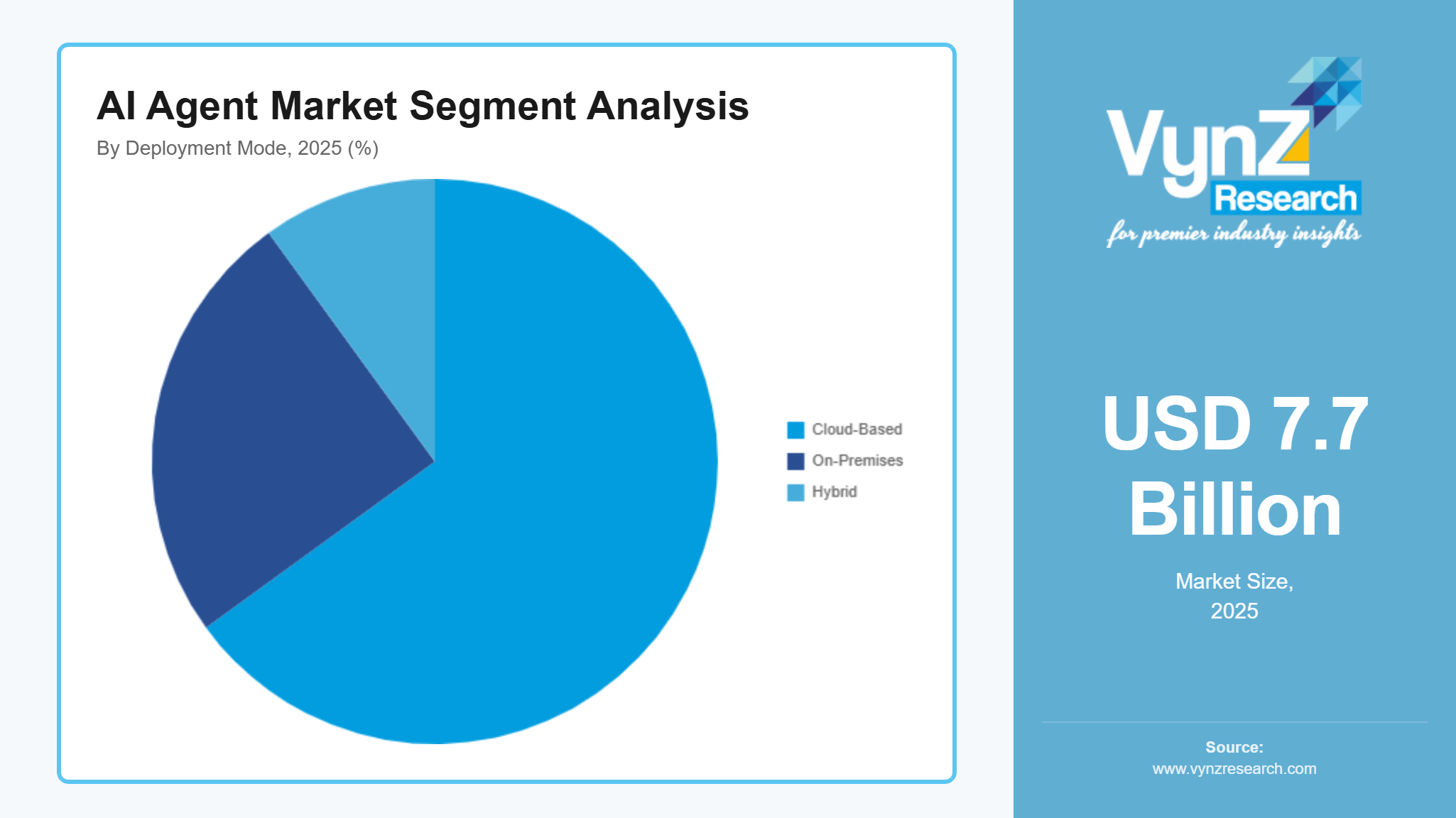
Cloud-Based is the largest category with a market share of about 65% in 2025, driven by scalability, cost-efficiency, and rapid deployment capabilities. Cloud platforms allow seamless integration with CRM, ERP, and analytics systems. Businesses prefer cloud-based AI agents for flexibility and reduced infrastructure investment. Continuous updates and centralized data management enhance performance and security. The global expansion of cloud ecosystems further strengthens market leadership. Enterprises adopting SaaS models increasingly rely on cloud-hosted AI solutions.
Cloud-Based is also the fastest-growing category during the forecast period, supported by rising SME adoption and remote operational models. Pay-as-you-go pricing lowers entry barriers for smaller enterprises. Faster onboarding and API-driven integrations simplify deployment. Expanding hyperscale cloud infrastructure globally accelerates growth momentum.
By Enterprise Size
Large Enterprises is the largest category with a market share of about 60% in 2025, driven by higher IT budgets and advanced digital infrastructure. Large organizations deploy AI agents across multiple departments including HR, finance, and customer service. Their need for workflow optimization at scale supports broader implementation. Complex enterprise ecosystems benefit significantly from AI-driven automation. Strong investment capacity further consolidates this segment’s leadership.
Small & Medium-Sized Enterprises (SMEs) is the fastest-growing category during the forecast period, fueled by affordable cloud-based AI solutions. SMEs increasingly adopt AI agents to enhance productivity and remain competitive. Subscription-based pricing and simplified deployment models enable rapid expansion in this segment. Growing awareness of AI-driven efficiency benefits is accelerating adoption among startups. Digital-native SMEs are integrating AI agents directly into core business processes. Government digitalization initiatives further support SME-level expansion.
By Application
Customer Support & Virtual Assistants is the largest category with a market share of about 30% in 2025, driven by high demand for 24/7 automated customer engagement. Enterprises deploy AI agents to manage queries, complaints, and personalized interactions across digital channels. Cost reduction and improved response time significantly boost adoption. Omnichannel integration further strengthens market leadership. AI-driven sentiment analysis enhances personalized engagement strategies. Businesses are reducing call center dependency through intelligent automation. Continuous learning from interaction data improves response accuracy over time.
IT Operations & Cybersecurity is the fastest-growing category with a CAGR of 40.1% during the forecast period, supported by increasing cyber threats and system complexity. AI agents automate incident detection, root-cause analysis, and threat mitigation. Real-time monitoring capabilities and predictive analytics accelerate demand. Rising ransomware and data breach incidents further push adoption. Automated patch management and self-healing systems enhance operational resilience. Enterprises are prioritizing AI-driven security frameworks for proactive risk management.
By End-Use Industry
IT & Telecommunications is the largest category with a market share of about 25% in 2025, driven by early AI adoption and advanced digital infrastructure. The industry leverages AI agents for network optimization, automated support, and system monitoring. Continuous innovation in AI-powered services strengthens leadership. High data generation in telecom networks creates strong AI integration demand. AI agents assist in predictive maintenance and service personalization.
BFSI is the fastest-growing category during the forecast period, fueled by demand for fraud detection, automated advisory services, and compliance monitoring. AI agents enhance risk analysis and customer engagement efficiency, accelerating adoption in financial institutions. Digital banking transformation is significantly increasing AI integration. Regulatory reporting automation is becoming a key use case. Personalized financial advisory bots further boost segment expansion.
Regional Insights
North America
North America is the largest regional market for the AI Agent Market, driven by early adoption of generative AI technologies and a strong presence of leading AI developers and cloud providers such as OpenAI and Microsoft Corporation. The United States leads the region with widespread enterprise deployment of AI agents across IT, BFSI, healthcare, and retail sectors. High digital maturity, advanced cloud infrastructure, and strong venture capital investments support continuous innovation in agentic AI systems. Large corporations are heavily investing in workflow automation, cybersecurity AI agents, and intelligent copilots to enhance productivity. Microsoft announced a $17.5 billion investment in cloud and AI infrastructure, upskilling, and operations in India over 2026–2029, reinforcing long-term enterprise adoption plans. The region benefits from a well-established SaaS ecosystem and strong API integration frameworks. Additionally, favorable R&D funding and rapid commercialization of AI models further reinforce market dominance.
Asia Pacific
Asia-Pacific is the fastest-growing region in the AI Agent Market, fueled by rapid digital transformation and expanding cloud infrastructure across emerging economies. Countries such as China, India, Japan, and South Korea are significantly investing in AI-driven automation and smart enterprise systems. Rising SME digitalization and startup ecosystem growth are accelerating AI agent adoption. The expansion of e-commerce, fintech, and digital public services is increasing demand for conversational and task-based AI agents. OpenAI, has partnered with Tata Group to build AI infrastructure in India, beginning with 100 MW capacity, with TCS stating it can scale up to 1 GW in later phases. Governments across the region are promoting AI innovation through national AI strategies and funding programs. Increasing internet penetration and mobile-first economies further support scalable AI deployment. India’s AI and deep tech sector attracted approximately $2.1 billion across 289 deals, reflecting strong investor confidence in advanced technology startups. Artificial intelligence alone accounted for $1.22 billion across 188 deals, representing a 58% year-over-year increase in AI funding. Non-AI deep tech segments recorded 147 deals worth about $1.19 billion. Cost-effective technical talent and growing AI research hubs position Asia-Pacific as the fastest-expanding regional market globally.
Europe
Europe represents a significant market for AI agents, supported by strong enterprise digitalization and regulatory-driven AI governance frameworks. Countries such as Germany, the United Kingdom, and France are investing in AI-powered automation across manufacturing, BFSI, and public administration sectors. The region places strong emphasis on ethical AI adoption and compliance with strict data protection regulations such as GDPR. Blockbrain, a GenAI agent platform based in Stuttgart, has raised €17.5 million in Series A funding to strengthen its enterprise AI agent platform, enhance security and governance features, and expand across Europe and the United Kingdom. Enterprises are integrating AI agents into customer engagement, cybersecurity monitoring, and operational optimization systems. Growing adoption of generative AI tools within enterprise software platforms supports steady expansion. Cross-border digital trade and Industry 4.0 initiatives further enhance AI integration. Continuous innovation in responsible and explainable AI strengthens Europe’s long-term market presence.
Rest of the World
The rest of the world, including Latin America, the Middle East, and Africa, is experiencing gradual but accelerating adoption of AI agent technologies. In Latin America, countries such as Brazil and Mexico are investing in enterprise automation and digital customer engagement tools. The Middle East is witnessing increasing AI integration aligned with national digital transformation strategies, particularly in government services and BFSI sectors. In Africa, rising mobile connectivity and cloud availability are creating new opportunities for AI-based automation solutions. While infrastructure maturity varies across regions, growing investments in data centers and cloud ecosystems are improving scalability. Increasing participation of SMEs and digital startups is expected to drive future growth. Over time, expanding digital infrastructure and AI awareness will strengthen market penetration across these regions.
Competitive Landscape / Company Insights
The AI Agent Market is moderately fragmented, characterized by the presence of global technology giants, cloud hyperscale’s, enterprise software providers, and emerging AI-native startups competing across multiple solution layers. Major players such as Microsoft Corporation, Google LLC, OpenAI, and Amazon Web Services dominate through advanced foundation models, large-scale cloud infrastructure, and integrated AI ecosystems. These companies leverage extensive R&D investments, proprietary large language models, and global enterprise customer bases to strengthen their competitive positioning. Their AI agent offerings are deeply integrated into productivity suites, cloud platforms, cybersecurity systems, and enterprise applications, enabling end-to-end automation capabilities.
In addition, enterprise software leaders such as Salesforce, Inc., Oracle Corporation, and SAP SE are embedding AI agents into CRM, ERP, and business intelligence platforms to enhance workflow automation and decision support. Specialized AI startups are focusing on vertical-specific agents, autonomous task execution, and agent orchestration frameworks to differentiate themselves. Competitive differentiation is primarily based on reasoning accuracy, multi-step autonomy, data privacy controls, integration flexibility, and scalability. Strategic partnerships, acquisitions, and model upgrades are common as vendors seek to expand capabilities and industry reach.
Mini Profiles
Microsoft Corporation (U.S.) is a leading enterprise technology provider that integrates advanced AI agent capabilities across its Azure cloud platform and Microsoft 365 ecosystem. Through Copilot and Azure AI services, the company enables autonomous task execution, workflow automation, and enterprise-grade conversational AI solutions.
Google LLC (U.S.) develops cutting-edge AI models and agent frameworks supported by its Google Cloud infrastructure. The company offers large language models, multimodal AI, and API-driven tools that help enterprises deploy intelligent agents for automation, analytics, and customer engagement.
OpenAI (U.S.) specializes in advanced generative AI and large language models that power autonomous and multi-step AI agents. Its models enable contextual reasoning, content generation, and complex workflow automation across diverse enterprise applications.
Amazon Web Services, Inc. (U.S.) provides scalable cloud infrastructure and AI services that support the deployment of intelligent agents. Through machine learning platforms and AI model hosting, AWS enables enterprises to build, train, and scale AI-driven automation systems.
Salesforce, Inc. (U.S.) embeds AI agent capabilities within its CRM ecosystem to enhance customer engagement, sales automation, and workflow intelligence. Its AI-driven tools support predictive insights, conversational automation, and integrated business process management.
Key Players
- Microsoft Corporation
- Google LLC
- OpenAI
- Amazon Web Services, Inc.
- Salesforce, Inc.
- Oracle Corporation
- SAP SE
- International Business Machines Corporation
- NVIDIA Corporation
- Meta Platforms, Inc.
- Baidu, Inc.
- Anthropic PBC
Recent Developments
January 2026 – Microsoft Corporation expanded its Copilot ecosystem with enhanced autonomous AI agent orchestration capabilities within Azure, enabling enterprises to deploy multi-step workflow agents across finance, HR, and IT operations.
December 2025 – Google LLC introduced advanced multimodal AI agent features in Google Cloud, allowing enterprises to integrate text, voice, and visual reasoning into automated business processes.
November 2025 – OpenAI launched upgraded agent-focused APIs designed to support complex task planning, improved contextual memory, and secure enterprise-grade deployment controls.
October 2025 – Amazon Web Services announced new AI agent development tools within its cloud platform, enabling scalable deployment of autonomous enterprise assistants with enhanced data security features.
September 2025 – Salesforce, Inc. enhanced its AI-driven enterprise automation capabilities by embedding next-generation agentic AI features across its CRM and workflow platforms to improve customer engagement and process efficiency.
Global AI Agents Market Coverage
Agent Type Insight and Forecast 2026 - 2035
- Reactive AI Agents
- Proactive AI Agents
- Autonomous / Multi-Step AI Agents
- Collaborative / Multi-Agent Systems
Technology Insight and Forecast 2026 - 2035
- Machine Learning (ML)
- Natural Language Processing (NLP)
- Deep Learning
- Reinforcement Learning
- Computer Vision
- Multimodal AI
Deployment Mode Insight and Forecast 2026 - 2035
- Cloud-Based
- On-Premises
- Hybrid
Enterprise Size Insight and Forecast 2026 - 2035
- Large Enterprises
- Small & Medium-Sized Enterprises (SMEs)
Application Insight and Forecast 2026 - 2035
- Customer Support & Virtual Assistants
- IT Operations & Helpdesk Automation
- Sales & Marketing Automation
- Human Resource Management
- Finance & Accounting Automation
- Cybersecurity & Threat Monitoring
- Supply Chain & Operations Management
End-Use Industry Insight and Forecast 2026 - 2035
- BFSI (Banking
- Financial Services & Insurance)
- Healthcare & Life Sciences
- Retail & E-commerce
- IT & Telecommunications
- Manufacturing
- Government & Public Sector
- Media & Entertainment
- Education
Global AI Agents Market by Region
- North America
- By Agent Type
- By Technology
- By Deployment Mode
- By Enterprise Size
- By Application
- By End-Use Industry
- By Country - U.S., Canada, Mexico
- Europe
- By Agent Type
- By Technology
- By Deployment Mode
- By Enterprise Size
- By Application
- By End-Use Industry
- By Country - Germany, U.K., France, Italy, Spain, Russia, Rest of Europe
- Asia-Pacific (APAC)
- By Agent Type
- By Technology
- By Deployment Mode
- By Enterprise Size
- By Application
- By End-Use Industry
- By Country - China, Japan, India, South Korea, Vietnam, Thailand, Malaysia, Rest of Asia-Pacific
- Rest of the World (RoW)
- By Agent Type
- By Technology
- By Deployment Mode
- By Enterprise Size
- By Application
- By End-Use Industry
- By Country - Brazil, Saudi Arabia, South Africa, U.A.E., Other Countries
Table of Contents for AI Agents Market Report
1. Research Overview
1.1. The Report Offers
1.2. Market Coverage
1.2.1. By
Agent Type
1.2.2. By
Technology
1.2.3. By
Deployment Mode
1.2.4. By
Enterprise Size
1.2.5. By
Application
1.2.6. By
End-Use Industry
1.3. Research Phases
1.4. Limitations
1.5. Market Methodology
1.5.1. Data Sources
1.5.1.1.
Primary Research
1.5.1.2.
Secondary Research
1.5.2. Methodology
1.5.2.1.
Data Exploration
1.5.2.2.
Forecast Parameters
1.5.2.3.
Data Validation
1.5.2.4.
Assumptions
1.5.3. Study Period & Data Reporting Unit
2. Executive Summary
3. Industry Overview
3.1. Industry Dynamics
3.1.1. Market Growth Drivers
3.1.2. Market Restraints
3.1.3. Key Market Trends
3.1.4. Major Opportunities
3.2. Industry Ecosystem
3.2.1. Porter’s Five Forces Analysis
3.2.2. Recent Development Analysis
3.2.3. Value Chain Analysis
3.3. Competitive Insight
3.3.1. Competitive Position of Industry
Players
3.3.2. Market Attractive Analysis
3.3.3. Market Share Analysis
4. Global Market Estimate and Forecast
4.1. Global Market Overview
4.2. Global Market Estimate and Forecast to 2035
5. Market Segmentation Estimate and Forecast
5.1. By Agent Type
5.1.1. Reactive AI Agents
5.1.1.1. Market Definition
5.1.1.2. Market Estimation and Forecast to 2035
5.1.2. Proactive AI Agents
5.1.2.1. Market Definition
5.1.2.2. Market Estimation and Forecast to 2035
5.1.3. Autonomous / Multi-Step AI Agents
5.1.3.1. Market Definition
5.1.3.2. Market Estimation and Forecast to 2035
5.1.4. Collaborative / Multi-Agent Systems
5.1.4.1. Market Definition
5.1.4.2. Market Estimation and Forecast to 2035
5.2. By Technology
5.2.1. Machine Learning (ML)
5.2.1.1. Market Definition
5.2.1.2. Market Estimation and Forecast to 2035
5.2.2. Natural Language Processing (NLP)
5.2.2.1. Market Definition
5.2.2.2. Market Estimation and Forecast to 2035
5.2.3. Deep Learning
5.2.3.1. Market Definition
5.2.3.2. Market Estimation and Forecast to 2035
5.2.4. Reinforcement Learning
5.2.4.1. Market Definition
5.2.4.2. Market Estimation and Forecast to 2035
5.2.5. Computer Vision
5.2.5.1. Market Definition
5.2.5.2. Market Estimation and Forecast to 2035
5.2.6. Multimodal AI
5.2.6.1. Market Definition
5.2.6.2. Market Estimation and Forecast to 2035
5.3. By Deployment Mode
5.3.1. Cloud-Based
5.3.1.1. Market Definition
5.3.1.2. Market Estimation and Forecast to 2035
5.3.2. On-Premises
5.3.2.1. Market Definition
5.3.2.2. Market Estimation and Forecast to 2035
5.3.3. Hybrid
5.3.3.1. Market Definition
5.3.3.2. Market Estimation and Forecast to 2035
5.4. By Enterprise Size
5.4.1. Large Enterprises
5.4.1.1. Market Definition
5.4.1.2. Market Estimation and Forecast to 2035
5.4.2. Small & Medium-Sized Enterprises (SMEs)
5.4.2.1. Market Definition
5.4.2.2. Market Estimation and Forecast to 2035
5.5. By Application
5.5.1. Customer Support & Virtual Assistants
5.5.1.1. Market Definition
5.5.1.2. Market Estimation and Forecast to 2035
5.5.2. IT Operations & Helpdesk Automation
5.5.2.1. Market Definition
5.5.2.2. Market Estimation and Forecast to 2035
5.5.3. Sales & Marketing Automation
5.5.3.1. Market Definition
5.5.3.2. Market Estimation and Forecast to 2035
5.5.4. Human Resource Management
5.5.4.1. Market Definition
5.5.4.2. Market Estimation and Forecast to 2035
5.5.5. Finance & Accounting Automation
5.5.5.1. Market Definition
5.5.5.2. Market Estimation and Forecast to 2035
5.5.6. Cybersecurity & Threat Monitoring
5.5.6.1. Market Definition
5.5.6.2. Market Estimation and Forecast to 2035
5.5.7. Supply Chain & Operations Management
5.5.7.1. Market Definition
5.5.7.2. Market Estimation and Forecast to 2035
5.6. By End-Use Industry
5.6.1. BFSI (Banking
5.6.1.1. Market Definition
5.6.1.2. Market Estimation and Forecast to 2035
5.6.2. Financial Services & Insurance)
5.6.2.1. Market Definition
5.6.2.2. Market Estimation and Forecast to 2035
5.6.3. Healthcare & Life Sciences
5.6.3.1. Market Definition
5.6.3.2. Market Estimation and Forecast to 2035
5.6.4. Retail & E-commerce
5.6.4.1. Market Definition
5.6.4.2. Market Estimation and Forecast to 2035
5.6.5. IT & Telecommunications
5.6.5.1. Market Definition
5.6.5.2. Market Estimation and Forecast to 2035
5.6.6. Manufacturing
5.6.6.1. Market Definition
5.6.6.2. Market Estimation and Forecast to 2035
5.6.7. Government & Public Sector
5.6.7.1. Market Definition
5.6.7.2. Market Estimation and Forecast to 2035
5.6.8. Media & Entertainment
5.6.8.1. Market Definition
5.6.8.2. Market Estimation and Forecast to 2035
5.6.9. Education
5.6.9.1. Market Definition
5.6.9.2. Market Estimation and Forecast to 2035
6. North America Market Estimate and Forecast
6.1. By
Agent Type
6.2. By
Technology
6.3. By
Deployment Mode
6.4. By
Enterprise Size
6.5. By
Application
6.6. By
End-Use Industry
6.6.1.
U.S. Market Estimate and Forecast
6.6.2.
Canada Market Estimate and Forecast
6.6.3.
Mexico Market Estimate and Forecast
7. Europe Market Estimate and Forecast
7.1. By
Agent Type
7.2. By
Technology
7.3. By
Deployment Mode
7.4. By
Enterprise Size
7.5. By
Application
7.6. By
End-Use Industry
7.6.1.
Germany Market Estimate and Forecast
7.6.2.
France Market Estimate and Forecast
7.6.3.
U.K. Market Estimate and Forecast
7.6.4.
Italy Market Estimate and Forecast
7.6.5.
Spain Market Estimate and Forecast
7.6.6.
Russia Market Estimate and Forecast
7.6.7.
Rest of Europe Market Estimate and Forecast
8. Asia-Pacific (APAC) Market Estimate and Forecast
8.1. By
Agent Type
8.2. By
Technology
8.3. By
Deployment Mode
8.4. By
Enterprise Size
8.5. By
Application
8.6. By
End-Use Industry
8.6.1.
China Market Estimate and Forecast
8.6.2.
Japan Market Estimate and Forecast
8.6.3.
India Market Estimate and Forecast
8.6.4.
South Korea Market Estimate and Forecast
8.6.5.
Rest of Asia-Pacific Market Estimate and Forecast
9. Rest of the World (RoW) Market Estimate and Forecast
9.1. By
Agent Type
9.2. By
Technology
9.3. By
Deployment Mode
9.4. By
Enterprise Size
9.5. By
Application
9.6. By
End-Use Industry
9.6.1.
Brazil Market Estimate and Forecast
9.6.2.
Saudi Arabia Market Estimate and Forecast
9.6.3.
South Africa Market Estimate and Forecast
9.6.4.
U.A.E. Market Estimate and Forecast
9.6.5.
Other Countries Market Estimate and Forecast
10. Company Profiles
10.1.
Microsoft Corporation
10.1.1.
Snapshot
10.1.2.
Overview
10.1.3.
Offerings
10.1.4.
Financial
Insight
10.1.5.
Recent
Developments
10.2.
Google LLC
10.2.1.
Snapshot
10.2.2.
Overview
10.2.3.
Offerings
10.2.4.
Financial
Insight
10.2.5.
Recent
Developments
10.3.
OpenAI
10.3.1.
Snapshot
10.3.2.
Overview
10.3.3.
Offerings
10.3.4.
Financial
Insight
10.3.5.
Recent
Developments
10.4.
Amazon Web Services, Inc.
10.4.1.
Snapshot
10.4.2.
Overview
10.4.3.
Offerings
10.4.4.
Financial
Insight
10.4.5.
Recent
Developments
10.5.
Salesforce, Inc.
10.5.1.
Snapshot
10.5.2.
Overview
10.5.3.
Offerings
10.5.4.
Financial
Insight
10.5.5.
Recent
Developments
10.6.
Oracle Corporation
10.6.1.
Snapshot
10.6.2.
Overview
10.6.3.
Offerings
10.6.4.
Financial
Insight
10.6.5.
Recent
Developments
10.7.
SAP SE
10.7.1.
Snapshot
10.7.2.
Overview
10.7.3.
Offerings
10.7.4.
Financial
Insight
10.7.5.
Recent
Developments
10.8.
International Business Machines Corporation
10.8.1.
Snapshot
10.8.2.
Overview
10.8.3.
Offerings
10.8.4.
Financial
Insight
10.8.5.
Recent
Developments
10.9.
NVIDIA Corporation
10.9.1.
Snapshot
10.9.2.
Overview
10.9.3.
Offerings
10.9.4.
Financial
Insight
10.9.5.
Recent
Developments
10.10.
Meta Platforms, Inc.
10.10.1.
Snapshot
10.10.2.
Overview
10.10.3.
Offerings
10.10.4.
Financial
Insight
10.10.5.
Recent
Developments
10.11.
Baidu, Inc.
10.11.1.
Snapshot
10.11.2.
Overview
10.11.3.
Offerings
10.11.4.
Financial
Insight
10.11.5.
Recent
Developments
10.12.
Anthropic PBC
10.12.1.
Snapshot
10.12.2.
Overview
10.12.3.
Offerings
10.12.4.
Financial
Insight
10.12.5.
Recent
Developments
11. Appendix
11.1. Exchange Rates
11.2. Abbreviations
Note: Financial insight and recent developments of different companies are subject to the availability of information in the secondary domain.
Frequently Asked Questions
Purchase Options
Latest Report
Research Methodology
- Desk Research / Pilot Interviews
- Build Market Size Model
- Research and Analysis
- Final Deliverable
Connect With Our Sales Team
- Toll-Free: +1-888-253-3960
- Phone: +91 9960 288 381
- Email: enquiry@vynzresearch.com
AI Agents Market