
Refrigeration Insulation Materials Market Size & Share Growth Forecast Report (2026-2035)
Industry Insight by Material Type (Polyurethane Foam (PU), Polyisocyanurate (PIR), Expanded Polystyrene (EPS), Extruded Polystyrene (XPS), Phenolic Foam, Fiberglass, Cellular Glass, Other Insulation Materials), by Application (Refrigerated Warehouses, Refrigerated Transport, Commercial Refrigeration, Industrial Refrigeration, Domestic Refrigeration), by End Use (Food and Beverage, Pharmaceuticals, Chemicals, Logistics and Cold Chain, Residential, Others)
| Status : Published | Published On : Jul, 2026 | Report Code : VRICT5241 | Industry : ICT & Media | Available Format :

|
Page : 156 |
Refrigeration Insulation Materials Market Overview
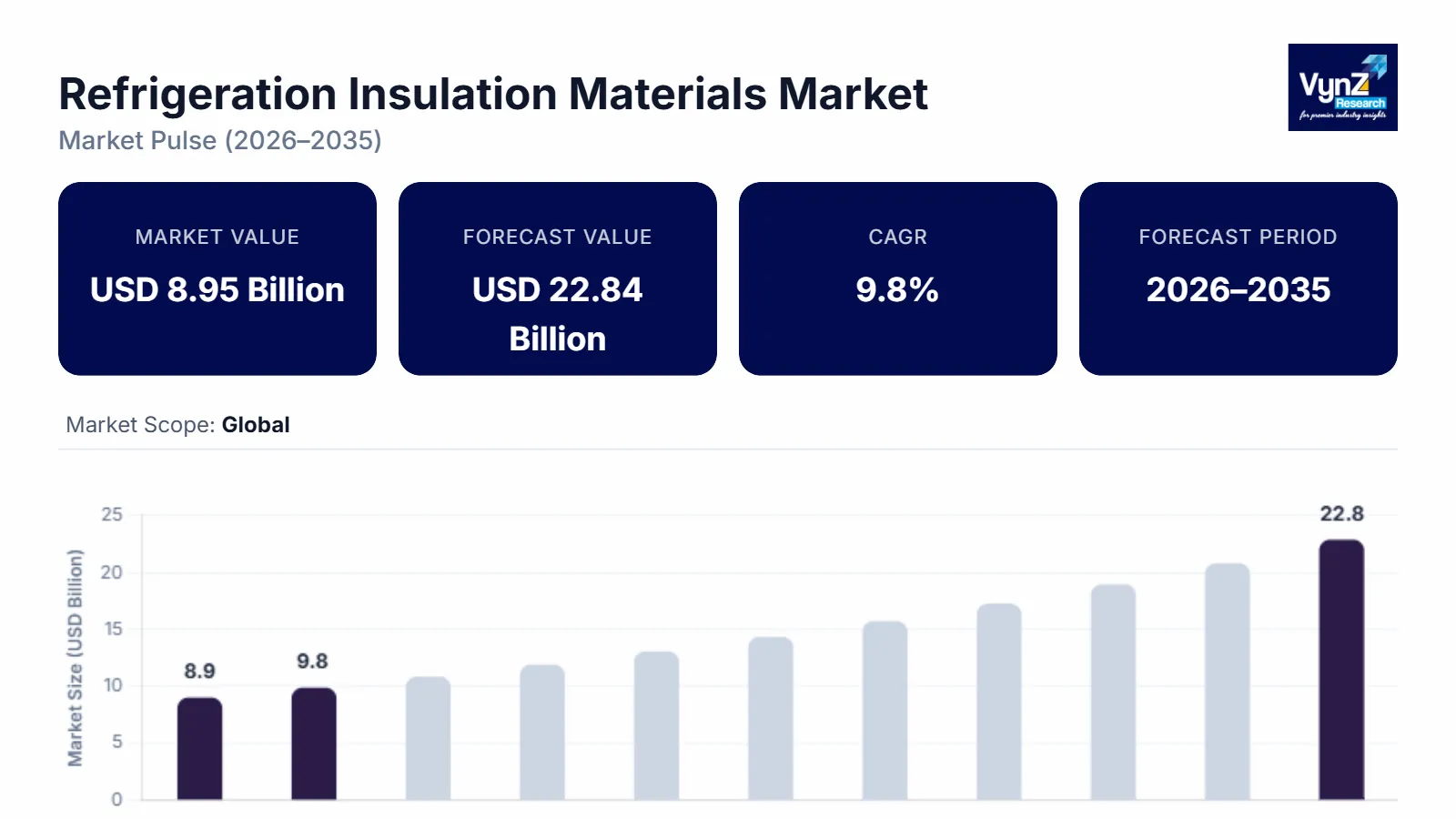
The refrigeration insulation materials market size was estimated at about USD 8.95 billion in 2025 and is expected to reach around USD 9.82 billion in 2026, rising to roughly USD 22.84 billion by 2035, growing at approximately 9.8% CAGR from 2026 to 2035.
Research Highlights
- Polyurethane foam held 42.6% market share in 2025 supported by superior thermal insulation performance.
- Refrigerated warehouses accounted for 34.8% share in 2025 due to expanding cold storage infrastructure.
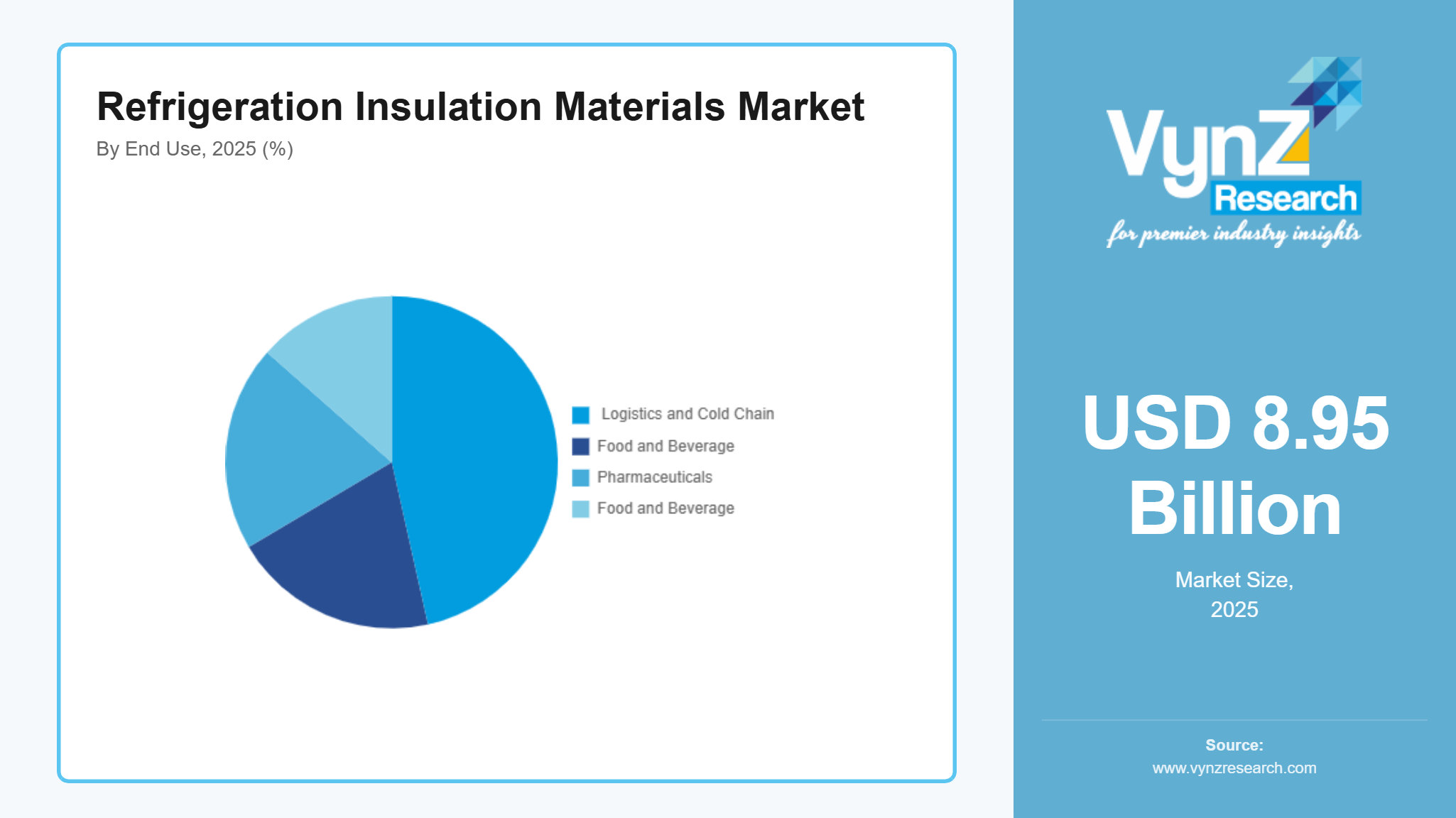
- Food and beverage represented 46.5% market share in 2025 owing to growing refrigerated food demand.
- The pharmaceuticals segment is projected to grow at 11.1% CAGR during 2026–2035 supported by vaccine cold chain expansion.
- North America represented 32.4% of the market in 2025 due to energy efficient refrigeration investments.
Market growth is facilitated by expanding cold chain infrastructure, increasing demand for energy efficient refrigeration systems, and rising investments in food and pharmaceutical storage along with growing adoption of high-performance insulation materials. Increasing demand for temperature-controlled logistics and continuous investments in sustainable building materials are further supporting market expansion across North America, Europe, and Asia Pacific. According to the International Energy Agency (IEA), improving insulation efficiency is essential for reducing energy consumption in cooling systems, while the United States Department of Energy (DOE) continues to promote advanced insulation technologies that enhance refrigeration efficiency and lower greenhouse gas emissions.
Refrigeration Insulation Materials Market Dynamics
Market Trends
The industry is witnessing notable shifts in material innovation, energy efficiency and sustainable manufacturing practices. One of the key trends shaping the market is the increasing adoption of low thermal conductivity insulation materials, reflecting changing preferences toward higher energy efficiency, lower operating costs, and improved environmental performance. Another emerging trend is the growing use of environmentally friendly insulation materials with low global warming potential, driven by evolving environmental regulations and sustainability initiatives. The United States Environmental Protection Agency (EPA) continues to encourage adoption of refrigerant and insulation technologies that reduce greenhouse gas emissions. These developments are encouraging manufacturers to focus on innovative insulation systems and sustainable product development, thereby strengthening competition within the global market.
Growth Drivers
The growth of the market is largely supported by rapid expansion of cold chain infrastructure, which continues to generate consistent demand across food processing, pharmaceutical storage and refrigerated logistics applications. Increasing investments in temperature-controlled warehouses and refrigerated transportation are further accelerating market expansion. Additionally, increasing emphasis on energy efficient refrigeration systems is playing a crucial role in boosting market adoption. As industries prioritize energy savings, environmental compliance and operational efficiency, demand for advanced insulation materials is expected to remain strong throughout the forecast period.
Market Restraints / Challenges
Despite favorable growth prospects, the market faces certain challenges that may limit its expansion. Volatility in raw material prices continues to affect manufacturing costs and profitability, particularly for producers dependent on petrochemical based insulation materials. According to the United States Department of Energy (DOE), fluctuations in material costs remain an important consideration for improving the affordability of energy efficient building products. Furthermore, stringent environmental regulations regarding insulation chemicals and manufacturing processes pose operational challenges for manufacturers.
Market Opportunities
The market presents significant opportunities in sustainable cold chain development and green building construction, particularly driven by increasing demand for energy efficient refrigeration systems and environmentally responsible insulation solutions. Companies offering high performance, recyclable and low emission insulation materials are well positioned to capture growing demand across food, healthcare, and logistics industries. The Food and Agriculture Organization (FAO) continues to support improvements in cold chain infrastructure to enhance food preservation and reduce post-harvest losses. Another key opportunity lies in advanced insulation technologies, where rising investments in high performance foams, vacuum insulation panels, and environmentally friendly materials are creating avenues for long term market growth.
Global Refrigeration Insulation Materials Market Report Coverage
|
Report Metric |
Details |
|
Historical Period |
2020 - 2024 |
|
Base Year Considered |
2025 |
|
Forecast Period |
2026 - 2035 |
|
Market Size in 2025 |
USD 8.95 Billion |
|
Revenue Forecast in 2035 |
USD 22.84 Billion |
|
Growth Rate |
9.8% |
|
Segments Covered in the Report |
Material Type, Application, End Use |
|
Report Scope |
Market Trends, Drivers, and Restraints; Revenue Estimation and Forecast; Segmentation Analysis; Companies’ Strategic Developments; Market Share Analysis of Key Players; Company Profiling |
|
Regions Covered in the Report |
North America, Europe, Asia pacific, Rest of the World |
|
Key Companies |
Armacell International S.A., BASF SE, Carlisle Companies Inc., Dow Inc., Huntsman Corporation, Kingspan Group plc, Owens Corning, Recticel NV, Saint-Gobain S.A., The 3M Company |
|
Customization |
Available upon request |
Refrigeration Insulation Materials Market Segmentation
By Material Type
Polyurethane foam accounted for the largest market share of approximately 42.6% in 2025 and is projected to expand at nearly 9.6% CAGR through 2035 supported by its superior thermal insulation performance, lightweight properties, and widespread application across commercial and industrial refrigeration systems.
Polyisocyanurate is expected to register the fastest growth at an estimated 10.8% CAGR due to its excellent fire resistance, higher thermal efficiency and increasing adoption in cold storage facilities.
By Application
Refrigerated warehouses held the largest revenue share of approximately 34.8% in 2025 and are expected to grow at nearly 9.5% CAGR supported by expanding cold chain infrastructure, increasing food storage capacity and growing pharmaceutical warehousing requirements.
Refrigerated transport is projected to register the fastest growth at around 10.6% CAGR due to increasing international food trade, pharmaceutical logistics, and temperature sensitive product distribution.
By End Use
The food and beverage segment accounted for the highest revenue share of approximately 46.5% in 2025 and is projected to expand at nearly 9.7% CAGR because of increasing consumption of frozen and processed foods, expansion of refrigerated storage facilities and growing demand for temperature-controlled food transportation.
The pharmaceuticals segment is expected to register the fastest growth at an estimated 11.1% CAGR, due to increasing demand for temperature-controlled storage of vaccines, biologics, and specialty medicines.
Regional Insights
North America
North America accounted for approximately 33% of the market in 2025 and is expected to grow at nearly 9.6% CAGR through 2035 due to the expansion of cold chain logistics, increasing demand for energy efficient refrigeration systems and stringent energy efficiency regulations. The United States and Canada continue to lead regional demand due to significant investments in food processing, pharmaceutical storage, and temperature-controlled warehouses. According to the United States Department of Energy (DOE), advanced insulation technologies are essential for reducing refrigeration energy consumption and improving building efficiency. Government initiatives promoting sustainable cooling systems, combined with growing investments in modern cold storage infrastructure, continue to strengthen regional market growth.
Europe
Europe represented approximately 26% of the global market in 2025 and is projected to expand at around 9.4% CAGR during the forecast period supported by stringent environmental regulations, increasing renovation of refrigerated infrastructure and growing demand for sustainable insulation materials across Germany, France, Italy, and the United Kingdom. According to the European Commission, improving building energy efficiency and sustainable cooling technologies remains a key priority under regional climate and energy policies. Increasing investments in pharmaceutical cold chain facilities and food preservation infrastructure continue to support market expansion, while manufacturers are focusing on low emission insulation solutions to comply with evolving regulatory standards.
Asia Pacific
Asia Pacific held about 24% of the market in 2025 and is anticipated to register nearly 10.4% CAGR because of rapid industrialization, expanding food processing industries and significant investments in cold chain logistics across China, India, Japan, South Korea, and Southeast Asia. According to the Food and Agriculture Organization (FAO), strengthening cold storage infrastructure is becoming increasingly important to reduce food losses and improve agricultural supply chains. Growing pharmaceutical manufacturing activities and increasing demand for temperature-controlled transportation are further supporting adoption of advanced refrigeration insulation materials throughout the region.
Rest of the World
The Rest of the World contributed around 17% of the market in 2025 and is expected to grow at nearly 9.2% CAGR supported by expanding refrigerated logistics, increasing healthcare investments and gradual modernization of food storage infrastructure across Latin America, the Middle East, and Africa. Government initiatives promoting food security and healthcare development continue to support demand for efficient refrigeration systems.
Competitive Landscape / Company Insights
The market is moderately to highly competitive with global and regional manufacturers focusing on product innovation, sustainable insulation technologies and capacity expansion. Companies are increasingly investing in research and development, environmentally friendly materials and advanced manufacturing processes to strengthen their market position. The United States Department of Energy (DOE) and the International Energy Agency (IEA) continue to support energy efficient insulation technologies that improve refrigeration performance and reduce energy consumption.
Mini Profiles
Armacell International S.A. focuses on flexible insulation solutions for refrigeration and HVAC applications, supported by strong global distribution, technical expertise, and energy efficiency focused product development.
BASF SE operates in advanced insulation materials and polyurethane systems, emphasizing innovation, sustainable chemistry, and high performance thermal solutions for industrial and commercial refrigeration.
Dow Inc. leverages extensive materials science capabilities, strategic partnerships, and global manufacturing networks to expand its presence in refrigeration insulation and energy efficient building solutions.
Kingspan Group plc focuses on high performance insulation products, supported by strong brand recognition, continuous research and development, and growing investments in sustainable construction technologies.
Saint-Gobain S.A. specializes in thermal insulation materials and engineered building solutions, supported by diversified manufacturing operations, advanced material technologies, and a broad international customer base.
Key Players
- Armacell
- International S.A.
- BASF SE
- Carlisle Companies Inc.
- Dow Inc.
- Huntsman Corporation
- Kingspan Group plc
- Owens Corning
- Recticel NV
- Saint-Gobain S.A.
- The 3M Company
Recent Developments
In February 2025, Carlisle Companies Inc. expanded production capacity for energy efficient insulation products to support growing demand from cold storage and refrigeration infrastructure projects. The investment is aimed at strengthening supply availability across North America.
In April 2025, Huntsman Corporation introduced new polyurethane insulation formulations designed to improve thermal performance and reduce environmental impact in refrigeration applications. The development supports increasing demand for sustainable insulation solutions.
In June 2025, Owens Corning announced additional investments in advanced insulation manufacturing technologies to enhance energy efficiency and production capacity. The initiative is intended to support expanding demand from commercial and industrial refrigeration projects.
In September 2025, Recticel NV launched upgraded high performance insulation products targeting cold chain and temperature-controlled logistics applications. The new portfolio emphasizes improved thermal resistance and sustainability performance.
In January 2026, The 3M Company expanded research activities focused on advanced insulation materials and energy efficient refrigeration technologies. The program aims to support lower energy consumption and improved thermal management across industrial cooling systems.
Global Refrigeration Insulation Materials Market Coverage
Material Type Insight and Forecast 2026 - 2035
- Polyurethane Foam (PU)
- Polyisocyanurate (PIR)
- Expanded Polystyrene (EPS)
- Extruded Polystyrene (XPS)
- Phenolic Foam
- Fiberglass
- Cellular Glass
- Other Insulation Materials
Application Insight and Forecast 2026 - 2035
- Refrigerated Warehouses
- Refrigerated Transport
- Commercial Refrigeration
- Industrial Refrigeration
- Domestic Refrigeration
End Use Insight and Forecast 2026 - 2035
- Food and Beverage
- Pharmaceuticals
- Chemicals
- Logistics and Cold Chain
- Residential
- Others
Global Refrigeration Insulation Materials Market by Region
- North America
- By Material Type
- By Application
- By End Use
- By Country - U.S., Canada, Mexico
- Europe
- By Material Type
- By Application
- By End Use
- By Country - Germany, U.K., France, Italy, Spain, Russia, Rest of Europe
- Asia-Pacific (APAC)
- By Material Type
- By Application
- By End Use
- By Country - China, Japan, India, South Korea, Vietnam, Thailand, Malaysia, Rest of Asia-Pacific
- Rest of the World (RoW)
- By Material Type
- By Application
- By End Use
- By Country - Brazil, Saudi Arabia, South Africa, U.A.E., Other Countries
Table of Contents for Refrigeration Insulation Materials Market Report
1. Research Overview
1.1. The Report Offers
1.2. Market Coverage
1.2.1. By
Material Type
1.2.2. By
Application
1.2.3. By
End Use
1.3. Research Phases
1.4. Limitations
1.5. Market Methodology
1.5.1. Data Sources
1.5.1.1.
Primary Research
1.5.1.2.
Secondary Research
1.5.2. Methodology
1.5.2.1.
Data Exploration
1.5.2.2.
Forecast Parameters
1.5.2.3.
Data Validation
1.5.2.4.
Assumptions
1.5.3. Study Period & Data Reporting Unit
2. Executive Summary
3. Industry Overview
3.1. Industry Dynamics
3.1.1. Market Growth Drivers
3.1.2. Market Restraints
3.1.3. Key Market Trends
3.1.4. Major Opportunities
3.2. Industry Ecosystem
3.2.1. Porter’s Five Forces Analysis
3.2.2. Recent Development Analysis
3.2.3. Value Chain Analysis
3.3. Competitive Insight
3.3.1. Competitive Position of Industry
Players
3.3.2. Market Attractive Analysis
3.3.3. Market Share Analysis
4. Global Market Estimate and Forecast
4.1. Global Market Overview
4.2. Global Market Estimate and Forecast to 2035
5. Market Segmentation Estimate and Forecast
5.1. By Material Type
5.1.1. Polyurethane Foam (PU)
5.1.1.1. Market Definition
5.1.1.2. Market Estimation and Forecast to 2035
5.1.2. Polyisocyanurate (PIR)
5.1.2.1. Market Definition
5.1.2.2. Market Estimation and Forecast to 2035
5.1.3. Expanded Polystyrene (EPS)
5.1.3.1. Market Definition
5.1.3.2. Market Estimation and Forecast to 2035
5.1.4. Extruded Polystyrene (XPS)
5.1.4.1. Market Definition
5.1.4.2. Market Estimation and Forecast to 2035
5.1.5. Phenolic Foam
5.1.5.1. Market Definition
5.1.5.2. Market Estimation and Forecast to 2035
5.1.6. Fiberglass
5.1.6.1. Market Definition
5.1.6.2. Market Estimation and Forecast to 2035
5.1.7. Cellular Glass
5.1.7.1. Market Definition
5.1.7.2. Market Estimation and Forecast to 2035
5.1.8. Other Insulation Materials
5.1.8.1. Market Definition
5.1.8.2. Market Estimation and Forecast to 2035
5.2. By Application
5.2.1. Refrigerated Warehouses
5.2.1.1. Market Definition
5.2.1.2. Market Estimation and Forecast to 2035
5.2.2. Refrigerated Transport
5.2.2.1. Market Definition
5.2.2.2. Market Estimation and Forecast to 2035
5.2.3. Commercial Refrigeration
5.2.3.1. Market Definition
5.2.3.2. Market Estimation and Forecast to 2035
5.2.4. Industrial Refrigeration
5.2.4.1. Market Definition
5.2.4.2. Market Estimation and Forecast to 2035
5.2.5. Domestic Refrigeration
5.2.5.1. Market Definition
5.2.5.2. Market Estimation and Forecast to 2035
5.3. By End Use
5.3.1. Food and Beverage
5.3.1.1. Market Definition
5.3.1.2. Market Estimation and Forecast to 2035
5.3.2. Pharmaceuticals
5.3.2.1. Market Definition
5.3.2.2. Market Estimation and Forecast to 2035
5.3.3. Chemicals
5.3.3.1. Market Definition
5.3.3.2. Market Estimation and Forecast to 2035
5.3.4. Logistics and Cold Chain
5.3.4.1. Market Definition
5.3.4.2. Market Estimation and Forecast to 2035
5.3.5. Residential
5.3.5.1. Market Definition
5.3.5.2. Market Estimation and Forecast to 2035
5.3.6. Others
5.3.6.1. Market Definition
5.3.6.2. Market Estimation and Forecast to 2035
6. North America Market Estimate and Forecast
6.1. By
Material Type
6.2. By
Application
6.3. By
End Use
6.3.1.
U.S. Market Estimate and Forecast
6.3.2.
Canada Market Estimate and Forecast
6.3.3.
Mexico Market Estimate and Forecast
7. Europe Market Estimate and Forecast
7.1. By
Material Type
7.2. By
Application
7.3. By
End Use
7.3.1.
Germany Market Estimate and Forecast
7.3.2.
France Market Estimate and Forecast
7.3.3.
U.K. Market Estimate and Forecast
7.3.4.
Italy Market Estimate and Forecast
7.3.5.
Spain Market Estimate and Forecast
7.3.6.
Russia Market Estimate and Forecast
7.3.7.
Rest of Europe Market Estimate and Forecast
8. Asia-Pacific (APAC) Market Estimate and Forecast
8.1. By
Material Type
8.2. By
Application
8.3. By
End Use
8.3.1.
China Market Estimate and Forecast
8.3.2.
Japan Market Estimate and Forecast
8.3.3.
India Market Estimate and Forecast
8.3.4.
South Korea Market Estimate and Forecast
8.3.5.
Rest of Asia-Pacific Market Estimate and Forecast
9. Rest of the World (RoW) Market Estimate and Forecast
9.1. By
Material Type
9.2. By
Application
9.3. By
End Use
9.3.1.
Brazil Market Estimate and Forecast
9.3.2.
Saudi Arabia Market Estimate and Forecast
9.3.3.
South Africa Market Estimate and Forecast
9.3.4.
U.A.E. Market Estimate and Forecast
9.3.5.
Other Countries Market Estimate and Forecast
10. Company Profiles
10.1.
Armacell International S.A.
10.1.1.
Snapshot
10.1.2.
Overview
10.1.3.
Offerings
10.1.4.
Financial
Insight
10.1.5.
Recent
Developments
10.2.
BASF SE
10.2.1.
Snapshot
10.2.2.
Overview
10.2.3.
Offerings
10.2.4.
Financial
Insight
10.2.5.
Recent
Developments
10.3.
Carlisle Companies Inc.
10.3.1.
Snapshot
10.3.2.
Overview
10.3.3.
Offerings
10.3.4.
Financial
Insight
10.3.5.
Recent
Developments
10.4.
Dow Inc.
10.4.1.
Snapshot
10.4.2.
Overview
10.4.3.
Offerings
10.4.4.
Financial
Insight
10.4.5.
Recent
Developments
10.5.
Huntsman Corporation
10.5.1.
Snapshot
10.5.2.
Overview
10.5.3.
Offerings
10.5.4.
Financial
Insight
10.5.5.
Recent
Developments
10.6.
Kingspan Group plc
10.6.1.
Snapshot
10.6.2.
Overview
10.6.3.
Offerings
10.6.4.
Financial
Insight
10.6.5.
Recent
Developments
10.7.
Owens Corning
10.7.1.
Snapshot
10.7.2.
Overview
10.7.3.
Offerings
10.7.4.
Financial
Insight
10.7.5.
Recent
Developments
10.8.
Recticel NV
10.8.1.
Snapshot
10.8.2.
Overview
10.8.3.
Offerings
10.8.4.
Financial
Insight
10.8.5.
Recent
Developments
10.9.
Saint-Gobain S.A.
10.9.1.
Snapshot
10.9.2.
Overview
10.9.3.
Offerings
10.9.4.
Financial
Insight
10.9.5.
Recent
Developments
10.10.
The 3M Company
10.10.1.
Snapshot
10.10.2.
Overview
10.10.3.
Offerings
10.10.4.
Financial
Insight
10.10.5.
Recent
Developments
11. Appendix
11.1. Exchange Rates
11.2. Abbreviations
Note: Financial insight and recent developments of different companies are subject to the availability of information in the secondary domain.
Frequently Asked Questions
Purchase Options
Latest Report
Research Methodology
- Desk Research / Pilot Interviews
- Build Market Size Model
- Research and Analysis
- Final Deliverable
Connect With Our Sales Team
- Toll-Free: +1-888-253-3960
- Phone: +91 9960 288 381
- Email: enquiry@vynzresearch.com
Refrigeration Insulation Materials Market