
Asia Pacific E-Cigarette Market Size & Share - Growth Forecast Report (2026-2035)
Industry Insight by Product Type (Disposable e cigarettes, Rechargeable e cigarettes, Modular e cigarettes), by Distribution Channel (Offline retail stores, Online retail channels), by Category (Closed system, Open system), by Flavor Type (Tobacco flavor, Menthol flavor, Fruit and other flavors)
| Status : Published | Published On : May, 2026 | Report Code : VRSME9208 | Industry : Semiconductor & Electronics | Available Format :

|
Page : 132 |
Asia Pacific E-Cigarette Market Overview
The Asia Pacific e-cigarette market which was valued at approximately USD 1.49 billion in 2025 and is estimated to reach around USD 1.60 billion in 2026, is projected to reach approximately USD 3.50 billion by 2035, expanding at a CAGR of about 9.2% during the forecast period from 2026 to 2035.
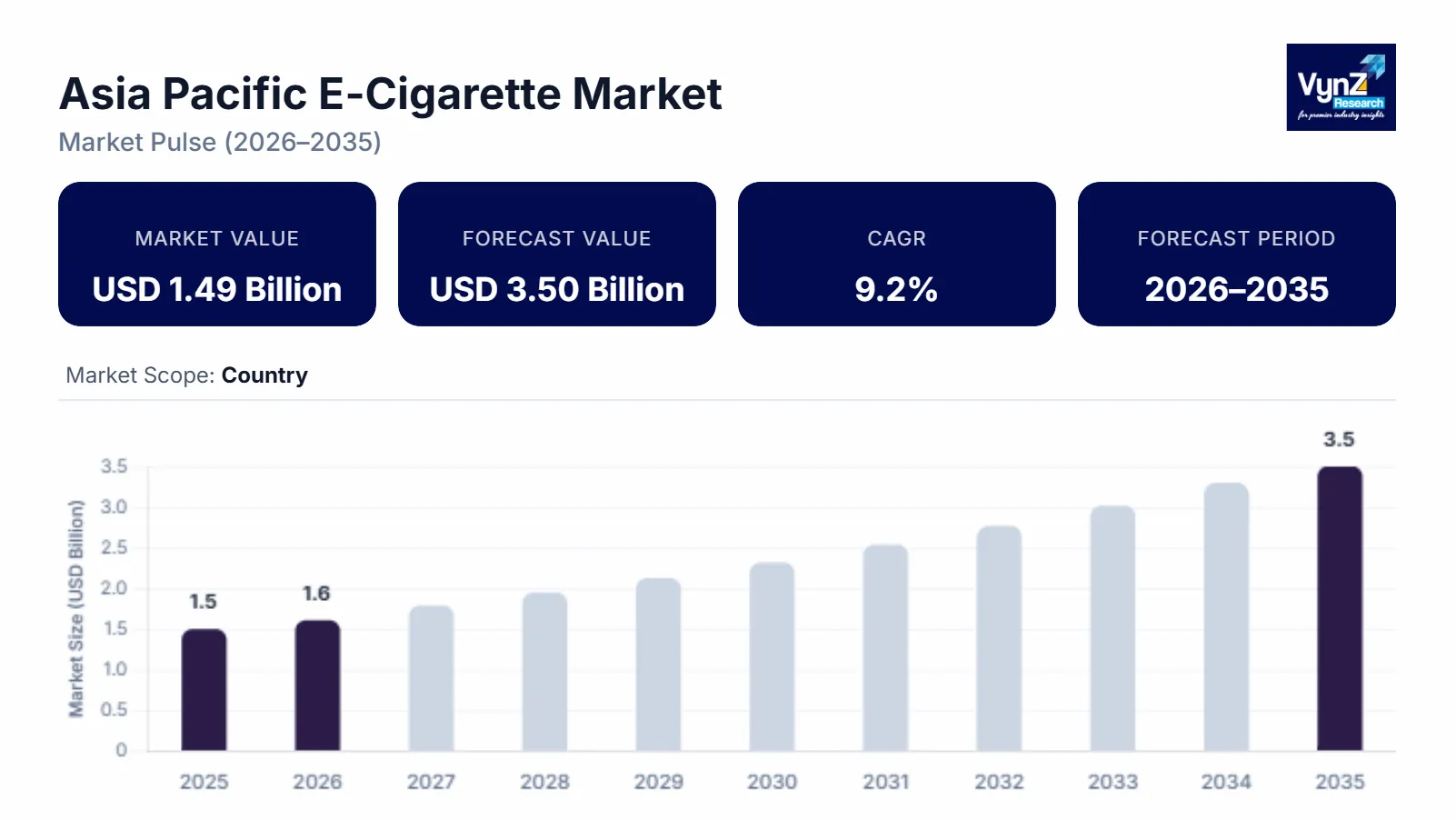
The market expands because more people choose better nicotine products over traditional tobacco products and urban customers prefer flavored vaping products and digital retail channels gain more popularity. The World Health Organization maintains its global tobacco harm reduction strategies which continue to shape regulatory frameworks and implementation practices in the Asia Pacific region. The market currently expands because customers in emerging metropolitan areas spend more money and cities grow bigger and their lifestyle choices evolve.
The Chinese, Japanese, South Korean and Indian governments develop public health programs to reduce smoking while they regulate nicotine consumption across their countries. The market competition increases because companies are investing more in product development and device safety and they are introducing new flavor options. The e-commerce growth and retail development in Beijing, Tokyo, Seoul and Mumbai bring better product access while supporting ongoing market growth in the region.
Asia Pacific E-Cigarette Market Dynamics
Market Trends
The is experiencing significant transformations because consumers now choose to buy their products through online platforms and they prefer to use flavored nicotine products. The market experiences its most important transformation through the fast adoption of less harmful nicotine delivery systems which match consumer demands for products that allow controlled usage, individualized design and easy daily application. The public health policy changes and the implementation of organized tobacco control systems create an emerging trend that establishes stricter product compliance standards and improves regulatory alignment throughout the industry. The market changes of these developments lead to product portfolio changes which drive companies to develop safer devices, create new flavors and build digital distribution systems which operate under regulated Asian markets.
Growth Drivers
The market grows because urban adult consumers continue to demand tobacco harm reduction initiatives which support their needs. The market in China, Japan, South Korea and India experiences growth through increased spending on public health education initiatives and dedicated tobacco cessation programs. E-commerce growth is essential for expanding product adoption throughout the market. The demand for advanced vaping devices and refill systems will remain strong during the entire forecast period because consumers now prioritize cost efficiency, product accessibility and lifestyle-oriented options, which are supported by regulatory acceptance in specific Asia Pacific countries.
Market Restraints / Challenges
The market will experience growth limitations because countries impose specific regulatory requirements that create obstacles for market expansion. Market entry becomes difficult for businesses through strict advertising bans, flavor restrictions and product approval regulations, which particularly impact price sensitive markets that operate under new regulatory frameworks. The Asia Pacific region contains multiple regulatory systems which create obstacles for manufacturers and distributors who operate between different territories. The use of imported components and technology-based manufacturing systems results in supply chain interruptions, unexpected cost changes and limited capacity to scale operations, which decreases market performance during times of regulatory enforcement and economic instability.
Market Opportunities
The market provides major opportunities for digitally enabled nicotine delivery systems because more consumers now prefer to order their products through e-commerce while customizing their vaping experiences. Companies that provide affordable devices with customization options and high-performance capabilities will attract more demand from young adult customers who live in urban areas. Smart vaping technologies and regulated product innovation create a market opportunity because businesses now invest in device safety and controlled nicotine delivery and connected product ecosystems to achieve higher profit margins. The evolution of digital retail platforms, automated compliance monitoring systems and product tracking systems will enable businesses to boost customer interaction while establishing enduring market presence.
Asia Pacific E-Cigarette Market Report Coverage
|
Report Metric |
Details |
|
Historical Period |
2020 - 2024 |
|
Base Year Considered |
2025 |
|
Forecast Period |
2026 - 2035 |
|
Market Size in 2025 |
USD 1.49 Billion |
|
Revenue Forecast in 2035 |
USD 3.50 Billion |
|
Growth Rate |
9.2% |
|
Segments Covered in the Report |
Product Type, Distribution Channel, Category, Flavor Type |
|
Report Scope |
Market Trends, Drivers, and Restraints; Revenue Estimation and Forecast; Segmentation Analysis; Companies’ Strategic Developments; Market Share Analysis of Key Players; Company Profiling |
|
Regions Covered in the Report |
China, Japan, South Korea, India, Rest of Asia Pacific |
|
Key Companies |
British American Tobacco, Imperial Brands, Japan Tobacco International, Juul Labs, KT&G Corporation, Nicoventures Trading Limited, NJOY LLC, Philip Morris International, RELX Technology, Shenzhen Smoore Technology |
|
Customization |
Available upon request |
Asia-Pacific E-Cigarette Market Segmentation
By Product Type
The market in 2025 saw disposable e-cigarettes generate the highest revenue share which reached about 42% of overall market revenue. The market presence of low cost, ready to use devices which need minimal upkeep work continues to attract first time users and younger adult customers from urban areas. The World Health Organization frameworks which present governmental support for tobacco harm reduction narratives indirectly encourage people to adopt different nicotine delivery systems. The increasing number of retail locations throughout China and Southeast Asia produces a stronger market presence. Disposable formats maintain their widespread appeal because they provide easy use, portable design, and affordable access which creates ongoing demand among mass consumer groups.
The period between 2026 and 2035 will bring about rechargeables e-cigarettes to become the most rapidly growing product category with an expected compound annual growth rate of 9.6%. The market expansion occurs because customers now prefer devices which create lower long-term usage costs alongside better battery performance. Customers increasingly choose reusable vaping systems which they can customize, which leads to market segment growth. The development of rechargeable systems occurs because Asian markets need standardized products while nicotine delivery systems require control, especially in advanced nations like Japan and South Korea.
By Distribution Channel
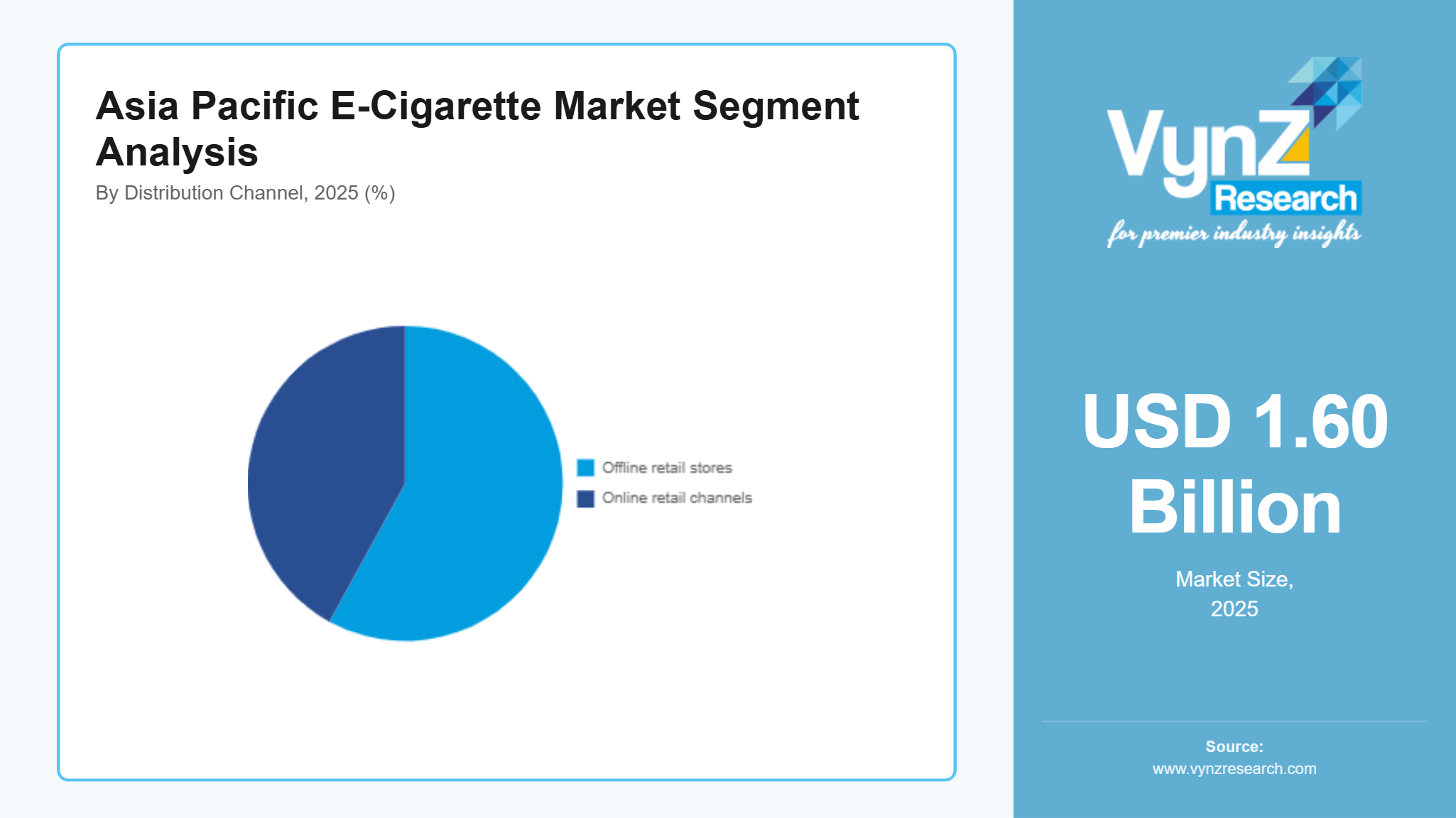
The market in 2025 received its main revenue source from offline retail stores, which created approximately 58% of the total market value. Physical product verification together with immediate product accessibility and in-store product guidance creates strong consumer demand that predominates in regulated marketplaces. Convenience stores together with specialty vape shops and tobacco outlets maintain their status as essential distribution channels, which serve customers throughout China, Japan and Southeast Asia. The government-controlled age verification rules together with retail licensing systems create barriers to product distribution through offline channels, which enables proper product access control while all major economies remain in full regulatory compliance.
The online retail sector will establish itself as the fastest expanding market segment with an expected compound annual growth rate of 11.2% during the period from 2026 to 2035. The market expansion occurs because customers now prefer to shop direct online to receive their products but want to keep their purchases discreet and their shopping experience simple. Online adoption through urban areas receives a boost from improved logistics systems and secure payment methods. Digital platforms which combine with direct-to-consumer channels owned by brands create better product access to both developed and emerging markets across Asia Pacific.
By Category
The Asia Pacific e-cigarette market reached its 2025 peak with closed system e-cigarettes which held 54% of the market through their user-friendly design. The simpler usage requirements of these systems become the primary reason their adoption exists among markets which implement stringent regulatory controls. The international tobacco control guidelines enable the adoption of closed systems in controlled markets throughout Asia Pacific because they require users to manage their nicotine intake through standardized product formats.
The open system e-cigarette market will grow at the fastest rate between 2026 and 2035 because it will achieve a compound annual growth rate of 10.4%. The market expansion occurs because customers now prefer to create their own vaping experience through custom products which deliver higher vapor output and enable them to manage nicotine intake. The product appeal grows because refillable tank systems together with coil efficiency receive improved technological development. The vape culture in urban areas now drives experienced users to adopt vaping products, which leads to segment expansion in major Asia Pacific markets.
By Flavor Type
The market in achieved its highest revenue share from fruit and other flavors which generated 46% of the market total in 2025. The market expansion occurs because younger adult users prefer products that offer different taste experiences together with improved sensory enjoyment. The product differentiation between competitors in the market space relies on flavor innovation, which remains essential despite the rising regulatory scrutiny faced by some countries. The ongoing demand for flavored vaping products receives support through retail and online platforms, which expand their product selection.
The segment dedicated to tobacco flavor e-cigarettes will experience sustained growth as traditional cigarette smokers transition to this product because it retains their familiar taste experience. The menthol flavor variants face moderate growth, which results from their cooling sensory appeal and their continued demand among specific consumer groups throughout the Asia Pacific area.
Regional Insights
China
China held 34% of the market in 2025 because urban consumers adopted e-cigarettes while the country maintained its capacity to produce vaping equipment and online businesses expanded their operations. Urban centers including Beijing, Shanghai, and Shenzhen sustain high product usage through their extensive retail facilities which match the changing behaviors of their residents. Government-supported public health systems partner with tobacco control programs and nicotine control regulations which use global health authority standards to construct organized market development procedures. The regional market in tier 1 and tier 2 cities strengthens its performance through rising demand for flavored vaping products and the growth of online distribution networks.
Japan
Japan possessed 18% of the market in 2025 because its consumers knew about e-cigarettes while retailers built advanced store systems and the government prohibited nicotine product sales through its strict regulatory framework. Tokyo, Osaka, and Yokohama serve as main product consumption areas where residents choose products according to their urban lifestyle needs and local store availability. Government-supported tobacco harm reduction initiatives work together with strict product compliance frameworks to regulate market entry while public health regulations control product consumption practices. The rising demand for reduced odor and low combustion alternatives is driving consistent product adoption among adult consumers who live in both urban and suburban areas.
South Korea
South Korea held a 12% market share in 2025 because its citizens used smartphones at high rates and e-commerce platforms became popular while consumers started using alternative nicotine products. The two demand centers of Seoul and Busan feature growing specialty shops which offer customers both physical and online shopping choices. Government-backed smoking reduction initiatives work together with public health campaigns to control how smoking rates develop nationwide while the government regulates product development through safety rules and standardization processes. The market growth of flavored and rechargeable devices among young adult customers is driven by two factors like the rising demand for these products and the increasing use of online distribution channels.
India
India possessed 8% of the market in 2025 because urban residents started using alternative nicotine products after they experienced global lifestyle trends while local regulations stayed weak. Mumbai, Delhi, and Bengaluru rank as major consumption centers because people can buy products online and through unlicensed retail outlets. Government tobacco control initiatives and public health policies maintain strict standards which derive from World Health Organization regulations and lead to a controlled market environment with uneven accessibility. The rising digital commerce penetration and youth-oriented product awareness are supporting niche demand expansion across metropolitan regions.
Rest of Asia Pacific
The Rest of Asia Pacific including Indonesia, Vietnam, Thailand and Malaysia accounted for 9% of the market in 2025. Urban areas in this region expand as their populations grow and people obtain more income and retail stores modernize. People in key metropolitan areas now have better access to alternative nicotine products because they can purchase products online and obtain products from international sources. Government tobacco control measures work with developing regulatory frameworks to establish controlled market development while global lifestyle trends create a growing effect on product consumption patterns. The Asia Pacific territories which remain outside this segmentation analysis account for 19% of the total market.
Competitive Landscape / Company Insights
The market has a moderate level of competition which international and local companies use to compete by developing new products, creating different flavors and establishing more online distribution channels. Companies are increasingly investing in R&D, branding and device safety technologies to enhance their market position in both regulated and semi-regulated Asia Pacific markets. The existence of government-supported tobacco control systems and international health organizations' public health recommendations affects product compliance while the implementation of stricter regulatory frameworks in China, Japan and South Korea establishes entry barriers which require companies to enter the market through organized methods and innovation-based development.
Mini Profiles
British American Tobacco focuses on reduced risk nicotine products and e-cigarette solutions, supported by strong global distribution strength and high brand recognition across regulated Asia-Pacific consumer markets.
Imperial Brands operates in premium and mass vaping segments, emphasizing product innovation, device performance, and diversified nicotine delivery systems tailored for evolving adult consumer preferences.
Japan Tobacco International leverages strong regional manufacturing capabilities and strategic partnerships to expand market presence across Asia-Pacific nicotine alternatives and next generation vaping product portfolios.
Juul Labs focuses on closed system e-cigarette devices and nicotine pod solutions, supported by strong brand recognition and technology driven product design across urban consumer markets.
KT&G Corporation operates in mass and emerging nicotine alternative segments, emphasizing cost efficiency, localized product development, and expanding distribution networks across Asia-Pacific regions.
Key Players
- British American Tobacco
- Imperial Brands
- Japan Tobacco International
- Juul Labs
- KT&G Corporation
- Nicoventures Trading Limited
- NJOY LLC
- Philip Morris International
- RELX Technology
- Shenzhen Smoore Technology
Recent Developments
In February 2026, Nicoventures Trading Limited advanced next generation nicotine product research focused on reduced risk solutions. The company strengthened regulatory aligned innovation and collaboration within global harm reduction frameworks and compliant vaping ecosystems.
In March 2026, NJOY LLC expanded regulatory approved e cigarette offerings targeting stricter compliance markets. The company focused on product validation, safety standards, and controlled nicotine delivery aligned with evolving public health regulations.
In May 2026, Philip Morris International progressed smoke free transformation initiatives through expanded heated tobacco and nicotine alternative systems. The company reinforced R&D investment and regulatory engagement supporting reduced risk product commercialization globally.
In April 2026, RELX Technology strengthened digital distribution and smart vaping device capabilities across Asia Pacific markets. The company enhanced product safety features and compliance aligned innovation supporting regulated consumer adoption trends.
In March 2026, Shenzhen Smoore Technology advanced vaping hardware innovation focused on atomization efficiency and device performance. The company expanded OEM manufacturing strength while aligning with global regulatory product quality standards.
Asia Pacific E-Cigarette Market Coverage
Product Type Insight and Forecast 2026 - 2035
- Disposable e cigarettes
- Rechargeable e cigarettes
- Modular e cigarettes
Distribution Channel Insight and Forecast 2026 - 2035
- Offline retail stores
- Online retail channels
Category Insight and Forecast 2026 - 2035
- Closed system
- Open system
Flavor Type Insight and Forecast 2026 - 2035
- Tobacco flavor
- Menthol flavor
- Fruit and other flavors
Asia Pacific E-Cigarette Market by Region
- China
- By Product Type
- By Distribution Channel
- By Category
- By Flavor Type
- Japan
- By Product Type
- By Distribution Channel
- By Category
- By Flavor Type
- India
- By Product Type
- By Distribution Channel
- By Category
- By Flavor Type
- South Korea
- By Product Type
- By Distribution Channel
- By Category
- By Flavor Type
- Vietnam
- By Product Type
- By Distribution Channel
- By Category
- By Flavor Type
- Thailand
- By Product Type
- By Distribution Channel
- By Category
- By Flavor Type
- Malaysia
- By Product Type
- By Distribution Channel
- By Category
- By Flavor Type
- Rest of Asia-Pacific
- By Product Type
- By Distribution Channel
- By Category
- By Flavor Type
Table of Contents for Asia Pacific E-Cigarette Market Report
1. Research Overview
1.1. The Report Offers
1.2. Market Coverage
1.2.1. By
Product Type
1.2.2. By
Distribution Channel
1.2.3. By
Category
1.2.4. By
Flavor Type
1.3. Research Phases
1.4. Limitations
1.5. Market Methodology
1.5.1. Data Sources
1.5.1.1.
Primary Research
1.5.1.2.
Secondary Research
1.5.2. Methodology
1.5.2.1.
Data Exploration
1.5.2.2.
Forecast Parameters
1.5.2.3.
Data Validation
1.5.2.4.
Assumptions
1.5.3. Study Period & Data Reporting Unit
2. Executive Summary
3. Industry Overview
3.1. Industry Dynamics
3.1.1. Market Growth Drivers
3.1.2. Market Restraints
3.1.3. Key Market Trends
3.1.4. Major Opportunities
3.2. Industry Ecosystem
3.2.1. Porter’s Five Forces Analysis
3.2.2. Recent Development Analysis
3.2.3. Value Chain Analysis
3.3. Competitive Insight
3.3.1. Competitive Position of Industry
Players
3.3.2. Market Attractive Analysis
3.3.3. Market Share Analysis
4. Asia Market Estimate and Forecast
4.1. Asia Market Overview
4.2. Asia Market Estimate and Forecast to 2035
5. Market Segmentation Estimate and Forecast
5.1. By Product Type
5.1.1. Disposable e cigarettes
5.1.1.1. Market Definition
5.1.1.2. Market Estimation and Forecast to 2035
5.1.2. Rechargeable e cigarettes
5.1.2.1. Market Definition
5.1.2.2. Market Estimation and Forecast to 2035
5.1.3. Modular e cigarettes
5.1.3.1. Market Definition
5.1.3.2. Market Estimation and Forecast to 2035
5.2. By Distribution Channel
5.2.1. Offline retail stores
5.2.1.1. Market Definition
5.2.1.2. Market Estimation and Forecast to 2035
5.2.2. Online retail channels
5.2.2.1. Market Definition
5.2.2.2. Market Estimation and Forecast to 2035
5.3. By Category
5.3.1. Closed system
5.3.1.1. Market Definition
5.3.1.2. Market Estimation and Forecast to 2035
5.3.2. Open system
5.3.2.1. Market Definition
5.3.2.2. Market Estimation and Forecast to 2035
5.4. By Flavor Type
5.4.1. Tobacco flavor
5.4.1.1. Market Definition
5.4.1.2. Market Estimation and Forecast to 2035
5.4.2. Menthol flavor
5.4.2.1. Market Definition
5.4.2.2. Market Estimation and Forecast to 2035
5.4.3. Fruit and other flavors
5.4.3.1. Market Definition
5.4.3.2. Market Estimation and Forecast to 2035
6. China Market Estimate and Forecast
6.1. By
Product Type
6.2. By
Distribution Channel
6.3. By
Category
6.4. By
Flavor Type
7. Japan Market Estimate and Forecast
7.1. By
Product Type
7.2. By
Distribution Channel
7.3. By
Category
7.4. By
Flavor Type
8. India Market Estimate and Forecast
8.1. By
Product Type
8.2. By
Distribution Channel
8.3. By
Category
8.4. By
Flavor Type
9. South Korea Market Estimate and Forecast
9.1. By
Product Type
9.2. By
Distribution Channel
9.3. By
Category
9.4. By
Flavor Type
10. Vietnam Market Estimate and Forecast
10.1. By
Product Type
10.2. By
Distribution Channel
10.3. By
Category
10.4. By
Flavor Type
11. Thailand Market Estimate and Forecast
11.1. By
Product Type
11.2. By
Distribution Channel
11.3. By
Category
11.4. By
Flavor Type
12. Malaysia Market Estimate and Forecast
12.1. By
Product Type
12.2. By
Distribution Channel
12.3. By
Category
12.4. By
Flavor Type
13. Rest of Asia-Pacific Market Estimate and Forecast
13.1. By
Product Type
13.2. By
Distribution Channel
13.3. By
Category
13.4. By
Flavor Type
14. Company Profiles
14.1.
British American Tobacco
14.1.1.
Snapshot
14.1.2.
Overview
14.1.3.
Offerings
14.1.4.
Financial
Insight
14.1.5.
Recent
Developments
14.2.
Imperial Brands
14.2.1.
Snapshot
14.2.2.
Overview
14.2.3.
Offerings
14.2.4.
Financial
Insight
14.2.5.
Recent
Developments
14.3.
Japan Tobacco International
14.3.1.
Snapshot
14.3.2.
Overview
14.3.3.
Offerings
14.3.4.
Financial
Insight
14.3.5.
Recent
Developments
14.4.
Juul Labs
14.4.1.
Snapshot
14.4.2.
Overview
14.4.3.
Offerings
14.4.4.
Financial
Insight
14.4.5.
Recent
Developments
14.5.
KT&G Corporation
14.5.1.
Snapshot
14.5.2.
Overview
14.5.3.
Offerings
14.5.4.
Financial
Insight
14.5.5.
Recent
Developments
14.6.
Nicoventures Trading Limited
14.6.1.
Snapshot
14.6.2.
Overview
14.6.3.
Offerings
14.6.4.
Financial
Insight
14.6.5.
Recent
Developments
14.7.
NJOY LLC
14.7.1.
Snapshot
14.7.2.
Overview
14.7.3.
Offerings
14.7.4.
Financial
Insight
14.7.5.
Recent
Developments
14.8.
Philip Morris International
14.8.1.
Snapshot
14.8.2.
Overview
14.8.3.
Offerings
14.8.4.
Financial
Insight
14.8.5.
Recent
Developments
14.9.
RELX Technology
14.9.1.
Snapshot
14.9.2.
Overview
14.9.3.
Offerings
14.9.4.
Financial
Insight
14.9.5.
Recent
Developments
14.10.
Shenzhen Smoore Technology
14.10.1.
Snapshot
14.10.2.
Overview
14.10.3.
Offerings
14.10.4.
Financial
Insight
14.10.5.
Recent
Developments
15. Appendix
15.1. Exchange Rates
15.2. Abbreviations
Note: Financial insight and recent developments of different companies are subject to the availability of information in the secondary domain.
Frequently Asked Questions
Purchase Options
Latest Report
Research Methodology
- Desk Research / Pilot Interviews
- Build Market Size Model
- Research and Analysis
- Final Deliverable
Connect With Our Sales Team
- Toll-Free: +1-888-253-3960
- Phone: +91 9960 288 381
- Email: enquiry@vynzresearch.com
Asia Pacific E-Cigarette Market