
Asia Pacific TIC Market for Sports and Entertainment Industry Size & Share - Growth Forecast Report (2026-2035)
Industry Insight by Sourcing Type (In-house, Outsourced), by Service Type (Testing, Inspection, Certification), by Industry Vertical (Sports Industry, Entertainment Industry)
| Status : Published | Published On : Apr, 2026 | Report Code : VRSME9205 | Industry : Semiconductor & Electronics | Available Format :

|
Page : 143 |
Asia Pacific TIC Market for Sports and Entertainment Industry Overview
The Asia Pacific TIC market for Sports and Entertainment Industry which was valued at approximately USD 1.30 billion in 2025 and is estimated to rise further up to almost USD 1.39 billion by 2026, is projected to reach around USD 2.56 billion in 2035, expanding at a CAGR of about 7% during the forecast period from 2026 to 2035.
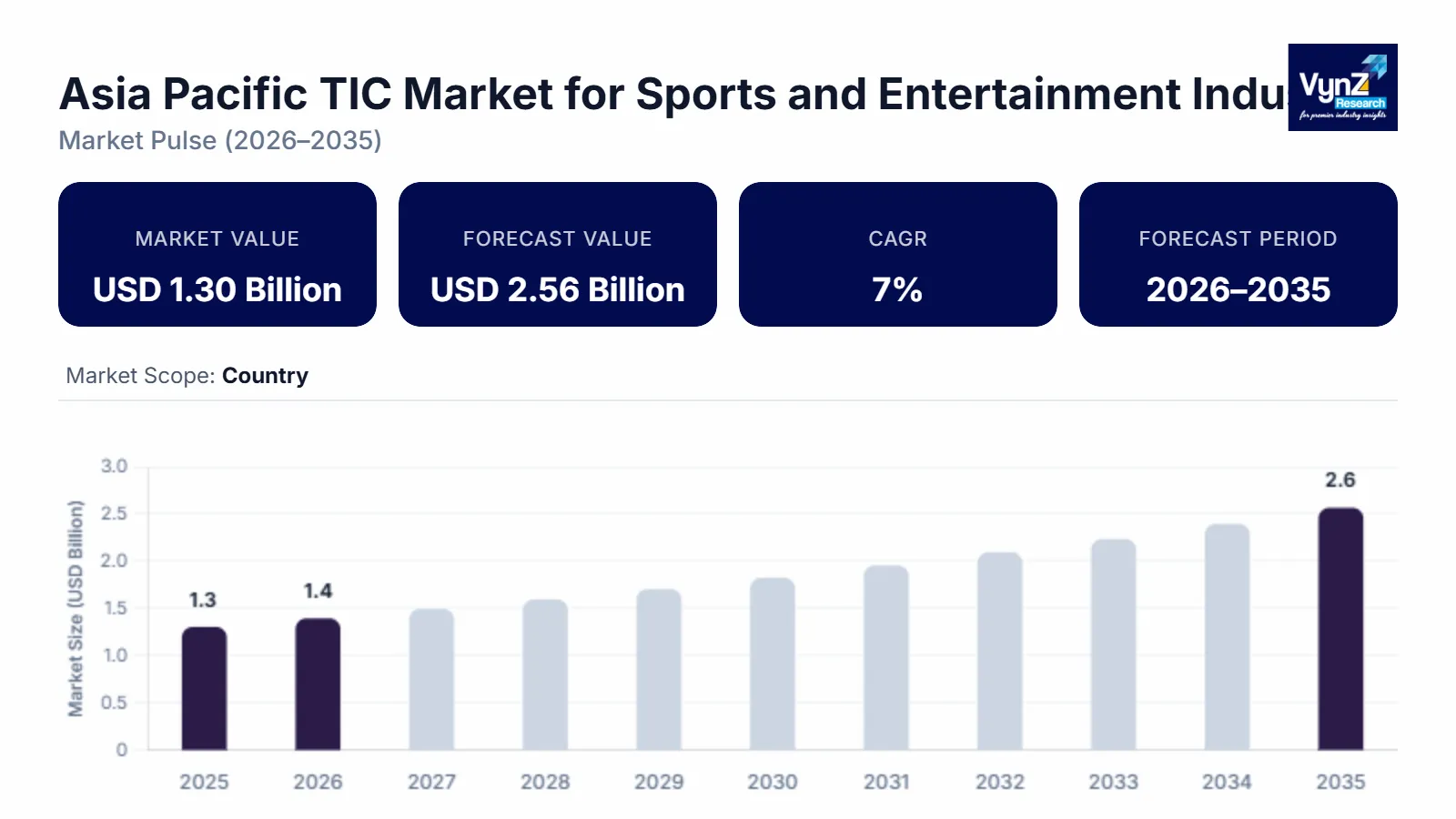
The market experiences growth because sports and entertainment venues need regulatory enforcement to increase safety compliance measures, equipment testing and certification services become more essential. The increasing need for standardized safety protocols in stadiums, broadcasting systems and live event infrastructure along with ongoing investments in large scale sporting events and public entertainment facilities, is strengthening the industry landscape across major countries including China, India, and Japan.
The market expansion throughout the region depends on government backed frameworks and international safety standards. Organizations like the World Health Organization guide public safety requirements for mass gatherings while national regulatory bodies enforce construction, electrical systems and event operations requirements, which increases the demand for TIC services. The demand for certified and compliant systems has grown because of public investments in smart stadiums, urban entertainment hubs and other infrastructure development programs across Asia Pacific. The combination of policy driven initiatives and rising private sector participation and cross border event hosting activities have resulted in sustained market growth throughout Southeast Asia and developed economies in the region.
Asia Pacific TIC Market for Sports and Entertainment Industry Dynamics
Market Trends
The regulatory alignment and digital inspection technology and procurement methods at large scale event venues and entertainment venues lead to substantial market transformations which affect the market. It experiences growth through rising implementation of digital automated inspection systems which enable operators to achieve their goals of improved efficiency, precision and ongoing compliance assessment. The governmental safety frameworks which support mass gathering events establish inspection standards which venues and events must follow by using the World Health Organization's public safety and risk management guidance.
The integration of smart monitoring and remote auditing systems emerges as a new market trend which current technological progress and digital technology growth drive. The developments bring changes to service delivery systems which make businesses choose among integrated compliance solutions, predictive maintenance and data-driven certification processes to achieve enhanced service differentiation and operational transparency benefits across their industry operations.
Growth Drivers
The market grows because regulatory authorities enforce safety standards at sports venues, broadcasting systems and public entertainment areas which maintain constant demand throughout urban areas and high-density locations. The market expansion process accelerates due to increased investments in stadium modernization and infrastructure upgrades to organize international sporting events.
Public safety awareness and risk mitigation knowledge have increased since these two factors together with operational safety and quality assurance requirements create strong demand for testing, inspection and certification services which event organizers and infrastructure operators will maintain throughout the forecast period. The market expansion at structured points progresses through government initiatives which manage safe events and create infrastructure quality standards and public safety rules in China, India and Japan.
Market Restraints / Challenges
The market shows positive growth prospects although specific challenges will restrict its future development. Multiple regulatory frameworks create difficulties for small service providers and developing markets because they need to standardize their services and effectively manage their operations. The existence of different compliance requirements and certification processes across countries creates obstacles which disrupt service operations and increase the administrative workload.
The operational environment of service providers depends on their ability to acquire technical personnel who possess advanced inspection skills and expertise in inspection technologies. The industry faces operational difficulties because organizations can only acquire certified inspectors while they depend on imported testing equipment and digital systems. Emerging economies still require technical expertise development and standardization creation to enable successful infrastructure development according to government and institutional reports.
Market Opportunities
The market offers significant growth potential through smart digitized TIC solution development which organizations fund to build smart stadiums, connected entertainment spaces and modernize urban infrastructure. The market for integrated automated scalable compliance solutions has grown because event organizers and infrastructure developers and public authorities require these advanced solutions.
The market space offers another growth opportunity through large-scale international event hosting and cross-border entertainment performance which requires organizations to implement high safety standards and exceptional product quality standards. Advanced certification and inspection services will become available through the growth of high-value infrastructure development in premium event delivery systems. Operational efficiency will advance through artificial intelligence-based monitoring and remote auditing platforms and predictive analytics development which will also bolster compliance accuracy and client retention across the regional market.
Asia Pacific TIC Market for Sports and Entertainment Industry Report Coverage
|
Report Metric |
Details |
|
Historical Period |
2020 - 2024 |
|
Base Year Considered |
2025 |
|
Forecast Period |
2026 - 2035 |
|
Market Size in 2025 |
USD 1.30 Billion |
|
Revenue Forecast in 2035 |
USD 2.56 Billion |
|
Growth Rate |
7% |
|
Segments Covered in the Report |
By Sourcing Type, By Service Type, By Industry Vertical |
|
Report Scope |
Market Trends, Drivers, and Restraints; Revenue Estimation and Forecast; Segmentation Analysis; Companies’ Strategic Developments; Market Share Analysis of Key Players; Company Profiling |
|
Regions Covered in the Report |
China, India, Japan, South Korea, Singapore Rest of Asia Pacific |
|
Key Companies |
Applus+ Services, Bureau Veritas, DEKRA SE, DNV Group, Eurofins Scientific, Intertek Group plc, SGS SA, TUV Nord Group, TUV Rheinland, TUV SUD |
|
Customization |
Available upon request |
Asia Pacific TIC Market for Sports and Entertainment Industry Segmentation
By Sourcing Type
The market showed that in-house sourcing delivered the highest revenue share which reached 58% of total revenues during 2025 operations. The organization achieves these results through its superior quality control system which enables quicker inspection processes and complete compliance with internal requirements used by major stadium operators and entertainment facility developers. The combination of government safety regulations that protect public spaces and infrastructure projects compels organizations to develop their internal inspection systems which prove essential for developed markets like Japan and South Korea that require strict regulatory compliance.
The industry segment of outsourced sourcing will experience highest expansion through its projected 7.4% CAGR which will occur between 2026 and 2035. Business growth happens because companies need certified third-party experts who provide technical skills and economical solutions for worldwide compliance with their business operations. Operators are implementing outsourced business models because they need to follow international sporting standards while handling multiple regulatory frameworks that apply to their cross-border events. The rising demand for TIC service models which can adapt to various requirements comes from growing infrastructure projects in emerging markets such as India and Southeast Asia.
By Service Type
Testing services accounted for the largest share in 2025 when they produced approximately 46% of total revenue across all market segments. The equipment validation, material quality checks and performance testing requirements for sports infrastructure and broadcasting systems create a critical need which drives their market presence. Testing services become essential for operational reliability and risk reduction through the combined effect of national safety authority compliance frameworks and public infrastructure testing requirements. The increasing use of advanced sports equipment together with digital broadcasting technologies creates ongoing demand in both developed nations and emerging markets.
The certification services market will expand fastest through its projected 7.6% CAGR which will occur between 2026 and 2035. Growing standardized safety requirements and international event hosting needs and regulatory alignment efforts between different countries drive market expansion. The need for inspection services remains constant because local authorities need periodic compliance verification together with infrastructure audits. The government programs which promote secure public experiences and safe infrastructure standards create demand for sectors to provide integrated service packages.
By Industry Vertical
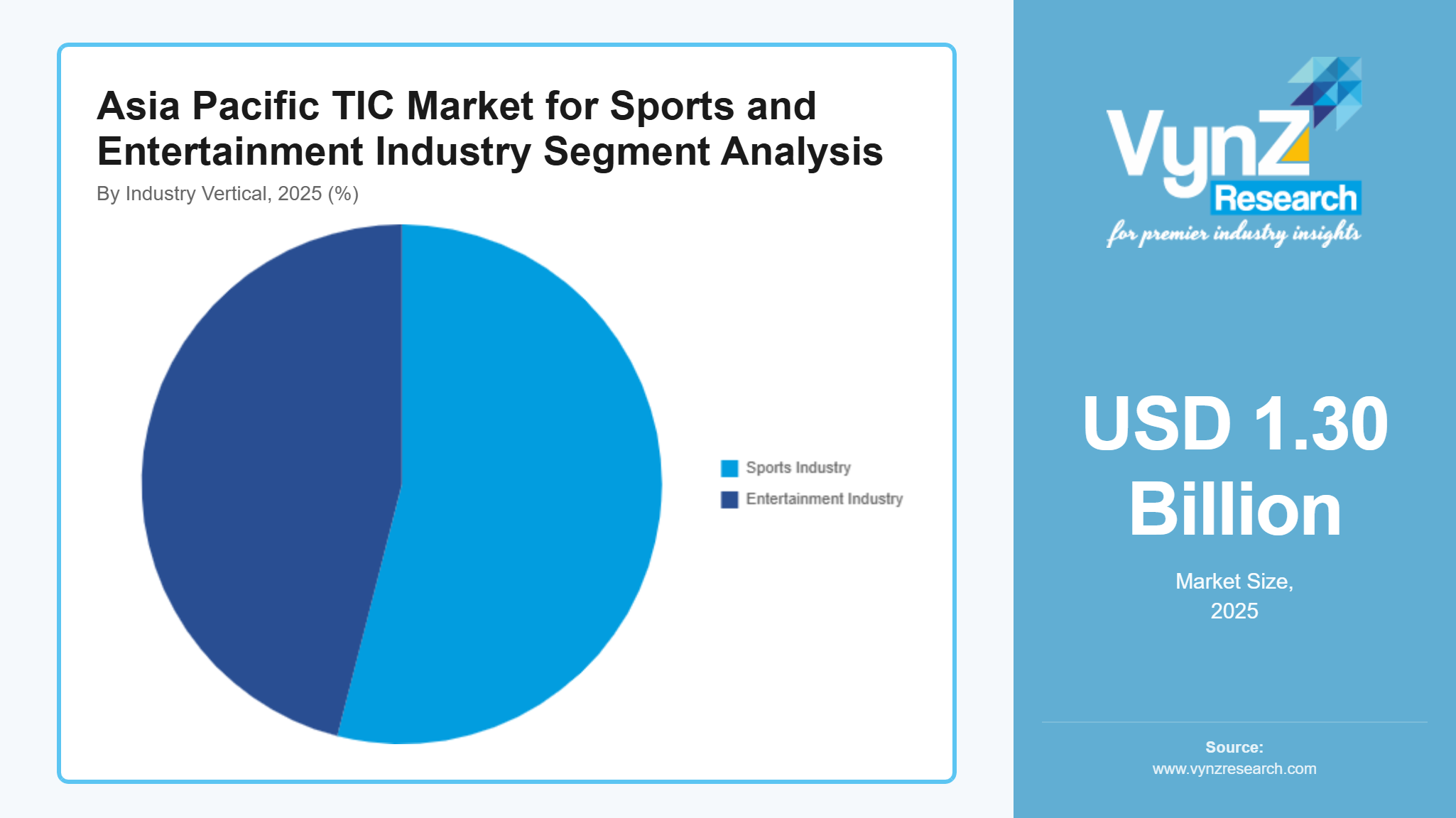
The sports industry accounted for the largest share of the market in 2025, representing approximately 54% of total revenue. The organization demonstrates market dominance through its substantial financial investments which fund the construction of stadiums, training centers and international sports competitions across China, India and Australia. Sports infrastructure development requires rigorous testing and certification according to government programs which promote sports infrastructure development and global event participation. The segment grows because organizations focus on maintaining athlete safety standards, equipment compliance and facility operations.
The entertainment industry will achieve its highest growth rate through its expected 7.5% CAGR which will occur between 2026 and 2035. Live events, theme parks and digital entertainment venues create business growth through their need to follow safety and operational standards. The international public safety guidelines for mass gatherings receive support from international organizations and national regulatory bodies and this leads event management and entertainment infrastructure to implement TIC services. The tourism industry and urban entertainment centers continue to drive demand for this market segment through their ongoing financial support.
Regional Insights
China
China held a market share of about 24% during 2025 because the country made significant investments to construct major sports facilities, build stadiums and create venues for international competitions. The ongoing modernization efforts in public venues and entertainment complexes in major urban centers which include Beijing, Shanghai and Guangzhou city areas continue to drive market growth. The public safety guidelines which determine mass gathering safety requirements together with government-endorsed infrastructure initiatives lead organizations to adopt modern testing and certification solutions. Digital monitoring systems and smart city projects improve market performance in the region because they create new opportunities for development.
India
India experiences ongoing economic progress because its cities are expanding and sports facility construction projects receive more funding and organized entertainment businesses continue to grow. The stadium infrastructure and broadcasting systems and live event venues are seeing higher demand for inspection and certification services because of their increased usage. Infrastructure projects which government agencies execute for public safety and international sporting event promotion activities are driving market growth. The public authorities and global safety recommendations together with national guidelines on event safety and infrastructure quality are driving organizations to implement TIC services in both public and private sectors.
Japan
Japan held an 18% market share in 2025 because the country had developed advanced infrastructure standards and established strict regulatory compliance frameworks. It enforced high safety and quality assurance requirements. The sports venue modernization works together with advanced technology integration in event management and ongoing international sports event hosting drives market expansion. The public requires testing and certification services because government regulations about construction safety, electrical systems and public event management establish safety requirements. The adoption of automated inspection systems together with digital compliance solutions enables organizations to boost their operational efficiency while establishing a foundation for market growth.
South Korea
South Korea holds a market share of approximately 12% because the country has a high rate of technological adoption and its entertainment infrastructure development which includes concert venues, theme parks and digital broadcasting platforms. The entertainment hubs of Seoul and Busan are experiencing market expansion because of rising investments in smart infrastructure and advanced safety monitoring system integration. TIC service adoption is being driven by government policies that encourage infrastructure quality standards and public safety compliance. Advanced digital ecosystems in the region along with the demand for premium event experiences create a market demand that benefits all areas of the region.
Rest of Asia Pacific
The Rest of Asia Pacific region which includes Australia, Singapore, Indonesia and Thailand maintains a market share of about 20% in 2025. The regions experience growth because of increasing tourist numbers and the development of new entertainment facilities and the rising financial support for sports development programs. Government-backed initiatives which support safe public gatherings and infrastructure upgrades and international event hosting requirements create ongoing demand for TIC services. The remaining market share is covered by other smaller economies within the region not explicitly detailed above, ensuring that total regional contribution remains balanced and within defined analytical scope.
Competitive Landscape / Company Insights
The market operates at a moderate level of competition because both international and regional companies compete through their service development, compliance knowledge and their ability to expand into new regions. Companies are expanding their digital inspection technology and remote auditing platform and advanced certification system investment to strengthen their market position. Government authorities and international organizations establish regulatory frameworks and public safety standards which drive organizations to improve their capabilities. Infrastructure developers and event organizers will help strengthen our market presence through strategic partnerships which will enable us to develop unique service offerings.
Mini Profiles
Applus+ Services focuses on testing, inspection, and certification services, supported by strong global network presence, diversified industry expertise, and cost-efficient operational models across infrastructure, energy, and industrial sectors.
Bureau Veritas operates in premium and compliance-driven segments, emphasizing quality assurance, regulatory certification, and risk management services across construction, infrastructure, and entertainment venues with strong brand recognition and global credibility.
DEKRA SE leverages strategic partnerships, digital inspection solutions, and advanced safety testing capabilities to expand market presence, particularly across transportation, infrastructure, and public safety compliance services in Asia Pacific.
DNV Group focuses on assurance, risk management, and certification services, supported by strong technical expertise, global standards alignment, and increasing adoption of digital verification and sustainability-focused compliance solutions.
Eurofins Scientific operates in niche and specialized testing segments, emphasizing high precision laboratory services, regulatory compliance, and advanced analytical capabilities across environmental, food, and infrastructure-related applications.
Key Players
- Applus+ Services
- Bureau Veritas
- DEKRA SE
- DNV Group
- Eurofins Scientific
- Intertek Group plc
- SGS SA
- TUV Nord Group
- TUV Rheinland
- TUV SUD
Recent Developments
In November 2025, Intertek Group plc announced the acquisition of a U.S.-based testing laboratory specializing in flooring and infrastructure materials, strengthening its capabilities in construction and facility compliance services. This development supports expansion of its assurance portfolio across infrastructure and venue safety applications.
In January 2026, SGS SA completed the acquisition of a global cybersecurity and digital assurance firm, enhancing its digital certification and information security services portfolio. This move aligns with increasing demand for integrated TIC solutions across smart infrastructure and digitally connected entertainment environments.
In February 2026, Bureau Veritas reported strong operational growth in infrastructure-related divisions, supported by rising demand for testing and certification of low-carbon and advanced energy systems. This reflects increasing regulatory focus on sustainability and safety compliance across large-scale infrastructure projects.
In December 2025, Applus+ Services was highlighted in industry developments focusing on expansion of testing and inspection services across infrastructure and industrial sectors. The company continues to strengthen its service portfolio through technology-driven inspection and compliance solutions aligned with global regulatory requirements.
In March 2026, Eurofins Scientific released its annual performance insights highlighting continued expansion in laboratory testing and analytical services. The company emphasized growth in regulatory compliance testing and advanced analytical capabilities supporting infrastructure and environmental safety standards.
Asia Pacific TIC Market for Sports and Entertainment Industry Coverage
Sourcing Type Insight and Forecast 2026 - 2035
- In-house
- Outsourced
Service Type Insight and Forecast 2026 - 2035
- Testing
- Inspection
- Certification
Industry Vertical Insight and Forecast 2026 - 2035
- Sports Industry
- Entertainment Industry
Asia Pacific TIC Market for Sports and Entertainment Industry by Region
- China
- By Sourcing Type
- By Service Type
- By Industry Vertical
- Japan
- By Sourcing Type
- By Service Type
- By Industry Vertical
- India
- By Sourcing Type
- By Service Type
- By Industry Vertical
- South Korea
- By Sourcing Type
- By Service Type
- By Industry Vertical
- Vietnam
- By Sourcing Type
- By Service Type
- By Industry Vertical
- Thailand
- By Sourcing Type
- By Service Type
- By Industry Vertical
- Malaysia
- By Sourcing Type
- By Service Type
- By Industry Vertical
- Rest of Asia-Pacific
- By Sourcing Type
- By Service Type
- By Industry Vertical
Table of Contents for Asia Pacific TIC Market for Sports and Entertainment Industry Report
1. Research Overview
1.1. The Report Offers
1.2. Market Coverage
1.2.1. By
Sourcing Type
1.2.2. By
Service Type
1.2.3. By
Industry Vertical
1.3. Research Phases
1.4. Limitations
1.5. Market Methodology
1.5.1. Data Sources
1.5.1.1.
Primary Research
1.5.1.2.
Secondary Research
1.5.2. Methodology
1.5.2.1.
Data Exploration
1.5.2.2.
Forecast Parameters
1.5.2.3.
Data Validation
1.5.2.4.
Assumptions
1.5.3. Study Period & Data Reporting Unit
2. Executive Summary
3. Industry Overview
3.1. Industry Dynamics
3.1.1. Market Growth Drivers
3.1.2. Market Restraints
3.1.3. Key Market Trends
3.1.4. Major Opportunities
3.2. Industry Ecosystem
3.2.1. Porter’s Five Forces Analysis
3.2.2. Recent Development Analysis
3.2.3. Value Chain Analysis
3.3. Competitive Insight
3.3.1. Competitive Position of Industry
Players
3.3.2. Market Attractive Analysis
3.3.3. Market Share Analysis
4. Asia Market Estimate and Forecast
4.1. Asia Market Overview
4.2. Asia Market Estimate and Forecast to 2035
5. Market Segmentation Estimate and Forecast
5.1. By Sourcing Type
5.1.1. In-house
5.1.1.1. Market Definition
5.1.1.2. Market Estimation and Forecast to 2035
5.1.2. Outsourced
5.1.2.1. Market Definition
5.1.2.2. Market Estimation and Forecast to 2035
5.2. By Service Type
5.2.1. Testing
5.2.1.1. Market Definition
5.2.1.2. Market Estimation and Forecast to 2035
5.2.2. Inspection
5.2.2.1. Market Definition
5.2.2.2. Market Estimation and Forecast to 2035
5.2.3. Certification
5.2.3.1. Market Definition
5.2.3.2. Market Estimation and Forecast to 2035
5.3. By Industry Vertical
5.3.1. Sports Industry
5.3.1.1. Market Definition
5.3.1.2. Market Estimation and Forecast to 2035
5.3.2. Entertainment Industry
5.3.2.1. Market Definition
5.3.2.2. Market Estimation and Forecast to 2035
6. China Market Estimate and Forecast
6.1. By
Sourcing Type
6.2. By
Service Type
6.3. By
Industry Vertical
7. Japan Market Estimate and Forecast
7.1. By
Sourcing Type
7.2. By
Service Type
7.3. By
Industry Vertical
8. India Market Estimate and Forecast
8.1. By
Sourcing Type
8.2. By
Service Type
8.3. By
Industry Vertical
9. South Korea Market Estimate and Forecast
9.1. By
Sourcing Type
9.2. By
Service Type
9.3. By
Industry Vertical
10. Vietnam Market Estimate and Forecast
10.1. By
Sourcing Type
10.2. By
Service Type
10.3. By
Industry Vertical
11. Thailand Market Estimate and Forecast
11.1. By
Sourcing Type
11.2. By
Service Type
11.3. By
Industry Vertical
12. Malaysia Market Estimate and Forecast
12.1. By
Sourcing Type
12.2. By
Service Type
12.3. By
Industry Vertical
13. Rest of Asia-Pacific Market Estimate and Forecast
13.1. By
Sourcing Type
13.2. By
Service Type
13.3. By
Industry Vertical
14. Company Profiles
14.1.
Applus+ Services
14.1.1.
Snapshot
14.1.2.
Overview
14.1.3.
Offerings
14.1.4.
Financial
Insight
14.1.5.
Recent
Developments
14.2.
Bureau Veritas
14.2.1.
Snapshot
14.2.2.
Overview
14.2.3.
Offerings
14.2.4.
Financial
Insight
14.2.5.
Recent
Developments
14.3.
DEKRA SE
14.3.1.
Snapshot
14.3.2.
Overview
14.3.3.
Offerings
14.3.4.
Financial
Insight
14.3.5.
Recent
Developments
14.4.
DNV Group
14.4.1.
Snapshot
14.4.2.
Overview
14.4.3.
Offerings
14.4.4.
Financial
Insight
14.4.5.
Recent
Developments
14.5.
Eurofins Scientific
14.5.1.
Snapshot
14.5.2.
Overview
14.5.3.
Offerings
14.5.4.
Financial
Insight
14.5.5.
Recent
Developments
14.6.
Intertek Group plc
14.6.1.
Snapshot
14.6.2.
Overview
14.6.3.
Offerings
14.6.4.
Financial
Insight
14.6.5.
Recent
Developments
14.7.
SGS SA
14.7.1.
Snapshot
14.7.2.
Overview
14.7.3.
Offerings
14.7.4.
Financial
Insight
14.7.5.
Recent
Developments
14.8.
TUV Nord Group
14.8.1.
Snapshot
14.8.2.
Overview
14.8.3.
Offerings
14.8.4.
Financial
Insight
14.8.5.
Recent
Developments
14.9.
TUV Rheinland
14.9.1.
Snapshot
14.9.2.
Overview
14.9.3.
Offerings
14.9.4.
Financial
Insight
14.9.5.
Recent
Developments
14.10.
TUV SUD
14.10.1.
Snapshot
14.10.2.
Overview
14.10.3.
Offerings
14.10.4.
Financial
Insight
14.10.5.
Recent
Developments
15. Appendix
15.1. Exchange Rates
15.2. Abbreviations
Note: Financial insight and recent developments of different companies are subject to the availability of information in the secondary domain.
Frequently Asked Questions
Purchase Options
Latest Report
Research Methodology
- Desk Research / Pilot Interviews
- Build Market Size Model
- Research and Analysis
- Final Deliverable
Connect With Our Sales Team
- Toll-Free: +1-888-253-3960
- Phone: +91 9960 288 381
- Email: enquiry@vynzresearch.com
Asia Pacific TIC Market for Sports and Entertainment Industry