
Asia Pacific Vertical Farming Market Size & Share | Growth Forecast Report (2026-2035)
Industry Insight by Structure (Building Based Vertical Farms, Shipping Container Vertical Farms), by Growth Mechanism (Hydroponics, Aeroponics, Aquaponics), by Component (Lighting, Irrigation Components, Climate Control, Sensors, Building Materials), by Crop Type (Leafy Greens, Tomatoes, Strawberries, Herbs, Peppers, Others)
| Status : Published | Published On : May, 2026 | Report Code : VRSME9210 | Industry : Semiconductor & Electronics | Available Format :

|
Page : 123 |
Asia Pacific Vertical Farming Market Overview
The Asia Pacific vertical farming market which was valued at approximately USD 2.2 billion in 2025 and is estimated to reach around USD 2.9 billion in 2026, is projected to reach approximately USD 24.6 billion by 2035, expanding at a CAGR of about 27.1% during the forecast period from 2026 to 2035.
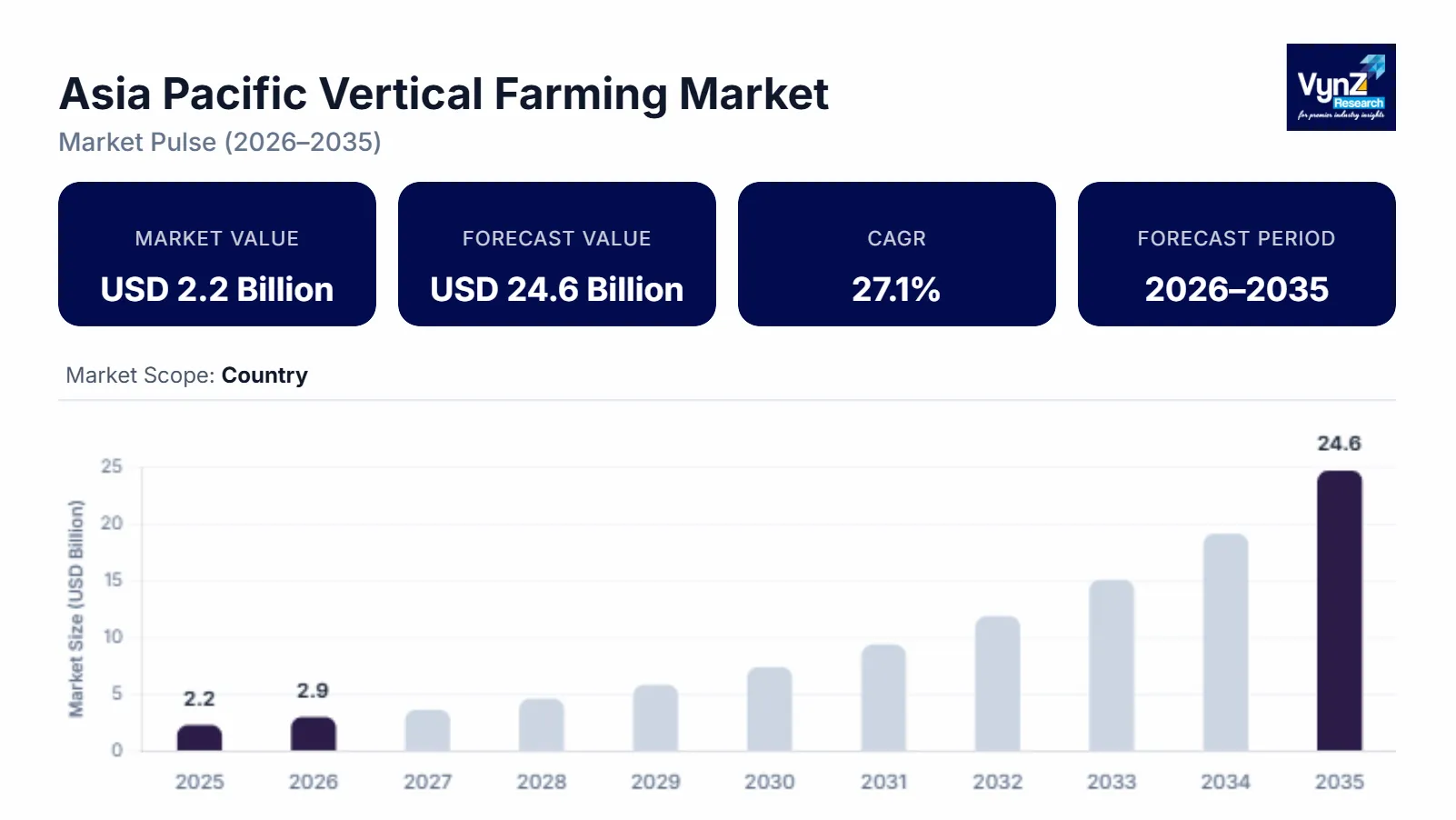
The market expansion process depends on three main factors which include growing food security worries and decreasing arable land availability together with rising demand for environmentally sustainable agricultural production systems. The Food and Agriculture Organization (FAO) and regional agricultural authorities maintain their reports which show that controlled environment agriculture plays a crucial role in enhancing crop productivity while decreasing water usage. Industry growth receives support through the increasing use of hydroponic systems and LED lighting technology together with climate-controlled farming equipment.
Government initiatives to enhance sustainable agricultural practices together with urban food production systems create incentives for major regional economies to adopt these practices. Asia Pacific nations maintain their investment in smart farming initiatives and agricultural modernization projects while they develop resource efficient farming techniques to build local food supply resilience. Public backing for water conservation methods, renewable energy system implementation and advanced greenhouse facilities development continues to boost market growth. The rising demand for pesticide free vegetables and locally grown produce together with increasing agricultural technology investments across China, Japan and India leads to sustained market growth throughout the entire region.
Asia Pacific Vertical Farming Market Dynamics
Market Trends
The sector is undergoing significant changes because of improvements in farming technology, modifications in consumer food choices and updates to controlled environment agricultural techniques. The market experiences a fundamental transformation through the growing implementation of hydroponic and LED farming systems which demonstrate ongoing shift towards more efficient water use and enhanced crop yields plus sustainable agricultural methods. Urban consumers are choosing to buy pesticide-free vegetables and local foods because they have become more aware of health issues and food safety risks. The establishment of agricultural sustainability programs through government support and food security initiatives in multiple Asia Pacific countries, drives the implementation of resource-efficient farming technologies.
Growth Drivers
The demand for urban cultivation projects combined with commercial farming operations, creates constant need for vertical farming systems, which sustain Asia Pacific market growth through rising food security concerns and decreasing agricultural land availability. The region faces growing demand for controlled environment agricultural systems, which need to operate stable crop production while using fewer resources because of rapid urbanization and population growth in its main economies. The agricultural technology infrastructure and smart farming project investments throughout Asia Pacific enable market growth by driving technological advancements. The increasing commitment to sustainable agriculture practices creates better chances for people to embrace these activities. The demand for indoor farming technologies and advanced cultivation systems will remain strong during the forecast period because consumers and food suppliers now prioritize crop quality along with water conservation and year-round production efficiency.
Market Restraints / Challenges
The market faces particular obstacles which restrict its expansion despite having strong potential for growth. Small and medium-scale farming operators, face profitability challenges because of high installation costs and operational expenses which affect their ability to penetrate the market through climate control equipment, automated cultivation infrastructure and lighting systems. Vertical farming facilities that use energy-intensive cultivation methods face additional financial burdens because of rising electricity rates. The market participants face operational difficulties because they need to deal with two main challenges which include technological complexity and their requirement for specialized operational expertise. The need to import equipment, advanced sensors and automated farming technologies results in higher capital expenses and maintenance costs plus supply chain disruptions during economic downturn periods.
Market Opportunities
The market provides strong potential in urban food production and smart agriculture infrastructure development because increasing population density and the demand for sustainable cultivation methods create growth opportunities. Commercial growers, food retailers and institutional farming projects will increase their demand for modular farming systems, energy-efficient lighting solutions and automated crop management technologies. Smart city initiatives and climate resilient food production systems are driving market growth across Asia Pacific economies through their combined expansion. Premium indoor farming solutions that use advanced technology offer another major market opportunity because commercial stake investments in automated cultivation facilities, digital agricultural platforms generate high profits and long-lasting business partnerships. Artificial intelligence, remote monitoring systems and precision farming technologies will improve operational efficiency and ensure consistent crop production.
Asia Pacific Vertical Farming Market Report Coverage
|
Report Metric |
Details |
|
Historical Period |
2020 - 2024 |
|
Base Year Considered |
2025 |
|
Forecast Period |
2026 - 2035 |
|
Market Size in 2025 |
USD 2.2 Billion |
|
Revenue Forecast in 2035 |
USD 24.6 Billion |
|
Growth Rate |
27.1% |
|
Segments Covered in the Report |
Structure, Growth Mechanism, Component, Crop Type |
|
Report Scope |
Market Trends, Drivers, and Restraints; Revenue Estimation and Forecast; Segmentation Analysis; Companies’ Strategic Developments; Market Share Analysis of Key Players; Company Profiling |
|
Regions Covered in the Report |
China, Japan, India, Southeast Asia, Rest of Asia Pacific |
|
Key Companies |
AeroFarms, Bowery Farming, BrightFarms, Crop One Holdings, Freight Farms, Gotham Greens, Koninklijke Philips N.V., Plenty, Sky Greens, Spread Co. Ltd. |
|
Customization |
Available upon request |
Asia Pacific Vertical Farming Market Segmentation
By Structure
In 2025, vertical farms built as buildings represented the major portion of the market with their share reaching 63% of total market revenues. Their superiority comes from their capability to cultivate large areas, their systems which control environmental conditions effectively and their rising use in urban commercial farming operations. The fixed indoor farming facilities become more widely used because of ongoing government investments in smart agriculture infrastructure and sustainable food production systems throughout Asia Pacific. The urban areas are experiencing rising demand for local vegetables while cities develop their metropolitan food supply networks which creates persistent demand throughout major regional economies.
The market for shipping container vertical farms will expand at the highest rate, with an expected compound annual growth rate of 28.6% between 2026 and 2035. The urban areas with dense populations require modular farming systems which can be deployed quickly and operate in most spaces to meet the growing market demand. The increase in educational institutions and commercial growers and remote food production projects all use the segment, which creates new business opportunities. The compact farming infrastructure across emerging markets receives new investments from public initiatives that promote climate resilient agriculture and resource efficient cultivation practices.
By Growth Mechanism
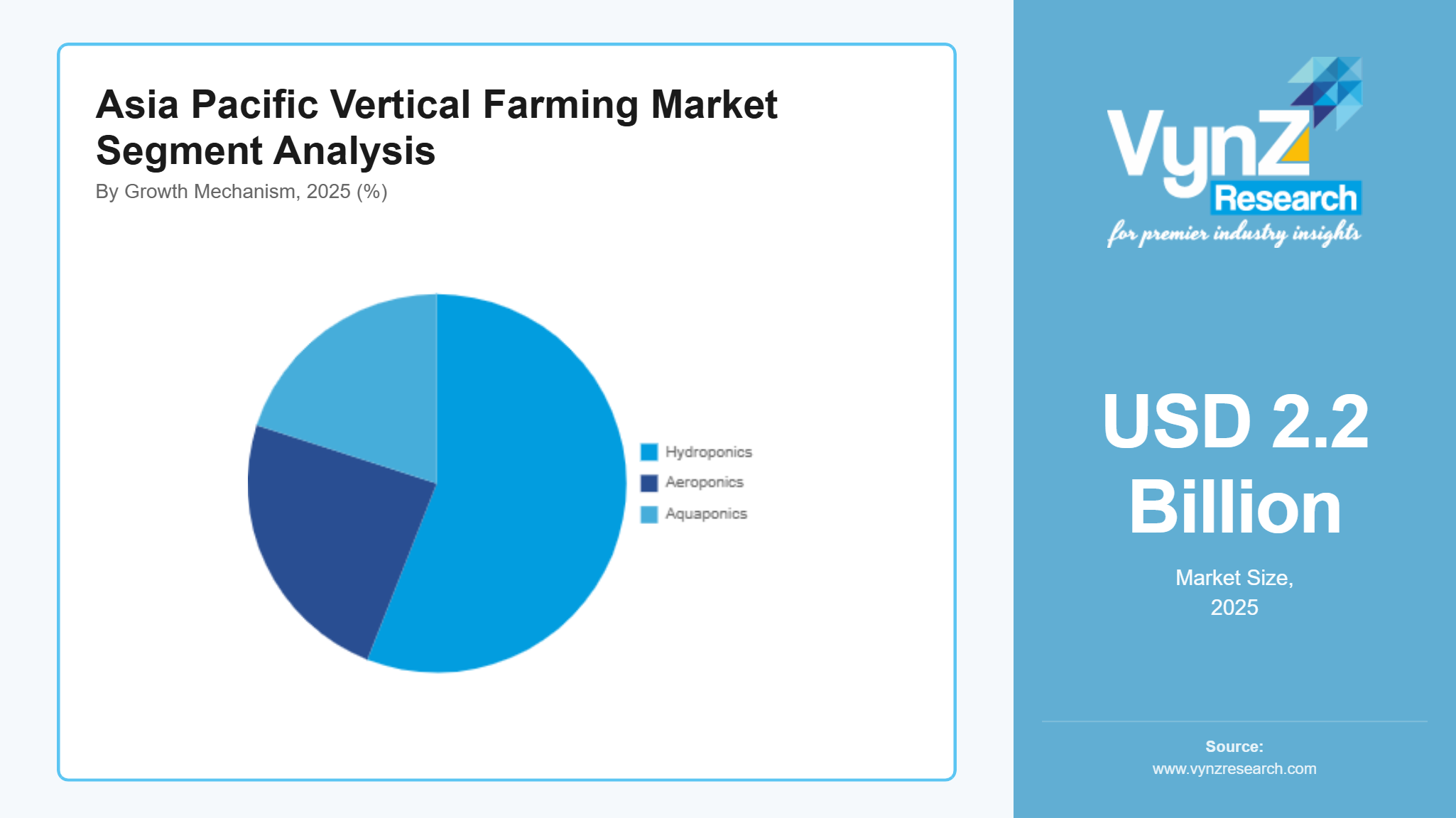
Hydroponics captured the most market share in 2025, as it generated about 56% of total revenue for its segment. The segment maintains its market lead because it enables efficient nutrient management while using less water and it provides strong commercial scalability for growing leafy vegetables. The agricultural authorities of the region together with sustainability programs maintain their support for hydroponic farming systems, as these systems enable better crop yield results without needing additional land usage. The commercial greenhouse industry expands its operations while automated nutrient delivery systems become more widely used in urban agricultural facilities, which drives wider urban agricultural system adoption.
The aeroponics market will experience its highest growth rate between 2026 and 2035, as it achieves a compound annual growth rate of 29.4%. The market grows because people need to conserve water, the advanced root oxygenation systems and higher crop productivity of these systems outmatch normal farming methods. The technology-driven farming operators adopt new precision agriculture technologies and automated environmental monitoring systems because their implementation costs drop. The segment expands throughout Asia Pacific because government funding boosts advanced agricultural technologies and sustainable food production techniques.
By Component
The lighting systems sector controlled the biggest share of the market in 2025, as it generated 34% of total revenue from all components. Energy efficient LED technologies usage has increased because they enable crop production throughout the year while optimizing plant growth cycles. The vertical farming operators make upgrades to their lighting systems, which helps them achieve better crop results, operational efficiency and higher cultivation output. The controlled environment agriculture facilities experience permanent demand increases because public initiatives for energy efficient agricultural systems and sustainable farming practices receive ongoing support.
The climate control and sensor technologies market will experience the highest growth rate between 2026 and 2035, as it achieves a compound annual growth rate of 28.1%. The market expands because organizations create more automated monitoring systems and use artificial intelligence for environmental control, while precision farming technologies gain ground. The commercial growers need real-time solutions which allow them to monitor temperature, humidity levels and nutrient contents to enhance their crop quality, while they cut down on operational waste. The smart farming infrastructure together with digital agriculture platforms creates a stronger market demand for both advanced farming operations and various technology farming markets.
By Crop Type
Leafy greens represented the major portion of the Asia Pacific vertical farming market in 2025, as they generated around 47% of total market revenues. The market maintains strong performance capacity because of its short cultivation cycles, constant customer demand and its compatibility with controlled environment farming systems. The urban market shows increasing demand for fresh vegetables which do not contain pesticides, while food retailers keep raising their purchases of locally grown vegetables. The commercial farming sector retains its segment leadership through government food security programs and sustainability initiatives, which drive efficient vegetable production development.
The market for herbs and strawberries will experience the fastest growth rate between 2026 and 2035, as it reaches an estimated compound annual growth rate of 27.8%. The market grows because more people eat premium food products, the hospitality and food service industries buy special products, and indoor farms grow specialty crops. The commercial growers select high value crops, as they want to boost their profit margins while creating unique products. The segment maintains its growth trend throughout Asia Pacific because premium retail channels expand their markets and consumers show higher demand for organic products of superior quality.
Regional Insights
China
The market in Asia Pacific was controlled by China with approximately 32% market share in 2025. The country made its share of the market because it invested heavily in agricultural smart systems. The country needed urban farming projects to solve its food security problems. The cities of Beijing, Shanghai, Shenzhen and Guangzhou need controlled environment farming systems for their commercial agriculture and urban food supply networks. Indoor farming expansion and automated cultivation technology adoption are driving market development across the nation. Vertical farming infrastructure development receives funding from government initiatives that back agricultural modernization and sustainable farming systems and water conservation technology. The national food security program and smart agriculture policies support the implementation of hydroponic systems and LED lights and climate control systems for farming. The growing consumer preference for pesticide-free vegetables and local produce drives regional market growth.
Japan
Japan represented approximately 18% of the regional market in 2025. The market is growing because of factors which include limited arable land, advanced agricultural technologies and resource-efficient food production policies. The market experiences constant demand because all three sectors namely, commercial farming facilities, retail food suppliers and urban cultivation projects are expanding their operations. The cities of Tokyo, Osaka and Yokohama are increasing their funding of indoor farming technologies to create better food supply systems and sustainable agriculture practices.
India
India achieved a 14% share of the market in 2025 through urbanization, population growth and investments in sustainable agriculture technologies. The hydroponic farming system and indoor cultivation facility installation is increasing across commercial agriculture and food retail sectors in major metropolitan areas of Mumbai, Bengaluru, Delhi and Hyderabad. The market is expanding because people are worried about water shortages and agricultural productivity issues.
Smart farming practice support, agricultural technology development and controlled environment cultivation support commercial farming operations through government initiatives. Vertical farming operators throughout the country benefit from growing investments in startup-driven technology platforms and urban food supply expansion which create favorable business conditions.
Southeast Asia
Southeast Asia accounted for 19% of the market share in 2025 because urban development and food demand grew while modern agriculture systems developed in Singapore, Thailand, Indonesia and Vietnam. Urban centers that have high population density are driving indoor farming technology adoption because their residents want fresh produce and better food supply security. The regional growth of digital agriculture systems and climate resilient farming technologies is expanding into new areas. Hydroponic systems and automated farming systems receive government support through food sustainability initiatives and smart agriculture project funding which enables their deployment across Southeast Asia.
Rest of Asia Pacific
17% of the regional market in 2025 belonged to the Rest of Asia Pacific which includes South Korea, Australia and New Zealand. Sustainable food production technology innovation and automated cultivation system adoption drive commercial farmers to enter these markets. Vertical farming technology providers gain business opportunities from advanced greenhouse systems and expanding research activities which focus on precision agriculture. Countries receive funding to implement climate-resilient agricultural systems and resource-efficient farming systems.
Competitive Landscape / Company Insights
The market is moderately competitive, with the presence of regional technology providers and international agricultural solution companies focusing on cultivation efficiency, automation technologies, and geographic expansion. Companies are increasingly investing in research and development, smart farming platforms, and energy efficient lighting systems to strengthen their market position. Government support for sustainable agriculture, water conservation, and controlled environment farming initiatives continues encouraging innovation across the sector. Strategic partnerships with food retailers, commercial growers, and urban farming projects are further shaping competitive dynamics throughout the regional market.
Mini Profiles
AeroFarms focuses on advanced indoor farming technologies and hydroponic cultivation systems, supported by strong technological capabilities, sustainable production methods, and increasing commercial partnerships across urban agriculture and food supply networks.
Bowery Farming operates in premium vertical farming segments, emphasizing automation technologies, crop quality, and data driven cultivation systems to improve operational efficiency and strengthen market competitiveness.
BrightFarms focuses on greenhouse based controlled environment agriculture solutions, supported by regional distribution networks, fresh produce supply capabilities, and growing partnerships with retail grocery chains across urban markets.
Crop One Holdings leverages commercial scale vertical farming infrastructure and strategic partnerships to expand market presence, supported by automated production systems and increasing institutional demand for sustainable food cultivation.
Freight Farms focuses on modular container farming solutions, supported by flexible deployment models, efficient cultivation technologies, and increasing adoption across educational institutions, commercial farming operators, and urban agriculture projects.
Key Players
- AeroFarms
- Bowery Farming
- BrightFarms
- Crop One Holdings
- Freight Farms
- Gotham Greens
- Koninklijke
- Philips N.V.
- Plenty
- Sky Greens
- Spread Co. Ltd.
Recent Developments
In February 2025, Gotham Greens expanded its controlled environment agriculture operations across major urban markets in Asia Pacific to strengthen regional fresh produce supply capabilities. The company also increased investments in energy efficient greenhouse technologies and sustainable water management systems.
In April 2025, Koninklijke Philips N.V. introduced advanced LED horticulture lighting solutions designed for commercial vertical farming facilities across Asia Pacific markets. The development supported improved crop yield optimization and reduced energy consumption for indoor cultivation projects.
In June 2025, Plenty announced expansion of its automated indoor farming technologies through new partnerships with commercial food retailers and agricultural distributors. The company also strengthened investments in artificial intelligence-based crop monitoring systems for precision farming applications.
In March 2025, Sky Greens expanded vertical farming infrastructure projects to support sustainable urban agriculture initiatives across Southeast Asia. The company further enhanced its low energy rotating cultivation systems to improve production efficiency and water conservation performance.
In May 2025, Spread Co. Ltd. increased production capacity at its automated indoor farming facilities to meet rising demand for pesticide free leafy vegetables across Asian retail markets. The company also expanded deployment of robotics and climate-controlled cultivation technologies within commercial farming operations.
Asia Pacific Vertical Farming Market Coverage
Structure Insight and Forecast 2026 - 2035
- Building Based Vertical Farms
- Shipping Container Vertical Farms
Growth Mechanism Insight and Forecast 2026 - 2035
- Hydroponics
- Aeroponics
- Aquaponics
Component Insight and Forecast 2026 - 2035
- Lighting
- Irrigation Components
- Climate Control
- Sensors
- Building Materials
Crop Type Insight and Forecast 2026 - 2035
- Leafy Greens
- Tomatoes
- Strawberries
- Herbs
- Peppers
- Others
Asia Pacific Vertical Farming Market by Region
- China
- By Structure
- By Growth Mechanism
- By Component
- By Crop Type
- Japan
- By Structure
- By Growth Mechanism
- By Component
- By Crop Type
- India
- By Structure
- By Growth Mechanism
- By Component
- By Crop Type
- South Korea
- By Structure
- By Growth Mechanism
- By Component
- By Crop Type
- Vietnam
- By Structure
- By Growth Mechanism
- By Component
- By Crop Type
- Thailand
- By Structure
- By Growth Mechanism
- By Component
- By Crop Type
- Malaysia
- By Structure
- By Growth Mechanism
- By Component
- By Crop Type
- Rest of Asia-Pacific
- By Structure
- By Growth Mechanism
- By Component
- By Crop Type
Table of Contents for Asia Pacific Vertical Farming Market Report
1. Research Overview
1.1. The Report Offers
1.2. Market Coverage
1.2.1. By
Structure
1.2.2. By
Growth Mechanism
1.2.3. By
Component
1.2.4. By
Crop Type
1.3. Research Phases
1.4. Limitations
1.5. Market Methodology
1.5.1. Data Sources
1.5.1.1.
Primary Research
1.5.1.2.
Secondary Research
1.5.2. Methodology
1.5.2.1.
Data Exploration
1.5.2.2.
Forecast Parameters
1.5.2.3.
Data Validation
1.5.2.4.
Assumptions
1.5.3. Study Period & Data Reporting Unit
2. Executive Summary
3. Industry Overview
3.1. Industry Dynamics
3.1.1. Market Growth Drivers
3.1.2. Market Restraints
3.1.3. Key Market Trends
3.1.4. Major Opportunities
3.2. Industry Ecosystem
3.2.1. Porter’s Five Forces Analysis
3.2.2. Recent Development Analysis
3.2.3. Value Chain Analysis
3.3. Competitive Insight
3.3.1. Competitive Position of Industry
Players
3.3.2. Market Attractive Analysis
3.3.3. Market Share Analysis
4. Asia Market Estimate and Forecast
4.1. Asia Market Overview
4.2. Asia Market Estimate and Forecast to 2035
5. Market Segmentation Estimate and Forecast
5.1. By Structure
5.1.1. Building Based Vertical Farms
5.1.1.1. Market Definition
5.1.1.2. Market Estimation and Forecast to 2035
5.1.2. Shipping Container Vertical Farms
5.1.2.1. Market Definition
5.1.2.2. Market Estimation and Forecast to 2035
5.2. By Growth Mechanism
5.2.1. Hydroponics
5.2.1.1. Market Definition
5.2.1.2. Market Estimation and Forecast to 2035
5.2.2. Aeroponics
5.2.2.1. Market Definition
5.2.2.2. Market Estimation and Forecast to 2035
5.2.3. Aquaponics
5.2.3.1. Market Definition
5.2.3.2. Market Estimation and Forecast to 2035
5.3. By Component
5.3.1. Lighting
5.3.1.1. Market Definition
5.3.1.2. Market Estimation and Forecast to 2035
5.3.2. Irrigation Components
5.3.2.1. Market Definition
5.3.2.2. Market Estimation and Forecast to 2035
5.3.3. Climate Control
5.3.3.1. Market Definition
5.3.3.2. Market Estimation and Forecast to 2035
5.3.4. Sensors
5.3.4.1. Market Definition
5.3.4.2. Market Estimation and Forecast to 2035
5.3.5. Building Materials
5.3.5.1. Market Definition
5.3.5.2. Market Estimation and Forecast to 2035
5.4. By Crop Type
5.4.1. Leafy Greens
5.4.1.1. Market Definition
5.4.1.2. Market Estimation and Forecast to 2035
5.4.2. Tomatoes
5.4.2.1. Market Definition
5.4.2.2. Market Estimation and Forecast to 2035
5.4.3. Strawberries
5.4.3.1. Market Definition
5.4.3.2. Market Estimation and Forecast to 2035
5.4.4. Herbs
5.4.4.1. Market Definition
5.4.4.2. Market Estimation and Forecast to 2035
5.4.5. Peppers
5.4.5.1. Market Definition
5.4.5.2. Market Estimation and Forecast to 2035
5.4.6. Others
5.4.6.1. Market Definition
5.4.6.2. Market Estimation and Forecast to 2035
6. China Market Estimate and Forecast
6.1. By
Structure
6.2. By
Growth Mechanism
6.3. By
Component
6.4. By
Crop Type
7. Japan Market Estimate and Forecast
7.1. By
Structure
7.2. By
Growth Mechanism
7.3. By
Component
7.4. By
Crop Type
8. India Market Estimate and Forecast
8.1. By
Structure
8.2. By
Growth Mechanism
8.3. By
Component
8.4. By
Crop Type
9. South Korea Market Estimate and Forecast
9.1. By
Structure
9.2. By
Growth Mechanism
9.3. By
Component
9.4. By
Crop Type
10. Vietnam Market Estimate and Forecast
10.1. By
Structure
10.2. By
Growth Mechanism
10.3. By
Component
10.4. By
Crop Type
11. Thailand Market Estimate and Forecast
11.1. By
Structure
11.2. By
Growth Mechanism
11.3. By
Component
11.4. By
Crop Type
12. Malaysia Market Estimate and Forecast
12.1. By
Structure
12.2. By
Growth Mechanism
12.3. By
Component
12.4. By
Crop Type
13. Rest of Asia-Pacific Market Estimate and Forecast
13.1. By
Structure
13.2. By
Growth Mechanism
13.3. By
Component
13.4. By
Crop Type
14. Company Profiles
14.1.
AeroFarms
14.1.1.
Snapshot
14.1.2.
Overview
14.1.3.
Offerings
14.1.4.
Financial
Insight
14.1.5.
Recent
Developments
14.2.
Bowery Farming
14.2.1.
Snapshot
14.2.2.
Overview
14.2.3.
Offerings
14.2.4.
Financial
Insight
14.2.5.
Recent
Developments
14.3.
BrightFarms
14.3.1.
Snapshot
14.3.2.
Overview
14.3.3.
Offerings
14.3.4.
Financial
Insight
14.3.5.
Recent
Developments
14.4.
Crop One Holdings
14.4.1.
Snapshot
14.4.2.
Overview
14.4.3.
Offerings
14.4.4.
Financial
Insight
14.4.5.
Recent
Developments
14.5.
Freight Farms
14.5.1.
Snapshot
14.5.2.
Overview
14.5.3.
Offerings
14.5.4.
Financial
Insight
14.5.5.
Recent
Developments
14.6.
Gotham Greens
14.6.1.
Snapshot
14.6.2.
Overview
14.6.3.
Offerings
14.6.4.
Financial
Insight
14.6.5.
Recent
Developments
14.7.
Koninklijke
14.7.1.
Snapshot
14.7.2.
Overview
14.7.3.
Offerings
14.7.4.
Financial
Insight
14.7.5.
Recent
Developments
14.8.
Philips N.V.
14.8.1.
Snapshot
14.8.2.
Overview
14.8.3.
Offerings
14.8.4.
Financial
Insight
14.8.5.
Recent
Developments
14.9.
Plenty
14.9.1.
Snapshot
14.9.2.
Overview
14.9.3.
Offerings
14.9.4.
Financial
Insight
14.9.5.
Recent
Developments
14.10.
Sky Greens
14.10.1.
Snapshot
14.10.2.
Overview
14.10.3.
Offerings
14.10.4.
Financial
Insight
14.10.5.
Recent
Developments
14.11.
Spread Co. Ltd.
14.11.1.
Snapshot
14.11.2.
Overview
14.11.3.
Offerings
14.11.4.
Financial
Insight
14.11.5.
Recent
Developments
15. Appendix
15.1. Exchange Rates
15.2. Abbreviations
Note: Financial insight and recent developments of different companies are subject to the availability of information in the secondary domain.
Frequently Asked Questions
Purchase Options
Latest Report
Research Methodology
- Desk Research / Pilot Interviews
- Build Market Size Model
- Research and Analysis
- Final Deliverable
Connect With Our Sales Team
- Toll-Free: +1-888-253-3960
- Phone: +91 9960 288 381
- Email: enquiry@vynzresearch.com
Asia Pacific Vertical Farming Market