TIC Market for Railway Industry Overview
The global TIC Market for Railway Industry, which was valued at approximately USD 3.8 billion in 2025 and is estimated to reach around USD 3.92 billion in 2026, is projected to reach approximately USD 5.31 billion by 2035, expanding at a CAGR of about 3.41% during the forecast period from 2026 to 2035.
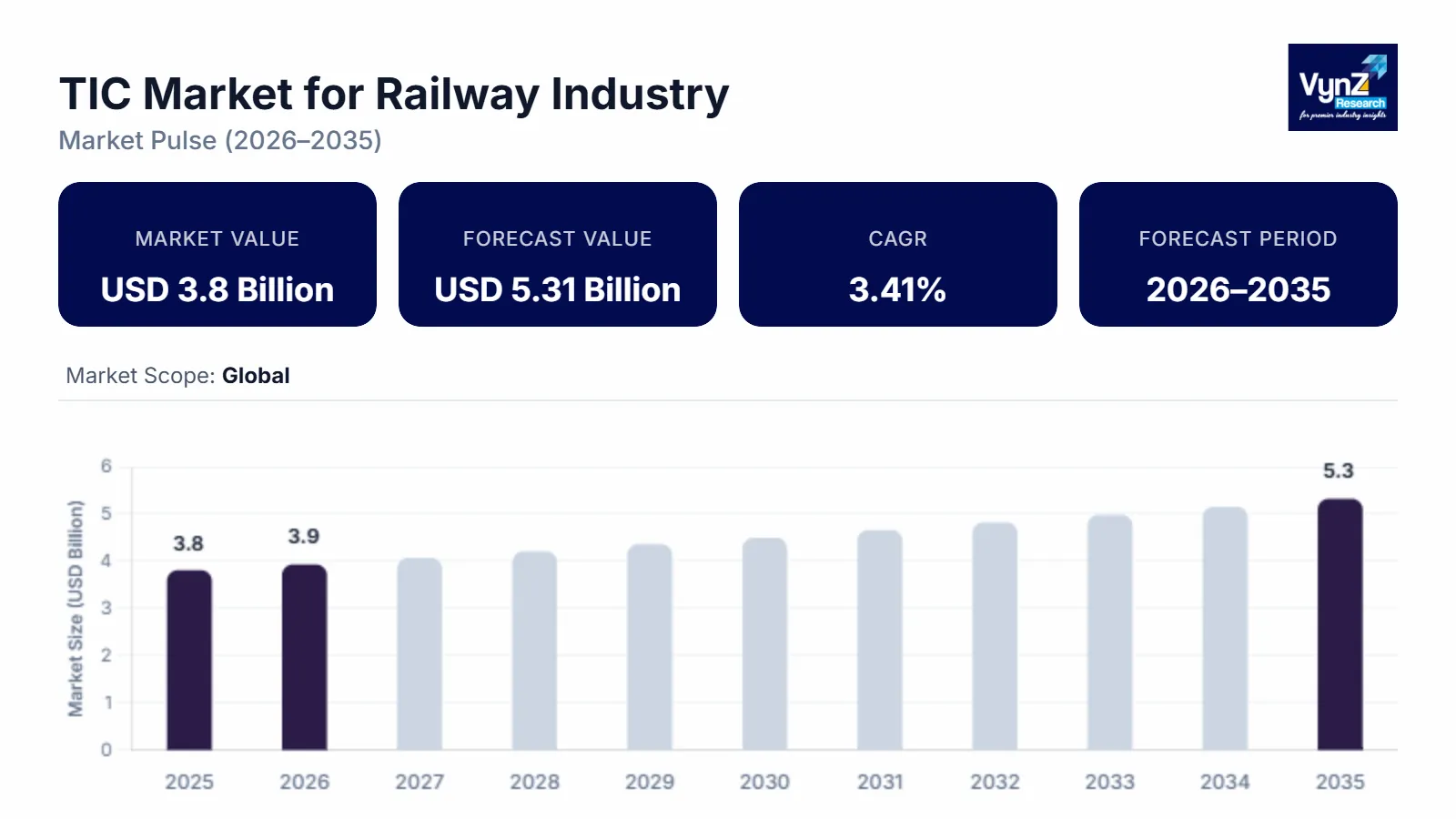
In addition to assisting the global transition toward effective and sustainable transportation systems, the TIC market for the railway sector is crucial for guaranteeing passenger safety, infrastructure dependability, and regulatory compliance. Railway operations are now more difficult due to automation, electrification, high-speed trains, digital signaling systems, and other technological developments.
The Testing, Inspection, and Certification (TIC) sector is vital to the railway business. Rolling stock, rail infrastructure, signaling systems, and component testing, inspection, auditing, and certification are among the services offered in this industry. The need for TIC services to verify system performance and safety is growing as governments throughout the world build up railway networks to ease traffic, cut emissions, and promote environmentally friendly transportation.
International and regional standards require thorough testing and certification before to deployment, thus regulatory compliance continues to be a key motivator. The necessity for standardized TIC procedures is further increased by interoperability among various train networks, particularly in cross-border areas like Europe. Large-scale expenditures in railway renovation and development, are driving the market's steady growth. Rail is being prioritized by governments and business operators as a sustainable form of transportation, which has raised demand for TIC services to guarantee adherence to stringent environmental and safety regulations.
TIC Market for Railway Industry Dynamics
Market Trends
The railway industry's TIC market is evolving because to the increasing usage of digital technologies like AI, IoT, and predictive maintenance for efficiency and real-time monitoring. The demand for testing and certification services is rising due to increased spending on electrification, metro systems, and high-speed rail. Additional elements propelling industry expansion include stricter safety rules and interoperability standards. The industry is changing because to automation, drone-based inspections, and environmental programs. Additionally, the rapid growth of railways in developing regions such as Asia-Pacific is creating new opportunities.
Growth Drivers
A huge worldwide push into train networks boosts TIC work sharply. Because governments spend more than $300 billion every year on upgrading tracks, building fast lines, or expanding city subways. Every job needs outside checks - on trains, signals, or bridges - for safety and function, which lifts TIC use by roughly 7.2% each year.
Rising safety rules plus tighter system compatibility demands are speeding up market expansion. Governments running railways now require sticking to EN, IEC, ISO, or UIC guidelines more than before. Because of efforts to stop accidents and aim for no deaths, checks happen way more often - up almost 20% in ten years - which feeds continuous rise in testing, inspecting, and certifying work.
Upgrades in train tech push more use of testing checks. With digital signals or self-driving controls, plus electric trains, everything needs constant verification - alongside tests that make sure it all works together. Firms offering these high-tech inspection services grow by about 8 to 9% a year, faster than those stuck on old-school track and station projects.
Market Restraints / Challenges
There are a number of significant obstacles facing the railway industry's TIC market. Budgets may be strained by new testing methods, infrastructure inspections, and the high expense of digital systems, particularly for smaller companies. Due to the complexity and ongoing change of regional regulatory systems, compliance is difficult and time-consuming. Technical difficulties are increased by integration problems with contemporary technologies and historical rail systems. Further impeding market expansion include cybersecurity threats in connected train systems, a lack of qualified personnel, and pressure to shorten inspection times while upholding safety regulations.
Market Opportunities
Growing high-speed rail and metro developments, particularly in Asia-Pacific and emerging nations, present significant prospects for the railway industry's TIC sector. TIC requirements are further increased by the expansion of train electrification and sustainability measures. Advanced testing and certification are becoming more and more necessary as digital technologies like AI, IoT, and predictive maintenance become more widely used. Furthermore, new revenue streams are made possible by the outsourcing of TIC services and the growing emphasis on lifetime asset management, safety, and interoperability.
Global TIC Market for Railway Industry Report Coverage
|
Report Metric
|
Details
|
|
Historical Period
|
2020 - 2024
|
|
Base Year Considered
|
2025
|
|
Forecast Period
|
2026 - 2035
|
|
Market Size in 2025
|
U.S.D. 3.8 Billion
|
|
Revenue Forecast in 2035
|
U.S.D. 5.31 Billion
|
|
Growth Rate
|
3.42%
|
|
Segments Covered in the Report
|
Security System Type, Asset Type, Railway Type and Stage of Life Cycle
|
|
Report Scope
|
Market Trends, Drivers, and Restraints; Revenue Estimation and Forecast; Segmentation Analysis; Companies’ Strategic Developments; Market Share Analysis of Key Players; Company Profiling
|
|
Regions Covered in the Report
|
North America, Europe, Asia Pacific
|
TIC Market for Railway Industry Segmentation
By Service Type
By kind of service, you’ve got testing, checking stuff out, giving official approval, or making sure things meet standards. Testing’s growing quickest - around 8.6% each year - because there's more demand to verify signals, train parts, also power setups on railways.
Testing makes up almost half of all TIC income since any updated or fresh setup needs safety and function checks. Inspections still matter a lot when it comes to regular reviews of tracks, bridges, or equipment.
Certification work keeps rising to handle rule demands, whereas safety checks help keep things running smoothly over time.
By Asset Type
When it comes to asset kinds, you’ve got rolling stock, rail setups, signaling tech, or power networks. The signaling part’s growing quickest - close to 9.4% each year - because automated and digital train controls are being used more everywhere.Rail vehicles keep needing tests over time, also checks for safety rules. Things like rails or bridges must get inspected now and then so they stay safe to use.
Fuel and power setups push more checks when tracks move to battery-run or mixed trains. Yet demand grows fast with this switch across lines.
By Railway Type
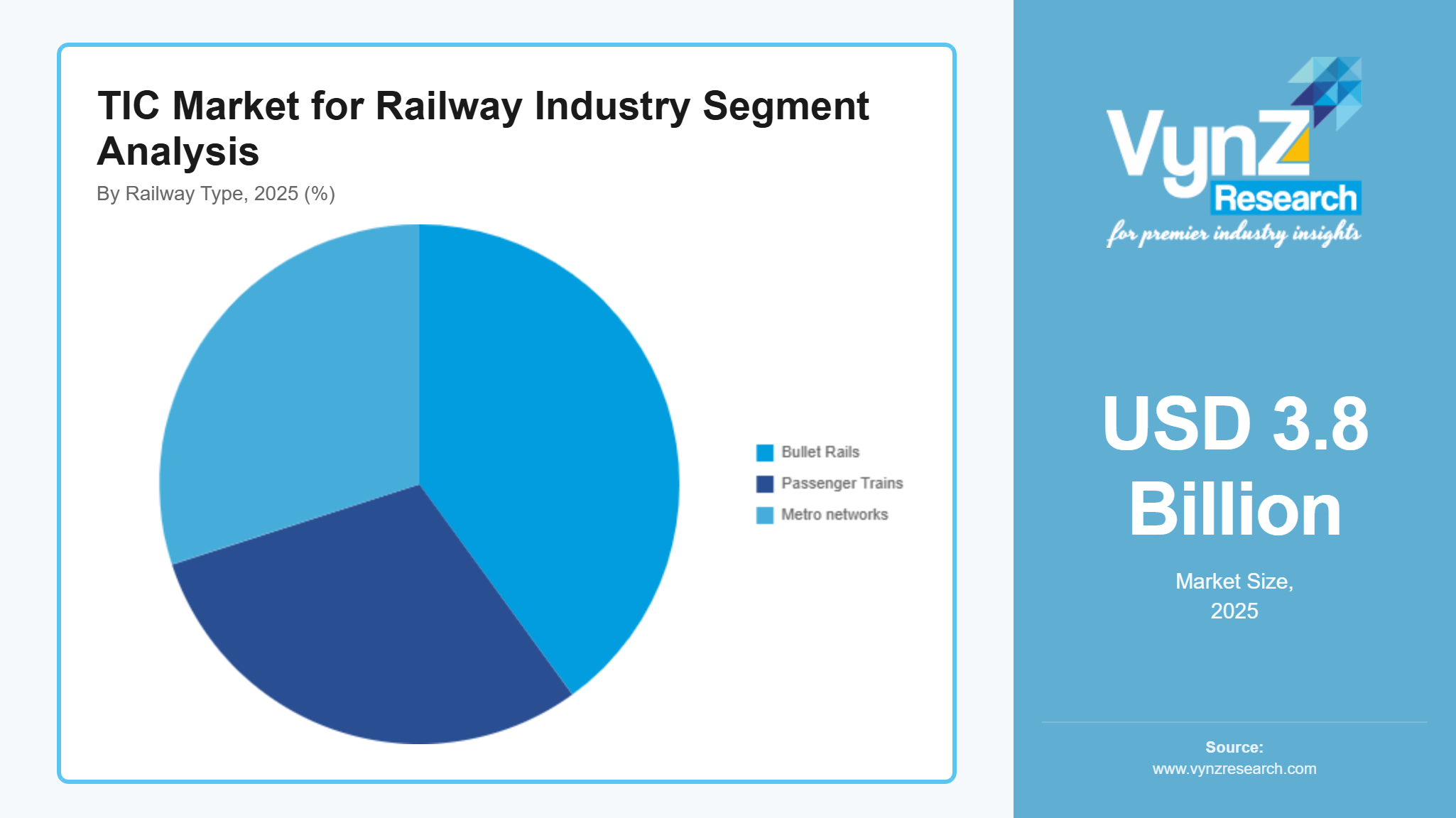
On trains, TIC checks passenger lines, cargo routes, city subways plus trams, also bullet train systems. Bullet rails grow quickest - about 10% each year - since they need tight safety rules along with complex tech setups.
Passenger trains bring in the most money, thanks to growing city transport networks. Meanwhile, freight operations depend on regular checks and approvals so equipment lasts and cargo stays secure.
Metro networks are growing slowly - thanks to cities expanding along with tech upgrades. While more people move downtown, rail projects get cash from local governments instead.
By Stage of Lifecycle
In terms of project phases, TIC checks kick in during planning plus building - then continue into startup, running, and upkeep. Startup evaluations along with trial runs expand most quickly, climbing close to 9.1% each year, since regulators demand thorough checks prior to greenlighting systems.
Testing during design and building checks if things meet standard rules. While running, check-ups keep equipment safe and working well.
Maintenance-linked TIC work grows because older train systems need regular checkups plus reliability reviews.
Regional Insights
North America
North America’s rail sector expands by about 6.5% each year, helped along through better train tracks and heavy use of cargo trains. In that region, the U.S. drives most need - thanks to wide shipping routes combined with strict rules set by national rail regulators.Funding for better train controls boosts checks and approvals. Upgrades in passenger lines also help grow safety reviews through trusted verification.Public and private teams lean more on outside testers to meet rules, while cutting risks through shared efforts.
Asia Pacific
Asia Pacific's growing quicker than anywhere else - close to 9.8% every year. In places like China, India, or Southeast Asia, fresh railway lines are popping up fast, making up more than 60% of all new tracks globally.Fast train plans push need for signal checks, vehicle tests, or power system scans. Public subway growth adds pressure on inspection work instead.Folks making trains for overseas markets must follow global rules, so more companies are turning to outside inspectors nearby.
Europe
Europe’s economy keeps moving up each year by roughly 5.8 to 6.2%, thanks mainly to well-established train systems and tough safety rules. Because different countries need their trains to work together, regular checks and certifications stay common.Folks using more digital signals and electric systems makes testing trickier. Rules about being eco-friendly pile on extra checks for power use and meeting green standards.Europe’s testing firms stick to smart oversight roles, combining audits with compliance guidance so they stay ahead. While others chase volume, these players double down on complex checks plus rule-based consulting - giving clients more confidence across supply chains.
Competitive Landscape / Company Insights
With major competitors like Intertek Group plc, Bureau Veritas, SGS SA, TÜV Rheinland, and TÜV SÜD competing on the basis of technical know-how, regulatory compliance, and global presence, the TIC market for the railway sector is somewhat consolidated. The capacity to manage intricate rail systems and offer end-to-end lifecycle services is what drives competition. In order to improve their market position and service capabilities, businesses are concentrating on digital transformation, AI-based inspections, and strategic acquisitions while growing in emerging areas.
Mini Profiles
Intertek Group plc is an UK-based global TIC provider operating in over 100 countries. Intertek offers testing, inspection, and certification services for rail components, rolling stock, and infrastructure. It focuses on digital assurance, safety compliance, and high-performance testing to support modern railway systems.
Bureau Veritas is a France-based multinational with a strong global presence. Bureau Veritas provides inspection and certification services for rail infrastructure, signaling systems, and safety compliance. It emphasizes sustainability, digital solutions, and regulatory expertise in complex rail projects.
MISTRAS Group is an US-based company specializing in asset protection and non-destructive testing (NDT). MISTRAS supports railway safety through structural integrity testing, monitoring, and advanced inspection technologies for tracks and infrastructure.
SGS SA is one of the world’s leading TIC companies, SGS provides comprehensive rail testing and certification services. It is known for its global laboratory network, strong compliance capabilities, and focus on quality assurance and safety standards.
Eurofins Scientific is a global leader in laboratory testing, Eurofins supports railway systems with specialized analytical and material testing services. It is particularly strong in high-precision testing and regulatory compliance across safety-critical environments.
Key Players
- Intertek Group Plc
- Bureau Veritas
- MISTRAS Group
- SGS SA
- Eurofins Scientific
- TUV Rheinland
- TUV SUD
- DEKRA SE
- Applus+
- DNV GL
Recent Developments
In March 2026, Panasonic has launched a liquid cooling systems business for AI data centers. This business focus on cooling systems for high-performance computing & generative AI servers and development of high-capacity cooling units (1,200 kW+) which aligns with rising demand from data centers and cloud computing.
In March 2026, ABB Robotics Partners with NVIDIA to Deliver Industrial-Grade Physical AI at Scale. The collaboration focuses on combining ABB Robotics’ software programming, design and simulation suite, RobotStudio, with the physically accurate simulation power of NVIDIA Omniverse libraries to close technology's long-standing 'sim-to-real’ gap. Developers can simulate robots in digital twins and generate synthetic data to train their physical AI models, enabling businesses of all types and sizes to deploy AI-driven robotics for various industrial workflows.
In February 2026, Google has awarded Form Energy, Inc. a USD billion contract to provide its cutting-edge iron-air batteries for a Minnesota data center project. One of the biggest and longest-lasting battery installations in the world, this project entails the deployment of a massive energy storage system that can provide electricity constantly for up to 100 hours. Iron-air batteries are less expensive for widespread use since they are made of inexpensive materials like iron.