
Indonesia Electric Three-Wheeler Market Size & Share Growth Forecast Report (2026-2035)
Industry Insight by Product (Passenger Carrier, Load Carrier), by Type (Battery Electric Three-Wheeler, Electric Three-Wheeler Types), by Motor Power (Low Power, Medium Power, High Power), by Driving Range (Short Range, Medium Range, Long Range)
| Status : Published | Published On : Jun, 2026 | Report Code : VRAT9675 | Industry : Automotive & Transportation | Available Format : | Page : 123 |
Indonesia Electric Three-Wheeler Market Overview
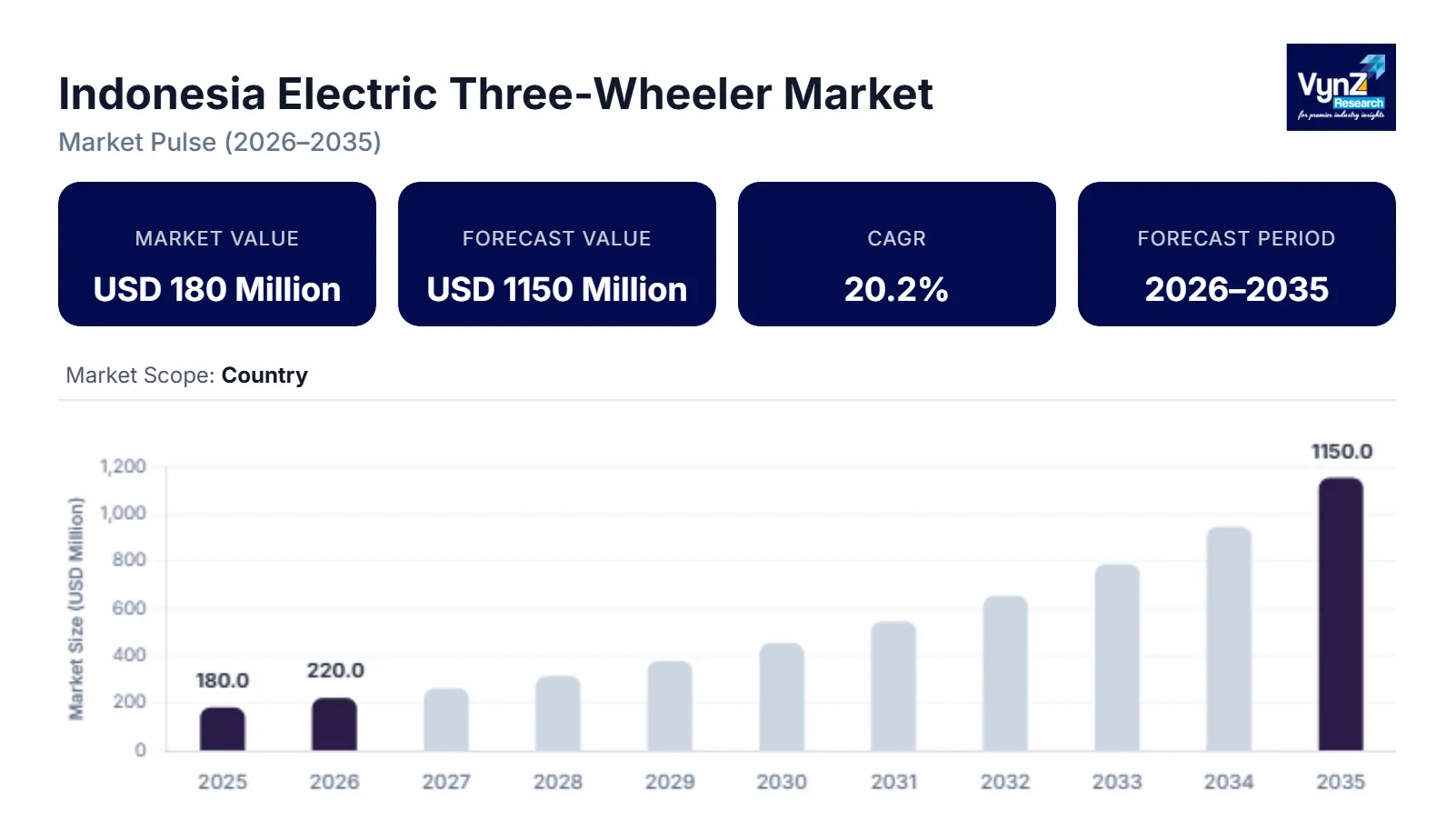
The Indonesia electric three-wheeler market size was estimated at about USD 180 million in 2025 and is expected to reach around USD 220 million in 2026, rising to roughly USD 1150 million by 2035, growing at approximately 20.2% CAGR from 2026 to 2035.
Research Highlights
- Passenger carriers held 56% market share in 2026, driven by urban mobility demand.
- Battery electric models captured 61% share in 2026, supported by government incentives.
- Medium-power vehicles represented 48% revenue share in 2026, balancing efficiency and affordability.
- Medium-range vehicles accounted for 45% share in 2026, supporting daily transport operations.
- Java contributed 45% of market revenue in 2026, driven by infrastructure expansion.
Market growth is supported by government incentives for electric vehicles and growing concern among people over the increasing fuel cost. Growing need for commercial transport and people switching to battery electric mobility solutions is also pushing the market forward. Companies are putting more money into making these vehicles and charging stations helping the market to get bigger in Jakarta, West Java and East Java. The government of Indonesia like the Ministry of Energy and Mineral Resources is doing a lot to help electric vehicles become more popular by giving companies tax breaks and building the infrastructure that electric vehicles need.
Indonesia Electric Three-Wheeler Market Dynamics
Market Trends
The industry is changing to advanced battery technology and companies are shifting to electric mobility. A significant trend is people wanting to use lithium-ion battery powered vehicles due to their higher capacity, low cost of operation and maintenance and less energy consumption. The International Energy Agency says that more and more people in Southeast Asia are using vehicles because governments want to make transportation better for the environment and they want to be sure they have enough energy. Another thing that is becoming popular is the idea of swapping batteries and building charging stations because governments are supporting it and everything is becoming digital. The Ministry of Energy and Mineral Resources in Indonesia says that Indonesia is building charging infrastructure and developing programs to encourage people buy EVs.
Growth Drivers
The market is growing because governments are giving people incentives to buy vehicles for transportation, logistics and ride-hailing. Companies are investing more in making batteries, building charging stations and making vehicles. The Ministry of Indonesia is encouraging them to manufacture vehicles locally to boost the automotive industry. Higher adoption of electric three-wheelers among people for mobility is also helping the electric three-wheeler market grow. The government and companies are working together to make electric vehicles more accessible to fleet operators and commercial users looking to lower costs. The Asian Development Bank says that electric three-wheelers are a part of making urban transportation better in Indonesia.
Market Restraints / Challenges
Even though the market is expected to grow there are some challenges that might stop it from growing smoothly. One of the challenges is that there are not enough charging stations and these vehicles are expensive to buy. This is making it hard for small fleet operators and people with tight budget. The International Energy Agency says that having charging stations is very important for people to want to buy electric vehicles. Another challenge is that companies have to rely on other countries for parts and technology which can cause supply disruption and make parts expensive.
Market Opportunities
There are chances of growth for logistics and last-mile delivery services in the market. As cities are getting bigger, companies that make durable electric three-wheelers are in a good position to sell them to delivery operators, small businesses and mobility service providers. The Asian Development Bank says that Indonesia will invest more in urban transportation during the forecast period. Another opportunity is in making batteries and building battery swapping ecosystems because companies are investing more in electric mobility infrastructure, charging platforms, better battery management systems and connected fleet technologies. The International Energy Agency and the Ministry of Energy and Mineral Resources say that developing battery ecosystems is very important for the region to meet the electric mobility goals.
Indonesia Electric Three-Wheeler Market Report Coverage
|
Report Metric |
Details |
|
Historical Period |
2020 - 2024 |
|
Base Year Considered |
2025 |
|
Forecast Period |
2026 - 2035 |
|
Market Size in 2025 |
USD 180 Million |
|
Revenue Forecast in 2035 |
USD 1150 Million |
|
Growth Rate |
20.2% |
|
Segments Covered in the Report |
By Product, By Type, By Motor Power, By Driving Range |
|
Report Scope |
Market Trends, Drivers, and Restraints; Revenue Estimation and Forecast; Segmentation Analysis; Companies’ Strategic Developments; Market Share Analysis of Key Players; Company Profiling |
|
Regions Covered in the Report |
Java, Sumatra, Kalimantan, Rest of Indonesia |
|
Key Companies |
Alessa Motors Nusantara, Electrum, GESITS, Piaggio Indonesia, Selis, Smoot Motor Indonesia, SWAP Energi, Terra Motors Indonesia, Viar Motor Indonesia, Volta Indonesia |
|
Customization |
Available upon request |
Indonesia Electric Three-wheeler Market Segmentation
By Product
Passenger carrier vehicles made up 56% of the market in 2025 due to higher use in cities for ride-hailing and short trips, government’s efforts to promote low-emission transportation as stated in Presidential Regulation No. 55/2019 and prioritization of sustainable urban mobility for transport development by the Indonesian Ministry of Transportation.
Load carrier vehicles are expected to grow at 21.1% each year through 2036 due to growing need for delivery services. The Low Carbon Development Initiative says that electric logistics fleets will help reduce emissions and improve city logistics with passenger and load carrier vehicles.
By Type
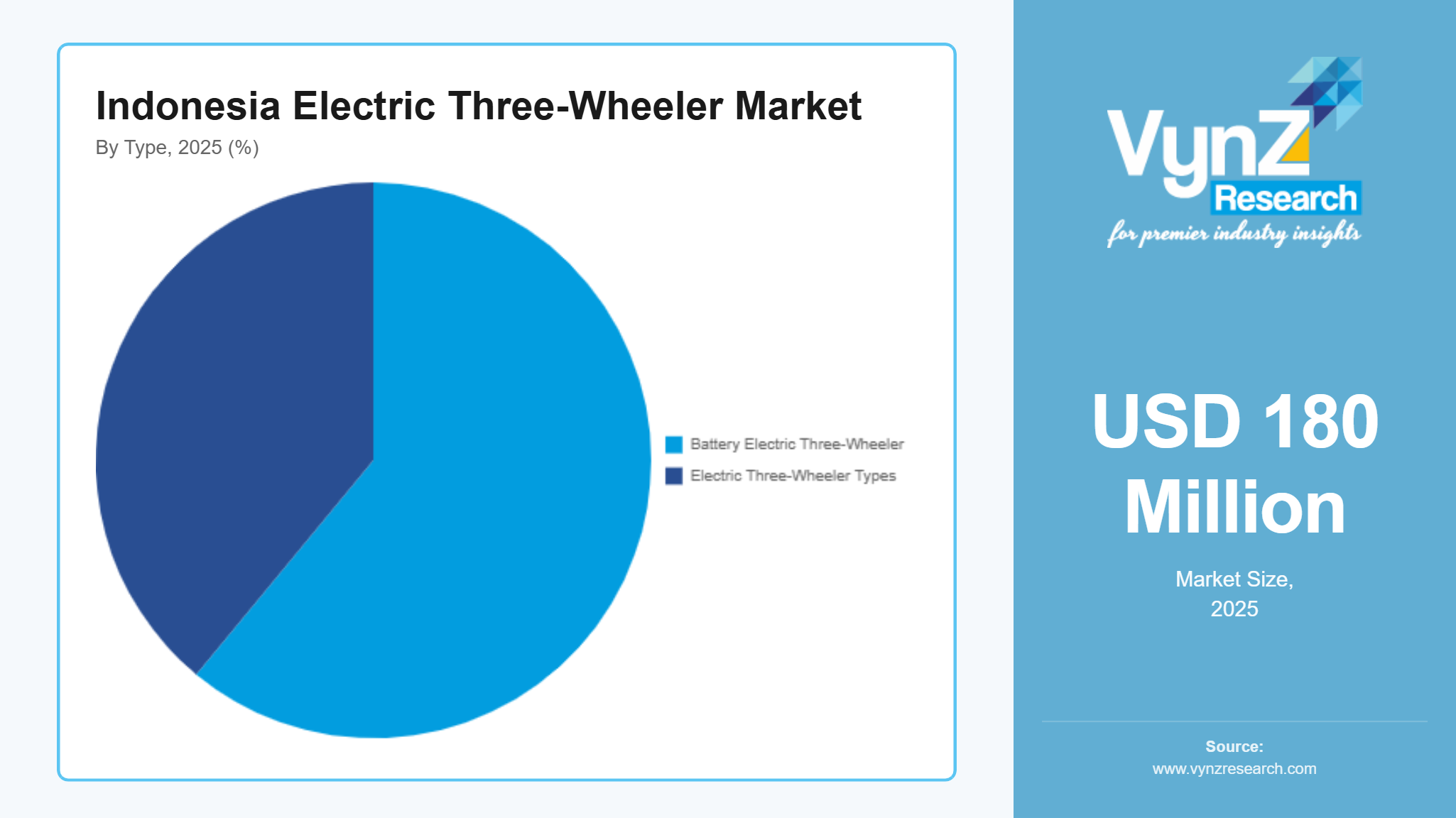
Battery three-wheelers accounted for about 61% of the market in 2025 because they are cheap to run, easy to maintain and have more charging stations. The growth is fueled by incentives and investments in infrastructure as stated in Presidential Regulation No. 55/2019.
Electric propulsion technologies are expected to grow at 18.5% each year during the forecast period due to growing efforts to improve technology and pilot projects in cities to develop mobility.
By Motor Power
Medium-power electric three-wheelers made up about 48% of the market in 2025 because they offer balance performance, affordability and energy efficiency. The Making Indonesia 4.0 initiative says that vehicle manufacturers are investing in electric drivetrain technologies for medium-power three-wheelers.
Higher motor power categories are supposed to grow the fastest at 22.3% each year through the forecast period helped by increasing adoption in logistics and commercial delivery applications.
By Driving Range
Long-range electric three-wheelers made up the largest part of the market with about 45% share in 2025 because they are suitable for transportation and delivery operations. The Indonesian EV Charging Infrastructure Acceleration Program says that charging network development is a priority for high-range electric three-wheelers.
Medium range electric three-wheelers are poised to grow the fastest at 22.5% each year fueled by increasing demand for operating capability and better commercial transportation efficiency.
Regional Insights
Java
Java held about 45% of the market share in 2025 due to a large population and their increasing preference to move around easily in big cities like Jakarta, Surabaya and Bandung. The Ministry of Transportation in Indonesia says that making mobility better is a priority and has rules like Presidential Regulation No. 55/2019 to help vehicles and charging stations. Reports from the Ministry of Energy and Mineral Resources say that many public charging stations in Java helps the market grow.
Sumatra
Sumatra accounted for 22% of the market share in 2025 as more people are moving to cities and businesses are expanding. Cities like Medan, Palembang and Pekanbaru are using three-wheelers for transportation of people and goods. The government has plans like the National Energy General Plan to help the market grow.
Kalimantan
Kalimantan had about 15% of the market share in 2025 due to higher modernization projects and a better infrastructure to transport people and goods. The Ministry of Public Works and Housing and the Nusantara Capital Authority think that transportation that is good for the environment is very important and therefore the government is encouraging people to use electric mobility programs.
Rest of Indonesia
The rest of Indonesia, which includes places like Sulawesi, Bali, Nusa Tenggara, Papua, Maluku and others held about 18% of the market share in 2025 due to higher electrification programs, better transportation connections and growing adoption of low-emission vehicles. The government has plans like the Indonesia Net Zero Emissions 2060 Roadmap to support the market growth. Reports from the Ministry of Energy and Mineral Resources and the International Energy Agency say that increase in charging stations will help the market grow further.
Competitive Landscape / Company Insights
The market is fairly competitive with manufacturers, electric vehicle startups and regional producers focusing on improving products, batteries and distribution networks. Companies are investing more in research and working with charging partners and the Indonesian government through the Ministry of Industry and the Ministry of Energy and Mineral Resources is encouraging investment in electric vehicle production, batteries and infrastructure with programs under Presidential Regulation No. 55/2019.
Mini Profiles
Alessa Motors Nusantara focuses on electric motorcycles and sustainable mobility solutions, supported by local manufacturing capabilities, expanding dealer networks, and growing participation in Indonesia's developing electric vehicle ecosystem.
Electrum operates in the urban electric mobility segment, emphasizing battery-swapping technology, fleet electrification, and integrated mobility solutions designed to improve operational efficiency and user convenience.
GESITS leverages domestic manufacturing expertise and strategic partnerships to expand market presence, offering locally developed electric vehicles aligned with Indonesia's transportation electrification objectives.
Piaggio Indonesia serves commercial and mobility markets through a diversified vehicle portfolio, supported by strong brand recognition, established distribution channels, and extensive automotive industry experience.
Terra Motors Indonesia focuses on electric three-wheelers and commercial mobility solutions, supported by technological innovation, regional operating experience, and a growing network of fleet and distribution partners.
Key Players
- Alessa Motors Nusantara
- Electrum
- GESITS
- Piaggio Indonesia
- Selis
- Smoot Motor Indonesia
- SWAP Energi
- Terra Motors Indonesia
- Viar Motor Indonesia
- Volta Indonesia
Recent Developments
In December 2025, Alessa Motors Nusantara announced plans to strengthen its electric vehicle business foundation through expanded local production, dealership network growth, and increased research and development activities for 2026. The company also reported achieving a domestic content level of 44%, supporting Indonesia's localization objectives.
In April 2026, Electrum reported that its operational electric vehicle fleet increased to more than 9,000 units from about 5,100 units a year earlier. The company also recorded strong growth in revenue from electric vehicle sales and leasing activities, reflecting rising adoption of electric mobility solutions.
In November 2025, Smoot Motor Indonesia entered a strategic partnership with PT Rider Gate Indonesia and PT Swap Energi Indonesia to establish an integrated electric vehicle leasing ecosystem. The initiative includes deployment of electric motorcycles supported by battery-swapping infrastructure and flexible financing models.
In November 2025, SWAP Energi partnered with PT Rider Gate Indonesia and Smoot Motor Indonesia to support the rollout of an integrated electric mobility leasing platform. The company expanded its role in battery-swapping infrastructure and battery system management to support growing electric vehicle adoption.
In November 2025, Viar Motor Indonesia was identified as a potential vehicle supplier for Indonesia's large-scale cooperative development program involving transportation asset procurement nationwide. The initiative is expected to create new opportunities for domestic vehicle manufacturers participating in commercial mobility projects.
Indonesia Electric Three-Wheeler Market Coverage
Product Insight and Forecast 2026 - 2035
- Passenger Carrier
- Load Carrier
Type Insight and Forecast 2026 - 2035
- Battery Electric Three-Wheeler
- Electric Three-Wheeler Types
Motor Power Insight and Forecast 2026 - 2035
- Low Power
- Medium Power
- High Power
Driving Range Insight and Forecast 2026 - 2035
- Short Range
- Medium Range
- Long Range
Indonesia Electric Three-Wheeler Market by Region
- Java
- By Product
- By Type
- By Motor Power
- By Driving Range
- Sumatra
- By Product
- By Type
- By Motor Power
- By Driving Range
- Kalimantan
- By Product
- By Type
- By Motor Power
- By Driving Range
- Rest of Indonesia
- By Product
- By Type
- By Motor Power
- By Driving Range
Table of Contents for Indonesia Electric Three-Wheeler Market Report
1. Research Overview
1.1. The Report Offers
1.2. Market Coverage
1.2.1. By
Product
1.2.2. By
Type
1.2.3. By
Motor Power
1.2.4. By
Driving Range
1.3. Research Phases
1.4. Limitations
1.5. Market Methodology
1.5.1. Data Sources
1.5.1.1.
Primary Research
1.5.1.2.
Secondary Research
1.5.2. Methodology
1.5.2.1.
Data Exploration
1.5.2.2.
Forecast Parameters
1.5.2.3.
Data Validation
1.5.2.4.
Assumptions
1.5.3. Study Period & Data Reporting Unit
2. Executive Summary
3. Industry Overview
3.1. Industry Dynamics
3.1.1. Market Growth Drivers
3.1.2. Market Restraints
3.1.3. Key Market Trends
3.1.4. Major Opportunities
3.2. Industry Ecosystem
3.2.1. Porter’s Five Forces Analysis
3.2.2. Recent Development Analysis
3.2.3. Value Chain Analysis
3.3. Competitive Insight
3.3.1. Competitive Position of Industry
Players
3.3.2. Market Attractive Analysis
3.3.3. Market Share Analysis
4. Indonesia Market Estimate and Forecast
4.1. Indonesia Market Overview
4.2. Indonesia Market Estimate and Forecast to 2035
5. Market Segmentation Estimate and Forecast
5.1. By Product
5.1.1. Passenger Carrier
5.1.1.1. Market Definition
5.1.1.2. Market Estimation and Forecast to 2035
5.1.2. Load Carrier
5.1.2.1. Market Definition
5.1.2.2. Market Estimation and Forecast to 2035
5.2. By Type
5.2.1. Battery Electric Three-Wheeler
5.2.1.1. Market Definition
5.2.1.2. Market Estimation and Forecast to 2035
5.2.2. Electric Three-Wheeler Types
5.2.2.1. Market Definition
5.2.2.2. Market Estimation and Forecast to 2035
5.3. By Motor Power
5.3.1. Low Power
5.3.1.1. Market Definition
5.3.1.2. Market Estimation and Forecast to 2035
5.3.2. Medium Power
5.3.2.1. Market Definition
5.3.2.2. Market Estimation and Forecast to 2035
5.3.3. High Power
5.3.3.1. Market Definition
5.3.3.2. Market Estimation and Forecast to 2035
5.4. By Driving Range
5.4.1. Short Range
5.4.1.1. Market Definition
5.4.1.2. Market Estimation and Forecast to 2035
5.4.2. Medium Range
5.4.2.1. Market Definition
5.4.2.2. Market Estimation and Forecast to 2035
5.4.3. Long Range
5.4.3.1. Market Definition
5.4.3.2. Market Estimation and Forecast to 2035
6. Java Market Estimate and Forecast
6.1. By
Product
6.2. By
Type
6.3. By
Motor Power
6.4. By
Driving Range
7. Sumatra Market Estimate and Forecast
7.1. By
Product
7.2. By
Type
7.3. By
Motor Power
7.4. By
Driving Range
8. Kalimantan Market Estimate and Forecast
8.1. By
Product
8.2. By
Type
8.3. By
Motor Power
8.4. By
Driving Range
9. Rest of Indonesia Market Estimate and Forecast
9.1. By
Product
9.2. By
Type
9.3. By
Motor Power
9.4. By
Driving Range
10. Company Profiles
10.1.
Alessa Motors Nusantara
10.1.1.
Snapshot
10.1.2.
Overview
10.1.3.
Offerings
10.1.4.
Financial
Insight
10.1.5.
Recent
Developments
10.2.
Electrum
10.2.1.
Snapshot
10.2.2.
Overview
10.2.3.
Offerings
10.2.4.
Financial
Insight
10.2.5.
Recent
Developments
10.3.
GESITS
10.3.1.
Snapshot
10.3.2.
Overview
10.3.3.
Offerings
10.3.4.
Financial
Insight
10.3.5.
Recent
Developments
10.4.
Piaggio Indonesia
10.4.1.
Snapshot
10.4.2.
Overview
10.4.3.
Offerings
10.4.4.
Financial
Insight
10.4.5.
Recent
Developments
10.5.
Selis
10.5.1.
Snapshot
10.5.2.
Overview
10.5.3.
Offerings
10.5.4.
Financial
Insight
10.5.5.
Recent
Developments
10.6.
Smoot Motor Indonesia
10.6.1.
Snapshot
10.6.2.
Overview
10.6.3.
Offerings
10.6.4.
Financial
Insight
10.6.5.
Recent
Developments
10.7.
SWAP Energi
10.7.1.
Snapshot
10.7.2.
Overview
10.7.3.
Offerings
10.7.4.
Financial
Insight
10.7.5.
Recent
Developments
10.8.
Terra Motors Indonesia
10.8.1.
Snapshot
10.8.2.
Overview
10.8.3.
Offerings
10.8.4.
Financial
Insight
10.8.5.
Recent
Developments
10.9.
Viar Motor Indonesia
10.9.1.
Snapshot
10.9.2.
Overview
10.9.3.
Offerings
10.9.4.
Financial
Insight
10.9.5.
Recent
Developments
10.10.
Volta Indonesia
10.10.1.
Snapshot
10.10.2.
Overview
10.10.3.
Offerings
10.10.4.
Financial
Insight
10.10.5.
Recent
Developments
11. Appendix
11.1. Exchange Rates
11.2. Abbreviations
Note: Financial insight and recent developments of different companies are subject to the availability of information in the secondary domain.
Frequently Asked Questions
Purchase Options
Latest Report
Research Methodology
- Desk Research / Pilot Interviews
- Build Market Size Model
- Research and Analysis
- Final Deliverable
Connect With Our Sales Team
- Toll-Free: +1-888-253-3960
- Phone: +91 9960 288 381
- Email: enquiry@vynzresearch.com
Indonesia Electric Three-Wheeler Market