Malaysia Electric Two-Wheeler Market Overview
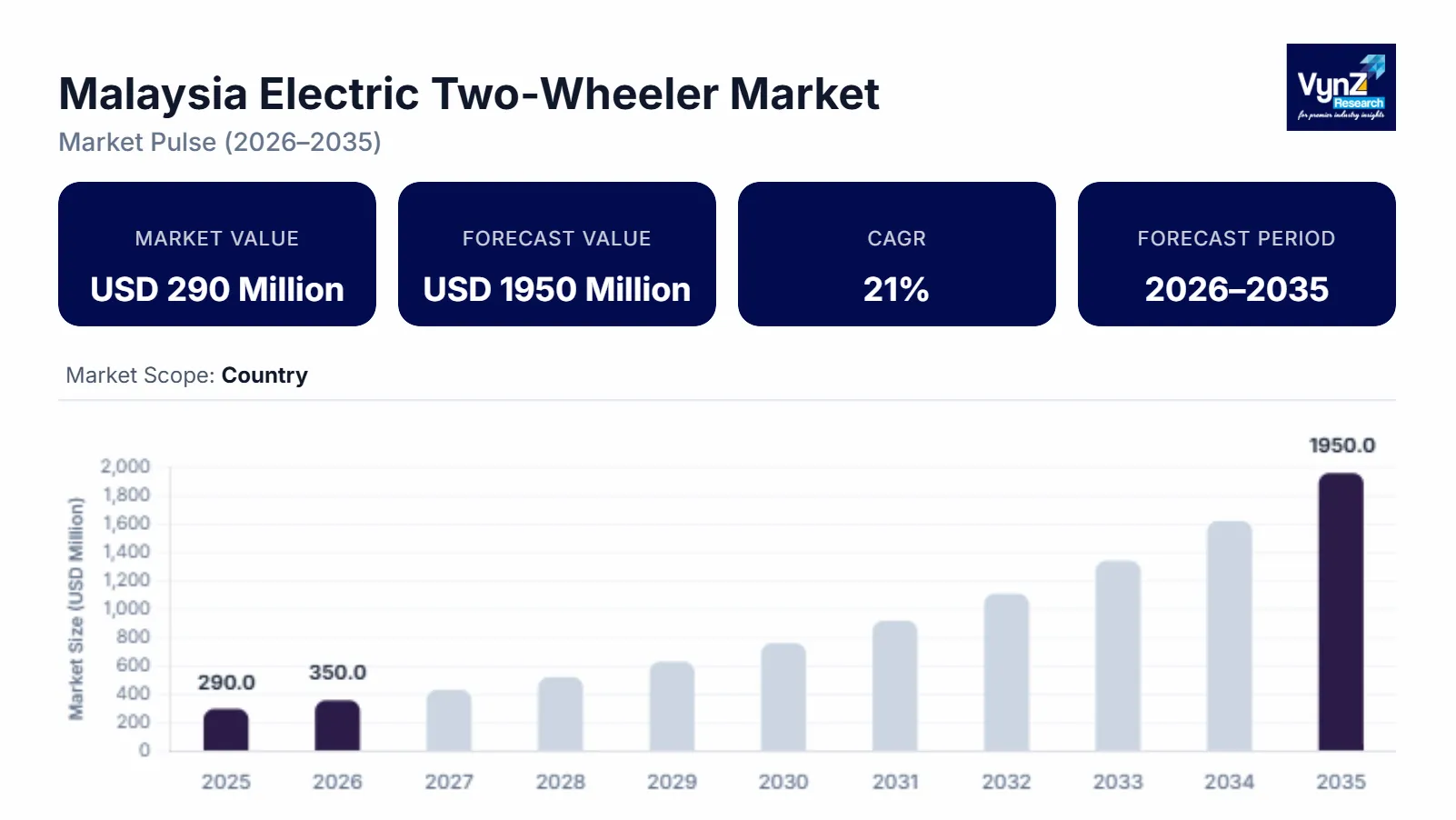
The Malaysia electric two-wheeler market size was estimated at about USD 290 million in 2025 and is expected to reach around USD 350 million in 2026 rising up to roughly USD 1950 million in 2035, growing at approximately 21% CAGR from 2026 to 2035.
Research Highlights
- Electric scooters held 62% market share in 2025 due to growing urban commuting demand.
- Lithium-ion batteries captured 71% share in 2025 for their higher efficiency.
- Non-removable batteries accounted for 57% share in 2025 supported by greater availability.
- Above 60V models are projected to grow at 22.5% CAGR through 2035.
- Central Malaysia held 35% market share in 2025 backed by fast urbanization.
The market is steadily growing due to the constant rise in fuel prices, higher awareness among people regarding environment protection needs, governments helping out by making policies that support the use of vehicles and preference of people to own vehicles that are affordable and good for the earth. Companies are spending money to make eco-friendly and better vehicles and products because the Ministry of Investment, Trade and Industry and the Malaysia Automotive Robotics and IoT Institute are encouraging them to do so to build their National Energy Transition Roadmap. The Ministry of Investment, Trade and Industry and the Malaysia Automotive Robotics and IoT Institute are helping companies to gain a better foothold in cities, like Kuala Lumpur, Selangor and Johor by promoting use of electric two-wheelers.
Malaysia Electric Two-Wheeler Market Dynamics
Market Trends
The industry is changing mainly due to higher preference among people to buy scooters and motorcycles as a cheaper and greener modes of transport that reduce maintenance costs. The Ministry of Investment, Trade and Industry and the Malaysia Automotive Robotics and IoT Institute are supporting such mobility. Another trend is the ability to use mobile apps and battery management systems making electric two-wheelers more appealing. Companies are focusing on making the riding experience better, building more charging points for more convenience and offering integrated mobility solutions.
Growth Drivers
The market is growing as fuel prices are high, growing need for cheaper and greener transportation and increasing demand for electric scooters and motorcycles in urban regions. The government is investing in electric vehicle infrastructure charging networks and local assembly which is helping the market grow as well and the National Energy Transition Roadmap and MITI are also supporting the market growth. People want to reduce emissions and save money and are therefore choosing two-wheelers and MARii is helping the industry by promoting electric vehicle adoption and local manufacturing.
Market Restraints / Challenges
The market faces some challenges as the battery cells and critical materials are imported which affects pricing and supply chain stability. The International Energy Agency (IEA) says that battery supply chains are concentrated in a few countries which creates risks for emerging markets like Malaysia. Charging infrastructure is limited outside cities and is a challenge for manufacturers and consumers who depend on developing charging networks and imported technologies leading to adoption barriers, cost pressures and slower market growth.
Market Opportunities
The market has opportunities in commuting and shared mobility services as more people are moving to cities and using digital services for meeting their transportation needs. Companies offering high-performance electric two-wheelers can capture demand from students, professionals and delivery operators. Another opportunity is in battery swapping networks and connected mobility solutions with greater investments in services creating new avenues. Advancements in charging technologies, fleet management tools and mobile service platforms will improve user convenience and drive market adoption in Malaysia.
Malaysia Electric Two-Wheeler Market Report Coverage
|
Report Metric
|
Details
|
|
Historical Period
|
2020 - 2024
|
|
Base Year Considered
|
2025
|
|
Forecast Period
|
2026 - 2035
|
|
Market Size in 2025
|
U.S.D. 290 Million
|
|
Revenue Forecast in 2035
|
U.S.D. 1950 Million
|
|
Growth Rate
|
21%
|
|
Segments Covered in the Report
|
By Product, By Battery Type, By Battery Technology, By Voltage
|
|
Report Scope
|
Market Trends, Drivers, and Restraints; Revenue Estimation and Forecast; Segmentation Analysis; Companies’ Strategic Developments; Market Share Analysis of Key Players; Company Profiling
|
|
Regions Covered in the Report
|
Central Malaysia, Southern Malaysia, Northern Malaysia, East Malaysia and Other Regions
|
Malaysia Electric Two-Wheeler Market Segmentation
By Product
In 2025 electric scooters made up 62% of the market supported by the growing preference of people for cheaper and convenient mode of transport. These are great for city rides and help them reduce running costs without worrying about the increasing fuel prices.
Electric motorcycles are expected to grow at around 22.3% during the forecast period due to advancement in battery technology, better performance and popularity among young generation.
By Battery Type
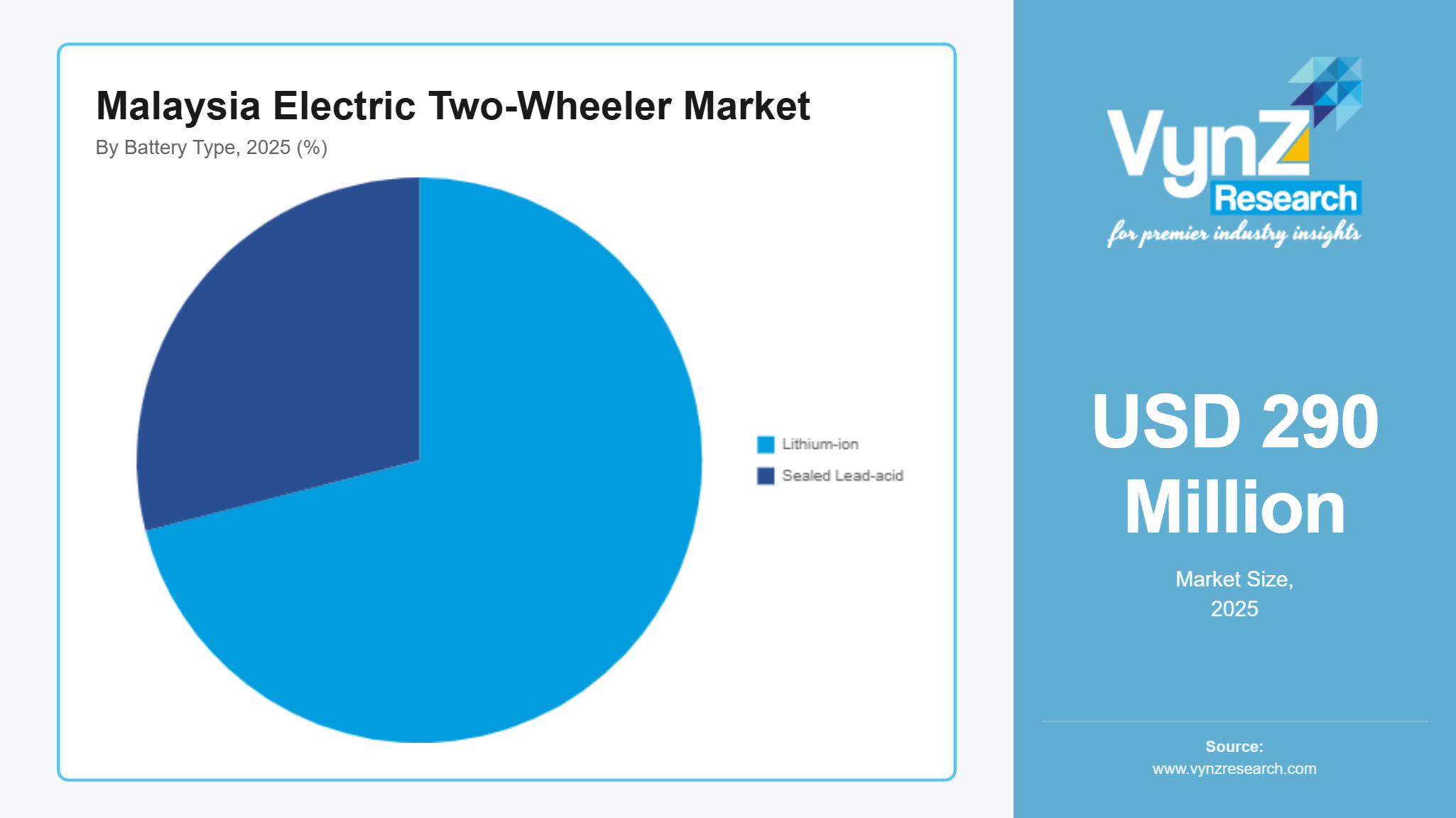
Lithium-ion batteries made up about 71% of the market in 2025 due to better technology, higher capacity and range, fast charging ability and durability.
Sealed lead-acid batteries are expected to grow at 20.8% through 2026 to 2035 due to low-cost, long-lasting capacity, and durability.
By Battery Technology
Non-removable battery technology contributed about 57% of the market share in 2025 due their higher availability, easy to make, and government support.
Removable battery technology is expected to grow at around 22.7% per year during the forecast period because they are convenient to use and swap.
By Voltage
The 48V–60V segment represented about 48% of the market in 2025 due to growing demand for their better performance, efficiency, affordability and government support.
The 60V segment is expected to grow the fastest at around 22.5% through 2026 to 2035 because people want premium electric motorcycles that perform well in most conditions.
Regional Insights
Central Malaysia
In 2025 Central Malaysia accounted for about 35% of the market because a lot of people living in cities can afford to buy and are more open to using electric two wheelers especially in Kuala Lumpur, Selangor and Putrajaya. The Ministry of Investment, Trade and Industry and the Malaysia Automotive Robotics and IoT Institute are also working on making electric vehicles more popular and creating a support system.
Southern Malaysia
The Southern Malaysia market is growing steadily and contributed about 24% of the market share in 2025 because more factories and buildings being built, good transportation policies and growing preference for two-wheelers among people to commute and make deliveries in places like Johor and others with a lot of business and trade happening. People in Southern Malaysia are interested in transportation that uses fuel and is more eco-friendly and companies are investing in greener mobility solutions.
Northern Malaysia
The Northern Malaysia market held nearly 18% of the market in 2025 due to large number of factories, better city infrastructure and people being more aware of eco-friendly mobility. There is a higher demand in places like Penang, Kedah and Perak and the Malaysia Automotive Robotics and IoT Institute and the National Energy Transition Roadmap are working to make electric vehicles more popular in the region.
East Malaysia and Other Regions
East Malaysia and other areas accounted for about 23% of the market in 2025 due to higher adoption and use in places like Sabah, Sarawak and Labuan, more infrastructure, focus on sustainability and help from the Ministry of Investment, Trade and Industry and national plans to make more electric vehicles.
Competitive Landscape / Company Insights
The market has a lot of companies competing with each other, both from other countries and smaller local companies, trying to come up with new products, set good prices and sell their products in new markets. These companies are spending money on making better batteries, doing research and adding new features to their products to beat other competitors. The Ministry of Investment, Trade and Industry and the Malaysia Automotive Robotics and IoT Institute are helping companies to build factories in the country, work with local partners and make better electric vehicles for their National Energy Transition Roadmap.
Mini Profiles
Airwheel Holding Limited focuses on electric scooters and smart mobility solutions, supported by international brand recognition, product innovation, and expanding distribution networks across urban electric transportation markets.
Blueshark Ecosystem Sdn. Bhd. operates in the premium electric two-wheeler segment, emphasizing connected mobility technologies, advanced battery systems, and digitally integrated riding experiences.
Eclimo Sdn. Bhd. leverages local manufacturing expertise and proprietary battery technology to expand market presence, offering electric motorcycles designed for urban mobility and commercial applications.
Go Auto Group focuses on electric mobility distribution and vehicle assembly activities, supported by strategic partnerships, automotive expertise, and a growing presence within Malaysia's EV ecosystem.
NIU Technologies operates in the smart electric mobility segment, emphasizing innovative design, connected vehicle features, and advanced performance capabilities for modern urban commuters.
Key Players
- Airwheel Holding Limited
- Artroniq Berhad
- Blueshark Ecosystem Sdn. Bhd
- EBixon Sdn. Bhd
- Eclimo Sdn. Bhd
- Go Auto Group
- Hong Leong Yamaha Motor Sdn. Bhd
- NIU Technologies
- Ningbo MYWAY Intelligent Technology Co. Ltd
- Treeletrik
Recent Developments
In February 2025, Artroniq Berhad expanded its electric mobility portfolio through continued investments in electric two-wheeler distribution and battery-powered transportation solutions. The company also strengthened its focus on supporting Malaysia's growing sustainable mobility ecosystem.
In April 2025, EBixon Sdn. Bhd. increased efforts to expand the adoption of electric motorcycles across commercial and personal mobility applications. The company focused on enhancing product availability and strengthening its local market presence.
In June 2025, Hong Leong Yamaha Motor Sdn. Bhd. continued evaluating opportunities in the electric two-wheeler segment while expanding its sustainable mobility initiatives in Malaysia. The company also increased focus on future-ready mobility technologies and electrification strategies.
In September 2025, Ningbo MYWAY Intelligent Technology Co. Ltd. expanded international marketing activities for its electric two-wheeler portfolio targeting Southeast Asian markets. The company strengthened partnerships aimed at improving regional product distribution and market access.
In January 2026, Treeletrik announced plans to accelerate electric motorcycle deployment and expand its dealer network across Malaysia. The initiative was intended to improve market penetration and support increasing consumer demand for electric mobility solutions.