
Philippines Electric Two-Wheeler Market Size & Share Growth Forecast Report (2026-2035)
Industry Insight by Vehicle Type (Electric Motorcycles, Electric Scooters), by Battery Type (Lithium Ion Battery, Lead Acid Battery), by Voltage (Below 48V, 48V to 60V, Above 60V), by End User (Personal Use, Commercial Use, Top of Form, Bottom of Form)
| Status : Published | Published On : Jul, 2026 | Report Code : VRAT9674 | Industry : Automotive & Transportation | Available Format :

|
Page : 123 |
Philippines Electric Two-Wheeler Market Overview
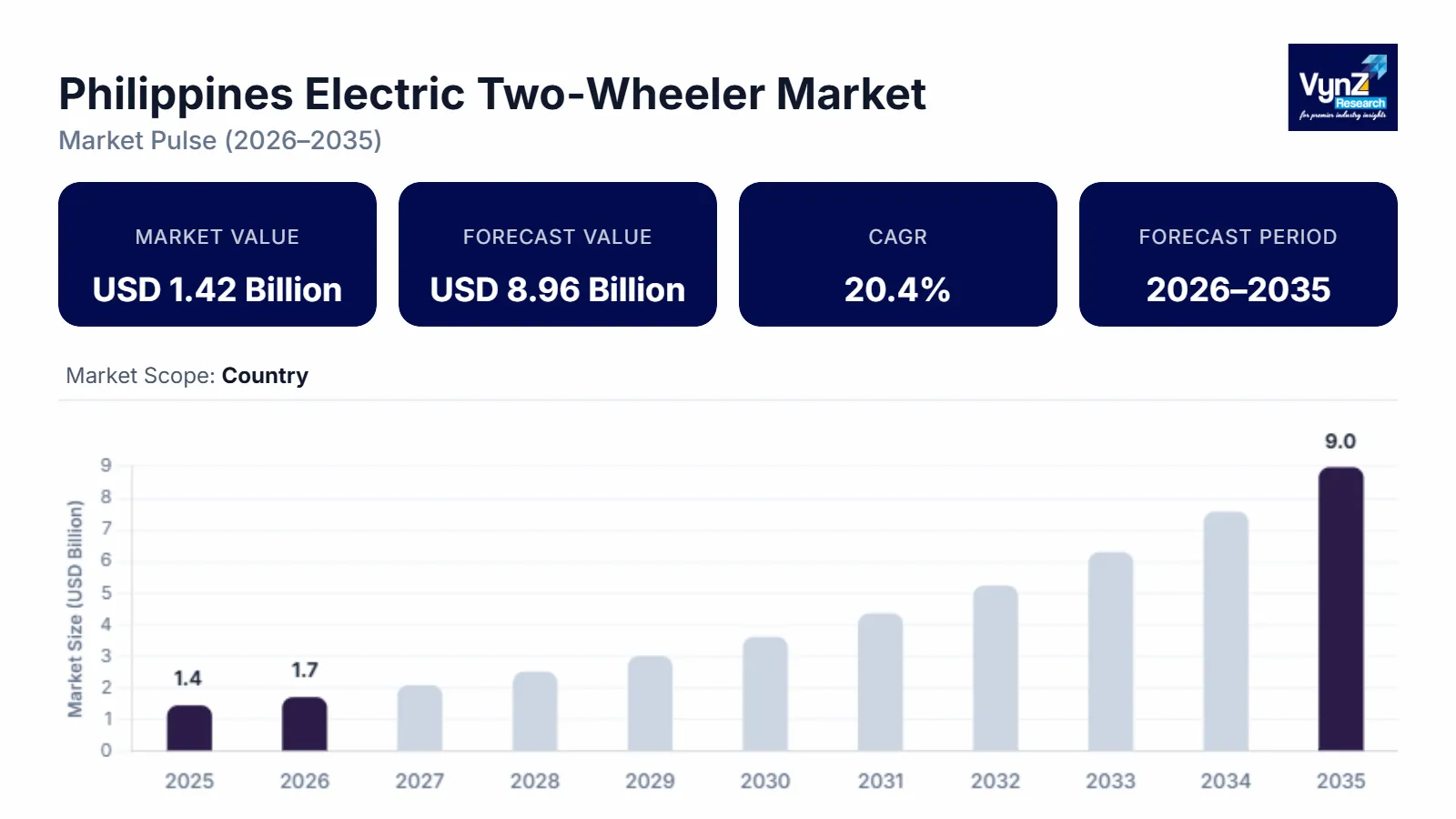
The Philippines electric two-wheeler market size was estimated at about USD 1.42 billion in 2025 and is expected to reach around USD 1.68 billion in 2026, rising to roughly USD 8.96 billion by 2035, growing at approximately 20.4% CAGR from 2026 to 2035.
Research Highlights
- Electric scooters held 59.8% market share in 2025 supported by increasing urban commuting and affordability.
- Lithium-ion batteries accounted for 71.5% share in 2025 due to higher efficiency and longer operational life.
- 48V to 60V batteries represented 47.3% share in 2025 owing to balanced performance and affordability.
- Above 60V batteries are projected to grow at 21.6% CAGR supported by premium electric motorcycles.
- Metro Manila represented 37.9% of the market in 2025 due to strong electric mobility and charging infrastructure investments.
Market growth is supported by increasing government support for electric mobility, rising fuel prices, and growing demand for affordable personal transportation along with expanding adoption of battery powered motorcycles and scooters. Increasing consumer preference for low emission mobility solutions and continued investments in electric vehicle infrastructure are further supporting market expansion across Metro Manila, Central Luzon, Calabarzon, and other urban regions. According to the Department of Energy (DOE), Philippines, the Electric Vehicle Industry Development Act (EVIDA) is accelerating electric vehicle adoption through charging infrastructure development and investment incentives. The Department of Trade and Industry (DTI) and the Board of Investments (BOI) continue to promote domestic electric vehicle manufacturing and localization initiatives.
Philippines Electric Two-Wheeler Market Dynamics
Market Trends
The industry is witnessing notable shifts in battery technology, connected mobility and consumer purchasing behavior. One of the key trends shaping the market is the increasing adoption of lithium-ion battery powered electric motorcycles and scooters reflecting changing consumer preference toward longer driving range, lower operating costs, and improved vehicle performance. According to the Department of Energy (DOE), Philippines, electric mobility remains a priority for reducing fossil fuel dependence and improving energy sustainability. Another emerging trend is the expansion of battery swapping infrastructure and smart charging solutions, driven by technological innovation and supportive government policies.
Growth Drivers
The growth of the market is largely supported by government incentives promoting electric mobility, which continue to generate consistent demand across personal transportation and commercial delivery applications. Increasing investments in charging infrastructure, battery technologies, and sustainable transportation projects are further accelerating market expansion. The Department of Energy (DOE), Philippines continues to promote electric mobility through national clean energy and transport policies. Additionally, rising fuel prices and increasing urban congestion are playing a crucial role in boosting adoption. As consumers and fleet operators prioritize lower operating costs and environmental sustainability, demand for electric motorcycles and scooters is expected to remain strong throughout the forecast period.
Market Restraints / Challenges
Despite favorable growth prospects, the market faces certain challenges that may limit its expansion. High purchase costs and limited public charging infrastructure continue to affect consumer adoption, particularly in price sensitive regions. Furthermore, dependence on imported batteries and electronic components poses operational challenges for manufacturers and distributors. Supply chain disruptions and battery price fluctuations can increase production costs and limit affordability.
Market Opportunities
The market presents significant opportunities in urban mobility and commercial delivery services, particularly driven by increasing digital commerce and technological advancements. Companies offering affordable, long range and connected electric two wheelers are well positioned to capture growing demand from individual consumers and fleet operators. The Department of Transportation (DOTr) continues to support sustainable transport modernization and clean mobility initiatives across major cities. Another key opportunity lies in battery swapping infrastructure and smart charging technologies, where increasing investments in digital mobility solutions are creating avenues for long term business growth.
Philippines Electric Two-Wheeler Market Report Coverage
|
Report Metric |
Details |
|
Historical Period |
2020 - 2024 |
|
Base Year Considered |
2025 |
|
Forecast Period |
2026 - 2035 |
|
Market Size in 2025 |
USD 1.42 Billion |
|
Revenue Forecast in 2035 |
USD 8.96 Billion |
|
Growth Rate |
20.4% |
|
Segments Covered in the Report |
Vehicle Type, Battery Type, Voltage, End User |
|
Report Scope |
Market Trends, Drivers, and Restraints; Revenue Estimation and Forecast; Segmentation Analysis; Companies’ Strategic Developments; Market Share Analysis of Key Players; Company Profiling |
|
Regions Covered in the Report |
Manila, Calabarzon, Luzon, rest of Philippines |
|
Key Companies |
Ampere Electric, EMotors Philippines Inc., Honda Motor Co., Ltd., NIU Technologies, Segway-Ninebot Group, Terra Motors Corporation, TVS Motor Company, VinFast Auto Ltd., Yadea Group Holdings Ltd., Yamaha Motor Co., Ltd. |
|
Customization |
Available upon request |
Philippines Electric Two-Wheeler Market Segmentation
By Vehicle Type
Electric scooters accounted for the largest market share of approximately 59.8% in 2025 and are expected to expand at nearly 20.1% CAGR through 2035 supported by their affordability, ease of operation, and increasing preference for daily urban commuting.
Electric motorcycles are projected to register the fastest growth at an estimated 21.2% CAGR due to increasing adoption among delivery service providers, commercial fleet operators and long distance commuters.
By Battery Type
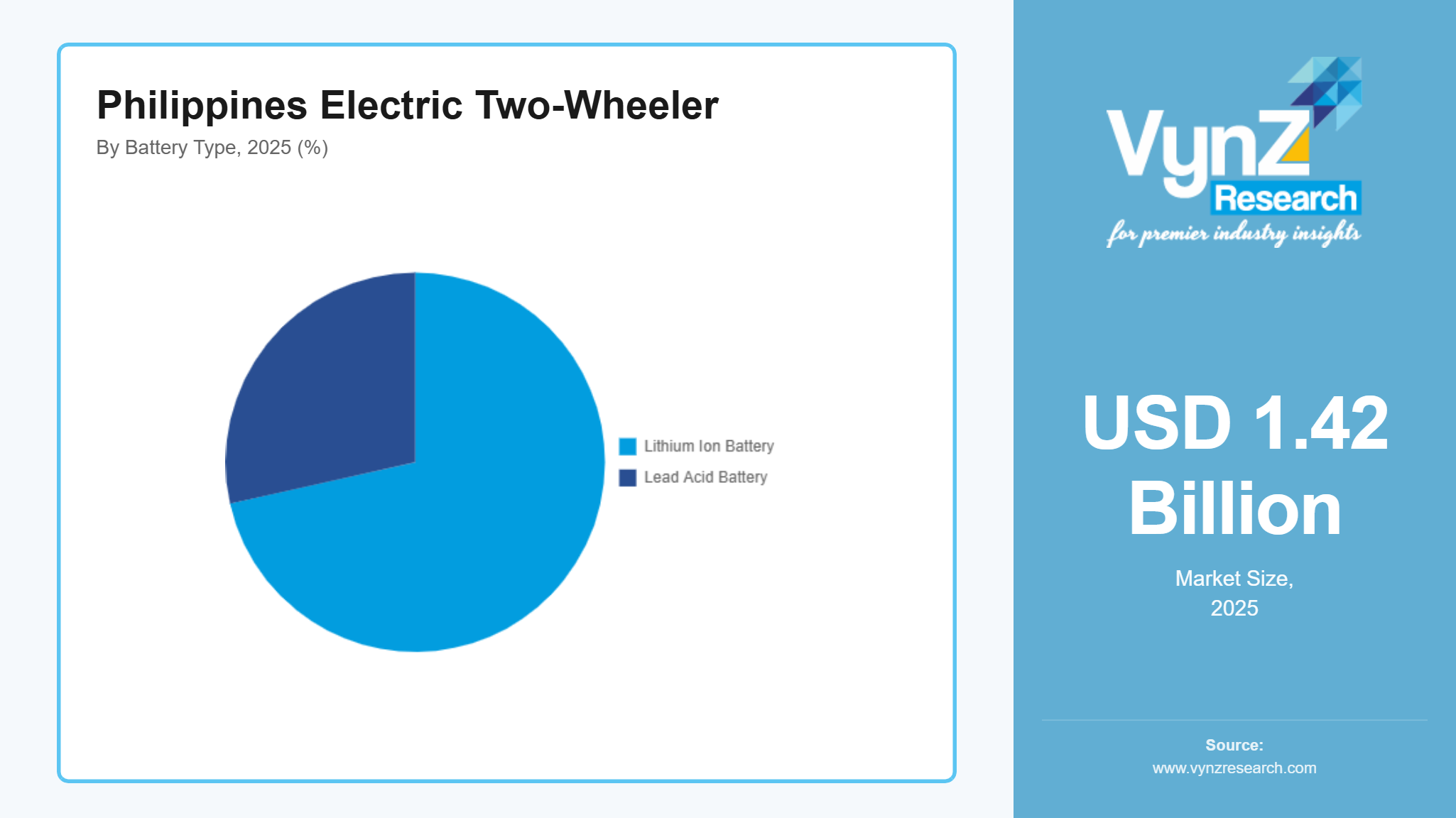
Lithium-ion batteries held the largest revenue share of approximately 71.5% in 2025 and are projected to grow at nearly 20.8% CAGR due to higher energy density, longer service life and faster charging capability.
Lead acid batteries will continue to grow at 19.23% CAGR during the forecast period because of their lower acquisition cost and established market presence.
By Voltage
The 48V to 60V segment accounted for the largest market share of approximately 47.3% in 2025 and is expected to grow at nearly 20.3% CAGR owing to balanced vehicle performance, affordability, and suitability for everyday commuting.
The above 60V segment is expected to register the fastest growth at around 21.6% CAGR supported by increasing demand for higher speed electric motorcycles, commercial delivery fleets, and premium electric mobility solutions.
By End User
Personal use accounted for the highest revenue share of approximately 67.4% in 2025 and is projected to expand at nearly 20.0% CAGR supported by rising consumer awareness, increasing fuel costs, and growing adoption of electric scooters for urban commuting.
Commercial use is expected to register the fastest growth at an estimated 21.5% CAGR due to rapid expansion of e commerce, food delivery services, courier operations, and corporate fleet electrification.
Regional Insights
Manila
Manila accounted for approximately 39% of the market in 2025 and is expected to grow at nearly 20.7% CAGR through 2035 due to increasing urban population, worsening traffic congestion and rapid adoption of electric motorcycles and scooters for daily commuting. According to the Department of Transportation (DOTr), Philippines, Manila remains the country's primary focus for transport electrification and sustainable urban mobility programs. Government initiatives, combined with expanding charging infrastructure and increasing consumer preference for low operating cost vehicles, continue to encourage investments in electric two wheelers. The Department of Energy (DOE), Philippines continues to support charging infrastructure deployment and electric mobility adoption under the Electric Vehicle Industry Development Act (EVIDA).
Luzon
Luzon accounted for approximately 17% of the market in 2025 and is projected to expand at around 20.2% CAGR during the forecast period supported by increasing industrial development, rising urbanization, and growing demand for affordable personal mobility solutions across rapidly developing cities. The Department of Trade and Industry (DTI) continues to encourage investments in electric vehicle manufacturing and supporting supply chains. Increasing commercial activities and expanding logistics operations are further strengthening demand for electric two wheelers throughout the region, particularly among delivery service providers and small businesses.
Calabarzon
Calabarzon represented approximately 15% of the market in 2025 and is anticipated to register nearly 20.5% CAGR through 2035 as growing manufacturing investments, expanding residential communities, and increasing consumer awareness regarding sustainable transportation continue to support regional market growth. According to the Board of Investments (BOI), Calabarzon remains one of the country's leading investment destinations for automotive and electric vehicle manufacturing projects. Growing adoption of electric motorcycles for personal commuting and commercial applications is further strengthening market demand across the region.
Rest of Philippines
The Rest of Philippines accounted for approximately 29% of the market in 2025 and is expected to grow at nearly 19.8% CAGR owing to increasing adoption across Cebu, Davao, Western Visayas, Northern Mindanao, Central Visayas, and other emerging provinces. The Department of Energy (DOE) and the Department of Transportation (DOTr) continue to promote nationwide electric mobility through infrastructure development, policy support, and clean transportation initiatives.
Competitive Landscape / Company Insights
The market is moderately competitive with domestic and international manufacturers focusing on product innovation, battery technologies, localization and dealer network expansion. Companies are increasingly investing in research and development, smart mobility solutions, and charging ecosystem partnerships to strengthen their market position. The Department of Trade and Industry (DTI) and the Board of Investments (BOI) continue supporting electric vehicle manufacturing and investment through the Electric Vehicle Industry Development Act, encouraging sustainable industry growth.
Mini Profiles
Ampere Electric focuses on affordable electric scooters and urban mobility solutions, supported by continuous product innovation, efficient battery technologies, and an expanding distribution network across Asian markets.
Honda Motor Co., Ltd. operates in the premium and mass mobility segments, emphasizing advanced engineering, vehicle reliability, and next generation electric two-wheeler technologies for urban transportation.
NIU Technologies leverages intelligent connectivity, digital mobility platforms, and advanced lithium-ion battery systems to strengthen its presence in the global electric two-wheeler market.
Terra Motors Corporation focuses on electric motorcycles and scooters, supported by localized manufacturing, expanding dealership networks, and strong expertise in Southeast Asian electric mobility solutions.
Yadea Group Holdings Ltd. specializes in high performance electric two wheelers, supported by extensive research and development, global manufacturing capabilities, and continuous investment in battery innovation.
Key Players
- Ampere Electric
- EMotors Philippines Inc.
- Honda Motor Co., Ltd.
- NIU Technologies
- Segway-Ninebot Group
- Terra Motors Corporation
- TVS Motor Company
- VinFast Auto Ltd.
- Yadea Group Holdings Ltd.
- Yamaha Motor Co., Ltd.
Recent Developments
In January 2025, EMotors Philippines Inc. expanded its electric motorcycle portfolio by introducing new commuter models designed for urban mobility. The launch supports the country's growing transition toward sustainable transportation.
In March 2025, Segway-Ninebot Group introduced upgraded smart electric scooters featuring enhanced battery management systems and connected mobility technologies. The new models strengthen the company's position in the Asian electric two-wheeler market.
In May 2025, TVS Motor Company expanded its electric vehicle business through new investments in advanced battery technologies and connected mobility solutions. The initiative supports future growth across Southeast Asian markets.
In September 2025, VinFast Auto Ltd. accelerated its Southeast Asian expansion by strengthening its electric two-wheeler distribution network and charging ecosystem. The strategy aims to improve accessibility and customer adoption across regional markets.
In February 2026, Yamaha Motor Co., Ltd. announced the expansion of its electric two-wheeler portfolio with new battery powered scooter models incorporating improved energy efficiency and smart connectivity features.
Philippines Electric Two-Wheeler Market Coverage
Vehicle Type Insight and Forecast 2026 - 2035
- Electric Motorcycles
- Electric Scooters
Battery Type Insight and Forecast 2026 - 2035
- Lithium Ion Battery
- Lead Acid Battery
Voltage Insight and Forecast 2026 - 2035
- Below 48V
- 48V to 60V
- Above 60V
End User Insight and Forecast 2026 - 2035
- Personal Use
- Commercial Use
- Top of Form
- Bottom of Form
Philippines Electric Two-Wheeler Market by Region
- Manila
- By Vehicle Type
- By Battery Type
- By Voltage
- By End User
- Calabarzon
- By Vehicle Type
- By Battery Type
- By Voltage
- By End User
- Luzon
- By Vehicle Type
- By Battery Type
- By Voltage
- By End User
- rest of Philippines
- By Vehicle Type
- By Battery Type
- By Voltage
- By End User
Table of Contents for Philippines Electric Two-Wheeler Market Report
1. Research Overview
1.1. The Report Offers
1.2. Market Coverage
1.2.1. By
Vehicle Type
1.2.2. By
Battery Type
1.2.3. By
Voltage
1.2.4. By
End User
1.3. Research Phases
1.4. Limitations
1.5. Market Methodology
1.5.1. Data Sources
1.5.1.1.
Primary Research
1.5.1.2.
Secondary Research
1.5.2. Methodology
1.5.2.1.
Data Exploration
1.5.2.2.
Forecast Parameters
1.5.2.3.
Data Validation
1.5.2.4.
Assumptions
1.5.3. Study Period & Data Reporting Unit
2. Executive Summary
3. Industry Overview
3.1. Industry Dynamics
3.1.1. Market Growth Drivers
3.1.2. Market Restraints
3.1.3. Key Market Trends
3.1.4. Major Opportunities
3.2. Industry Ecosystem
3.2.1. Porter’s Five Forces Analysis
3.2.2. Recent Development Analysis
3.2.3. Value Chain Analysis
3.3. Competitive Insight
3.3.1. Competitive Position of Industry
Players
3.3.2. Market Attractive Analysis
3.3.3. Market Share Analysis
4. Philippines Market Estimate and Forecast
4.1. Philippines Market Overview
4.2. Philippines Market Estimate and Forecast to 2035
5. Market Segmentation Estimate and Forecast
5.1. By Vehicle Type
5.1.1. Electric Motorcycles
5.1.1.1. Market Definition
5.1.1.2. Market Estimation and Forecast to 2035
5.1.2. Electric Scooters
5.1.2.1. Market Definition
5.1.2.2. Market Estimation and Forecast to 2035
5.2. By Battery Type
5.2.1. Lithium Ion Battery
5.2.1.1. Market Definition
5.2.1.2. Market Estimation and Forecast to 2035
5.2.2. Lead Acid Battery
5.2.2.1. Market Definition
5.2.2.2. Market Estimation and Forecast to 2035
5.3. By Voltage
5.3.1. Below 48V
5.3.1.1. Market Definition
5.3.1.2. Market Estimation and Forecast to 2035
5.3.2. 48V to 60V
5.3.2.1. Market Definition
5.3.2.2. Market Estimation and Forecast to 2035
5.3.3. Above 60V
5.3.3.1. Market Definition
5.3.3.2. Market Estimation and Forecast to 2035
5.4. By End User
5.4.1. Personal Use
5.4.1.1. Market Definition
5.4.1.2. Market Estimation and Forecast to 2035
5.4.2. Commercial Use
5.4.2.1. Market Definition
5.4.2.2. Market Estimation and Forecast to 2035
5.4.3. Top of Form
5.4.3.1. Market Definition
5.4.3.2. Market Estimation and Forecast to 2035
5.4.4. Bottom of Form
5.4.4.1. Market Definition
5.4.4.2. Market Estimation and Forecast to 2035
6. Manila Market Estimate and Forecast
6.1. By
Vehicle Type
6.2. By
Battery Type
6.3. By
Voltage
6.4. By
End User
7. Calabarzon Market Estimate and Forecast
7.1. By
Vehicle Type
7.2. By
Battery Type
7.3. By
Voltage
7.4. By
End User
8. Luzon Market Estimate and Forecast
8.1. By
Vehicle Type
8.2. By
Battery Type
8.3. By
Voltage
8.4. By
End User
9. rest of Philippines Market Estimate and Forecast
9.1. By
Vehicle Type
9.2. By
Battery Type
9.3. By
Voltage
9.4. By
End User
10. Company Profiles
10.1.
Ampere Electric
10.1.1.
Snapshot
10.1.2.
Overview
10.1.3.
Offerings
10.1.4.
Financial
Insight
10.1.5.
Recent
Developments
10.2.
EMotors Philippines Inc.
10.2.1.
Snapshot
10.2.2.
Overview
10.2.3.
Offerings
10.2.4.
Financial
Insight
10.2.5.
Recent
Developments
10.3.
Honda Motor Co., Ltd.
10.3.1.
Snapshot
10.3.2.
Overview
10.3.3.
Offerings
10.3.4.
Financial
Insight
10.3.5.
Recent
Developments
10.4.
NIU Technologies
10.4.1.
Snapshot
10.4.2.
Overview
10.4.3.
Offerings
10.4.4.
Financial
Insight
10.4.5.
Recent
Developments
10.5.
Segway-Ninebot Group
10.5.1.
Snapshot
10.5.2.
Overview
10.5.3.
Offerings
10.5.4.
Financial
Insight
10.5.5.
Recent
Developments
10.6.
Terra Motors Corporation
10.6.1.
Snapshot
10.6.2.
Overview
10.6.3.
Offerings
10.6.4.
Financial
Insight
10.6.5.
Recent
Developments
10.7.
TVS Motor Company
10.7.1.
Snapshot
10.7.2.
Overview
10.7.3.
Offerings
10.7.4.
Financial
Insight
10.7.5.
Recent
Developments
10.8.
VinFast Auto Ltd.
10.8.1.
Snapshot
10.8.2.
Overview
10.8.3.
Offerings
10.8.4.
Financial
Insight
10.8.5.
Recent
Developments
10.9.
Yadea Group Holdings Ltd.
10.9.1.
Snapshot
10.9.2.
Overview
10.9.3.
Offerings
10.9.4.
Financial
Insight
10.9.5.
Recent
Developments
10.10.
Yamaha Motor Co., Ltd.
10.10.1.
Snapshot
10.10.2.
Overview
10.10.3.
Offerings
10.10.4.
Financial
Insight
10.10.5.
Recent
Developments
11. Appendix
11.1. Exchange Rates
11.2. Abbreviations
Note: Financial insight and recent developments of different companies are subject to the availability of information in the secondary domain.
Frequently Asked Questions
Purchase Options
Latest Report
Research Methodology
- Desk Research / Pilot Interviews
- Build Market Size Model
- Research and Analysis
- Final Deliverable
Connect With Our Sales Team
- Toll-Free: +1-888-253-3960
- Phone: +91 9960 288 381
- Email: enquiry@vynzresearch.com
Philippines Electric Two-Wheeler Market