
Thailand Electric Two-Wheeler Market Size & Share Growth Forecast Report (2026-2035)
Industry Insight by Vehicle Type (Electric Scooter/Moped, Electric Motorcycle), by Battery Type (Lithium-ion, Lead-acid), by Voltage (Below 48V, 48V–60V, Above 60V), by End User (Personal, Commercial)
| Status : Published | Published On : Jul, 2026 | Report Code : VRAT9674 | Industry : Automotive & Transportation | Available Format :

|
Page : 146 |
Thailand Electric Two-Wheeler Market Overview
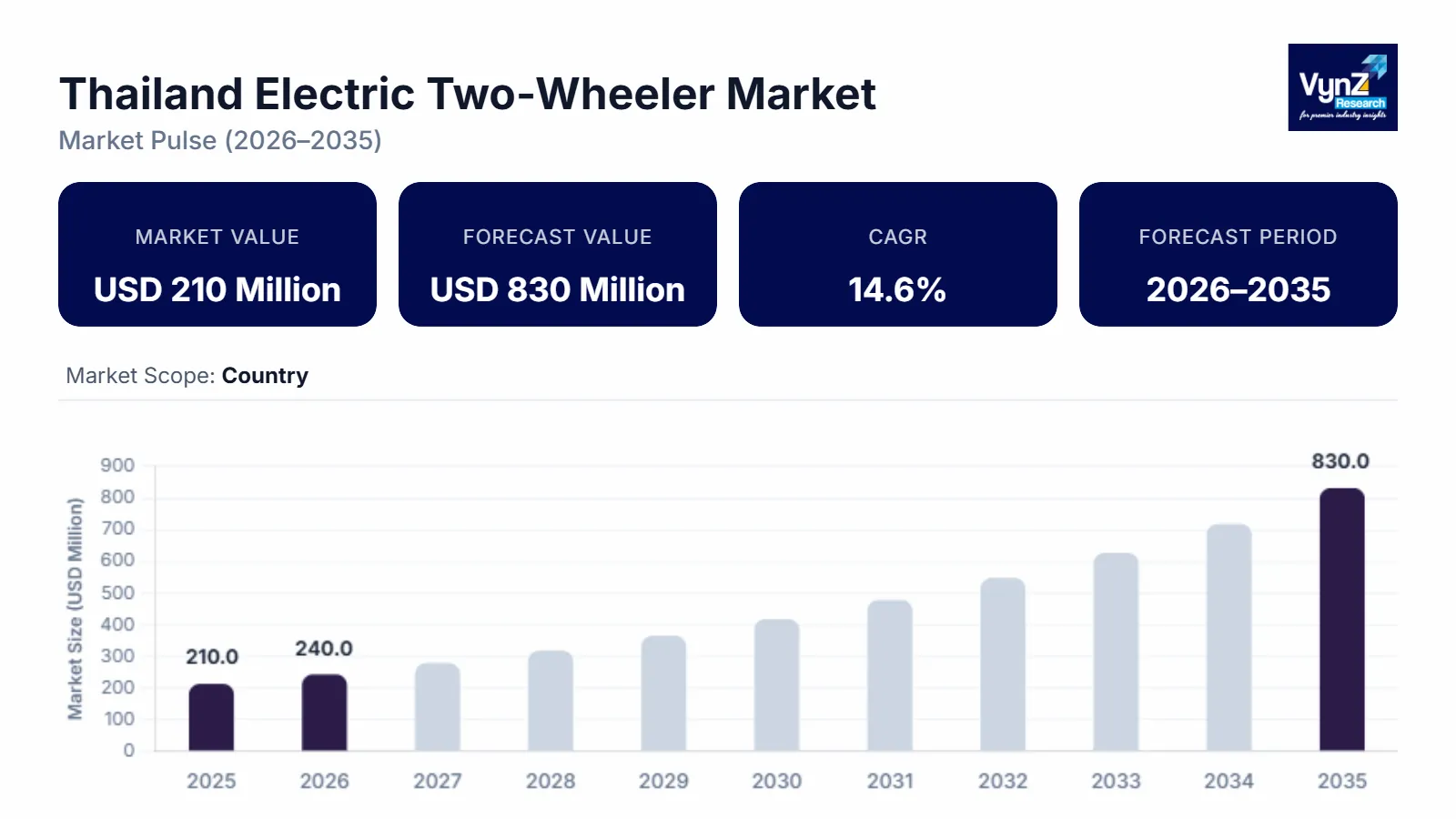
The Thailand Electric Two-Wheeler Market size was estimated at USD 210 million in 2025 and is expected to reach around USD 240 million in 2026, rising to roughly USD 830 million by 2035, growing at approximately 14.6% CAGR from 2026 to 2035.
Research Highlights
- Electric scooters dominated with 68% market share in 2025 due to affordable urban mobility.
- Lithium-ion batteries captured 79% share in 2025 supported by superior battery performance.
- The 48V to 60V segment held 47% share in 2025 owing to balanced efficiency.
- Commercial end users are forecast to grow at 15.8% CAGR driven by fleet electrification.
- Bangkok Metropolitan Region accounted for 35% share in 2025 supported by strong EV infrastructure.
Several forces are pushing this market forward at once. Fuel costs keep climbing, battery tech just keeps getting better, and government incentives for electric mobility also keep expanding. All these things together are giving buyers real reasons to move across, and it is no longer only a niche crowd. Lithium-ion powered, connected two-wheelers are increasingly becoming the default choice, rather than the exception.
Demand is being shaped from the ground up too. Commuters want cheaper ways to move through cities, and last mile mobility needs are growing just as quick. Thailand’s National Electric Vehicle Policy, backed by the 30@30 initiative from the National Electric Vehicle Policy Committee, has put actual investment behind this shift and it shows in Bangkok Metropolitan Region, the Eastern Economic Corridor, and Chiang Mai, where adoption is moving the fastest.
The Thailand Board of Investment (BOI) and the Electric Vehicle Association of Thailand (EVAT) describe a pretty similar story. Policy support, investment incentives, and a widening base of local EV manufacturing are steadily building out the country’s electric two-wheeler ecosystem.
Thailand Electric Two-Wheeler Market Dynamics
Market Trends
Electric mobility adoption, battery technology, and commuting habits are all shifting at once in Thailand's electric two-wheeler industry. The move toward lithium-ion connected two-wheelers as buyers want longer range, less maintenance, better energy efficiency is notable. Smart charging infrastructure is expanding fast too, pushed along by government policy and digital mobility initiatives. Between the National Electric Vehicle Policy Committee and the Electricity Generating Authority of Thailand (EGAT), nationwide charging networks are getting built out steadily. That's nudging manufacturers toward connected technology and better battery management systems — and reshaping how companies compete with each other.
Growth Drivers
Government incentives and growing domestic EV manufacturing are the biggest forces behind this market's growth, feeding steady demand in both personal mobility and commercial delivery. The 30@30 electric vehicle policy has brought more investment into the space, with the Thailand Board of Investment (BOI) and the National Electric Vehicle Policy Committee backing it through tax incentives and investment promotion. Fuel prices matter here too. As they climb, and as environmental concerns grow more pressing, both everyday consumers and fleet operators are leaning harder into electric scooters and motorcycles. The Ministry of Energy Thailand and EVAT expect that demand to hold up well throughout the forecast period.
Market Restraints / Challenges
The growth story of the market isn't without challenges. Battery costs remain high, and much of the battery material is still imported. This hits affordability hardest for price-sensitive buyers. The International Energy Agency (IEA) and BOI both point to this battery supply chain dependence as a real constraint for emerging EV markets like Thailand's. Charging infrastructure is another point. It's solid in major cities but thins out quickly elsewhere, which creates operational headaches for manufacturers and service providers alike. Add in the reliance on imported technology and battery components, and production costs rise, sometimes enough to delay rollout, especially when global supply chains hit turbulence. EGAT and the IEA have both flagged this as an ongoing risk.
Market Opportunities
Domestic battery manufacturing stands out as one of the bigger opportunities alongside electric mobility services getting a boost from supportive government policy and rising urban transportation demand. Companies building high-performance two-wheelers, battery swapping networks, or connected mobility platforms are well placed to pick up demand from city commuters and commercial fleets. BOI continues backing investment across the EV value chain through its incentive programs. Smart charging and battery recycling are worth watching too. Public and private money is flowing into both, and advances in digital charging management and battery monitoring stand to make EVs more convenient to own, which in turn should support wider adoption. The National Electric Vehicle Policy Committee, EGAT, and EVAT are all pushing initiatives in this direction.
Thailand Electric Two-Wheeler Market Report Coverage
|
Report Metric |
Details |
|
Historical Period |
2020 - 2024 |
|
Base Year Considered |
2025 |
|
Forecast Period |
2026 - 2035 |
|
Market Size in 2025 |
USD 0.21 Billion |
|
Revenue Forecast in 2035 |
USD 0.83 Billion |
|
Growth Rate |
14.6% |
|
Segments Covered in the Report |
Vehicle Type, Battery Type, Voltage, End User |
|
Report Scope |
Market Trends, Drivers, and Restraints; Revenue Estimation and Forecast; Segmentation Analysis; Companies’ Strategic Developments; Market Share Analysis of Key Players; Company Profiling |
|
Regions Covered in the Report |
Bangkok Metropolitan Region, Eastern Economic Corridor, Northern Thailand, Rest of Thailand |
|
Key Companies |
[List Key Players] |
|
Customization |
Available upon request |
Thailand Electric Two-Wheeler Market Segmentation
By Vehicle Type
Electric scooters and mopeds held about 68% of the market share in 2025 and is expected to grow at a CAGR of roughly 14.3% through 2035. It's not hard to see why. They are cheaper to buy, easier to park and maneuver, and well suited to the short commutes most urban riders actually make. BOI and EVAT point to incentives for light electric vehicles and expanding charging access as the reasons demand keeps climbing in metro areas.
Electric motorcycles, though smaller in share, are growing faster at an estimated 15.2% CAGR over the forecast period. Delivery operators are buying more of them, battery performance keeps improving, and higher-powered models are finally becoming widely available, all of which is opening up intercity and logistics use cases. The 30@30 policy and backing from the National Electric Vehicle Policy Committee should keep that momentum going.
By Battery Type
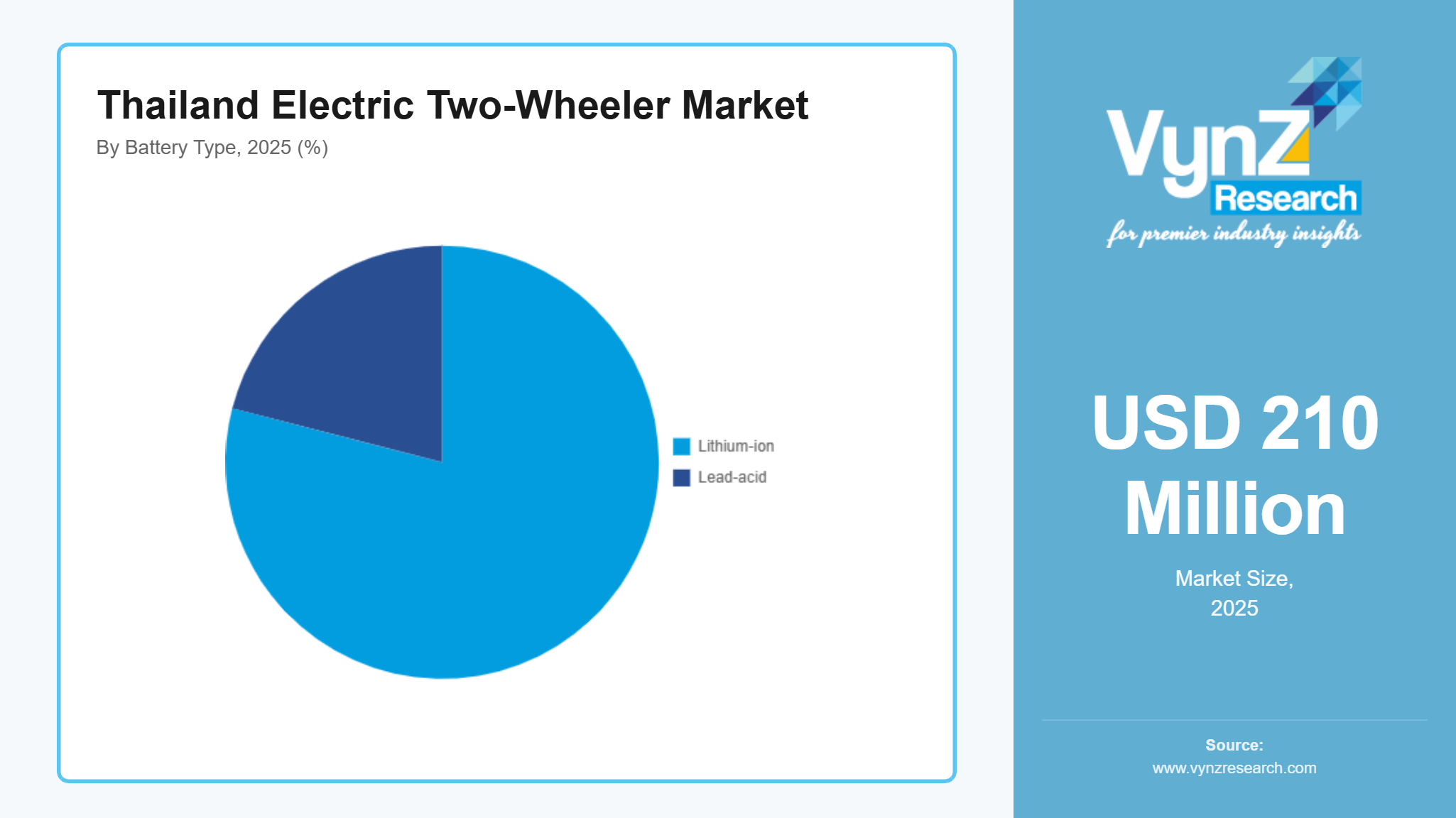
Lithium-ion runs the show with roughly 79% share in 2025 and a projected CAGR close to 14.8% all the way through 2035 due to better energy density, a longer service life, quicker charging, and reducing prices. The IEA along with BOI both note that continuous investment in battery manufacturing, and localization efforts are helping the whole industry move ahead.
Meanwhile, lead-acid batteries still work as the default pick for entry-level, price-sensitive two-wheelers, mainly because the upfront cost is lower and the supply chain is already basically set. This segment grows at about 11.8% CAGR. Part of it is that makers slowly pivot toward newer battery tech to match rising performance expectations and the tightening efficiency requirements, which keep getting stricter over time.
By Voltage
The 48V–60V range is the sweet spot for most buyers right now, holding about 47% share in 2025 and expected to grow at close to 14.5% CAGR through 2035. It strikes a good balance of solid range, solid performance, and it fits daily commuting needs well. EVAT notes that demand in this bracket keeps rising as battery efficiency improves.
Above 60V segment is expected to grow at 15.4% CAGR due to growing need by high-performance motorcycles along with expanding commercial fleets and steady advances in battery systems. BOI-backed domestic production initiatives should keep widening what's available here.
By End User
Personal use accounts for the bulk of the market, about 73% in 2025, growing at roughly 14.1% CAGR. Higher fuel prices, growing environmental concern, and government incentives are nudging everyday riders toward electric, and continued policy support from BOI and the National Electric Vehicle Policy Committee is helping keep that confidence up.
Commercial use is where the fastest growth is happening at an estimated 15.8% CAGR. E-commerce, food delivery, and urban logistics are all scaling up fast, and fleets are electrifying to keep pace. EVAT and the Ministry of Energy Thailand expect that trend to hold as charging infrastructure and commercial EV deployment continue to expand.
Regional Insights
Bangkok Metropolitan Region
Bangkok accounted for roughly 35% market share in 2025 and is expected to keep growing at close to 14.8% CAGR through 2035. That's driven by population density, increasing EV ownership, and stronger charging infrastructure. Consumer purchasing power here is strong, sustainability is increasingly top of mind for buyers, and most of the major EV manufacturers and distributors are based in the region — all of which keeps Bangkok firmly in the lead. BOI and EVAT both describe it as Thailand's central hub for electric mobility investment and advanced EV deployment.
Eastern Economic Corridor
The Eastern Economic Corridor came in at about 23% share in 2025, with growth projected around 15.1% CAGR — among the fastest of any region. Industrial development here is strong, automotive manufacturing is expanding, and investment policy has been favorable, all of which is accelerating things further. BOI and the National Electric Vehicle Policy Committee both point to the corridor as Thailand's core manufacturing base for EVs, batteries, and related components.
As EV production localizes further and battery manufacturing investment grows, demand is rising across both personal and commercial two-wheelers — reinforcing just how central this region has become to the national market.
Northern Thailand
Northern Thailand represented roughly 18% share in 2025, with growth expected near 13.9% CAGR through 2035. Rising environmental awareness, growing tourism-related transportation needs and developing charging infrastructure particularly around Chiang Mai and Chiang Rai are pushing adoption. The Ministry of Energy Thailand and EVAT both note that regional clean transportation and renewable energy initiatives are helping sustain demand.
More public charging stations, more regional dealerships getting involved, and continued clean energy support should keep adoption accelerating — and open up real opportunities for manufacturers and service providers working in the region.
Rest of Thailand
The remaining provinces — Central, Northeastern, Southern, and others — together accounted for about 24% share in 2025, with growth projected at roughly 14.2% CAGR through 2035. Improving transportation infrastructure and expanding charging networks are the main drivers, backed by government initiatives reaching well beyond the major metro areas. BOI, the National Electric Vehicle Policy Committee, and the Ministry of Energy Thailand all point to domestic manufacturing and clean transportation investment as key reasons adoption is spreading into these markets. As vehicles get more affordable, dealer networks expand, and regional businesses get more involved, demand should keep building steadily across these emerging urban and semi-urban areas.
Competitive Landscape / Company Insights
Competition in Thailand's electric two-wheeler market is moderate, with both domestic and international manufacturers jockeying for position — mostly through product innovation, better battery tech, localization, and strategic partnerships. Most players are pouring more into R&D, expanding manufacturing capacity, and building out connected mobility features to stay competitive. BOI, the National Electric Vehicle Policy Committee, and EVAT all point to the same underlying story: government incentives and investment promotion keep drawing new entrants in and pushing production capacity higher across the country's electric mobility ecosystem.
Mini Profiles
AIMA Technology Group Co Ltd focuses on electric scooters, electric motorcycles, and battery powered mobility solutions, supported by extensive manufacturing capabilities, continuous product innovation, and an expanding international distribution network.
E-Revolution Co Ltd operates in Thailand's electric mobility segment, emphasizing affordable electric two wheelers, local market expertise, after sales support, and expanding dealership presence across urban regions.
Hero Electric Vehicles Pvt Ltd leverages cost competitive manufacturing, advanced battery technologies, and strategic regional partnerships to strengthen its presence in Southeast Asia's growing electric two-wheeler market.
Honda Motor Co Ltd focuses on premium and mass market electric two wheelers, supported by strong brand recognition, extensive dealer networks, and continuous investments in sustainable mobility technologies.
Ningbo MYWAY Intelligent Technology Co Ltd specializes in electric scooters and intelligent mobility solutions, supported by export-oriented manufacturing, product diversification, and ongoing investments in battery and vehicle technology.
Key Players
- AIMA Technology Group Co., Ltd.
- E-Revolution Co. Ltd.
- Hero Electric Vehicles Pvt. Ltd.
- Honda Motor Co., Ltd.
- Ningbo MYWAY Intelligent Technology Co., Ltd.
- STAR 8 (Thailand) Co., Ltd.
- Terra Motors Corporation
- UDA Motor Co., Ltd.
- Yadea Technology Group Co., Ltd.
- Zhejiang Luyuan Electric Vehicle Co., Ltd.
Recent Developments
In January 2026, STAR 8 (Thailand) Co., Ltd. continued expanding its domestic electric mobility portfolio to support Thailand's accelerating EV transition and growing urban transportation demand. The company strengthened its presence by aligning with government initiatives promoting clean mobility and local EV adoption.
In January 2026, Terra Motors Corporation continued expanding its electric two-wheeler operations across Southeast Asia, with Thailand remaining a strategic growth market for urban mobility solutions. The company focused on strengthening dealership networks and enhancing after-sales services to support increasing regional demand.
In May 2026, UDA Motor Co., Ltd. continued strengthening its electric two-wheeler portfolio in Thailand by expanding product availability through regional dealer networks. The company also focused on improving customer support and service accessibility to support rising electric vehicle adoption across the country.
In May 2026, Yadea Technology Group Co., Ltd. announced a stronger after-sales service strategy for the Thai market, positioning customer support as a key competitive advantage. The company also continued expanding its retail ecosystem and mobility services to strengthen its long-term presence in Thailand.
In March 2026, Zhejiang Luyuan Electric Vehicle Co., Ltd. continued expanding its international electric two-wheeler business by promoting advanced battery technologies and energy-efficient mobility solutions for Southeast Asian markets, including Thailand. The company strengthened its regional strategy through continued product innovation and wider distribution initiatives.
Thailand Electric Two-Wheeler Market Coverage
Vehicle Type Insight and Forecast 2026 - 2035
- Electric Scooter/Moped
- Electric Motorcycle
Battery Type Insight and Forecast 2026 - 2035
- Lithium-ion
- Lead-acid
Voltage Insight and Forecast 2026 - 2035
- Below 48V
- 48V–60V
- Above 60V
End User Insight and Forecast 2026 - 2035
- Personal
- Commercial
Thailand Electric Two-Wheeler Market by Region
- Bangkok Metropolitan Region
- By Vehicle Type
- By Battery Type
- By Voltage
- By End User
- Eastern Economic Corridor
- By Vehicle Type
- By Battery Type
- By Voltage
- By End User
- Northern Thailand
- By Vehicle Type
- By Battery Type
- By Voltage
- By End User
- Rest of Thailand
- By Vehicle Type
- By Battery Type
- By Voltage
- By End User
Table of Contents for Thailand Electric Two-Wheeler Market Report
1. Research Overview
1.1. The Report Offers
1.2. Market Coverage
1.2.1. By
Vehicle Type
1.2.2. By
Battery Type
1.2.3. By
Voltage
1.2.4. By
End User
1.3. Research Phases
1.4. Limitations
1.5. Market Methodology
1.5.1. Data Sources
1.5.1.1.
Primary Research
1.5.1.2.
Secondary Research
1.5.2. Methodology
1.5.2.1.
Data Exploration
1.5.2.2.
Forecast Parameters
1.5.2.3.
Data Validation
1.5.2.4.
Assumptions
1.5.3. Study Period & Data Reporting Unit
2. Executive Summary
3. Industry Overview
3.1. Industry Dynamics
3.1.1. Market Growth Drivers
3.1.2. Market Restraints
3.1.3. Key Market Trends
3.1.4. Major Opportunities
3.2. Industry Ecosystem
3.2.1. Porter’s Five Forces Analysis
3.2.2. Recent Development Analysis
3.2.3. Value Chain Analysis
3.3. Competitive Insight
3.3.1. Competitive Position of Industry
Players
3.3.2. Market Attractive Analysis
3.3.3. Market Share Analysis
4. Thailand Market Estimate and Forecast
4.1. Thailand Market Overview
4.2. Thailand Market Estimate and Forecast to 2035
5. Market Segmentation Estimate and Forecast
5.1. By Vehicle Type
5.1.1. Electric Scooter/Moped
5.1.1.1. Market Definition
5.1.1.2. Market Estimation and Forecast to 2035
5.1.2. Electric Motorcycle
5.1.2.1. Market Definition
5.1.2.2. Market Estimation and Forecast to 2035
5.2. By Battery Type
5.2.1. Lithium-ion
5.2.1.1. Market Definition
5.2.1.2. Market Estimation and Forecast to 2035
5.2.2. Lead-acid
5.2.2.1. Market Definition
5.2.2.2. Market Estimation and Forecast to 2035
5.3. By Voltage
5.3.1. Below 48V
5.3.1.1. Market Definition
5.3.1.2. Market Estimation and Forecast to 2035
5.3.2. 48V–60V
5.3.2.1. Market Definition
5.3.2.2. Market Estimation and Forecast to 2035
5.3.3. Above 60V
5.3.3.1. Market Definition
5.3.3.2. Market Estimation and Forecast to 2035
5.4. By End User
5.4.1. Personal
5.4.1.1. Market Definition
5.4.1.2. Market Estimation and Forecast to 2035
5.4.2. Commercial
5.4.2.1. Market Definition
5.4.2.2. Market Estimation and Forecast to 2035
6. Bangkok Metropolitan Region Market Estimate and Forecast
6.1. By
Vehicle Type
6.2. By
Battery Type
6.3. By
Voltage
6.4. By
End User
7. Eastern Economic Corridor Market Estimate and Forecast
7.1. By
Vehicle Type
7.2. By
Battery Type
7.3. By
Voltage
7.4. By
End User
8. Northern Thailand Market Estimate and Forecast
8.1. By
Vehicle Type
8.2. By
Battery Type
8.3. By
Voltage
8.4. By
End User
9. Rest of Thailand Market Estimate and Forecast
9.1. By
Vehicle Type
9.2. By
Battery Type
9.3. By
Voltage
9.4. By
End User
10. Company Profiles
10.1.
AIMA Technology Group Co., Ltd.
10.1.1.
Snapshot
10.1.2.
Overview
10.1.3.
Offerings
10.1.4.
Financial
Insight
10.1.5.
Recent
Developments
10.2.
E-Revolution Co. Ltd.
10.2.1.
Snapshot
10.2.2.
Overview
10.2.3.
Offerings
10.2.4.
Financial
Insight
10.2.5.
Recent
Developments
10.3.
Hero Electric Vehicles Pvt. Ltd.
10.3.1.
Snapshot
10.3.2.
Overview
10.3.3.
Offerings
10.3.4.
Financial
Insight
10.3.5.
Recent
Developments
10.4.
Honda Motor Co., Ltd.
10.4.1.
Snapshot
10.4.2.
Overview
10.4.3.
Offerings
10.4.4.
Financial
Insight
10.4.5.
Recent
Developments
10.5.
Ningbo MYWAY Intelligent Technology Co., Ltd.
10.5.1.
Snapshot
10.5.2.
Overview
10.5.3.
Offerings
10.5.4.
Financial
Insight
10.5.5.
Recent
Developments
10.6.
STAR 8 (Thailand) Co., Ltd.
10.6.1.
Snapshot
10.6.2.
Overview
10.6.3.
Offerings
10.6.4.
Financial
Insight
10.6.5.
Recent
Developments
10.7.
Terra Motors Corporation
10.7.1.
Snapshot
10.7.2.
Overview
10.7.3.
Offerings
10.7.4.
Financial
Insight
10.7.5.
Recent
Developments
10.8.
UDA Motor Co., Ltd.
10.8.1.
Snapshot
10.8.2.
Overview
10.8.3.
Offerings
10.8.4.
Financial
Insight
10.8.5.
Recent
Developments
10.9.
Yadea Technology Group Co., Ltd.
10.9.1.
Snapshot
10.9.2.
Overview
10.9.3.
Offerings
10.9.4.
Financial
Insight
10.9.5.
Recent
Developments
10.10.
Zhejiang Luyuan Electric Vehicle Co., Ltd.
10.10.1.
Snapshot
10.10.2.
Overview
10.10.3.
Offerings
10.10.4.
Financial
Insight
10.10.5.
Recent
Developments
11. Appendix
11.1. Exchange Rates
11.2. Abbreviations
Note: Financial insight and recent developments of different companies are subject to the availability of information in the secondary domain.
Frequently Asked Questions
Purchase Options
Latest Report
Research Methodology
- Desk Research / Pilot Interviews
- Build Market Size Model
- Research and Analysis
- Final Deliverable
Connect With Our Sales Team
- Toll-Free: +1-888-253-3960
- Phone: +91 9960 288 381
- Email: enquiry@vynzresearch.com
Thailand Electric Two-Wheeler Market