
Air Treatment Market Size & Share Growth Forecast Report (2026-2035)
Industry Insight by Filtration Technology (HEPA, Activated Carbon, Electrostatic Precipitators, Others), by Type (Portable, In-Duct), by Connectivity (Non-Smart, Smart), by End User (Residential, Commercial, Industrial)
| Status : Published | Published On : Aug, 2026 | Report Code : VRCH2135 | Industry : Chemicals & Materials | Available Format :

|
Page : 143 |
Air Treatment Market Overview
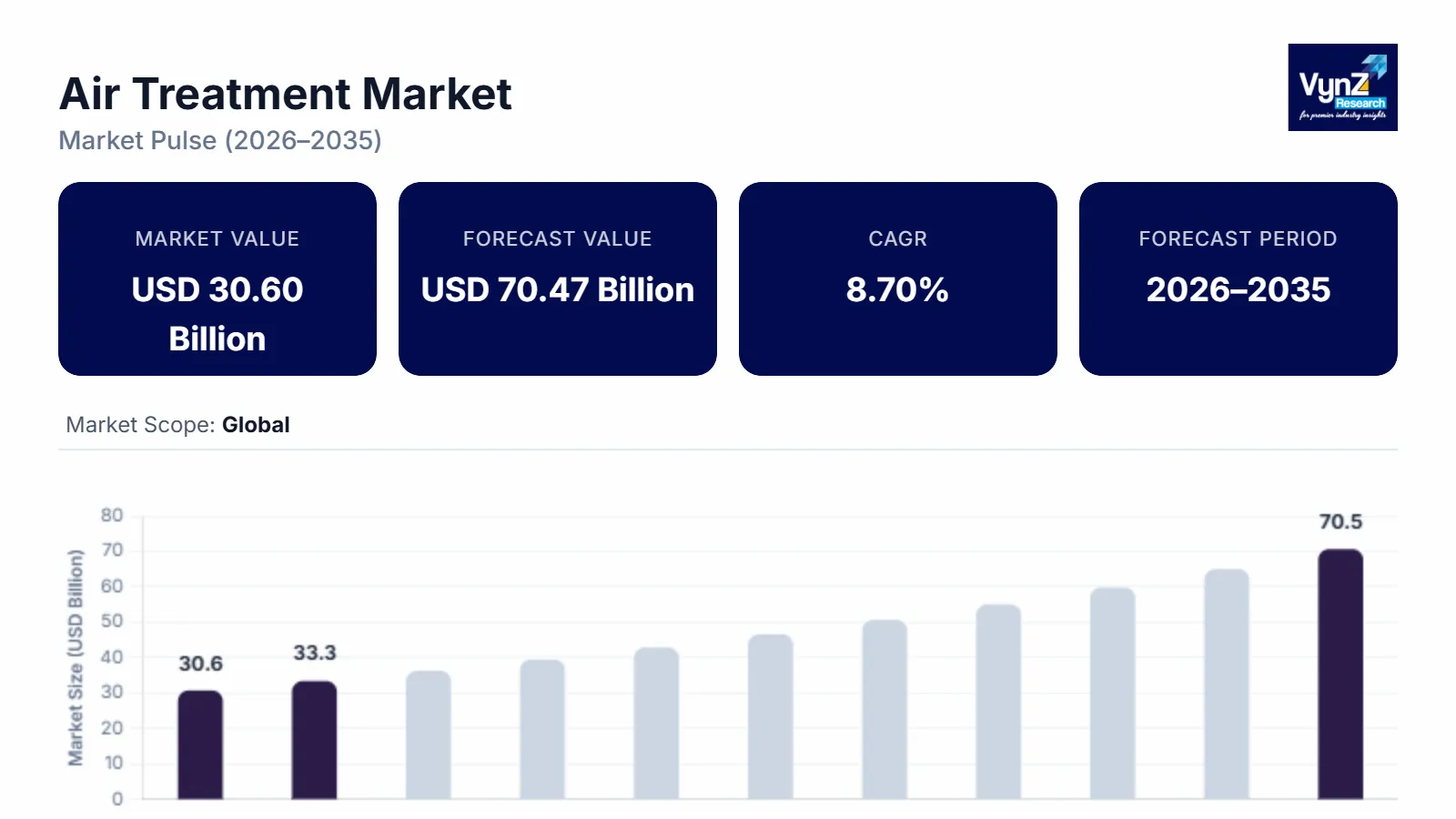
The air treatment market size was estimated at about USD 30.60 billion in 2025 and is expected to reach around USD 33.26 billion in 2026, rising up to roughly USD 70.47 billion in 2035, growing at approximately 8.70% CAGR from 2026 to 2035.
Research Highlights
- HEPA filtration held 67.80% in 2025 supported by established fine particulate removal capabilities.
- Standalone units captured 79.20% in 2025 due to convenient installation and residential adoption.
- Non smart systems accounted for 85.50% in 2025 because of lower costs and simpler operation.
- Smart connectivity is projected to grow at approximately 11.10% CAGR backed by connected monitoring and automation.
- Asia Pacific held 32.40% in 2025 supported by urbanization, pollution concerns and expanding HVAC adoption.
Market growth is driven by increasing demand for improving indoor air quality, growing investments in energy efficiency, and a rise in HVAC (Heating, Ventilation, and Air Conditioning) adoptions. The demand for better indoor surroundings in commercial and residential buildings, along with growing investments focused on energy efficiency in North America Europe, and the Asia Pacific is likely to push the market forward in the near term. The U.S. Department of Energy points out HVAC, air cleaning, and advanced ventilation as building technologies and systems that are sort key to market expansion. Also, the international agency re-stated the importance of smart, high performing buildings as the need for cooling keeps increasing.
Air Treatment Market Dynamics
Market Trends
The air treatment market is witnessing a rise in energy efficient filtration, improved ventilation and digital air quality monitoring. One of the main trends in the market is the rise in filtration and air cleaning technologies, which stem from the need for improved indoor environments. Apart from enhanced filtration and cleaning technologies, the second prominent trend in the air treatment market is smart air quality monitoring. This trend is enabled by leaps in technology as well as increased emphasis on building performance, which has triggered manufacturers to develop and adopt sensors and control systems that are connected and automated.
Growth Drivers
The growth of the market is primarily supported by the need for enhanced indoor air quality, which remains high and consistent across residential, commercial and institutional buildings. Additionally, the need for improved building efficiency and HVAC modernization will continue to propel the growth of the market. In addition to the aforementioned drivers, the increasing need for improved cooling is also anticipated to propel market growth. This need for enhanced cooling will necessitate better filtration, ventilation and overall air treatment in order to achieve the desired indoor conditions while maintaining energy efficiency. According to the International Energy Agency, the need for electricity for cooling purposes is on the rise, especially in emerging economies.
Market Restraints / Challenges
Although the market is projected to witness robust growth over the forecast period, it faces a number of challenges and restraints that could impede its growth. Some of the major restraints facing the market are the high costs of filtration and purification equipment and systems. Advanced air treatment systems such as filtration and purification are expensive, limiting their adoption in many commercial buildings due to high capital costs. A key challenge in regard to air treatment systems stems from the need for proper maintenance in order to ensure that they function at their maximum efficiency capacity. The need for regular cleaning and servicing of the air treatment equipment and systems can limit their application, especially in commercial buildings where the cost of maintenance is very high. The U.S. Environmental Protection Agency emphasizes the importance of regular maintenance of HVAC systems and filtration as a way of ensuring improved indoor air quality.
Market Opportunities
The major opportunities in the market include smart air quality management systems. Smart air quality management systems present an enormous potential as they incorporate the latest building technologies. Manufacturers that are in a position to provide cutting-edge products such as real-time air monitoring and automated systems stand to benefit greatly from this trend, especially from commercial buildings. Another opportunity in the air treatment market stems from the need for retrofitting existing buildings with more efficient ventilation and air treatment systems. Apart from the need for better air treatment, the opportunity exists for manufacturers to introduce more efficient systems that incorporate better automation and monitoring technologies to meet the needs of modern building standards.
Global Air Treatment Market Report Coverage
|
Report Metric |
Details |
|
Historical Period |
2020 - 2024 |
|
Base Year Considered |
2025 |
|
Forecast Period |
2026 - 2035 |
|
Market Size in 2025 |
USD 30.60 Billion |
|
Revenue Forecast in 2035 |
USD 70.47 Billion |
|
Growth Rate |
8.70% |
|
Segments Covered in the Report |
Filtration Technology, Type, Connectivity, End User |
|
Report Scope |
Market Trends, Drivers, and Restraints; Revenue Estimation and Forecast; Segmentation Analysis; Companies’ Strategic Developments; Market Share Analysis of Key Players; Company Profiling |
|
Regions Covered in the Report |
Asia Pacific, North America, Europe, Rest of the World |
|
Key Companies |
Ahlstrom-Munksjö, Atlas Copco, Camfil, Donaldson, Freudenberg, Honeywell, LG Electronics, Mann+Hummel, Parker-Hannifin, Samsung |
|
Customization |
Available upon request |
Air Treatment Market Segmentation
By Filtration Technology
HEPA filtration accounted for nearly 67.80% of the market value by 2025. It is majorly adopted for its ability to effectively remove particles from the air, thus being extensively used in residential, healthcare, and commercial applications.
Hybrid filtration is expected to grow at a highest CAGR of 9.10% from 2026 to 2035, as it enables the simultaneous removal of particulate, odor, and gaseous pollutants.
By Type
Stand-alone portable air treatment devices held around 79.20% of the market value by 2025. The segment is majorly contributed by the extensive adoption of these devices in residential and commercial applications owing to their flexible installation process and cost-effectiveness.
In-duct air treatment devices are further projected to register the highest CAGR of 8.70% from 2026 to 2035. This can be attributed to the rising need for enhanced indoor air quality in commercial buildings and their seamless integration with central HVAC systems.
By Connectivity
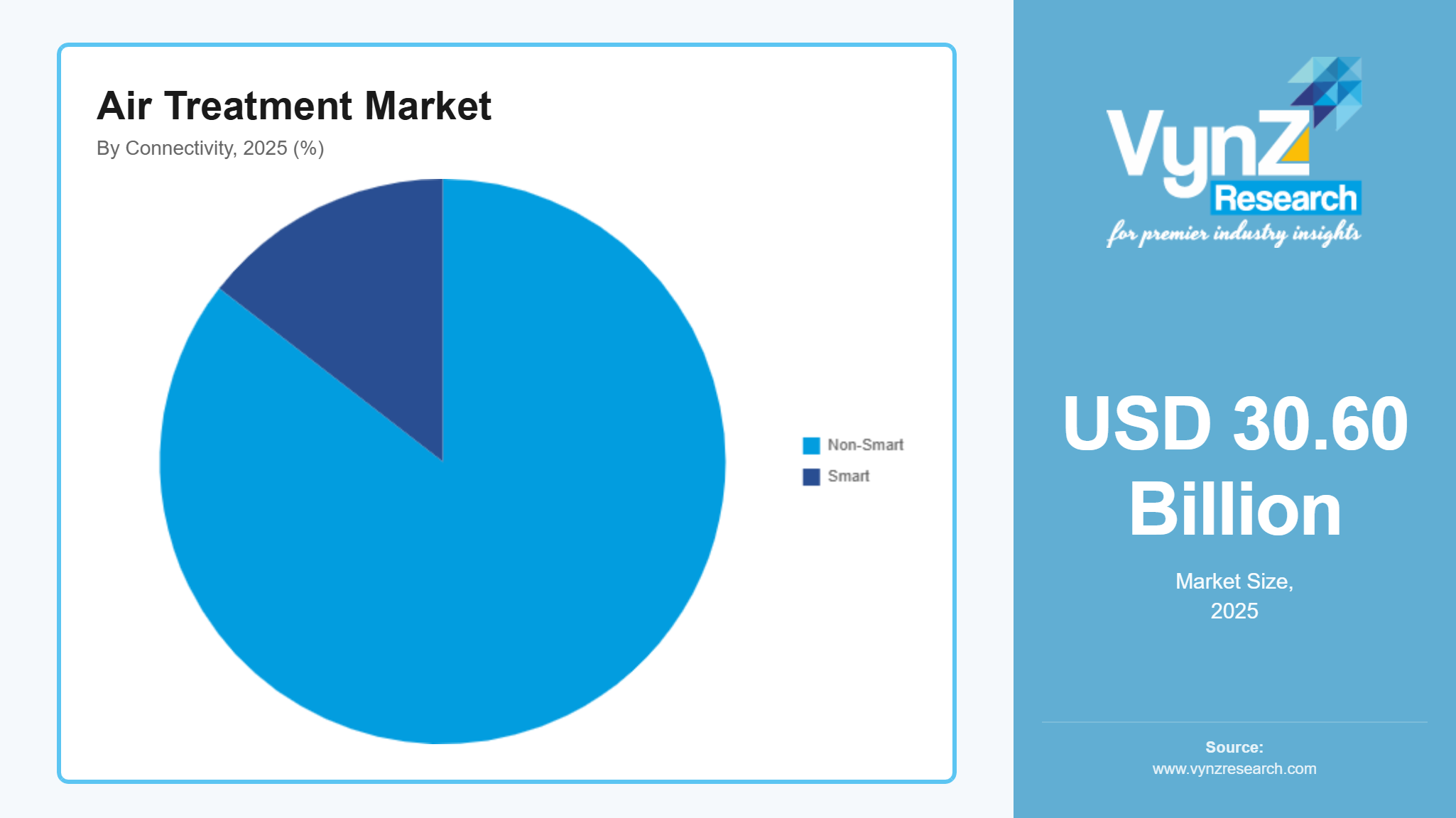
Non-smart devices contributed around 85.50% of the market value by 2025 due to their affordability and ease of use in comparison to their smart counterparts.
Smart devices are anticipated to register the highest CAGR of 11.10% from 2026 to 2035, owing to their intuitive operation and real-time air quality monitoring capabilities. This is further supported by the decreasing costs of sensors and rising adoption of smart home devices across the globe.
By End User
Residential air treatment devices accounted for around 61.40% of the market value by 2025. The segment is majorly driven by the rising awareness of indoor air quality among homeowners and the subsequent demand for residential air treatment devices.
The commercial segment will grow at a CAGR of 9.60% from 2026 to 2035, as offices, healthcare facilities, hotels, and educational institutes increasingly focus on maintaining indoor air quality for enhanced occupant health and productivity.
Regional Insights
Asia Pacific
Asia Pacific held about 32.40% of the air treatment market in 2025. The region is likely to see the fastest momentum during the forecast window 2026 to 2035 and it should register a CAGR of 9.10%. Market expansion across Asia Pacific is commonly linked to rapid urbanization, high levels of indoor air pollution, and a noticeable uptick in both residential plus commercial HVAC installations. Also, the International Energy Agency projects a big jump in electricity demand across Asia, mostly because of cooling needs. On top of that, cleaner air programs, together with manufacturing activity, are expected to move the market forward in Asia Pacific.
North America
North America accounted for around 18.70% of the market in 2025, and it is expected to show this growth trajectory with a healthy CAGR of 7.20% over the forecast period. The air treatment market in North America is mainly fueled by a higher indoor air awareness index, commercial construction activity and also established HVAC infrastructure. Also, the US Environmental Protection Agency stresses the importance of better ventilation and proper filtration, which helps in managing indoor contaminants. On top of that, the US department of energy keeps pushing energy-efficient upgrades for commercial HVAC systems, so the adoption stays steady.
Europe
Europe secured around 16.90% of the market in 2025. The region is anticipated to maintain its position and register a CAGR of 6.80% during the forecast period. The high indoor air pollution awareness among occupants, commercial construction activities, and focus on energy-efficient ventilation systems are some of the prime factors driving the market growth in Europe. Moreover, the European Commission has taken initiatives under the building performance policy to improve the energy performance of buildings, which in turn, is creating demand for modernized, sustainable air treatment and ventilation systems across commercial and institutional facilities in the region.
Rest of the World
Rest of the World region comprises around 10.20% of the market in 2025. The region is projected to witness substantial growth in the coming years on account of rapid urbanization and economic development, which in turn, is raising demand for commercial and residential HVAC systems. Moreover, the International Energy Agency estimates a consistent rise in cooling needs in developing countries. Consequently, government-led energy efficiency programs are also promoting the adoption of efficient air treatment systems across the region. The remaining 21.80% is contributed by other small-scale developing countries.
Competitive Landscape / Company Insights
The air treatment market is moderately competitive with a number of major players concentrating on improving the performance of filtration, energy efficiency as well as geographic reach of their products. Moreover, there is an increasing emphasis on connected monitoring and advanced technologies to improve the purification process. According to the U.S. Environmental Protection Agency, filtration and ventilation are key areas of indoor air quality improvement. The U.S. Department of Energy, therefore, promotes energy efficient HVAC and air cleaning appliances through supporting their developments and manufacturing processes.
Mini Profiles
Ahlstrom-Munksjö focuses on advanced filtration materials, supported by specialized fiber technologies and broad industrial applications across air filtration, energy efficiency and clean air solutions.
Donaldson operates across industrial and commercial filtration segments, emphasizing high-performance air filtration, engineered systems and specialized solutions for demanding air treatment applications.
Freudenberg leverages advanced filtration technologies and global manufacturing capabilities to expand its air treatment presence across industrial, commercial and specialized clean air applications.
Honeywell focuses on air purification and indoor air quality solutions, supported by established technology capabilities, connected controls and broad commercial and residential market reach.
LG Electronics operates across residential and commercial air treatment segments, emphasising energy efficiency, smart connectivity and integrated purification technologies for evolving indoor air quality requirements.
Key Players
- Ahlstrom-Munksjö
- Atlas Copco Camfil
- Donaldson
- Freudenberg
- Honeywell
- LG Electronics
- Mann+Hummel
- Parker-Hannifin
- Samsung
Recent Developments
Atlas Copco introduced next generation air filters featuring inPASS technology, designed to simplify maintenance and reduce operating costs. The development strengthens its filtration portfolio by improving filter replacement and service efficiency.
Camfil supported the launch of the revised REHVA Guidebook on Air Filtration in HVAC Systems at Mostra Convegno Expocomfort in Milan. The company contributed technical expertise to the updated guidance, reinforcing its focus on efficient HVAC filtration and indoor air quality.
MANN-FILTER expanded its portfolio of lower carbon filters by introducing additional air and oil filters using lignin-based filtration media. The development extends its sustainability strategy while bringing renewable plant-based materials into series production.
Parker-Hannifin announced an agreement to acquire Filtration Group Corporation for approximately USD 9.25 billion. The transaction significantly expands Parker's filtration portfolio across HVAC/R, industrial and life sciences applications, strengthening its position in global air treatment markets.
Samsung's Bespoke AI WindFree air conditioner received recognition at the IFA Innovation Awards for its AI based cooling and humidity management capabilities. The system combines adaptive operation with energy efficient comfort, reflecting Samsung's continued development of intelligent indoor air management technologies.
Global Air Treatment Market Coverage
Filtration Technology Insight and Forecast 2026 - 2035
- HEPA
- Activated Carbon
- Electrostatic Precipitators
- Others
Type Insight and Forecast 2026 - 2035
- Portable
- In-Duct
Connectivity Insight and Forecast 2026 - 2035
- Non-Smart
- Smart
End User Insight and Forecast 2026 - 2035
- Residential
- Commercial
- Industrial
Global Air Treatment Market by Region
- North America
- By Filtration Technology
- By Type
- By Connectivity
- By End User
- By Country - U.S., Canada, Mexico
- Europe
- By Filtration Technology
- By Type
- By Connectivity
- By End User
- By Country - Germany, U.K., France, Italy, Spain, Russia, Rest of Europe
- Asia-Pacific (APAC)
- By Filtration Technology
- By Type
- By Connectivity
- By End User
- By Country - China, Japan, India, South Korea, Vietnam, Thailand, Malaysia, Rest of Asia-Pacific
- Rest of the World (RoW)
- By Filtration Technology
- By Type
- By Connectivity
- By End User
- By Country - Brazil, Saudi Arabia, South Africa, U.A.E., Other Countries
Table of Contents for Air Treatment Market Report
1. Research Overview
1.1. The Report Offers
1.2. Market Coverage
1.2.1. By
Filtration Technology
1.2.2. By
Type
1.2.3. By
Connectivity
1.2.4. By
End User
1.3. Research Phases
1.4. Limitations
1.5. Market Methodology
1.5.1. Data Sources
1.5.1.1.
Primary Research
1.5.1.2.
Secondary Research
1.5.2. Methodology
1.5.2.1.
Data Exploration
1.5.2.2.
Forecast Parameters
1.5.2.3.
Data Validation
1.5.2.4.
Assumptions
1.5.3. Study Period & Data Reporting Unit
2. Executive Summary
3. Industry Overview
3.1. Industry Dynamics
3.1.1. Market Growth Drivers
3.1.2. Market Restraints
3.1.3. Key Market Trends
3.1.4. Major Opportunities
3.2. Industry Ecosystem
3.2.1. Porter’s Five Forces Analysis
3.2.2. Recent Development Analysis
3.2.3. Value Chain Analysis
3.3. Competitive Insight
3.3.1. Competitive Position of Industry
Players
3.3.2. Market Attractive Analysis
3.3.3. Market Share Analysis
4. Global Market Estimate and Forecast
4.1. Global Market Overview
4.2. Global Market Estimate and Forecast to 2035
5. Market Segmentation Estimate and Forecast
5.1. By Filtration Technology
5.1.1. HEPA
5.1.1.1. Market Definition
5.1.1.2. Market Estimation and Forecast to 2035
5.1.2. Activated Carbon
5.1.2.1. Market Definition
5.1.2.2. Market Estimation and Forecast to 2035
5.1.3. Electrostatic Precipitators
5.1.3.1. Market Definition
5.1.3.2. Market Estimation and Forecast to 2035
5.1.4. Others
5.1.4.1. Market Definition
5.1.4.2. Market Estimation and Forecast to 2035
5.2. By Type
5.2.1. Portable
5.2.1.1. Market Definition
5.2.1.2. Market Estimation and Forecast to 2035
5.2.2. In-Duct
5.2.2.1. Market Definition
5.2.2.2. Market Estimation and Forecast to 2035
5.3. By Connectivity
5.3.1. Non-Smart
5.3.1.1. Market Definition
5.3.1.2. Market Estimation and Forecast to 2035
5.3.2. Smart
5.3.2.1. Market Definition
5.3.2.2. Market Estimation and Forecast to 2035
5.4. By End User
5.4.1. Residential
5.4.1.1. Market Definition
5.4.1.2. Market Estimation and Forecast to 2035
5.4.2. Commercial
5.4.2.1. Market Definition
5.4.2.2. Market Estimation and Forecast to 2035
5.4.3. Industrial
5.4.3.1. Market Definition
5.4.3.2. Market Estimation and Forecast to 2035
6. North America Market Estimate and Forecast
6.1. By
Filtration Technology
6.2. By
Type
6.3. By
Connectivity
6.4. By
End User
6.4.1.
U.S. Market Estimate and Forecast
6.4.2.
Canada Market Estimate and Forecast
6.4.3.
Mexico Market Estimate and Forecast
7. Europe Market Estimate and Forecast
7.1. By
Filtration Technology
7.2. By
Type
7.3. By
Connectivity
7.4. By
End User
7.4.1.
Germany Market Estimate and Forecast
7.4.2.
France Market Estimate and Forecast
7.4.3.
U.K. Market Estimate and Forecast
7.4.4.
Italy Market Estimate and Forecast
7.4.5.
Spain Market Estimate and Forecast
7.4.6.
Russia Market Estimate and Forecast
7.4.7.
Rest of Europe Market Estimate and Forecast
8. Asia-Pacific (APAC) Market Estimate and Forecast
8.1. By
Filtration Technology
8.2. By
Type
8.3. By
Connectivity
8.4. By
End User
8.4.1.
China Market Estimate and Forecast
8.4.2.
Japan Market Estimate and Forecast
8.4.3.
India Market Estimate and Forecast
8.4.4.
South Korea Market Estimate and Forecast
8.4.5.
Rest of Asia-Pacific Market Estimate and Forecast
9. Rest of the World (RoW) Market Estimate and Forecast
9.1. By
Filtration Technology
9.2. By
Type
9.3. By
Connectivity
9.4. By
End User
9.4.1.
Brazil Market Estimate and Forecast
9.4.2.
Saudi Arabia Market Estimate and Forecast
9.4.3.
South Africa Market Estimate and Forecast
9.4.4.
U.A.E. Market Estimate and Forecast
9.4.5.
Other Countries Market Estimate and Forecast
10. Company Profiles
10.1.
Ahlstrom-Munksjö
10.1.1.
Snapshot
10.1.2.
Overview
10.1.3.
Offerings
10.1.4.
Financial
Insight
10.1.5.
Recent
Developments
10.2.
Atlas Copco
10.2.1.
Snapshot
10.2.2.
Overview
10.2.3.
Offerings
10.2.4.
Financial
Insight
10.2.5.
Recent
Developments
10.3.
Camfil
10.3.1.
Snapshot
10.3.2.
Overview
10.3.3.
Offerings
10.3.4.
Financial
Insight
10.3.5.
Recent
Developments
10.4.
Donaldson
10.4.1.
Snapshot
10.4.2.
Overview
10.4.3.
Offerings
10.4.4.
Financial
Insight
10.4.5.
Recent
Developments
10.5.
Freudenberg
10.5.1.
Snapshot
10.5.2.
Overview
10.5.3.
Offerings
10.5.4.
Financial
Insight
10.5.5.
Recent
Developments
10.6.
Honeywell
10.6.1.
Snapshot
10.6.2.
Overview
10.6.3.
Offerings
10.6.4.
Financial
Insight
10.6.5.
Recent
Developments
10.7.
LG Electronics
10.7.1.
Snapshot
10.7.2.
Overview
10.7.3.
Offerings
10.7.4.
Financial
Insight
10.7.5.
Recent
Developments
10.8.
Mann+Hummel
10.8.1.
Snapshot
10.8.2.
Overview
10.8.3.
Offerings
10.8.4.
Financial
Insight
10.8.5.
Recent
Developments
10.9.
Parker-Hannifin
10.9.1.
Snapshot
10.9.2.
Overview
10.9.3.
Offerings
10.9.4.
Financial
Insight
10.9.5.
Recent
Developments
10.10.
Samsung
10.10.1.
Snapshot
10.10.2.
Overview
10.10.3.
Offerings
10.10.4.
Financial
Insight
10.10.5.
Recent
Developments
11. Appendix
11.1. Exchange Rates
11.2. Abbreviations
Note: Financial insight and recent developments of different companies are subject to the availability of information in the secondary domain.
Frequently Asked Questions
Purchase Options
Latest Report
Research Methodology
- Desk Research / Pilot Interviews
- Build Market Size Model
- Research and Analysis
- Final Deliverable
Connect With Our Sales Team
- Toll-Free: +1-888-253-3960
- Phone: +91 9960 288 381
- Email: enquiry@vynzresearch.com
Air Treatment Market