
Butylated Hydroxytoluene Market Size & Share Growth Forecast Report (2026-2035)
Industry Insight by Grade (Technical Grade, Food Grade, Other Grades), by Form (Powdered BHT, Crystalline BHT, Liquid BHT), by Application (Polymer Stabilization, Food Preservation, Petroleum and Lubricant Stabilization, Cosmetic Formulation, Other Applications), by End Use (Plastics and Rubber, Food and Beverage, Animal Feed, Personal Care, Pharmaceuticals, Other End Uses)
| Status : Published | Published On : Nov, 2026 | Report Code : VRCH2150 | Industry : Chemicals & Materials | Available Format :

|
Page : 146 |
Butylated Hydroxytoluene Market Overview
The global butylated hydroxytoluene market was valued at an estimated USD 264 million in 2025 and is projected to reach USD 279 million in 2026, increasing to USD 461 million by 2035, registering a CAGR of 5.70% from 2026 to 2035.
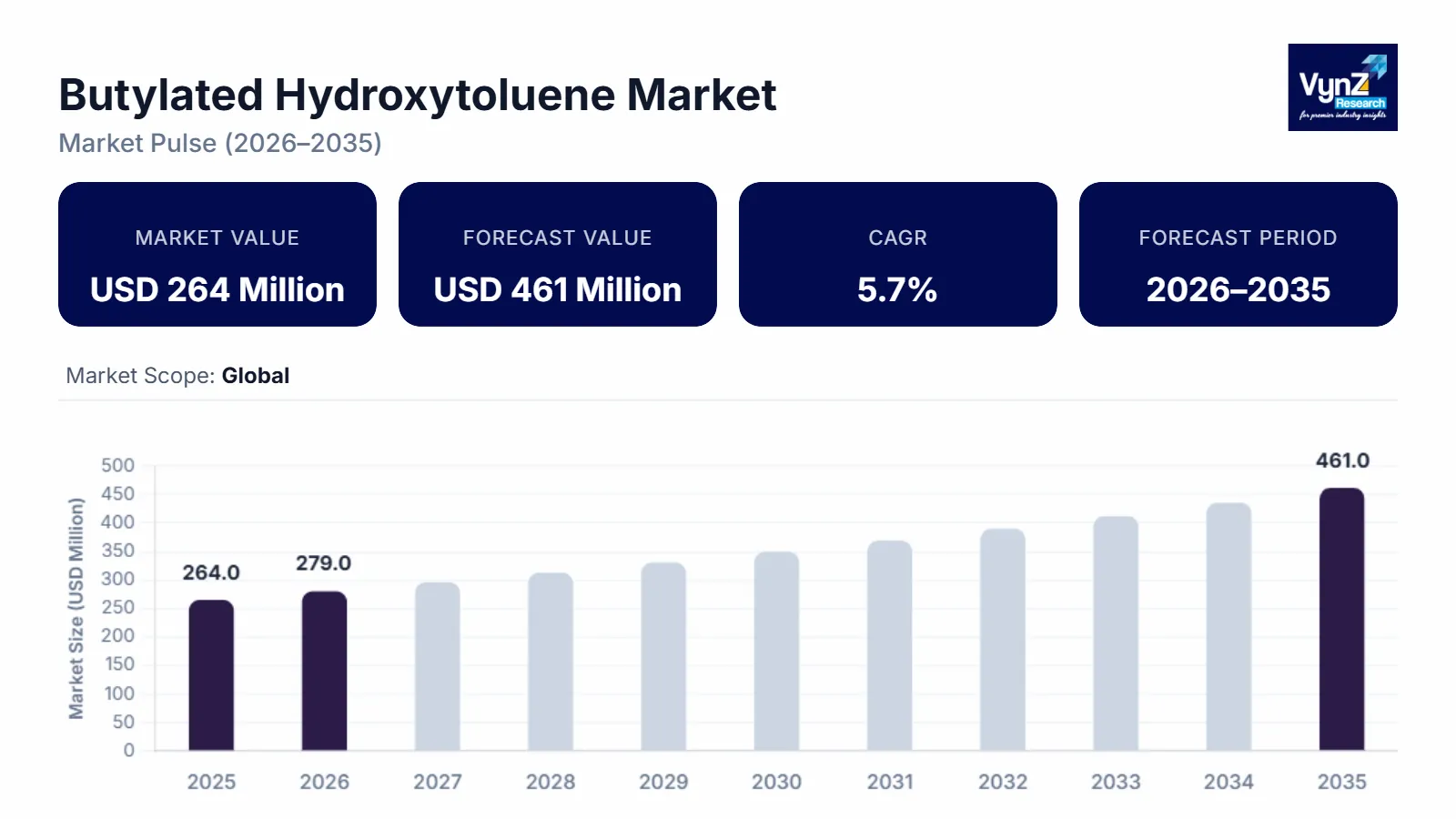
The butylated hydroxytoluene market is supported by continued demand for synthetic antioxidants across food preservation, plastics and rubber manufacturing, petroleum products and personal care formulations. Increasing requirements for oxidation control, product stability and extended shelf life are encouraging manufacturers to maintain BHT-based formulations, while expanding industrial production and demand for specialized chemical additives are supporting long-term consumption. Market expansion is influenced by industrial antioxidant requirements, food preservation applications and increasing production of plastics and rubber products. The US Food and Drug Administration identifies BHT as an antioxidant used in food and food-contact applications, while the WHO and FAO Joint Expert Committee on Food Additives lists it as food additive INS 321. The FDA's 2026 post-market reassessment of BHT is also increasing the importance of safety documentation and regulatory compliance among manufacturers and food processors.
Research Methodology
VynZ Research uses primary and secondary research to evaluate the global BHT industry, including its production structure, application requirements, distribution channels and competitive environment. The VynZ Research team examines company disclosures, product specifications, regulatory publications, trade information and relevant chemical industry reports to establish historical market conditions. Primary research includes discussions with manufacturers, distributors, procurement specialists and application experts, while secondary research supports the assessment of production trends, consumption patterns and regional demand. Market estimates are developed through data triangulation, cross-verification and forecasting models, with particular attention to regulatory developments affecting food and industrial applications.
Research Highlights
- Technical-grade BHT accounted for an estimated 60% of global revenue in 2025, supported by its extensive use in polymer stabilization, petroleum products and industrial formulations.
- Plastics and rubber represented approximately 43% of market revenue in 2025, driven by increasing requirements for oxidation resistance in polymer products and rubber components.
- Polymer stabilization accounted for an estimated 41% share in 2025, reflecting the importance of antioxidants in protecting plastics and synthetic rubber against thermal and oxidative degradation.
- Food and beverage applications are projected to register an estimated CAGR of 6% from 2026 to 2035, supported by demand for oxidation control in fats, oils and packaged food formulations.
- Asia-Pacific accounted for approximately 44% of global revenue in 2025, supported by its extensive chemical manufacturing base, expanding food processing industry and growing polymer production.
Butylated Hydroxytoluene Market Dynamics
Market Trends
The industry is witnessing increasing demand for application-specific antioxidant grades as manufacturers focus on improving product stability, processing performance and shelf life. Technical-grade BHT remains important in polymer processing, rubber manufacturing, petroleum products and industrial formulations, while food-grade material serves applications requiring compliance with food additive specifications. Manufacturers are also emphasizing consistent purity, controlled impurity levels and improved formulation compatibility to meet the requirements of different end-use industries. These developments are encouraging suppliers to strengthen quality assurance and expand their product portfolios across industrial and food-related applications. Another notable trend involves increasing regulatory scrutiny and the development of antioxidant formulations that combine synthetic and natural ingredients.
Growth Drivers
Growing demand from plastics and rubber manufacturing represents a major driver, as BHT helps limit oxidative degradation during processing, storage and product use. The compound is incorporated into polymer and rubber formulations to protect materials against deterioration caused by oxygen and heat, supporting the performance of industrial components, packaging materials, automotive products and other manufactured goods. Expansion of automotive production, construction materials and industrial packaging is creating additional demand for stabilizing additives. The continued use of synthetic antioxidants in established manufacturing processes is therefore supporting consumption across major industrial markets. Food preservation is another important growth driver, particularly in products containing fats and oils that are susceptible to oxidative rancidity.
Market Restraints / Challenges
Regulatory scrutiny and changing consumer preferences represent important challenges for manufacturers, particularly in food and personal care applications. The FDA's 2026 reassessment of BHT has introduced additional uncertainty regarding its future food-related regulatory position, as the agency seeks information on exposure, safety and current applications. Although inclusion in the assessment does not itself establish that a substance is unsafe, food manufacturers may review ingredient specifications and consider alternative antioxidant systems while the scientific evaluation progresses. Such developments can influence procurement decisions and increase compliance expenditure across the supply chain. Raw material price fluctuations and manufacturing costs also affect market profitability.
Market Opportunities
The expansion of industrial polymer manufacturing presents opportunities for suppliers offering high-purity BHT and customized antioxidant formulations. Increasing use of plastics, synthetic rubber, automotive components and industrial materials is creating requirements for additives that protect products against oxidation during processing and storage. Manufacturers can strengthen their position by improving formulation compatibility, maintaining consistent technical specifications and developing reliable supply arrangements for large industrial customers. Demand for specialized antioxidants in high-performance rubber and polymer applications is also creating opportunities for suppliers with established chemical processing and technical service capabilities. Another opportunity lies in the development of diversified antioxidant solutions for food, feed, pharmaceutical and personal care applications.
Global Butylated Hydroxytoluene Market Report Coverage
|
Report Metric |
Details |
|
Historical Period |
2020 - 2024 |
|
Base Year Considered |
2025 |
|
Forecast Period |
2026 - 2035 |
|
Market Size in 2025 |
USD 264 Million |
|
Revenue Forecast in 2035 |
USD 461 Million |
|
Growth Rate |
5.70% |
|
Segments Covered in the Report |
Grade, Form, Application, End Use |
|
Report Scope |
Market Trends, Drivers, and Restraints; Revenue Estimation and Forecast; Segmentation Analysis; Companies’ Strategic Developments; Market Share Analysis of Key Players; Company Profiling |
|
Regions Covered in the Report |
North America, Europe, Asia Pacific, Rest of the World |
|
Key Companies |
BASF SE, Camlin Fine Sciences Limited, Clean Science and Technology Limited, Eastman Chemical Company, Honshu Chemical Industry Co., Ltd., LANXESS AG, Merck KGaA, OXIRIS Chemicals S.A., Sasol Limited, Yasho Industries Limited |
|
Customization |
Available upon request |
Butylated Hydroxytoluene Market Segmentation
By Grade
Technical-grade BHT accounted for approximately 60% of global revenue in 2025, making it the leading product category. Its dominance is supported by extensive consumption across plastics and rubber manufacturing, petroleum products, lubricants and other industrial formulations.
Food-grade BHT is expected to register a CAGR of 5% during the forecast period. Demand is supported by its use in food formulations containing fats and oils, where oxidation control helps maintain flavor and product quality.
By Form
Powdered and crystalline BHT represented an estimated 64% of the market in 2025, supported by convenient handling, storage and incorporation into solid antioxidant formulations.
Liquid and formulated BHT products are projected to record a CAGR of 6% through 2035. Their adoption is supported by applications requiring easier dispersion and incorporation into oils, lubricants, petroleum products and selected industrial formulations.
By Application
Polymer stabilization accounted for an estimated 41% of global application revenue in 2025, supported by the widespread use of BHT in plastics and synthetic rubber formulations.
Food preservation is projected to register a CAGR of 6% during 2026–2035, supported by continued demand for processed food preservation solutions, although evolving safety assessments may influence its use in selected formulations.
By End Use
Plastics and rubber represented the largest end-use category, accounting for approximately 43% of global revenue in 2025. Demand is supported by the use of stabilized materials in automotive components, packaging, construction products, industrial equipment and consumer goods.
Food and beverage is projected to grow at a CAGR of 6% during 2026–2035, driven by processed food manufacturing and the need to maintain product quality throughout distribution and storage.
Regional Insights
North America
North America accounted for an estimated 22% of global revenue in 2025, supported by established chemical manufacturing, food processing, petroleum refining and plastics production. The United States represents the largest national market within the region, with demand supported by industrial antioxidant consumption and food preservation applications. The US Food and Drug Administration identifies BHT as an authorized antioxidant for specified food and food-contact applications, subject to applicable regulatory provisions. Its ongoing safety reassessment is also increasing the importance of compliance documentation among manufacturers and food processors.
Europe
Europe represented approximately 19% of global revenue in 2025, supported by established specialty chemical manufacturing, food processing, plastics production and personal care industries. Germany, France, Spain, Italy and the United Kingdom are important national markets due to their chemical manufacturing capabilities and established industrial supply chains. The European Commission's Regulation (EU) 2022/2195 established specific concentration limits for BHT in cosmetic products following the Scientific Committee on Consumer Safety assessment, strengthening the importance of compliance across personal care formulations.
Asia Pacific
Asia Pacific held the largest regional position, accounting for approximately 44% of global revenue in 2025. China, India, Japan and South Korea represent major consumption and manufacturing centers due to their extensive chemical industries, food processing capabilities and plastics production. The region benefits from established chemical supply chains, competitive manufacturing costs and growing demand for antioxidants across industrial and consumer product applications. Increasing production of synthetic rubber, polymers and packaged food products is supporting demand for both technical and food-grade BHT.
Rest of the World
The Rest of the World accounted for the remaining estimated 15% of global revenue in 2025, covering Latin America, the Middle East and Africa. Brazil, Mexico, Saudi Arabia, the United Arab Emirates and South Africa represent important demand centers due to their food processing, petroleum, plastics and industrial manufacturing activities. Demand is supported by the use of antioxidants in lubricant formulations, polymer products, food preservation and other industrial applications, while regional chemical distributors help connect international manufacturers with local buyers.
Competitive Landscape / Company Insights
The butylated hydroxytoluene industry is moderately competitive, with established chemical manufacturers and specialized antioxidant suppliers competing through product quality, manufacturing efficiency and application-specific formulations. Major companies focus on technical-grade and food-grade products, distribution expansion and improved supply reliability. Regulatory compliance, product purity and consistent antioxidant performance remain important competitive factors. Increasing attention to manufacturing efficiency and sustainable chemical production is also encouraging suppliers to strengthen production capabilities and diversify their antioxidant portfolios.
Mini Profiles
Camlin Fine Sciences manufactures specialty antioxidants and food ingredients, including BHT, serving food preservation and industrial formulation applications through its antioxidant portfolio.
Eastman Chemical Company supplies specialty chemical antioxidants and Tenox products for food, industrial and polymer applications, supported by established technical and distribution capabilities.
Honshu Chemical Industry manufactures specialty organic chemicals and antioxidant ingredients, serving industrial and chemical formulation requirements across international markets.
LANXESS supplies specialty chemical antioxidants and rubber additives, with an established portfolio serving polymer, tire and industrial manufacturing customers.
Sasol Limited produces specialty chemicals and industrial antioxidants, supplying chemical intermediates and performance additives to multiple end-use industries.
Key Players
- BASF SE
- Camlin Fine Sciences Limited
- Clean Science and Technology Limited
- Eastman Chemical Company
- Honshu Chemical Industry Co., Ltd.
- LANXESS AG
- Merck KGaA
- OXIRIS Chemicals S.A.
- Sasol Limited
- Yasho Industries Limited
Recent Developments
Clean Science and Technology Limited expanded its antioxidant product portfolio during FY2024–25, with BHT included among its newly developed performance chemicals. Its subsidiary, Clean Fino-Chem, had already commenced commercial BHT production, strengthening the company's participation in the specialty antioxidant supply chain.
Camlin Fine Sciences Limited reported continued traction in its antioxidant portfolio during FY2025–26, supported by customer engagement and demand for shelf-life enhancement solutions. Its Xtendra portfolio includes BHT, BHA, TBHQ and antioxidant blends for food and related applications.
Yasho Industries Limited reported continued expansion of its manufacturing operations and international business during FY2025–26. Its broader specialty chemical portfolio and increased production capabilities support its position in industrial additives and antioxidant-related applications.
Global Butylated Hydroxytoluene Market Coverage
Grade Insight and Forecast 2026 - 2035
- Technical Grade
- Food Grade
- Other Grades
Form Insight and Forecast 2026 - 2035
- Powdered BHT
- Crystalline BHT
- Liquid BHT
Application Insight and Forecast 2026 - 2035
- Polymer Stabilization
- Food Preservation
- Petroleum and Lubricant Stabilization
- Cosmetic Formulation
- Other Applications
End Use Insight and Forecast 2026 - 2035
- Plastics and Rubber
- Food and Beverage
- Animal Feed
- Personal Care
- Pharmaceuticals
- Other End Uses
Global Butylated Hydroxytoluene Market by Region
- North America
- By Grade
- By Form
- By Application
- By End Use
- By Country - U.S., Canada, Mexico
- Europe
- By Grade
- By Form
- By Application
- By End Use
- By Country - Germany, U.K., France, Italy, Spain, Russia, Rest of Europe
- Asia-Pacific (APAC)
- By Grade
- By Form
- By Application
- By End Use
- By Country - China, Japan, India, South Korea, Vietnam, Thailand, Malaysia, Rest of Asia-Pacific
- Rest of the World (RoW)
- By Grade
- By Form
- By Application
- By End Use
- By Country - Brazil, Saudi Arabia, South Africa, U.A.E., Other Countries
Table of Contents for Butylated Hydroxytoluene Market Report
1. Research Overview
1.1. The Report Offers
1.2. Market Coverage
1.2.1. By
Grade
1.2.2. By
Form
1.2.3. By
Application
1.2.4. By
End Use
1.3. Research Phases
1.4. Limitations
1.5. Market Methodology
1.5.1. Data Sources
1.5.1.1.
Primary Research
1.5.1.2.
Secondary Research
1.5.2. Methodology
1.5.2.1.
Data Exploration
1.5.2.2.
Forecast Parameters
1.5.2.3.
Data Validation
1.5.2.4.
Assumptions
1.5.3. Study Period & Data Reporting Unit
2. Executive Summary
3. Industry Overview
3.1. Industry Dynamics
3.1.1. Market Growth Drivers
3.1.2. Market Restraints
3.1.3. Key Market Trends
3.1.4. Major Opportunities
3.2. Industry Ecosystem
3.2.1. Porter’s Five Forces Analysis
3.2.2. Recent Development Analysis
3.2.3. Value Chain Analysis
3.3. Competitive Insight
3.3.1. Competitive Position of Industry
Players
3.3.2. Market Attractive Analysis
3.3.3. Market Share Analysis
4. Global Market Estimate and Forecast
4.1. Global Market Overview
4.2. Global Market Estimate and Forecast to 2035
5. Market Segmentation Estimate and Forecast
5.1. By Grade
5.1.1. Technical Grade
5.1.1.1. Market Definition
5.1.1.2. Market Estimation and Forecast to 2035
5.1.2. Food Grade
5.1.2.1. Market Definition
5.1.2.2. Market Estimation and Forecast to 2035
5.1.3. Other Grades
5.1.3.1. Market Definition
5.1.3.2. Market Estimation and Forecast to 2035
5.2. By Form
5.2.1. Powdered BHT
5.2.1.1. Market Definition
5.2.1.2. Market Estimation and Forecast to 2035
5.2.2. Crystalline BHT
5.2.2.1. Market Definition
5.2.2.2. Market Estimation and Forecast to 2035
5.2.3. Liquid BHT
5.2.3.1. Market Definition
5.2.3.2. Market Estimation and Forecast to 2035
5.3. By Application
5.3.1. Polymer Stabilization
5.3.1.1. Market Definition
5.3.1.2. Market Estimation and Forecast to 2035
5.3.2. Food Preservation
5.3.2.1. Market Definition
5.3.2.2. Market Estimation and Forecast to 2035
5.3.3. Petroleum and Lubricant Stabilization
5.3.3.1. Market Definition
5.3.3.2. Market Estimation and Forecast to 2035
5.3.4. Cosmetic Formulation
5.3.4.1. Market Definition
5.3.4.2. Market Estimation and Forecast to 2035
5.3.5. Other Applications
5.3.5.1. Market Definition
5.3.5.2. Market Estimation and Forecast to 2035
5.4. By End Use
5.4.1. Plastics and Rubber
5.4.1.1. Market Definition
5.4.1.2. Market Estimation and Forecast to 2035
5.4.2. Food and Beverage
5.4.2.1. Market Definition
5.4.2.2. Market Estimation and Forecast to 2035
5.4.3. Animal Feed
5.4.3.1. Market Definition
5.4.3.2. Market Estimation and Forecast to 2035
5.4.4. Personal Care
5.4.4.1. Market Definition
5.4.4.2. Market Estimation and Forecast to 2035
5.4.5. Pharmaceuticals
5.4.5.1. Market Definition
5.4.5.2. Market Estimation and Forecast to 2035
5.4.6. Other End Uses
5.4.6.1. Market Definition
5.4.6.2. Market Estimation and Forecast to 2035
6. North America Market Estimate and Forecast
6.1. By
Grade
6.2. By
Form
6.3. By
Application
6.4. By
End Use
6.4.1.
U.S. Market Estimate and Forecast
6.4.2.
Canada Market Estimate and Forecast
6.4.3.
Mexico Market Estimate and Forecast
7. Europe Market Estimate and Forecast
7.1. By
Grade
7.2. By
Form
7.3. By
Application
7.4. By
End Use
7.4.1.
Germany Market Estimate and Forecast
7.4.2.
France Market Estimate and Forecast
7.4.3.
U.K. Market Estimate and Forecast
7.4.4.
Italy Market Estimate and Forecast
7.4.5.
Spain Market Estimate and Forecast
7.4.6.
Russia Market Estimate and Forecast
7.4.7.
Rest of Europe Market Estimate and Forecast
8. Asia-Pacific (APAC) Market Estimate and Forecast
8.1. By
Grade
8.2. By
Form
8.3. By
Application
8.4. By
End Use
8.4.1.
China Market Estimate and Forecast
8.4.2.
Japan Market Estimate and Forecast
8.4.3.
India Market Estimate and Forecast
8.4.4.
South Korea Market Estimate and Forecast
8.4.5.
Rest of Asia-Pacific Market Estimate and Forecast
9. Rest of the World (RoW) Market Estimate and Forecast
9.1. By
Grade
9.2. By
Form
9.3. By
Application
9.4. By
End Use
9.4.1.
Brazil Market Estimate and Forecast
9.4.2.
Saudi Arabia Market Estimate and Forecast
9.4.3.
South Africa Market Estimate and Forecast
9.4.4.
U.A.E. Market Estimate and Forecast
9.4.5.
Other Countries Market Estimate and Forecast
10. Company Profiles
10.1.
BASF SE
10.1.1.
Snapshot
10.1.2.
Overview
10.1.3.
Offerings
10.1.4.
Financial
Insight
10.1.5.
Recent
Developments
10.2.
Camlin Fine Sciences Limited
10.2.1.
Snapshot
10.2.2.
Overview
10.2.3.
Offerings
10.2.4.
Financial
Insight
10.2.5.
Recent
Developments
10.3.
Clean Science and Technology Limited
10.3.1.
Snapshot
10.3.2.
Overview
10.3.3.
Offerings
10.3.4.
Financial
Insight
10.3.5.
Recent
Developments
10.4.
Eastman Chemical Company
10.4.1.
Snapshot
10.4.2.
Overview
10.4.3.
Offerings
10.4.4.
Financial
Insight
10.4.5.
Recent
Developments
10.5.
Honshu Chemical Industry Co., Ltd.
10.5.1.
Snapshot
10.5.2.
Overview
10.5.3.
Offerings
10.5.4.
Financial
Insight
10.5.5.
Recent
Developments
10.6.
LANXESS AG
10.6.1.
Snapshot
10.6.2.
Overview
10.6.3.
Offerings
10.6.4.
Financial
Insight
10.6.5.
Recent
Developments
10.7.
Merck KGaA
10.7.1.
Snapshot
10.7.2.
Overview
10.7.3.
Offerings
10.7.4.
Financial
Insight
10.7.5.
Recent
Developments
10.8.
OXIRIS Chemicals S.A.
10.8.1.
Snapshot
10.8.2.
Overview
10.8.3.
Offerings
10.8.4.
Financial
Insight
10.8.5.
Recent
Developments
10.9.
Sasol Limited
10.9.1.
Snapshot
10.9.2.
Overview
10.9.3.
Offerings
10.9.4.
Financial
Insight
10.9.5.
Recent
Developments
10.10.
Yasho Industries Limited
10.10.1.
Snapshot
10.10.2.
Overview
10.10.3.
Offerings
10.10.4.
Financial
Insight
10.10.5.
Recent
Developments
11. Appendix
11.1. Exchange Rates
11.2. Abbreviations
Note: Financial insight and recent developments of different companies are subject to the availability of information in the secondary domain.
Frequently Asked Questions
Purchase Options
Latest Report
Research Methodology
- Desk Research / Pilot Interviews
- Build Market Size Model
- Research and Analysis
- Final Deliverable
Connect With Our Sales Team
- Toll-Free: +1-888-253-3960
- Phone: +91 9960 288 381
- Email: enquiry@vynzresearch.com
Butylated Hydroxytoluene Market