
Calcium Carbonate Market Size & Share Growth Forecast Report (2026-2035)
Industry Insight by Type (Ground Calcium Carbonate, Precipitated Calcium Carbonate), by Application (Filler and Pigment, Raw Substance for Construction Material, Dietary Supplement, Additive for Thermoplastics, Component of Adhesives, Desulfurization of Fuel Gas, Neutralizing Agent in Soil, Other Applications), by End-User Industry (Paper, Plastic, Adhesives and Sealants, Construction, Paints and Coatings, Pharmaceutical, Automotive, Agriculture, Rubber, Other End-User Industries)
| Status : Published | Published On : Nov, 2026 | Report Code : VRCH2151 | Industry : Chemicals & Materials | Available Format :

|
Page : 154 |
Calcium Carbonate Market Overview
The global calcium carbonate market was estimated at approximately USD 37 billion in 2025 and is expected to reach around USD 41 billion in 2026, rising to nearly USD 65 billion by 2035, at a projected CAGR of 5.50% from 2026 to 2035.
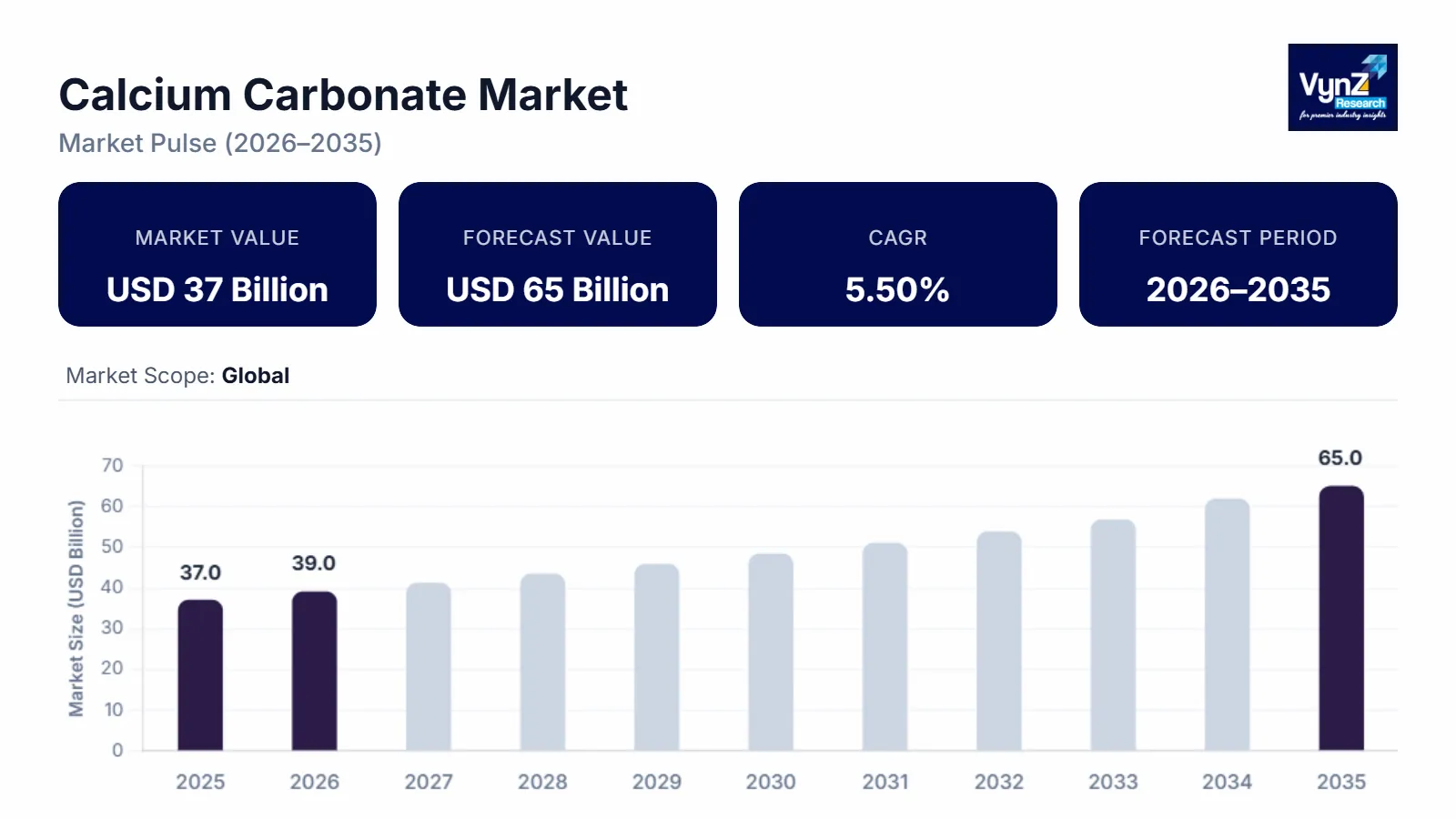
Market growth is driven by expanding construction activity, rising demand for paper and packaging materials, and increasing use of mineral fillers in plastics and coatings. The U.S. Geological Survey's Mineral Commodity Summaries 2026 identifies limestone as an important industrial mineral with substantial global production and reserves, while India's Ministry of Mines reported limestone production of approximately 407 million tons in 2023–24. The Food and Agriculture Organization also identifies calcium carbonate as a material used to correct acidic soil conditions, supporting its agricultural applications.
Research Methodology
The VynZ Research team assessed the calcium carbonate market through secondary research covering industry reports, company disclosures, government publications, regulatory databases, and trade information. The study reviewed demand across ground and precipitated calcium carbonate, major industrial applications, and end-user industries. Market estimates were cross-checked against published revenue and volume assessments, while segment shares and growth indicators were evaluated against available industry data. Government sources, including the U.S. Geological Survey, Food and Agriculture Organization, U.S. Food and Drug Administration, and India's Ministry of Mines, were used to understand mineral availability, industrial applications, agricultural use, and regulatory conditions.
Research Highlights
- Ground calcium carbonate accounted for approximately 76% of the global market in 2025, supported by its cost advantages, natural availability, and broad use in paper, plastics, and construction applications.
- Filler and pigment applications represented nearly 56% of market demand in 2025, reflecting extensive consumption in paper manufacturing, coatings, and polymer formulations.
- The paper industry held approximately 35% of the end-user market in 2025, supported by calcium carbonate’s role in improving brightness, opacity, and paper production economics.
- Precipitated calcium carbonate is projected to register a CAGR of 4% through 2035, driven by demand for controlled particle size, brightness, and higher-performance mineral grades.
- Asia-Pacific accounted for approximately 48% of global demand in 2025 and is expected to remain the leading regional market, supported by large paper, packaging, construction, and plastics manufacturing bases.
Calcium Carbonate Market Dynamics
Market Trends
The calcium carbonate industry is witnessing a shift toward engineered mineral grades with controlled particle size, brightness, purity, and surface characteristics. Ground calcium carbonate continues to serve high-volume applications, while precipitated calcium carbonate is gaining importance in products requiring consistent particle properties and improved performance. The U.S. Geological Survey's mineral reporting and industry assessments indicate the importance of natural mineral resources to industrial supply chains, while manufacturers are increasingly focusing on processing efficiency and application-specific grades. Another emerging trend is the development of lower-carbon and recycled calcium carbonate solutions. Producers are exploring recovered mineral feedstocks, carbon dioxide utilization, and on-site manufacturing to reduce transportation requirements and improve resource efficiency.
Growth Drivers
The growth of the calcium carbonate market is largely supported by construction and infrastructure development, where the mineral is used in cement-based materials, sealants, coatings, and other building products. Increasing investment in roads, housing, commercial buildings, and industrial facilities is supporting demand for mineral fillers and construction-grade materials. Additionally, demand from paper, packaging, and plastics manufacturing is supporting continued consumption. Calcium carbonate is used to improve paper brightness and opacity, while plastic manufacturers incorporate it as a filler to modify product properties and manage formulation costs. The U.S. Food and Drug Administration also lists calcium carbonate for specified food-related technical uses, including nutrient supplementation and pH control, supporting demand for suitable high-purity grades in regulated applications.
Market Restraints / Challenges
Despite favorable demand prospects, the market faces challenges associated with quarrying permissions, environmental compliance, and the operational costs of mineral processing. Limestone extraction and grinding require effective management of land use, dust, water consumption, and transportation. The U.S. Environmental Protection Agency's effluent guidelines for the mineral mining and processing industry establish wastewater requirements for covered operations, while environmental permitting requirements in major producing regions can increase compliance costs and extend project development timelines. Furthermore, transportation and energy costs can affect the competitiveness of calcium carbonate suppliers, particularly when material is shipped over long distances to paper mills, plastics processors, and construction manufacturers.
Market Opportunities
The market presents opportunities in precipitated calcium carbonate and other engineered grades, particularly in applications requiring controlled particle size, brightness, and purity. Paper and packaging manufacturers are increasingly using specialized mineral fillers and coating pigments to improve product quality and production efficiency. On-site PCC facilities also offer opportunities by reducing transportation requirements and providing a more consistent supply to large industrial customers. These models can strengthen long-term supplier relationships while supporting demand from paper mills and packaging manufacturers. Another opportunity lies in agriculture and high-purity applications. The Food and Agriculture Organization identifies calcium carbonate as a material used to correct acidic soil conditions, creating demand from agricultural markets where soil pH management is required.
Global Calcium Carbonate Market Report Coverage
|
Report Metric |
Details |
|
Historical Period |
2020 - 2024 |
|
Base Year Considered |
2025 |
|
Forecast Period |
2026 - 2035 |
|
Market Size in 2025 |
USD 37 Billion |
|
Revenue Forecast in 2035 |
USD 65 Billion |
|
Growth Rate |
5.5% |
|
Segments Covered in the Report |
Type, Application, End User Industry |
|
Report Scope |
Market Trends, Drivers, and Restraints; Revenue Estimation and Forecast; Segmentation Analysis; Companies’ Strategic Developments; Market Share Analysis of Key Players; Company Profiling |
|
Regions Covered in the Report |
North America, Europe, Asia Pacific, Rest of the World |
|
Key Companies |
ACCM, Carmeuse Group, Gulshan Polyols Ltd., Huber Engineered Materials, Imerys, Minerals Technologies Inc., Omya International AG, Saudi Carbonate Company, Sibelco, Shiraishi Group |
|
Customization |
Available upon request |
Calcium Carbonate Market Segmentation
By Type
Ground calcium carbonate accounted for approximately 76% of global demand in 2025, supported by its natural availability, comparatively economical processing, and extensive use in paper, plastics, paints, and construction materials.
Precipitated calcium carbonate is projected to register the faster growth rate, with a CAGR of 4% through 2035. Its controlled particle size, brightness, and surface characteristics make it suitable for applications requiring more specific performance properties, particularly specialty paper, plastics, and pharmaceutical formulations.
By Application
Filler and pigment applications accounted for approximately 56% of market demand in 2025, supported by extensive use in paper, coatings, plastics, and industrial formulations.
Dietary supplement applications are expected to register a CAGR of 3% through 2035, supported by demand for calcium-based nutritional products and fortified food formulations.
By End-User Industry
The paper industry accounted for approximately 35% of global demand in 2025, supported by its use of calcium carbonate as a filler and coating pigment.
Agriculture is projected to register a CAGR of 3.5% through 2035, supported by the use of calcium carbonate in soil neutralization and pH management.
Regional Insights
Asia Pacific
Asia Pacific accounted for approximately 48% of the global calcium carbonate market in 2025, making it the largest regional market. China represents a major source of regional demand, supported by extensive paper, packaging, plastics, construction, and manufacturing industries. India also contributes through its large limestone resource base and expanding industrial activity. The region is supported by continued industrial investment and demand for paper, packaging, construction materials, and plastic products. Increasing adoption of on-site mineral processing facilities is also improving supply reliability for large paper manufacturers. China and India remain important markets because of their manufacturing capacity and growing demand for application-specific mineral grades.
North America
North America represents 18% of the calcium carbonate market, supported by demand from paper, plastics, construction, paints, coatings, and pharmaceutical manufacturers. The United States has a developed industrial minerals supply chain, while manufacturers increasingly require specialized grades with controlled particle characteristics and consistent quality. Investment in on-site PCC facilities and engineered mineral products is supporting the regional market, particularly among paper and packaging producers seeking reliable supplies and improved production efficiency. Demand is expected to remain supported by infrastructure investment, packaging requirements, and the adoption of value-added mineral fillers.
Europe
Europe accounted for an estimated 14% of the global market in 2025, supported by established paper, construction, automotive, plastics, and specialty chemical industries. Germany, France, Italy, and the United Kingdom represent important consumption markets, with demand linked to industrial manufacturing and the use of mineral fillers in coatings, polymers, and building materials. The region's environmental requirements are also encouraging manufacturers to improve energy efficiency, mineral recovery, and emissions documentation across processing operations. The European market is expected to maintain steady growth as manufacturers focus on specialized calcium carbonate grades and lower-impact production processes
Rest of the World
The Rest of the World accounted for the remaining estimated 20% of global demand in 2025, covering South America, the Middle East, and Africa. Demand is supported by construction activity, industrial manufacturing, agriculture, and the development of local mineral-processing capacity. Brazil is an important market in South America, while Saudi Arabia and the UAE are supporting regional consumption through infrastructure, plastics, coatings, and industrial development. Investment in local grinding and precipitated calcium carbonate facilities is creating opportunities for regional suppliers to serve customers with shorter delivery times and application-specific products.
Competitive Landscape / Company Insights
The calcium carbonate market is moderately consolidated, with global producers such as Imerys, Omya, Minerals Technologies, Sibelco, and Huber Engineered Materials competing alongside regional suppliers. Companies focus on mineral processing efficiency, product quality, application-specific grades, and supply-chain integration. Investment in on-site PCC facilities, engineered fillers, and lower-carbon production is strengthening competition in value-added applications. The U.S. Geological Survey and regional mining authorities remain important sources for understanding mineral availability and supply conditions.
Mini Profiles
ACCM supplies calcium carbonate products for industrial applications, serving customers requiring mineral fillers and functional materials across manufacturing sectors.
Carmeuse Group operates in industrial minerals and lime products, with a broad customer base across construction, environmental, and manufacturing applications.
Huber Engineered Materials supplies engineered mineral products, including calcium carbonate grades, for applications in plastics, coatings, construction, and other industrial markets.
Jordan Carbonate Company manufactures calcium carbonate products for regional industrial customers, with applications across plastics, paints, paper, and construction-related industries.
Sibelco supplies ground and precipitated calcium carbonate for applications including construction, agriculture, ceramics, coatings, and polymers.
Key Players
- ACCM
- Carmeuse Group
- Gulshan Polyols Ltd.
- Huber Engineered Materials
- Imerys
- Minerals Technologies Inc.
- Omya International AG
- Saudi Carbonate Company
- Sibelco
- Shiraishi Group
Recent Developments
Gulshan Polyols Ltd. entered into a strategic partnership with Trident Limited to establish an on-site precipitated calcium carbonate facility at Barnala, Punjab, with an installed capacity of approximately 22,000 tonnes per annum. The project is expected to supply PCC slurry to Trident's operations and generate additional revenue over the facility's operating period.
Imerys signed an agreement to acquire SB Mineração, a Brazilian producer of ground calcium carbonate used in polymers, thermosets, paints, and coatings. The proposed acquisition is intended to strengthen Imerys' industrial presence in Brazil and expand its supply capabilities in Latin America.
Minerals Technologies Inc. expanded its paper and packaging satellite operations in Asia, including the start-up of three new plants in China and India and the doubling of capacity at an existing Indian facility. The expansion supports growing demand for calcium carbonate fillers and coating pigments, with a significant share of the additional capacity directed toward packaging applications.
Saudi Carbonate Company announced a major expansion of its precipitated calcium carbonate production capacity, positioning the company to serve growing demand across the Middle East and Africa. The additional capacity is intended to support customers in plastics, paints, pharmaceuticals, and paper manufacturing.
Shiraishi Group introduced a dedicated information page covering calcium carbonate for food applications, strengthening its communication around food-grade mineral products. The company also expanded its digital information resources for customers seeking product and application guidance.
Global Calcium Carbonate Market Coverage
Type Insight and Forecast 2026 - 2035
- Ground Calcium Carbonate
- Precipitated Calcium Carbonate
Application Insight and Forecast 2026 - 2035
- Filler and Pigment
- Raw Substance for Construction Material
- Dietary Supplement
- Additive for Thermoplastics
- Component of Adhesives
- Desulfurization of Fuel Gas
- Neutralizing Agent in Soil
- Other Applications
End-User Industry Insight and Forecast 2026 - 2035
- Paper
- Plastic
- Adhesives and Sealants
- Construction
- Paints and Coatings
- Pharmaceutical
- Automotive
- Agriculture
- Rubber
- Other End-User Industries
Global Calcium Carbonate Market by Region
- North America
- By Type
- By Application
- By End-User Industry
- By Country - U.S., Canada, Mexico
- Europe
- By Type
- By Application
- By End-User Industry
- By Country - Germany, U.K., France, Italy, Spain, Russia, Rest of Europe
- Asia-Pacific (APAC)
- By Type
- By Application
- By End-User Industry
- By Country - China, Japan, India, South Korea, Vietnam, Thailand, Malaysia, Rest of Asia-Pacific
- Rest of the World (RoW)
- By Type
- By Application
- By End-User Industry
- By Country - Brazil, Saudi Arabia, South Africa, U.A.E., Other Countries
Table of Contents for Calcium Carbonate Market Report
1. Research Overview
1.1. The Report Offers
1.2. Market Coverage
1.2.1. By
Type
1.2.2. By
Application
1.2.3. By
End-User Industry
1.3. Research Phases
1.4. Limitations
1.5. Market Methodology
1.5.1. Data Sources
1.5.1.1.
Primary Research
1.5.1.2.
Secondary Research
1.5.2. Methodology
1.5.2.1.
Data Exploration
1.5.2.2.
Forecast Parameters
1.5.2.3.
Data Validation
1.5.2.4.
Assumptions
1.5.3. Study Period & Data Reporting Unit
2. Executive Summary
3. Industry Overview
3.1. Industry Dynamics
3.1.1. Market Growth Drivers
3.1.2. Market Restraints
3.1.3. Key Market Trends
3.1.4. Major Opportunities
3.2. Industry Ecosystem
3.2.1. Porter’s Five Forces Analysis
3.2.2. Recent Development Analysis
3.2.3. Value Chain Analysis
3.3. Competitive Insight
3.3.1. Competitive Position of Industry
Players
3.3.2. Market Attractive Analysis
3.3.3. Market Share Analysis
4. Global Market Estimate and Forecast
4.1. Global Market Overview
4.2. Global Market Estimate and Forecast to 2035
5. Market Segmentation Estimate and Forecast
5.1. By Type
5.1.1. Ground Calcium Carbonate
5.1.1.1. Market Definition
5.1.1.2. Market Estimation and Forecast to 2035
5.1.2. Precipitated Calcium Carbonate
5.1.2.1. Market Definition
5.1.2.2. Market Estimation and Forecast to 2035
5.2. By Application
5.2.1. Filler and Pigment
5.2.1.1. Market Definition
5.2.1.2. Market Estimation and Forecast to 2035
5.2.2. Raw Substance for Construction Material
5.2.2.1. Market Definition
5.2.2.2. Market Estimation and Forecast to 2035
5.2.3. Dietary Supplement
5.2.3.1. Market Definition
5.2.3.2. Market Estimation and Forecast to 2035
5.2.4. Additive for Thermoplastics
5.2.4.1. Market Definition
5.2.4.2. Market Estimation and Forecast to 2035
5.2.5. Component of Adhesives
5.2.5.1. Market Definition
5.2.5.2. Market Estimation and Forecast to 2035
5.2.6. Desulfurization of Fuel Gas
5.2.6.1. Market Definition
5.2.6.2. Market Estimation and Forecast to 2035
5.2.7. Neutralizing Agent in Soil
5.2.7.1. Market Definition
5.2.7.2. Market Estimation and Forecast to 2035
5.2.8. Other Applications
5.2.8.1. Market Definition
5.2.8.2. Market Estimation and Forecast to 2035
5.3. By End-User Industry
5.3.1. Paper
5.3.1.1. Market Definition
5.3.1.2. Market Estimation and Forecast to 2035
5.3.2. Plastic
5.3.2.1. Market Definition
5.3.2.2. Market Estimation and Forecast to 2035
5.3.3. Adhesives and Sealants
5.3.3.1. Market Definition
5.3.3.2. Market Estimation and Forecast to 2035
5.3.4. Construction
5.3.4.1. Market Definition
5.3.4.2. Market Estimation and Forecast to 2035
5.3.5. Paints and Coatings
5.3.5.1. Market Definition
5.3.5.2. Market Estimation and Forecast to 2035
5.3.6. Pharmaceutical
5.3.6.1. Market Definition
5.3.6.2. Market Estimation and Forecast to 2035
5.3.7. Automotive
5.3.7.1. Market Definition
5.3.7.2. Market Estimation and Forecast to 2035
5.3.8. Agriculture
5.3.8.1. Market Definition
5.3.8.2. Market Estimation and Forecast to 2035
5.3.9. Rubber
5.3.9.1. Market Definition
5.3.9.2. Market Estimation and Forecast to 2035
5.3.10. Other End-User Industries
5.3.10.1. Market Definition
5.3.10.2. Market Estimation and Forecast to 2035
6. North America Market Estimate and Forecast
6.1. By
Type
6.2. By
Application
6.3. By
End-User Industry
6.3.1.
U.S. Market Estimate and Forecast
6.3.2.
Canada Market Estimate and Forecast
6.3.3.
Mexico Market Estimate and Forecast
7. Europe Market Estimate and Forecast
7.1. By
Type
7.2. By
Application
7.3. By
End-User Industry
7.3.1.
Germany Market Estimate and Forecast
7.3.2.
France Market Estimate and Forecast
7.3.3.
U.K. Market Estimate and Forecast
7.3.4.
Italy Market Estimate and Forecast
7.3.5.
Spain Market Estimate and Forecast
7.3.6.
Russia Market Estimate and Forecast
7.3.7.
Rest of Europe Market Estimate and Forecast
8. Asia-Pacific (APAC) Market Estimate and Forecast
8.1. By
Type
8.2. By
Application
8.3. By
End-User Industry
8.3.1.
China Market Estimate and Forecast
8.3.2.
Japan Market Estimate and Forecast
8.3.3.
India Market Estimate and Forecast
8.3.4.
South Korea Market Estimate and Forecast
8.3.5.
Rest of Asia-Pacific Market Estimate and Forecast
9. Rest of the World (RoW) Market Estimate and Forecast
9.1. By
Type
9.2. By
Application
9.3. By
End-User Industry
9.3.1.
Brazil Market Estimate and Forecast
9.3.2.
Saudi Arabia Market Estimate and Forecast
9.3.3.
South Africa Market Estimate and Forecast
9.3.4.
U.A.E. Market Estimate and Forecast
9.3.5.
Other Countries Market Estimate and Forecast
10. Company Profiles
10.1.
ACCM
10.1.1.
Snapshot
10.1.2.
Overview
10.1.3.
Offerings
10.1.4.
Financial
Insight
10.1.5.
Recent
Developments
10.2.
Carmeuse Group
10.2.1.
Snapshot
10.2.2.
Overview
10.2.3.
Offerings
10.2.4.
Financial
Insight
10.2.5.
Recent
Developments
10.3.
Gulshan Polyols Ltd.
10.3.1.
Snapshot
10.3.2.
Overview
10.3.3.
Offerings
10.3.4.
Financial
Insight
10.3.5.
Recent
Developments
10.4.
Huber Engineered Materials
10.4.1.
Snapshot
10.4.2.
Overview
10.4.3.
Offerings
10.4.4.
Financial
Insight
10.4.5.
Recent
Developments
10.5.
Imerys
10.5.1.
Snapshot
10.5.2.
Overview
10.5.3.
Offerings
10.5.4.
Financial
Insight
10.5.5.
Recent
Developments
10.6.
Minerals Technologies Inc.
10.6.1.
Snapshot
10.6.2.
Overview
10.6.3.
Offerings
10.6.4.
Financial
Insight
10.6.5.
Recent
Developments
10.7.
Omya International AG
10.7.1.
Snapshot
10.7.2.
Overview
10.7.3.
Offerings
10.7.4.
Financial
Insight
10.7.5.
Recent
Developments
10.8.
Saudi Carbonate Company
10.8.1.
Snapshot
10.8.2.
Overview
10.8.3.
Offerings
10.8.4.
Financial
Insight
10.8.5.
Recent
Developments
10.9.
Sibelco
10.9.1.
Snapshot
10.9.2.
Overview
10.9.3.
Offerings
10.9.4.
Financial
Insight
10.9.5.
Recent
Developments
10.10.
Shiraishi Group
10.10.1.
Snapshot
10.10.2.
Overview
10.10.3.
Offerings
10.10.4.
Financial
Insight
10.10.5.
Recent
Developments
11. Appendix
11.1. Exchange Rates
11.2. Abbreviations
Note: Financial insight and recent developments of different companies are subject to the availability of information in the secondary domain.
Frequently Asked Questions
Purchase Options
Latest Report
Research Methodology
- Desk Research / Pilot Interviews
- Build Market Size Model
- Research and Analysis
- Final Deliverable
Connect With Our Sales Team
- Toll-Free: +1-888-253-3960
- Phone: +91 9960 288 381
- Email: enquiry@vynzresearch.com
Calcium Carbonate Market