
Flocculants Market Size & Share Growth Forecast Report (2026-2035)
Industry Insight by Type (Organic flocculants, Inorganic flocculants, Natural or bio-based flocculants), by Application (Water treatment, Wastewater treatment, Mining and mineral processing, Oil and gas, Pulp and paper), by End Use (Municipal, Industrial, Commercial)
| Status : Published | Published On : Jun, 2026 | Report Code : VRCH2131 | Industry : Chemicals & Materials | Available Format :

|
Page : 156 |
Flocculants Market Overview
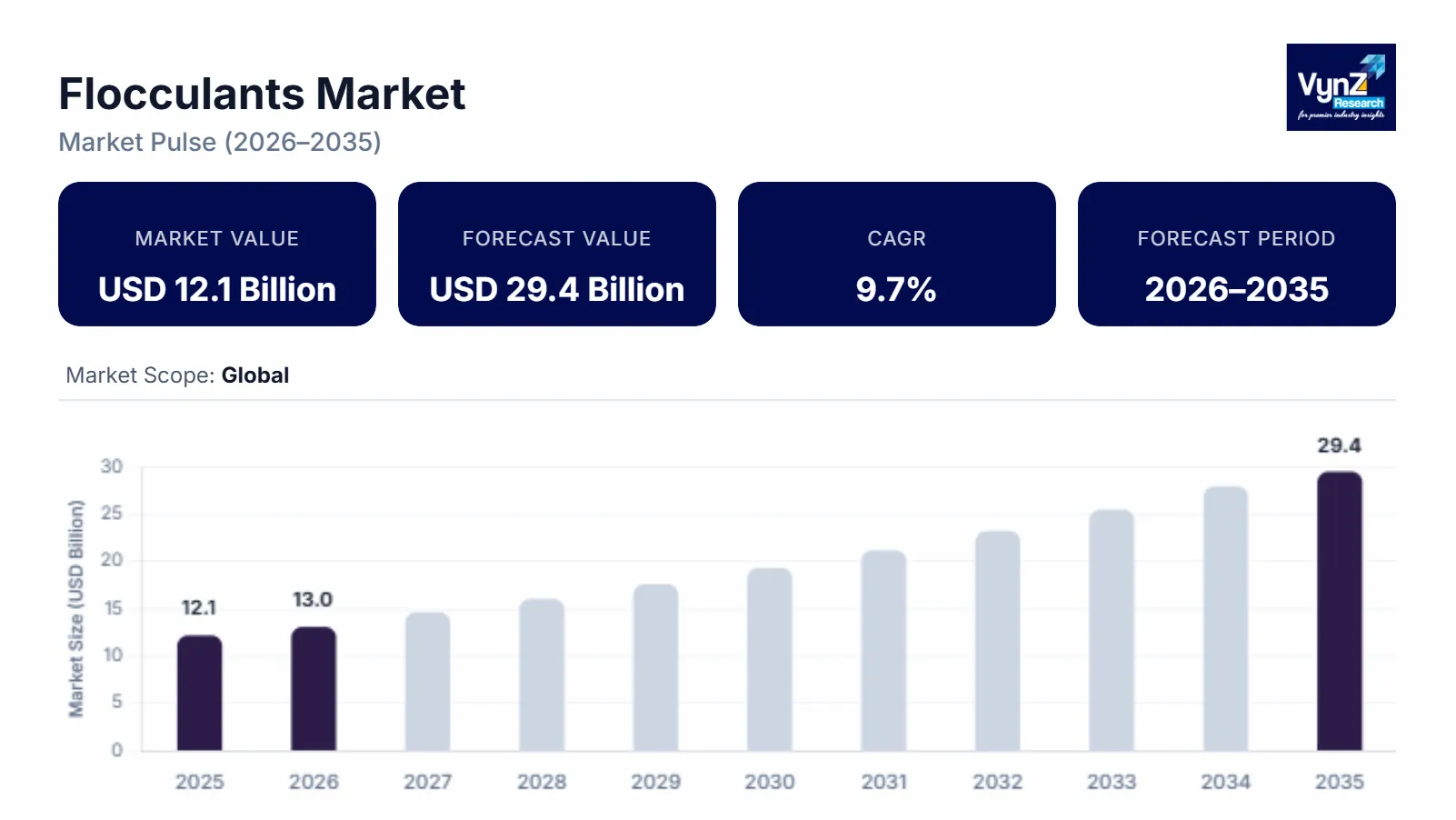
The flocculants Market size was estimated at about USD 12.1 billion in 2025 and is expected to reach around USD 13.0 billion in 2026, rising up to roughly USD 29.4 billion in 2035, growing at approximately 9.7% CAGR from 2026 to 2035.
Research Highlights
- Organic flocculants segment led in 2025, driven by 54% industrial wastewater treatment share
- Bio based flocculants expected fastest growth in 2035 at 10.3% CAGR due sustainability demand
- Wastewater treatment dominated in 2025 with 38% share supported by municipal infrastructure expansion
- Mining application fastest growing at 9.9% CAGR driven by mineral extraction efficiency needs
- Asia Pacific dominated in 2025 with 56% share driven by rapid industrialization and water infrastructure growth
The market is growing steadily because many industries and towns need ways to clean their water, follow specific rules about releasing wastewater into the environment and use specific chemicals to produce less waste. As environmental rules are getting stricter companies are using polymers to separate solids from liquids and investing in advanced technologies. The World Health Organization has set guidelines for drinking water quality and the United Nations and the United States Environmental Protection Agency also have rules to control pollution. There is a lot of development happening in India, China, North America and Europe to modernize infrastructure and design sustainability projects which is creating more demand and helping the market to grow,
Flocculants Market Dynamics
Market Trends
The is changing because people are looking for better and more efficient ways to reuse water and make it cleaner. One big change is that people want flocculants that are not bad for the environment. Another change is that people are using sophisticated machines that help clean water. These machines use chemicals and are controlled by computers. Rules set by the WHO Guidelines for Drinking Water Quality and the European Environment Agency Water Framework Directive are helping to make these changes happen.
Growth Drivers
The market is growing fast because cities are building more wastewater treatment plants that need flocculants to clean water. Countries like India, the United States and China are investing a lot of money in these plants. Industries have to follow rules about how to treat their wastewater and make sure that the water is safe for people to use. This is encouraging them look for better ways and use substances to treat wastewater, which is driving the growth of the market further.
Market Restraints / Challenges
The market faces some growth challenges as the price of materials can go up and down making it hard for companies to make a profit. Another problem is that there are rules about how to handle chemicals which makes it hard for companies to make and sell flocculants. Sometimes companies have to wait for a long time to get the materials they need causing problems in production.
Market Opportunities
The market offers significant growth opportunities to industries recycling wastewater as water is getting scarce pushing the demand for treating wastewater. Companies that can make flocculants that are efficient and customizable can do well. Another opportunity is to use technology to make water treatment better which includes using computers and sensors to control the treatment process. Programs like the United Nations Sustainable Development Goal 6 are helping water treatment and sanitation a priority which is expected to help the market grow in the run.
Global Flocculants Market Report Coverage
|
Report Metric |
Details |
|
Historical Period |
2020 - 2024 |
|
Base Year Considered |
2025 |
|
Forecast Period |
2026 - 2035 |
|
Market Size in 2025 |
USD 12.1 Billion |
|
Revenue Forecast in 2035 |
USD 29.4 Billion |
|
Growth Rate |
9.7% |
|
Segments Covered in the Report |
By Type, By Application, By End Use |
|
Report Scope |
Market Trends, Drivers, and Restraints; Revenue Estimation and Forecast; Segmentation Analysis; Companies’ Strategic Developments; Market Share Analysis of Key Players; Company Profiling |
|
Regions Covered in the Report |
Asia Pacific, North America, Europe, Rest of the World |
|
Key Companies |
Accepta, Aries Chemical, BASF, Buckman, Ecolab, Italmatch Chemicals, Kemira, Kurita Water Industries, Solenis, Thermax |
|
Customization |
Available upon request |
Flocculants Market Segmentation
By Type
The organic flocculants segment held around 54% market share in 2025 due to higher efficiency, effectiveness in treating any type of wastewater treatment and wide adoption in mining and chemical processing. The rules set by the United States Environmental Protection Agency and the European Environment Agency encourage companies to use organic flocculants.
Bio-based flocculants are expected to grow at a rate of around 10.3% from 2026 to 2035 because many countries are now focusing on being more sustainable and reducing pollution. The United Nations Environment Program is also encouraging companies to reduce pollution thereby pushing the demand for safe treatment chemicals in municipal and food processing applications.
By Application
Wastewater treatment contributed of around 38% of the market share in 2025 as many cities are expanding their infrastructure and treating wastewater is becoming more important. The government is also supporting programs like Jal Jeevan Mission of India and Water Pollution Prevention Action Plan of China.
The mining and mineral processing segment is expected to grow at a rate of around 9.9% from 2026 to 2035 because many companies are extracting minerals and need efficient technologies to separate solids from liquids. The United States Environmental Protection Agency is also setting rules to monitor the environment closely.
By End Use
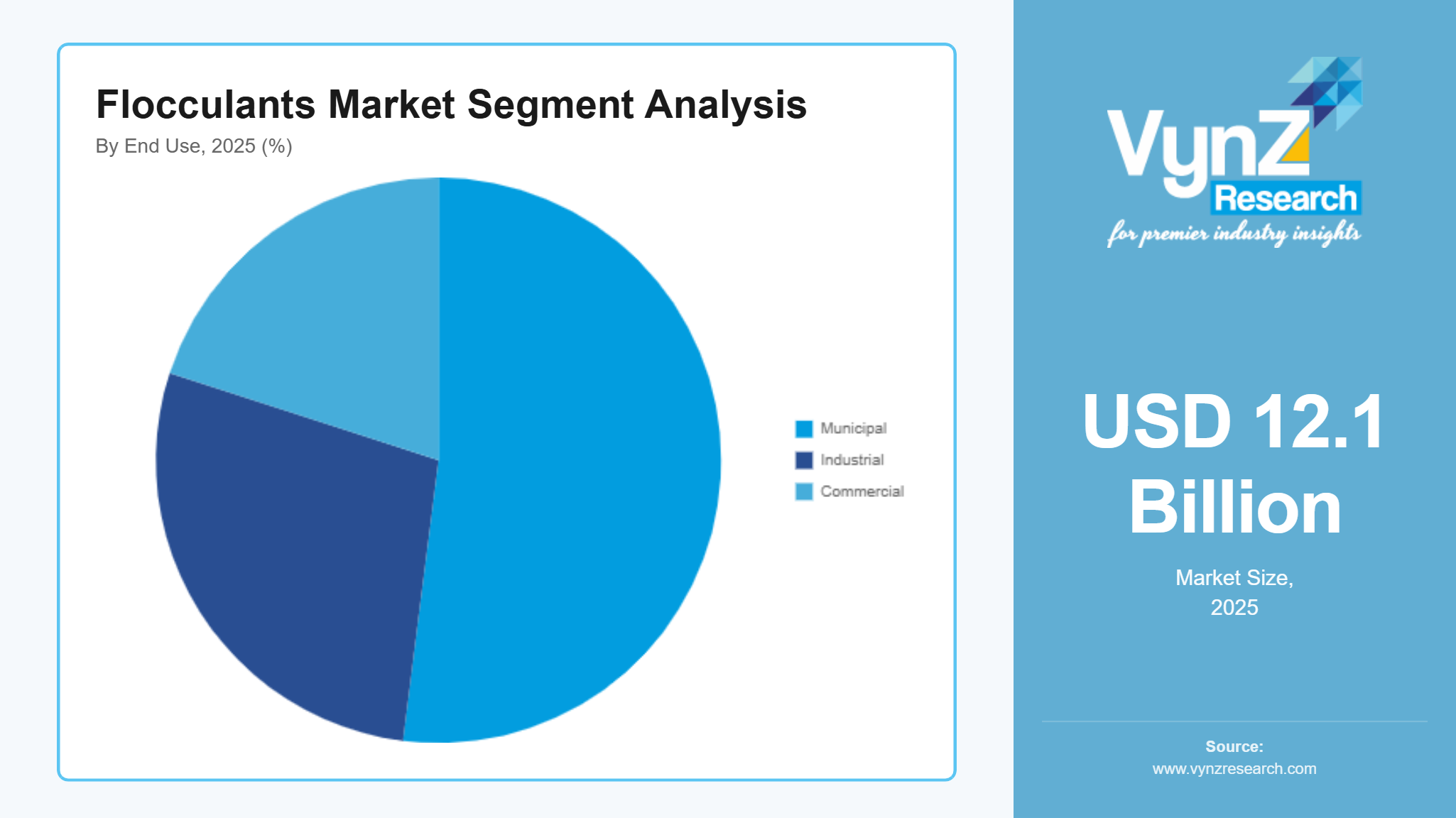
The industrial segment accounted for about 52% of the market share in 2025 due to increasing need of treating wastewater in a large scale in many industries like chemical manufacturing, mining and pulp and paper. The European Environment Agency and the United Nations are also setting rules to encourage companies to keep the water clean.
The municipal segment is expected to grow at a rate of around 9.8% from 2026 to 2035 due to expansion of cities and growing need for water. The government is also investing in public water infrastructure with programs like the United States Environmental Protection Agency Clean Water State Revolving Fund.
Regional Insights
Asia Pacific
Asia Pacific held about 56% of the market in 2025 due to rapid expansion of cities, growing need for building wastewater treatment systems and higher adoption by the mining, chemicals and paper industries in China, India and Southeast Asia. Governments here are helping a lot to promote the use of water treatment chemicals with programs like Water Pollution Prevention Action Plan of China, Jal Jeevan Mission of India and Water Environment Conservation Programs of Japan. Demand is further increased due to the set laws of the government that companies need to follow and increasing investments.
North America
North America contributed 18% of the market in 2025 with the United States and Canada being the primary contributors due to higher demand in oil and gas mining and water utilities industries. The United States Environmental Protection Agency has rules to make sure water is clean which is increasing the demand further. Investments in replacing old wastewater treatment systems and building new ones are also increasing the demand for flocculants.
Europe
The market in Europe accounted for 16% of the market in 2025 with the main contributors being Germany, France and the United Kingdom. There are strict rules in these countries to protect the environment and for modernizing their wastewater treatment systems following the guidelines of the European Environment Agency which is increasing the demand for more efficient treatment solutions. Higher adoption by industries and cities for recycling wastewater is also increasing the demand for flocculants.
Rest of the World
The rest of the world held 10% of the market in 2025 including Latin America, the Middle East and Africa due to a steady development and growing demand from the industries for mining activities. Higher investments in developing water treatment infrastructure in countries like Brazil, Saudi Arabia and South Africa are also increasing the demand helped by the governments of these countries with programs to make sure water is safe and investments in better systems.
Competitive Landscape / Company Insights
The market is moderately competitive with companies trying to come up with new products, pricing standards, and investing more to make products that are safe for people and the environment. Rules set by the United States Environmental Protection Agency, the European Environment Agency and the United Nations Environment Program about clean water, safe water and pollution control are making companies think about how to make better chemicals. This is increasing competition among them.
Mini Profiles
Aries Chemical focuses on water treatment chemical solutions including flocculants, supported by strong industrial supply capabilities and consistent service delivery across municipal and industrial wastewater applications in multiple regions.
BASF operates in premium chemical segments, emphasizing advanced polymer technologies and high performance flocculant formulations, supported by strong global research infrastructure and diversified industrial end use penetration across water treatment markets.
Buckman leverages strong industrial partnerships and technical service networks to expand market presence, focusing on specialty chemical solutions for water treatment, pulp and paper, and process optimization applications globally.
Ecolab focuses on integrated water management and treatment chemical solutions, supported by strong global distribution and service capabilities, enabling efficient flocculant deployment across municipal and industrial wastewater systems.
Kemira leverages advanced water chemistry expertise and sustainable product development to expand market presence, focusing on high efficiency flocculants for municipal, pulp and paper, and industrial water treatment applications.
Key Players
- Accepta
- Aries Chemical
- BASF
- Buckman
- Ecolab
- Italmatch
- Chemicals
- Kemira
- Kurita Water Industries
- Solenis
- Thermax
Recent Developments
In January 2025, Solenis expanded its water treatment portfolio by enhancing its flocculant and polymer-based solutions targeting industrial wastewater applications. The company focused on improving operational efficiency and sustainability performance across pulp and paper and municipal sectors through advanced formulation upgrades.
In March 2025, Kurita Water Industries announced expansion of its global water treatment chemical business with increased focus on high performance flocculants for semiconductor and industrial wastewater treatment. The initiative strengthened its position in high purity and precision driven water treatment applications.
In June 2025, Italmatch Chemicals introduced new specialty polymer based flocculant solutions designed for improved solid liquid separation efficiency in mining and oilfield applications. The development aligned with rising demand for low dosage, high efficiency chemical treatment systems.
In September 2025, Thermax enhanced its water and wastewater treatment chemical offerings by integrating advanced flocculation technologies for industrial effluent management. The company emphasized sustainability driven solutions supporting regulatory compliance and resource efficiency across heavy industries.
In February 2026, Accepta expanded its product line with upgraded flocculant formulations targeting municipal and industrial wastewater treatment systems. The development focused on improving sedimentation performance and supporting stricter environmental discharge standards across multiple regions
Global Flocculants Market Coverage
Type Insight and Forecast 2026 - 2035
- Organic flocculants
- Inorganic flocculants
- Natural or bio-based flocculants
Application Insight and Forecast 2026 - 2035
- Water treatment
- Wastewater treatment
- Mining and mineral processing
- Oil and gas
- Pulp and paper
End Use Insight and Forecast 2026 - 2035
- Municipal
- Industrial
- Commercial
Global Flocculants Market by Region
- North America
- By Type
- By Application
- By End Use
- By Country - U.S., Canada, Mexico
- Europe
- By Type
- By Application
- By End Use
- By Country - Germany, U.K., France, Italy, Spain, Russia, Rest of Europe
- Asia-Pacific (APAC)
- By Type
- By Application
- By End Use
- By Country - China, Japan, India, South Korea, Vietnam, Thailand, Malaysia, Rest of Asia-Pacific
- Rest of the World (RoW)
- By Type
- By Application
- By End Use
- By Country - Brazil, Saudi Arabia, South Africa, U.A.E., Other Countries
Table of Contents for Flocculants Market Report
1. Research Overview
1.1. The Report Offers
1.2. Market Coverage
1.2.1. By
Type
1.2.2. By
Application
1.2.3. By
End Use
1.3. Research Phases
1.4. Limitations
1.5. Market Methodology
1.5.1. Data Sources
1.5.1.1.
Primary Research
1.5.1.2.
Secondary Research
1.5.2. Methodology
1.5.2.1.
Data Exploration
1.5.2.2.
Forecast Parameters
1.5.2.3.
Data Validation
1.5.2.4.
Assumptions
1.5.3. Study Period & Data Reporting Unit
2. Executive Summary
3. Industry Overview
3.1. Industry Dynamics
3.1.1. Market Growth Drivers
3.1.2. Market Restraints
3.1.3. Key Market Trends
3.1.4. Major Opportunities
3.2. Industry Ecosystem
3.2.1. Porter’s Five Forces Analysis
3.2.2. Recent Development Analysis
3.2.3. Value Chain Analysis
3.3. Competitive Insight
3.3.1. Competitive Position of Industry
Players
3.3.2. Market Attractive Analysis
3.3.3. Market Share Analysis
4. Global Market Estimate and Forecast
4.1. Global Market Overview
4.2. Global Market Estimate and Forecast to 2035
5. Market Segmentation Estimate and Forecast
5.1. By Type
5.1.1. Organic flocculants
5.1.1.1. Market Definition
5.1.1.2. Market Estimation and Forecast to 2035
5.1.2. Inorganic flocculants
5.1.2.1. Market Definition
5.1.2.2. Market Estimation and Forecast to 2035
5.1.3. Natural or bio-based flocculants
5.1.3.1. Market Definition
5.1.3.2. Market Estimation and Forecast to 2035
5.2. By Application
5.2.1. Water treatment
5.2.1.1. Market Definition
5.2.1.2. Market Estimation and Forecast to 2035
5.2.2. Wastewater treatment
5.2.2.1. Market Definition
5.2.2.2. Market Estimation and Forecast to 2035
5.2.3. Mining and mineral processing
5.2.3.1. Market Definition
5.2.3.2. Market Estimation and Forecast to 2035
5.2.4. Oil and gas
5.2.4.1. Market Definition
5.2.4.2. Market Estimation and Forecast to 2035
5.2.5. Pulp and paper
5.2.5.1. Market Definition
5.2.5.2. Market Estimation and Forecast to 2035
5.3. By End Use
5.3.1. Municipal
5.3.1.1. Market Definition
5.3.1.2. Market Estimation and Forecast to 2035
5.3.2. Industrial
5.3.2.1. Market Definition
5.3.2.2. Market Estimation and Forecast to 2035
5.3.3. Commercial
5.3.3.1. Market Definition
5.3.3.2. Market Estimation and Forecast to 2035
6. North America Market Estimate and Forecast
6.1. By
Type
6.2. By
Application
6.3. By
End Use
6.3.1.
U.S. Market Estimate and Forecast
6.3.2.
Canada Market Estimate and Forecast
6.3.3.
Mexico Market Estimate and Forecast
7. Europe Market Estimate and Forecast
7.1. By
Type
7.2. By
Application
7.3. By
End Use
7.3.1.
Germany Market Estimate and Forecast
7.3.2.
France Market Estimate and Forecast
7.3.3.
U.K. Market Estimate and Forecast
7.3.4.
Italy Market Estimate and Forecast
7.3.5.
Spain Market Estimate and Forecast
7.3.6.
Russia Market Estimate and Forecast
7.3.7.
Rest of Europe Market Estimate and Forecast
8. Asia-Pacific (APAC) Market Estimate and Forecast
8.1. By
Type
8.2. By
Application
8.3. By
End Use
8.3.1.
China Market Estimate and Forecast
8.3.2.
Japan Market Estimate and Forecast
8.3.3.
India Market Estimate and Forecast
8.3.4.
South Korea Market Estimate and Forecast
8.3.5.
Rest of Asia-Pacific Market Estimate and Forecast
9. Rest of the World (RoW) Market Estimate and Forecast
9.1. By
Type
9.2. By
Application
9.3. By
End Use
9.3.1.
Brazil Market Estimate and Forecast
9.3.2.
Saudi Arabia Market Estimate and Forecast
9.3.3.
South Africa Market Estimate and Forecast
9.3.4.
U.A.E. Market Estimate and Forecast
9.3.5.
Other Countries Market Estimate and Forecast
10. Company Profiles
10.1.
Accepta
10.1.1.
Snapshot
10.1.2.
Overview
10.1.3.
Offerings
10.1.4.
Financial
Insight
10.1.5.
Recent
Developments
10.2.
Aries Chemical
10.2.1.
Snapshot
10.2.2.
Overview
10.2.3.
Offerings
10.2.4.
Financial
Insight
10.2.5.
Recent
Developments
10.3.
BASF
10.3.1.
Snapshot
10.3.2.
Overview
10.3.3.
Offerings
10.3.4.
Financial
Insight
10.3.5.
Recent
Developments
10.4.
Buckman
10.4.1.
Snapshot
10.4.2.
Overview
10.4.3.
Offerings
10.4.4.
Financial
Insight
10.4.5.
Recent
Developments
10.5.
Ecolab
10.5.1.
Snapshot
10.5.2.
Overview
10.5.3.
Offerings
10.5.4.
Financial
Insight
10.5.5.
Recent
Developments
10.6.
Italmatch Chemicals
10.6.1.
Snapshot
10.6.2.
Overview
10.6.3.
Offerings
10.6.4.
Financial
Insight
10.6.5.
Recent
Developments
10.7.
Kemira
10.7.1.
Snapshot
10.7.2.
Overview
10.7.3.
Offerings
10.7.4.
Financial
Insight
10.7.5.
Recent
Developments
10.8.
Kurita Water Industries
10.8.1.
Snapshot
10.8.2.
Overview
10.8.3.
Offerings
10.8.4.
Financial
Insight
10.8.5.
Recent
Developments
10.9.
Solenis
10.9.1.
Snapshot
10.9.2.
Overview
10.9.3.
Offerings
10.9.4.
Financial
Insight
10.9.5.
Recent
Developments
10.10.
Thermax
10.10.1.
Snapshot
10.10.2.
Overview
10.10.3.
Offerings
10.10.4.
Financial
Insight
10.10.5.
Recent
Developments
11. Appendix
11.1. Exchange Rates
11.2. Abbreviations
Note: Financial insight and recent developments of different companies are subject to the availability of information in the secondary domain.
Frequently Asked Questions
Purchase Options
Latest Report
Research Methodology
- Desk Research / Pilot Interviews
- Build Market Size Model
- Research and Analysis
- Final Deliverable
Connect With Our Sales Team
- Toll-Free: +1-888-253-3960
- Phone: +91 9960 288 381
- Email: enquiry@vynzresearch.com
Flocculants Market