
India Coding and Marking Systems Market Size & Share - Growth Forecast Report (2026-2035)
Industry Insight by Technology (Inkjet Printing Systems, Laser Coding Systems, Thermal Transfer Overprinting Systems), by Product Type (Continuous Inkjet Printers, Laser Coders, Thermal Inkjet Printers, High Resolution Printers), by Application (Food and Beverage Packaging, Pharmaceuticals, Consumer Goods, Industrial Products), by End User (Manufacturing Industries, Packaging Companies, Logistics and Warehousing)
| Status : Published | Published On : Jun, 2026 | Report Code : VRCH2131 | Industry : Chemicals & Materials | Available Format :

|
Page : 123 |
India Coding and Marking Systems Market Overview
The India coding and marking systems market size was estimated at about USD 280 million in 2025 and is expected to reach around USD 300 million in 2026 rising up to roughly USD 640 million in 2035, growing at approximately 8.9% CAGR from 2026 to 2035.
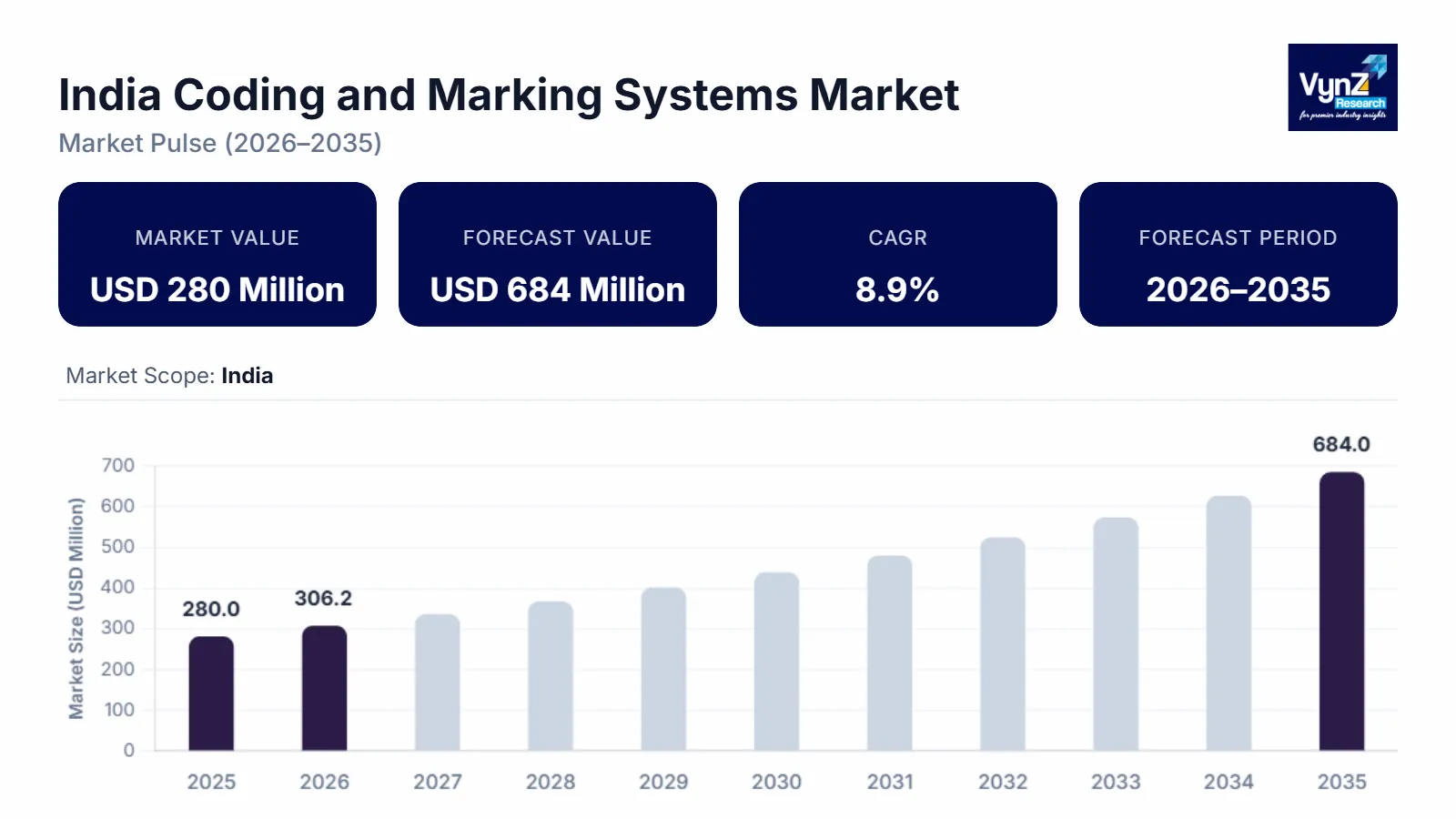
Research Highlights
- Inkjet systems led 48% share in 2025 due to FMCG packaging demand.
- Laser coding fastest at 9.4% CAGR driven by serialization and compliance needs.
- Continuous inkjet printers held 46% share in 2025 supported by high-speed production.
- North India led with 34% share in 2025 driven by pharma and industrial hubs.
- Manufacturing industries led 51% share in 2025 driven by large scale production activity.
The market is growing due to higher adoption and usage of machines for production and companies need to keep track of their products by using special codes and marks on them. Companies must follow the strict rules regarding labeling products especially for food and medicine packaging that use inkjet and laser machines to put these labels on products. The World Health Organization has guidelines for keeping products safe and making sure they can be tracked easily and rules are made by the Central Drugs Standard Control Organization and food safety standards from health authorities. The government is also helping companies in some states like Maharashtra, Gujarat and Tamil Nadu with programs like Make in India to make it easier for them to use proper labeling systems based on automation and advanced coding and marking technologies.
India Coding and Marking Systems Market Dynamics
Market Trends
The market is changing with the type of technology used to abide by the set rules and companies are moving towards high-resolution inkjet and laser-based coding systems to meet the buyers demand for accuracy, higher efficiency and less production stoppage. Another trend is using Industry 4.0 style marking solutions in workflows because digital manufacturing is becoming more common and production line monitoring is getting more automated. National quality groups and the World Health Organization are making sure that products are safe which is making companies use trackable labeling systems for certain products.
Growth Drivers
The market is growing mainly because there is an increase in production and packaged food manufacturing across India and companies are spending more on automation, export-oriented manufacturing and have to abode by tougher product identification rules and anti-counterfeit compliance needs. Market growth is also propelled by several programs from the Government like Make in India and food safety related activities giving extra support.
Market Restraints / Challenges
Even if the market is expanding, there are still some real issues that can slow it down like the high cost of equipment along with maintenance expenses that can limit scalability and profitability making it tougher for smaller companies to purchase these systems. Also, when companies depend on imported parts and supplies, they can get hit with cost pressure, supply chain setbacks, and delayed equipment upgrades.
Market Opportunities
There are good openings in the market for companies offering smart factory integration and automated production line coding solutions, especially as more manufacturers are moving towards digital transformation. Organizations that can deliver scalable, high-speed coding setups can match the demand coming from pharmaceutical, food, and export-focused production plants. Another strong opportunity is traceability and serialization solutions due to higher spending on compliance and anti-counterfeit capabilities. Industrial Internet of Things enabled marking systems and artificial intelligence driven quality checking tools boost efficiency and raise adoption rates.
India Coding and Marking Systems Market Report Coverage
|
Report Metric |
Details |
|
Historical Period |
2020 - 2024 |
|
Base Year Considered |
2025 |
|
Forecast Period |
2026 - 2035 |
|
Market Size in 2025 |
USD 280 Million |
|
Revenue Forecast in 2035 |
USD 64 Million |
|
Growth Rate |
8.9% |
|
Segments Covered in the Report |
By Technology, By Application, By Product Type, By End User |
|
Report Scope |
Market Trends, Drivers, and Restraints; Revenue Estimation and Forecast; Segmentation Analysis; Companies’ Strategic Developments; Market Share Analysis of Key Players; Company Profiling |
|
Regions Covered in the Report |
North India, West India, South India, East India, Other Regions |
|
Key Companies |
Control Print Limited, Danaher Corporation, Domino Printing Sciences plc, Dover Corporation, Hitachi Ltd., Markem-Imaje, SATO Holdings Corporation, Videojet Technologies, Weber Marking Systems GmbH, Zebra Technologies Corporation |
|
Customization |
Available upon request |
India Coding and Marking Systems Market Segmentation
By Technology
Inkjet printing systems held the largest share of the market with about 48% of the revenue mainly because they are compatible with the food and packaged food industry requirements and used extensively on production lines, do not cost too much to use and the government has rules about food safety labeling for companies to follow.
Laser coding systems will grow the fastest at around 9.4% from 2026 to 2035 due to growing need to mark products in a way that cannot be removed, higher usage of ink and other materials and efficiency of laser coding systems for pharmaceutical and industrial companies.
Thermal transfer overprinting systems are anticipated to expand at around 8.1% through the forecast window because companies still have a growing need to print images on their packages, specifically for logistics and retail packaging.
By Product Type
Inkjet printers had the strongest presence in 2025 with roughly 46% of the market share helped by their flexibility, relatively lower operating cost, and compatibility with high-speed production lines in food, beverage, and pharmaceutical environments that need to obey strict government rules for product labeling.
Laser coders are expected to grow at a fastest rate of about 9.6% from 2026 to 2035 mainly because they are relatively easier to set up and maintain followed closely by thermal inkjet printers which are forecast to grow at around 8% during the same period.
By Application
Food and beverage packaging was the market leader in 2025 making up about 42% of the total revenue since there are a lot of food and beverage products produced and companies need to label them using advanced coding systems to abide by the set government rules about labeling.
Pharmaceutical applications will grow rapidly at 9.8% from 2026 to 2035 backed by the growing need by the companies to follow labeling and tracing standards to prevent counterfeiting.
By End User
Manufacturing industries contributed about 51% of the total market revenue in 2025 due to higher production of pharmaceutical and food items and stringent rules of the government to follow.
Packaging companies are expected to grow the fastest at 9.5% from 2026 to 2035 because companies are outsourcing their packaging needs more and want effective labeling solutions.
Regional Insights
North India
North India held 34% of the market share in 2025 due to larger medicine making and packaged food production and better logistics and warehousing networks in Delhi NCR and nearby industrial areas. Places like Noida and Gurugram have a lot of demand and the government is also helping with programs like Make in India, developing dedicated corridors and enforcing rules on food safety and medicine labeling.
West India
West India made up 31% of the market share in 2025 backed by a more established industrial setup with many FMCG, chemical and medicine manufacturing units across cities like Mumbai, Pune, Ahmedabad and Vadodara where production runs smoothly at well-connected export points. The government is pushing exports through manufacturing incentives, modernizing industry and encouraging businesses to put money into automated coding and marking solutions.
South India
South India contributed approximately 27% of the market share due to faster industrial momentum, a well rooted electronics manufacturing network and a steadily growing medicine base. Cities such as Bengaluru, Chennai and Hyderabad are leading here while the government supports factories through technology parks and export-oriented zones.
Rest of India
Other regions in India together accounted for around 8% of the market share due to strong industrial clusters and developing manufacturing zones, greater adoption coding and marking systems and the support from the government to expand the infrastructure.
Competitive Landscape / Company Insights
The market is moderately competitive with a lot of global and local companies trying to develop new technologies and lower prices to reach to a wider market. They are spending a lot of money on research and development and using automation and digital tools to make their businesses stronger. The government is also ensuring that the products are safe and can be tracked and companies follow the rules laid by the government authorities.
Mini Profiles
Control Print Limited focuses on industrial coding and marking solutions, supported by strong domestic distribution network and cost-efficient product offerings across packaging, pharmaceuticals, and FMCG manufacturing sectors in India.
Danaher Corporation operates in premium industrial automation and coding systems segment, emphasizing high performance technologies, advanced inkjet platforms, and precision driven product identification solutions for regulated manufacturing environments globally.
Domino Printing Sciences plc leverages strong global R&D capabilities and technological partnerships to expand market presence, offering advanced coding, marking, and digital printing systems for high speed production lines.
Dover Corporation focuses on diversified industrial technology solutions, supported by strong brand recognition and integrated coding and marking portfolio through subsidiaries serving packaging, logistics, and manufacturing industries.
Hitachi Ltd. operates in high end industrial technology segment, emphasizing innovation, automation integration, and smart manufacturing solutions, strengthening its presence in advanced coding and marking applications across global markets.
Key Players
Recent Developments
In January 2025, Domino Printing Sciences plc expanded its industrial inkjet coding portfolio with upgraded high speed variable data printing systems designed for pharmaceutical serialization and FMCG packaging lines. The company also strengthened its digital integration capabilities to support real time production tracking across automated manufacturing environments.
In March 2025, SATO Holdings Corporation introduced new smart labeling and barcode printing solutions focused on improving traceability in logistics and healthcare supply chains. The development aligned with increasing demand for compliant labeling systems across regulated industries and warehouse automation networks.
In June 2025, Videojet Technologies launched an enhanced continuous inkjet platform designed for improved uptime, reduced maintenance, and higher precision coding in fast moving production lines. The upgrade strengthened its position in food, beverage, and pharmaceutical packaging applications globally.
In September 2025, Zebra Technologies Corporation advanced its industrial printing and asset tracking solutions with AI enabled scanning and cloud based printing management systems. The initiative focused on improving supply chain visibility and operational efficiency across manufacturing and logistics sectors.
In February 2026, Markem-Imaje introduced next generation laser coding systems with improved sustainability performance and reduced consumable dependency for high volume packaging operations. The launch reinforced its focus on compliance driven marking solutions for regulated industrial applications.
India Coding and Marking Systems Market Coverage
Technology Insight and Forecast 2026 - 2035
- Inkjet Printing Systems
- Laser Coding Systems
- Thermal Transfer Overprinting Systems
Product Type Insight and Forecast 2026 - 2035
- Continuous Inkjet Printers
- Laser Coders
- Thermal Inkjet Printers
- High Resolution Printers
Application Insight and Forecast 2026 - 2035
- Food and Beverage Packaging
- Pharmaceuticals
- Consumer Goods
- Industrial Products
End User Insight and Forecast 2026 - 2035
- Manufacturing Industries
- Packaging Companies
- Logistics and Warehousing
India Coding and Marking Systems Market by Region
- North India
- By Technology
- By Product Type
- By Application
- By End User
- West India
- By Technology
- By Product Type
- By Application
- By End User
- South India
- By Technology
- By Product Type
- By Application
- By End User
- East India
- By Technology
- By Product Type
- By Application
- By End User
- Other Regions
- By Technology
- By Product Type
- By Application
- By End User
Table of Contents for India Coding and Marking Systems Market Report
1. Research Overview
1.1. The Report Offers
1.2. Market Coverage
1.2.1. By
Technology
1.2.2. By
Product Type
1.2.3. By
Application
1.2.4. By
End User
1.3. Research Phases
1.4. Limitations
1.5. Market Methodology
1.5.1. Data Sources
1.5.1.1.
Primary Research
1.5.1.2.
Secondary Research
1.5.2. Methodology
1.5.2.1.
Data Exploration
1.5.2.2.
Forecast Parameters
1.5.2.3.
Data Validation
1.5.2.4.
Assumptions
1.5.3. Study Period & Data Reporting Unit
2. Executive Summary
3. Industry Overview
3.1. Industry Dynamics
3.1.1. Market Growth Drivers
3.1.2. Market Restraints
3.1.3. Key Market Trends
3.1.4. Major Opportunities
3.2. Industry Ecosystem
3.2.1. Porter’s Five Forces Analysis
3.2.2. Recent Development Analysis
3.2.3. Value Chain Analysis
3.3. Competitive Insight
3.3.1. Competitive Position of Industry
Players
3.3.2. Market Attractive Analysis
3.3.3. Market Share Analysis
4. India Market Estimate and Forecast
4.1. India Market Overview
4.2. India Market Estimate and Forecast to 2035
5. Market Segmentation Estimate and Forecast
5.1. By Technology
5.1.1. Inkjet Printing Systems
5.1.1.1. Market Definition
5.1.1.2. Market Estimation and Forecast to 2035
5.1.2. Laser Coding Systems
5.1.2.1. Market Definition
5.1.2.2. Market Estimation and Forecast to 2035
5.1.3. Thermal Transfer Overprinting Systems
5.1.3.1. Market Definition
5.1.3.2. Market Estimation and Forecast to 2035
5.2. By Product Type
5.2.1. Continuous Inkjet Printers
5.2.1.1. Market Definition
5.2.1.2. Market Estimation and Forecast to 2035
5.2.2. Laser Coders
5.2.2.1. Market Definition
5.2.2.2. Market Estimation and Forecast to 2035
5.2.3. Thermal Inkjet Printers
5.2.3.1. Market Definition
5.2.3.2. Market Estimation and Forecast to 2035
5.2.4. High Resolution Printers
5.2.4.1. Market Definition
5.2.4.2. Market Estimation and Forecast to 2035
5.3. By Application
5.3.1. Food and Beverage Packaging
5.3.1.1. Market Definition
5.3.1.2. Market Estimation and Forecast to 2035
5.3.2. Pharmaceuticals
5.3.2.1. Market Definition
5.3.2.2. Market Estimation and Forecast to 2035
5.3.3. Consumer Goods
5.3.3.1. Market Definition
5.3.3.2. Market Estimation and Forecast to 2035
5.3.4. Industrial Products
5.3.4.1. Market Definition
5.3.4.2. Market Estimation and Forecast to 2035
5.4. By End User
5.4.1. Manufacturing Industries
5.4.1.1. Market Definition
5.4.1.2. Market Estimation and Forecast to 2035
5.4.2. Packaging Companies
5.4.2.1. Market Definition
5.4.2.2. Market Estimation and Forecast to 2035
5.4.3. Logistics and Warehousing
5.4.3.1. Market Definition
5.4.3.2. Market Estimation and Forecast to 2035
6. North India Market Estimate and Forecast
6.1. By
Technology
6.2. By
Product Type
6.3. By
Application
6.4. By
End User
7. West India Market Estimate and Forecast
7.1. By
Technology
7.2. By
Product Type
7.3. By
Application
7.4. By
End User
8. South India Market Estimate and Forecast
8.1. By
Technology
8.2. By
Product Type
8.3. By
Application
8.4. By
End User
9. East India Market Estimate and Forecast
9.1. By
Technology
9.2. By
Product Type
9.3. By
Application
9.4. By
End User
10. Other Regions Market Estimate and Forecast
10.1. By
Technology
10.2. By
Product Type
10.3. By
Application
10.4. By
End User
11. Company Profiles
11.1.
Control Print Limited
11.1.1.
Snapshot
11.1.2.
Overview
11.1.3.
Offerings
11.1.4.
Financial
Insight
11.1.5.
Recent
Developments
11.2.
Danaher Corporation
11.2.1.
Snapshot
11.2.2.
Overview
11.2.3.
Offerings
11.2.4.
Financial
Insight
11.2.5.
Recent
Developments
11.3.
Domino Printing Sciences plc
11.3.1.
Snapshot
11.3.2.
Overview
11.3.3.
Offerings
11.3.4.
Financial
Insight
11.3.5.
Recent
Developments
11.4.
Dover Corporation
11.4.1.
Snapshot
11.4.2.
Overview
11.4.3.
Offerings
11.4.4.
Financial
Insight
11.4.5.
Recent
Developments
11.5.
Hitachi Ltd.
11.5.1.
Snapshot
11.5.2.
Overview
11.5.3.
Offerings
11.5.4.
Financial
Insight
11.5.5.
Recent
Developments
11.6.
Markem-Imaje
11.6.1.
Snapshot
11.6.2.
Overview
11.6.3.
Offerings
11.6.4.
Financial
Insight
11.6.5.
Recent
Developments
11.7.
SATO Holdings Corporation
11.7.1.
Snapshot
11.7.2.
Overview
11.7.3.
Offerings
11.7.4.
Financial
Insight
11.7.5.
Recent
Developments
11.8.
Videojet Technologies
11.8.1.
Snapshot
11.8.2.
Overview
11.8.3.
Offerings
11.8.4.
Financial
Insight
11.8.5.
Recent
Developments
11.9.
Weber Marking Systems GmbH
11.9.1.
Snapshot
11.9.2.
Overview
11.9.3.
Offerings
11.9.4.
Financial
Insight
11.9.5.
Recent
Developments
11.10.
Zebra Technologies Corporation
11.10.1.
Snapshot
11.10.2.
Overview
11.10.3.
Offerings
11.10.4.
Financial
Insight
11.10.5.
Recent
Developments
12. Appendix
12.1. Exchange Rates
12.2. Abbreviations
Note: Financial insight and recent developments of different companies are subject to the availability of information in the secondary domain.
Frequently Asked Questions
Purchase Options
Latest Report
Research Methodology
- Desk Research / Pilot Interviews
- Build Market Size Model
- Research and Analysis
- Final Deliverable
Connect With Our Sales Team
- Toll-Free: +1-888-253-3960
- Phone: +91 9960 288 381
- Email: enquiry@vynzresearch.com
India Coding and Marking Systems Market