
Asia Pacific TIC Market for Consumer Goods & Retail Industry Size & Share - Growth Forecast Report (2026-2035)
Industry Insight by Sourcing Type (In-House, Outsourced), by Service Type (Testing, Inspection, Certification), by Industry Vertical (Apparel and textiles, Electrical & electronic goods, Personal care and cosmetics, Home and garden, Toys and children’s products, Footwear and leather, Bags and accessories, Fashion accessories, Smart and wireless devices, Others)
| Status : Published | Published On : Apr, 2026 | Report Code : VRCG7053 | Industry : Consumer Goods | Available Format :

|
Page : 134 |
Asia Pacific TIC Market for Consumer Goods & Retail Industry Overview
The Asia Pacific TIC market for consumer goods and retail industry which was valued at approximately USD 23.8 billion in 2025 and is estimated to rise further up to almost USD 25.1 billion by 2026, is projected to reach around USD 36.9 billion in 2035, expanding at a CAGR of about 4.1% during the forecast period from 2026 to 2035.
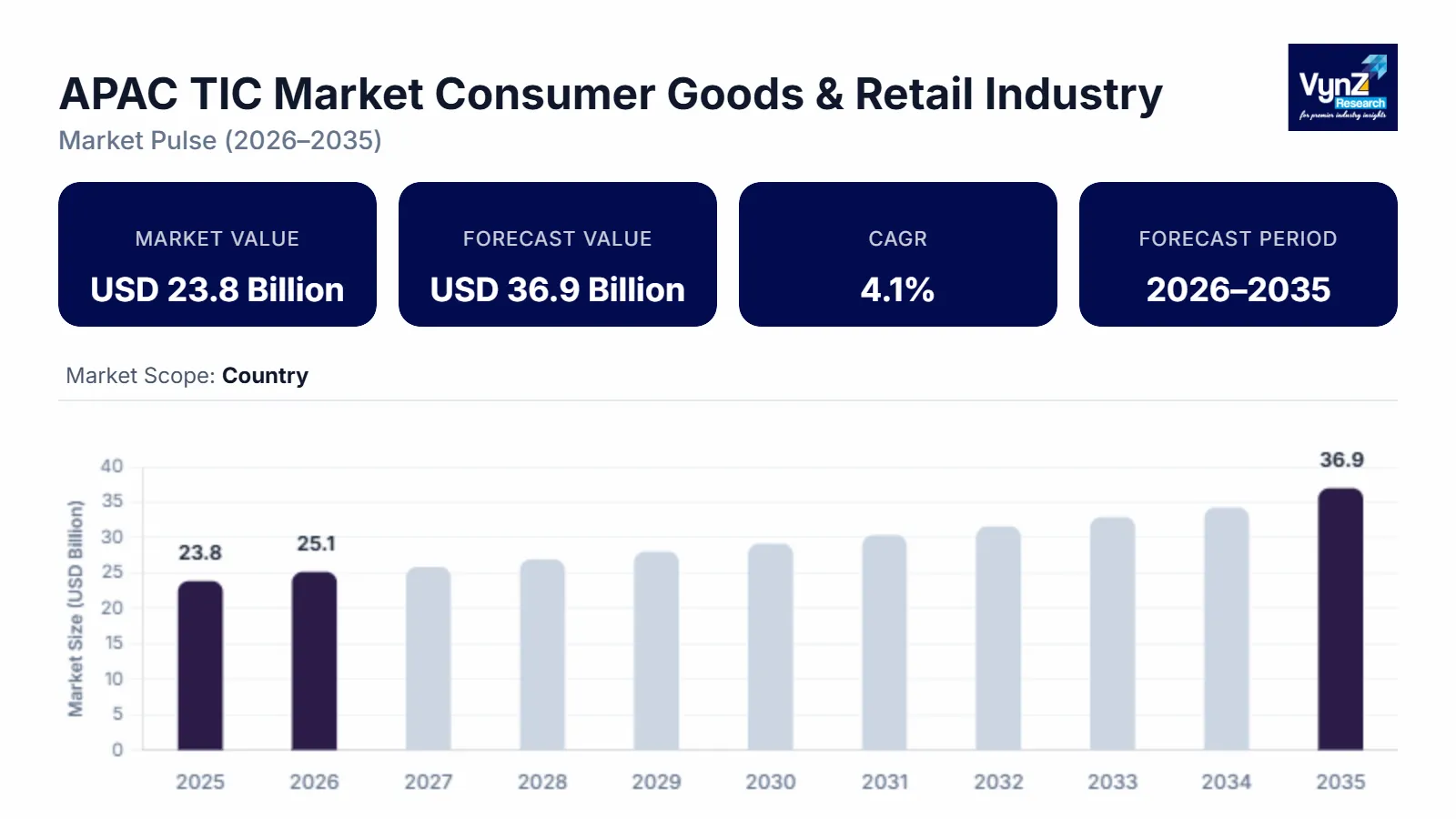
Market expansion occurs because businesses need to meet rising regulatory obligations while international trade in consumer products continues to grow and customers demand products with better quality and safety requirements. So, businesses start using third-party testing and certification services more frequently. Major regions which include China, India and Japan experience market growth because retail products which meet compliance standards are in demand. Also, regulatory infrastructure and standardization frameworks continue to receive ongoing investments.
International regulatory bodies and government-aligned institutions build more comprehensive compliance frameworks which enable market expansion. The World Health Organization together with public regulatory agencies establishes guidelines and safety standards which organizations use to promote product safety, quality assurance and consumer protection for all goods including cosmetics and healthcare related consumer products. National quality control initiatives across all Asia Pacific economies and certification mandates in the region have raised testing and inspection standards while trade facilitation measures backed by governments and export quality mandates create rising demand for TIC services through the regional consumer goods and retail market.
Asia Pacific TIC Market for Consumer Goods & Retail Industry Dynamics
Market Trends
The market is undergoing changes because of new digital inspection technologies and more demanding compliance standards. The market shows increased use of automated testing systems which allow testing to be done at remote locations because these systems meet the demand for efficient testing procedures and testing result tracking. The market experiences growth in sustainability and safety certification because businesses want to comply with new regulations and environmental protection guidelines. The World Health Organization and International Organization for Standardization established frameworks which guide businesses to implement standardized systems for their compliance requirements.
Market Drivers
The market experiences growth because governments enforce regulations more strictly and international trade volume increases. The demand for products has increased because businesses invest more in both manufacturing and quality control systems. The growing understanding of product safety by consumers leads to higher product adoption because businesses need to follow safety regulations while maintaining their brand reputation. The market experiences higher demand because government initiatives and WHO standards combined with WTO standards create more market requirements.
Market Restraints / Challenges
The market encounters operational challenges because different countries have varying regulatory requirements which create operational obstacles for companies. The existence of different certification standards generates obstacles which particularly affect smaller businesses. The testing process requires both skilled workers and advanced equipment which results in elevated operational costs and difficulties in expanding the business. The International Labor Organization (ILO) reports show that emerging economies face skill shortages which affect their technical service sector development.
Market Opportunities
The market creates business potential through digital testing and automation which arises from the growing implementation of Industry 4.0 technologies. The demand for exports has increased which benefits companies that provide effective technology-based solutions to customers. Environmental compliance initiatives create business potential for sustainability certification services. The United Nations Environment Program and WHO have developed programs and guidelines which promote the use of eco-friendly testing and certification services.
Asia Pacific TIC Market for Consumer Goods & Retail Industry Report Coverage
|
Report Metric |
Details |
|
Historical Period |
2020 - 2024 |
|
Base Year Considered |
2025 |
|
Forecast Period |
2026 - 2035 |
|
Market Size in 2025 |
USD 23.8 Billion |
|
Revenue Forecast in 2035 |
USD 36.9 Billion |
|
Growth Rate |
4.1% |
|
Segments Covered in the Report |
By Sourcing Type, By Service Type and By Industry Vertical |
|
Report Scope |
Market Trends, Drivers, and Restraints; Revenue Estimation and Forecast; Segmentation Analysis; Companies’ Strategic Developments; Market Share Analysis of Key Players; Company Profiling |
|
Regions Covered in the Report |
China, Japan, India, South Korea, Malaysia, Rest of Asia Pacific |
|
Key Companies |
Bureau Veritas, Eurofins Scientific, HQTS Group Ltd., Intertek Group plc, SGS SA, Setsco Services, TUV Nord Group, TUV Rheinland, TUV SUD |
|
Customization |
Available upon request |
Asia Pacific TIC Market for Consumer Goods & Retail Industry Segmentation
By Sourcing Type
In 2025, the market recorded its highest revenue from in house sourcing, which generated approximately 58% of total revenue. The method provides better control of quality processes and cost-effective results for large manufacturing operations which work hand in hand with internal compliance systems. Dedicated testing facilities receive continuous investment from major manufacturers in China, India, and Japan because their national quality control systems and regulatory requirements determine their testing methods, which follow ISO and WHO organizational standards. In-house production capabilities continue to grow throughout high-volume production environments due to these factors.
The period from 2026 to 2035 will see outsourced sourcing grow at the highest rate because its CAGR is projected to reach 5.2% during that time. The market expansion occurs because small and medium enterprises seek cost-effective solutions through specialized third-party providers while cross border trade activities need independent certification. Manufacturers in emerging economies expand their outsourced testing services through government backed export quality initiatives and international trade compliance frameworks.
By Service Type
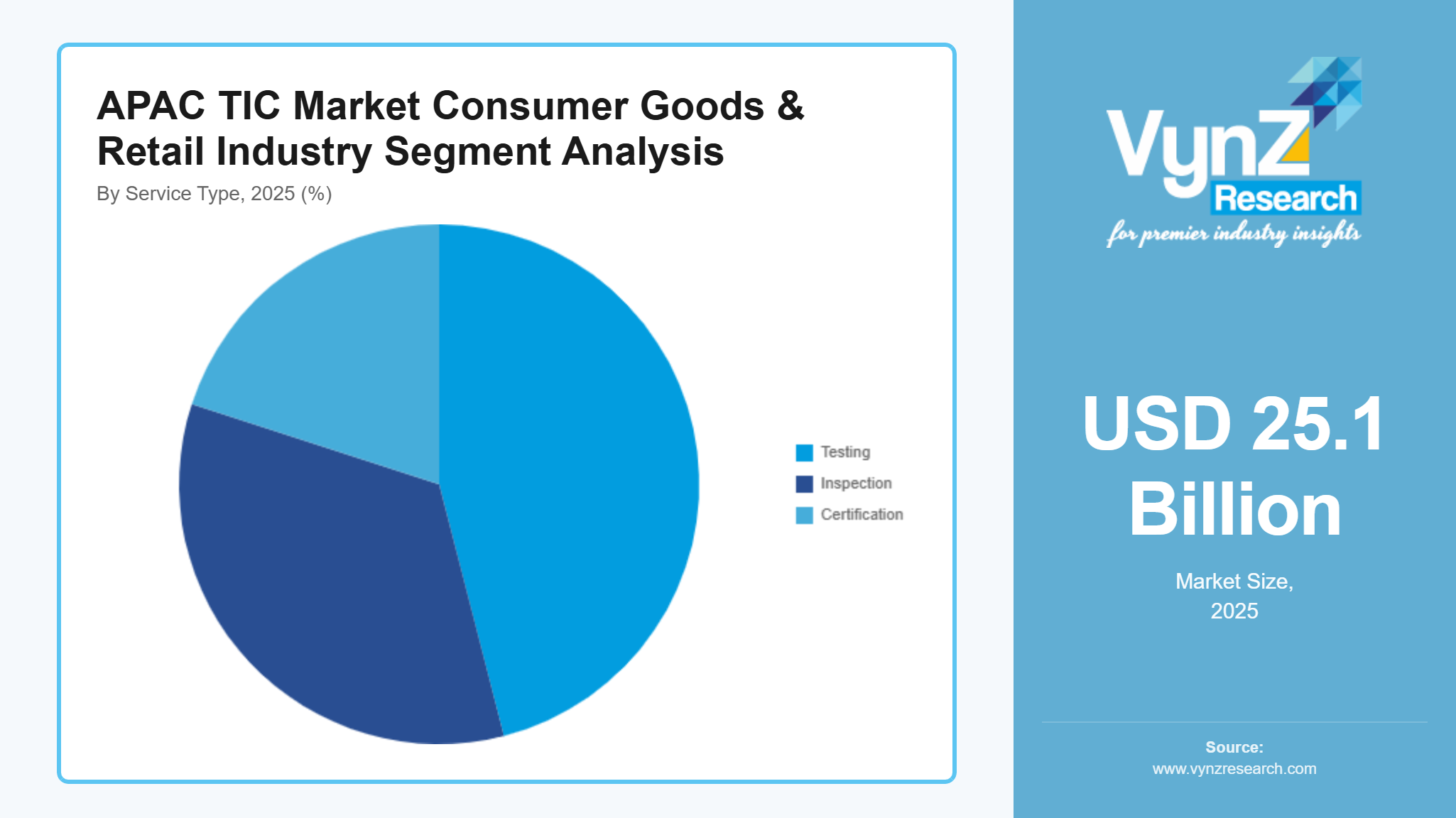
Testing services accounted for the largest share in 2025, representing approximately 46% of total segment revenue. The need for product validation, safety assurance and compliance with regulatory standards drives their market presence in consumer goods categories. The adoption process maintains its momentum because WHO and national regulatory authorities established their safety guidelines and product quality frameworks in the Asia Pacific region. The testing services market in manufacturing hubs maintains strong demand because product complexity increases and consumers become more aware of quality.
The certification business will achieve the highest growth rate because its predicted CAGR for the upcoming time frame stands at 4.8%. Standardized labeling, international trade compliance and brand credibility drive market growth. Government certification requirements and worldwide trade regulations lead businesses to secure recognized certifications, especially for their export products. The logistics industry growth supports inspection services and other related services, which create a consistent revenue stream across different market areas.
By Industry Vertical
The apparel and textile segment accounted for the largest share in 2025, contributing approximately 34% of total market revenue. Its market leadership results from high export volumes combined with strict quality requirements, growing international safety and sustainability standards compliance. Testing and certification services in this market sector grow because of regulatory frameworks which establish environmental and labor standards based on international guidelines from organizations like ILO and UNEP. The segment growth receives support from companies that increase their focus on sustainable sourcing and eco labeling.
The consumer electronics and electrical segment is expected to register the fastest growth, with an estimated CAGR of 5.5% during the forecast period. The market expansion occurs because product development requires more advanced technology while electronic goods must follow stricter safety rules. TIC service usage becomes mandatory through government safety regulations which govern product safety and energy efficiency and environmental compliance. Rising consumer awareness and regulatory enforcement across Asia Pacific markets drive stable growth in the toys and cosmetics and household goods segments.
Regional Insights
China
The market reached 32% in 2025 because of China's manufacturing power and export business. The industrial centers of Guangdong, Zhejiang, and Jiangsu maintain market growth because they produce large quantities while following stringent compliance standards. The government through its product quality and export standard initiatives, which regulatory bodies enforce according to WHO and WTO frameworks, promotes investments in testing and certification services while digital inspection platforms create additional regional market growth.
Japan
Japan achieved 14% market share in 2025 because it has advanced manufacturing capabilities and maintains high standards for product quality and safety. Consumer goods markets experience growth because technological innovations and strict regulatory requirements create new business opportunities. Electronics and automotive related consumer products and healthcare goods are experiencing rising demand from consumers. The country now requires TIC service providers to adopt ISO compliant quality frameworks and compliance systems which the government supports.
India
India held an estimated share of 12% in 2025 because domestic consumption increased and manufacturing activities expanded. India's growth depends on three factors which include infrastructure establishment and stricter regulatory enforcement and national quality certification program implementation. The market continues to grow because urban centers in Mumbai and Delhi and Bengaluru create sustained demand. Government testing and certification programs receive support from BIS and WHO as they establish worldwide safety and quality standards which benefit consumer goods companies.
Malaysia
Malaysia accounted for 6% of the market in 2025 because consumer goods manufacturers increased their production and export operations. The market experiences constant growth because industrial zones are expanding and government policies provide support to businesses. The electronics industry and textile industry and packaged goods sector require more testing and certification services because they have increased their operational activities. The government establishes trade facilitation programs which include international standard compliance requirements to develop the regional market.
Rest of Asia Pacific
The Asian Pacific region outside of its core areas controlled 5% of the market in 2025 because new manufacturing centers developed and trade ties with global markets increased. Vietnam, Thailand and Indonesia face rising demand because their industries are expanding and they are improving their regulatory systems. The government supports TIC service adoption through its quality infrastructure programs which match basic safety standards. The remaining share of the market is covered by other smaller economies within the region, ensuring the total regional distribution remains balanced.
Competitive Landscape / Company Insights
The market operates at a medium level competitive environment because global and regional companies battle for market share through their service development work, pricing methods and their efforts to enter new markets. Companies are increasingly investing in digital testing technologies, automation and certification capabilities to strengthen their market position. The competitive landscape of the market changes according to regulatory alignment with standards which organizations like ISO, WHO and WTO support because government quality infrastructure programs in the Asia Pacific region create an environment that fosters innovation and service differentiation among major market players.
Mini Profiles
Bureau Veritas focuses on testing, inspection, and certification services, supported by strong global brand recognition, extensive laboratory networks, and regulatory expertise that enhance compliance solutions across consumer goods and retail sectors.
Eurofins Scientific operates in premium and specialized testing segments, emphasizing advanced laboratory capabilities and analytical precision, supported by continuous investment in R&D and a broad international service portfolio.
HQTS Group Ltd. leverages local expertise and strategic partnerships to expand market presence, offering cost effective quality control and inspection solutions with strong reach across Asian manufacturing hubs.
Intertek Group plc focuses on comprehensive assurance and quality services, supported by digital innovation, global accreditation, and integrated solutions that strengthen supply chain reliability and product compliance.
SGS SA operates across mass and premium certification segments, emphasizing performance, safety, and sustainability standards, supported by extensive global infrastructure and strong expertise in regulatory compliance frameworks.
Key Players
- Bureau Veritas
- Eurofins Scientific
- HQTS Group Ltd.
- Intertek Group plc
- SGS SA
- Setsco Services
- TUV Nord Group
- TUV Rheinland
- TUV SUD
Recent Developments
In January 2026, TUV SUD expanded its digital assurance and sustainability certification services across Asia Pacific, focusing on consumer goods compliance. The initiative supports rising regulatory requirements and demand for integrated quality solutions.
In November 2025, TUV Nord strengthened its inspection and certification services by enhancing capabilities in product testing and industrial compliance. The company focused on expanding its presence in Asian markets through strategic partnerships.
In August 2025, Setsco Services increased investments in laboratory infrastructure and testing capabilities to support growing demand from consumer goods manufacturers. The expansion aligns with stricter regulatory standards and export quality requirements in Southeast Asia.
In April 2026, HQTS expanded its quality control and supplier audit services, targeting small and medium exporters in Asia. The company focused on improving digital inspection processes to enhance efficiency and scalability.
In February 2026, Intertek continued expanding its assurance services portfolio with a focus on sustainability and supply chain transparency. The company invested in digital platforms to strengthen compliance and testing capabilities across consumer goods sectors.
Asia Pacific TIC Market for Consumer Goods & Retail Industry Coverage
Sourcing Type Insight and Forecast 2026 - 2035
- In-House
- Outsourced
Service Type Insight and Forecast 2026 - 2035
- Testing
- Inspection
- Certification
Industry Vertical Insight and Forecast 2026 - 2035
- Apparel and textiles
- Electrical & electronic goods
- Personal care and cosmetics
- Home and garden
- Toys and children’s products
- Footwear and leather
- Bags and accessories
- Fashion accessories
- Smart and wireless devices
- Others
Asia Pacific TIC Market for Consumer Goods & Retail Industry by Region
- China
- By Sourcing Type
- By Service Type
- By Industry Vertical
- Japan
- By Sourcing Type
- By Service Type
- By Industry Vertical
- India
- By Sourcing Type
- By Service Type
- By Industry Vertical
- South Korea
- By Sourcing Type
- By Service Type
- By Industry Vertical
- Vietnam
- By Sourcing Type
- By Service Type
- By Industry Vertical
- Thailand
- By Sourcing Type
- By Service Type
- By Industry Vertical
- Malaysia
- By Sourcing Type
- By Service Type
- By Industry Vertical
- Rest of Asia-Pacific
- By Sourcing Type
- By Service Type
- By Industry Vertical
Table of Contents for Asia Pacific TIC Market for Consumer Goods & Retail Industry Report
1. Research Overview
1.1. The Report Offers
1.2. Market Coverage
1.2.1. By
Sourcing Type
1.2.2. By
Service Type
1.2.3. By
Industry Vertical
1.3. Research Phases
1.4. Limitations
1.5. Market Methodology
1.5.1. Data Sources
1.5.1.1.
Primary Research
1.5.1.2.
Secondary Research
1.5.2. Methodology
1.5.2.1.
Data Exploration
1.5.2.2.
Forecast Parameters
1.5.2.3.
Data Validation
1.5.2.4.
Assumptions
1.5.3. Study Period & Data Reporting Unit
2. Executive Summary
3. Industry Overview
3.1. Industry Dynamics
3.1.1. Market Growth Drivers
3.1.2. Market Restraints
3.1.3. Key Market Trends
3.1.4. Major Opportunities
3.2. Industry Ecosystem
3.2.1. Porter’s Five Forces Analysis
3.2.2. Recent Development Analysis
3.2.3. Value Chain Analysis
3.3. Competitive Insight
3.3.1. Competitive Position of Industry
Players
3.3.2. Market Attractive Analysis
3.3.3. Market Share Analysis
4. Asia Market Estimate and Forecast
4.1. Asia Market Overview
4.2. Asia Market Estimate and Forecast to 2035
5. Market Segmentation Estimate and Forecast
5.1. By Sourcing Type
5.1.1. In-House
5.1.1.1. Market Definition
5.1.1.2. Market Estimation and Forecast to 2035
5.1.2. Outsourced
5.1.2.1. Market Definition
5.1.2.2. Market Estimation and Forecast to 2035
5.2. By Service Type
5.2.1. Testing
5.2.1.1. Market Definition
5.2.1.2. Market Estimation and Forecast to 2035
5.2.2. Inspection
5.2.2.1. Market Definition
5.2.2.2. Market Estimation and Forecast to 2035
5.2.3. Certification
5.2.3.1. Market Definition
5.2.3.2. Market Estimation and Forecast to 2035
5.3. By Industry Vertical
5.3.1. Apparel and textiles
5.3.1.1. Market Definition
5.3.1.2. Market Estimation and Forecast to 2035
5.3.2. Electrical & electronic goods
5.3.2.1. Market Definition
5.3.2.2. Market Estimation and Forecast to 2035
5.3.3. Personal care and cosmetics
5.3.3.1. Market Definition
5.3.3.2. Market Estimation and Forecast to 2035
5.3.4. Home and garden
5.3.4.1. Market Definition
5.3.4.2. Market Estimation and Forecast to 2035
5.3.5. Toys and children’s products
5.3.5.1. Market Definition
5.3.5.2. Market Estimation and Forecast to 2035
5.3.6. Footwear and leather
5.3.6.1. Market Definition
5.3.6.2. Market Estimation and Forecast to 2035
5.3.7. Bags and accessories
5.3.7.1. Market Definition
5.3.7.2. Market Estimation and Forecast to 2035
5.3.8. Fashion accessories
5.3.8.1. Market Definition
5.3.8.2. Market Estimation and Forecast to 2035
5.3.9. Smart and wireless devices
5.3.9.1. Market Definition
5.3.9.2. Market Estimation and Forecast to 2035
5.3.10. Others
5.3.10.1. Market Definition
5.3.10.2. Market Estimation and Forecast to 2035
6. China Market Estimate and Forecast
6.1. By
Sourcing Type
6.2. By
Service Type
6.3. By
Industry Vertical
7. Japan Market Estimate and Forecast
7.1. By
Sourcing Type
7.2. By
Service Type
7.3. By
Industry Vertical
8. India Market Estimate and Forecast
8.1. By
Sourcing Type
8.2. By
Service Type
8.3. By
Industry Vertical
9. South Korea Market Estimate and Forecast
9.1. By
Sourcing Type
9.2. By
Service Type
9.3. By
Industry Vertical
10. Vietnam Market Estimate and Forecast
10.1. By
Sourcing Type
10.2. By
Service Type
10.3. By
Industry Vertical
11. Thailand Market Estimate and Forecast
11.1. By
Sourcing Type
11.2. By
Service Type
11.3. By
Industry Vertical
12. Malaysia Market Estimate and Forecast
12.1. By
Sourcing Type
12.2. By
Service Type
12.3. By
Industry Vertical
13. Rest of Asia-Pacific Market Estimate and Forecast
13.1. By
Sourcing Type
13.2. By
Service Type
13.3. By
Industry Vertical
14. Company Profiles
14.1.
Bureau Veritas
14.1.1.
Snapshot
14.1.2.
Overview
14.1.3.
Offerings
14.1.4.
Financial
Insight
14.1.5.
Recent
Developments
14.2.
Eurofins Scientific
14.2.1.
Snapshot
14.2.2.
Overview
14.2.3.
Offerings
14.2.4.
Financial
Insight
14.2.5.
Recent
Developments
14.3.
HQTS Group Ltd.
14.3.1.
Snapshot
14.3.2.
Overview
14.3.3.
Offerings
14.3.4.
Financial
Insight
14.3.5.
Recent
Developments
14.4.
Intertek Group plc
14.4.1.
Snapshot
14.4.2.
Overview
14.4.3.
Offerings
14.4.4.
Financial
Insight
14.4.5.
Recent
Developments
14.5.
SGS SA
14.5.1.
Snapshot
14.5.2.
Overview
14.5.3.
Offerings
14.5.4.
Financial
Insight
14.5.5.
Recent
Developments
14.6.
Setsco Services
14.6.1.
Snapshot
14.6.2.
Overview
14.6.3.
Offerings
14.6.4.
Financial
Insight
14.6.5.
Recent
Developments
14.7.
TUV Nord Group
14.7.1.
Snapshot
14.7.2.
Overview
14.7.3.
Offerings
14.7.4.
Financial
Insight
14.7.5.
Recent
Developments
14.8.
TUV Rheinland
14.8.1.
Snapshot
14.8.2.
Overview
14.8.3.
Offerings
14.8.4.
Financial
Insight
14.8.5.
Recent
Developments
14.9.
TUV SUD
14.9.1.
Snapshot
14.9.2.
Overview
14.9.3.
Offerings
14.9.4.
Financial
Insight
14.9.5.
Recent
Developments
15. Appendix
15.1. Exchange Rates
15.2. Abbreviations
Note: Financial insight and recent developments of different companies are subject to the availability of information in the secondary domain.
Frequently Asked Questions
Purchase Options
Latest Report
Research Methodology
- Desk Research / Pilot Interviews
- Build Market Size Model
- Research and Analysis
- Final Deliverable
Connect With Our Sales Team
- Toll-Free: +1-888-253-3960
- Phone: +91 9960 288 381
- Email: enquiry@vynzresearch.com
Asia Pacific TIC Market for Consumer Goods & Retail Industry