
Inflatable Pet Collars Market Size & Share - Growth Forecast Report (2026-2035)
Industry Insight by Pet Type (Dogs, Cats, Others), by Size (Extra-Small / Small, Medium, Large / Extra-Large), by Material (Inflatable bladder (PVC/TPU), Fabric-covered / reinforced designs, Others), by Product Type (Standard inflatable collars, Premium / reinforced designs, Others), by End-Use (Post-operative recovery, Dermatological conditions, Post-operative recovery, Dermatological conditions, Minor injuries / wound protection), by Distribution Channel (Online, Offline, Veterinary clinics)
| Status : Published | Published On : Apr, 2026 | Report Code : VRCG7054 | Industry : Consumer Goods | Available Format :

|
Page : 210 |
Inflatable Pet Collars Market Overview
The inflatable pet collars market which was valued at approximately USD 151.2 million in 2025 and is estimated to reach around USD 167.1 million in 2026, is projected to reach close to USD 325.2 million by 2035, expanding at a CAGR of about 7.7% during the forecast period from 2026 to 2035.
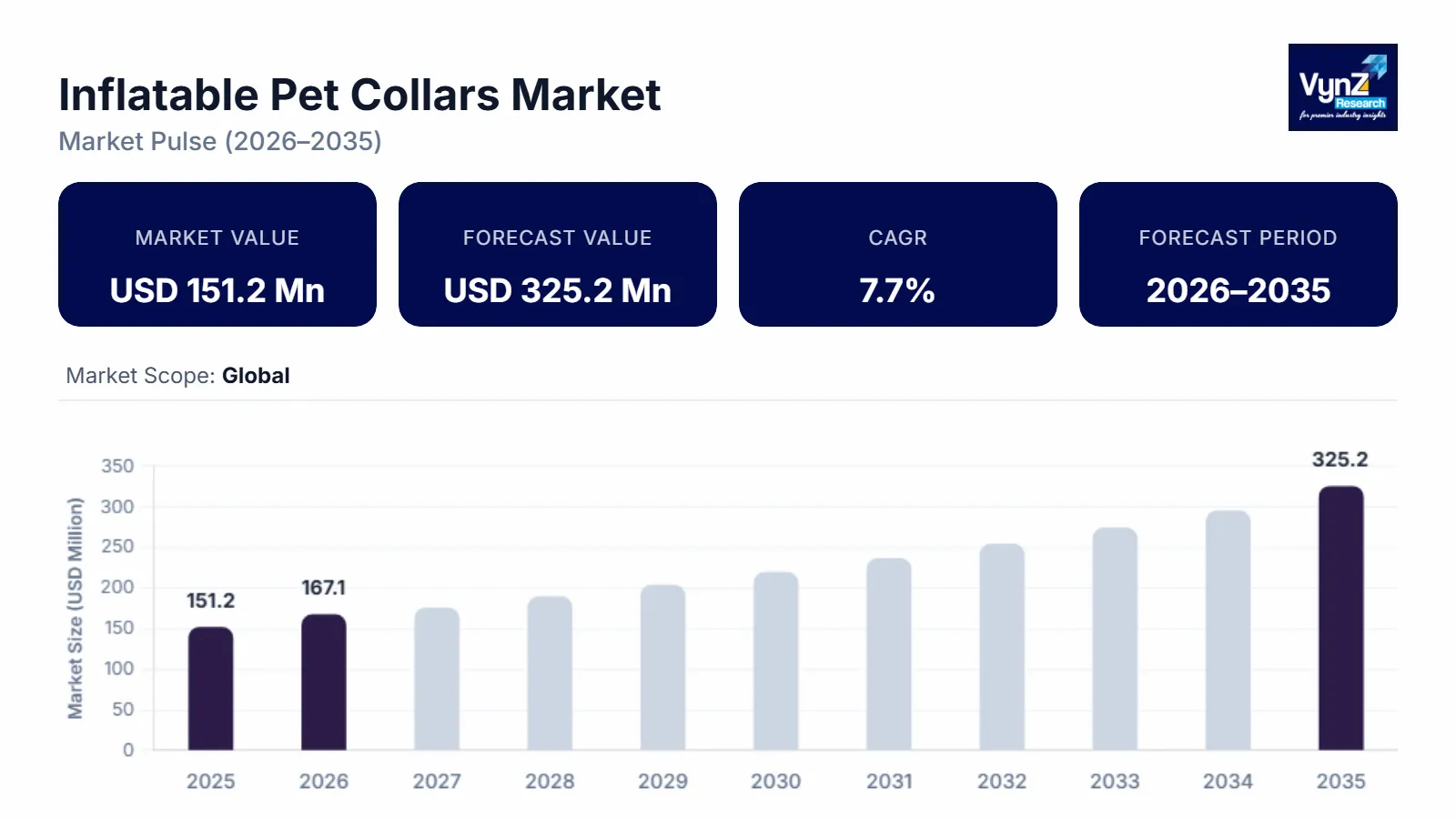
The global inflatable pet collars market is being driven by an increasing number of pets globally, a rise in spending on healthcare and post-operative care for pets, and an increase in pet humanization trends that focus on comfort and reducing stress to improve recovery outcomes. Because they allow owners to maintain their pets' visibility and enable them to continue with daily activities such as eating, drinking, and sleeping while wearing the inflatable collar (which allows better compliance among both pets and owners compared to traditional recovery options), inflatable collars are also providing value to owners. Further supporting growth of the inflatable collars market is the increased availability of recovery products through e-commerce platforms, omnichannel retail stores for pets, and ongoing product innovation including multiple size options available for cats and dogs; washable covers; durable outer fabrics; and design features of collar-loops that securely attach to standard pet collars.
Inflatable Pet Collars Market Dynamics
Market Trends
A further trend that will define the inflatable pet collars market is the improvement of comfort for post-surgical recovery. There has been increasing demand from pet owners for more comfortable than traditional hard-plastic cones, which can limit the owner's ability to see their pet while recovering, and interfere with normal daily routines. This innovation is focused on improving both the fit (for example, products that fit over a standard dog or cat collar) and stability of products, including styles that allow for easy washing and more durable outer coverings, as well as various sizes that fit both dogs and cats. The final significant trend is the growing impact of e-commerce channels. Product awareness/discovery, user reviews, and fast shipping have driven the increase in usage and competition within all price points in the inflatable pet collars market.
Growth Drivers
The key factors that drive the inflatable pet collars market include increased populations of companion pets, an increase in the number of veterinary procedures performed, for example, spaying/neutering, and an increase in the number of pet owners willing to pay for products to aid with their pets' recovery from surgery or injury to reduce stress and promote comfort. Additionally, greater retail accessibility, along with the rising global availability through e-commerce, has expanded the reach of the products. Also, veterinarians and pet care professionals continue to normalise recovery collars for protecting incision sites and sensitive skin. Indirectly, animal health programmes implemented within government sectors also tend to increase demand for aftercare accessories due to increases in sterilizations and vaccinations provided by those same programmes. For instance, the revised Animal Birth Control (ABC) programme in India provides both local entities/SPCA's up to ₹800 per dog and ₹600 per cat as funding assistance for performing the sterilization/vaccination services. A one-time grant of ₹2 Crore is also available to qualified organisations.
Market Restraints / Challenges
The primary challenges facing the inflatable pet collar industry include comparisons to solid E-collar performance in several types of wounds (e.g., paws, lower legs, tails, etc.), as well as rear portions of a dog's body, and variability in effectiveness based upon animal type and flexibility. Another challenge facing the inflatable pet collars includes durability of product due to potential for pets to pierce or chew through the inflatable bladder, potentially causing early failure and inconsistent customer satisfaction. Strong competition from other categories of pet injury management products, combined with high levels of both category and brand fragmentation, present a barrier to achieving vet-quality dimensions, veterinarian-consistent positioning, and consistent quality across all brands.
Market Opportunities
Premium comfort and durability upgrades for high-end bite resistant materials, stronger seam reinforcement, and easier-to-clean cover options provide an opportunity for the inflatable pet collars market through better fit systems (collar loop) and enhanced sizing tools. In addition, the potential for a larger marketplace exists from expanding into veterinary clinic, grooming networks, and pet speciality retailers. The categories may also exist due to regulation/public sector actions to improve veterinary infrastructure and promote responsible pet ownership, such as government funded sterilization/vaccination programmes or new animal welfare/traceability laws in large markets. There is also an increasing expenditure on pet health care and increasing demand for humane, stress reducing, and recovering solutions, especially for routine surgeries, dermatology related issues, etc., where full rigid-cone coverage may not always be necessary.
Global Inflatable Pet Collars Market Report Coverage
|
Report Metric |
Details |
|
Historical Period |
2020 - 2024 |
|
Base Year Considered |
2025 |
|
Forecast Period |
2026 - 2035 |
|
Market Size in 2025 |
USD 151.2 Million |
|
Revenue Forecast in 2035 |
USD 325.2 Million |
|
Growth Rate |
7.7% |
|
Segments Covered in the Report |
Pet Type, Size, Product Type, Material, Distribution Channel, End-Use / Indication |
|
Report Scope |
Market Trends, Drivers, and Restraints; Revenue Estimation and Forecast; Segmentation Analysis; Companies’ Strategic Developments; Market Share Analysis of Key Players; Company Profiling |
|
Regions Covered in the Report |
North America, Europe, Asia-Pacific, Latin America, Middle East & Africa |
|
Key Companies |
The KONG Company LLC; Acorn Pet Products; PetAZ Pty Ltd; Comfurt Collar LLC; TRIXIE Heimtierbedarf GmbH & Co. KG; Doba Inc.; COLLAR Company; Felt and Yarn Pvt. Ltd.; Boss Pet Products, Inc.; Kohl's Corporation |
|
Customization |
Available upon request |
Inflatable Pet Collars Market Segmentation
By Pet Type
Dogs are the largest category with a market share of about 50% in 2025, because they make up a large proportion of pet owners' pets, and therefore will have higher frequency of use for both post-surgical and wound-protective products. In addition to having an opportunity to generate steady sales through routine veterinary services such as spaying and neutering, there is also a steady stream of purchases that result from owners trying to prevent their dogs from licking or scratching at incisions and skin irritation. Furthermore, dogs require a wide range of collars due to size variations, and strong presence in pet-speciality retail and online channels increases opportunities for this market.
Cats are the fastest-growing category during the forecast period, because there is an increase in cat population in cities. Additionally, pet owners prefer non-restrictive products such as inflatable collars over traditional rigid cone collars. Pet owners choose to use inflatable collars that provide pets less stress while providing them greater mobility and comfort while eating, especially when living at home. Online purchasing options have improved, along with collar attachments systems (loops) and sizing (less options) for pets, which has increased adoption rates within this category.
By Size
Medium is the largest category with a market share of about 40% in 2025, as most dog breeds are medium; many owners find a good balance for comfort and security when they buy a medium. Most SKU's for pets from big box stores and on the web have medium, making it easier to keep inventory turning and get repeat customers.
Extra-Small / Small is the fastest-growing category during the forecast period, as pet owners of cat and small dog breeds increasingly adopt products in sizes that fit their pets. As pet owners shop online through e-retailers, they are finding it easier to select the correct size for their pet using sizing tools, reading product reviews, or learning from manufacturer instructions. Owners seeking comfortable recoveries with respect to their companions are also driving growth in this segment.
By Material
Inflatable bladder (PVC/TPU) is the largest category with a market share of about 60% in 2025, as most inflatable recovery collars use inflatable air bladders constructed using a variety of flexible plastic materials, including PVC or TPU. They allow for cost-effective, high-volume production; affordable prices across all markets; and reliable performance for typical recovery situations if the correct size and type inflatable bladder is used and properly attached to a standard collar.
Fabric-covered / reinforced designs are the fastest-growing category during the forecast period, driven by consumer's desire for increased comfort, washability, and durability. The incorporation of reinforced outer coverings, bite resistant fabrics, and enhanced closure systems provide solutions to many common areas of failure (punctures and slippage), therefore facilitating upgrades. Premiumisation has been most evident within E-commerce environments, which allow sellers to differentiate their products based on feature content, photography, and customer reviews.
By Product Type
Standard inflatable collars are the largest category with a market share of about 60% in 2025. The standard, donut-shaped inflatable collars fulfil the primary requirement limiting access to most parts of your dog's body at a cost that is easy on your wallet. They can be found from almost all of the major pet manufacturers, as well as private label versions. They are frequently used in the average "every day" recovery situation when comfort and visibility of the injury are top priority.
Premium / reinforced designs are the fastest-growing category with a CAGR of 8.3% during the forecast period, due to an increase in customer willingness to spend money on products that are longer lasting, have better closure, and provide greater stability. The use of upgraded materials, along with being able to be washed, will help alleviate some of the most common problems such as punctures, losing air, and chafing, resulting in greater repeat business and higher levels of satisfaction. Additionally, premium items can create distinctions by using features in e-commerce and pet speciality stores.
By End-Use
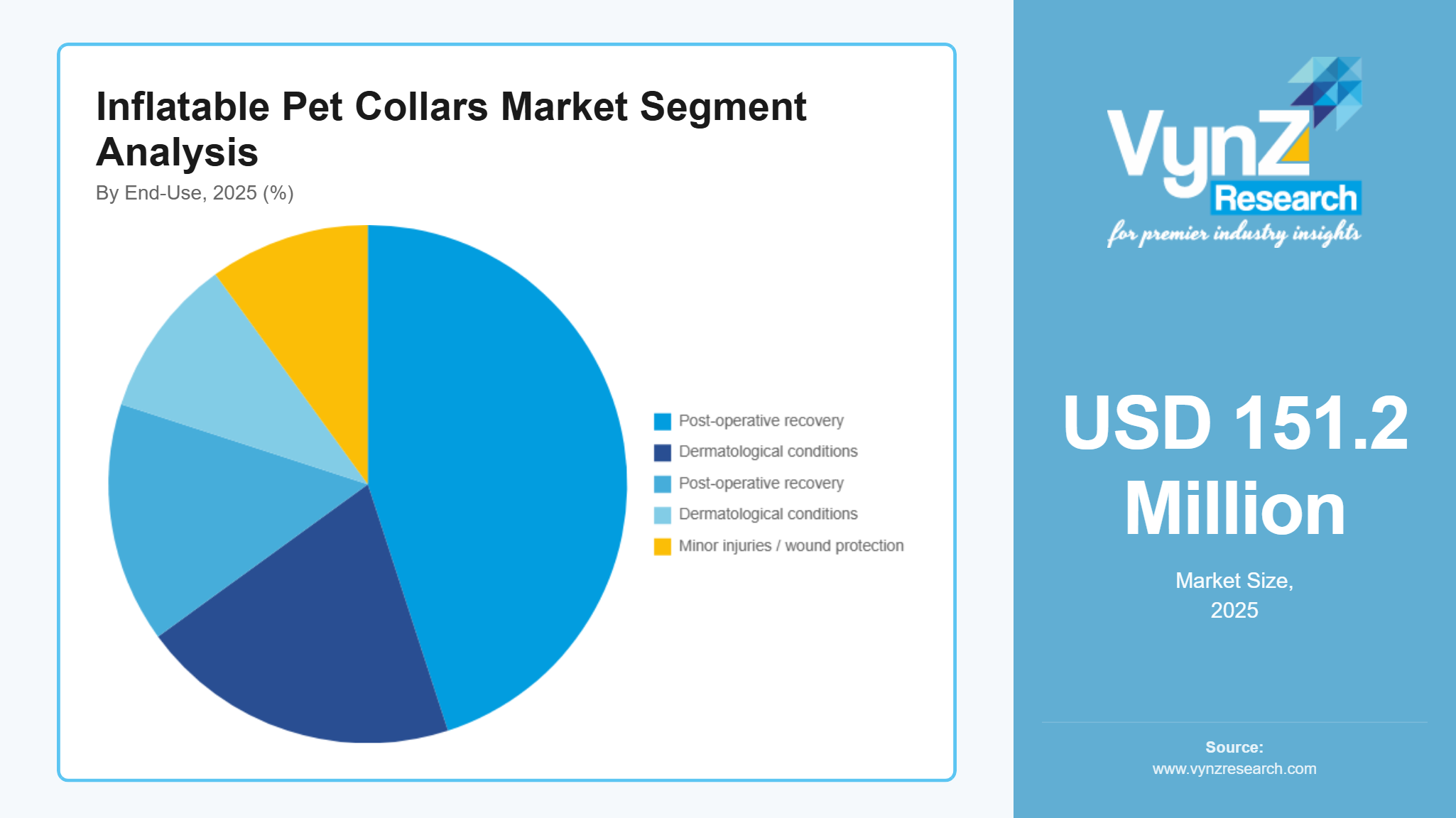
Post-operative recovery is the largest category with a market share of about 45% in 2025, due to the fact that many pets have had some type of surgery (e.g., spay/neuter), and therefore they require some form of protection from licking/chewing around the surgical site after being released back into their home environment. Additionally, there exists a continuous, repeat business opportunity within this segment since minor surgical procedures are performed on a regular basis for pets. Vet clinics and shops typically provide protective collars along with post-surgical care recommendations.
Dermatological conditions and minor injuries are the fastest-growing category with a CAGR of 8.1% during the forecast period, as people become more aware of self-injury for hotspots, rashes, and irritation at one or two areas of the body. These washable, reuse-based designs are used repeatedly for pet's recurring skin issues. Owners can review products online and discover them beyond just using them after surgery. As the owners seek solutions, they will be able to allow pets to be comfortable eating, drinking, and sleeping for extended periods (multi days) while undergoing treatments.
By Distribution Channel
Online is the largest category with a market share of about 45% in 2025, due to a combination of factors that include, but are not limited to, a higher product sku count, lower pricing, faster shipping options, and a higher number of reviews used to make purchasing decisions. Due to the need for timely recovery (in most cases), many customers are able to recover their item much quicker when they can have it shipped directly via internet.
Veterinary clinics and pet speciality retail is the fastest-growing category with a CAGR of 7.9% during the forecast period, this rapid growth can be attributed to both the fact that many veterinarians recommend using proper recovery products after surgery or injury and that there are limited amounts of quality and properly sized recovery products available. There are several benefits associated with purchasing through traditional brick-and-mortar locations, such as being able to receive one on one assistance to ensure the product fits well and also developing a higher degree of trust with new clients when purchasing products. As a result, a number of retailers have added recovery items to their pet health and wellness product lines.
Regional Insights
North America
North America accounted for approximately 35% of the market in 2025, driven by high pet ownership, strong veterinary spending, and widespread awareness of post-surgical pet care products. The United States leads regional demand due to its large companion animal population, well-established veterinary networks, and strong penetration of pet specialty retail and e-commerce platforms. Government-backed initiatives such as the U.S. National One Health Framework are also supporting structured animal health preparedness and improving coordination in veterinary care systems.
High veterinary influence on purchasing decisions, combined with strong consumer preference for premium and reliable recovery products, is encouraging consistent adoption. Expanding omnichannel distribution networks and advanced logistics infrastructure are further strengthening product availability and sustaining North America’s dominant market position.
Asia-Pacific
Asia Pacific accounted for approximately 25% of the market in 2025, supported by rising pet adoption, rapid urbanization, and increasing pet humanization trends across China, India, and Japan. Growth in veterinary services, rising disposable income, and higher awareness of post-operative pet recovery solutions are driving steady demand. Government initiatives such as India’s Animal Birth Control (ABC) Rules and large-scale sterilization and vaccination programs are increasing the volume of veterinary procedures, indirectly supporting demand for recovery products.
Expanding e-commerce penetration, improving access to affordable pet healthcare products, and growing urban pet ownership are accelerating market adoption. However, variation in product quality standards across countries continues to create a mixed competitive landscape, even as demand rises strongly.
Europe
Europe accounted for approximately 15% of the market in 2025, driven by strong regulatory frameworks for animal welfare, high veterinary service penetration, and widespread awareness of responsible pet care practices. Countries such as Germany, France, and the United Kingdom represent key demand centers due to their advanced veterinary infrastructure and high adoption of pet insurance and clinical care services. European Commission-backed initiatives supporting animal health research and pet welfare regulations, including mandatory pet identification and registration policies, are strengthening structured pet care systems across the region.
Rising demand for premium, durable, and comfort-focused pet recovery products, along with increasing clinical recommendations for post-operative care, continues to support stable and quality-driven market growth.
Rest of the World
The Rest of the World region, including Latin America and Middle East & Africa, accounted for approximately 25% of the market in 2025, supported by gradual improvements in veterinary infrastructure, rising pet ownership, and increasing awareness of animal health management. Countries such as Brazil, Mexico, the United Arab Emirates, and South Africa are witnessing expanding access to veterinary services and growing availability of pet care products through both retail and online channels.
Government-led animal health programs, including sterilization and rabies control initiatives under public veterinary frameworks, are contributing to rising surgical procedures and steady demand for recovery products. Although affordability challenges and uneven distribution networks persist, improving economic conditions and expanding pet care ecosystems are expected to support long-term market expansion.
Competitive Landscape / Company Insights
The Inflatable Pet Collar Market has an overall moderate degree of fragmentation. Established pet care brands, veterinary-focused manufacturers, as well as many marketplace vendors providing private label and/or un-branded products contribute to this level of fragmentation. Positioning in terms of competitive advantage is primarily based on the performance characteristics of each inflatable pet collar product (the fit, the extent of coverage, and the stability of the inflated pet collar). Durability factors such as puncture-resistance, seam-strength, and the quality of the outer fabric, and the cleanliness or ease of cleaning the inflatable pet collar.
Additionally, the clarity and quality of the instructional guidelines (i.e., size charts and use case examples) provided to assist consumers in using the inflatable pet collar correctly. Competitive pressures exist both within traditional brick-and-mortar channels, including pet-specialty stores and veterinary offices, as well as through e-commerce platforms where online reviews/ratings significantly amplify competitive effects and drive price transparency. As such, companies with a history of consistently producing high-quality inflatable pet collars, which provide clear instructional guidelines regarding proper wound placement, and maintaining a steady supply chain will be best able to preserve their market share in an increasingly competitive e-commerce environment.
Mini Profiles
The KONG Company LLC is a pet products company known for companion animal accessories and toys, and it participates in the recovery and protective-collar space through comfort-oriented solutions sold via pet retail and e-commerce channels.
Acorn Pet Products operates in the pet accessories segment and offers products distributed through online and offline channels, competing across pet care categories that include recovery and protective solutions.
PetAZ Pty Ltd supplies pet care and accessory products and participates in recovery-product demand through retail and e-commerce distribution serving companion animal owners.
Comfurt Collar LLC is associated with comfort-focused pet collar products and competes within the protective and recovery collar segment where fit, comfort, and durability are key decision factors.
TRIXIE Heimtierbedarf GmbH & Co. KG is a European pet products supplier with a broad accessory portfolio sold through pet specialty and online channels, including categories related to pet collars and recovery support.
Key Players
- The KONG Company LLC
- Acorn Pet Products
- PetAZ Pty Ltd
- Comfurt Collar LLC
- TRIXIE Heimtierbedarf GmbH & Co. KG
- Doba Inc.
- COLLAR Company
- Felt and Yarn Pvt. Ltd.
- Boss Pet Products, Inc.
- Kohl's Corporation
Recent Developments
In March 2025, KONG Company LLC continued global distribution of its KONG Cloud inflatable recovery collar across veterinary and pet specialty channels, strengthening availability in post-surgical pet care segments as demand for comfortable alternatives to traditional recovery cones remained strong.
In March 2025, TRIXIE Heimtierbedarf GmbH & Co. KG maintained a strong presence across online marketplaces with its inflatable protective collar range available in multiple sizes across European and international markets, supporting steady adoption of lightweight and flexible pet recovery solutions.
In June 2025, COLLAR Company continued expanding its global retail and e-commerce distribution network for pet care and recovery accessories, leveraging its established safety product portfolio to enhance accessibility of inflatable collars across key regions.
In February 2026, Doba Inc. expanded its global pet care portfolio distribution through enhanced retail and e-commerce partnerships, strengthening availability of pet health and recovery products, including inflatable collars, across key international markets.
In September 2025, Kohl’s Corporation expanded its online pet supplies assortment, including recovery collars and accessories, strengthening omnichannel retail penetration and improving consumer access to pet care products through digital platforms.
Global Inflatable Pet Collars Market Coverage
Pet Type Insight and Forecast 2026 - 2035
- Dogs
- Cats
- Others
Size Insight and Forecast 2026 - 2035
- Extra-Small / Small
- Medium
- Large / Extra-Large
Material Insight and Forecast 2026 - 2035
- Inflatable bladder (PVC/TPU)
- Fabric-covered / reinforced designs
- Others
Product Type Insight and Forecast 2026 - 2035
- Standard inflatable collars
- Premium / reinforced designs
- Others
End-Use Insight and Forecast 2026 - 2035
- Post-operative recovery
- Dermatological conditions
- Post-operative recovery
- Dermatological conditions
- Minor injuries / wound protection
Distribution Channel Insight and Forecast 2026 - 2035
- Online
- Offline
- Veterinary clinics
Global Inflatable Pet Collars Market by Region
- North America
- By Pet Type
- By Size
- By Material
- By Product Type
- By End-Use
- By Distribution Channel
- By Country - U.S., Canada, Mexico
- Europe
- By Pet Type
- By Size
- By Material
- By Product Type
- By End-Use
- By Distribution Channel
- By Country - Germany, U.K., France, Italy, Spain, Russia, Rest of Europe
- Asia-Pacific (APAC)
- By Pet Type
- By Size
- By Material
- By Product Type
- By End-Use
- By Distribution Channel
- By Country - China, Japan, India, South Korea, Vietnam, Thailand, Malaysia, Rest of Asia-Pacific
- Rest of the World (RoW)
- By Pet Type
- By Size
- By Material
- By Product Type
- By End-Use
- By Distribution Channel
- By Country - Brazil, Saudi Arabia, South Africa, U.A.E., Other Countries
Table of Contents for Inflatable Pet Collars Market Report
1. Research Overview
1.1. The Report Offers
1.2. Market Coverage
1.2.1. By
Pet Type
1.2.2. By
Size
1.2.3. By
Material
1.2.4. By
Product Type
1.2.5. By
End-Use
1.2.6. By
Distribution Channel
1.3. Research Phases
1.4. Limitations
1.5. Market Methodology
1.5.1. Data Sources
1.5.1.1.
Primary Research
1.5.1.2.
Secondary Research
1.5.2. Methodology
1.5.2.1.
Data Exploration
1.5.2.2.
Forecast Parameters
1.5.2.3.
Data Validation
1.5.2.4.
Assumptions
1.5.3. Study Period & Data Reporting Unit
2. Executive Summary
3. Industry Overview
3.1. Industry Dynamics
3.1.1. Market Growth Drivers
3.1.2. Market Restraints
3.1.3. Key Market Trends
3.1.4. Major Opportunities
3.2. Industry Ecosystem
3.2.1. Porter’s Five Forces Analysis
3.2.2. Recent Development Analysis
3.2.3. Value Chain Analysis
3.3. Competitive Insight
3.3.1. Competitive Position of Industry
Players
3.3.2. Market Attractive Analysis
3.3.3. Market Share Analysis
4. Global Market Estimate and Forecast
4.1. Global Market Overview
4.2. Global Market Estimate and Forecast to 2035
5. Market Segmentation Estimate and Forecast
5.1. By Pet Type
5.1.1. Dogs
5.1.1.1. Market Definition
5.1.1.2. Market Estimation and Forecast to 2035
5.1.2. Cats
5.1.2.1. Market Definition
5.1.2.2. Market Estimation and Forecast to 2035
5.1.3. Others
5.1.3.1. Market Definition
5.1.3.2. Market Estimation and Forecast to 2035
5.2. By Size
5.2.1. Extra-Small / Small
5.2.1.1. Market Definition
5.2.1.2. Market Estimation and Forecast to 2035
5.2.2. Medium
5.2.2.1. Market Definition
5.2.2.2. Market Estimation and Forecast to 2035
5.2.3. Large / Extra-Large
5.2.3.1. Market Definition
5.2.3.2. Market Estimation and Forecast to 2035
5.3. By Material
5.3.1. Inflatable bladder (PVC/TPU)
5.3.1.1. Market Definition
5.3.1.2. Market Estimation and Forecast to 2035
5.3.2. Fabric-covered / reinforced designs
5.3.2.1. Market Definition
5.3.2.2. Market Estimation and Forecast to 2035
5.3.3. Others
5.3.3.1. Market Definition
5.3.3.2. Market Estimation and Forecast to 2035
5.4. By Product Type
5.4.1. Standard inflatable collars
5.4.1.1. Market Definition
5.4.1.2. Market Estimation and Forecast to 2035
5.4.2. Premium / reinforced designs
5.4.2.1. Market Definition
5.4.2.2. Market Estimation and Forecast to 2035
5.4.3. Others
5.4.3.1. Market Definition
5.4.3.2. Market Estimation and Forecast to 2035
5.5. By End-Use
5.5.1. Post-operative recovery
5.5.1.1. Market Definition
5.5.1.2. Market Estimation and Forecast to 2035
5.5.2. Dermatological conditions
5.5.2.1. Market Definition
5.5.2.2. Market Estimation and Forecast to 2035
5.5.3. Post-operative recovery
5.5.3.1. Market Definition
5.5.3.2. Market Estimation and Forecast to 2035
5.5.4. Dermatological conditions
5.5.4.1. Market Definition
5.5.4.2. Market Estimation and Forecast to 2035
5.5.5. Minor injuries / wound protection
5.5.5.1. Market Definition
5.5.5.2. Market Estimation and Forecast to 2035
5.6. By Distribution Channel
5.6.1. Online
5.6.1.1. Market Definition
5.6.1.2. Market Estimation and Forecast to 2035
5.6.2. Offline
5.6.2.1. Market Definition
5.6.2.2. Market Estimation and Forecast to 2035
5.6.3. Veterinary clinics
5.6.3.1. Market Definition
5.6.3.2. Market Estimation and Forecast to 2035
6. North America Market Estimate and Forecast
6.1. By
Pet Type
6.2. By
Size
6.3. By
Material
6.4. By
Product Type
6.5. By
End-Use
6.6. By
Distribution Channel
6.6.1.
U.S. Market Estimate and Forecast
6.6.2.
Canada Market Estimate and Forecast
6.6.3.
Mexico Market Estimate and Forecast
7. Europe Market Estimate and Forecast
7.1. By
Pet Type
7.2. By
Size
7.3. By
Material
7.4. By
Product Type
7.5. By
End-Use
7.6. By
Distribution Channel
7.6.1.
Germany Market Estimate and Forecast
7.6.2.
France Market Estimate and Forecast
7.6.3.
U.K. Market Estimate and Forecast
7.6.4.
Italy Market Estimate and Forecast
7.6.5.
Spain Market Estimate and Forecast
7.6.6.
Russia Market Estimate and Forecast
7.6.7.
Rest of Europe Market Estimate and Forecast
8. Asia-Pacific (APAC) Market Estimate and Forecast
8.1. By
Pet Type
8.2. By
Size
8.3. By
Material
8.4. By
Product Type
8.5. By
End-Use
8.6. By
Distribution Channel
8.6.1.
China Market Estimate and Forecast
8.6.2.
Japan Market Estimate and Forecast
8.6.3.
India Market Estimate and Forecast
8.6.4.
South Korea Market Estimate and Forecast
8.6.5.
Rest of Asia-Pacific Market Estimate and Forecast
9. Rest of the World (RoW) Market Estimate and Forecast
9.1. By
Pet Type
9.2. By
Size
9.3. By
Material
9.4. By
Product Type
9.5. By
End-Use
9.6. By
Distribution Channel
9.6.1.
Brazil Market Estimate and Forecast
9.6.2.
Saudi Arabia Market Estimate and Forecast
9.6.3.
South Africa Market Estimate and Forecast
9.6.4.
U.A.E. Market Estimate and Forecast
9.6.5.
Other Countries Market Estimate and Forecast
10. Company Profiles
10.1.
The KONG Company LLC
10.1.1.
Snapshot
10.1.2.
Overview
10.1.3.
Offerings
10.1.4.
Financial
Insight
10.1.5.
Recent
Developments
10.2.
Acorn Pet Products
10.2.1.
Snapshot
10.2.2.
Overview
10.2.3.
Offerings
10.2.4.
Financial
Insight
10.2.5.
Recent
Developments
10.3.
PetAZ Pty Ltd
10.3.1.
Snapshot
10.3.2.
Overview
10.3.3.
Offerings
10.3.4.
Financial
Insight
10.3.5.
Recent
Developments
10.4.
Comfurt Collar LLC
10.4.1.
Snapshot
10.4.2.
Overview
10.4.3.
Offerings
10.4.4.
Financial
Insight
10.4.5.
Recent
Developments
10.5.
TRIXIE Heimtierbedarf GmbH & Co. KG
10.5.1.
Snapshot
10.5.2.
Overview
10.5.3.
Offerings
10.5.4.
Financial
Insight
10.5.5.
Recent
Developments
10.6.
Doba Inc.
10.6.1.
Snapshot
10.6.2.
Overview
10.6.3.
Offerings
10.6.4.
Financial
Insight
10.6.5.
Recent
Developments
10.7.
COLLAR Company
10.7.1.
Snapshot
10.7.2.
Overview
10.7.3.
Offerings
10.7.4.
Financial
Insight
10.7.5.
Recent
Developments
10.8.
Felt and Yarn Pvt. Ltd.
10.8.1.
Snapshot
10.8.2.
Overview
10.8.3.
Offerings
10.8.4.
Financial
Insight
10.8.5.
Recent
Developments
10.9.
Boss Pet Products, Inc.
10.9.1.
Snapshot
10.9.2.
Overview
10.9.3.
Offerings
10.9.4.
Financial
Insight
10.9.5.
Recent
Developments
10.10.
Kohl's Corporation
10.10.1.
Snapshot
10.10.2.
Overview
10.10.3.
Offerings
10.10.4.
Financial
Insight
10.10.5.
Recent
Developments
11. Appendix
11.1. Exchange Rates
11.2. Abbreviations
Note: Financial insight and recent developments of different companies are subject to the availability of information in the secondary domain.
Frequently Asked Questions
Purchase Options
Latest Report
Research Methodology
- Desk Research / Pilot Interviews
- Build Market Size Model
- Research and Analysis
- Final Deliverable
Connect With Our Sales Team
- Toll-Free: +1-888-253-3960
- Phone: +91 9960 288 381
- Email: enquiry@vynzresearch.com
Inflatable Pet Collars Market