
Biomass Boiler Market Size & Share | Growth Forecast Report (2026-2035)
Industry Insight by application, heating accounted for an estimated 54% share in 2025, supported by demand for space heating, hot water and industrial process heat. (Residential users accounted for an estimated 42.8% share in 2025duew to higher demand.), by capacity, the 50-kW category is assigned a proposed CAGR of 9.7% from 2026 to 2035, with potential for projects involving process heat, centralised heating and combined heat and power. (Market Report Scope, ANDRITZ, Babcock & Wilcox, Doosan Enerbility, Hurst Boiler, Mitsubishi Heavy Industries, ÖkoFEN, Schmid Energy Solutions, Sumitomo Heavy Industries, Thermax), by Fuel Type (Wood pellets, Wood chips, Logs, Agricultural residues, Forestry residues, Other biomass fuels), by Capacity (Below 10 kW, 10 kW to 20 kW, 20 kW to 50 kW, Above 50 kW), by Application (Heating, Power generation, Combined heat and power, Other applications), by End User (Residential, Commercial, Industrial)
| Status : Published | Published On : Nov, 2026 | Report Code : VREP3074 | Industry : Energy & Power | Available Format :

|
Page : 145 |
Biomass Boiler Market Overview
The global biomass boiler market was valued at approximately USD 7.72 billion in 2025 and is estimated to reach USD 8.31 billion in 2026, before expanding to USD 18.58 billion by 2035, registering a proposed CAGR of 9.35% from 2026 to 2035.
Biomass boilers convert organic fuels, including wood pellets, wood chips and agricultural residues, into heat or steam for residential, commercial and industrial applications. Demand is supported by industrial decarbonization, renewable heating requirements and the availability of biomass byproducts. The International Energy Agency reports that bioenergy and renewable electricity accounted for nearly 80% of the growth in renewable heat use till 2025, demonstrating the importance of renewable heat technologies in the energy transition.
Market growth is driven by industrial demand for renewable process heat, increasing use of agricultural and forestry residues, and improvements in boiler automation and combustion efficiency. Rising investment in industrial energy systems and combined heat and power installations is also supporting adoption across selected manufacturing sectors. The International Energy Agency identifies China and India as important contributors to industrial renewable heat growth, particularly through manufacturing expansion and biomass residue utilization in sugar and ethanol production. These developments support demand for biomass-based thermal energy systems, although the economics of individual projects depend on feedstock availability, operating costs and emissions requirements.
Research Methodology
VynZ Research evaluates the biomass boiler industry through a structured assessment of published market estimates, technology developments, company disclosures, fuel availability and regional energy policies. The VynZ Research team examines the relationships between boiler installations, thermal energy demand, biomass consumption and industrial investment to develop market estimates and forecasts. Secondary research includes information from the International Energy Agency, the European Commission and relevant national energy agencies, alongside company announcements and industry publications. Market sizing assumptions are assessed for consistency across the base year and forecast period, while segment and regional estimates are checked against the overall market model.
Research Highlights
By fuel type, wood pellet boilers accounted for an estimated 40.5% share in 2025, reflecting their suitability for automated feeding, standardized fuel handling and residential and commercial heating installations.
By application, heating accounted for an estimated 54% share in 2025, supported by demand for space heating, hot water and industrial process heat.
Residential users accounted for an estimated 42.8% share in 2025duew to
higher demand.
By capacity, the
50-kW
category is assigned a proposed CAGR of
9.7
% from 2026 to 2035,
with potential for projects involving process heat, centralised
heating and combined heat and power.
Europe accounted for an estimated 39.6% share in 2025
due to
established biomass heating applications, industrial demand and support from renewable energy policies
.
Biomass Boiler Market Dynamics
Market Trends
The biomass boiler industry is experiencing increasing demand for automated fuel feeding, improved combustion control and more effective emissions management. Pellet boilers are suited to installations requiring standardized fuel handling, while industrial systems using wood chips and agricultural residues require equipment designed for variations in moisture, particle size and calorific value. These differences are influencing product development, with manufacturers focusing on fuel flexibility, operational reliability and heat recovery. Another important trend is the integration of biomass boilers with combined heat and power systems, which supply useful heat alongside electricity.
Growth Drivers
Industrial demand for renewable process heat is a major driver of biomass boiler adoption. Food processing, sugar production, pulp and paper manufacturing and selected chemical processes require thermal energy that can potentially be supplied by biomass boilers. Facilities located near agricultural or forestry operations may benefit from access to locally available residues, reducing dependence on conventional fuels when feedstock preparation and transport remain economical. The International Energy Agency reports that industrial renewable heat use has expanded in China and India, with agricultural residues contributing to heat production in India's sugar and ethanol industries. Government measures supporting renewable energy, industrial efficiency and emissions reduction can further encourage investment in biomass heating systems.
Market Restraints / Challenges
Biomass availability, fuel quality and transportation costs remain important restraints on market development. Wood pellets, wood chips and agricultural residues differ in moisture content, ash production and energy value, requiring appropriate fuel preparation and combustion systems. Seasonal availability can create supply fluctuations, while competition from other biomass users may increase procurement costs. Industrial facilities may also need dedicated storage, conveyors, drying equipment and ash handling systems, increasing the initial investment required for installation. These factors can weaken the economic case for biomass boilers where alternative fuels are readily available or where the required biomass supply cannot be secured over the project's operating life. Environmental compliance and equipment maintenance create additional operational challenges.
Market Opportunities
Industrial decarbonization creates opportunities for biomass boiler suppliers offering high-capacity systems, fuel preparation equipment and integrated emissions controls. Sugar mills, paper manufacturers and food processing plants can potentially utilize suitable production residues to generate steam, reducing waste and diversifying thermal energy supplies. Manufacturers that combine boiler design with automated fuel feeding, heat recovery and maintenance services can address a wider range of industrial requirements. A second opportunity lies in replacing or upgrading existing industrial heating equipment. Biomass boiler installations can be attractive where customers have a dependable fuel supply, high annual heat demand and sufficient space for fuel storage and handling.
Global Biomass Boiler Market Report Coverage
|
Report Metric |
Details |
|
Historical Period |
2020 - 2024 |
|
Base Year Considered |
2025 |
|
Forecast Period |
2026 - 2035 |
|
Market Size in 2025 |
USD 7.72 Billion |
|
Revenue Forecast in 2035 |
USD 18.58 Billion |
|
Growth Rate |
9.35% |
|
Segments Covered in the Report |
Fuel Type, Capacity, Application, End User |
|
Report Scope |
Market Trends, Drivers, and Restraints; Revenue Estimation and Forecast; Segmentation Analysis; Companies’ Strategic Developments; Market Share Analysis of Key Players; Company Profiling |
|
Regions Covered in the Report |
North America, Europe, Asia Pacific, Rest of the World |
|
Key Companies |
ANDRITZ, Babcock & Wilcox, Doosan Enerbility, Hurst Boiler, Mitsubishi Heavy Industries, ÖkoFEN, Schmid Energy Solutions, Sumitomo, Thermax, Valmet |
|
Customization |
Available upon request |
Biomass Boiler Market Segmentation
By Fuel Type
Wood pellet boilers accounted for an estimated 40.5% share in 2025, making them the leading fuel category in this assessment. Standardized fuel dimensions and relatively consistent fuel specifications support automated feeding and combustion control, particularly in residential and commercial heating systems.
Wood chip boilers are assigned a proposed CAGR of 9.6% from 2026 to 2035, reflecting potential demand from industrial customers seeking locally available fuel. Agricultural and forestry residues can also support industrial steam generation when moisture content, ash characteristics and fuel supply remain manageable.
By Capacity
The 10 kW to 20 kW capacity category held a reported 31.1% share in 2025, making it the largest capacity segment in the reference classification. These systems are relevant to buildings with moderate heating requirements and installations that need more output than small domestic boilers can provide.
Systems above 50 kW serve larger commercial premises, industrial facilities and selected district heating applications. This category is assigned a proposed CAGR of 9.7% from 2026 to 2035, reflecting the potential for projects involving process heat, centralized heating and combined heat and power.
By Application
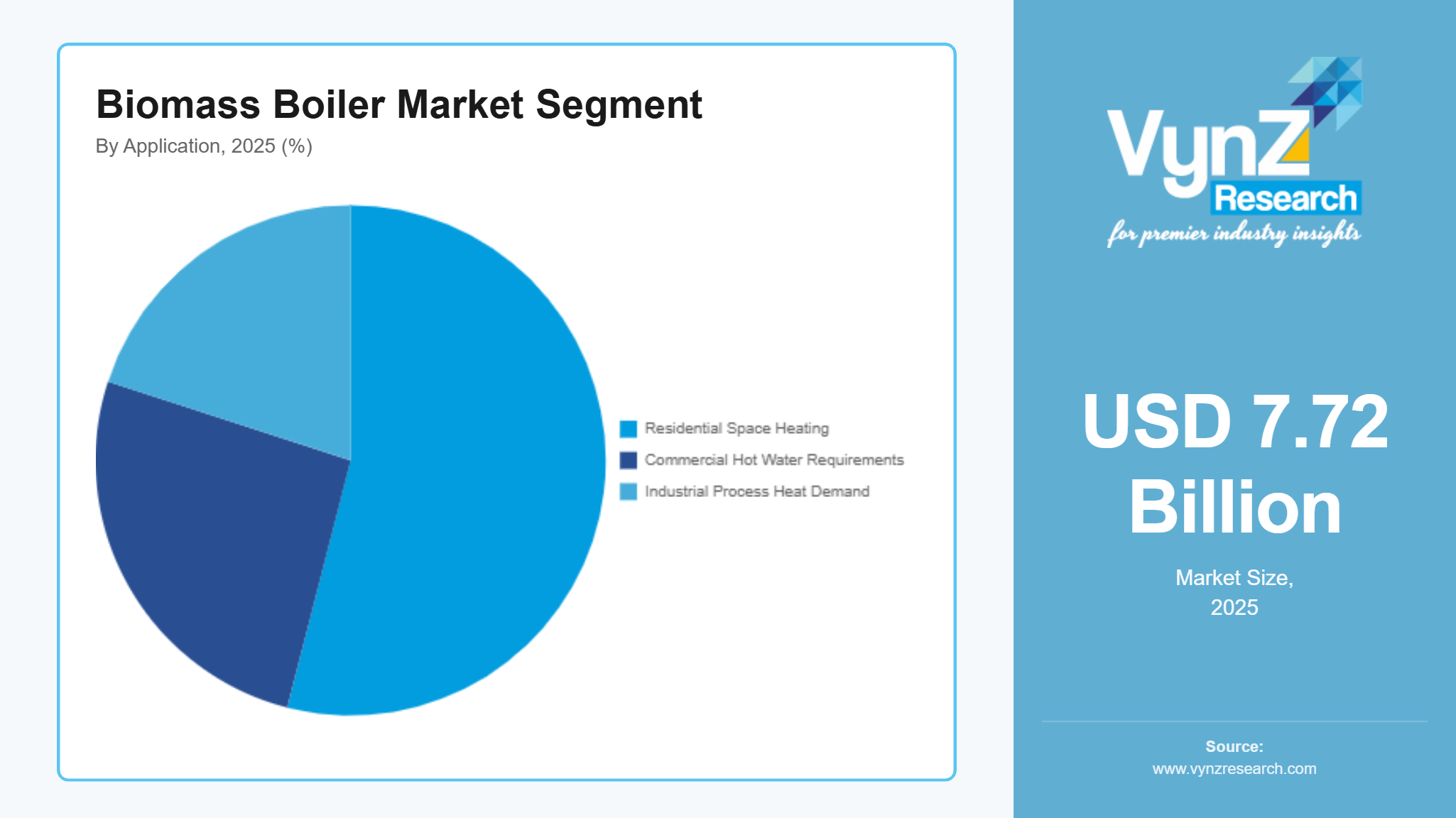
Heating accounted for an estimated 54% share in 2025, supported by residential space heating, commercial hot water requirements and industrial process heat demand.
Power generation and combined heat and power installations create additional demand for larger biomass boiler systems. Power generation is assigned a proposed CAGR of 9.8% from 2026 to 2035, reflecting potential investment in industrial energy projects and facilities requiring both electricity and useful heat.]
By End User
Residential users accounted for an estimated 42.8% share in 2025, making them the leading end user category in this working model. Demand is influenced by heating requirements, household energy costs, availability of suitable biomass fuels and the practicality of fuel storage.
The industrial category is assigned a proposed CAGR of 9.9% from 2026 to 2035, reflecting potential demand from manufacturing facilities, food processing plants and other operations requiring process steam.
Regional Insights
North America
North America accounted for an estimated 18.2% share in 2025 in this proposed regional allocation. Demand is associated with industrial heating, commercial installations and biomass resources generated by forestry and agricultural activities. The United States and Canada have established wood processing industries that can provide potential feedstock for appropriately located boiler projects. However, transportation costs, regional fuel availability and competing heating technologies influence the commercial viability of individual installations. The proposed share is an analytical allocation rather than a verified regional revenue measurement.
Europe
Europe held an estimated 39.6% share in 2025, making it the largest regional market in this proposed allocation. Established biomass heating applications, industrial energy requirements and renewable energy policies support demand for biomass boiler installations. Published market research also identifies Europe as the leading region, with a reported 40% share in 2025.
Asia Pacific
Asia Pacific accounted for an estimated 29.1% share in 2025 in the proposed regional model. Industrial expansion, manufacturing activity and the availability of agricultural residues create opportunities for biomass-based process heat in selected markets. The International Energy Agency identifies China and India as important contributors to industrial renewable heat growth, with agricultural residues playing a role in India's sugar and ethanol industries.
Rest of the World
Rest of the World accounted for the remaining 13.1% share in 2025 in this proposed regional allocation, combining Latin America with the Middle East and Africa. In parts of Latin America, agricultural and forestry residues can provide potential fuel sources for industrial heating projects. Opportunities depend on the proximity of biomass supplies to energy users, the reliability of fuel logistics and the availability of suitable boiler technologies.
Competitive Landscape / Company Insights
The biomass boiler market is competitive, with manufacturers differentiating themselves through combustion technology, fuel flexibility, boiler efficiency and emissions control. ANDRITZ, Babcock & Wilcox, Doosan Enerbility, Mitsubishi Heavy Industries and Thermax participate in industrial energy and boiler applications, while specialized suppliers address residential and commercial heating requirements. Competition increasingly emphasizes integrated fuel handling, automated operation, heat recovery and maintenance services. Recent projects announced by Valmet and Sumitomo Heavy Industries demonstrate continuing investment in industrial biomass combustion and fuel flexible boiler systems.
Mini Profiles
ANDRITZ supplies industrial biomass boilers, power generation equipment and integrated energy systems, serving industries that require reliable steam production, fuel flexibility and emissions management.
Babcock & Wilcox provides boiler engineering and thermal energy technologies for industrial and power generation applications, with capabilities in combustion systems and plant modernization.
Doosan Enerbility supplies power generation and energy infrastructure technologies, including boiler-related engineering capabilities for large-scale industrial and utility applications.
Hurst Boiler manufactures boiler systems for industrial and commercial customers, offering solid fuel equipment for process heating, steam generation and selected renewable energy applications.
Mitsubishi Heavy Industries provides power generation equipment and industrial energy technologies, serving customers requiring high-capacity thermal systems and integrated plant engineering.
Key Players
- ANDRITZ
- Babcock & Wilcox
- Doosan Enerbility
- Hurst Boiler
- Mitsubishi Heavy Industries
- ÖkoFEN
- Schmid Energy Solutions
- Sumitomo Heavy Industries
- Thermax
- Valmet
Recent Developments
ÖkoFEN presented the Pellematic Condens XL, a condensing pellet boiler designed for medium capacity applications, with a stated output range of 100 kW to 130 kW. The product demonstrates continued development of automated pellet combustion and condensing technology for collective housing and commercial heating.
Schmid Energy Solutions is undertaking a production efficiency and product innovation project at its Polish operations, supported by European Union funding. The project includes development of biomass boilers designed to reduce nitrogen oxide emissions and improvements to manufacturing processes through hybrid welding technology.
Sumitomo Heavy Industries completed and delivered a 74 MW class woody biomass and recycled fuel-fired boiler to Tosoh Corporation. The circulating fluidized bed system is designed to use wood-based fuels and selected recycled fuels, supporting fuel flexibility and industrial decarbonization.
Thermax showcased biomass boilers designed for low and medium temperature applications, including systems capable of using agricultural residues such as paddy straw. Its product range includes technologies for industrial process heat, power generation and cogeneration, supported by emissions control and fuel handling solutions.
Valmet received an order to supply a bubbling fluidized bed biomass boiler and flue gas cleaning system for Saica Group's facility in Spain. The project is designed to supply industrial steam while reducing fossil fuel consumption and supporting the customer's decarbonization objectives.
Global Biomass Boiler Market Coverage
application, heating accounted for an estimated 54% share in 2025, supported by demand for space heating, hot water and industrial process heat. Insight and Forecast 2026 - 2035
- Residential users accounted for an estimated 42.8% share in 2025duew to higher demand.
capacity, the 50-kW category is assigned a proposed CAGR of 9.7% from 2026 to 2035, with potential for projects involving process heat, centralised heating and combined heat and power. Insight and Forecast 2026 - 2035
- Market Report Scope
- ANDRITZ
- Babcock & Wilcox
- Doosan Enerbility
- Hurst Boiler
- Mitsubishi Heavy Industries
- ÖkoFEN
- Schmid Energy Solutions
- Sumitomo Heavy Industries
- Thermax
- Valmet
Fuel Type Insight and Forecast 2026 - 2035
- Wood pellets
- Wood chips
- Logs
- Agricultural residues
- Forestry residues
- Other biomass fuels
Capacity Insight and Forecast 2026 - 2035
- Below 10 kW
- 10 kW to 20 kW
- 20 kW to 50 kW
- Above 50 kW
Application Insight and Forecast 2026 - 2035
- Heating
- Power generation
- Combined heat and power
- Other applications
End User Insight and Forecast 2026 - 2035
- Residential
- Commercial
- Industrial
Global Biomass Boiler Market by Region
- North America
- By application, heating accounted for an estimated 54% share in 2025, supported by demand for space heating, hot water and industrial process heat.
- By capacity, the 50-kW category is assigned a proposed CAGR of 9.7% from 2026 to 2035, with potential for projects involving process heat, centralised heating and combined heat and power.
- By Fuel Type
- By Capacity
- By Application
- By End User
- By Country - U.S., Canada, Mexico
- Europe
- By application, heating accounted for an estimated 54% share in 2025, supported by demand for space heating, hot water and industrial process heat.
- By capacity, the 50-kW category is assigned a proposed CAGR of 9.7% from 2026 to 2035, with potential for projects involving process heat, centralised heating and combined heat and power.
- By Fuel Type
- By Capacity
- By Application
- By End User
- By Country - Germany, U.K., France, Italy, Spain, Russia, Rest of Europe
- Asia-Pacific (APAC)
- By application, heating accounted for an estimated 54% share in 2025, supported by demand for space heating, hot water and industrial process heat.
- By capacity, the 50-kW category is assigned a proposed CAGR of 9.7% from 2026 to 2035, with potential for projects involving process heat, centralised heating and combined heat and power.
- By Fuel Type
- By Capacity
- By Application
- By End User
- By Country - China, Japan, India, South Korea, Vietnam, Thailand, Malaysia, Rest of Asia-Pacific
- Rest of the World (RoW)
- By application, heating accounted for an estimated 54% share in 2025, supported by demand for space heating, hot water and industrial process heat.
- By capacity, the 50-kW category is assigned a proposed CAGR of 9.7% from 2026 to 2035, with potential for projects involving process heat, centralised heating and combined heat and power.
- By Fuel Type
- By Capacity
- By Application
- By End User
- By Country - Brazil, Saudi Arabia, South Africa, U.A.E., Other Countries
Table of Contents for Biomass Boiler Market Report
1. Research Overview
1.1. The Report Offers
1.2. Market Coverage
1.2.1. By
application, heating accounted for an estimated 54% share in 2025, supported by demand for space heating, hot water and industrial process heat.
1.2.2. By
capacity, the 50-kW category is assigned a proposed CAGR of 9.7% from 2026 to 2035, with potential for projects involving process heat, centralised heating and combined heat and power.
1.2.3. By
Fuel Type
1.2.4. By
Capacity
1.2.5. By
Application
1.2.6. By
End User
1.3. Research Phases
1.4. Limitations
1.5. Market Methodology
1.5.1. Data Sources
1.5.1.1.
Primary Research
1.5.1.2.
Secondary Research
1.5.2. Methodology
1.5.2.1.
Data Exploration
1.5.2.2.
Forecast Parameters
1.5.2.3.
Data Validation
1.5.2.4.
Assumptions
1.5.3. Study Period & Data Reporting Unit
2. Executive Summary
3. Industry Overview
3.1. Industry Dynamics
3.1.1. Market Growth Drivers
3.1.2. Market Restraints
3.1.3. Key Market Trends
3.1.4. Major Opportunities
3.2. Industry Ecosystem
3.2.1. Porter’s Five Forces Analysis
3.2.2. Recent Development Analysis
3.2.3. Value Chain Analysis
3.3. Competitive Insight
3.3.1. Competitive Position of Industry
Players
3.3.2. Market Attractive Analysis
3.3.3. Market Share Analysis
4. Global Market Estimate and Forecast
4.1. Global Market Overview
4.2. Global Market Estimate and Forecast to 2035
5. Market Segmentation Estimate and Forecast
5.1. By application, heating accounted for an estimated 54% share in 2025, supported by demand for space heating, hot water and industrial process heat.
5.1.1. Residential users accounted for an estimated 42.8% share in 2025duew to higher demand.
5.1.1.1. Market Definition
5.1.1.2. Market Estimation and Forecast to 2035
5.2. By capacity, the 50-kW category is assigned a proposed CAGR of 9.7% from 2026 to 2035, with potential for projects involving process heat, centralised heating and combined heat and power.
5.2.1. Market Report Scope
5.2.1.1. Market Definition
5.2.1.2. Market Estimation and Forecast to 2035
5.2.2. ANDRITZ
5.2.2.1. Market Definition
5.2.2.2. Market Estimation and Forecast to 2035
5.2.3. Babcock & Wilcox
5.2.3.1. Market Definition
5.2.3.2. Market Estimation and Forecast to 2035
5.2.4. Doosan Enerbility
5.2.4.1. Market Definition
5.2.4.2. Market Estimation and Forecast to 2035
5.2.5. Hurst Boiler
5.2.5.1. Market Definition
5.2.5.2. Market Estimation and Forecast to 2035
5.2.6. Mitsubishi Heavy Industries
5.2.6.1. Market Definition
5.2.6.2. Market Estimation and Forecast to 2035
5.2.7. ÖkoFEN
5.2.7.1. Market Definition
5.2.7.2. Market Estimation and Forecast to 2035
5.2.8. Schmid Energy Solutions
5.2.8.1. Market Definition
5.2.8.2. Market Estimation and Forecast to 2035
5.2.9. Sumitomo Heavy Industries
5.2.9.1. Market Definition
5.2.9.2. Market Estimation and Forecast to 2035
5.2.10. Thermax
5.2.10.1. Market Definition
5.2.10.2. Market Estimation and Forecast to 2035
5.2.11. Valmet
5.2.11.1. Market Definition
5.2.11.2. Market Estimation and Forecast to 2035
5.3. By Fuel Type
5.3.1. Wood pellets
5.3.1.1. Market Definition
5.3.1.2. Market Estimation and Forecast to 2035
5.3.2. Wood chips
5.3.2.1. Market Definition
5.3.2.2. Market Estimation and Forecast to 2035
5.3.3. Logs
5.3.3.1. Market Definition
5.3.3.2. Market Estimation and Forecast to 2035
5.3.4. Agricultural residues
5.3.4.1. Market Definition
5.3.4.2. Market Estimation and Forecast to 2035
5.3.5. Forestry residues
5.3.5.1. Market Definition
5.3.5.2. Market Estimation and Forecast to 2035
5.3.6. Other biomass fuels
5.3.6.1. Market Definition
5.3.6.2. Market Estimation and Forecast to 2035
5.4. By Capacity
5.4.1. Below 10 kW
5.4.1.1. Market Definition
5.4.1.2. Market Estimation and Forecast to 2035
5.4.2. 10 kW to 20 kW
5.4.2.1. Market Definition
5.4.2.2. Market Estimation and Forecast to 2035
5.4.3. 20 kW to 50 kW
5.4.3.1. Market Definition
5.4.3.2. Market Estimation and Forecast to 2035
5.4.4. Above 50 kW
5.4.4.1. Market Definition
5.4.4.2. Market Estimation and Forecast to 2035
5.5. By Application
5.5.1. Heating
5.5.1.1. Market Definition
5.5.1.2. Market Estimation and Forecast to 2035
5.5.2. Power generation
5.5.2.1. Market Definition
5.5.2.2. Market Estimation and Forecast to 2035
5.5.3. Combined heat and power
5.5.3.1. Market Definition
5.5.3.2. Market Estimation and Forecast to 2035
5.5.4. Other applications
5.5.4.1. Market Definition
5.5.4.2. Market Estimation and Forecast to 2035
5.6. By End User
5.6.1. Residential
5.6.1.1. Market Definition
5.6.1.2. Market Estimation and Forecast to 2035
5.6.2. Commercial
5.6.2.1. Market Definition
5.6.2.2. Market Estimation and Forecast to 2035
5.6.3. Industrial
5.6.3.1. Market Definition
5.6.3.2. Market Estimation and Forecast to 2035
6. North America Market Estimate and Forecast
6.1. By
application, heating accounted for an estimated 54% share in 2025, supported by demand for space heating, hot water and industrial process heat.
6.2. By
capacity, the 50-kW category is assigned a proposed CAGR of 9.7% from 2026 to 2035, with potential for projects involving process heat, centralised heating and combined heat and power.
6.3. By
Fuel Type
6.4. By
Capacity
6.5. By
Application
6.6. By
End User
6.6.1.
U.S. Market Estimate and Forecast
6.6.2.
Canada Market Estimate and Forecast
6.6.3.
Mexico Market Estimate and Forecast
7. Europe Market Estimate and Forecast
7.1. By
application, heating accounted for an estimated 54% share in 2025, supported by demand for space heating, hot water and industrial process heat.
7.2. By
capacity, the 50-kW category is assigned a proposed CAGR of 9.7% from 2026 to 2035, with potential for projects involving process heat, centralised heating and combined heat and power.
7.3. By
Fuel Type
7.4. By
Capacity
7.5. By
Application
7.6. By
End User
7.6.1.
Germany Market Estimate and Forecast
7.6.2.
France Market Estimate and Forecast
7.6.3.
U.K. Market Estimate and Forecast
7.6.4.
Italy Market Estimate and Forecast
7.6.5.
Spain Market Estimate and Forecast
7.6.6.
Russia Market Estimate and Forecast
7.6.7.
Rest of Europe Market Estimate and Forecast
8. Asia-Pacific (APAC) Market Estimate and Forecast
8.1. By
application, heating accounted for an estimated 54% share in 2025, supported by demand for space heating, hot water and industrial process heat.
8.2. By
capacity, the 50-kW category is assigned a proposed CAGR of 9.7% from 2026 to 2035, with potential for projects involving process heat, centralised heating and combined heat and power.
8.3. By
Fuel Type
8.4. By
Capacity
8.5. By
Application
8.6. By
End User
8.6.1.
China Market Estimate and Forecast
8.6.2.
Japan Market Estimate and Forecast
8.6.3.
India Market Estimate and Forecast
8.6.4.
South Korea Market Estimate and Forecast
8.6.5.
Rest of Asia-Pacific Market Estimate and Forecast
9. Rest of the World (RoW) Market Estimate and Forecast
9.1. By
application, heating accounted for an estimated 54% share in 2025, supported by demand for space heating, hot water and industrial process heat.
9.2. By
capacity, the 50-kW category is assigned a proposed CAGR of 9.7% from 2026 to 2035, with potential for projects involving process heat, centralised heating and combined heat and power.
9.3. By
Fuel Type
9.4. By
Capacity
9.5. By
Application
9.6. By
End User
9.6.1.
Brazil Market Estimate and Forecast
9.6.2.
Saudi Arabia Market Estimate and Forecast
9.6.3.
South Africa Market Estimate and Forecast
9.6.4.
U.A.E. Market Estimate and Forecast
9.6.5.
Other Countries Market Estimate and Forecast
10. Company Profiles
10.1.
ANDRITZ
10.1.1.
Snapshot
10.1.2.
Overview
10.1.3.
Offerings
10.1.4.
Financial
Insight
10.1.5.
Recent
Developments
10.2.
Babcock & Wilcox
10.2.1.
Snapshot
10.2.2.
Overview
10.2.3.
Offerings
10.2.4.
Financial
Insight
10.2.5.
Recent
Developments
10.3.
Doosan Enerbility
10.3.1.
Snapshot
10.3.2.
Overview
10.3.3.
Offerings
10.3.4.
Financial
Insight
10.3.5.
Recent
Developments
10.4.
Hurst Boiler
10.4.1.
Snapshot
10.4.2.
Overview
10.4.3.
Offerings
10.4.4.
Financial
Insight
10.4.5.
Recent
Developments
10.5.
Mitsubishi Heavy Industries
10.5.1.
Snapshot
10.5.2.
Overview
10.5.3.
Offerings
10.5.4.
Financial
Insight
10.5.5.
Recent
Developments
10.6.
ÖkoFEN
10.6.1.
Snapshot
10.6.2.
Overview
10.6.3.
Offerings
10.6.4.
Financial
Insight
10.6.5.
Recent
Developments
10.7.
Schmid Energy Solutions
10.7.1.
Snapshot
10.7.2.
Overview
10.7.3.
Offerings
10.7.4.
Financial
Insight
10.7.5.
Recent
Developments
10.8.
Sumitomo
10.8.1.
Snapshot
10.8.2.
Overview
10.8.3.
Offerings
10.8.4.
Financial
Insight
10.8.5.
Recent
Developments
10.9.
Thermax
10.9.1.
Snapshot
10.9.2.
Overview
10.9.3.
Offerings
10.9.4.
Financial
Insight
10.9.5.
Recent
Developments
10.10.
Valmet
10.10.1.
Snapshot
10.10.2.
Overview
10.10.3.
Offerings
10.10.4.
Financial
Insight
10.10.5.
Recent
Developments
11. Appendix
11.1. Exchange Rates
11.2. Abbreviations
Note: Financial insight and recent developments of different companies are subject to the availability of information in the secondary domain.
Purchase Options
Latest Report
Research Methodology
- Desk Research / Pilot Interviews
- Build Market Size Model
- Research and Analysis
- Final Deliverable
Connect With Our Sales Team
- Toll-Free: +1-888-253-3960
- Phone: +91 9960 288 381
- Email: enquiry@vynzresearch.com
Biomass Boiler Market