
Underfloor Heating Market Size & Share Growth Forecast Report (2026-2035)
Industry Insight by Offering (Hardware, Services), by System Type (Electric, Hydronic), by Installation Type (New Construction, Retrofit), by Application (Residential, Commercial, Institutional, Industrial)
| Status : Published | Published On : Sep, 2026 | Report Code : VREP3071 | Industry : Energy & Power | Available Format :

|
Page : 134 |
Underfloor Heating Market Overview
The underfloor heating market size was estimated at about USD 6.25 billion in 2025 and is expected to reach around USD 6.68 billion in 2026, rising to approximately USD 12.08 billion in 2035, growing at a 6.80% CAGR from 2026 to 2035.
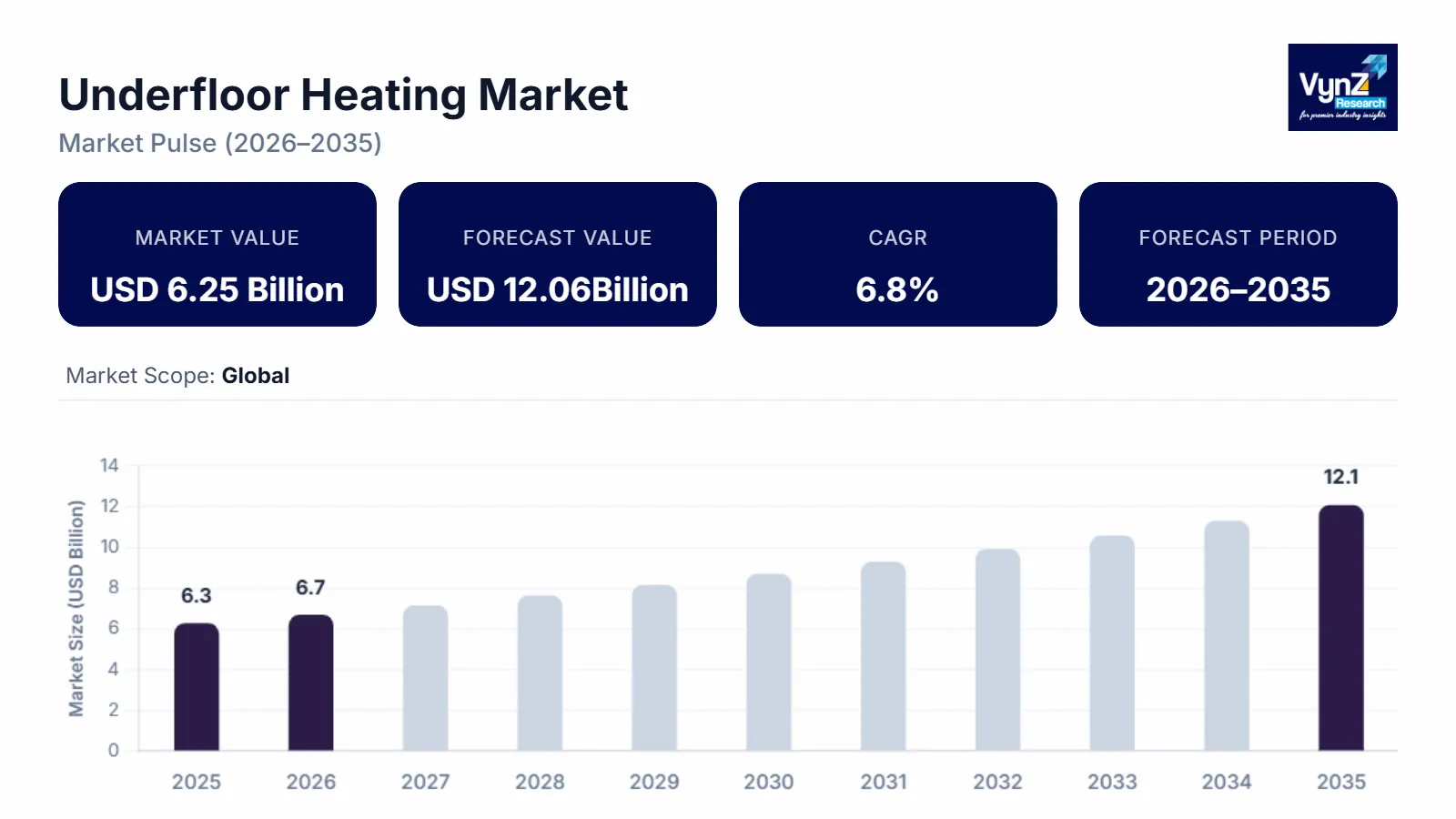
The underfloor heating market is growing due to the rising need for energy-efficient heating, the rise in demand for building renovations, the inclusion of heat pumps, and the presence of smart thermostats. The revised European Energy Performance of Buildings Directive is promoting building renovations and decarbonization, and the International Energy Agency is considering underfloor heating as an appropriate method of distributing heat from air-to-water and geothermal heat pumps
Research Methodology
VynZ Research undertakes extensive secondary research, individual company analysis, technological evaluation, demand analysis by region, construction activity, heating system adoption, and regulatory guidance to understand the underfloor heating market. Our team at VynZ Research reads through government data, energy performance directives, building renovation programs, industry regulations, company reports, and other reliable resources to come up with market sizes and projections. Factors considered in our analysis include electric and hydronic underfloor heating, their installation rates, applications in building construction, technology usage, and regional construction activity levels.
Research Highlights
- Hydronic systems accounted for approximately 60.90% of the market in 2025,due to compatibility with large-area heating and low-temperature heat sources.
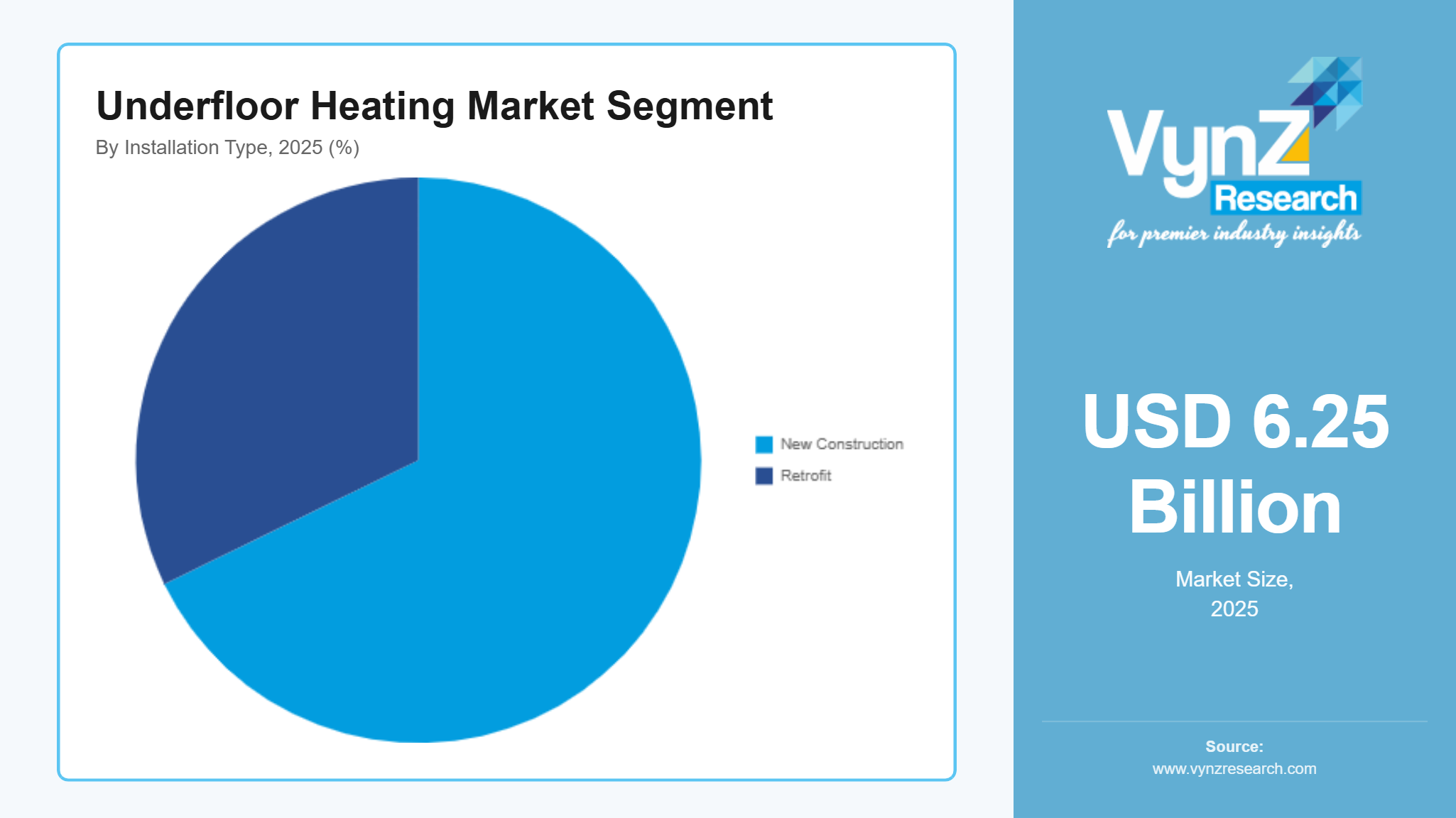
- New construction represented about 67.80% in 2025, supported by easier system integration during building design and installation.
- Residential applications contributed nearly 53.90% in 2025, driven by demand for comfort, concealed heating, and energy-efficient building systems.
- Retrofit installations are projected to expand at approximately 10.00% CAGR, supported by building-renovation activity and low-profile system technologies.
- Europe accounted for approximately 28.20% in 2025, due to building-efficiency policies, renovation programs, and established radiant-heating infrastructure.
Underfloor Heating Market Dynamics
Market Trends
The underfloor heating industry is moving towards low-temperature and digital control. Hydronic floor heating is particularly compatible with heat pumps since the large heated surface can operate at lower water temperatures. Smart thermostats, zoning, weather responsive controls and remote monitoring are also becoming increasingly relevant as building owners seek to have better control of their energy consumption. The International Energy Agency identifies heat pumps plus underfloor heating as an established building-heating configuration, while the European Commission continues to promote efficient heating systems and building renovation. Another key trend is thinning and faster retrofit systems; manufacturers are introducing dry construction panels, low-height systems and direct-flooring technologies that reduce structural alterations and installation time.
Growth Drivers
The growth of the market is largely driven by building energy-efficiency requirements and renovation. The European Commission reports that about 75% of EU buildings have poor energy performance and is targeting a substantial increase in renovation activity. Heating-system upgrades are specifically identified as an energy-renovation measure, creating opportunities for radiant heating solutions in residential and commercial buildings. Heat-pump deployment is another important growth factor; underfloor heating can operate effectively with low-temperature hydronic heat distribution, supporting the transition from fossil-fuel to electrified systems.
Market Restraints / Challenges
Despite favorable growth prospects, high initial installation costs remain a major constraint, particularly for retrofit projects that require floor reconstruction, insulation improvements, electrical work or hydronic distribution. Project economics can be less attractive when installation requires substantial changes to floor height, doors, finishes or existing heating infrastructure. In addition, underfloor heating requires appropriate system design, installation, commissioning and floor-covering compatibility. Retrofit projects can therefore be more technically complex than new construction. Installer availability is also relevant, as hydronic systems require correct pipework spacing, manifold balancing, pressure testing and control configuration. These requirements can increase project time and installation costs where qualified specialists are limited.
Market Opportunities
The market presents significant opportunities in building renovation and low-profile systems. The European Commission's renovation policies emphasize improvements to heating systems, insulation, digital controls and renewable-energy integration, creating demand for technologies that can be incorporated into existing structures. Another opportunity is in the smart control and heat-pump-friendly hydronic systems; connected thermostats can provide zoning, remote monitoring, scheduling and adaptive temperature control, while manufacturers are developing systems suited to low-temperature renewable heating.
Global Underfloor Heating Market Report Coverage
|
Report Metric |
Details |
|
Historical Period |
2020 - 2024 |
|
Base Year Considered |
2025 |
|
Forecast Period |
2026 - 2035 |
|
Market Size in 2025 |
USD 6.25 Billion |
|
Revenue Forecast in 2035 |
USD 12.08 Billion |
|
Growth Rate |
6.8% |
|
Segments Covered in the Report |
Offering, System Type, Installation Type, Application |
|
Report Scope |
Market Trends, Drivers, and Restraints; Revenue Estimation and Forecast; Segmentation Analysis; Companies’ Strategic Developments; Market Share Analysis of Key Players; Company Profiling |
|
Regions Covered in the Report |
Europe, North America, Asia Pacific, Rest of World |
|
Key Companies |
Amuheat, Danfoss, Honeywell, Mitsubishi Electric, REHAU, Schlüter-Systems, Siemens, Uponor, Warmup, Watts |
|
Customization |
Available upon request |
Underfloor Heating Market Segmentation
By Offering
Hardware accounted for approximately 84.10% of market revenue in 2025, reflecting the substantial value of pipes, electric heating elements, manifolds, insulation components, actuators, thermostats, and related installation products required for each system.
The services segment is estimated to expand at approximately 8.90% CAGR through the forecast period, supported by installation, commissioning, configuration, maintenance, and system optimisation.
By System Type
Hydronic systems held roughly 60.90% of market revenue in 2025, due to their suitability for larger floor areas, residential developments, commercial buildings, and integration with heat pumps.
Electric systems are expected to register approximately 8.30% CAGR, benefiting from simpler installation requirements and suitability for bathrooms, individual rooms, renovation projects, and areas where extending a hydronic network is impractical.
By Installation Type
New construction contributed almost 67.80% of the market in 2025, as underfloor heating can be incorporated into the original building design alongside insulation, floor structure, heating equipment, and controls.
Retrofit installations are projected to record approximately 10% CAGR during 2026 to 2035. Growth is supported by renovation programs, energy-efficiency requirements, and the development of thinner systems that reduce floor-height constraints.
By Application
Residential applications accounted for approximately 53.90% of market revenue in 2025, owing to demand for indoor comfort, concealed heating, renovation, and integration with modern heating technologies.
Commercial applications are expected to expand by 9.32% CAGR as hotels, offices, retail buildings, and other facilities seek energy-efficient heating and improved occupant comfort.
Regional Insights
Europe
Europe accounted for approximately 28.20% of the underfloor heating market in 2025, supported by established radiant-heating infrastructure, renovation programs, and stringent building-energy requirements. The revised Energy Performance of Buildings Directive aims to improve building performance and progressively decarbonize the building stock, creating a favorable environment for efficient heating technologies. The European Commission also identifies heating-system efficiency, renewable-energy integration, and digital controls as important elements of building renovation. These measures support demand for hydronic systems, smart thermostats, and low-temperature heating solutions.
North America
North America represented approximately 24.10% of market revenue in 2025, supported by residential construction, remodeling activity, electric floor-heating adoption, and hydronic radiant systems. Demand is concentrated particularly in colder regions and renovation projects where targeted floor heating can supplement or replace conventional heating. Smart controls are strengthening system functionality through mobile applications, programmable schedules, floor-temperature sensing, and integration with broader home-automation platforms. Manufacturers operating in the region are also developing modular panels and electric systems intended to simplify installation.
Asia Pacific
Asia Pacific held nearly 24% of the market in 2025 and is projected to record about 10.10% CAGR from 2026 to 2035. Growth is supported by urban residential construction, increasing demand for indoor comfort, smart-building development, and expanding adoption of energy-efficient heating technologies. Heat-pump deployment provides an additional demand channel. The IEA reported that China remained the world's largest heat-pump market, while Japan also recorded growth in heat-pump sales. Integration of low-temperature heat distribution with building controls creates additional opportunities for underfloor systems.
Rest of World
Rest of World accounted for the remaining 23.70% of the market in 2025, covering Latin America, the Middle East, and Africa. Demand varies substantially according to climate, building design, construction standards, energy prices, and the prevalence of conventional heating systems. Commercial and hospitality projects provide opportunities in selected markets, while adoption in Africa and parts of Latin America remains constrained by installation costs, specialist availability, and lower heating requirements in warmer climates.
Competitive Landscape / Company Insights
The underfloor heating market is moderately competitive, with manufacturers differentiated through hydronic and electric system technologies, heating components, controls, installation solutions, and regional distribution networks. Companies are increasingly focusing on low-profile retrofit systems, smart thermostats, heat-pump compatibility, and easier commissioning. Product development is also moving toward integrated solutions that combine heating elements, controls, insulation, and installation accessories. Recent industry developments from Uponor, Danfoss, REHAU, Schlüter-Systems, and Watts demonstrate continued investment in efficient radiant-heating technologies.
Mini Profiles
Amuheat provides electric and hydronic underfloor heating solutions, serving residential and selected commercial applications with systems designed around installation flexibility and controlled radiant heating.
Honeywell contributes heating-control and building-automation technologies that support temperature management, connected controls, and broader energy-management requirements in modern buildings.
Mitsubishi Electric develops heat-pump and climate-control technologies that can support low-temperature heating configurations and integrated building energy solutions.
Siemens provides building automation and heating-control technologies that support connected building management, energy optimisation, and intelligent climate-control infrastructure.
Warmup specialises in electric and hydronic underfloor heating systems, with smart thermostats, connected controls, and installation solutions for new construction and renovation projects.
Key Players
- Amuheat
- Danfoss
- Honeywell
- Mitsubishi Electric Corporation
- REHAU
- Schlüter-Systems
- Siemens
- Uponor
- Warmup
- Watts Water Technologies
Recent Developments
Danfoss showcased its Icon2 hydronic floor-heating solution at ISH 2025 with wired and wireless thermostats and app-guided commissioning. The system also integrates with the Danfoss Ally platform for broader heating control.
REHAU introduced the RAUTHERM NEO-X5 pipe for surface-heating applications in 2025. The five-layer pipe design focuses on easier installation, flexibility, and reliability across common floor-heating installation systems.
Schlüter-Systems presented its BEKOTEC-THERM and DITRA-HEAT-E surface-heating systems at ISH 2025. The company highlighted thin-layer radiant heating and compatibility with renewable energy sources for residential and commercial buildings.
Uponor introduced Siccus 16 as a 2025 innovation for dry underfloor heating and renovation applications. The system uses a low-height construction and direct flooring approach designed to reduce installation complexity and project time.
Watts continued expanding its radiant-heating portfolio, including hydronic and electric underfloor solutions, controls, tubing, panels, and floor-heating accessories. Its 2025 sustainability reporting also identifies hydronic and electric heating systems for under-floor radiant applications within its HVAC portfolio.
Global Underfloor Heating Market Coverage
Offering Insight and Forecast 2026 - 2035
- Hardware
- Services
System Type Insight and Forecast 2026 - 2035
- Electric
- Hydronic
Installation Type Insight and Forecast 2026 - 2035
- New Construction
- Retrofit
Application Insight and Forecast 2026 - 2035
- Residential
- Commercial
- Institutional
- Industrial
Global Underfloor Heating Market by Region
- North America
- By Offering
- By System Type
- By Installation Type
- By Application
- By Country - U.S., Canada, Mexico
- Europe
- By Offering
- By System Type
- By Installation Type
- By Application
- By Country - Germany, U.K., France, Italy, Spain, Russia, Rest of Europe
- Asia-Pacific (APAC)
- By Offering
- By System Type
- By Installation Type
- By Application
- By Country - China, Japan, India, South Korea, Vietnam, Thailand, Malaysia, Rest of Asia-Pacific
- Rest of the World (RoW)
- By Offering
- By System Type
- By Installation Type
- By Application
- By Country - Brazil, Saudi Arabia, South Africa, U.A.E., Other Countries
Table of Contents for Underfloor Heating Market Report
1. Research Overview
1.1. The Report Offers
1.2. Market Coverage
1.2.1. By
Offering
1.2.2. By
System Type
1.2.3. By
Installation Type
1.2.4. By
Application
1.3. Research Phases
1.4. Limitations
1.5. Market Methodology
1.5.1. Data Sources
1.5.1.1.
Primary Research
1.5.1.2.
Secondary Research
1.5.2. Methodology
1.5.2.1.
Data Exploration
1.5.2.2.
Forecast Parameters
1.5.2.3.
Data Validation
1.5.2.4.
Assumptions
1.5.3. Study Period & Data Reporting Unit
2. Executive Summary
3. Industry Overview
3.1. Industry Dynamics
3.1.1. Market Growth Drivers
3.1.2. Market Restraints
3.1.3. Key Market Trends
3.1.4. Major Opportunities
3.2. Industry Ecosystem
3.2.1. Porter’s Five Forces Analysis
3.2.2. Recent Development Analysis
3.2.3. Value Chain Analysis
3.3. Competitive Insight
3.3.1. Competitive Position of Industry
Players
3.3.2. Market Attractive Analysis
3.3.3. Market Share Analysis
4. Global Market Estimate and Forecast
4.1. Global Market Overview
4.2. Global Market Estimate and Forecast to 2035
5. Market Segmentation Estimate and Forecast
5.1. By Offering
5.1.1. Hardware
5.1.1.1. Market Definition
5.1.1.2. Market Estimation and Forecast to 2035
5.1.2. Services
5.1.2.1. Market Definition
5.1.2.2. Market Estimation and Forecast to 2035
5.2. By System Type
5.2.1. Electric
5.2.1.1. Market Definition
5.2.1.2. Market Estimation and Forecast to 2035
5.2.2. Hydronic
5.2.2.1. Market Definition
5.2.2.2. Market Estimation and Forecast to 2035
5.3. By Installation Type
5.3.1. New Construction
5.3.1.1. Market Definition
5.3.1.2. Market Estimation and Forecast to 2035
5.3.2. Retrofit
5.3.2.1. Market Definition
5.3.2.2. Market Estimation and Forecast to 2035
5.4. By Application
5.4.1. Residential
5.4.1.1. Market Definition
5.4.1.2. Market Estimation and Forecast to 2035
5.4.2. Commercial
5.4.2.1. Market Definition
5.4.2.2. Market Estimation and Forecast to 2035
5.4.3. Institutional
5.4.3.1. Market Definition
5.4.3.2. Market Estimation and Forecast to 2035
5.4.4. Industrial
5.4.4.1. Market Definition
5.4.4.2. Market Estimation and Forecast to 2035
6. North America Market Estimate and Forecast
6.1. By
Offering
6.2. By
System Type
6.3. By
Installation Type
6.4. By
Application
6.4.1.
U.S. Market Estimate and Forecast
6.4.2.
Canada Market Estimate and Forecast
6.4.3.
Mexico Market Estimate and Forecast
7. Europe Market Estimate and Forecast
7.1. By
Offering
7.2. By
System Type
7.3. By
Installation Type
7.4. By
Application
7.4.1.
Germany Market Estimate and Forecast
7.4.2.
France Market Estimate and Forecast
7.4.3.
U.K. Market Estimate and Forecast
7.4.4.
Italy Market Estimate and Forecast
7.4.5.
Spain Market Estimate and Forecast
7.4.6.
Russia Market Estimate and Forecast
7.4.7.
Rest of Europe Market Estimate and Forecast
8. Asia-Pacific (APAC) Market Estimate and Forecast
8.1. By
Offering
8.2. By
System Type
8.3. By
Installation Type
8.4. By
Application
8.4.1.
China Market Estimate and Forecast
8.4.2.
Japan Market Estimate and Forecast
8.4.3.
India Market Estimate and Forecast
8.4.4.
South Korea Market Estimate and Forecast
8.4.5.
Rest of Asia-Pacific Market Estimate and Forecast
9. Rest of the World (RoW) Market Estimate and Forecast
9.1. By
Offering
9.2. By
System Type
9.3. By
Installation Type
9.4. By
Application
9.4.1.
Brazil Market Estimate and Forecast
9.4.2.
Saudi Arabia Market Estimate and Forecast
9.4.3.
South Africa Market Estimate and Forecast
9.4.4.
U.A.E. Market Estimate and Forecast
9.4.5.
Other Countries Market Estimate and Forecast
10. Company Profiles
10.1.
Amuheat
10.1.1.
Snapshot
10.1.2.
Overview
10.1.3.
Offerings
10.1.4.
Financial
Insight
10.1.5.
Recent
Developments
10.2.
Danfoss
10.2.1.
Snapshot
10.2.2.
Overview
10.2.3.
Offerings
10.2.4.
Financial
Insight
10.2.5.
Recent
Developments
10.3.
Honeywell
10.3.1.
Snapshot
10.3.2.
Overview
10.3.3.
Offerings
10.3.4.
Financial
Insight
10.3.5.
Recent
Developments
10.4.
Mitsubishi Electric Corporation
10.4.1.
Snapshot
10.4.2.
Overview
10.4.3.
Offerings
10.4.4.
Financial
Insight
10.4.5.
Recent
Developments
10.5.
REHAU
10.5.1.
Snapshot
10.5.2.
Overview
10.5.3.
Offerings
10.5.4.
Financial
Insight
10.5.5.
Recent
Developments
10.6.
Schlüter-Systems
10.6.1.
Snapshot
10.6.2.
Overview
10.6.3.
Offerings
10.6.4.
Financial
Insight
10.6.5.
Recent
Developments
10.7.
Siemens
10.7.1.
Snapshot
10.7.2.
Overview
10.7.3.
Offerings
10.7.4.
Financial
Insight
10.7.5.
Recent
Developments
10.8.
Uponor
10.8.1.
Snapshot
10.8.2.
Overview
10.8.3.
Offerings
10.8.4.
Financial
Insight
10.8.5.
Recent
Developments
10.9.
Warmup
10.9.1.
Snapshot
10.9.2.
Overview
10.9.3.
Offerings
10.9.4.
Financial
Insight
10.9.5.
Recent
Developments
10.10.
Watts Water Technologies
10.10.1.
Snapshot
10.10.2.
Overview
10.10.3.
Offerings
10.10.4.
Financial
Insight
10.10.5.
Recent
Developments
11. Appendix
11.1. Exchange Rates
11.2. Abbreviations
Note: Financial insight and recent developments of different companies are subject to the availability of information in the secondary domain.
Frequently Asked Questions
Purchase Options
Latest Report
Research Methodology
- Desk Research / Pilot Interviews
- Build Market Size Model
- Research and Analysis
- Final Deliverable
Connect With Our Sales Team
- Toll-Free: +1-888-253-3960
- Phone: +91 9960 288 381
- Email: enquiry@vynzresearch.com
Underfloor Heating Market