
Metal Pallet Market Size & Share Growth Forecast Report (2026-2035)
Industry Insight by Material Type (Steel Pallets, Other Metal Pallets), by Application (Logistics and Transportation Enterprises, Manufacturing Enterprises, Others), by Design Type (Standard, Stackable, Rackable, Collapsible, Customized), by End Use (Manufacturing, Logistics and Transportation, Warehousing and Distribution, Automotive, Chemicals and Pharmaceuticals, Food and Beverage, Other Industrial Users)
| Status : Published | Published On : Oct, 2026 | Report Code : VREP3072 | Industry : Energy & Power | Available Format :

|
Page : 165 |
Metal Pallet Market Overview
The metal pallet market size was estimated at USD 2.08 billion in 2025, reaching USD 2.19 billion in 2026 and projected to rise to USD 3.41 billion in 2035, expanding at approximately 5.3% CAGR from 2026 to 2035.
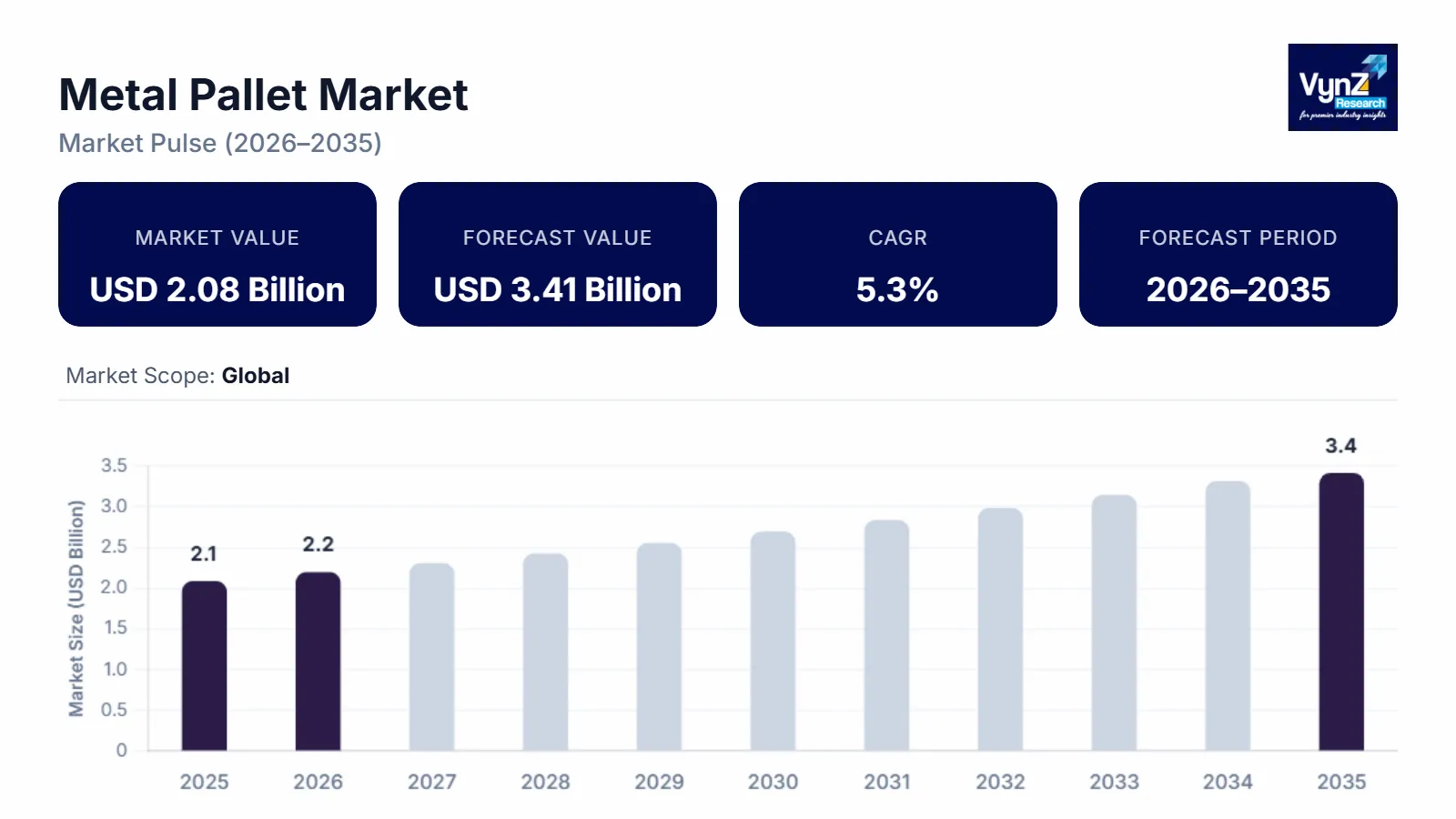
The market is supported by a rise in demand for durable reusable handling platforms across manufacturing, logistics, warehousing, automotive, chemicals, and industrial supply chains. Metal pallets are most relevant in environments where high load bearing capacity, frequent handling, flame resistance, dimensional accuracy, and a longer service life are critical factors. The European Commission's Packaging and Packaging Waste Regulation has also contributed significantly to the larger shift towards reusable transport packaging, including pallets.
The market growth is fueled by increased manufacturing activity, the rise of organized warehousing, and a heightened focus on reusable transport packaging, in addition to the growing need for heavy-duty material handling systems. The European Commission's Packaging and Packaging Waste Regulation is imposing a 40% re-use target for specified transport packaging by 2030, with pallets as one of the specified formats included in the legislation. The regulation, therefore, provides a policy foundation for increased adoption of reusable pallet systems across the European supply chains.
Research Methodology
VynZ Research utilizes secondary research, industry assessment, company analysis, and application mapping, and data triangulation to estimate the market size and forecast its trajectory. VynZ Research team analyzes material composition, pallet designs, applications, industrial demand, logistics activity, regional manufacturing activity, and regulatory developments before finalizing the market estimates. Publically available government and institution information is analyzed alongside company information and industry data to arrive at demand indicators that have been used to verify the market size. Regional and segment estimates are then reconciled with the overall market value to ensure consistency across the 2025 base year and 2026 to 2035 forecast period.
Research Highlights
- Steel pallets accounted for an estimated 82.4% of the market in 2025, supported by high load carrying capacity and widespread industrial use.
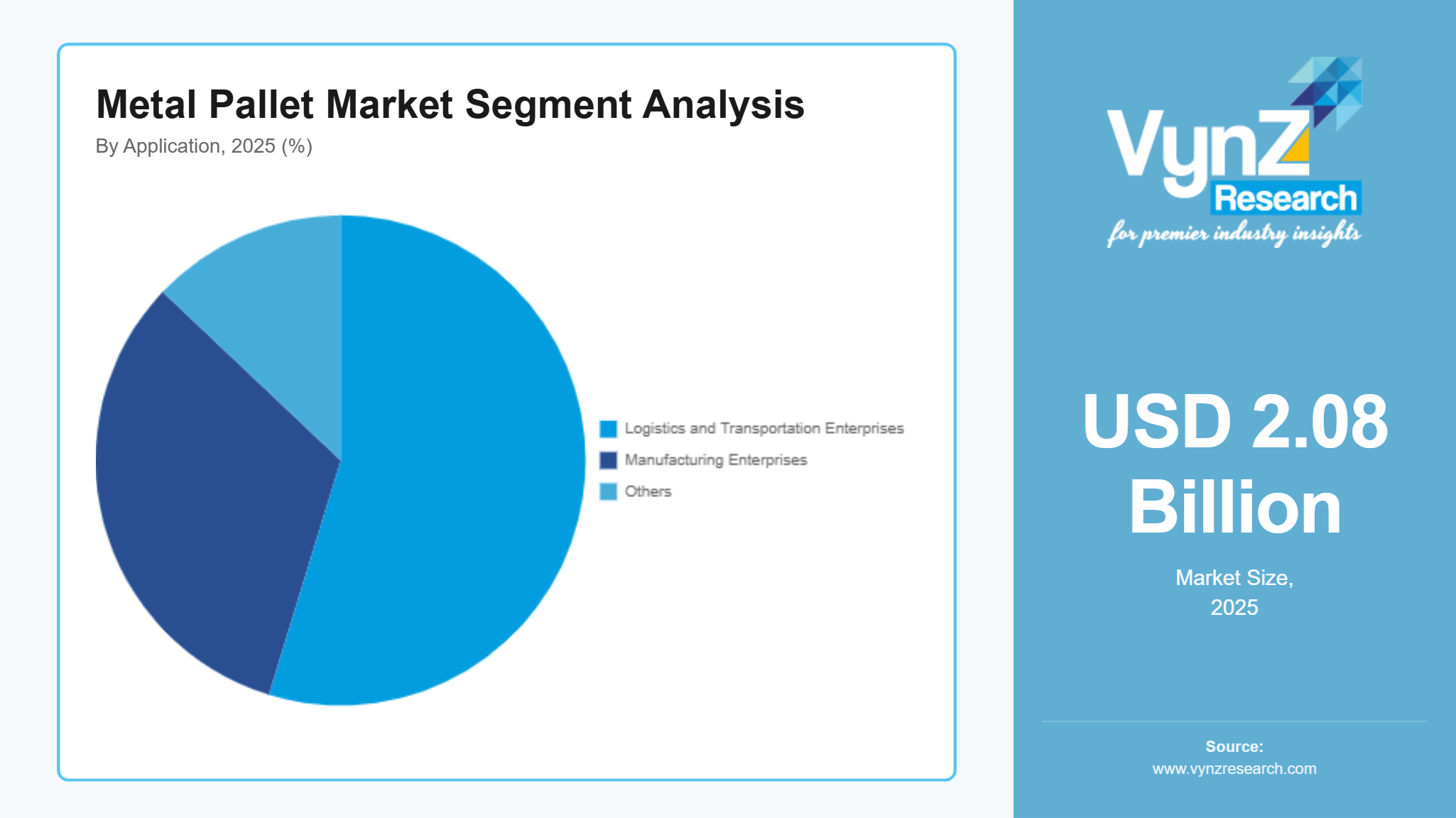
- Logistics and transportation enterprises represented approximately 50.8% of demand in 2025, due to increasing requirements for durable reusable handling platforms.
- Manufacturing enterprises accounted for an estimated 31.6% share in 2025, driven by repeated internal material movement and warehouse storage requirements.
- Other metal pallets are estimated to record approximately 6.7% CAGR from 2026 to 2035, owing to demand for aluminum and specialized corrosion resistant applications.
- North America represented approximately 29.5% of the market in 2025, because of established logistics infrastructure and high industrial handling requirements.
Metal Pallet Market Dynamics
Market Trends
The metal pallet market is witnessing a shift towards durable, reusable, and specialized handling platforms. The preference is for materials that offer long-term benefits and reduced need for replacements. Steel remains the favored choice in the industry due to its superior strength and ability to withstand heavy-duty industrial and warehouse applications. In terms of design, there is a rising demand for stackable, collapsible, galvanized, stainless-steel, and custom-designed pallets. The industry is also witnessing an increased need for pallet specifications that are compatible with automated warehouses. The standardization of size, fork-friendly features, stacking abilities, rackability, and resistance to corrosion is gaining importance in the market.
Growth Drivers
The regional market is driven primarily by the manufacturing and industrial warehousing sectors. These end-markets require pallets that are fit to withstand the constant pressure of forklifts, racks, and heavy-duty transportation. Metal pallets find their use in automobile, engineering, chemical, machineries, and other industrial end-markets. India has a diverse supplier base that offers a wide range of metal pallets. These include light, medium, and heavy-duty, foldable, galvanized, stainless-steel, and mild steel pallets. The demand for reusable transport packaging is also a key growth driver for the market.
Market Restraints/Challenges
The main challenge in front of the market is the high upfront costs associated with metal pallets. Compared to wood and plastic equivalents, metal requires higher raw material inputs and manufacturing efforts. Added to this, customization in size, surface finish, welding, corrosion resistance treatment, and other special needs contribute to higher costs. Such cost implications are a hindrance to the growth of the market. It was also observed that metal pallets are often a bad choice in terms of higher operational costs. The use of metal pallets can increase the overall weight of the transported goods. Such weight considerations are a primary concern for manufacturers and logistics providers when it comes to transportation. The European Commission also states that a transition to reusable transport packaging involves tremendous challenges and entails a considerable investment in adapting packaging logistics.
Market Opportunities
Customized heavy-duty pallets present an attractive growth opportunity for the regional market. Automotive manufacturing units, warehouses, chemical, and engineering plants are major end-users for such pallets. Manufacturers can position themselves as providers of reliable, durable, and specialized handling platforms. The customization can be done in terms of load bearing capacity, rackability, collapsibility, resistance to corrosion, stacking ability, and size. Indian manufacturers offer customized metal pallet solutions for specific customers and applications. Metal pallets can be manufactured with special consideration to a customer’s requirements, drawings, load, size, and storage needs. It was observed that application-specific manufacturing is one of the prime areas that have the potential to become a growth market. The development of a closed-loop logistics model presents an attractive opportunity for the market. It allows the logistics provider to ensure the longest possible use of a pallet before it is taken back and reprocessed.
Global Metal Pallet Market Report Coverage
|
Report Metric |
Details |
|
Historical Period |
2020 - 2024 |
|
Base Year Considered |
2025 |
|
Forecast Period |
2026 - 2035 |
|
Market Size in 2025 |
USD 2.08 Billion |
|
Revenue Forecast in 2035 |
USD 3.41 Billion |
|
Growth Rate |
5.3% |
|
Segments Covered in the Report |
Material Type, Application, Design Type, End Use |
|
Report Scope |
Market Trends, Drivers, and Restraints; Revenue Estimation and Forecast; Segmentation Analysis; Companies’ Strategic Developments; Market Share Analysis of Key Players; Company Profiling |
|
Regions Covered in the Report |
North America, Europe, Asia Pacific, Rest of the World |
|
Key Companies |
Brambles, Durapak, EMD International, Future Industries, Maxpallet, Pilco Marketing and Manufacturing, Saraswati Engineering, Sheetla Techno Industries, Stakall, Sanjay Engineering Works |
|
Customization |
Available upon request |
Metal Pallet Market Segmentation
By Material Type
Steel pallets accounted for the largest share in 2025, estimated at 82.4%, supported by their high load bearing capacity, durability, resistance to repeated industrial handling, and suitability for warehouse racking.
Other metal pallets are expected to record approximately 6.7% CAGR from 2026 to 2035, supported by applications requiring lower weight, corrosion resistance, hygiene, or specialized operating characteristics.
By Application
Logistics and transportation enterprises held the majority share in 2025, estimated at 50.8%, because pallets are fundamental to repeated loading, unloading, storage, and movement across distribution networks.
Manufacturing enterprises represented approximately 31.6% of the 2025 market, supported by internal material movement, production line supply, warehouse storage, and finished goods handling.
By Design Type
Rackable Metal Pallets accounted for 38.2% of the metal pallet market in 2025. Their adoption is supported by the expansion of high-density warehouse racking, automated storage systems, and manufacturing facilities requiring reliable vertical storage.
Stackable metal pallets are expected to register a 4.6% CAGR from 2026 to 2035. Demand is supported by businesses seeking to improve floor-space utilization while maintaining straightforward material handling processes.
By End Use
Manufacturing represented 35.8% of the metal pallet market in 2025 and is projected to grow at a 4.4% CAGR from 2026 to 2035. Manufacturing facilities use metal pallets for production material staging, component movement, assembly-line operations, and finished-goods handling.
Warehousing is expected to expand at a 4.9% CAGR from 2026 to 2035. Warehouse operators increasingly require pallet systems that can withstand repeated loading, unloading, racking, stacking, and automated handling cycles.
Regional Insights
North America
North America accounted for approximately 29.5% of the metal pallet market in 2025, supported by established warehousing, manufacturing, automotive, and logistics infrastructure. The region's demand is influenced by high material handling requirements and the use of standardized warehouse systems. Reusable pallet pooling also has an established presence, with CHEP operating extensive share and reuse networks that support repeated pallet circulation, inspection, repair, and redistribution. These characteristics continue to support demand for durable handling platforms across large supply chains.
Europe
Europe represented approximately 25.8% of revenue in 2025, due to manufacturing, automotive production, logistics infrastructure, and regulatory emphasis on reusable transport packaging. The Packaging and Packaging Waste Regulation requires at least 40% of specified transport packaging to be reusable from 2030, with pallets specifically included among the covered formats. This regulatory direction is strengthening attention toward durable reusable handling systems and lifecycle management across European supply chains.
Asia Pacific
Asia Pacific accounted for approximately 23.1% of the market in 2025, owing to manufacturing expansion, industrial warehousing, export activity, and increasing logistics infrastructure across China, India, Japan, South Korea, and Southeast Asia. India has a broad domestic supplier base for steel and metal pallets, while manufacturers such as Sheetla Techno Industries and Saraswati Engineering provide industrial pallet systems for manufacturing, warehousing, logistics, and export applications. This combination of manufacturing activity and expanding material handling requirements supports regional growth.
Rest of the World
Rest of the World represented the remaining 21.6% of the 2025 market, covering Latin America, the Middle East, Africa, and other markets. Demand is supported by industrial development, logistics infrastructure, manufacturing, chemicals, energy, and warehousing requirements, although adoption differs considerably according to industrial maturity and logistics investment.
Competitive Landscape / Company Insights
The metal pallet market is moderately competitive, with manufacturers and material handling companies competing through load capacity, durability, customization, corrosion protection, stackability, and geographic reach. Regional manufacturers remain important because pallet dimensions and handling requirements often vary by customer and warehouse configuration. Companies are also emphasizing reusable designs and lifecycle performance as supply chains increasingly focus on resource efficiency. CHEP's share and reuse model demonstrates the wider movement toward circular pallet systems, while specialist manufacturers provide customized steel and metal formats for industrial applications.
Mini Profiles
Brambles operates the CHEP share and reuse model, providing reusable pallets and containers across global supply chains, with strong exposure to consumer staples, retail, automotive, and manufacturing applications.
Durapak supplies industrial pallet and material handling solutions in India, serving manufacturing and warehouse requirements where durable pallet construction and repeated handling are important.
EMD International manufactures and supplies steel pallet solutions including galvanized, aluminum, stainless steel, and painted configurations for industrial storage and material handling applications.
Future Industries participates in India's industrial pallet supply base, providing metal pallet solutions for material handling and warehouse applications.
Saraswati Engineering manufactures steel, metal, stainless steel, wire mesh, cage, and customized pallet solutions for industrial, automotive, recycling, and warehouse applications.
Key Players
- Brambles
- Durapak
- EMD International
- Future Industries
- Maxpallet
- Pilco Marketing and Manufacturing Corp.
- Saraswati Engineering
- Sanjay Engineering Works
- Sheetla Techno Industries
- Stakall
Recent Developments
Brambles continued expanding its circular supply chain model through CHEP, with its 2025 annual report highlighting approximately 348 million pallets, crates, and containers across its operations. The company also reported continued development of connected supply chain capabilities and share and reuse systems across automotive, retail, consumer staples, and manufacturing customers.
Maxpallet continued expanding its portfolio of metal pallets and crates for industrial storage and material handling applications. Its current product portfolio includes export metal pallets, all purpose metal pallets, metal crates, and customized handling formats designed for industrial requirements.
Sheetla Techno Industries continued developing its industrial pallet portfolio, including metal, steel, foldable, cage, stackable, and customized pallet formats. Its current offering emphasizes heavy duty construction, corrosion resistance, reusable designs, and compatibility with forklifts, pallet trucks, and automated warehouse systems.
Saraswati Engineering continued supplying customized industrial pallet systems covering steel, stainless steel, wire mesh, cage, and specialized pallet configurations. Its product portfolio serves automotive, recycling, manufacturing, storage, and material handling applications, reflecting continued diversification across industrial pallet requirements.
Stakall continues to manufacture steel, stainless steel, and aluminum pallets and related storage systems, with customized sizes, capacities, and finishes. Its current portfolio includes steel pallets, cage bins, collapsible cage bins, corrugated steel boxes, drum pallets, and stacking frames for material handling applications.
Global Metal Pallet Market Coverage
Material Type Insight and Forecast 2026 - 2035
- Steel Pallets
- Other Metal Pallets
Application Insight and Forecast 2026 - 2035
- Logistics and Transportation Enterprises
- Manufacturing Enterprises
- Others
Design Type Insight and Forecast 2026 - 2035
- Standard
- Stackable
- Rackable
- Collapsible
- Customized
End Use Insight and Forecast 2026 - 2035
- Manufacturing
- Logistics and Transportation
- Warehousing and Distribution
- Automotive
- Chemicals and Pharmaceuticals
- Food and Beverage
- Other Industrial Users
Global Metal Pallet Market by Region
- North America
- By Material Type
- By Application
- By Design Type
- By End Use
- By Country - U.S., Canada, Mexico
- Europe
- By Material Type
- By Application
- By Design Type
- By End Use
- By Country - Germany, U.K., France, Italy, Spain, Russia, Rest of Europe
- Asia-Pacific (APAC)
- By Material Type
- By Application
- By Design Type
- By End Use
- By Country - China, Japan, India, South Korea, Vietnam, Thailand, Malaysia, Rest of Asia-Pacific
- Rest of the World (RoW)
- By Material Type
- By Application
- By Design Type
- By End Use
- By Country - Brazil, Saudi Arabia, South Africa, U.A.E., Other Countries
Table of Contents for Metal Pallet Market Report
1. Research Overview
1.1. The Report Offers
1.2. Market Coverage
1.2.1. By
Material Type
1.2.2. By
Application
1.2.3. By
Design Type
1.2.4. By
End Use
1.3. Research Phases
1.4. Limitations
1.5. Market Methodology
1.5.1. Data Sources
1.5.1.1.
Primary Research
1.5.1.2.
Secondary Research
1.5.2. Methodology
1.5.2.1.
Data Exploration
1.5.2.2.
Forecast Parameters
1.5.2.3.
Data Validation
1.5.2.4.
Assumptions
1.5.3. Study Period & Data Reporting Unit
2. Executive Summary
3. Industry Overview
3.1. Industry Dynamics
3.1.1. Market Growth Drivers
3.1.2. Market Restraints
3.1.3. Key Market Trends
3.1.4. Major Opportunities
3.2. Industry Ecosystem
3.2.1. Porter’s Five Forces Analysis
3.2.2. Recent Development Analysis
3.2.3. Value Chain Analysis
3.3. Competitive Insight
3.3.1. Competitive Position of Industry
Players
3.3.2. Market Attractive Analysis
3.3.3. Market Share Analysis
4. Global Market Estimate and Forecast
4.1. Global Market Overview
4.2. Global Market Estimate and Forecast to 2035
5. Market Segmentation Estimate and Forecast
5.1. By Material Type
5.1.1. Steel Pallets
5.1.1.1. Market Definition
5.1.1.2. Market Estimation and Forecast to 2035
5.1.2. Other Metal Pallets
5.1.2.1. Market Definition
5.1.2.2. Market Estimation and Forecast to 2035
5.2. By Application
5.2.1. Logistics and Transportation Enterprises
5.2.1.1. Market Definition
5.2.1.2. Market Estimation and Forecast to 2035
5.2.2. Manufacturing Enterprises
5.2.2.1. Market Definition
5.2.2.2. Market Estimation and Forecast to 2035
5.2.3. Others
5.2.3.1. Market Definition
5.2.3.2. Market Estimation and Forecast to 2035
5.3. By Design Type
5.3.1. Standard
5.3.1.1. Market Definition
5.3.1.2. Market Estimation and Forecast to 2035
5.3.2. Stackable
5.3.2.1. Market Definition
5.3.2.2. Market Estimation and Forecast to 2035
5.3.3. Rackable
5.3.3.1. Market Definition
5.3.3.2. Market Estimation and Forecast to 2035
5.3.4. Collapsible
5.3.4.1. Market Definition
5.3.4.2. Market Estimation and Forecast to 2035
5.3.5. Customized
5.3.5.1. Market Definition
5.3.5.2. Market Estimation and Forecast to 2035
5.4. By End Use
5.4.1. Manufacturing
5.4.1.1. Market Definition
5.4.1.2. Market Estimation and Forecast to 2035
5.4.2. Logistics and Transportation
5.4.2.1. Market Definition
5.4.2.2. Market Estimation and Forecast to 2035
5.4.3. Warehousing and Distribution
5.4.3.1. Market Definition
5.4.3.2. Market Estimation and Forecast to 2035
5.4.4. Automotive
5.4.4.1. Market Definition
5.4.4.2. Market Estimation and Forecast to 2035
5.4.5. Chemicals and Pharmaceuticals
5.4.5.1. Market Definition
5.4.5.2. Market Estimation and Forecast to 2035
5.4.6. Food and Beverage
5.4.6.1. Market Definition
5.4.6.2. Market Estimation and Forecast to 2035
5.4.7. Other Industrial Users
5.4.7.1. Market Definition
5.4.7.2. Market Estimation and Forecast to 2035
6. North America Market Estimate and Forecast
6.1. By
Material Type
6.2. By
Application
6.3. By
Design Type
6.4. By
End Use
6.4.1.
U.S. Market Estimate and Forecast
6.4.2.
Canada Market Estimate and Forecast
6.4.3.
Mexico Market Estimate and Forecast
7. Europe Market Estimate and Forecast
7.1. By
Material Type
7.2. By
Application
7.3. By
Design Type
7.4. By
End Use
7.4.1.
Germany Market Estimate and Forecast
7.4.2.
France Market Estimate and Forecast
7.4.3.
U.K. Market Estimate and Forecast
7.4.4.
Italy Market Estimate and Forecast
7.4.5.
Spain Market Estimate and Forecast
7.4.6.
Russia Market Estimate and Forecast
7.4.7.
Rest of Europe Market Estimate and Forecast
8. Asia-Pacific (APAC) Market Estimate and Forecast
8.1. By
Material Type
8.2. By
Application
8.3. By
Design Type
8.4. By
End Use
8.4.1.
China Market Estimate and Forecast
8.4.2.
Japan Market Estimate and Forecast
8.4.3.
India Market Estimate and Forecast
8.4.4.
South Korea Market Estimate and Forecast
8.4.5.
Rest of Asia-Pacific Market Estimate and Forecast
9. Rest of the World (RoW) Market Estimate and Forecast
9.1. By
Material Type
9.2. By
Application
9.3. By
Design Type
9.4. By
End Use
9.4.1.
Brazil Market Estimate and Forecast
9.4.2.
Saudi Arabia Market Estimate and Forecast
9.4.3.
South Africa Market Estimate and Forecast
9.4.4.
U.A.E. Market Estimate and Forecast
9.4.5.
Other Countries Market Estimate and Forecast
10. Company Profiles
10.1.
Brambles
10.1.1.
Snapshot
10.1.2.
Overview
10.1.3.
Offerings
10.1.4.
Financial
Insight
10.1.5.
Recent
Developments
10.2.
Durapak
10.2.1.
Snapshot
10.2.2.
Overview
10.2.3.
Offerings
10.2.4.
Financial
Insight
10.2.5.
Recent
Developments
10.3.
EMD International
10.3.1.
Snapshot
10.3.2.
Overview
10.3.3.
Offerings
10.3.4.
Financial
Insight
10.3.5.
Recent
Developments
10.4.
Future Industries
10.4.1.
Snapshot
10.4.2.
Overview
10.4.3.
Offerings
10.4.4.
Financial
Insight
10.4.5.
Recent
Developments
10.5.
Maxpallet
10.5.1.
Snapshot
10.5.2.
Overview
10.5.3.
Offerings
10.5.4.
Financial
Insight
10.5.5.
Recent
Developments
10.6.
Pilco Marketing & Manufacturing Corp.
10.6.1.
Snapshot
10.6.2.
Overview
10.6.3.
Offerings
10.6.4.
Financial
Insight
10.6.5.
Recent
Developments
10.7.
Saraswati Engineering
10.7.1.
Snapshot
10.7.2.
Overview
10.7.3.
Offerings
10.7.4.
Financial
Insight
10.7.5.
Recent
Developments
10.8.
Sanjay Engineering Works
10.8.1.
Snapshot
10.8.2.
Overview
10.8.3.
Offerings
10.8.4.
Financial
Insight
10.8.5.
Recent
Developments
10.9.
Sheetla Techno Industries
10.9.1.
Snapshot
10.9.2.
Overview
10.9.3.
Offerings
10.9.4.
Financial
Insight
10.9.5.
Recent
Developments
10.10.
Stakall
10.10.1.
Snapshot
10.10.2.
Overview
10.10.3.
Offerings
10.10.4.
Financial
Insight
10.10.5.
Recent
Developments
11. Appendix
11.1. Exchange Rates
11.2. Abbreviations
Note: Financial insight and recent developments of different companies are subject to the availability of information in the secondary domain.
Frequently Asked Questions
Purchase Options
Latest Report
Research Methodology
- Desk Research / Pilot Interviews
- Build Market Size Model
- Research and Analysis
- Final Deliverable
Connect With Our Sales Team
- Toll-Free: +1-888-253-3960
- Phone: +91 9960 288 381
- Email: enquiry@vynzresearch.com
Metal Pallet Market