
Renewable Energy Market Size & Share Growth Forecast Report (2026-2035)
Industry Insight by Type (Solar Energy, Wind Energy, Hydropower, Bioenergy, Others), by Application (Power Generation, Heating & Cooling, Transportation), by Installation Type (Utility Scale, Distributed Generation), by End Use (Residential, Commercial, Industrial, Utility)
| Status : Published | Published On : Jul, 2026 | Report Code : VREP3071 | Industry : Energy & Power | Available Format :

|
Page : 176 |
Renewable Energy Market Overview
The renewable energy market size was estimated at USD 1260 billion in 2025 and is expected to reach around USD 1420 billion in 2026, rising to roughly USD 4600 billion by 2035, growing at approximately 12.48% CAGR from 2026 to 2035.
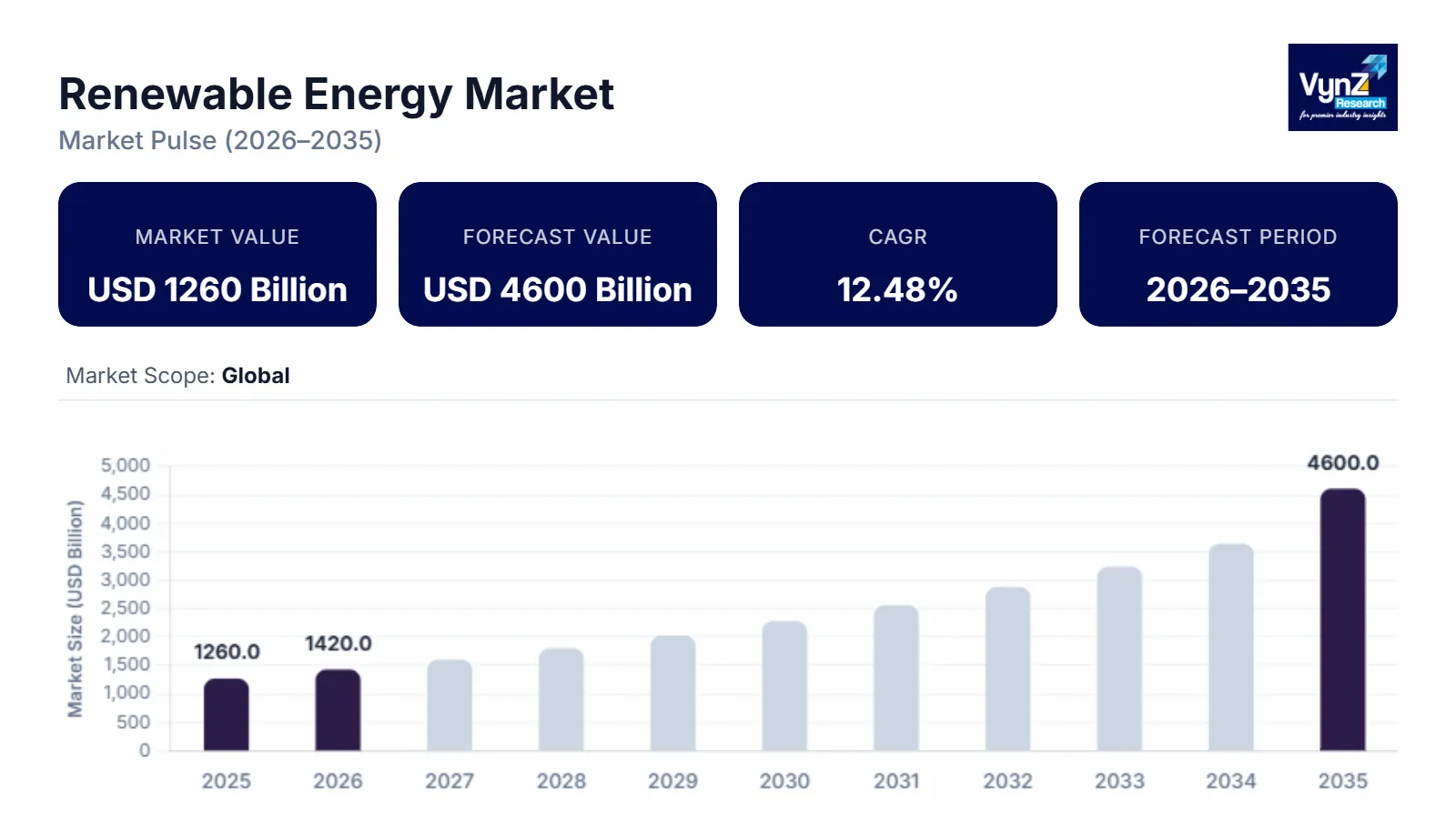
Research Highlights
- Solar energy held 38.6% share in 2025, driven by declining photovoltaic module costs.
- Power generation captured 69.2% share in 2025, supported by rising electricity demand.
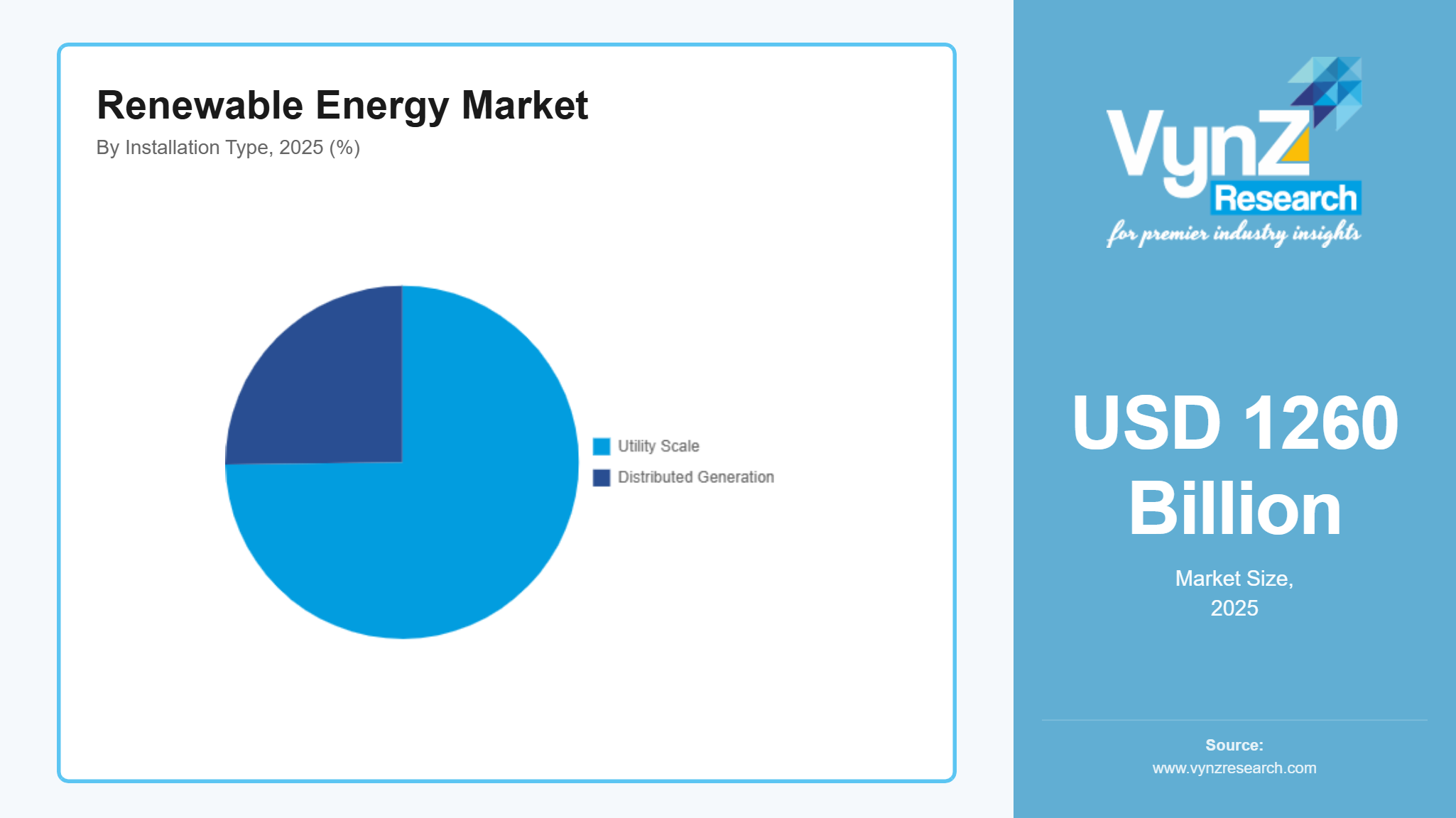
- Utility scale installations accounted for 74.8% share in 2025, owing to infrastructure investments.
- Wind energy is projected to grow at 13.8% CAGR, driven by offshore wind expansion.
- Asia Pacific contributed 42.8% share in 2025, supported by renewable capacity expansion.
Growth in this market is being fueled by rising investment in clean energy infrastructure, government policies that support decarbonization, and the fast pace at which solar and wind capacity is being added. Energy storage and smart grid technologies are also seeing wider adoption, which is adding further momentum. Residential, commercial, and industrial sectors are all pushing demand for low carbon electricity, and this is being reinforced by continued backing from organizations like the International Renewable Energy Agency (IRENA) and the International Energy Agency (IEA), along with renewable deployment programs funded through the World Bank. Together, these factors are helping the market expand across Asia Pacific, Europe, and North America.
Renewable Energy Market Dynamics
Market Trends
Clean energy deployment, digital grid management, and energy storage integration are all shifting in noticeable ways across the Renewable Energy Market. Utility scale solar and offshore wind projects are expanding at a fast clip, solar alone held roughly 38.6% share in 2025, reflecting a growing preference for sustainable electricity generation, better energy efficiency, and lower carbon emissions. According to the International Renewable Energy Agency (IRENA), renewable capacity additions keep picking up pace, helped along by favorable government policies and falling technology costs. Battery energy storage systems and smart grid technologies are another area seeing rapid integration, pushed forward by digital innovation and national energy transition strategies. The International Energy Agency (IEA) points to rising investment in grid modernization as a way to improve renewable energy integration and system reliability. As a result, companies are putting more focus on integrated clean energy solutions, advanced monitoring systems, and flexible power management, which is sharpening competition across the market.
Growth Drivers
Accelerating decarbonization initiatives are a major factor behind the market's growth, generating steady demand across residential, commercial, utility, and industrial sectors alike with the utility segment alone holding around 51.7% end-use share in 2025. Investment continues to grow in renewable power plants, transmission infrastructure, and energy storage facilities, which is speeding up market expansion even further. Both the International Renewable Energy Agency (IRENA) and the World Bank remain active in supporting renewable energy deployment through financing programs and policy guidance. Government climate commitments also play a crucial role in driving adoption. Utilities, industries, and businesses are placing greater priority on energy security, cost efficiency, and carbon reduction, and demand for renewable power generation technologies is expected to hold strong through the forecast period. The International Energy Agency (IEA) continues to report growing investment in renewable electricity, driven by long term clean energy policies.
Market Restraints / Challenges
Even with favorable growth prospects, the Renewable Energy Market isn't without its challenges. High capital investment requirements and ongoing supply chain disruptions continue to weigh on project development and profitability, especially in emerging economies where financing access is limited. The World Bank has flagged financing constraints and infrastructure gaps as key barriers slowing renewable energy deployment. Grid integration and transmission limitations add further operational challenges for developers and utilities, particularly as utility scale installations, which made up roughly 74.8% of market revenue in 2025, continue to expand. Reliance on critical minerals and imported renewable energy components can push project costs higher and cause delivery delays during periods of economic uncertainty. The International Energy Agency (IEA) continues to stress the need for stronger electricity networks and more resilient supply chains to sustain long term renewable energy growth.
Market Opportunities
Utility scale renewable power generation offers significant opportunity, driven largely by rising electricity demand, energy transition goals, and ongoing technological advancements. Companies that offer high efficiency solar modules, advanced wind turbines, and integrated energy storage solutions are well placed to capture growing demand from utilities, industries, and commercial customers, a segment expected to grow at roughly 13.5% CAGR through 2035. The International Renewable Energy Agency (IRENA) continues to promote renewable energy deployment worldwide through policy and investment support. Green hydrogen production and battery energy storage represent another key opportunity area, with rising investment in advanced clean energy technologies opening the door to higher value projects and long-term partnerships. Smart grids, digital energy management, and storage technologies are all expected to improve grid flexibility and how effectively renewable energy is utilized. Both the International Energy Agency (IEA) and the World Bank continue to back these developments through energy transition and infrastructure programs.
Global Renewable Energy Market Report Coverage
|
Report Metric |
Details |
|
Historical Period |
2020 - 2024 |
|
Base Year Considered |
2025 |
|
Forecast Period |
2026 - 2035 |
|
Market Size in 2025 |
USD 1260 Billion |
|
Revenue Forecast in 2035 |
USD 4600 Billion |
|
Growth Rate |
12.48% |
|
Segments Covered in the Report |
Type, Application, Installation Type, End Use |
|
Report Scope |
Market Trends, Drivers, and Restraints; Revenue Estimation and Forecast; Segmentation Analysis; Companies’ Strategic Developments; Market Share Analysis of Key Players; Company Profiling |
|
Regions Covered in the Report |
Asia Pacific, Europe, North America, Rest of the World |
|
Key Companies |
ACEN Corporation, Brookfield Renewable Partners, Encavis AG, Enel Green Power, Iberdrola S.A., Neoen S.A., NextEra Energy, Inc., Sembcorp Industries Ltd., Siemens Gamesa Renewable Energy S.A., Vestas Wind Systems A/S |
|
Customization |
Available upon request |
Renewable Energy Market Segmentation
By Type
Solar energy held the largest share at roughly 38.6% in 2025, and it's expected to grow at around 13.1% CAGR through 2035. Falling photovoltaic module costs, fast utility scale rollout, and favorable government incentives keep reinforcing its lead. The International Renewable Energy Agency (IRENA) and the International Energy Agency (IEA) continue to log record additions in global solar capacity, backed by long term clean energy transition policies and rising investment in grid connected renewable projects. Wind energy is set to grow the fastest of the group, at an estimated 13.8% CAGR over the forecast period. Offshore wind projects are expanding, turbine efficiency keeps improving, and investment in large scale renewable infrastructure is picking up across both developed and emerging economies. The Global Wind Energy Council (GWEC) and the International Energy Agency (IEA) point to strong policy support along with growing public and private investment as the main drivers behind this long-term expansion.
By Application
Power generation was the dominant segment in 2025, at roughly 69.2% share, and it's projected to grow at about 12.3% CAGR through 2035. Rising electricity demand, quickening decarbonization efforts, and steady investment in renewable generation assets all keep this segment strong. The International Energy Agency (IEA) and the International Renewable Energy Agency (IRENA) continue to push renewable electricity expansion through energy transition frameworks and infrastructure spending. Transportation is expected to see the fastest growth of the three, at an estimated 13.6% CAGR. Renewable electricity, biofuels, and green hydrogen are all gaining ground across road, rail, and marine transport, and this is driving market growth. National decarbonization strategies and clean fuel programs backed by the International Energy Agency (IEA) are encouraging wider adoption of renewable energy in transportation.
By Installation Type
Utility scale installations made up around 74.8% of market revenue in 2025 and are projected to grow at roughly 12.4% CAGR through 2035. Continued investment in large renewable power plants, transmission infrastructure, and national energy transition programs keeps demand strong here. The International Renewable Energy Agency (IRENA) and the World Bank continue to support utility scale renewable projects through financing and policy assistance. Distributed generation is set to grow fastest, at an estimated 13.3% CAGR. Rooftop solar installations, commercial microgrids, and decentralized energy systems are on the rise, improving energy access and lowering electricity costs for consumers. Government backed clean energy programs and grid modernization efforts continue to speed up distributed renewable deployment across residential and commercial sectors.
By End Use
The utility segment led with the highest revenue share, at roughly 51.7% in 2025, and is expected to grow at about 12.2% CAGR through 2035. Growing deployment of utility scale renewable projects, grid expansion, and national carbon reduction targets keep demand strong in this segment. The International Renewable Energy Agency (IRENA) and the International Energy Agency (IEA) continue to support utility scale renewable deployment through policy recommendations and investment frameworks. The industrial segment is expected to grow the fastest, at an estimated 13.5% CAGR. Renewable electricity adoption, corporate sustainability commitments, and industrial decarbonization efforts continue to drive demand across manufacturing, mining, and heavy industries. The World Bank and the International Energy Agency (IEA) continue to encourage renewable energy integration through industrial efficiency and clean energy investment programs.
Regional Insights
Asia Pacific
Asia Pacific held around 42.8% of the Renewable Energy Market in 2025 and is expected to grow at roughly 13.2% CAGR through 2035, on the back of rapid renewable capacity expansion, rising electricity demand, and strong government investment in clean energy infrastructure. China, India, Japan, and Australia are all seeing strong deployment, which keeps supporting regional growth. The International Renewable Energy Agency (IRENA) and the International Energy Agency (IEA) continue to name Asia Pacific as the largest contributor to global renewable energy capacity additions. Government incentives, favorable renewable energy targets, and growing investment in utility scale solar, wind, and energy storage projects are all speeding up clean energy deployment across the region. National decarbonization strategies and transmission network expansion continue to strengthen how the region performs.
Europe
Europe accounted for roughly 24.6% of the market in 2025 and is expected to grow at around 12.4% CAGR over the forecast period. Ambitious climate policies, offshore wind development, and rising investment in renewable electricity generation across Germany, Spain, France, and the Nordic countries are driving this growth. The European Commission and the International Energy Agency (IEA) continue to promote renewable deployment through energy transition policies and infrastructure investment.
North America
North America made up around 18.1% of the market in 2025 and is expected to expand at roughly 12.0% CAGR through 2035. Growing utility scale renewable projects, grid modernization programs, and corporate clean energy procurement continue to support long term growth across the United States and Canada. The U.S. Department of Energy (DOE) and the International Renewable Energy Agency (IRENA) continue to support renewable energy deployment through funding programs and technology development initiatives.
Rest of the World
The Rest of the World accounted for around 14.5% of the market in 2025 and is projected to grow at roughly 12.7% CAGR through 2035. Growth here is being driven by expanding renewable energy investments across Latin America, the Middle East, and Africa, where governments are building up clean energy capacity to improve energy security and cut emissions. The World Bank and the International Renewable Energy Agency (IRENA) continue to support renewable infrastructure development through financing and technical assistance.
Competitive Landscape / Company Insights
Competition in the Renewable Energy Market is fierce, with both global and regional players focused on technology innovation, capacity expansion, and strategic partnerships to hold their ground. Companies continue to pour resources into research and development, digital energy management, and advanced renewable technologies as they look to sharpen operational efficiency and project performance. Meanwhile, policy support and clean energy investment frameworks from the International Renewable Energy Agency (IRENA), the International Energy Agency (IEA), and the World Bank keep encouraging innovation and driving long term industry growth.
Mini Profiles
ACEN Corporation focuses on renewable power generation, supported by diversified solar and wind assets, strong regional presence, and continuous investments in sustainable energy projects across Asia Pacific markets.
Brookfield Renewable Partners operates in large scale renewable energy markets, emphasizing diversified clean energy assets, operational efficiency, and long-term infrastructure investments across global hydro, wind, and solar projects.
Encavis AG leverages strategic acquisitions, long term power purchase agreements, and efficient renewable asset management to strengthen its market presence across utility scale solar and wind energy projects.
Iberdrola S.A. focuses on integrated renewable energy generation, supported by global brand recognition, extensive offshore wind expertise, and significant investments in clean energy infrastructure and grid modernization.
NextEra Energy, Inc. specializes in utility scale renewable electricity generation, supported by advanced technology, strong research capabilities, and one of the world's largest portfolios of wind, solar, and battery storage assets.
Key Players
- ACEN Corporation
- Brookfield Renewable Partners
- Encavis AG
- Enel Green Power
- Iberdrola S.A.
- Neoen S.A.
- NextEra Energy, Inc.
- Sembcorp Industries Ltd.
- Siemens Gamesa Renewable Energy S.A.
- Vestas Wind Systems A/S
Recent Developments
In February 2026, Enel Green Power announced its 2026–2028 Strategic Plan, allocating around EUR 20 billion to renewable energy investments. The plan targets approximately 15 GW of new renewable capacity, with a strong focus on wind, solar, and battery energy storage.
In November 2025, Siemens Gamesa Renewable Energy S.A. reported significant operational improvement as part of Siemens Energy's annual results. The company remained on track to achieve operational break even during 2026 through productivity improvements and stronger service performance.
In May 2026, Vestas Wind Systems A/S secured multiple international wind turbine orders supporting utility scale renewable energy projects. The company continued expanding its global service portfolio to improve long term operational performance for customers.
In February 2025, Sembcorp Industries Ltd. expanded its renewable energy portfolio by advancing new solar and energy storage investments across Asia. The company continued strengthening its clean energy pipeline to support regional decarbonization goals.
In March 2025, Neoen S.A. progressed several large scale solar and battery storage projects across Europe and Australia. The expansion reinforced the company's strategy of increasing renewable generation capacity and grid stability solutions.
Global Renewable Energy Market Coverage
Type Insight and Forecast 2026 - 2035
- Solar Energy
- Wind Energy
- Hydropower
- Bioenergy
- Others
Application Insight and Forecast 2026 - 2035
- Power Generation
- Heating & Cooling
- Transportation
Installation Type Insight and Forecast 2026 - 2035
- Utility Scale
- Distributed Generation
End Use Insight and Forecast 2026 - 2035
- Residential
- Commercial
- Industrial
- Utility
Global Renewable Energy Market by Region
- North America
- By Type
- By Application
- By Installation Type
- By End Use
- By Country - U.S., Canada, Mexico
- Europe
- By Type
- By Application
- By Installation Type
- By End Use
- By Country - Germany, U.K., France, Italy, Spain, Russia, Rest of Europe
- Asia-Pacific (APAC)
- By Type
- By Application
- By Installation Type
- By End Use
- By Country - China, Japan, India, South Korea, Vietnam, Thailand, Malaysia, Rest of Asia-Pacific
- Rest of the World (RoW)
- By Type
- By Application
- By Installation Type
- By End Use
- By Country - Brazil, Saudi Arabia, South Africa, U.A.E., Other Countries
Table of Contents for Renewable Energy Market Report
1. Research Overview
1.1. The Report Offers
1.2. Market Coverage
1.2.1. By
Type
1.2.2. By
Application
1.2.3. By
Installation Type
1.2.4. By
End Use
1.3. Research Phases
1.4. Limitations
1.5. Market Methodology
1.5.1. Data Sources
1.5.1.1.
Primary Research
1.5.1.2.
Secondary Research
1.5.2. Methodology
1.5.2.1.
Data Exploration
1.5.2.2.
Forecast Parameters
1.5.2.3.
Data Validation
1.5.2.4.
Assumptions
1.5.3. Study Period & Data Reporting Unit
2. Executive Summary
3. Industry Overview
3.1. Industry Dynamics
3.1.1. Market Growth Drivers
3.1.2. Market Restraints
3.1.3. Key Market Trends
3.1.4. Major Opportunities
3.2. Industry Ecosystem
3.2.1. Porter’s Five Forces Analysis
3.2.2. Recent Development Analysis
3.2.3. Value Chain Analysis
3.3. Competitive Insight
3.3.1. Competitive Position of Industry
Players
3.3.2. Market Attractive Analysis
3.3.3. Market Share Analysis
4. Global Market Estimate and Forecast
4.1. Global Market Overview
4.2. Global Market Estimate and Forecast to 2035
5. Market Segmentation Estimate and Forecast
5.1. By Type
5.1.1. Solar Energy
5.1.1.1. Market Definition
5.1.1.2. Market Estimation and Forecast to 2035
5.1.2. Wind Energy
5.1.2.1. Market Definition
5.1.2.2. Market Estimation and Forecast to 2035
5.1.3. Hydropower
5.1.3.1. Market Definition
5.1.3.2. Market Estimation and Forecast to 2035
5.1.4. Bioenergy
5.1.4.1. Market Definition
5.1.4.2. Market Estimation and Forecast to 2035
5.1.5. Others
5.1.5.1. Market Definition
5.1.5.2. Market Estimation and Forecast to 2035
5.2. By Application
5.2.1. Power Generation
5.2.1.1. Market Definition
5.2.1.2. Market Estimation and Forecast to 2035
5.2.2. Heating & Cooling
5.2.2.1. Market Definition
5.2.2.2. Market Estimation and Forecast to 2035
5.2.3. Transportation
5.2.3.1. Market Definition
5.2.3.2. Market Estimation and Forecast to 2035
5.3. By Installation Type
5.3.1. Utility Scale
5.3.1.1. Market Definition
5.3.1.2. Market Estimation and Forecast to 2035
5.3.2. Distributed Generation
5.3.2.1. Market Definition
5.3.2.2. Market Estimation and Forecast to 2035
5.4. By End Use
5.4.1. Residential
5.4.1.1. Market Definition
5.4.1.2. Market Estimation and Forecast to 2035
5.4.2. Commercial
5.4.2.1. Market Definition
5.4.2.2. Market Estimation and Forecast to 2035
5.4.3. Industrial
5.4.3.1. Market Definition
5.4.3.2. Market Estimation and Forecast to 2035
5.4.4. Utility
5.4.4.1. Market Definition
5.4.4.2. Market Estimation and Forecast to 2035
6. North America Market Estimate and Forecast
6.1. By
Type
6.2. By
Application
6.3. By
Installation Type
6.4. By
End Use
6.4.1.
U.S. Market Estimate and Forecast
6.4.2.
Canada Market Estimate and Forecast
6.4.3.
Mexico Market Estimate and Forecast
7. Europe Market Estimate and Forecast
7.1. By
Type
7.2. By
Application
7.3. By
Installation Type
7.4. By
End Use
7.4.1.
Germany Market Estimate and Forecast
7.4.2.
France Market Estimate and Forecast
7.4.3.
U.K. Market Estimate and Forecast
7.4.4.
Italy Market Estimate and Forecast
7.4.5.
Spain Market Estimate and Forecast
7.4.6.
Russia Market Estimate and Forecast
7.4.7.
Rest of Europe Market Estimate and Forecast
8. Asia-Pacific (APAC) Market Estimate and Forecast
8.1. By
Type
8.2. By
Application
8.3. By
Installation Type
8.4. By
End Use
8.4.1.
China Market Estimate and Forecast
8.4.2.
Japan Market Estimate and Forecast
8.4.3.
India Market Estimate and Forecast
8.4.4.
South Korea Market Estimate and Forecast
8.4.5.
Rest of Asia-Pacific Market Estimate and Forecast
9. Rest of the World (RoW) Market Estimate and Forecast
9.1. By
Type
9.2. By
Application
9.3. By
Installation Type
9.4. By
End Use
9.4.1.
Brazil Market Estimate and Forecast
9.4.2.
Saudi Arabia Market Estimate and Forecast
9.4.3.
South Africa Market Estimate and Forecast
9.4.4.
U.A.E. Market Estimate and Forecast
9.4.5.
Other Countries Market Estimate and Forecast
10. Company Profiles
10.1.
ACEN Corporation
10.1.1.
Snapshot
10.1.2.
Overview
10.1.3.
Offerings
10.1.4.
Financial
Insight
10.1.5.
Recent
Developments
10.2.
Brookfield Renewable Partners
10.2.1.
Snapshot
10.2.2.
Overview
10.2.3.
Offerings
10.2.4.
Financial
Insight
10.2.5.
Recent
Developments
10.3.
Encavis AG
10.3.1.
Snapshot
10.3.2.
Overview
10.3.3.
Offerings
10.3.4.
Financial
Insight
10.3.5.
Recent
Developments
10.4.
Enel Green Power
10.4.1.
Snapshot
10.4.2.
Overview
10.4.3.
Offerings
10.4.4.
Financial
Insight
10.4.5.
Recent
Developments
10.5.
Iberdrola S.A.
10.5.1.
Snapshot
10.5.2.
Overview
10.5.3.
Offerings
10.5.4.
Financial
Insight
10.5.5.
Recent
Developments
10.6.
Neoen S.A.
10.6.1.
Snapshot
10.6.2.
Overview
10.6.3.
Offerings
10.6.4.
Financial
Insight
10.6.5.
Recent
Developments
10.7.
NextEra Energy, Inc.
10.7.1.
Snapshot
10.7.2.
Overview
10.7.3.
Offerings
10.7.4.
Financial
Insight
10.7.5.
Recent
Developments
10.8.
Sembcorp Industries Ltd.
10.8.1.
Snapshot
10.8.2.
Overview
10.8.3.
Offerings
10.8.4.
Financial
Insight
10.8.5.
Recent
Developments
10.9.
Siemens Gamesa Renewable Energy S.A.
10.9.1.
Snapshot
10.9.2.
Overview
10.9.3.
Offerings
10.9.4.
Financial
Insight
10.9.5.
Recent
Developments
10.10.
Vestas Wind Systems A/S
10.10.1.
Snapshot
10.10.2.
Overview
10.10.3.
Offerings
10.10.4.
Financial
Insight
10.10.5.
Recent
Developments
11. Appendix
11.1. Exchange Rates
11.2. Abbreviations
Note: Financial insight and recent developments of different companies are subject to the availability of information in the secondary domain.
Frequently Asked Questions
Purchase Options
Latest Report
Research Methodology
- Desk Research / Pilot Interviews
- Build Market Size Model
- Research and Analysis
- Final Deliverable
Connect With Our Sales Team
- Toll-Free: +1-888-253-3960
- Phone: +91 9960 288 381
- Email: enquiry@vynzresearch.com
Renewable Energy Market