
Military Battery Market Size & Share Growth Forecast Report (2026-2035)
Industry Insight by Platform (Land Systems, Airborne Platforms, Naval Platforms), by Battery Type (Rechargeable, Non-rechargeable), by Composition (Lithium-based, Lead-acid, Nickel-based, Thermal, Others), by End User (Original Equipment Manufacturer (OEM), Aftermarket)
| Status : Published | Published On : Oct, 2026 | Report Code : VREP3073 | Industry : Energy & Power | Available Format :

|
Page : 167 |
Military Battery Market Overview
The military battery market size was estimated at about USD 1.57 billion in 2025 and is expected to reach around USD 1.65 billion in 2026, rising up to roughly USD 2.58 billion in 2035, growing at approximately 5.1% CAGR from 2026 to 2035.
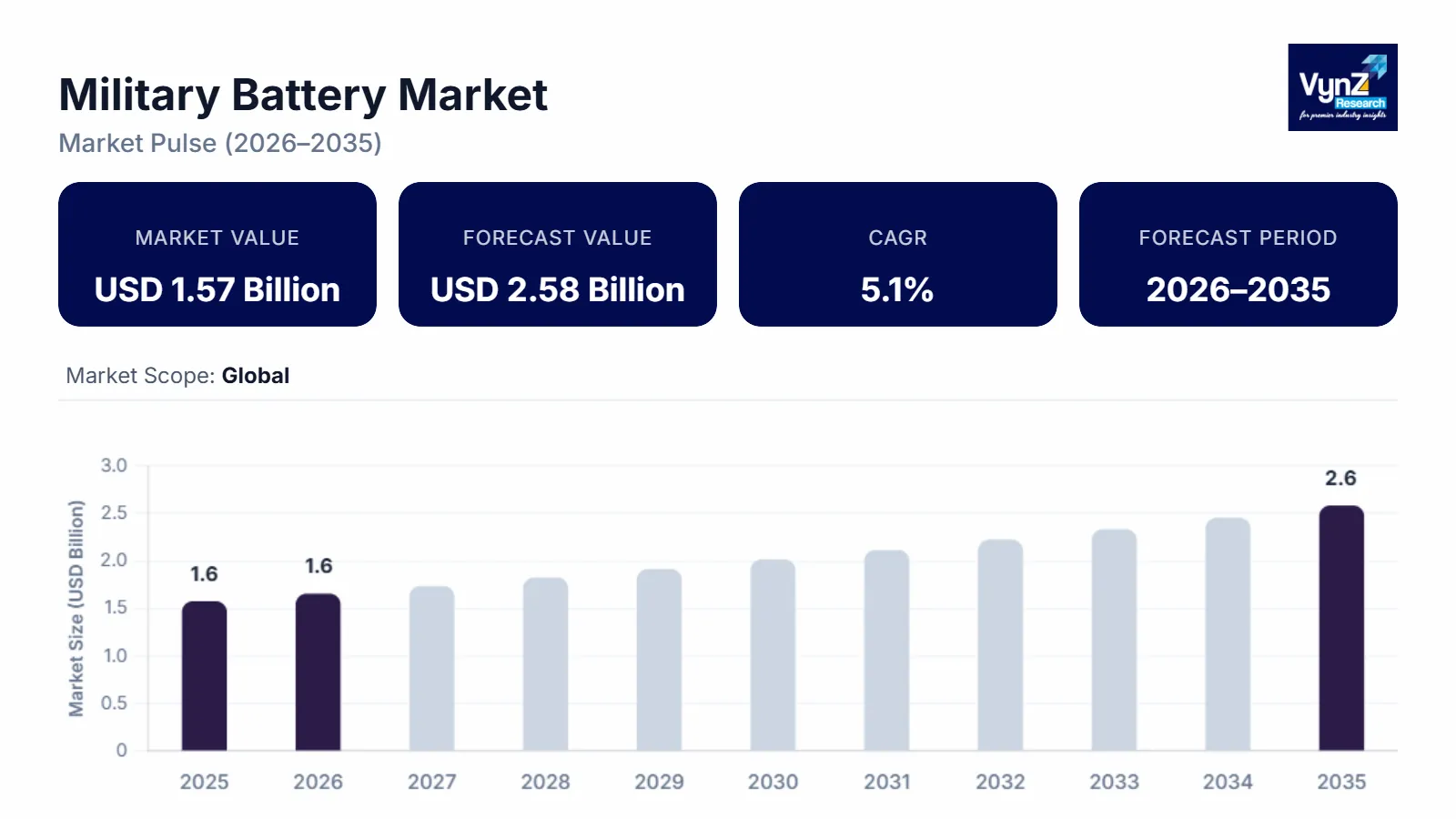
Market growth is being driven by military platform electrification, expanding unmanned systems, and increased soldier demand for portable power, as well as adoption of high-energy-density lithium technologies. The U.S. Department of Defense has identified battery storage as a critical area of technology, while the U.S. Department of Energy announced the availability of up to USD 725 million in potential funding for the domestic battery materials, components, and advanced battery manufacturing including applications related to defense sectors.
Research Methodology
VynZ Research implements a combination of secondary research methodology, company disclosure, government publications, defense procurement records, technology evaluation, and industry level market analysis. The VynZ Research team analyzes military battery demand across platforms, battery technologies, composition, and end users, while cross-checking market share and growth assumptions against established industry benchmarks. Government sources, including the U.S. Department of Defense, U.S. Department of Energy, U.S. Army, and U.S. Geological Survey, are analyzed to assess procurement activity, battery standardization, critical-mineral supply chains, and technology development.
Research Highlights
- Land systems accounted for 60.9% in 2025, supported by vehicle electrification, soldier systems, and auxiliary power requirements.
- Rechargeable batteries held 58.7% in 2025, driven by increasing demand for reusable power across portable and vehicle applications.
- Lithium-based batteries represented 68.1% in 2025, due to higher energy density and growing demand for lightweight military equipment.
- Airborne platforms are projected to grow at 6.1% CAGR, because of rising energy requirements from unmanned aerial systems and advanced avionics.
- North America accounted for approximately 36.8% in 2025, for a high defense spending, domestic battery investment, and established military procurement infrastructure.
Military Battery Market Dynamics
Market Trends
The military battery market is witnessing a shift to higher energy density, rechargeable batteries, standardized battery formats and intelligent battery management. One important trend is the transition to advanced rechargeable batteries for soldier-worn and handheld equipment. Another emerging trend is battery standardization across military equipment.
Growth Drivers
The growth of the market is driven by increased electrification of military platforms and increasing onboard power requirements. Current combat vehicles, communication equipment, sensors, electronic systems and unmanned platforms require greater quantities of reliable stored power. Soldier modernization and unmanned-systems deployment are also contributing factors. Advanced equipment such as night-vision devices, weapons and radios is fueling the demand for improved rechargeable power sources. Extreme weather requirements are driving battery research towards those that maintain capacity in hot and cold temperatures.
Market Restraints / Challenges
Although the market is seeing positive growth, it faces challenges such as critical-mineral supply dependencies and stringent qualification requirements. Lithium, cobalt, graphite, and other materials are essential to several advanced battery technologies, while defense systems undergo extensive testing for safety, durability, temperature resistance, and reliability. Furthermore, battery standardization and extreme operating requirements can add to the cost of development and certification. Military equipment may require varied electrical characteristics, physical formats, environmental tolerances, and safety specifications, limiting interchangeability.
Market Opportunities
The market offers significant opportunities in advanced lithium-ion, high-energy-density, and standardized rechargeable batteries, as defense organizations seek lightweight power systems for soldiers, vehicles, sensors, and unmanned platforms. Another key opportunity lies in domestic battery supply chains and recycling technologies. The U.S. Department of Energy announced funding initiatives for domestic battery materials and manufacturing, while the Department of Defense is supporting critical-material supply-chain resilience. These opportunities provide battery manufacturers, material suppliers, recycling companies, and technology developers serving defense applications with growth potential.
Global Military Battery Market Report Coverage
|
Report Metric |
Details |
|
Historical Period |
2020 - 2024 |
|
Base Year Considered |
2025 |
|
Forecast Period |
2026 - 2035 |
|
Market Size in 2025 |
USD 1.57 Billion |
|
Revenue Forecast in 2035 |
USD 2.58 Billion |
|
Growth Rate |
5.1% |
|
Segments Covered in the Report |
Platform, Battery Type, Composition, End User |
|
Report Scope |
Market Trends, Drivers, and Restraints; Revenue Estimation and Forecast; Segmentation Analysis; Companies’ Strategic Developments; Market Share Analysis of Key Players; Company Profiling |
|
Regions Covered in the Report |
North America, Europe, Asia Pacific, Rest of World |
|
Key Companies |
Arotech, Bren-Tronics, Concorde Battery, Denchi Power, EaglePicher Technologies, EnerSys, GS Yuasa, Saft, Teledyne Battery Products, Ultralife |
|
Customization |
Available upon request |
Military Battery Market Segmentation
By Platform
Land systems accounted for the largest share at approximately 60.9% in 2025, supported by extensive requirements for vehicle starting, auxiliary power, silent-watch operations, communications, sensors, and soldier equipment.
Airborne platforms are estimated to grow at approximately 6.1% CAGR from 2026 to 2035, due to UAV deployment, advanced avionics, onboard sensors, and higher power requirements.
By Battery Type
Rechargeable batteries represented approximately 58.7% of the market in 2025, maintaining the leading position as military organizations seek reusable power systems for equipment with recurring operating cycles.
Non-rechargeable batteries remain important where long shelf life, immediate availability, low self-discharge, and dependable operation are required and is expected to grow at 6.2% CAGR.
By Composition
Lithium-based batteries held approximately 68.1% of the market in 2025, retaining the largest share because of their energy-density advantages and suitability for portable electronics, unmanned systems, vehicles, and other weight-sensitive applications.
Thermal batteries retain importance in applications requiring long storage periods followed by rapid high-power discharge, while lead-acid and nickel-based technologies remain relevant in applications where established reliability, cost, and operating characteristics are important and are estimated to expand at approximately 5.2% CAGR from 2026 to 2035.
By End User
OEMs contributed roughly 72.9% of the market in 2025, retaining the largest share because military batteries frequently require direct integration with propulsion, avionics, communications, power-management, and electronic systems.
The aftermarket segment is supported by replacement demand, maintenance cycles, fleet sustainment, and upgrades to legacy military equipment and is estimated to grow at approximately 5.1% CAGR from 2026 to 2035.
Regional Insights
North America
North America accounted for approximately 36.8% of the military battery market in 2025, making it the largest regional market. The region is supported by extensive U.S. defense procurement, established battery manufacturers, military modernization programs, and investment in domestic battery supply chains. The region is estimated to grow at approximately 4.8% CAGR from 2026 to 2035. The U.S. Department of Defense has identified battery storage as a critical technology area, while the Department of Energy is supporting domestic battery materials and manufacturing. These initiatives are strengthening local production capabilities and reducing exposure to external supply-chain disruptions.
Europe
Europe represented approximately 26% of the market in 2025, driven by military modernization, aerospace and defense manufacturing, and increasing requirements for secure energy systems. European defense organizations are also increasing attention to supply-chain resilience and advanced power technologies as military platforms incorporate greater electronic functionality. Europe is estimated to register approximately 4.6% CAGR from 2026 to 2035. Demand is supported by modernization of land vehicles, aircraft, naval systems, communications equipment, and unmanned platforms. Battery suppliers with established defense certifications and regional production capabilities remain relevant as procurement organizations emphasize reliability and secure supply.
Asia Pacific
Asia Pacific held nearly 23.5% of the market in 2025 and is expected to be the fastest-growing major region. The benchmark identifies Asia Pacific as the fastest-growing regional market, with approximately 6.41% CAGR through 2030, supported by defense modernization in Japan, South Korea, Australia, India, and other markets. The region is estimated to maintain approximately 6.4% CAGR from 2026 to 2035, supported by expanding unmanned systems, naval modernization, aircraft programs, soldier modernization, and domestic defense manufacturing.
Rest of World
Rest of World contributed roughly 13.7% of the market in 2025 and is estimated to grow at around 4% CAGR from 2026 to 2035. Demand is supported by military vehicle modernization, communications infrastructure, unmanned systems, and replacement requirements across the Middle East, Latin America, and Africa.
Competitive Landscape / Company Insights
The military battery market is moderately competitive, with established battery manufacturers and specialized defense suppliers competing through lithium technologies, thermal batteries, portable power systems, qualification capabilities, and platform integration. Companies are increasing attention to high-energy-density systems, standardized battery formats, and domestic supply chains. The U.S. Department of Defense continues to emphasize battery technology and resilient critical-material supply chains, while Army programs are encouraging greater interoperability and standardization across military equipment.
Mini Profiles
Arotech Corporation focuses on advanced batteries and power-management systems for defense applications, including soldier systems, unmanned platforms, vehicles, and specialized military equipment.
Bren-Tronics develops portable lithium battery systems, chargers, and power solutions for military and defense applications, with capabilities spanning engineering, testing, certification, and manufacturing.
Concorde Battery Corporation supplies battery systems for aviation and defense applications and participates in U.S. Department of Defense battery procurement programs.
Denchi Power specializes in rugged battery packs, chargers, and energy-management systems for defense applications across dismounted soldiers, vehicles, and autonomous platforms.
EaglePicher Technologies develops specialized batteries and power systems for demanding aerospace and defense applications, including thermal and storage battery systems.
Key Players
- Arotech Corporation
- Bren-Tronics
- Concorde Battery Corporation
- Denchi Power
- EaglePicher Technologies
- EnerSys
- GS Yuasa Corporation
- Saft
- Teledyne Battery Products
- Ultralife Corporation
Recent Developments
EnerSys launched Hawker ARMASAFE iON-X 24-volt lithium-ion batteries in 2025 for military vehicle applications. The 105 Ah and 162 Ah batteries are designed for tactical vehicles, silent-watch operations, robotics, unmanned vehicles, and weapon systems and meet MIL-PRF-32565C requirements.
EaglePicher Technologies received a U.S. Air Force contract in 2025 valued at approximately USD 3.1 million for development and production of a replacement battery for the Minuteman III flight-control unit. The award covers a defense-specific battery requirement extending into 2027.
GS Yuasa Corporation continued expanding its defense-battery capabilities, with its 2025 reporting highlighting increasing orders for defense applications and thermal batteries. The company also reported plans to increase production capacity as demand for defense-related battery systems rises.
Teledyne Battery Products received a U.S. Defense Logistics Agency indefinite-delivery contract in 2025 valued at approximately USD 8.42 million for battery storage products. The contract provides for military battery supply through 2029.
Ultralife Corporation received an approximately USD 5.2 million U.S. Defense Logistics Agency award in 2025 for BA-5390 lithium manganese dioxide military batteries. Most shipments are scheduled for 2026, with completion expected in early 2027.
Global Military Battery Market Coverage
Platform Insight and Forecast 2026 - 2035
- Land Systems
- Airborne Platforms
- Naval Platforms
Battery Type Insight and Forecast 2026 - 2035
- Rechargeable
- Non-rechargeable
Composition Insight and Forecast 2026 - 2035
- Lithium-based
- Lead-acid
- Nickel-based
- Thermal
- Others
End User Insight and Forecast 2026 - 2035
- Original Equipment Manufacturer (OEM)
- Aftermarket
Global Military Battery Market by Region
- North America
- By Platform
- By Battery Type
- By Composition
- By End User
- By Country - U.S., Canada, Mexico
- Europe
- By Platform
- By Battery Type
- By Composition
- By End User
- By Country - Germany, U.K., France, Italy, Spain, Russia, Rest of Europe
- Asia-Pacific (APAC)
- By Platform
- By Battery Type
- By Composition
- By End User
- By Country - China, Japan, India, South Korea, Vietnam, Thailand, Malaysia, Rest of Asia-Pacific
- Rest of the World (RoW)
- By Platform
- By Battery Type
- By Composition
- By End User
- By Country - Brazil, Saudi Arabia, South Africa, U.A.E., Other Countries
Table of Contents for Military Battery Market Report
1. Research Overview
1.1. The Report Offers
1.2. Market Coverage
1.2.1. By
Platform
1.2.2. By
Battery Type
1.2.3. By
Composition
1.2.4. By
End User
1.3. Research Phases
1.4. Limitations
1.5. Market Methodology
1.5.1. Data Sources
1.5.1.1.
Primary Research
1.5.1.2.
Secondary Research
1.5.2. Methodology
1.5.2.1.
Data Exploration
1.5.2.2.
Forecast Parameters
1.5.2.3.
Data Validation
1.5.2.4.
Assumptions
1.5.3. Study Period & Data Reporting Unit
2. Executive Summary
3. Industry Overview
3.1. Industry Dynamics
3.1.1. Market Growth Drivers
3.1.2. Market Restraints
3.1.3. Key Market Trends
3.1.4. Major Opportunities
3.2. Industry Ecosystem
3.2.1. Porter’s Five Forces Analysis
3.2.2. Recent Development Analysis
3.2.3. Value Chain Analysis
3.3. Competitive Insight
3.3.1. Competitive Position of Industry
Players
3.3.2. Market Attractive Analysis
3.3.3. Market Share Analysis
4. Global Market Estimate and Forecast
4.1. Global Market Overview
4.2. Global Market Estimate and Forecast to 2035
5. Market Segmentation Estimate and Forecast
5.1. By Platform
5.1.1. Land Systems
5.1.1.1. Market Definition
5.1.1.2. Market Estimation and Forecast to 2035
5.1.2. Airborne Platforms
5.1.2.1. Market Definition
5.1.2.2. Market Estimation and Forecast to 2035
5.1.3. Naval Platforms
5.1.3.1. Market Definition
5.1.3.2. Market Estimation and Forecast to 2035
5.2. By Battery Type
5.2.1. Rechargeable
5.2.1.1. Market Definition
5.2.1.2. Market Estimation and Forecast to 2035
5.2.2. Non-rechargeable
5.2.2.1. Market Definition
5.2.2.2. Market Estimation and Forecast to 2035
5.3. By Composition
5.3.1. Lithium-based
5.3.1.1. Market Definition
5.3.1.2. Market Estimation and Forecast to 2035
5.3.2. Lead-acid
5.3.2.1. Market Definition
5.3.2.2. Market Estimation and Forecast to 2035
5.3.3. Nickel-based
5.3.3.1. Market Definition
5.3.3.2. Market Estimation and Forecast to 2035
5.3.4. Thermal
5.3.4.1. Market Definition
5.3.4.2. Market Estimation and Forecast to 2035
5.3.5. Others
5.3.5.1. Market Definition
5.3.5.2. Market Estimation and Forecast to 2035
5.4. By End User
5.4.1. Original Equipment Manufacturer (OEM)
5.4.1.1. Market Definition
5.4.1.2. Market Estimation and Forecast to 2035
5.4.2. Aftermarket
5.4.2.1. Market Definition
5.4.2.2. Market Estimation and Forecast to 2035
6. North America Market Estimate and Forecast
6.1. By
Platform
6.2. By
Battery Type
6.3. By
Composition
6.4. By
End User
6.4.1.
U.S. Market Estimate and Forecast
6.4.2.
Canada Market Estimate and Forecast
6.4.3.
Mexico Market Estimate and Forecast
7. Europe Market Estimate and Forecast
7.1. By
Platform
7.2. By
Battery Type
7.3. By
Composition
7.4. By
End User
7.4.1.
Germany Market Estimate and Forecast
7.4.2.
France Market Estimate and Forecast
7.4.3.
U.K. Market Estimate and Forecast
7.4.4.
Italy Market Estimate and Forecast
7.4.5.
Spain Market Estimate and Forecast
7.4.6.
Russia Market Estimate and Forecast
7.4.7.
Rest of Europe Market Estimate and Forecast
8. Asia-Pacific (APAC) Market Estimate and Forecast
8.1. By
Platform
8.2. By
Battery Type
8.3. By
Composition
8.4. By
End User
8.4.1.
China Market Estimate and Forecast
8.4.2.
Japan Market Estimate and Forecast
8.4.3.
India Market Estimate and Forecast
8.4.4.
South Korea Market Estimate and Forecast
8.4.5.
Rest of Asia-Pacific Market Estimate and Forecast
9. Rest of the World (RoW) Market Estimate and Forecast
9.1. By
Platform
9.2. By
Battery Type
9.3. By
Composition
9.4. By
End User
9.4.1.
Brazil Market Estimate and Forecast
9.4.2.
Saudi Arabia Market Estimate and Forecast
9.4.3.
South Africa Market Estimate and Forecast
9.4.4.
U.A.E. Market Estimate and Forecast
9.4.5.
Other Countries Market Estimate and Forecast
10. Company Profiles
10.1.
Arotech Corporation
10.1.1.
Snapshot
10.1.2.
Overview
10.1.3.
Offerings
10.1.4.
Financial
Insight
10.1.5.
Recent
Developments
10.2.
Bren-Tronics
10.2.1.
Snapshot
10.2.2.
Overview
10.2.3.
Offerings
10.2.4.
Financial
Insight
10.2.5.
Recent
Developments
10.3.
Concorde Battery Corporation
10.3.1.
Snapshot
10.3.2.
Overview
10.3.3.
Offerings
10.3.4.
Financial
Insight
10.3.5.
Recent
Developments
10.4.
Denchi Power
10.4.1.
Snapshot
10.4.2.
Overview
10.4.3.
Offerings
10.4.4.
Financial
Insight
10.4.5.
Recent
Developments
10.5.
EaglePicher Technologies
10.5.1.
Snapshot
10.5.2.
Overview
10.5.3.
Offerings
10.5.4.
Financial
Insight
10.5.5.
Recent
Developments
10.6.
EnerSys
10.6.1.
Snapshot
10.6.2.
Overview
10.6.3.
Offerings
10.6.4.
Financial
Insight
10.6.5.
Recent
Developments
10.7.
GS Yuasa Corporation
10.7.1.
Snapshot
10.7.2.
Overview
10.7.3.
Offerings
10.7.4.
Financial
Insight
10.7.5.
Recent
Developments
10.8.
Saft
10.8.1.
Snapshot
10.8.2.
Overview
10.8.3.
Offerings
10.8.4.
Financial
Insight
10.8.5.
Recent
Developments
10.9.
Teledyne Battery Products
10.9.1.
Snapshot
10.9.2.
Overview
10.9.3.
Offerings
10.9.4.
Financial
Insight
10.9.5.
Recent
Developments
10.10.
Ultralife Corporation
10.10.1.
Snapshot
10.10.2.
Overview
10.10.3.
Offerings
10.10.4.
Financial
Insight
10.10.5.
Recent
Developments
11. Appendix
11.1. Exchange Rates
11.2. Abbreviations
Note: Financial insight and recent developments of different companies are subject to the availability of information in the secondary domain.
Frequently Asked Questions
Purchase Options
Latest Report
Research Methodology
- Desk Research / Pilot Interviews
- Build Market Size Model
- Research and Analysis
- Final Deliverable
Connect With Our Sales Team
- Toll-Free: +1-888-253-3960
- Phone: +91 9960 288 381
- Email: enquiry@vynzresearch.com
Military Battery Market