
Barley Market Size & Share Growth Forecast Report (2026-2035)
Industry Insight by Product Type (Whole Grain Barley, Non-Whole Grain Barley, Barley Flakes, Barley Flour, Malted Barley), by Application (Animal Feed, Food, Beverages, Other Industrial Applications), by End Use (Animal Feed Industry, Brewing Industry, Distilling Industry, Food Processing Industry, Nutraceutical Industry, Other Industrial Uses)
| Status : Published | Published On : Nov, 2026 | Report Code : VRFB11054 | Industry : Food & Beverage | Available Format :

|
Page : 145 |
Barley Market Overview
The global barley market was valued at approximately USD 28.75 billion in 2025 and is estimated to reach USD 30.45 billion in 2026, rising to USD 41.04 billion by 2035, expanding at a proposed CAGR of 3.35% from 2026 to 2035.
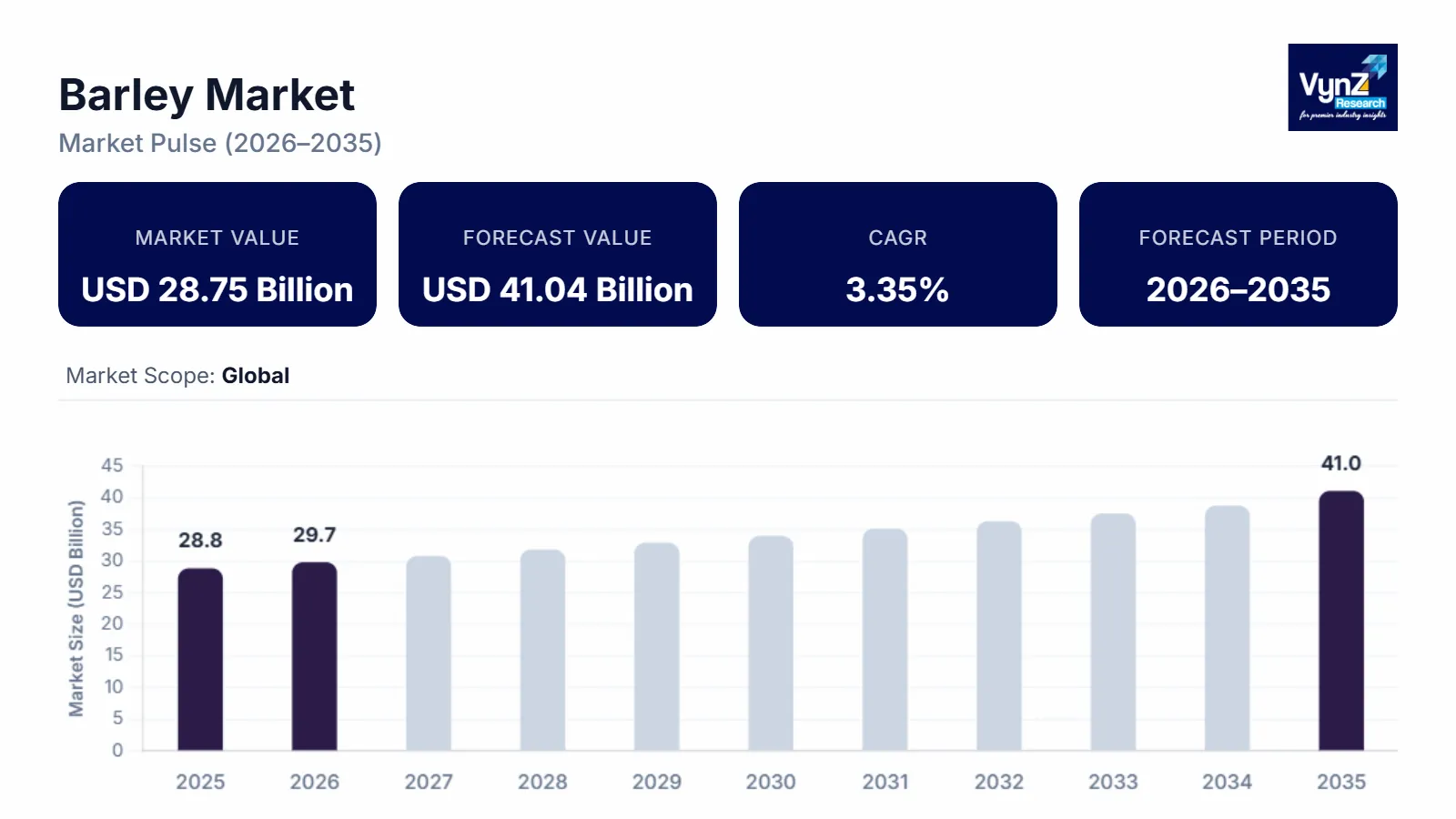
The barley industry continues to benefit from its extensive applications in livestock nutrition, malt production, brewing, distilling and food processing, with increasing demand for specialty grains and functional food ingredients supporting market diversification. Growing investments in agricultural productivity, climate-resilient crop varieties and domestic malting infrastructure are further strengthening the global supply chain. Market growth is driven by increasing livestock feed consumption, demand for malt ingredients and expanding applications in processed foods. According to the United States Department of Agriculture (USDA), global barley production for 2026–2027 is projected to exceed, reflecting the continuing importance of the crop in international agricultural supply chains. The Food and Agriculture Organization (FAO) also monitors barley production, utilization and trade through its cereal supply and demand assessments, highlighting the importance of global grain availability and trade flows in determining agricultural market conditions.
Research Methodology
VynZ Research employs a structured research methodology combining secondary research, industry assessment, market estimation and analytical validation to evaluate the global barley industry. The VynZ Research team examines agricultural production statistics, consumption patterns, international trade, commodity pricing, processing capacity and company developments using information from government agricultural departments, international organizations and established industry publications. Primary research considerations include discussions with agricultural suppliers, grain processors, malt manufacturers and industry participants. Historical trends and available market estimates are evaluated to develop independent forecasts for the 2026–2035 period.
Research Highlights
- The malted barley segment accounted for an estimated 60% share of the global product type market in 2025, supported by its extensive utilization in brewing, distilling and malt ingredient production.
- The beverage application segment represented approximately 58% of market revenue in 2025, driven by consistent requirements from breweries and alcoholic beverage manufacturers.
- The animal feed segment accounted for an estimated 49% share of end-use demand in 2025, supported by the use of barley in cattle, poultry and other livestock nutrition.
- The food grade barley segment is projected to register a CAGR of approximately 3.90% during 2026–2035, due to growing demand for high fiber cereals, beta glucan ingredients and functional food formulations.
- Europe accounted for approximately 34.8% of the global barley market in 2025, owing to its established grain production infrastructure, malting facilities and extensive brewing industry, while Asia-Pacific is projected to remain the fastest-growing regional market.
Barley Market Dynamics
Market Trends
The global barley industry is witnessing increasing demand for specialty malting varieties, hulless barley and processed grain ingredients, reflecting changing requirements across food manufacturing and beverage production. One of the significant trends is the growing use of barley containing beta-glucan, a soluble fiber associated with cholesterol management and digestive health. Food manufacturers are incorporating barley flour, flakes and whole grain ingredients into breakfast cereals, bakery products and nutritional formulations, creating additional opportunities beyond conventional livestock feed and brewing applications. Another emerging trend is the development of improved barley varieties with enhanced disease resistance, drought tolerance and malting characteristics.
Growth Drivers
The growth of the barley market is largely supported by rising demand from the livestock industry, where barley serves as an important energy source in cattle, poultry and other animal feed formulations. Its nutritional composition and availability in major grain-producing regions support its use as an alternative to corn and other feed ingredients, particularly when relative commodity prices influence feed formulation decisions. USDA agricultural assessments indicate that global barley consumption remains closely connected to feed requirements, with changes in production and export availability affecting procurement patterns across major importing countries. Additionally, expanding malting and brewing activities are generating consistent demand for high-quality barley varieties with suitable protein content, germination characteristics and enzyme activity. The growth of domestic brewing industries in India and other emerging economies is encouraging investments in local malt production and structured agricultural sourcing.
Market Restraints / Challenges
Despite favorable growth prospects, the barley market faces challenges associated with climate variability, agricultural input costs and fluctuations in international commodity prices. Irregular rainfall, prolonged drought, excessive moisture and rising temperatures can affect crop yields and grain quality, particularly in semi-arid agricultural regions. These conditions create uncertainty for farmers and grain processors, while inconsistent production can influence export availability and procurement costs. The FAO's cereal market assessments identify weather conditions and disruptions to international trade routes as important factors affecting global grain supply and market stability. Furthermore, barley producers face competition from alternative feed grains, particularly corn and wheat, which can influence purchasing decisions among livestock feed manufacturers. Differences in transportation costs, storage requirements and grain quality specifications create additional operational challenges for exporters and processors.
Market Opportunities
The market presents significant opportunities in specialty barley varieties, particularly hulless barley and high beta-glucan cultivars used in functional foods, dietary fiber ingredients and health-oriented formulations. Growing interest in whole grains and plant-derived nutritional ingredients is encouraging food manufacturers to explore barley-based products beyond traditional cereals and bakery applications. Improved processing technologies, including pearling, milling and controlled malting, are creating opportunities to develop higher-value ingredients for food manufacturers, nutritional product companies and beverage processors. Another important opportunity lies in expanding domestic malting capacity in emerging economies, where rising beverage production is encouraging investment in local agricultural sourcing and processing facilities. Such investments can improve access to quality malt ingredients, strengthen regional supply chains and create additional opportunities for barley cultivation and processing.
Global Barley Market Report Coverage
|
Report Metric |
Details |
|
Historical Period |
2020 - 2024 |
|
Base Year Considered |
2025 |
|
Forecast Period |
2026 - 2035 |
|
Market Size in 2025 |
USD 28.75 Billion |
|
Revenue Forecast in 2035 |
USD 41.04 Billion |
|
Growth Rate |
3.35% |
|
Segments Covered in the Report |
Product Type, Application, End Use |
|
Report Scope |
Market Trends, Drivers, and Restraints; Revenue Estimation and Forecast; Segmentation Analysis; Companies’ Strategic Developments; Market Share Analysis of Key Players; Company Profiling |
|
Regions Covered in the Report |
North America, Europe, Asia-Pacific, Rest of the World |
|
Key Companies |
AB InBev, Archer Daniels Midland, Boortmalt, Cargill, GrainCorp, Malteurop, RAGT, Soufflet Malt, United Breweries, Viterra |
|
Customization |
Available upon request |
Barley Market Segmentation
By Product Type
The malted barley segment accounted for an estimated 60% share of product type revenue in 2025, supported by its extensive use in beer production, distilling and industrial malt processing. Its established demand from breweries and beverage manufacturers makes it an important component of the global barley value chain.
Malted barley is expected to maintain steady growth through the forecast period, supported by the expansion of brewing facilities and increasing demand for specialty malt ingredients. The segment is projected to register a CAGR of approximately 3.60% from 2026 to 2035, reflecting continued requirements from beverage manufacturers and distillers.
By Application
The beverage segment accounted for approximately 58% of market revenue in 2025, reflecting the substantial utilization of malted barley in brewing and distilling operations. Barley remains a principal raw material for malt production, with quality specifications influencing procurement decisions among breweries and malt manufacturers.
The food application is expected to record comparatively faster growth during the forecast period, supported by increasing demand for whole grain ingredients, barley flour, flakes and beta-glucan-enriched formulations. This segment is projected to expand at a CAGR of approximately 3.90% from 2026 to 2035, as food manufacturers diversify cereal-based product portfolios and incorporate fiber-rich ingredients into conventional formulations.
By End Use
Animal feed accounted for an estimated 49% share of end use demand in 2025, supported by its utilization in livestock rations and the availability of barley across major agricultural producing countries. Demand remains particularly relevant in North America, Europe and Australia, where established grain production and livestock industries support commercial consumption.
The brewing and distilling segment represents another important source of barley demand because malt production requires varieties with suitable protein levels, germination capacity and enzymatic characteristics. This segment is projected to grow at a CAGR of approximately 3.60% during 2026–2035, supported by brewery expansion, specialty malt requirements and investments in regional processing infrastructure.
Regional Insights
North America
North America accounted for an estimated 18% share of the global barley market in 2025, supported by established agricultural production, livestock feed consumption and commercial malting operations. Canada and the United States remain important contributors to regional supply, with Canadian barley exports serving major international buyers, particularly in Asia. Government agricultural programs and research initiatives are encouraging the adoption of improved barley varieties, sustainable cultivation practices and climate-resilient farming systems. The USDA's agricultural support programs and research activities are contributing to improvements in crop productivity and resource management. Meanwhile, established rail networks, storage facilities and export terminals across Canada and the United States support efficient movement of barley to domestic processors and international markets.
Europe
Europe held approximately 34.8% of the global barley market in 2025, making it the largest regional market. Its position is supported by extensive barley cultivation, established grain trading networks and a well-developed brewing and malting industry. Germany, France, the United Kingdom and Spain represent important regional markets, with demand generated by animal feed manufacturers, malt producers and food processors. The European Union's Common Agricultural Policy supports agricultural productivity, environmental sustainability and farm income through funding and rural development measures. In addition, European food safety and plant health regulations influence grain handling, storage, quality assessment and international trade. The region's established malting capacity and integrated agricultural supply chain are expected to maintain its leading position, although changing weather patterns and production costs may influence future cultivation and procurement decisions.
Asia Pacific
Asia Pacific contributed an estimated 25.2% share of the global barley market in 2025 and is projected to remain the fastest-growing regional market. China, India, Australia and Japan are important contributors through agricultural production, livestock feed consumption, grain imports and beverage manufacturing. Increasing demand for malt ingredients, expanding brewing operations and growing requirements for animal protein are supporting regional consumption. China's significant import requirements and Australia's export-oriented production further strengthen regional trade activity. Government initiatives supporting agricultural research, improved seed varieties and domestic processing are creating opportunities for market development. India's investment in local malting capacity reflects the growing importance of regional sourcing and processing. Agricultural research and productivity programs in China, India and Australia are also supporting efforts to improve crop resilience, grain quality and production efficiency.
Rest of the World
The Rest of the World accounted for an estimated 22% share of the global barley market in 2025, covering Latin America, the Middle East, Africa and Oceania. Australia and Argentina are important barley-producing and exporting countries, while Saudi Arabia, Morocco and other Middle Eastern and African markets generate demand through livestock feed imports and agricultural procurement. Government food security programs, agricultural modernization and investments in drought-tolerant crop varieties are influencing barley cultivation and procurement across these markets. The FAO's agricultural assessments and national crop development initiatives support improved understanding of production conditions, grain availability and trade requirements. Australia continues to play an important role in international barley supply, while growing feed demand in the Middle East and North Africa creates opportunities for exporters and grain traders.
Competitive Landscape / Company Insights
The barley market is moderately competitive, with global agricultural trading companies, malt manufacturers and specialized grain processors focusing on sourcing efficiency, processing capacity and long-term procurement arrangements. Major participants compete through integrated agricultural supply chains, quality control, international distribution networks and investments in malting infrastructure. Companies are also strengthening farmer relationships and developing improved barley varieties to maintain consistent supply. Increasing demand for specialty malt, feed ingredients and sustainable agricultural sourcing is encouraging strategic partnerships and capacity expansion across major producing regions.
Mini Profiles
Archer Daniels Midland operates an extensive agricultural processing and commodity sourcing network, supporting grain procurement, feed ingredients and international agricultural supply chains.
Cargill maintains a diversified agricultural business covering grain origination, trading, processing and malt-related supply chain activities across international markets.
GrainCorp provides grain storage, handling, marketing and logistics services, with an established position in Australia's barley production and export network.
Malteurop specializes in malt production and barley processing, supplying brewing, distilling and food manufacturing customers through its international operations.
Viterra operates an integrated agricultural supply network covering grain origination, storage, handling and international marketing, including barley trading.
Key Players
- AB InBev
- Archer Daniels Midland
- Boortmalt
- Cargill
- GrainCorp
- Malteurop
- RAGT
- Soufflet
- Malt
- United Breweries
- Viterra
Recent Developments
AB InBev announced plans to procure more than 16,000 tons of domestically cultivated barley in India through its agricultural sourcing initiatives. The company is strengthening relationships with more than 2,000 farmers across Rajasthan, Haryana and Uttar Pradesh to improve the availability of quality malting barley.
Boortmalt partnered with Asahi in the United Kingdom to support sustainable barley cultivation and strengthen the future supply of brewing ingredients. The company has also introduced regenerative farming initiatives with brewing industry partners to improve agricultural sustainability and supply chain resilience.
RAGT completed the acquisition of Syngenta's two-row spring and winter malting barley seed business, including its Market Stainton breeding facility in the United Kingdom. The transaction strengthens its barley breeding portfolio and expands its capabilities in supplying varieties to farmers and the malting industry.
Soufflet Malt announced the development of a new malthouse in South Rajasthan through a partnership with United Breweries. The facility is planned with an initial annual production capacity of 110,000 tons, alongside arrangements to strengthen domestic barley procurement and farmer participation.
United Breweries entered into a strategic partnership with Soufflet Malt to support the development of domestic malt production capacity in India. The arrangement is expected to improve access to locally produced malt, strengthen agricultural sourcing and support the expansion of the country's brewing supply chain.
Global Barley Market Coverage
Product Type Insight and Forecast 2026 - 2035
- Whole Grain Barley
- Non-Whole Grain Barley
- Barley Flakes
- Barley Flour
- Malted Barley
Application Insight and Forecast 2026 - 2035
- Animal Feed
- Food
- Beverages
- Other Industrial Applications
End Use Insight and Forecast 2026 - 2035
- Animal Feed Industry
- Brewing Industry
- Distilling Industry
- Food Processing Industry
- Nutraceutical Industry
- Other Industrial Uses
Global Barley Market by Region
- North America
- By Product Type
- By Application
- By End Use
- By Country - U.S., Canada, Mexico
- Europe
- By Product Type
- By Application
- By End Use
- By Country - Germany, U.K., France, Italy, Spain, Russia, Rest of Europe
- Asia-Pacific (APAC)
- By Product Type
- By Application
- By End Use
- By Country - China, Japan, India, South Korea, Vietnam, Thailand, Malaysia, Rest of Asia-Pacific
- Rest of the World (RoW)
- By Product Type
- By Application
- By End Use
- By Country - Brazil, Saudi Arabia, South Africa, U.A.E., Other Countries
Table of Contents for Barley Market Report
1. Research Overview
1.1. The Report Offers
1.2. Market Coverage
1.2.1. By
Product Type
1.2.2. By
Application
1.2.3. By
End Use
1.3. Research Phases
1.4. Limitations
1.5. Market Methodology
1.5.1. Data Sources
1.5.1.1.
Primary Research
1.5.1.2.
Secondary Research
1.5.2. Methodology
1.5.2.1.
Data Exploration
1.5.2.2.
Forecast Parameters
1.5.2.3.
Data Validation
1.5.2.4.
Assumptions
1.5.3. Study Period & Data Reporting Unit
2. Executive Summary
3. Industry Overview
3.1. Industry Dynamics
3.1.1. Market Growth Drivers
3.1.2. Market Restraints
3.1.3. Key Market Trends
3.1.4. Major Opportunities
3.2. Industry Ecosystem
3.2.1. Porter’s Five Forces Analysis
3.2.2. Recent Development Analysis
3.2.3. Value Chain Analysis
3.3. Competitive Insight
3.3.1. Competitive Position of Industry
Players
3.3.2. Market Attractive Analysis
3.3.3. Market Share Analysis
4. Global Market Estimate and Forecast
4.1. Global Market Overview
4.2. Global Market Estimate and Forecast to 2035
5. Market Segmentation Estimate and Forecast
5.1. By Product Type
5.1.1. Whole Grain Barley
5.1.1.1. Market Definition
5.1.1.2. Market Estimation and Forecast to 2035
5.1.2. Non-Whole Grain Barley
5.1.2.1. Market Definition
5.1.2.2. Market Estimation and Forecast to 2035
5.1.3. Barley Flakes
5.1.3.1. Market Definition
5.1.3.2. Market Estimation and Forecast to 2035
5.1.4. Barley Flour
5.1.4.1. Market Definition
5.1.4.2. Market Estimation and Forecast to 2035
5.1.5. Malted Barley
5.1.5.1. Market Definition
5.1.5.2. Market Estimation and Forecast to 2035
5.2. By Application
5.2.1. Animal Feed
5.2.1.1. Market Definition
5.2.1.2. Market Estimation and Forecast to 2035
5.2.2. Food
5.2.2.1. Market Definition
5.2.2.2. Market Estimation and Forecast to 2035
5.2.3. Beverages
5.2.3.1. Market Definition
5.2.3.2. Market Estimation and Forecast to 2035
5.2.4. Other Industrial Applications
5.2.4.1. Market Definition
5.2.4.2. Market Estimation and Forecast to 2035
5.3. By End Use
5.3.1. Animal Feed Industry
5.3.1.1. Market Definition
5.3.1.2. Market Estimation and Forecast to 2035
5.3.2. Brewing Industry
5.3.2.1. Market Definition
5.3.2.2. Market Estimation and Forecast to 2035
5.3.3. Distilling Industry
5.3.3.1. Market Definition
5.3.3.2. Market Estimation and Forecast to 2035
5.3.4. Food Processing Industry
5.3.4.1. Market Definition
5.3.4.2. Market Estimation and Forecast to 2035
5.3.5. Nutraceutical Industry
5.3.5.1. Market Definition
5.3.5.2. Market Estimation and Forecast to 2035
5.3.6. Other Industrial Uses
5.3.6.1. Market Definition
5.3.6.2. Market Estimation and Forecast to 2035
6. North America Market Estimate and Forecast
6.1. By
Product Type
6.2. By
Application
6.3. By
End Use
6.3.1.
U.S. Market Estimate and Forecast
6.3.2.
Canada Market Estimate and Forecast
6.3.3.
Mexico Market Estimate and Forecast
7. Europe Market Estimate and Forecast
7.1. By
Product Type
7.2. By
Application
7.3. By
End Use
7.3.1.
Germany Market Estimate and Forecast
7.3.2.
France Market Estimate and Forecast
7.3.3.
U.K. Market Estimate and Forecast
7.3.4.
Italy Market Estimate and Forecast
7.3.5.
Spain Market Estimate and Forecast
7.3.6.
Russia Market Estimate and Forecast
7.3.7.
Rest of Europe Market Estimate and Forecast
8. Asia-Pacific (APAC) Market Estimate and Forecast
8.1. By
Product Type
8.2. By
Application
8.3. By
End Use
8.3.1.
China Market Estimate and Forecast
8.3.2.
Japan Market Estimate and Forecast
8.3.3.
India Market Estimate and Forecast
8.3.4.
South Korea Market Estimate and Forecast
8.3.5.
Rest of Asia-Pacific Market Estimate and Forecast
9. Rest of the World (RoW) Market Estimate and Forecast
9.1. By
Product Type
9.2. By
Application
9.3. By
End Use
9.3.1.
Brazil Market Estimate and Forecast
9.3.2.
Saudi Arabia Market Estimate and Forecast
9.3.3.
South Africa Market Estimate and Forecast
9.3.4.
U.A.E. Market Estimate and Forecast
9.3.5.
Other Countries Market Estimate and Forecast
10. Company Profiles
10.1.
AB InBev
10.1.1.
Snapshot
10.1.2.
Overview
10.1.3.
Offerings
10.1.4.
Financial
Insight
10.1.5.
Recent
Developments
10.2.
Archer Daniels Midland
10.2.1.
Snapshot
10.2.2.
Overview
10.2.3.
Offerings
10.2.4.
Financial
Insight
10.2.5.
Recent
Developments
10.3.
Boortmalt
10.3.1.
Snapshot
10.3.2.
Overview
10.3.3.
Offerings
10.3.4.
Financial
Insight
10.3.5.
Recent
Developments
10.4.
Cargill
10.4.1.
Snapshot
10.4.2.
Overview
10.4.3.
Offerings
10.4.4.
Financial
Insight
10.4.5.
Recent
Developments
10.5.
GrainCorp
10.5.1.
Snapshot
10.5.2.
Overview
10.5.3.
Offerings
10.5.4.
Financial
Insight
10.5.5.
Recent
Developments
10.6.
Malteurop
10.6.1.
Snapshot
10.6.2.
Overview
10.6.3.
Offerings
10.6.4.
Financial
Insight
10.6.5.
Recent
Developments
10.7.
RAGT
10.7.1.
Snapshot
10.7.2.
Overview
10.7.3.
Offerings
10.7.4.
Financial
Insight
10.7.5.
Recent
Developments
10.8.
Soufflet Malt
10.8.1.
Snapshot
10.8.2.
Overview
10.8.3.
Offerings
10.8.4.
Financial
Insight
10.8.5.
Recent
Developments
10.9.
United Breweries
10.9.1.
Snapshot
10.9.2.
Overview
10.9.3.
Offerings
10.9.4.
Financial
Insight
10.9.5.
Recent
Developments
10.10.
Viterra
10.10.1.
Snapshot
10.10.2.
Overview
10.10.3.
Offerings
10.10.4.
Financial
Insight
10.10.5.
Recent
Developments
11. Appendix
11.1. Exchange Rates
11.2. Abbreviations
Note: Financial insight and recent developments of different companies are subject to the availability of information in the secondary domain.
Frequently Asked Questions
Purchase Options
Latest Report
Research Methodology
- Desk Research / Pilot Interviews
- Build Market Size Model
- Research and Analysis
- Final Deliverable
Connect With Our Sales Team
- Toll-Free: +1-888-253-3960
- Phone: +91 9960 288 381
- Email: enquiry@vynzresearch.com
Barley Market