AI in Drug Discovery Market Size & Share - Growth Forecast Report (2026-2035)
Industry Insight by Component (Software, Services), by Technology (Machine Learning, Deep Learning, Natural Language Processing, Computer Vision and Other AI Models), by Drug Type (Small Molecule Drugs, Large Molecule Drugs, Biologics, Other Drug Types), by Therapeutic Area (Oncology, Cardiovascular Diseases, Neurological Disorders, Infectious Diseases, Metabolic Disorders, Other Therapeutic Areas), by Application (Target Identification, Target Validation, Lead Identification, Lead Optimization, Drug Design and Development, Preclinical Research, Drug Repurposing), by End User (Pharmaceutical Companies, Biotechnology Companies, Contract Research Organizations, Academic and Research Institutes)
| Status : Published | Published On : May, 2026 | Report Code : VRHC1340 | Industry : Healthcare | Available Format :

|
Page : 165 |
AI in Drug Discovery Market Overview
The AI in Drug Discovery market which was valued at approximately USD 2.58 billion in 2025 and is estimated to rise further up to almost USD 3.25 billion in 2026, is projected to reach around USD 22.35 billion in 2035, expanding at a CAGR of about 24.1% during the forecast period from 2026 to 2035.
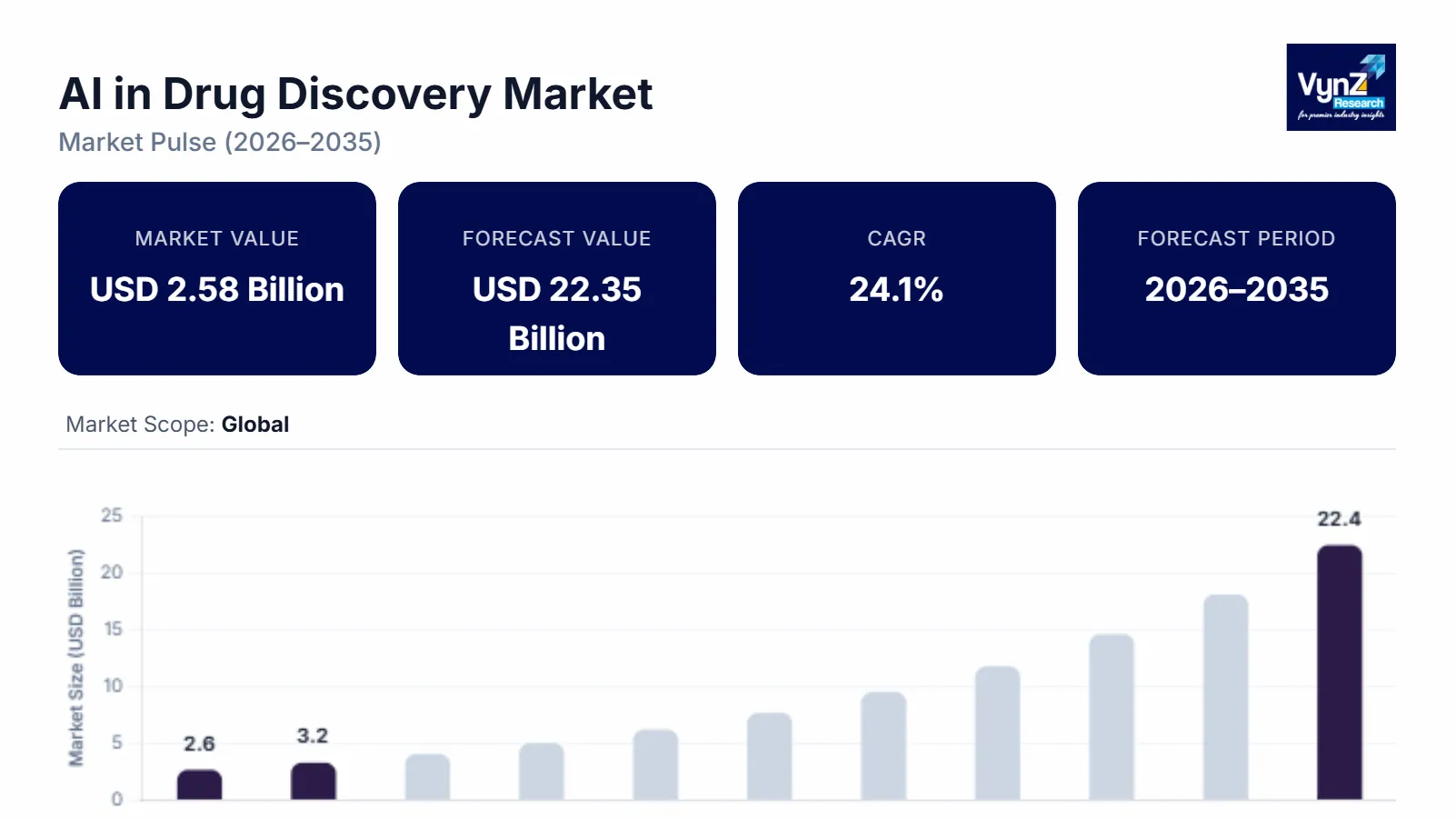
Market growth is driven by the increasing combination of artificial intelligence into target finding and lead refinement, the rising need for quicker and more cost-efficient drug development workflows, and the growing reliance on predictive analytics within pharma research. The World Health Organization is stressing the bigger global burden of chronic and infectious diseases increasing the demand for faster therapeutic discovery and precision-oriented treatment choices.
Government supported healthcare digitization efforts together with higher public budgets for biomedical innovation are also pushing adoption across the major pharmaceutical ecosystems. Increasing cooperation between public research institutions and biotechnology firms and regulatory encouragement for innovation led drug development is helping the market expand across North America, Europe and Asia Pacific.
AI in Drug Discovery Market Dynamics
Market Trends
AI is used extensively into the drug research workflows and the discovery process is becoming more data heavy by default. A major trend is the rising adoption of generative AI along with predictive modeling and companies want faster target identification, better accuracy, and shorter overall research timelines. Cloud-based platforms, multimodal data integration and rapid digital transformation are pushing organizations toward integrated AI discovery systems.
Government backed biomedical research programs and public funding for digital health innovation are reinforcing the momentum. National initiatives and data driven healthcare help normalize AI based discovery tools across the industry. Regulatory alignment for computational drug development is also speeding things up, especially in North America, Europe, and Asia Pacific.
Growth Drivers
The market growth is being driven by the rising need for faster and more cost-efficient drug development across both pharmaceutical and biotechnology companies. More spending on computational biology and upgrading advanced R&D infrastructure is giving the market further lift. Also, the expanding burden of chronic illnesses and infectious diseases is pushing adoption, since many organizations are trying to improve drug success rates and move lead optimization along sooner. Public health agencies keep spotlighting global disease pressure and that keeps strengthening advanced discovery technologies.
Market Restraints / Challenges
The market faces challenges in high implementation costs and integration difficulties with existing pharmaceutical systems, slowing down deployment. Data quality limitations and regulatory uncertainties are other barriers especially for smaller firms. Dependence on high performance computing infrastructure and a shortage of skilled AI professionals create constraints and often lead to higher spend and scalability issues.
Market Opportunities
The market still holds solid opportunities, especially in precision medicine and AI enabled personalized drug development, mainly because demand for targeted therapies is rising. Firms that can offer scalable AI platforms are likely to do well, particularly those supporting pharma companies and research organizations that want faster development cycles. Another opportunity is in drug repurposing and virtual screening technologies, supported by growing investment in digital research ecosystems and the increasing use of machine learning with cloud-based discovery tools.
Global AI in Drug Discovery Market Report Coverage
|
Report Metric |
Details |
|
Historical Period |
2020 - 2024 |
|
Base Year Considered |
2025 |
|
Forecast Period |
2026 - 2035 |
|
Market Size in 2025 |
USD 2.58 Billion |
|
Revenue Forecast in 2035 |
USD 22.35 Billion |
|
Growth Rate |
24.1% |
|
Segments Covered in the Report |
Component, Technology, Drug Type, Therapeutic Area, Application, End User |
|
Report Scope |
Market Trends, Drivers, and Restraints; Revenue Estimation and Forecast; Segmentation Analysis; Companies’ Strategic Developments; Market Share Analysis of Key Players; Company Profiling |
|
Regions Covered in the Report |
North America, Europe, Asia Pacific, Rest of the World |
|
Key Companies |
Atomwise, BenevolentAI, BioXcel Therapeutics, Exscientia, IBM Corporation, Insilico Medicine, NVIDIA Corporation, Recursion Pharmaceuticals, Schrödinger Inc., Verge Genomics |
|
Customization |
Available upon request |
AI in Drug Discovery Market Segmentation
By Component
Software held roughly around 58% of the total revenue of the market because many teams are now using AI driven platforms for lead optimization and predictive modeling across pharma R&D pipelines. Advanced software solutions, data analytics tools and cloud computing infrastructure promoted big scale drug discovery programs. Regulations toward digital transformation in healthcare research and higher investment in computational biology keeps pushing software demand.
Services should grow the quickest during the forecast window, with an estimated CAGR of 25.6%, mainly because companies are outsourcing AI based drug discovery tasks to specialist providers. Pharmaceutical and biotech groups are leaning harder on consulting, integration, and managed AI services to lower operational strain and speed up research schedules.
By Technology
Machine Learning held the largest market share in 2025 at about 34%, mostly because it is widely used for predictive analytics, molecular screening, and compound optimization. It increases computational efficiency and compatibility with broad datasets. Government supported programs push AI enabled biomedical research and data driven healthcare systems are also reinforcing machine learning use across major research hubs.
Deep Learning is projected to expand at the fastest pace, estimated CAGR 26.4%, supported by the rising need for high accuracy pattern recognition in complicated biological datasets. It can handle unstructured biomedical data and it also boosts drug target prediction which makes it more attractive in more advanced research settings.
By Drug Type
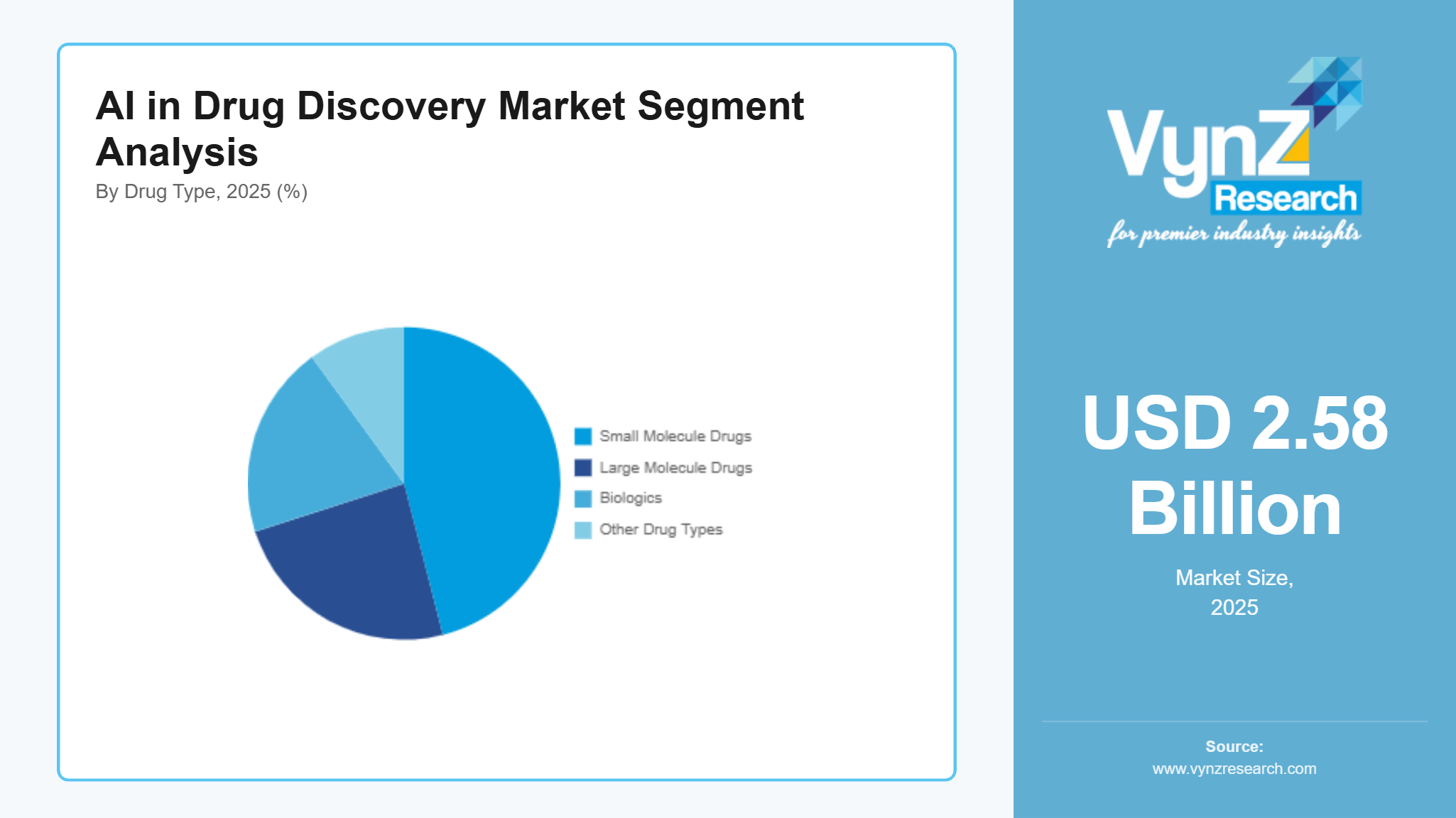
Small molecule drugs accounted for the biggest share in 2025 at roughly 46% due to constant presence in standard pharmaceutical pipelines and quicker computational modeling. When AI gets integrated, screening efficiency rises and early-stage development timelines get shorter for small molecule compounds. Regulatory frameworks backing digital drug development along with higher R&D investments are keeping this segment in a dominant position.
Biologics are expected to grow the fastest with an estimated CAGR of 27.1% driven by demand for targeted therapies and precision medicine approaches. AI is increasingly being used for protein modeling and biologic drug design and large molecule drugs are also seeing steady adoption, particularly in oncology and immunotherapy research.
By Therapeutic Area
Oncology held the largest share of the AI in Drug Discovery market in 2025 at about 38%, mainly because cancer prevalence is high everywhere and the demand is strong for targeted, personalized treatment options. AI tools are used heavily for cancer biomarker identification, drug sensitivity prediction and even clinical trial optimization.
Neurological disorders are projected to grow the fastest pace, with an estimated CAGR of 26.8%, driven by deeper research attention on Alzheimer’s disease, Parkinson’s disease, and other neurodegenerative conditions. AI based modeling is helping people understand complex neural pathways better and that speeds up therapeutic discovery.
Regional Insights
North America
In 2025, North America accounted for roughly 38% of the market due to heavy pharmaceutical R&D spending, more mature digital health infrastructure, and early take on artificial intelligence within life sciences research. A lot of the big innovation hubs across the United States and Canada keep backing large scale rollouts of AI powered drug discovery platforms, especially in biotech companies and research institutes. There are also government supported biomedical innovation programs and federal research funding that are helping regional capacity grow. More cooperation between pharmaceutical firms and universities is pushing the market further in the whole area.
Europe
Europe, in 2025 held about 27% of the market. This is backed by firm regulatory arrangements, structured healthcare systems, and ongoing investment toward digital healthcare modernization. Germany, the United Kingdom and France still operate as key innovation hotspots enabling broader adoption across pharmaceutical and biotechnology sectors. Public sector research grants and government supported life sciences initiatives are helping faster AI adoption with regulatory attention on ethical AI deployments in clinical settings strengthening regional demand.
Asia Pacific
Asia Pacific represented around 20% of the market in 2025 fueled by the speedy growth of pharmaceutical manufacturing, higher R&D budgets, and a visible digital shift inside healthcare operations. China, India, Japan, and South Korea are the main contributors, supported by expanding biotechnology ecosystems and more intense clinical research work. Government programs aimed at digital health infrastructure and biotechnology advancement are boosting regional adoption quite a bit. Also, national funding for AI research is speeding up how these tools get blended into drug development workflows.
Rest of the World
The rest of the world made up the remaining share, roughly 15% of the market in 2025 due to improvements in healthcare infrastructure and a growing presence in global pharmaceutical research efforts. The momentum comes from rising awareness of AI enabled drug discovery solutions and also from international pharmaceutical companies getting more involved in emerging markets. Government driven healthcare modernization and early digital transformation attempts are helping raise long term adoption chances across these regions.
Competitive Landscape / Company Insights
The market competition is high as global biotech players, pharmaceutical companies, and AI technology providers are all putting effort into improved algorithm design, strategic partnerships and tighter pipeline integration to expand their market. More firms are putting money into digital readiness, cloud-based platforms, and AI powered R&D setup to speed up drug discovery and reduce development timelines. Government backed biomedical innovation schemes and public research funding are promoting cooperation between companies and universities and regulators keep stressing data led healthcare along with precision medicine.
Mini Profiles
Atomwise focuses on AI based drug discovery solutions, supported by strong deep learning drug screening capabilities and computational chemistry platforms enabling faster identification of potential therapeutic compounds for pharmaceutical research applications.
BenevolentAI operates in the precision drug discovery segment, emphasizing advanced artificial intelligence models and integrated biomedical knowledge graphs to support target identification and accelerated drug development processes across therapeutic areas.
Exscientia leverages AI driven design platforms and strategic pharmaceutical partnerships to expand market presence, enabling automated drug design, optimization workflows, and faster transition from discovery to preclinical development stages.
Insilico Medicine focuses on end-to-end AI powered drug discovery solutions, supported by generative AI models and strong computational biology capabilities, enabling rapid target identification and molecule generation for novel therapies.
Recursion Pharmaceuticals operates in the data driven drug discovery segment, emphasizing large scale biological data integration and automated experimentation platforms to improve predictive accuracy and accelerate therapeutic discovery pipelines.
Key Players
- Atomwise
- BenevolentAI
- BioXcel
- Therapeutics
- Exscientia
- IBM Corporation
- Insilico
- Medicine
- NVIDIA Corporation
- Recursion Pharmaceuticals
- Schrödinger Inc.
- Verge Genomics
Recent Developments
In October 2025, NVIDIA Corporation expanded its collaboration with major pharmaceutical partners by strengthening its AI supercomputing infrastructure for drug discovery applications. The initiative focuses on accelerating molecular simulation and predictive modeling using high-performance AI systems integrated into pharmaceutical R&D pipelines. This development reinforces NVIDIA’s role in enabling large-scale computational drug discovery ecosystems across global healthcare organizations.
In November 2025, IBM Corporation announced the deployment of its IBM Fusion AI data platform integrated with NVIDIA architecture for advanced biomedical research applications. The system enables large-scale training and inferencing for drug discovery workflows, improving semantic data processing and AI model accuracy. This development strengthens IBM’s position in supporting healthcare institutions with scalable AI infrastructure for research and clinical innovation.
In March 2026, Insilico Medicine announced a major strategic partnership expansion with Eli Lilly in an AI-driven drug discovery deal valued at up to USD 2.75 billion. The collaboration focuses on using Insilico’s generative AI platform to identify and develop novel oral drug candidates for multiple disease areas. This milestone highlights strong commercial validation of AI-native drug discovery pipelines in late-stage pharmaceutical development.
In March 2025, Schrödinger Inc. participated in global AI in drug discovery initiatives showcasing advancements in machine learning-enhanced in silico molecular design. The company highlighted improved computational modeling capabilities aimed at accelerating preclinical drug development and improving predictive accuracy in compound optimization. This reflects Schrödinger’s continued focus on physics-based and AI-integrated drug discovery solutions.
In 2025, BioXcel Therapeutics advanced its AI-driven clinical development programs by expanding its neuroscience-focused drug pipeline using data-centric drug development platforms. The company strengthened its approach to AI-enabled drug repurposing and clinical trial optimization, aiming to accelerate therapeutic validation in neuropsychiatric and neurological disorders. This reinforces its position in AI-assisted precision medicine development.
Global AI in Drug Discovery Market Coverage
Component Insight and Forecast 2026 - 2035
- Software
- Services
Technology Insight and Forecast 2026 - 2035
- Machine Learning
- Deep Learning
- Natural Language Processing
- Computer Vision and Other AI Models
Drug Type Insight and Forecast 2026 - 2035
- Small Molecule Drugs
- Large Molecule Drugs
- Biologics
- Other Drug Types
Therapeutic Area Insight and Forecast 2026 - 2035
- Oncology
- Cardiovascular Diseases
- Neurological Disorders
- Infectious Diseases
- Metabolic Disorders
- Other Therapeutic Areas
Application Insight and Forecast 2026 - 2035
- Target Identification
- Target Validation
- Lead Identification
- Lead Optimization
- Drug Design and Development
- Preclinical Research
- Drug Repurposing
End User Insight and Forecast 2026 - 2035
- Pharmaceutical Companies
- Biotechnology Companies
- Contract Research Organizations
- Academic and Research Institutes
Global AI in Drug Discovery Market by Region
- North America
- By Component
- By Technology
- By Drug Type
- By Therapeutic Area
- By Application
- By End User
- By Country - U.S., Canada, Mexico
- Europe
- By Component
- By Technology
- By Drug Type
- By Therapeutic Area
- By Application
- By End User
- By Country - Germany, U.K., France, Italy, Spain, Russia, Rest of Europe
- Asia-Pacific (APAC)
- By Component
- By Technology
- By Drug Type
- By Therapeutic Area
- By Application
- By End User
- By Country - China, Japan, India, South Korea, Vietnam, Thailand, Malaysia, Rest of Asia-Pacific
- Rest of the World (RoW)
- By Component
- By Technology
- By Drug Type
- By Therapeutic Area
- By Application
- By End User
- By Country - Brazil, Saudi Arabia, South Africa, U.A.E., Other Countries
Table of Contents for AI in Drug Discovery Market Report
1. Research Overview
1.1. The Report Offers
1.2. Market Coverage
1.2.1. By
Component
1.2.2. By
Technology
1.2.3. By
Drug Type
1.2.4. By
Therapeutic Area
1.2.5. By
Application
1.2.6. By
End User
1.3. Research Phases
1.4. Limitations
1.5. Market Methodology
1.5.1. Data Sources
1.5.1.1.
Primary Research
1.5.1.2.
Secondary Research
1.5.2. Methodology
1.5.2.1.
Data Exploration
1.5.2.2.
Forecast Parameters
1.5.2.3.
Data Validation
1.5.2.4.
Assumptions
1.5.3. Study Period & Data Reporting Unit
2. Executive Summary
3. Industry Overview
3.1. Industry Dynamics
3.1.1. Market Growth Drivers
3.1.2. Market Restraints
3.1.3. Key Market Trends
3.1.4. Major Opportunities
3.2. Industry Ecosystem
3.2.1. Porter’s Five Forces Analysis
3.2.2. Recent Development Analysis
3.2.3. Value Chain Analysis
3.3. Competitive Insight
3.3.1. Competitive Position of Industry
Players
3.3.2. Market Attractive Analysis
3.3.3. Market Share Analysis
4. Global Market Estimate and Forecast
4.1. Global Market Overview
4.2. Global Market Estimate and Forecast to 2035
5. Market Segmentation Estimate and Forecast
5.1. By Component
5.1.1. Software
5.1.1.1. Market Definition
5.1.1.2. Market Estimation and Forecast to 2035
5.1.2. Services
5.1.2.1. Market Definition
5.1.2.2. Market Estimation and Forecast to 2035
5.2. By Technology
5.2.1. Machine Learning
5.2.1.1. Market Definition
5.2.1.2. Market Estimation and Forecast to 2035
5.2.2. Deep Learning
5.2.2.1. Market Definition
5.2.2.2. Market Estimation and Forecast to 2035
5.2.3. Natural Language Processing
5.2.3.1. Market Definition
5.2.3.2. Market Estimation and Forecast to 2035
5.2.4. Computer Vision and Other AI Models
5.2.4.1. Market Definition
5.2.4.2. Market Estimation and Forecast to 2035
5.3. By Drug Type
5.3.1. Small Molecule Drugs
5.3.1.1. Market Definition
5.3.1.2. Market Estimation and Forecast to 2035
5.3.2. Large Molecule Drugs
5.3.2.1. Market Definition
5.3.2.2. Market Estimation and Forecast to 2035
5.3.3. Biologics
5.3.3.1. Market Definition
5.3.3.2. Market Estimation and Forecast to 2035
5.3.4. Other Drug Types
5.3.4.1. Market Definition
5.3.4.2. Market Estimation and Forecast to 2035
5.4. By Therapeutic Area
5.4.1. Oncology
5.4.1.1. Market Definition
5.4.1.2. Market Estimation and Forecast to 2035
5.4.2. Cardiovascular Diseases
5.4.2.1. Market Definition
5.4.2.2. Market Estimation and Forecast to 2035
5.4.3. Neurological Disorders
5.4.3.1. Market Definition
5.4.3.2. Market Estimation and Forecast to 2035
5.4.4. Infectious Diseases
5.4.4.1. Market Definition
5.4.4.2. Market Estimation and Forecast to 2035
5.4.5. Metabolic Disorders
5.4.5.1. Market Definition
5.4.5.2. Market Estimation and Forecast to 2035
5.4.6. Other Therapeutic Areas
5.4.6.1. Market Definition
5.4.6.2. Market Estimation and Forecast to 2035
5.5. By Application
5.5.1. Target Identification
5.5.1.1. Market Definition
5.5.1.2. Market Estimation and Forecast to 2035
5.5.2. Target Validation
5.5.2.1. Market Definition
5.5.2.2. Market Estimation and Forecast to 2035
5.5.3. Lead Identification
5.5.3.1. Market Definition
5.5.3.2. Market Estimation and Forecast to 2035
5.5.4. Lead Optimization
5.5.4.1. Market Definition
5.5.4.2. Market Estimation and Forecast to 2035
5.5.5. Drug Design and Development
5.5.5.1. Market Definition
5.5.5.2. Market Estimation and Forecast to 2035
5.5.6. Preclinical Research
5.5.6.1. Market Definition
5.5.6.2. Market Estimation and Forecast to 2035
5.5.7. Drug Repurposing
5.5.7.1. Market Definition
5.5.7.2. Market Estimation and Forecast to 2035
5.6. By End User
5.6.1. Pharmaceutical Companies
5.6.1.1. Market Definition
5.6.1.2. Market Estimation and Forecast to 2035
5.6.2. Biotechnology Companies
5.6.2.1. Market Definition
5.6.2.2. Market Estimation and Forecast to 2035
5.6.3. Contract Research Organizations
5.6.3.1. Market Definition
5.6.3.2. Market Estimation and Forecast to 2035
5.6.4. Academic and Research Institutes
5.6.4.1. Market Definition
5.6.4.2. Market Estimation and Forecast to 2035
6. North America Market Estimate and Forecast
6.1. By
Component
6.2. By
Technology
6.3. By
Drug Type
6.4. By
Therapeutic Area
6.5. By
Application
6.6. By
End User
6.6.1.
U.S. Market Estimate and Forecast
6.6.2.
Canada Market Estimate and Forecast
6.6.3.
Mexico Market Estimate and Forecast
7. Europe Market Estimate and Forecast
7.1. By
Component
7.2. By
Technology
7.3. By
Drug Type
7.4. By
Therapeutic Area
7.5. By
Application
7.6. By
End User
7.6.1.
Germany Market Estimate and Forecast
7.6.2.
France Market Estimate and Forecast
7.6.3.
U.K. Market Estimate and Forecast
7.6.4.
Italy Market Estimate and Forecast
7.6.5.
Spain Market Estimate and Forecast
7.6.6.
Russia Market Estimate and Forecast
7.6.7.
Rest of Europe Market Estimate and Forecast
8. Asia-Pacific (APAC) Market Estimate and Forecast
8.1. By
Component
8.2. By
Technology
8.3. By
Drug Type
8.4. By
Therapeutic Area
8.5. By
Application
8.6. By
End User
8.6.1.
China Market Estimate and Forecast
8.6.2.
Japan Market Estimate and Forecast
8.6.3.
India Market Estimate and Forecast
8.6.4.
South Korea Market Estimate and Forecast
8.6.5.
Rest of Asia-Pacific Market Estimate and Forecast
9. Rest of the World (RoW) Market Estimate and Forecast
9.1. By
Component
9.2. By
Technology
9.3. By
Drug Type
9.4. By
Therapeutic Area
9.5. By
Application
9.6. By
End User
9.6.1.
Brazil Market Estimate and Forecast
9.6.2.
Saudi Arabia Market Estimate and Forecast
9.6.3.
South Africa Market Estimate and Forecast
9.6.4.
U.A.E. Market Estimate and Forecast
9.6.5.
Other Countries Market Estimate and Forecast
10. Company Profiles
10.1.
Atomwise
10.1.1.
Snapshot
10.1.2.
Overview
10.1.3.
Offerings
10.1.4.
Financial
Insight
10.1.5.
Recent
Developments
10.2.
BenevolentAI
10.2.1.
Snapshot
10.2.2.
Overview
10.2.3.
Offerings
10.2.4.
Financial
Insight
10.2.5.
Recent
Developments
10.3.
BioXcel Therapeutics
10.3.1.
Snapshot
10.3.2.
Overview
10.3.3.
Offerings
10.3.4.
Financial
Insight
10.3.5.
Recent
Developments
10.4.
Exscientia
10.4.1.
Snapshot
10.4.2.
Overview
10.4.3.
Offerings
10.4.4.
Financial
Insight
10.4.5.
Recent
Developments
10.5.
IBM Corporation
10.5.1.
Snapshot
10.5.2.
Overview
10.5.3.
Offerings
10.5.4.
Financial
Insight
10.5.5.
Recent
Developments
10.6.
Insilico Medicine
10.6.1.
Snapshot
10.6.2.
Overview
10.6.3.
Offerings
10.6.4.
Financial
Insight
10.6.5.
Recent
Developments
10.7.
NVIDIA Corporation
10.7.1.
Snapshot
10.7.2.
Overview
10.7.3.
Offerings
10.7.4.
Financial
Insight
10.7.5.
Recent
Developments
10.8.
Recursion Pharmaceuticals
10.8.1.
Snapshot
10.8.2.
Overview
10.8.3.
Offerings
10.8.4.
Financial
Insight
10.8.5.
Recent
Developments
10.9.
Schrödinger Inc.
10.9.1.
Snapshot
10.9.2.
Overview
10.9.3.
Offerings
10.9.4.
Financial
Insight
10.9.5.
Recent
Developments
10.10.
Verge Genomics
10.10.1.
Snapshot
10.10.2.
Overview
10.10.3.
Offerings
10.10.4.
Financial
Insight
10.10.5.
Recent
Developments
11. Appendix
11.1. Exchange Rates
11.2. Abbreviations
Note: Financial insight and recent developments of different companies are subject to the availability of information in the secondary domain.
Frequently Asked Questions
Purchase Options
Latest Report
Research Methodology
- Desk Research / Pilot Interviews
- Build Market Size Model
- Research and Analysis
- Final Deliverable
Connect With Our Sales Team
- Toll-Free: +1-888-253-3960
- Phone: +91 9960 288 381
- Email: enquiry@vynzresearch.com
AI in Drug Discovery Market