
No-Code Machine Learning Platforms Market Size & Share - Growth Forecast Report (2026-2035)
Industry Insight by Type (Automated Machine Learning (AutoML), Data Preparation & Preprocessing, Model Deployment & Management, Others), by Technology (Natural Language Processing (NLP), Machine Learning, Deep Learning, Computer Vision), by Application (Marketing Automation, Predictive Analytics, Customer Service, Risk Management), by Industry (Healthcare, BFSI, Retail & E-commerce, IT & Telecom, Others), by Deployment (Cloud-based, On-premise), by End-user (SMEs, Large Enterprises, Startups)
| Status : Published | Published On : Mar, 2026 | Report Code : VRICT5227 | Industry : ICT & Media | Available Format :

|
Page : 178 |
No-Code Machine Learning Platforms Market Overview
The no-code machine learning platforms market which was valued at approximately USD 3.1 billion in 2025 and is estimated to rise further up to almost USD 3.5 billion in 2026, is projected to reach around USD 16.3 billion by 2035, expanding at a CAGR of about 18% during the forecast period from 2026 to 2035.
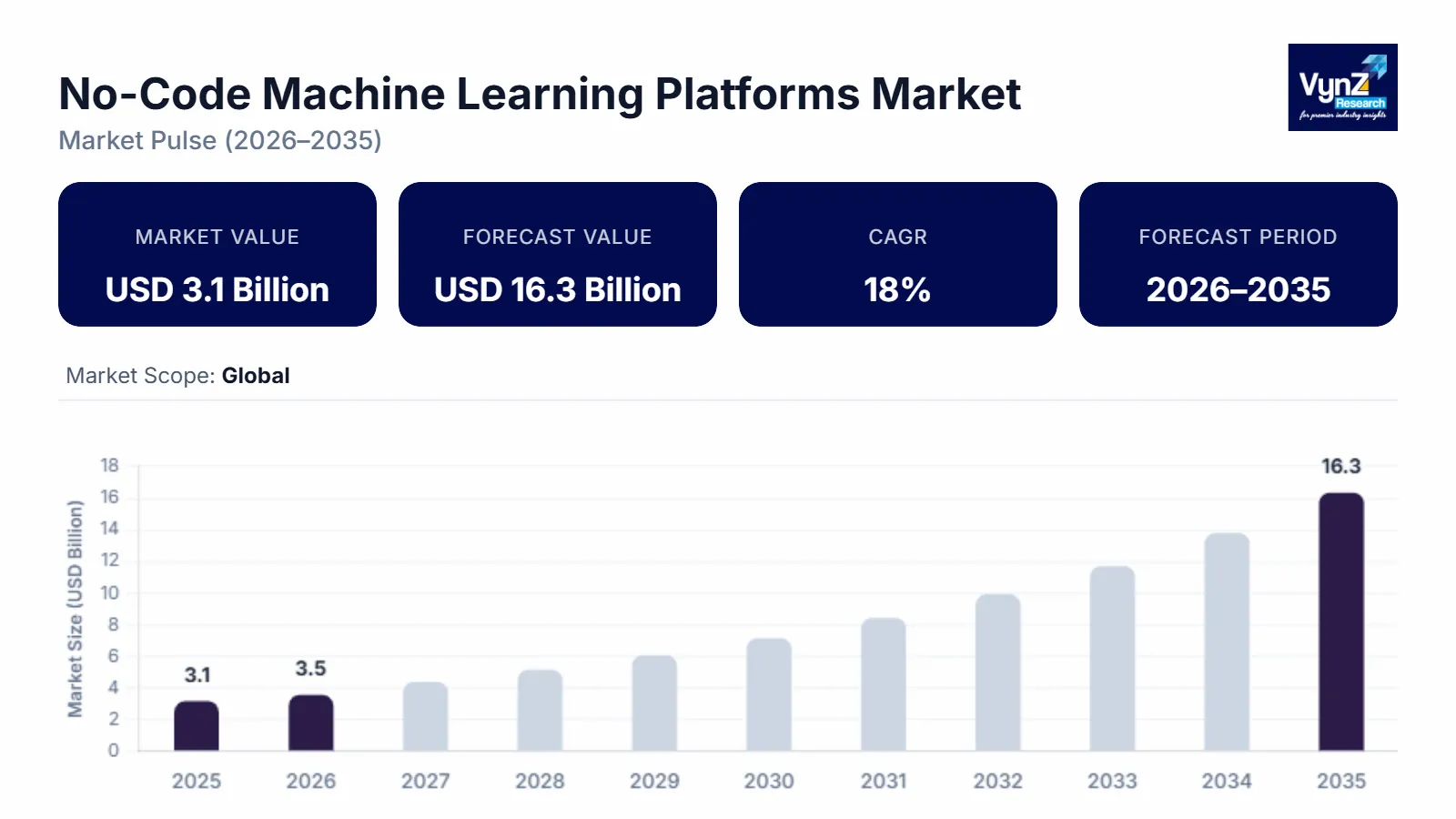
The market is expanding rapidly because enterprises choose artificial intelligence solutions which need no programming skills. It shows growth through increased automated data analytics demand and digital transformation projects which enterprises are undertaking and the rising adoption of artificial intelligence in finance, healthcare and retail businesses. Organizations are now using machine learning in their daily operations because cloud computing increases their capacity and AI development tools have become easier to use. The industrywide adoption of digital innovation programs backed by governmental support and the implementation of responsible AI frameworks have improved industrywide adoption of these technologies.
The National Institute of Standards and Technology and the Organisation for Economic Co-operation and Development have established governance frameworks and technical guidelines which help companies deploy artificial intelligence systems in a secure and scalable manner. Public funding for AI research infrastructure, digital workforce training programs and national data innovation initiatives pushes organizations to test automated machine learning solutions which simplify development processes. The market expansion in key technology centers like San Francisco, London and Bangalore occurs because enterprises need to deploy models quickly and make decisions based on data while their artificial intelligence innovation systems grow.
No-Code Machine Learning Platforms Market Dynamics
Market Trends
The market results show that artificial intelligence development has become accessible to all people and that non-technical users can now create and install machine learning systems through simplified analytics platforms. The market progresses through two major trends which display rising demand for automated machine learning systems and visual workflow tools that help organizations create models at higher efficiency while needing fewer specialized data science experts. The Organisation for Economic Co-operation and Development and the National Institute of Standards and Technology release reports which present AI policy frameworks that increasingly require organizations to create accessible machine learning systems for all their operational processes.
The rising need for digital transformation and AI-enabled business analytics drives enterprises to combine their existing cloud ecosystems and data infrastructure with no-code platform technology. Government organizations like the European Commission and the U.S. Department of Commerce create digital innovation plans with AI roadmaps to help businesses adopt AI technologies and build scalable cloud computing systems. Technology vendors now shift their focus toward integrated analytics and automation tools while developing interfaces that deliver an easy user experience which alters the market competition pattern.
Growth Drivers
The market grows because enterprises now need data-based decision making and they require simpler AI development tools. Organizations throughout all sectors now spend money on digital transformation projects that link artificial intelligence to business intelligence, customer analytics and operational optimization. The National Science Foundation and the Organisation for Economic Co-operation and Development issue national AI development strategies and technological innovation reports which show that governments now invest more public funding into AI research, data infrastructure development and digital skills training programs which drive enterprise AI technology adoption.
The increasing demand for no-code machine learning platforms results from the developing cloud computing infrastructure together with enterprise analytics ecosystems which create new requirement. The demand for AI tools which support business forecasting, customer behavior analysis and predictive analytics will continue to grow in all industries because companies need operational efficiency and automation and fast deployment of their AI tools.
Market Restraints / Challenges
The market shows strong growth potential however, it encounters obstacles which arise from difficulties with data governance, model transparency and regulatory compliance requirements. The National Institute of Standards and Technology and the European Commission publish government policy reports which show that organizations need responsible AI frameworks and risk management guidelines together with algorithmic accountability systems. Organizations face operational difficulties when they need to meet three main requirements which include data privacy regulations, model validation rules and ethical AI deployment standards.
The ability to use models becomes restricted through three main factors which include limited data quality, integration problems and the need for advanced cloud-based systems. The presence of regulated industry rules requires enterprises to maintain specific validation processes, governance protocols and specialized knowledge, which leads to delayed adoption of automated machine learning solutions in certain markets.
Market Opportunities
The market allows businesses to improve AI accessibility for small and medium-sized enterprises which do not have experienced data science professionals. The Organisation for Economic Co-operation and Development and the National Science Foundation create national AI development strategies through their government-supported digital innovation programs, which build AI ecosystems that help businesses develop their digital capabilities. The market for machine learning solutions will grow through platforms that provide budget-friendly, expandable and easily implementable solutions which target SMEs and emerging digital enterprise users.
Businesses can develop digital capabilities embedded within their operational processes through their headless integrating machine learning-based no-code solutions to cloud-based data platforms, intelligent analytics systems and automation workflows. The operational efficiency of organizations and the user acceptance of systems will improve through development of automated model development systems, explainable AI systems and unified analytics dashboard systems. The businesses that provide secure and enterprise-grade AI solutions will gain advantages from organizations that expand their data-driven business strategies and enterprise automation programs.
Global No-Code Machine Learning Platforms Market Report Coverage
|
Report Metric |
Details |
|
Historical Period |
2020 - 2024 |
|
Base Year Considered |
2025 |
|
Forecast Period |
2026 - 2035 |
|
Market Size in 2025 |
USD 3.1 Billion |
|
Revenue Forecast in 2035 |
USD 16.3 Billion |
|
Growth Rate |
18% |
|
Segments Covered in the Report |
By Type, By Technology, By Application, By Industry, By Deployment, By End User |
|
Report Scope |
Market Trends, Drivers, and Restraints; Revenue Estimation and Forecast; Segmentation Analysis; Companies’ Strategic Developments; Market Share Analysis of Key Players; Company Profiling |
|
Regions Covered in the Report |
North America, Europe, Asia Pacific, Rest of the World |
|
Key Companies |
Alteryx, Amazon Web Services, BigML, DataRobot, Google, H2O.ai, Levity, Microsoft, MonkeyLearn, RapidMiner |
|
Customization |
Available upon request |
No-Code Machine Learning Platforms Market Segmentation
By Type
The market in 2025 saw automated machine learning solutions emerge as the dominant segment which generated approximately 42% of total segment revenue. The increase in demand for simplified model development pipelines which enable enterprises to build predictive models without needing extensive coding expertise has established this model development system as the primary choice among users. The Organisation for Economic Co-operation and Development and National Science Foundation AI adoption research indicates that organizations are increasingly using AutoML systems to speed up analytics development while reducing their need for specialized data science teams.
Model deployment and lifecycle management platforms are expected to register the fastest growth with an estimated CAGR of about 21.4% during the forecast period from 2026 to 2035. The demand from enterprises for scalable AI deployment solutions which include continuous monitoring and automated model governance systems drives market expansion. Organizations are uniting their cloud-based machine learning infrastructure and enterprise data platform investments with automated deployment frameworks which enable real-time analytics capabilities and operational decision-making processes.
By Technology
The market in 2025 saw machine learning platforms control most market share which generated approximately 45% of overall segment revenue. The dominant market position exists because organizations use predictive analytics, business forecasting and operational optimization solutions in all major industry sectors including finance, retail and telecommunications. The European Commission, the U.S. National Institute of Standards and Technology national AI policy initiatives support digital transformation strategies which aim to increase enterprise ecosystems through the adoption of accessible AI tools.
Natural language processing technologies will experience the quickest growth according to estimates which predict an annual growth rate of 22.1% from 2026 through 2035. The increasing deployment of AI-powered conversational systems with automated document analysis and intelligent customer interaction platforms drives market expansion. Enterprises use NLP-enabled analytics tools through no-code environments to enhance customer engagement operations and extract insights from unstructured data sources.
By Application
Predictive analytics generated the highest revenue in 2025 because it accounted for approximately 40% of total segment revenue. Organizations throughout various sectors utilize predictive modeling methods to enhance their demand forecasting capabilities, operational planning processes and customer behavior analysis efforts. The Organisation for Economic Co-operation and Development reports that government-backed digital transformation initiatives together with analytics adoption frameworks show increasing spending on advanced analytics capabilities which help organizations achieve better productivity and decision-making outcomes.
The market for marketing automation applications will experience the highest growth rate which will continue throughout the forecast period with an expected CAGR of 21.7% from 2026 to 2035. The market expands because businesses now adopt AI-driven marketing platforms which let them optimize campaigns and create personalized experiences and segment customers without needing to learn complex programming skills. The growing need for digital customer engagement platforms together with data-driven marketing strategies drives organizations to adopt automated analytics solutions.
By Industry
The BFSI sector accounted for the largest revenue share in 2025 at approximately 28% which resulted from increased demand for fraud detection, credit risk analysis and predictive financial analytics. Financial institutions are being directed by authorities including the European Commission and financial regulatory bodies from North America and Asia to establish automated analytics platforms that enable both compliance monitoring and operational productivity through regulatory frameworks established for digital finance and data governance.
The healthcare sector will experience the highest growth rate which will reach an estimated CAGR of 22.4% between 2026 and 2035. The expansion of AI-assisted clinical analytics, patient data management systems and predictive healthcare models drives industry growth. Government digital health initiatives together with healthcare data infrastructure investments enable the implementation of simplified machine learning tools which improve diagnostics, operational planning and population health management.
By Deployment
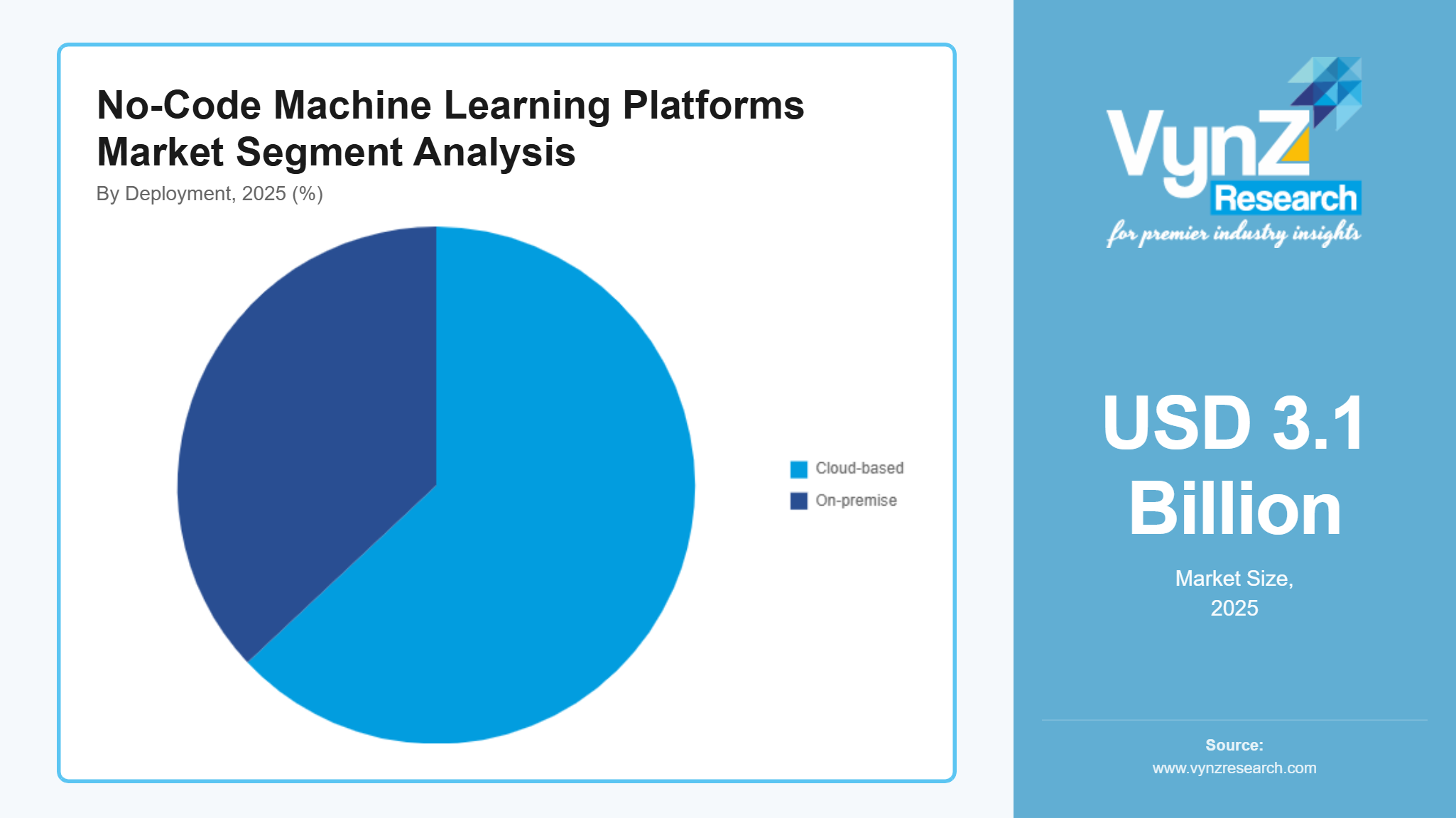
The market in 2025 experienced cloud-based platforms as its leading segment with these platforms generating about 63% of the total segment revenue. Enterprises prefer scalable computing infrastructure because it allows for remote access and integrates smoothly with cloud analytics ecosystems. The U.S. Department of Commerce and other national digital infrastructure programs together with AI innovation frameworks enable enterprises to increase their use of cloud-based analytics platforms.
The cloud deployment market will experience the highest growth rate during the forecast period which will see an estimated CAGR of 21.9%. Organizations implement no-code machine learning tools on scalable cloud infrastructure because enterprise data ecosystems are expanding rapidly and organizations are adopting hybrid cloud architectures and they require real-time analytics capabilities.
By End User
Large enterprises accounted for the largest share in 2025 which represented approximately 54% of total market revenue. Organizations control market share because they spend heavily on digital transformation projects and build advanced analytics systems and establish enterprise AI programs. Large organizations increasingly use no-code machine learning tools so cross-functional teams can develop predictive models and streamline business intelligence processes.
The fastest growth rate will occur between 2026 and 2035 when SMEs and startups will achieve an estimated CAGR of 23.2%. The growth of smaller businesses currently relies on two factors which are affordable AI platforms that became available to the market and government programs that support digital innovation to increase technology usage among small businesses. Initiatives which promote AI-driven entrepreneurship and digital capability development enable SMEs and startups to implement data-driven solutions without needing dedicated data science expertise.
Regional Insights
North America
The market in North America reached 32% of total market share during 2025 because enterprise sectors adopted artificial intelligence technologies and the region had an advanced cloud computing infrastructure. The technology hubs of San Francisco, Seattle, Boston and Toronto lead the development of enterprise analytics, software platforms and AI-powered automation solutions. The finance, retail and healthcare sectors are now using no-code AI tools to speed up analytics development while decreasing their need for specialized data science personnel.
Regional adoption of responsible AI development and digital transformation initiatives receives support from government-funded programs. The National Science Foundation, the U.S. Department of Commerce fund policy frameworks and research programs which help organizations expand their AI capabilities while making machine learning technologies accessible to businesses and startups and research institutions.
Europe
The market share of Europe reaches 25% in 2025 because effective regulatory systems, corporate digital transformation plans and industrial sector AI development have enabled European businesses to use artificial intelligence technology. The United Kingdom, Germany, France and the Netherlands are making significant investments in AI-powered analytics systems which will enhance operational efficiency and innovation capacity of their financial services, manufacturing and public administration sectors.
Regional growth receives support from policy programs which promote the creation of trustworthy artificial intelligence systems and drive innovation through data-based solutions. The European Commission established digital transformation programs which want businesses to use AI systems that enable organizations to achieve automation, predictive analytics and advanced data management across their public and private operations.
Asia Pacific
The Asia Pacific region will contribute 21% of the global market size for 2025 because its digital transformation efforts, cloud infrastructure expansion and AI-based analytics tool adoption by businesses are all growing rapidly. China, India, Japan and South Korea have a strong demand for machine learning platforms which need to be easy to use across their IT services, telecommunications, retail and financial technology industries. The technology hubs of Beijing, Bangalore, Tokyo and Singapore are leading the development of AI business applications throughout the region.
The government programs which strengthen artificial intelligence capabilities in the country will help the market experience expansion. Organizations such as NITI Aayog and other technology development frameworks across Asia promote national AI development programs and digital innovation strategies which help businesses and startups use user-friendly machine learning tools for their analytics and process automation needs.
Rest of the World
The 2025 market share of the Rest of the World includes Latin America, the Middle East and Africa which together represent 22% of total market size. The digital infrastructure expansion and enterprise cloud adoption increase and business operations awareness about artificial intelligence applications all drive growth in these regions. São Paulo, Dubai and Johannesburg are developing emerging technology hubs which use AI analytics platforms to boost organizational productivity and efficiency.
The government programs which support digital transformation and which create technology adoption paths will help organizations build their artificial intelligence and data analytics capacity. International development organizations and national technology agencies support initiatives which help businesses use AI tools that require no coding skills.
Competitive Landscape / Company Insights
The market operates with moderate to intense competition, which exists between international and domestic companies that compete through product development, price setting and market expansion efforts. Companies establish their market presence through investments in research activities, cloud system integration and digital platform development. The adoption of artificial intelligence development frameworks which organizations like the National Institute of Standards and Technology and the European Commission advocate for responsible AI deployment and accessible enterprise machine learning tools has received support from these frameworks.
Mini Profiles
Alteryx focuses on no-code and low-code analytics automation platforms, supported by strong enterprise distribution networks, a robust partner ecosystem, and user-friendly data preparation capabilities that enhance accessibility for business analysts.
BigML operates in niche machine learning platform segments, emphasizing model transparency, automated machine learning tools, and scalable cloud infrastructure designed to support predictive analytics across diverse enterprise applications.
Cloud-based services from Amazon Web Services leverage strategic partnerships, global cloud infrastructure, and extensive developer ecosystems to expand market presence, enabling scalable no-code machine learning deployment for enterprises and startups.
DataRobot focuses on automated machine learning platforms, supported by strong enterprise adoption, advanced AI lifecycle management tools, and global enterprise partnerships that strengthen its presence across data-driven decision-making environments.
Google operates in premium and enterprise AI platform segments, emphasizing advanced machine learning frameworks, scalable cloud infrastructure, and integrated AI services that support large-scale predictive analytics and automation across industries.
Key Players
- Alteryx
- Amazon Web Services
- BigML
- DataRobot
- H2O.ai
- Levity
- Microsoft
- MonkeyLearn
- RapidMiner
Recent Developments
In July 2025, DataRobot launched a major update to its AI Cloud platform, introducing a no-code time series modeling capability with a drag-and-drop interface. This development significantly enhances accessibility for business users, enabling faster deployment of predictive models without requiring coding expertise.
In January 2026, Google continued expanding its no-code AI ecosystem through advancements in AutoML and generative AI tools, enabling users to build multimodal models using text, image, and audio inputs. These enhancements reflect the growing demand for intuitive AI platforms that support non-technical users across industries.
In March 2026, Alteryx strengthened its position in the no-code ML market by enhancing its analytics automation platform with improved AI-driven workflows and user-friendly model deployment features. The update supports enterprise users in accelerating data preparation and predictive analytics without deep technical expertise.
In February 2026, Amazon Web Services continued to expand its no-code machine learning capabilities through Amazon SageMaker, enabling business analysts to build and deploy models using visual interfaces. This aligns with the broader industry shift toward democratizing AI and reducing reliance on specialized data science teams.
In early 2026, H2O.ai advanced its no-code AI offerings by integrating generative AI and automated machine learning features into its platform. These enhancements allow organizations to rapidly develop and deploy AI applications, supporting the growing adoption of citizen-developer initiatives in enterprises.
Global No-Code Machine Learning Platforms Market Coverage
Type Insight and Forecast 2026 - 2035
- Automated Machine Learning (AutoML)
- Data Preparation & Preprocessing
- Model Deployment & Management
- Others
Technology Insight and Forecast 2026 - 2035
- Natural Language Processing (NLP)
- Machine Learning
- Deep Learning
- Computer Vision
Application Insight and Forecast 2026 - 2035
- Marketing Automation
- Predictive Analytics
- Customer Service
- Risk Management
Industry Insight and Forecast 2026 - 2035
- Healthcare
- BFSI
- Retail & E-commerce
- IT & Telecom
- Others
Deployment Insight and Forecast 2026 - 2035
- Cloud-based
- On-premise
End-user Insight and Forecast 2026 - 2035
- SMEs
- Large Enterprises
- Startups
Global No-Code Machine Learning Platforms Market by Region
- North America
- By Type
- By Technology
- By Application
- By Industry
- By Deployment
- By End-user
- By Country - U.S., Canada, Mexico
- Europe
- By Type
- By Technology
- By Application
- By Industry
- By Deployment
- By End-user
- By Country - Germany, U.K., France, Italy, Spain, Russia, Rest of Europe
- Asia-Pacific (APAC)
- By Type
- By Technology
- By Application
- By Industry
- By Deployment
- By End-user
- By Country - China, Japan, India, South Korea, Vietnam, Thailand, Malaysia, Rest of Asia-Pacific
- Rest of the World (RoW)
- By Type
- By Technology
- By Application
- By Industry
- By Deployment
- By End-user
- By Country - Brazil, Saudi Arabia, South Africa, U.A.E., Other Countries
Table of Contents for No-Code Machine Learning Platforms Market Report
1. Research Overview
1.1. The Report Offers
1.2. Market Coverage
1.2.1. By
Type
1.2.2. By
Technology
1.2.3. By
Application
1.2.4. By
Industry
1.2.5. By
Deployment
1.2.6. By
End-user
1.3. Research Phases
1.4. Limitations
1.5. Market Methodology
1.5.1. Data Sources
1.5.1.1.
Primary Research
1.5.1.2.
Secondary Research
1.5.2. Methodology
1.5.2.1.
Data Exploration
1.5.2.2.
Forecast Parameters
1.5.2.3.
Data Validation
1.5.2.4.
Assumptions
1.5.3. Study Period & Data Reporting Unit
2. Executive Summary
3. Industry Overview
3.1. Industry Dynamics
3.1.1. Market Growth Drivers
3.1.2. Market Restraints
3.1.3. Key Market Trends
3.1.4. Major Opportunities
3.2. Industry Ecosystem
3.2.1. Porter’s Five Forces Analysis
3.2.2. Recent Development Analysis
3.2.3. Value Chain Analysis
3.3. Competitive Insight
3.3.1. Competitive Position of Industry
Players
3.3.2. Market Attractive Analysis
3.3.3. Market Share Analysis
4. Global Market Estimate and Forecast
4.1. Global Market Overview
4.2. Global Market Estimate and Forecast to 2035
5. Market Segmentation Estimate and Forecast
5.1. By Type
5.1.1. Automated Machine Learning (AutoML)
5.1.1.1. Market Definition
5.1.1.2. Market Estimation and Forecast to 2035
5.1.2. Data Preparation & Preprocessing
5.1.2.1. Market Definition
5.1.2.2. Market Estimation and Forecast to 2035
5.1.3. Model Deployment & Management
5.1.3.1. Market Definition
5.1.3.2. Market Estimation and Forecast to 2035
5.1.4. Others
5.1.4.1. Market Definition
5.1.4.2. Market Estimation and Forecast to 2035
5.2. By Technology
5.2.1. Natural Language Processing (NLP)
5.2.1.1. Market Definition
5.2.1.2. Market Estimation and Forecast to 2035
5.2.2. Machine Learning
5.2.2.1. Market Definition
5.2.2.2. Market Estimation and Forecast to 2035
5.2.3. Deep Learning
5.2.3.1. Market Definition
5.2.3.2. Market Estimation and Forecast to 2035
5.2.4. Computer Vision
5.2.4.1. Market Definition
5.2.4.2. Market Estimation and Forecast to 2035
5.3. By Application
5.3.1. Marketing Automation
5.3.1.1. Market Definition
5.3.1.2. Market Estimation and Forecast to 2035
5.3.2. Predictive Analytics
5.3.2.1. Market Definition
5.3.2.2. Market Estimation and Forecast to 2035
5.3.3. Customer Service
5.3.3.1. Market Definition
5.3.3.2. Market Estimation and Forecast to 2035
5.3.4. Risk Management
5.3.4.1. Market Definition
5.3.4.2. Market Estimation and Forecast to 2035
5.4. By Industry
5.4.1. Healthcare
5.4.1.1. Market Definition
5.4.1.2. Market Estimation and Forecast to 2035
5.4.2. BFSI
5.4.2.1. Market Definition
5.4.2.2. Market Estimation and Forecast to 2035
5.4.3. Retail & E-commerce
5.4.3.1. Market Definition
5.4.3.2. Market Estimation and Forecast to 2035
5.4.4. IT & Telecom
5.4.4.1. Market Definition
5.4.4.2. Market Estimation and Forecast to 2035
5.4.5. Others
5.4.5.1. Market Definition
5.4.5.2. Market Estimation and Forecast to 2035
5.5. By Deployment
5.5.1. Cloud-based
5.5.1.1. Market Definition
5.5.1.2. Market Estimation and Forecast to 2035
5.5.2. On-premise
5.5.2.1. Market Definition
5.5.2.2. Market Estimation and Forecast to 2035
5.6. By End-user
5.6.1. SMEs
5.6.1.1. Market Definition
5.6.1.2. Market Estimation and Forecast to 2035
5.6.2. Large Enterprises
5.6.2.1. Market Definition
5.6.2.2. Market Estimation and Forecast to 2035
5.6.3. Startups
5.6.3.1. Market Definition
5.6.3.2. Market Estimation and Forecast to 2035
6. North America Market Estimate and Forecast
6.1. By
Type
6.2. By
Technology
6.3. By
Application
6.4. By
Industry
6.5. By
Deployment
6.6. By
End-user
6.6.1.
U.S. Market Estimate and Forecast
6.6.2.
Canada Market Estimate and Forecast
6.6.3.
Mexico Market Estimate and Forecast
7. Europe Market Estimate and Forecast
7.1. By
Type
7.2. By
Technology
7.3. By
Application
7.4. By
Industry
7.5. By
Deployment
7.6. By
End-user
7.6.1.
Germany Market Estimate and Forecast
7.6.2.
France Market Estimate and Forecast
7.6.3.
U.K. Market Estimate and Forecast
7.6.4.
Italy Market Estimate and Forecast
7.6.5.
Spain Market Estimate and Forecast
7.6.6.
Russia Market Estimate and Forecast
7.6.7.
Rest of Europe Market Estimate and Forecast
8. Asia-Pacific (APAC) Market Estimate and Forecast
8.1. By
Type
8.2. By
Technology
8.3. By
Application
8.4. By
Industry
8.5. By
Deployment
8.6. By
End-user
8.6.1.
China Market Estimate and Forecast
8.6.2.
Japan Market Estimate and Forecast
8.6.3.
India Market Estimate and Forecast
8.6.4.
South Korea Market Estimate and Forecast
8.6.5.
Rest of Asia-Pacific Market Estimate and Forecast
9. Rest of the World (RoW) Market Estimate and Forecast
9.1. By
Type
9.2. By
Technology
9.3. By
Application
9.4. By
Industry
9.5. By
Deployment
9.6. By
End-user
9.6.1.
Brazil Market Estimate and Forecast
9.6.2.
Saudi Arabia Market Estimate and Forecast
9.6.3.
South Africa Market Estimate and Forecast
9.6.4.
U.A.E. Market Estimate and Forecast
9.6.5.
Other Countries Market Estimate and Forecast
10. Company Profiles
10.1.
Alteryx
10.1.1.
Snapshot
10.1.2.
Overview
10.1.3.
Offerings
10.1.4.
Financial
Insight
10.1.5.
Recent
Developments
10.2.
Amazon Web Services
10.2.1.
Snapshot
10.2.2.
Overview
10.2.3.
Offerings
10.2.4.
Financial
Insight
10.2.5.
Recent
Developments
10.3.
BigML
10.3.1.
Snapshot
10.3.2.
Overview
10.3.3.
Offerings
10.3.4.
Financial
Insight
10.3.5.
Recent
Developments
10.4.
DataRobot
10.4.1.
Snapshot
10.4.2.
Overview
10.4.3.
Offerings
10.4.4.
Financial
Insight
10.4.5.
Recent
Developments
10.5.
Google
10.5.1.
Snapshot
10.5.2.
Overview
10.5.3.
Offerings
10.5.4.
Financial
Insight
10.5.5.
Recent
Developments
10.6.
H2O.ai
10.6.1.
Snapshot
10.6.2.
Overview
10.6.3.
Offerings
10.6.4.
Financial
Insight
10.6.5.
Recent
Developments
10.7.
Levity
10.7.1.
Snapshot
10.7.2.
Overview
10.7.3.
Offerings
10.7.4.
Financial
Insight
10.7.5.
Recent
Developments
10.8.
Microsoft
10.8.1.
Snapshot
10.8.2.
Overview
10.8.3.
Offerings
10.8.4.
Financial
Insight
10.8.5.
Recent
Developments
10.9.
MonkeyLearn
10.9.1.
Snapshot
10.9.2.
Overview
10.9.3.
Offerings
10.9.4.
Financial
Insight
10.9.5.
Recent
Developments
10.10.
RapidMiner
10.10.1.
Snapshot
10.10.2.
Overview
10.10.3.
Offerings
10.10.4.
Financial
Insight
10.10.5.
Recent
Developments
11. Appendix
11.1. Exchange Rates
11.2. Abbreviations
Note: Financial insight and recent developments of different companies are subject to the availability of information in the secondary domain.
Frequently Asked Questions
Purchase Options
Latest Report
Research Methodology
- Desk Research / Pilot Interviews
- Build Market Size Model
- Research and Analysis
- Final Deliverable
Connect With Our Sales Team
- Toll-Free: +1-888-253-3960
- Phone: +91 9960 288 381
- Email: enquiry@vynzresearch.com
No-Code Machine Learning Platforms Market