
Construction & Demolition Robots Market Size & Share - Growth Forecast Report (2026-2035)
Industry Insight by Product Type (Traditional robots, Robotic arms, Exoskeletons), by Automation (Semi-autonomous robots, Fully autonomous robots), by Function (Demolition robots, Bricklaying robots, Concrete structural erection robots, 3d printing robots, Others), by Product Size (Mini, Medium, Large), by Application (Public infrastructure, Commercial and residential buildings, Nuclear dismantling and demolition, Others), by Sales Type (New equipment, Aftermarket), by Region (North America, Europe, Asia Pacific, Rest of the World)
| Status : Published | Published On : May, 2026 | Report Code : VRSME9207 | Industry : Semiconductor & Electronics | Available Format :

|
Page : 156 |
Construction & Demolition Robots Market Overview
The global construction and demolition robots market which was valued at approximately USD 0.58 billion in 2025 and is estimated to rise further up to almost USD 0.69 billion in 2026, is projected to reach around USD 2.98 billion in 2035, expanding at a CAGR of about 17.8% during the forecast period from 2026 to 2035.
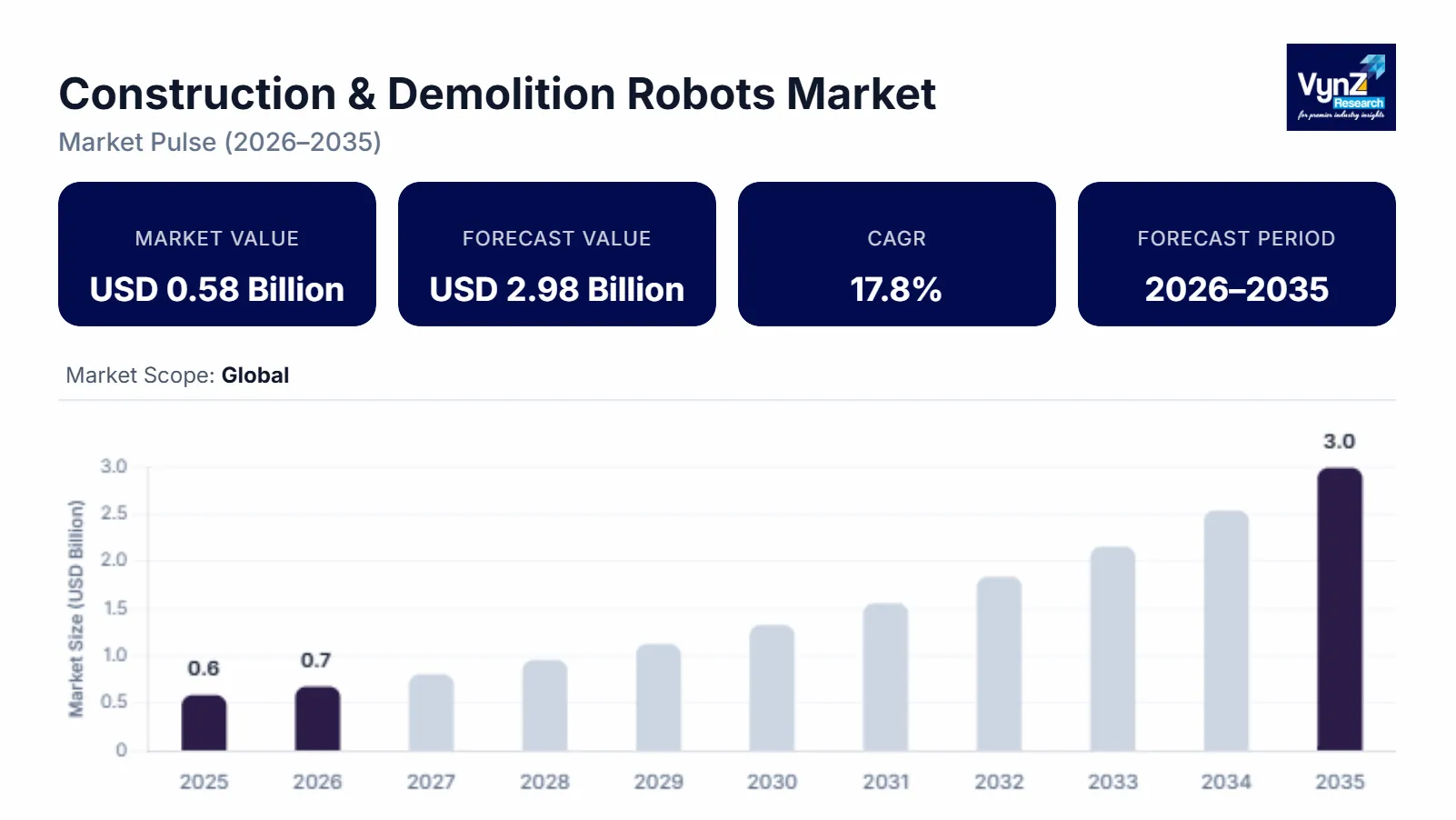
The market experiences growth because construction activities become more automated, work sites require better safety measures for dangerous demolition operations, infrastructure projects face increasing worker shortages and the use of robotic construction systems becomes more common. The current market growth across Asia Pacific, North America, and Europe results from increased demand for precise demolition and construction operations and ongoing funding for smart infrastructure projects.
International labor and safety organizations document ongoing construction site hazards which drive organizations to implement robotic systems that decrease workplace injuries while boosting their operational performance. Market growth receives a boost from government infrastructure development programs which require safety compliance and from regulatory safety standards which protect workers. Public investment initiatives that focus on urban redevelopment, expansion of transport infrastructure and the promotion of sustainable construction methods are driving the adoption of robotic technologies within construction operations.
Construction & Demolition Robots Market Dynamics
Market Trends
The market is currently experiencing substantial technological changes because construction automation technology now functions as an essential component for operational processes across all building activities. The market development process is currently moving forward through the increased usage of completely autonomous robotic systems which demonstrate the increasing demand for machines that operate without human control in dangerous work areas with high risk. The construction industry is currently adopting 3D printing robots and robotic arms for structural construction work as digital construction technologies and building information modeling systems experience fast technological progress. International construction and infrastructure agencies report that more organizations are now implementing smart construction methods which lead companies to develop robotic systems that work together with cutting edge control technologies, which changes the competitive landscape of the industry.
Growth Drivers
The market experiences its main growth support through the rising demand for worker safety, which sustains permanent need across demolition and infrastructure projects. Rising investments in large scale infrastructure and urban development projects are further accelerating market expansion. The construction industry, which faces workforce shortages, drives increased equipment adoption operational need. Construction companies expect their need for robotic equipment to stay high because they make operational efficiency and safety regulations their main business objectives. Global labor and safety organizations report that construction sites experience both workforce shortages and occupational hazards, which drives construction sites toward adopting automation solutions.
Market Restraints / Challenges
The market encounters multiple challenges that will restrict its market potential despite exhibiting promising growth opportunities. The market entry process for small and medium contractors becomes difficult because of two factors which include high initial investment costs and capital intensity that hampers both profitability and market entry. The manufacturing process requires both skilled operators and technical expertise which creates operational difficulties for manufacturers and end users. The market system experiences negative effects during economic downturns because businesses need to import high technology special components. Safety certification and equipment standard regulatory requirements create multiple challenges which prevent successful market entry across different regions.
Market Opportunities
Smart infrastructure development offers substantial market opportunities which urban centers need to develop because cities expand and construction operations shift to digital methods. Large infrastructure developers and government-backed projects will create new demand for companies which sell modular high-performance robotic systems. The nuclear dismantling and high-risk demolition markets present a vital chance to develop specialized operations from which companies can achieve sustainable profits through long-term contracts. Automation developments alongside artificial intelligence and remote operation technology improvements, will boost operational productivity for construction organizations.
Global Construction & Demolition Robots Market Report Coverage
|
Report Metric |
Details |
|
Historical Period |
2020 - 2024 |
|
Base Year Considered |
2025 |
|
Forecast Period |
2026 - 2035 |
|
Market Size in 2025 |
USD 0.58 Billion |
|
Revenue Forecast in 2035 |
USD 2.98 Billion |
|
Growth Rate |
17.8% |
|
Segments Covered in the Report |
Product Type, Automation, Function, Product Size, Application, Sales Type |
|
Report Scope |
Market Trends, Drivers, and Restraints; Revenue Estimation and Forecast; Segmentation Analysis; Companies’ Strategic Developments; Market Share Analysis of Key Players; Company Profiling |
|
Regions Covered in the Report |
North America, Europe, Asia Pacific, Rest of the World |
|
Key Companies |
Advanced Construction Robotics Inc., Brokk AB, Conjet AB, Construction Robotics LLC, CyBe Construction BV, Ekso Bionics Holdings Inc., Fastbrick Robotics Limited, Fujita Corporation, Husqvarna AB, Komatsu Ltd. |
|
Customization |
Available upon request |
Construction & Demolition Robots Market Segmentation
By Product Type
The market in 2025 took its highest share from robotic arms which brought in approximately 46% of the entire market revenue for this category. The technology achieves its maximum efficiency through its ability to operate in demolition work, material handling and precision construction tasks while being used more often in automated construction workflows. The infrastructure modernization programs together with safety compliance standards which government and regulatory bodies promote lead to widespread adoption of these technologies as they reduce human work in dangerous areas. The combination of these factors creates consistent demand in both developed and developing markets for construction activities.
The exoskeleton market will experience the highest growth rate which is expected to reach an 18.6% CAGR through the period from 2026 to 2035. The construction industry develops because organizations focus on creating safe environments which improve ergonomic performance while decreasing physical demands on workers. The occupational safety organizations show increasing workplace injuries which drive companies to implement wearable robotic solutions that boost their productivity. The market for traditional robots maintains stable demand because the technology already exists in demolition operations which need controlled environments and the machines can function reliably.
By Automation
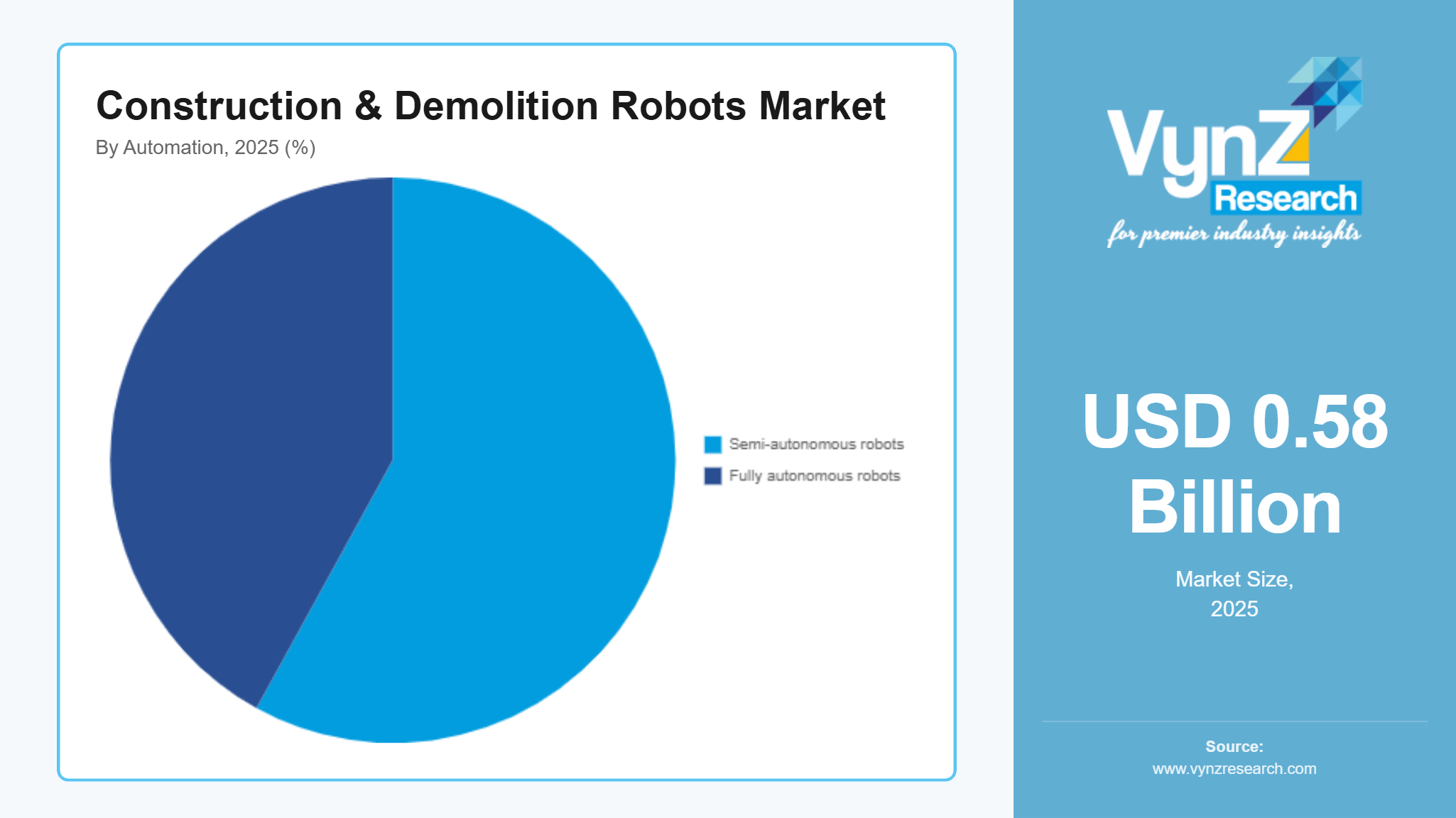
The 2025 market reached its highest value through semi-autonomous robots which generated approximately 58% of total segment revenue. The technology achieves its maximum efficiency through its ability to operate in automated construction. The gradual automation of robotic technologies together with construction site safety requirements creates a regulatory environment which permits controlled robotic system implementation. The systems maintain their market presence because they suit regions which have moderate technology and depend on human workers.
The market for fully autonomous robots will expand at the highest growth rate which will reach a 19.2% CAGR from 2026 to 2035. The construction industry grows because artificial intelligence and sensor technology and real time data processing technology enable machines to work independently in complex environments. The government digital infrastructure programs together with smart construction programs enable digital transformation in large-scale infrastructure projects which need both efficiency and operational precision. The expansion of this sector develops because businesses are investing more in automated technological solutions.
By Function
The demolition robot market reached its highest value in 2025 when it generated roughly 41% of total segment revenue. The technology achieves its maximum efficiency through its ability to operate in demolition work. The construction sector adopts government safety rules and construction regulations which protect workers to build infrastructure and dismantle industrial facilities. The segment maintains constant demand because both businesses and government organizations need to complete their demolition activities with controlled efficiency.
The 3D printing robot market will experience the highest growth rate which will reach a 20.1% CAGR through the upcoming period. The construction sector grows because businesses adopt advanced construction technologies which enable them to finish projects faster while producing less waste and achieving better design outcomes. The public sector invests in sustainable construction and smart city initiatives which drive the adoption of automated construction solutions. The bricklaying robots together with concrete structural erection robots experience growth because they improve productivity and precision construction methods become more popular.
By Product Size
The medium-sized robot market reached its highest value in 2025 when these robots generated approximately 49% of total segment revenue. The system achieves its maximum operational performance through its ability to handle various construction tasks while maintaining cost efficiency compared to larger systems. The construction market adopts the technology because infrastructure expansion projects need systems which can operate in multiple construction environments. The government construction programs and modernization initiatives strengthen market demand for medium-sized robotic solutions which are vital in major markets.
The mini robot market will experience the highest growth rate which will reach an 18.9% CAGR through the period from 2026 to 2035. The construction industry expands because businesses need compact flexible solutions which can operate in narrow urban construction spaces and renovation areas. The urban development authorities show that cities are investing more in smart city and redevelopment projects which require them to use smaller robots that can navigate tight spaces. The market for large robots maintains stable demand because heavy-duty industrial operations need equipment which can function at high capacity and travel long distances.
Regional Insights
Asia Pacific
The market in 2025 received 33% of its share from Asia Pacific because urban areas expand, infrastructure projects proceed and construction automation use increases. The construction market persists in its expansion because Beijing, Tokyo and Mumbai provide urban construction and redevelopment projects which require high-density development. The regional infrastructure development authorities register continuous funding for smart city projects and transportation systems which create a demand for sophisticated robotic technologies that enhance operational efficiency and secure working environments.
North America
The market share of North America reached 27% according to 2025 market predictions. The region maintains steady economic growth because of its active industrial base which brings technological progress and construction automation systems that workers began using. The construction industry requires ongoing material supply because projects now encompass both infrastructure restoration work and commercial building activities. The safety regulations established by occupational safety and labor agencies compel workplaces to adopt robotic systems which help decrease hazards and enhance productivity.
Europe
The market share of Europe for 2025 reached 22% which European countries will boost through their infrastructure modernization initiatives and their need to meet regulatory requirements and their growing demand for sustainable construction methods. The UK, Germany and France have seen a rise in their commercial and industrial projects which now utilize robotic construction technologies. The construction and safety authorities of the region show strong support for both sustainable practices and safety improvements through their automation programs.
Rest of the World
The market share for Rest of the World territories stood at 18% while South America, Middle East and Africa make up the major market share in 2025. The construction sector sees growth because of increased infrastructure investments, ongoing urban development projects and the slow shift of construction sites towards using automated systems. Countries in emerging economies now start to implement robotic systems which are essential for large projects that require high standards of efficiency and safety. The remaining market demand not specifically covered by Asia Pacific, North America, and Europe is included within this segment, representing a mix of developing regions with long term growth potential.
Competitive Landscape / Company Insights
The market shows a moderate level of competition because both international and local companies operate in the market while they develop new products, build automation functions and expand their market reach. The companies in the market are increasing their research and development spending together with their digital integration efforts to improve their competitive standing. The development of advanced robotic systems which meet safety regulations receives support from occupational safety rules and infrastructure authority guidelines. The construction industry and public infrastructure projects provide strategic partnerships which help the company to enter new markets and maintain its competitive advantage over time.
Mini Profiles
Advanced Construction Robotics Inc. focuses on autonomous construction equipment and robotic solutions, supported by strong engineering capabilities and growing contractor adoption across infrastructure projects, enhancing efficiency and safety in complex construction environments.
Brokk AB operates in the premium demolition robotics segment, emphasizing high performance, durability, and precision control, widely used in hazardous environments requiring remote operated solutions for safety and operational efficiency.
Construction Robotics LLC focuses on robotic systems for masonry and material handling, supported by innovation in automation technologies and increasing adoption across commercial construction projects seeking productivity and labor optimization.
CyBe Construction BV leverages digital construction technologies and strategic partnerships to expand market presence, offering advanced 3d printing solutions that enable faster project execution and cost-efficient building processes.
Ekso Bionics Holdings Inc. focuses on wearable robotic exoskeletons, supported by strong research capabilities and increasing adoption in industrial applications to enhance worker safety, reduce fatigue, and improve operational productivity.
Key Players
- Advanced Construction Robotics Inc.
- Brokk AB
- Conjet AB
- Construction Robotics LLC
- CyBe Construction BV
- Ekso Bionics Holdings Inc.
- Fastbrick Robotics Limited
- Fujita Corporation
- Husqvarna AB
- Komatsu Ltd.
Recent Developments
In February 2025, Fastbrick Robotics Limited piloted its Hadrian X robotic bricklaying system with a major U.S. homebuilder, successfully constructing a residential structure within a single day. This development highlights growing commercialization of autonomous construction technologies and increasing adoption in large scale housing projects.
In April 2026, Fujita Corporation advanced its deployment of construction robotics through integration of automated systems in infrastructure and building projects, focusing on improving productivity and safety. The initiative aligns with Japan’s national push toward automation to address labor shortages and aging workforce challenges.
In March 2026, Husqvarna AB expanded its robotic demolition equipment portfolio, emphasizing enhanced remote operation and precision capabilities for hazardous construction environments. The company continues to strengthen its position in safety driven demolition solutions across industrial and infrastructure applications.
In January 2026, Komatsu Ltd. accelerated development of autonomous construction equipment integrated with artificial intelligence and smart control systems. These advancements are supporting efficient project execution and aligning with global trends toward digitally enabled and automated construction practices.
In May 2025, CyBe Construction BV supported deployment of 3d printing construction technologies in real world building projects, contributing to faster construction timelines and reduced material waste. This reflects increasing adoption of additive manufacturing in sustainable and automated construction processes.
Global Construction & Demolition Robots Market Coverage
Product Type Insight and Forecast 2026 - 2035
- Traditional robots
- Robotic arms
- Exoskeletons
Automation Insight and Forecast 2026 - 2035
- Semi-autonomous robots
- Fully autonomous robots
Function Insight and Forecast 2026 - 2035
- Demolition robots
- Bricklaying robots
- Concrete structural erection robots
- 3d printing robots
- Others
Product Size Insight and Forecast 2026 - 2035
- Mini
- Medium
- Large
Application Insight and Forecast 2026 - 2035
- Public infrastructure
- Commercial and residential buildings
- Nuclear dismantling and demolition
- Others
Sales Type Insight and Forecast 2026 - 2035
- New equipment
- Aftermarket
Region Insight and Forecast 2026 - 2035
- North America
- Europe
- Asia Pacific
- Rest of the World
Global Construction & Demolition Robots Market by Region
- North America
- By Product Type
- By Automation
- By Function
- By Product Size
- By Application
- By Sales Type
- By Region
- By Country - U.S., Canada, Mexico
- Europe
- By Product Type
- By Automation
- By Function
- By Product Size
- By Application
- By Sales Type
- By Region
- By Country - Germany, U.K., France, Italy, Spain, Russia, Rest of Europe
- Asia-Pacific (APAC)
- By Product Type
- By Automation
- By Function
- By Product Size
- By Application
- By Sales Type
- By Region
- By Country - China, Japan, India, South Korea, Vietnam, Thailand, Malaysia, Rest of Asia-Pacific
- Rest of the World (RoW)
- By Product Type
- By Automation
- By Function
- By Product Size
- By Application
- By Sales Type
- By Region
- By Country - Brazil, Saudi Arabia, South Africa, U.A.E., Other Countries
Table of Contents for Construction & Demolition Robots Market Report
1. Research Overview
1.1. The Report Offers
1.2. Market Coverage
1.2.1. By
Product Type
1.2.2. By
Automation
1.2.3. By
Function
1.2.4. By
Product Size
1.2.5. By
Application
1.2.6. By
Sales Type
1.2.7. By
Region
1.3. Research Phases
1.4. Limitations
1.5. Market Methodology
1.5.1. Data Sources
1.5.1.1.
Primary Research
1.5.1.2.
Secondary Research
1.5.2. Methodology
1.5.2.1.
Data Exploration
1.5.2.2.
Forecast Parameters
1.5.2.3.
Data Validation
1.5.2.4.
Assumptions
1.5.3. Study Period & Data Reporting Unit
2. Executive Summary
3. Industry Overview
3.1. Industry Dynamics
3.1.1. Market Growth Drivers
3.1.2. Market Restraints
3.1.3. Key Market Trends
3.1.4. Major Opportunities
3.2. Industry Ecosystem
3.2.1. Porter’s Five Forces Analysis
3.2.2. Recent Development Analysis
3.2.3. Value Chain Analysis
3.3. Competitive Insight
3.3.1. Competitive Position of Industry
Players
3.3.2. Market Attractive Analysis
3.3.3. Market Share Analysis
4. Global Market Estimate and Forecast
4.1. Global Market Overview
4.2. Global Market Estimate and Forecast to 2035
5. Market Segmentation Estimate and Forecast
5.1. By Product Type
5.1.1. Traditional robots
5.1.1.1. Market Definition
5.1.1.2. Market Estimation and Forecast to 2035
5.1.2. Robotic arms
5.1.2.1. Market Definition
5.1.2.2. Market Estimation and Forecast to 2035
5.1.3. Exoskeletons
5.1.3.1. Market Definition
5.1.3.2. Market Estimation and Forecast to 2035
5.2. By Automation
5.2.1. Semi-autonomous robots
5.2.1.1. Market Definition
5.2.1.2. Market Estimation and Forecast to 2035
5.2.2. Fully autonomous robots
5.2.2.1. Market Definition
5.2.2.2. Market Estimation and Forecast to 2035
5.3. By Function
5.3.1. Demolition robots
5.3.1.1. Market Definition
5.3.1.2. Market Estimation and Forecast to 2035
5.3.2. Bricklaying robots
5.3.2.1. Market Definition
5.3.2.2. Market Estimation and Forecast to 2035
5.3.3. Concrete structural erection robots
5.3.3.1. Market Definition
5.3.3.2. Market Estimation and Forecast to 2035
5.3.4. 3d printing robots
5.3.4.1. Market Definition
5.3.4.2. Market Estimation and Forecast to 2035
5.3.5. Others
5.3.5.1. Market Definition
5.3.5.2. Market Estimation and Forecast to 2035
5.4. By Product Size
5.4.1. Mini
5.4.1.1. Market Definition
5.4.1.2. Market Estimation and Forecast to 2035
5.4.2. Medium
5.4.2.1. Market Definition
5.4.2.2. Market Estimation and Forecast to 2035
5.4.3. Large
5.4.3.1. Market Definition
5.4.3.2. Market Estimation and Forecast to 2035
5.5. By Application
5.5.1. Public infrastructure
5.5.1.1. Market Definition
5.5.1.2. Market Estimation and Forecast to 2035
5.5.2. Commercial and residential buildings
5.5.2.1. Market Definition
5.5.2.2. Market Estimation and Forecast to 2035
5.5.3. Nuclear dismantling and demolition
5.5.3.1. Market Definition
5.5.3.2. Market Estimation and Forecast to 2035
5.5.4. Others
5.5.4.1. Market Definition
5.5.4.2. Market Estimation and Forecast to 2035
5.6. By Sales Type
5.6.1. New equipment
5.6.1.1. Market Definition
5.6.1.2. Market Estimation and Forecast to 2035
5.6.2. Aftermarket
5.6.2.1. Market Definition
5.6.2.2. Market Estimation and Forecast to 2035
5.7. By Region
5.7.1. North America
5.7.1.1. Market Definition
5.7.1.2. Market Estimation and Forecast to 2035
5.7.2. Europe
5.7.2.1. Market Definition
5.7.2.2. Market Estimation and Forecast to 2035
5.7.3. Asia Pacific
5.7.3.1. Market Definition
5.7.3.2. Market Estimation and Forecast to 2035
5.7.4. Rest of the World
5.7.4.1. Market Definition
5.7.4.2. Market Estimation and Forecast to 2035
6. North America Market Estimate and Forecast
6.1. By
Product Type
6.2. By
Automation
6.3. By
Function
6.4. By
Product Size
6.5. By
Application
6.6. By
Sales Type
6.7. By
Region
6.7.1.
U.S. Market Estimate and Forecast
6.7.2.
Canada Market Estimate and Forecast
6.7.3.
Mexico Market Estimate and Forecast
7. Europe Market Estimate and Forecast
7.1. By
Product Type
7.2. By
Automation
7.3. By
Function
7.4. By
Product Size
7.5. By
Application
7.6. By
Sales Type
7.7. By
Region
7.7.1.
Germany Market Estimate and Forecast
7.7.2.
France Market Estimate and Forecast
7.7.3.
U.K. Market Estimate and Forecast
7.7.4.
Italy Market Estimate and Forecast
7.7.5.
Spain Market Estimate and Forecast
7.7.6.
Russia Market Estimate and Forecast
7.7.7.
Rest of Europe Market Estimate and Forecast
8. Asia-Pacific (APAC) Market Estimate and Forecast
8.1. By
Product Type
8.2. By
Automation
8.3. By
Function
8.4. By
Product Size
8.5. By
Application
8.6. By
Sales Type
8.7. By
Region
8.7.1.
China Market Estimate and Forecast
8.7.2.
Japan Market Estimate and Forecast
8.7.3.
India Market Estimate and Forecast
8.7.4.
South Korea Market Estimate and Forecast
8.7.5.
Rest of Asia-Pacific Market Estimate and Forecast
9. Rest of the World (RoW) Market Estimate and Forecast
9.1. By
Product Type
9.2. By
Automation
9.3. By
Function
9.4. By
Product Size
9.5. By
Application
9.6. By
Sales Type
9.7. By
Region
9.7.1.
Brazil Market Estimate and Forecast
9.7.2.
Saudi Arabia Market Estimate and Forecast
9.7.3.
South Africa Market Estimate and Forecast
9.7.4.
U.A.E. Market Estimate and Forecast
9.7.5.
Other Countries Market Estimate and Forecast
10. Company Profiles
10.1.
Advanced Construction Robotics Inc.
10.1.1.
Snapshot
10.1.2.
Overview
10.1.3.
Offerings
10.1.4.
Financial
Insight
10.1.5.
Recent
Developments
10.2.
Brokk AB
10.2.1.
Snapshot
10.2.2.
Overview
10.2.3.
Offerings
10.2.4.
Financial
Insight
10.2.5.
Recent
Developments
10.3.
Conjet AB
10.3.1.
Snapshot
10.3.2.
Overview
10.3.3.
Offerings
10.3.4.
Financial
Insight
10.3.5.
Recent
Developments
10.4.
Construction Robotics LLC
10.4.1.
Snapshot
10.4.2.
Overview
10.4.3.
Offerings
10.4.4.
Financial
Insight
10.4.5.
Recent
Developments
10.5.
CyBe Construction BV
10.5.1.
Snapshot
10.5.2.
Overview
10.5.3.
Offerings
10.5.4.
Financial
Insight
10.5.5.
Recent
Developments
10.6.
Ekso Bionics Holdings Inc.
10.6.1.
Snapshot
10.6.2.
Overview
10.6.3.
Offerings
10.6.4.
Financial
Insight
10.6.5.
Recent
Developments
10.7.
Fastbrick Robotics Limited
10.7.1.
Snapshot
10.7.2.
Overview
10.7.3.
Offerings
10.7.4.
Financial
Insight
10.7.5.
Recent
Developments
10.8.
Fujita Corporation
10.8.1.
Snapshot
10.8.2.
Overview
10.8.3.
Offerings
10.8.4.
Financial
Insight
10.8.5.
Recent
Developments
10.9.
Husqvarna AB
10.9.1.
Snapshot
10.9.2.
Overview
10.9.3.
Offerings
10.9.4.
Financial
Insight
10.9.5.
Recent
Developments
10.10.
Komatsu Ltd.
10.10.1.
Snapshot
10.10.2.
Overview
10.10.3.
Offerings
10.10.4.
Financial
Insight
10.10.5.
Recent
Developments
11. Appendix
11.1. Exchange Rates
11.2. Abbreviations
Note: Financial insight and recent developments of different companies are subject to the availability of information in the secondary domain.
Frequently Asked Questions
Purchase Options
Latest Report
Research Methodology
- Desk Research / Pilot Interviews
- Build Market Size Model
- Research and Analysis
- Final Deliverable
Connect With Our Sales Team
- Toll-Free: +1-888-253-3960
- Phone: +91 9960 288 381
- Email: enquiry@vynzresearch.com
Construction & Demolition Robots Market