TIC Market for Marine Industry Overview
The global TIC Market for Marine Industry, which was valued at approximately USD 2.6 billion in 2025 and is estimated to reach around USD 2.7 billion in 2026, is projected to reach approximately USD 3.8 billion by 2035, expanding at a CAGR of about 3.8% during the forecast period from 2026 to 2035.
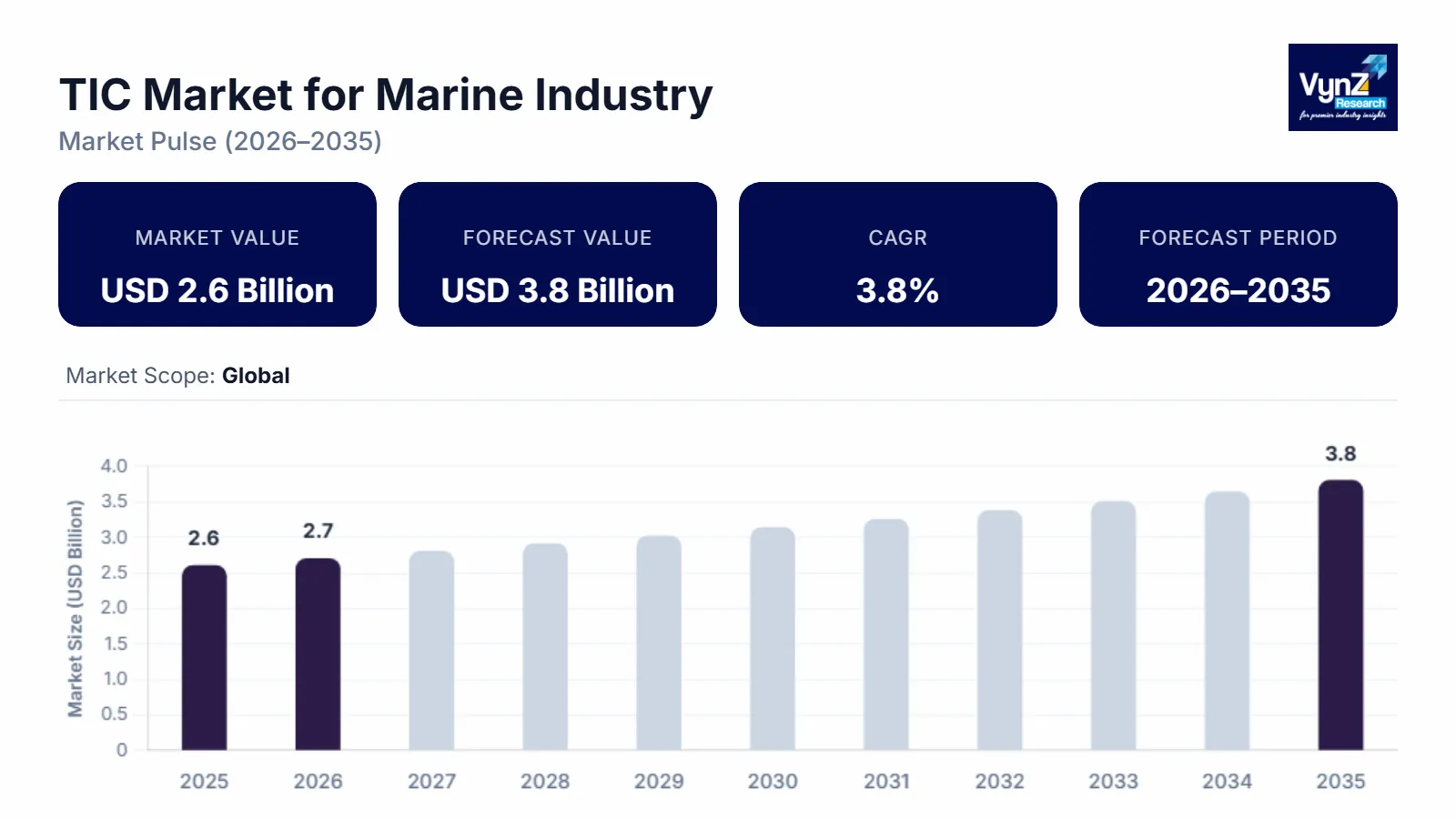
In order to guarantee vessel safety, regulatory compliance, and operational effectiveness throughout international maritime and offshore operations, the marine industry's Testing, Inspection, and Certification (TIC) market is essential. The shipping industry is becoming more dependent on digitization due to automated port operations and smart ships. Strict international maritime laws, rising shipbuilding and offshore energy project investments along with expanding maritime commerce drives the market growth. By supporting ship classification, environmental compliance, cargo inspection, and safety audits, TIC services assist operators in adhering to standards established by organizations such as the International Maritime Organization (IMO).
The marine industry operates in the four main areas i.e., naval, commercial, leisure, and offshore renewable energy. Globalization has led to product standardization norms and has penetrated developed technologies across various industries such as building & construction, marine, electronics, and automotive industries, etc., resulting in the growth of the TIC market during the forecast period 2025-2030. Moreover, the growing middle-class population, rapid urbanization, mandatory safety regulations, upsurge in the illicit trade of counterfeit and pirated products, advancement in networking and communication technology, the inclination of outsourcing testing, inspection, and certification services has propelled the growth of the TIC market in the marine industry. Nevertheless, TIC provides various advantages related to its credibility and image, compliance with legal and regulatory requirements, less turnover of employees, high level of cost control improvement, and fast improvement of different processes. TIC is required in the marine industry so as to ensure ships and cargo are regulated by environmental, safety, nuclear legislation. The market is witnessing steady growth due to increasing global trade volumes, expansion of port infrastructure, and rising offshore exploration activities, particularly in oil & gas and renewable energy sectors like offshore wind. Environmental regulations related to emissions, ballast water management, and fuel quality are further boosting demand for specialized testing and certification services.
TIC Market for Marine Industry Dynamics
Market Trends
Due to the increasing use of digital inspections, remote surveys, and AI-driven asset monitoring, the marine industry's TIC market is expanding. Cybersecurity certification, data-driven platform-based service models and ESG compliance are developing due to decarbonization initiatives and alternative marine fuels that are boosting testing requirements. Key trends in the marine industry's TIC market include the growing use of digital inspections, remote surveys, and AI-based asset monitoring. Demand for testing is being driven by a strong emphasis on decarbonization and alternative marine fuels, while platform-based, data-driven service models, cybersecurity certification, and ESG compliance are developing development areas.
Growth Drivers
Tougher global shipping rules push up demand for inspection and check services at sea. Because of standards set by the IMO or local regulators, boats must pass regular checks on pollution levels, equipment safety, plus structural fitness. Instead of risking fines or being held back in port, vessel operators spend about 28–32% of their upkeep funds just to stay within legal limits.
Fleet upgrades plus old ships push up TIC needs. More than 45% of cargo vessels worldwide are older than 15 years - so checks on hulls, engines, and extended use approvals happen more often. Tests focusing on structure strength along with rust analysis rise around 7 to 9% each year.
Environmental rules plus efforts to cut carbon are pushing more use of marine TIC. Fresh regulations on sulfur output, how ballast water is handled, or substitute fuels mean ongoing checks and approvals. Because of this shift to greener practices, eco-focused marine TIC work is growing by about 8–10% each year as shipping firms adapt their methods.
Market Restraints / Challenges
The testing, inspection, and certification market face certain challenges like trade wars and growth fluctuations, huge investment for automation and installation of industrial safety systems, high cost of TIC owing to diverse standards and regulations globally. Moreover, there are certainly more challenges faced by the marine industry in shipping such as optimizing risk management, providing energy efficiency, offering accidental navigations and salvage, and help insurers manage claims. Also, a lack of testing facilities and skilled personnel may hamper the growth of the TIC market.
Market Opportunities
The TIC market for the marine industry offers strong opportunities that are driven by offshore renewable energy expansion, increasing global trade and stricter environmental regulations. Advanced certification services are in high demand due to the increasing use of smart shipping systems and digital inspection technology. Long-term income potential for TIC providers are also made possible by the growing emphasis on decarbonization, alternative fuels, and lifespan asset management.
Global TIC Market for Marine Industry Report Coverage
|
Report Metric
|
Details
|
|
Historical Period
|
2020 - 2024
|
|
Base Year Considered
|
2025
|
|
Forecast Period
|
2026 - 2035
|
|
Market Size in 2025
|
U.S.D. 2.6 Billion
|
|
Revenue Forecast in 2035
|
U.S.D. 3.8 Billion
|
|
Growth Rate
|
3.8%
|
|
Segments Covered in the Report
|
Service Type, Vessel Type, Compliance Area and End User
|
|
Report Scope
|
Market Trends, Drivers, and Restraints; Revenue Estimation and Forecast; Segmentation Analysis; Companies’ Strategic Developments; Market Share Analysis of Key Players; Company Profiling
|
|
Regions Covered in the Report
|
North America, Europe, Asia Pacific
|
TIC Market for Marine Industry Segmentation
By Service Type
The marine TIC sector covers inspection, plus testing, along with certification, audits, also advisory work. The quickest rising part? Inspection - growing close to 8.3% per year - as ships need hull checks, gear reviews, or meet port rules.
Inspection jobs bring in most of the cash - around 44 to 46 percent of total income. Ship owners must do routine checks, evaluate harm after incidents, also track equipment health so they can keep sailing, stay insured, plus meet rules from certification groups.
Testing checks help judge fuel quality, measure exhaust output, or assess how strong materials are. As vessels switch to cleaner fuels or new drive setups, they need tighter inspections - so demand grows. Certification’s picking up speed because ship owners need class approval, check-ups on safety rules, or green compliance just to keep sailing worldwide.
By Vessel Type
By ship kind, you’ve got freighters, oil tankers, ferries, sea work boats, or military crafts. Freighters are rising quickest - nearly 8.6% a year - thanks to stronger world shipping and more ships being added.
Tankers take up a big portion because they face tough checks on safety and pollution rules. When it comes to oil, gas, or chemical carriers, regular inspections happen so leaks don’t occur while meeting global standards.
Boats that carry people - like cruise liners or ferries - need frequent checks to stay safe and clean. Since the pandemic ended, rules now call for more regular inspections, which helps keep testing and certifying work steady. Ships built overseas or used by navies bring in big-money deals because they need advanced tech plus tough safety rules - even though fewer are made.
By Compliance Area
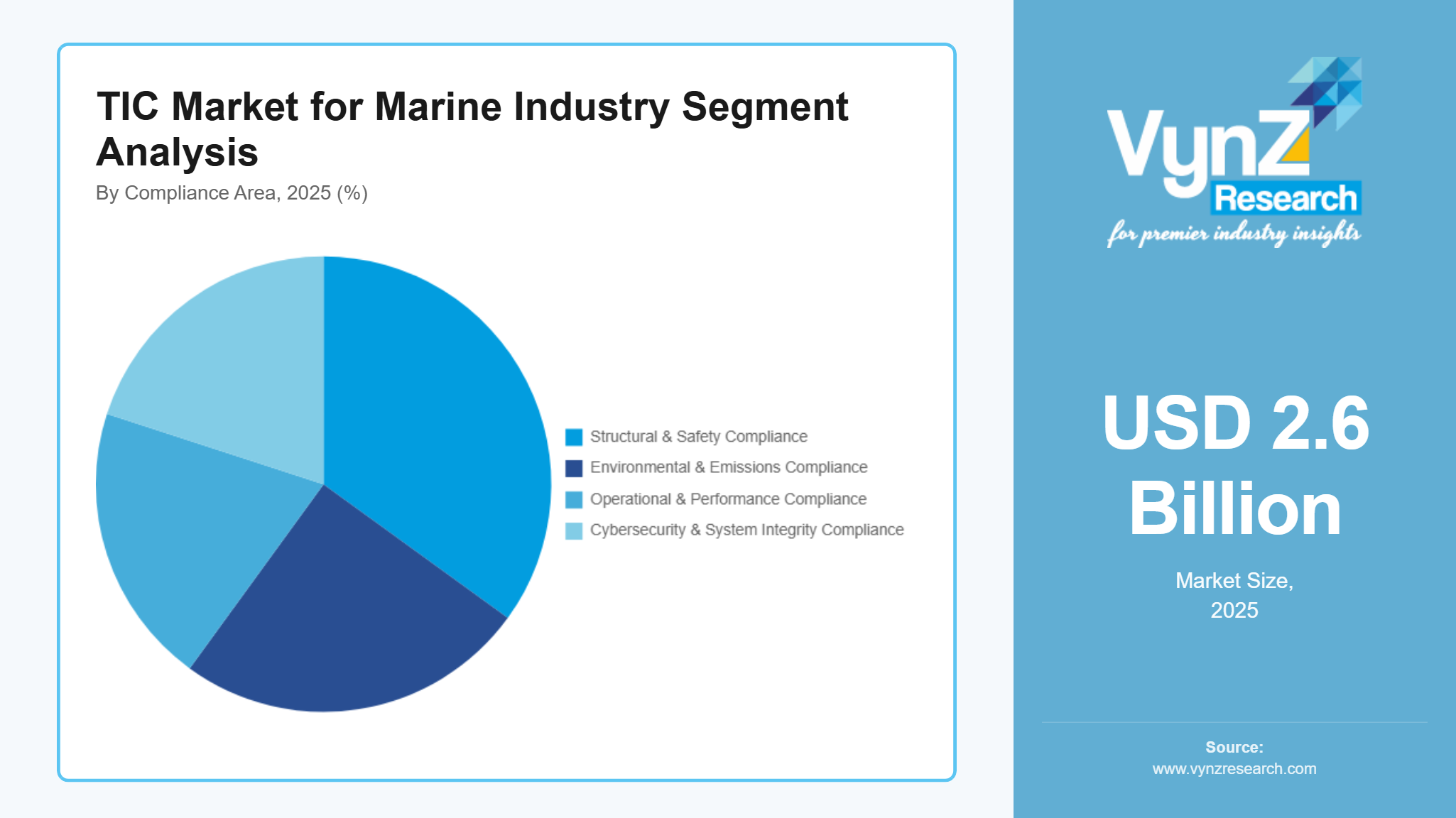
When it comes to safety and how solid things are built, that’s one part of the market - also checking pollution levels plus what machines give off into air or water. Another chunk deals with gear performance and whether systems work right - not just once but over time. Then there's looking at equipment function, seeing if everything runs smooth without hiccups. On top of that, companies get checked for weak spots in protection against threats. What’s picking up speed? Rules around nature stuff - this side’s growing close to 9.2% every year.
Sulfur limits getting enforced, along with rules on ballast water, while greenhouse gases must now be tracked - this pushes ships toward more emission checks and approvals. Skipping these steps could mean big penalties or having your vessel held up.
Checking the ship's build and safety is key, looking at things like how strong the body is, if it can handle fires, also what gear there is to save lives. Such checks must happen anytime the boat is in use. Machinery tests matter more when ships use hybrid motors - digital steering adds complexity. Inspections get tougher because tech keeps growing.
By End User
Ship owners plus operators make up more than half of the need, 'cause they’ve always got checks and paperwork to handle. The marine TIC sector backs these folks, along with yards where vessels are built, harbor managers, also those running offshore sites.
Shipyard work includes building, fixing, or upgrading boats - here, inspections play a key role. Checks by outside experts help meet rules and keep standards high ahead of handover. Port authorities rely on TIC checks to maintain safety rules at ports. Because inspections happen more often, need stays steady. Offshore crews land top-dollar inspection deals because their work’s dangerous + gear checks get tricky.
Regional Insights
North America
North America keeps growing at about 5.6–6.2% each year, thanks to offshore energy work along with river shipping and solid rule enforcement. In both the U.S. and Canada, officials insist on thorough checks so things stay safe while protecting nature.
Oil rigs at sea need more checks on parts and equipment. Because of this, inspection services for boats and platforms rise by about 7% each year. Folks are using more digital check tools instead of old ways, which speeds things up. These changes also push tech-driven inspections forward by making them easier to use.
Asia Pacific
Asia Pacific's growing quicker than anywhere else - around 9 to 10 percent each year - thanks to busy shipyards and heavy sea trading. In this area, countries like China, South Korea, and Japan are leading the push for checking and certifying ships. Big port upgrades plus new ship fleets mean more checks to do. During builds or refits, local yards mostly depend on outside inspectors.
Tighter eco-rules at local harbors are pushing more checks on pollution output, so firms now need approval stamps faster. Rules spreading through dock zones boost business for testers who verify clean operations instead of just chasing fines.
Europe
Europe's economy keeps moving up by roughly 5.5 to 6 percent every year, thanks to tight rules on safety and pollution. Because the EU demands regular checks and solid paperwork, companies keep needing testing, inspection, and certification services.
Decarbonization efforts plus a shift toward new ship fuels mean more demand for checks and approvals. In some nations, services testing hydrogen and LNG-powered ships expand fast - double digits yearly. European TIC firms target complex tasks - like detailed material checks or full-cycle reviews - which pushes up typical deal sizes.
Competitive Landscape / Company Insights
The classification bodies that oversee vessel certification, like DNV, Lloyd's Register, ABS, and RINA, dominate the maritime TIC (Testing, Inspection, and Certification) industry. Digital inspections, alternative fuels, and decarbonization are the main drivers of growth of this industry. With a growing emphasis on ESG compliance, cybersecurity, and offshore renewable energy projects, competition is centered on regulatory competence, global reach, and digital skills. Global reach and cross-industry services are two ways that diversified players like SGS and Bureau Veritas compete.
Mini Profiles
Intertek Group Plc is an UK-based global TIC provider offering quality assurance, testing, inspection, and certification services across industries including marine, energy, and manufacturing. Known for strong global presence and integrated assurance solutions, Intertek supports clients in meeting safety, performance, and regulatory standards.
Bureau Veritas which is headquartered in France, Bureau Veritas specializes in testing, inspection, and certification services with strong expertise in marine classification, offshore projects, and infrastructure. It plays a key role in ensuring compliance with safety, environmental, and quality standards worldwide.
MISTRAS Group is an US-based company focused on asset integrity management, non-destructive testing (NDT), and industrial inspection. It serves sectors like oil & gas, aerospace, and marine, helping extend asset life and improve operational safety through advanced diagnostics.
SGS SA is the one of the world’s largest TIC companies, headquartered in Switzerland. SGS offers comprehensive inspection, verification, testing, and certification services, with strong capabilities in marine, environmental testing, and supply chain assurance across global markets.
Eurofins Scientific is a leading global laboratory testing company specializing in environmental, food, and pharmaceutical testing. Eurofins is known for its strong R&D capabilities and acquisition-driven growth strategy, expanding its presence across multiple testing segments.
TUV Rheinland is a Germany-based TIC provider offering testing, inspection, and certification services across industrial, automotive, and marine sectors. It is recognized for its strong emphasis on safety, quality assurance, and technical compliance.
Key Players
- Intertek Group Plc
- Bureau Veritas
- MISTRAS Group
- SGS SA
- Eurofins Scientific
- TUV Rheinland
- TUV SUD
- DEKRA SE
- Applus+
- DNV GL
Recent Developments
In March 2026, Panasonic has launched a liquid cooling systems business for AI data centers. This business focus on cooling systems for high-performance computing & generative AI servers and development of high-capacity cooling units (1,200 kW+) which aligns with rising demand from data centers and cloud computing.
In March 2026, ABB Robotics Partners with NVIDIA to Deliver Industrial-Grade Physical AI at Scale. The collaboration focuses on combining ABB Robotics’ software programming, design and simulation suite, RobotStudio, with the physically accurate simulation power of NVIDIA Omniverse libraries to close technology's long-standing 'sim-to-real’ gap. Developers can simulate robots in digital twins and generate synthetic data to train their physical AI models, enabling businesses of all types and sizes to deploy AI-driven robotics for various industrial workflows.
In February 2026, Google has awarded Form Energy, Inc. a USD billion contract to provide its cutting-edge iron-air batteries for a Minnesota data center project. One of the biggest and longest-lasting battery installations in the world, this project entails the deployment of a massive energy storage system that can provide electricity constantly for up to 100 hours. Iron-air batteries are less expensive for widespread use since they are made of inexpensive materials like iron.