Asia Electric Three-wheeler Market Overview
The Asia electric three-wheeler market which was valued at approximately USD 1.82 billion in 2025 and is estimated to rise further up to almost USD 2.05 billion in 2026, is projected to reach around USD 5.7 billion by 2035, expanding at a CAGR of about 12% during the forecast period from 2026 to 2035.
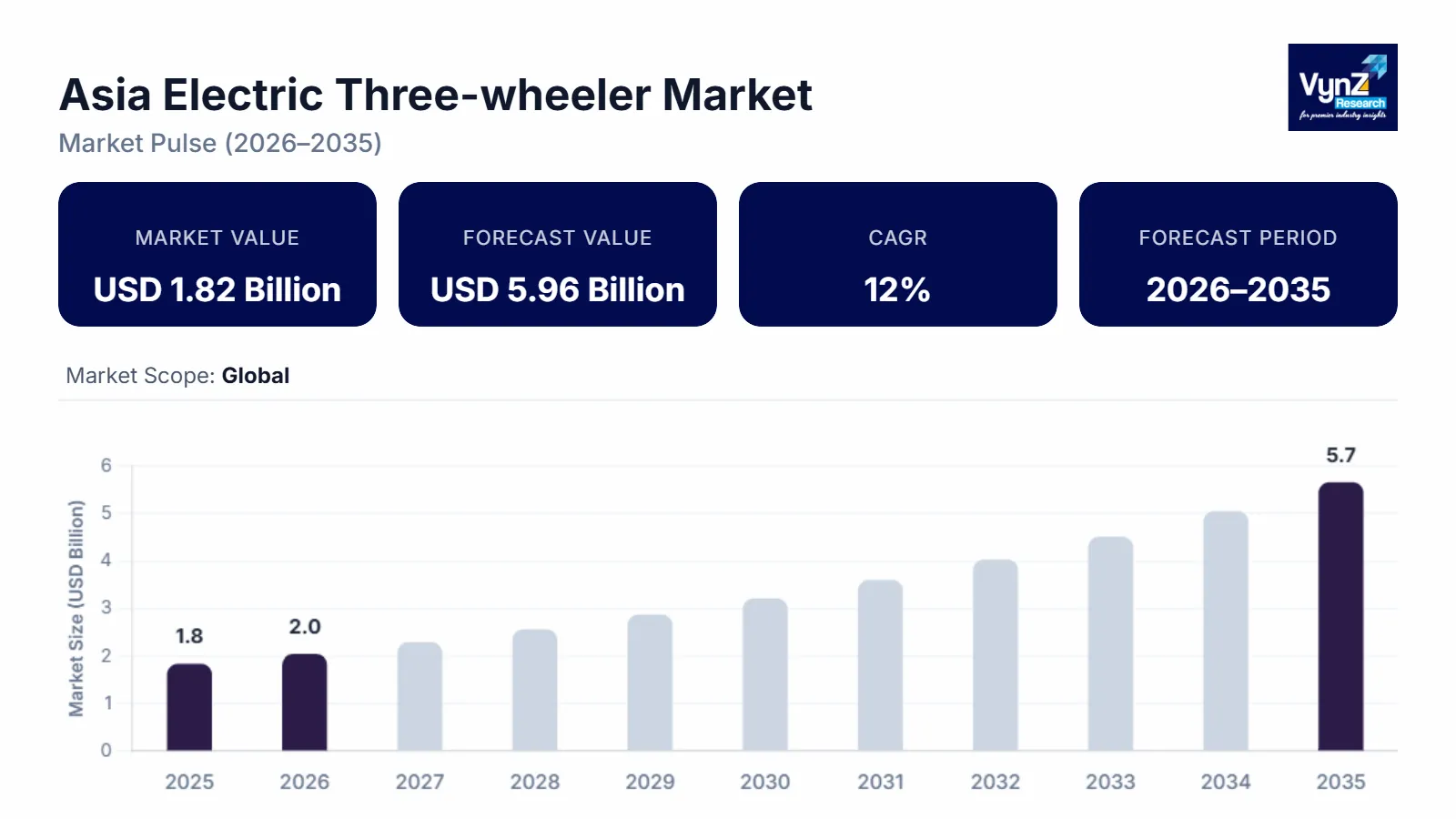
The market experiences growth because urban areas develop faster while fuel prices become more unpredictable and electrification policies receive strong support together with people using last mile mobility solutions more frequently. The growing need for budget-friendly transportation services which carry passengers and freight, together with ongoing investments in environmentally friendly transportation projects, drive business growth in major markets throughout China, India, and Bangladesh.
Government-supported energy agencies report that electric vehicle adoption is growing steadily because cities use emission reduction goals and urban air quality improvement plans as their emission limit standards. The regulatory frameworks which provide financial incentives for businesses, enable industrial expansion throughout Asian countries. Government initiatives which promote electric mobility through purchase subsidies, battery swapping policies, and local manufacturing incentives, are helping to establish a stronger market presence.
Asia Electric Three-wheeler Market Dynamics
Market Trends
The industry is experiencing a transformation which brings forth energy efficient solutions that combine digital technology with modern urban mobility systems. The market sees its most significant development through the fast adoption of battery-operated systems which provide last mile transport solutions to densely populated urban areas that require low-cost transportation and eco-friendly options. The government-sponsored mobility studies together with urban transportation plans show that three-wheeler fleets must transition to electric power to achieve two goals: better air quality and decreased use of fossil fuels. The industry shows a growing trend towards using battery swapping and telematics enabled fleet management systems because of regulatory compliance and digital technology expansion. The industry is witnessing a change in competitive dynamics because manufacturers are being motivated to develop products with long-lasting batteries and intelligent connectivity capabilities and flexible vehicle design systems.
Growth Drivers
The market experiences its growth through ongoing policy-based electrification initiatives, which create continuous demand for passenger and freight transportation services. Developing economies experience growth through increased financial resources for establishing charging stations, producing goods locally and executing city transportation initiatives. The growing cost of fuel together with the decreased expense of ownership for vehicles is driving higher vehicle adoption rates. The demand for electric three wheelers will maintain strong growth because urban commuters and small fleet owners choose affordable options that maximize their daily operations. The government programs which collaborate with environmental and public health organizations demonstrate the need for reducing vehicle emissions, which will create sustained demand in the market.
Market Restraints / Challenges
The market possesses strong growth potential but battery expenses and insufficient charging stations create accessibility obstacles in semi-urban and rural territories. Small operators face two main obstacles which prevent them from making upfront payments because they need to pay full price and they lack access to subsidies. The need for manufacturers to import battery components and essential raw materials creates operational difficulties for their businesses. Supply chain interruptions together with rising expenses create two problems which result in lower production output and increased operational costs thus harming market performance. Government energy transition reports show that two major obstacles prevent progress toward achieving large-scale electrification targets: infrastructure deficiencies and funding shortages.
Market Opportunities
The market provides major growth potential through its need for budget-friendly electric transportation solutions, which arise from fast urban population growth and rising need for shared transportation services. Companies which provide budget-friendly and reliable vehicles will attract additional small business customers and logistics firms to their products. The development of battery swapping ecosystems together with localized manufacturing capabilities presents a key business opportunity which will experience growth through increasing public and private investment. Smart mobility platforms and digital fleet solutions will achieve higher operational efficiency and better customer engagement through their development, which receives government support for sustainable urban transportation systems.
Asia Electric Three-wheeler Market Report Coverage
|
Report Metric
|
Details
|
|
Historical Period
|
2020 - 2024
|
|
Base Year Considered
|
2025
|
|
Forecast Period
|
2026 - 2035
|
|
Market Size in 2025
|
U.S.D. 1.82 Billion
|
|
Revenue Forecast in 2035
|
U.S.D. 5.96 Billion
|
|
Growth Rate
|
12%
|
|
Segments Covered in the Report
|
By Product, By Type, By Motor Power, By End User
|
|
Report Scope
|
Market Trends, Drivers, and Restraints; Revenue Estimation and Forecast; Segmentation Analysis; Companies’ Strategic Developments; Market Share Analysis of Key Players; Company Profiling
|
|
Regions Covered in the Report
|
China, India, Indonesia, Rest of Asia
|
Asia Electric Three-wheeler Market Segmentation
By Product
The e-rickshaw segment controlled the market through 2025 with its share of total revenue reaching approximately 48%. The technology achieved widespread adoption because it provides inexpensive transportation solutions to cities which have high populations. Urban mobility programs which receive government support together with electrification policies that aim to cut emissions effectively create an increasing demand for these vehicles throughout developing countries.
E-auto and other variants will experience rapid growth because they will achieve a compound annual growth rate of 13.2% from 2026 to 2035. The demand for higher load capacity together with better durability and more comfortable passenger seats drives this growth. The segment expansion receives support from both organized fleet operations and the adoption of advanced battery technology especially within structured urban transport environments.
By Type
The passenger segment held market dominance during 2025 when it captured about 58% of the total market. The high daily usage of the system in urban and semi-urban locations together with low-cost public transportation demand drives its current market leadership position. The reduction of traffic congestion through better mobility frameworks developed under government support has become the driving force for major cities to adopt new transportation systems.
Load carrier segment will experience rapid growth through the forecast period because it will achieve a compound annual growth rate of approximately 12.8%. The growth comes from small logistics companies and e-commerce delivery networks which need to send more products. The adoption rate of urban distribution infrastructure will rise because small businesses and local supply chains require cost-effective methods to handle cargo.
By Motor Power
Mid-range power vehicles controlled the market during 2025 through their revenue contribution of approximately 46%. The product gained market leadership because it delivers both passenger and light cargo functionality at an affordable price. The urban transport system expansion receives support through energy-efficient vehicle regulatory frameworks which drive vehicle adoption.
The higher power category will achieve the fastest market growth through its estimated annual growth rate of 13.5% from 2026 to 2035. The market expansion comes from businesses which need to acquire better speed together with higher load capacity and improved operational performance. The commercial sector moves toward faster vehicles because motor and battery technology currently supports higher-performance vehicle development.
By End User
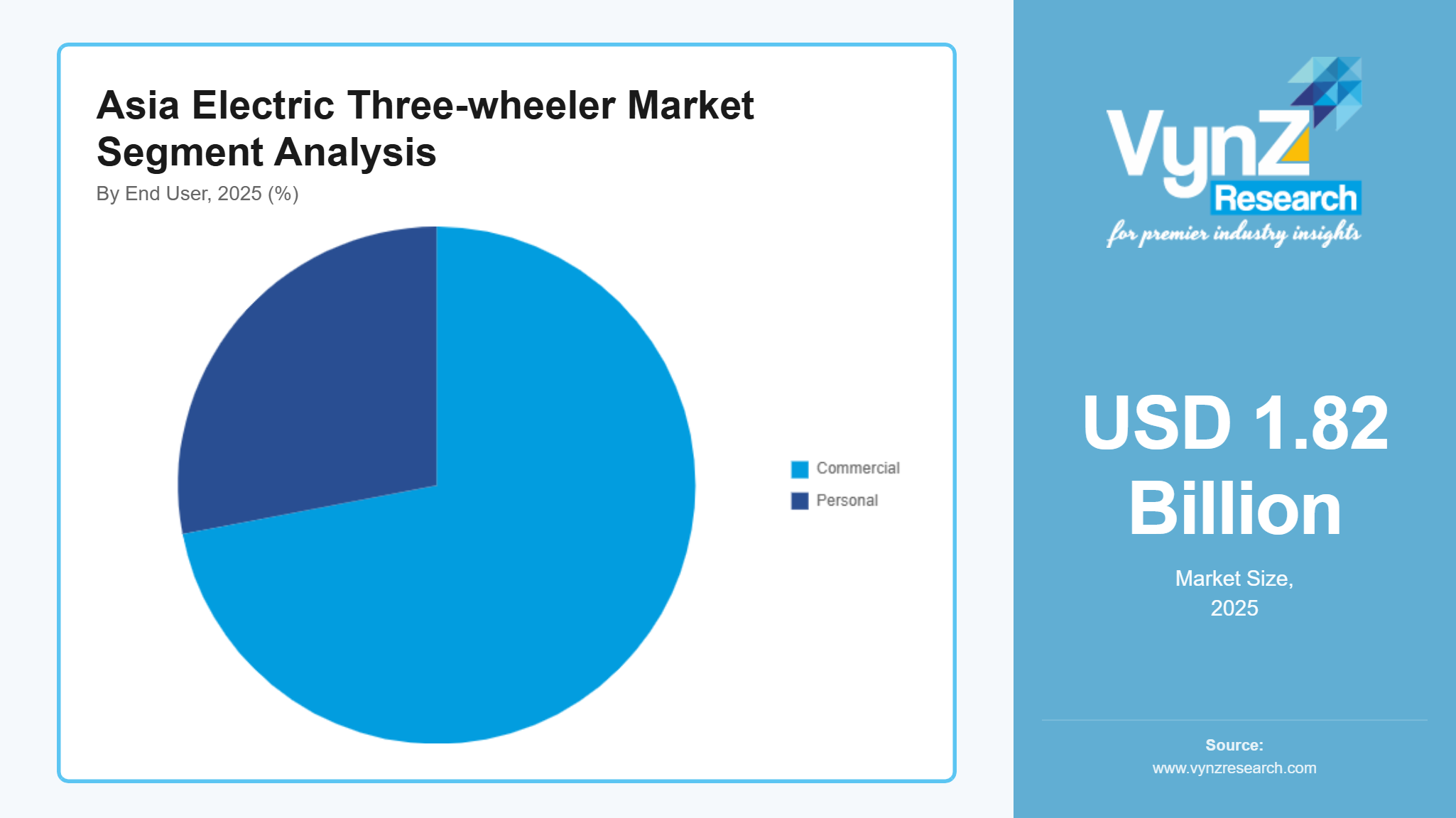
The commercial segment achieved the most revenue share during 2025 because it generated about 72% of total market revenue. The system dominates the market because it operates passenger transport services and goods delivery systems in high-density urban areas. The government electric mobility initiative which supports public and shared transit systems helps to grow this market sector.
The personal usage segment will achieve the fastest market expansion through its estimated annual growth rate of 11.9% during the forecast period. The market growth happens because people can now afford products which most consumers recognize through their financing options. The vehicle design and convenience feature improvements lead to higher vehicle adoption by individual users who create an ongoing market demand across developing urban centers.
Regional Insights
China
China maintained its position as the dominant market by holding 34% market share which originated from its strong manufacturing capacities and high urban mobility needs and its cities including Beijing, Shanghai and Shenzhen which created strong demand for electric vehicle adoption. The country maintains its electric vehicle production leadership status while it develops its battery supply chain which leads to market growth. National environmental agencies back government policies which focus on carbon neutrality and air pollution reduction to increase electric three-wheeler adoption for both passenger and cargo transport. The regional market performance receives a boost from the charging infrastructure expansion together with the financial incentives which support fleet electrification.
India
India accounted for approximately 29% of the market during 2025 because residents of Delhi, Kolkata and Lucknow require affordable last mile transportation options. The region shows growth because small transport operators have highly adopted electric mobility while electric mobility penetration has increased in semi urban areas. Government initiatives which support electric vehicle adoption through subsidy programs and local production incentives and urban transport reforms will lead to broader adoption among the population. The national energy and transport authorities demand that vehicular emissions and fuel usage decrease which provides additional motivation for electric three-wheeler implementation in passenger and logistics operations.
Indonesia
Indonesia captured about 14% of the market in 2025 while urban growth and rising need for affordable transport options drive persistent market expansion in Jakarta and Surabaya. The market maintains steady demand because urban transport and small-scale logistics both show increasing adoption. The government promotes electric mobility through its national energy transition plans which include emission reduction commitments that support electric vehicle infrastructure investment. The country will experience market growth from both pilot project development and electric fleet adoption incentives.
Rest of Asia
The rest of Asia, including countries such as Thailand, Malaysia, Philippines, and Vietnam, collectively contributes around 13% of the market in 2025. The growth of these areas receives support from infrastructure development and urbanization expansion and public knowledge of sustainable mobility solutions. Government-backed clean transport programs together with the development of charging stations create market opportunities that will last for a long time. The remaining share beyond the key countries is distributed across smaller emerging markets within Asia, ensuring that the total regional contribution sums to 100%, with this segment capturing diverse growth potential across developing economies.
Competitive Landscape / Company Insights
The market operates between two levels of competition because regional manufacturers and emerging domestic players introduce new products while they work to decrease their production costs and expand into new markets. Companies improve their market presence through investments in battery technology and local manufacturing and digital fleet solutions. Electric mobility programs which the government supports together with domestic production and emission reduction regulations create a competitive environment. National transport and energy authorities provide companies with operational support which enables them to increase their market presence throughout important Asian markets.
Mini Profiles
ATUL Auto Ltd. focuses on electric three-wheeler manufacturing and affordable mobility solutions, supported by strong distribution networks, cost efficient production, and established brand presence across urban and semi urban markets.
Changzhou Yufeng Vehicle Co. Ltd. operates in the mass segment, emphasizing durable vehicle design, consistent performance, and scalable manufacturing capabilities to meet rising demand for urban transport solutions.
Jiangsu Kingbon Vehicle Co. Ltd. leverages local manufacturing expertise, supply chain integration, and strategic partnerships to expand its presence across regional markets and strengthen production efficiency.
Kinetic Green Energy & Power Solutions Ltd. focuses on electric mobility solutions and battery powered vehicles, supported by brand recognition, innovation capabilities, and expanding dealer networks across key Indian cities.
Lohia Auto Industries operates in the affordable mobility segment, emphasizing cost efficiency, reliable vehicle performance, and strong penetration in last mile passenger and cargo transport applications.
Key Players
- ATUL Auto Ltd.
- Changzhou Yufeng Vehicle Co. Ltd.
- Jiangsu East Yonsland Vehicle Manufacturing Co.
- Jiangsu Kingbon Vehicle Co. Ltd.
- Kinetic Green Energy & Power Solutions Ltd.
- Lohia Auto Industries
- Terra Motors Corporation
- Xianghe Qiangsheng Electric Tricycle Factory
Recent Developments
In January 2026, ATUL Auto Ltd. approved the acquisition of its subsidiary’s L5 electric three-wheeler business to streamline operations and expand market reach. This move is expected to improve cost efficiency and strengthen dealership integration across markets.
In November 2025, Kinetic Green Energy & Power Solutions Ltd. partnered with a charging technology provider to launch fast charging electric three wheelers, improving operational efficiency. Earlier in July 2025, it expanded into premium mobility through a global design collaboration.
In March 2026, Terra Motors Corporation expanded its electric three-wheeler deployment across Southeast Asia, focusing on fleet electrification programs. The initiative supports last mile logistics and aligns with regional clean mobility policies.
In August 2025, Lohia Auto Industries strengthened its electric mobility portfolio by expanding production capacity for e rickshaws and cargo vehicles. This development supports rising domestic demand and government electrification targets.
In February 2026, Jiangsu Kingbon Vehicle Co. Ltd. increased export focused production of electric three wheelers to cater to emerging Asian markets. The expansion reflects growing cross border demand for affordable electric mobility solutions.