India Electric Two-Wheeler Market Overview
The India electric two-wheeler market size was estimated at about USD 1.25 billion in 2025 and is expected to reach around USD 1.85 billion in 2026 rising up to roughly USD 6.38 billion in 2035, growing at approximately 17.71% CAGR from 2026 to 2035.
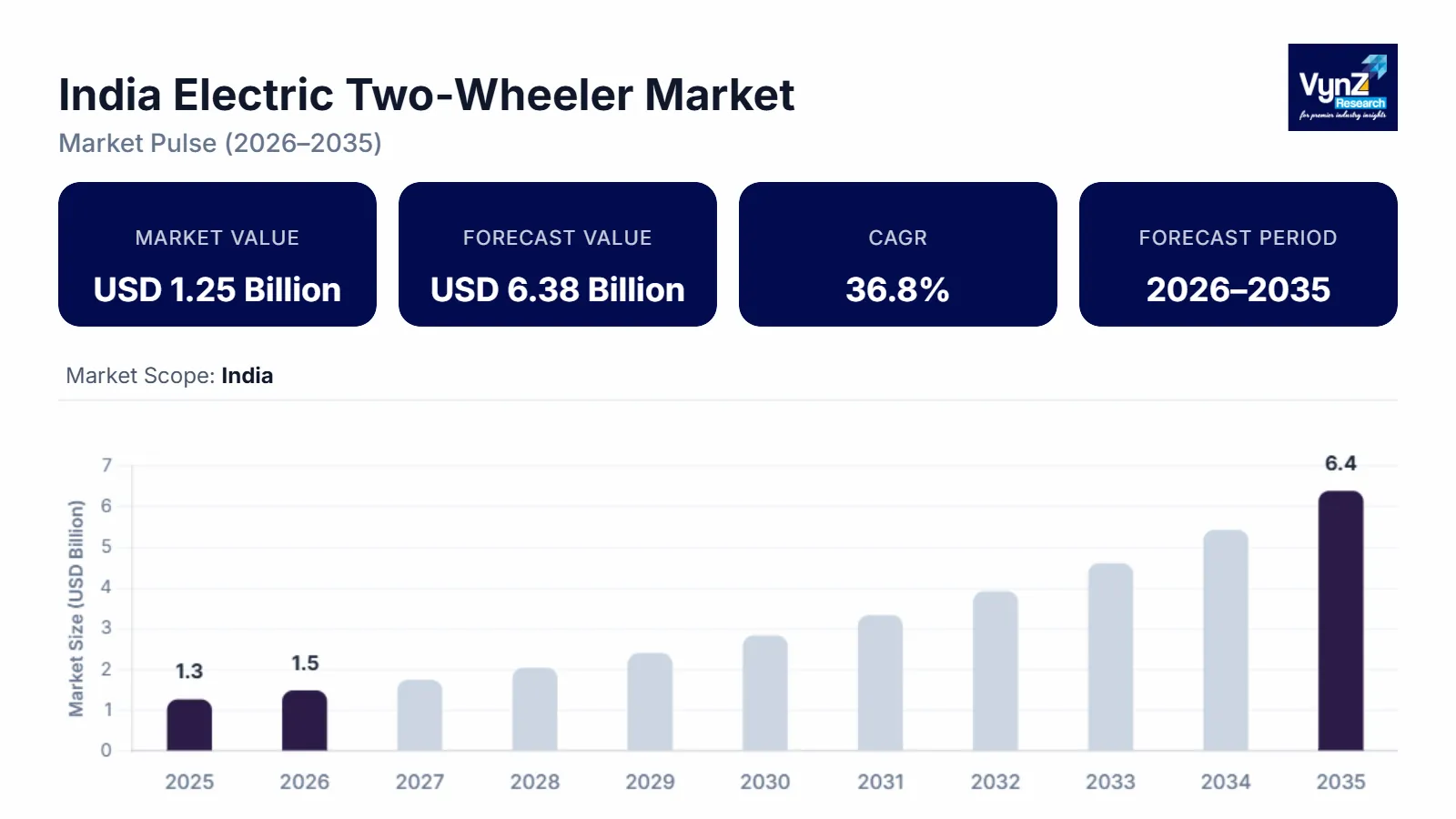
Research Highlights
- Scooters captured nearly 68% market share in 2025 driven by rising urban commuting demand.
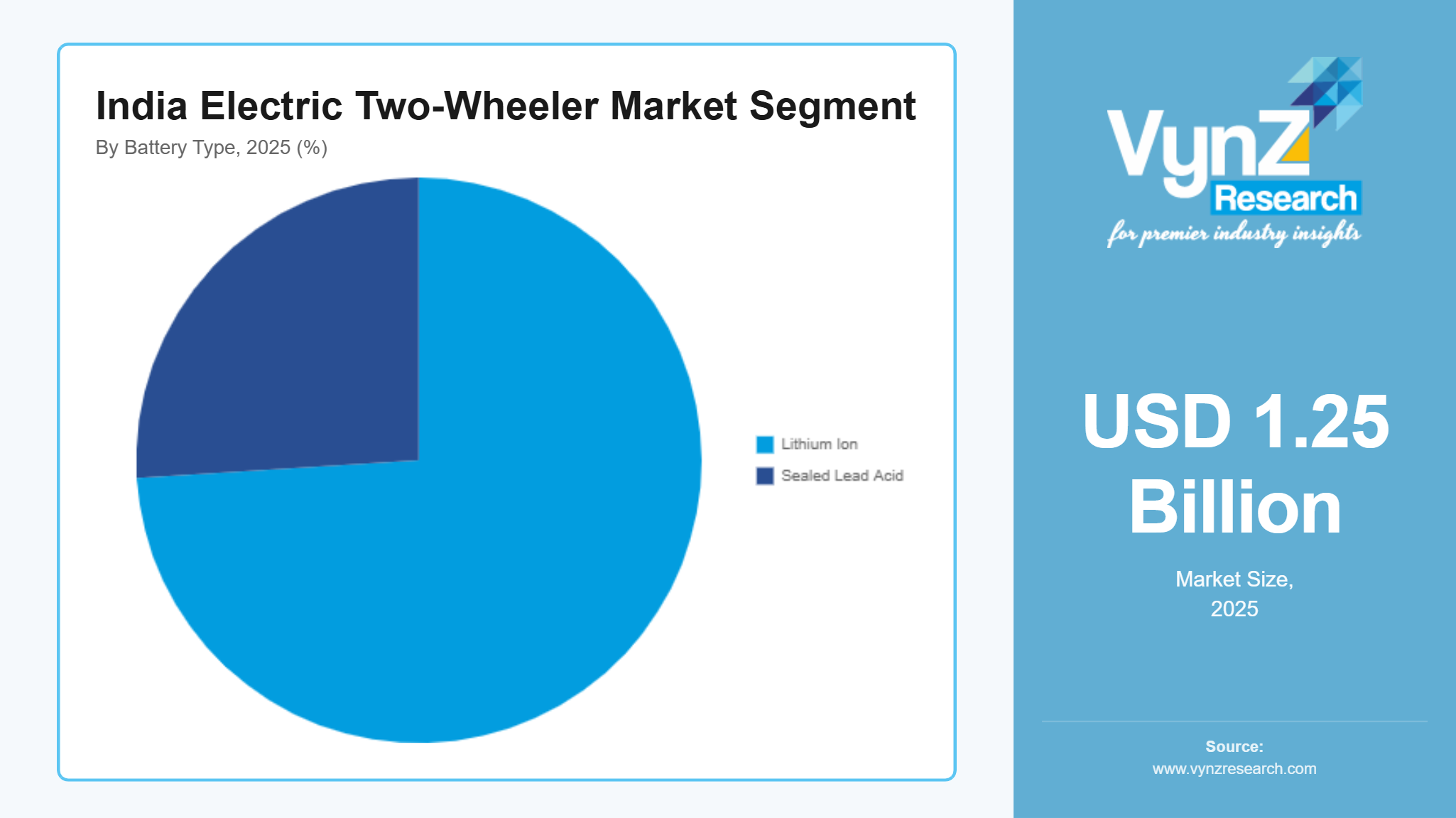
- Lithium-ion batteries held approximately 74% revenue share in 2025 due to higher efficiency benefits.
- Fixed battery systems dominated with around 63% market share in 2025 supported by affordable scooter adoption.
- Above 60V segment is projected to grow fastest at 19.6 % CAGR through 2035.
- Maharashtra accounted for nearly 28% market share in 2025 owing to expanding EV infrastructure.
Market growth is supported by people switching to electric vehicles, government help in the form of subsidies and more batteries production. The growth is further backed by people accepting these transportation solutions for cheaper city transport and ongoing investments in the FAME scheme and other incentive programs by the Ministry of Heavy Industries, especially in areas like Maharashtra, Tamil Nadu and Karnataka. Reports from NITI Aayog and the International Energy Agency say that electric vehicles are becoming more popular as charging points are increasing and battery costs are decreasing which is encouraging people to buy electric two-wheelers in India. The government is also helping by making policies for vehicles giving incentives for making batteries locally and spending money on charging networks.
India Electric Two-Wheeler Market Dynamics
Market Trends
The industry is moving towards advanced battery technology, connected mobility and higher demand for lithium-ion battery powered scooters because they are more efficient, have a longer mileage and cost less to maintain. Reports from NITI Aayog and the International Energy Agency show that cities are adopting electric mobility solutions faster and this is helped by more charging stations and digital vehicle connectivity. There is also a push to make batteries and other parts in the country which is helped by government regulations and incentives to companies that make vehicles through production linked incentive schemes which is helping to build up the industry in big cities.
Growth Drivers
The market is growing because fuel prices are going up and people want cheaper ways to get around cities, higher investments in charging stations, battery manufacturing and making vehicles in the country. The Bureau of Energy Efficiency says that people are looking for ways to save energy and not use fossil fuels and the government is helping by giving incentives to companies that make vehicles that protect environment and are affordable. The Ministry of Heavy Industries is also helping through its FAME initiative which is making vehicles more affordable for people.
Market Restraints / Challenges
One of the significant challenges faced by the industry is that battery prices can go up and down which affects company profits and purchasing patterns of people. The International Energy Agency says that getting lithium and other important minerals is an issue for companies that make electric vehicles and there are not enough charging stations in cities and rural areas which can make it hard for people to use electric vehicles. Companies have to rely on other countries for battery cells and other important parts which can be expensive and unpredictable and following government regulations is also a challenge especially when it comes to battery safety and recycling which can be complicated for companies.
Market Opportunities
There are opportunities for companies in the market that can provide easy ways for people to get around cities especially as more and more people move to cities and become more aware of the environment. Companies that make electric scooters with good battery range and digital connectivity can sell more to people who commute to work and delivery companies. NITI Aayog reports say that shared mobility and battery swapping ecosystems could be big in the future especially in crowded cities. There is also an opportunity for smart electric motorcycles and companies that invest in connected mobility platforms and advanced telematics can make more money and build strong relationships with customers.
India Electric Two-Wheeler Market Report Coverage
|
Report Metric
|
Details
|
|
Historical Period
|
2020 - 2024
|
|
Base Year Considered
|
2025
|
|
Forecast Period
|
2026 - 2035
|
|
Market Size in 2025
|
U.S.D. 1.25 Billion
|
|
Revenue Forecast in 2035
|
U.S.D. 6.38 Billion
|
|
Growth Rate
|
17.71%
|
|
Segments Covered in the Report
|
By Product, By Battery Type, By Battery Technology, By Voltage
|
|
Report Scope
|
Market Trends, Drivers, and Restraints; Revenue Estimation and Forecast; Segmentation Analysis; Companies’ Strategic Developments; Market Share Analysis of Key Players; Company Profiling
|
|
Regions Covered in the Report
|
Maharashtra, Tamil Nadu, Karnataka, Rest of India
|
India Electric Two-Wheeler Market Segmentation
By Product
Electric scooters had the largest share of the market of around 68% in 2025 because they are easy to use in cities and do not cost a lot to maintain. Many companies are making electric scooters in big cities and the Ministry of Heavy Industries FAME program is helping them.
Motorcycles are expected to grow at roughly 20.2% every year from 2026 to 2035 mainly due to their ability to cover larger distance, move faster and higher preference by people.
By Battery Type
Lithium-ion batteries contributed about 74% to the market in 2025 mainly backed by their durability, ability to charge quickly and decreasing cost.
Sealed lead acid batteries are expected to grow at a steady rate of 18.6% during the forecast period because they are cheap and easy to get.
By Battery Technology
Fixed battery systems accounted for around 63% of the market share in 2025 due to their higher efficiency, they are easy to produce, and higher demand for scooters with these types of batteries.
Removable battery systems are expected to grow at approximately 21.4% from 2026 to 2035 due to higher investment by companies in battery swapping infrastructure.
By Voltage
The 48V to 60V segment held 52% of the market share in 2025 supported by its better performance and lower price, large number of people are using them in scooters and they are good for the environment.
The 60V segment will fast at 19.6% during the forecast period because many people want to buy premium motorcycles and high-performance scooters and the Ministry of Heavy Industries is helping companies make electric powertrain technology.
Regional Insights
Maharashtra
Maharashtra held 28% of the market share in 2025 mainly attributed to the growing number of people who want intra-city travel and charging stations for electric vehicles in cities like Mumbai, Pune and Nagpur.
Tamil Nadu
Tamil Nadu accounted for 24% of the market in 2025 due to large number of electric vehicles are made here and the government is helping the industry in Chennai and Coimbatore where electric vehicles and batteries are made in large scale with incentives and investment in the industry.
Karnataka
Karnataka contributed 21% of the market in 2025 with a high adoption for advanced battery technology, higher use of electric vehicles in cities like Bengaluru, and several startups are coming up with affordable and efficient vehicles.
Rest of India
The rest of India represented 27% of the total market in 2025 mainly because electric vehicles are becoming popular in states like Gujarat, Delhi, Telangana, Uttar Pradesh and Rajasthan. More people can afford scooters now and it is easier to charge them. Government is giving incentives and investing in charging points helping the electric vehicle market grow in cities and towns.
Competitive Landscape / Company Insights
The market moderately competitive because there are a lot of local and global companies working on producing better vehicles using artificial intelligence and sophisticated tools. They are putting a lot of money into research and development and the government is also helping by making programs and rules that support innovation and expansion. Companies are using cloud computing and artificial intelligence to automate production which is making the market even more competitive.
Mini Profiles
Ather Energy focuses on smart electric scooters and connected mobility solutions, supported by expanding charging infrastructure, premium positioning, and strong brand recognition across urban Indian electric mobility markets.
Bajaj Auto Ltd. operates in mass and premium electric two wheeler segments, emphasizing product reliability, manufacturing scale, and expanding dealership networks to strengthen nationwide electric vehicle adoption.
Hero Electric Vehicles Pvt. Ltd. leverages extensive domestic distribution capabilities and affordable electric scooter offerings to expand market presence among cost conscious urban and semi urban consumers.
Ola Electric Mobility Ltd. focuses on high performance electric scooters and digital mobility platforms, supported by large scale manufacturing investments and direct to consumer sales infrastructure across India.
TVS Motor Company operates in commuter and premium electric mobility categories, emphasizing advanced vehicle technology, battery efficiency, and strategic product expansion to strengthen long term market competitiveness.
Key Players
Ather Energy
Bajaj Auto Ltd.
Hero Electric Vehicles Pvt. Ltd.
Lohia Auto Industries
Ola Electric Mobility Ltd.
Okinawa
Autotech Pvt. Ltd.
Spero Electric
TVS Motor Company
Vida Mobility
Yadea Technology Group
Recent Developments
In July 2025, Lohia Auto Industries expanded its electric mobility portfolio with new low speed electric scooter models targeting urban and semi urban commuters. The company also strengthened dealership expansion initiatives to improve market penetration across northern and western India.
In October 2025, Yadea Technology Group unveiled its next generation electric mobility and charging ecosystem at EICMA 2025. The company introduced advanced sodium ion battery solutions and intelligent battery swapping technologies to strengthen global electric two wheeler expansion.
In December 2025, Vida Mobility expanded its connected electric scooter offerings and strengthened battery swapping accessibility across major Indian cities. The company also focused on digital service integration and charging infrastructure partnerships to improve customer convenience.
In February 2026, Ola Electric Mobility Ltd. announced expansion of its direct to consumer retail network and upgraded fast charging infrastructure across metropolitan markets. The company also introduced software enhanced connected features to strengthen smart mobility adoption among urban consumers.
In April 2026, Bajaj Auto Ltd. strengthened its electric two wheeler production capacity following rising domestic demand and increasing EV registrations in India. The company continued expanding its premium electric scooter portfolio to improve competitiveness within the rapidly growing urban mobility segment.