Indonesia Electric Two-Wheeler Market Overview
The Indonesia electric two-wheeler market size was estimated at about USD 1.42 billion in 2025 and is expected to reach around USD 1.74 billion in 2026, rising to roughly USD 9.35 billion by 2035, growing at approximately 20.5% CAGR from 2026 to 2035.
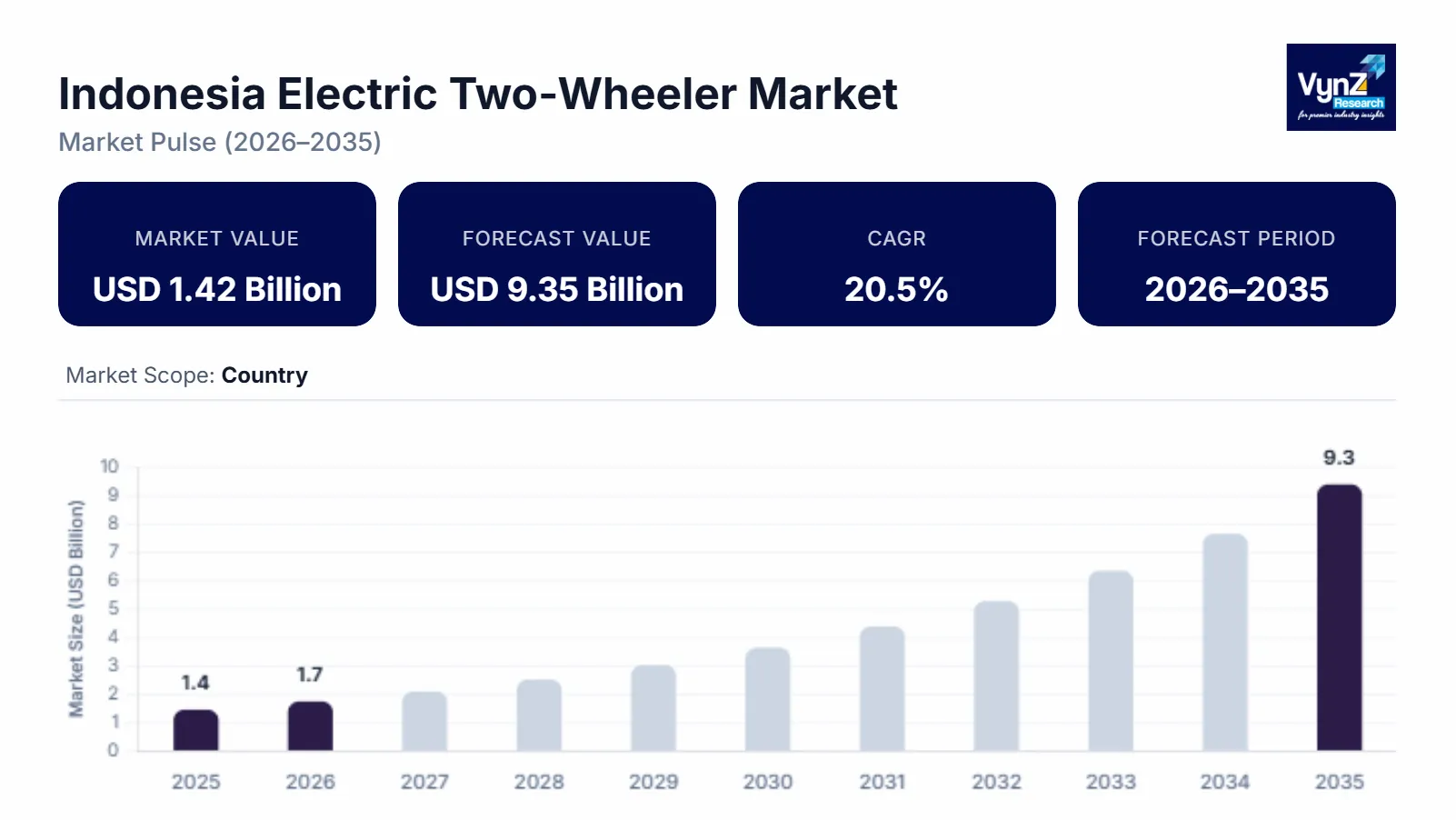
Research Highlights
- Electric scooters held 68% market share in 2026, supported by affordable urban transportation demand.
- Lithium-ion batteries accounted for 72% market share in 2026, driven by superior performance.
- Removable battery models captured 58% market share in 2026, benefiting from battery-swapping adoption.
- The 48V–60V segment represented 47% market revenue in 2026, balancing efficiency and affordability.
- Java contributed 52% of market revenue in 2026, supported by strong EV infrastructure.
The market is growing due to government support for buying electric motorcycles, growing concern over the increasing fuel process and higher investment in battery technology and locally produced vehicles. Increased preference for battery swapping, smart charging solutions, and demand for daily travel and ongoing investments under government rules and national energy plans are helping the market grow in areas like Jakarta, West Java and East Java. The Ministry of Energy and Mineral Resources of Indonesia is working hard to increase the use of vehicles by giving people incentives to buy them and building more charging points. Reports from the International Energy Agency identify Indonesia as a potential market for electric vehicles because it has a strong battery supply chain and is making more electric vehicles locally.
Indonesia Electric Two-Wheeler Market Dynamics
Market Trends
The industry is changing fast as people are adopting battery-swapping, connected mobility tech and preferring lithium-ion powered motorcycles and scooters as they are energy efficient, cost less to maintain and perform better. The International Energy Agency says electric two-wheelers are growing fast in emerging markets in Indonesia as they are affordable and practical. Another trend is the growth of battery-swapping ecosystems backed by the regulations and digital integration in mobility services encouraging companies to focus on vehicle platforms, subscription-based battery services and integrated charging solutions. The Ministry of Energy and Mineral Resources of Indonesia supports charging and battery-swapping infrastructure development.
Growth Drivers
The market growth is encouraged by the government incentives for electric motorcycle adoption which is increasing the demand for convenient mobility, ride-hailing and commercial transportation. More investments are made in battery production, vehicle assembly and charging infrastructure. According to Ministry reports, these are the priorities set for the electric vehicle manufacturing industry. Higher adoption of two-wheelers is promoted due to their fuel efficiency, cost efficiency, easy maintenance and eco friendliness. The Asian Development Bank says electric mobility is key to urban transportation in Indonesia.
Market Restraints / Challenges
The market faces significant growth challenges due to high initial costs, uneven charging infrastructure, and lower market penetration. The International Energy Agency says infrastructure accessibility is crucial for electric vehicle adoption. Manufacturers and suppliers also face challenges with imported battery materials and advanced vehicle components leading to cost pressures and supply chain disruptions which is why the government emphasizes strengthening battery and component manufacturing.
Market Opportunities
The market offers opportunities in battery-swapping networks and shared mobility services, growing demand due to extensive urbanization initiatives and increased demand for cost-effective transportation solutions. Companies manufacturing vehicles with better technology and features are likely to meet the growing demand for sustainable transport, which is increasing the investments in this area, according to the Asian Development Bank. Localized battery manufacturing and electric vehicle ecosystem development are also offering opportunities for growth with higher investments in production, technology development, battery management and connected vehicle technologies.
Indonesia Electric Two-Wheeler Market Report Coverage
|
Report Metric
|
Details
|
|
Historical Period
|
2020 - 2024
|
|
Base Year Considered
|
2025
|
|
Forecast Period
|
2026 - 2035
|
|
Market Size in 2025
|
U.S.D. 1.42 Billion
|
|
Revenue Forecast in 2035
|
U.S.D. 9.35 Billion
|
|
Growth Rate
|
20.5%
|
|
Segments Covered in the Report
|
By Product, By Battery Type, By Battery Technology, By Voltage
|
|
Report Scope
|
Market Trends, Drivers, and Restraints; Revenue Estimation and Forecast; Segmentation Analysis; Companies’ Strategic Developments; Market Share Analysis of Key Players; Company Profiling
|
|
Regions Covered in the Report
|
Java, Sumatra, Kalimantan, Rest of Indonesia
|
Indonesia Electric Two-Wheeler Market Segmentation
By Product
Electric scooters and mopeds accounted for about 68% of the market share in 2025 as they are affordable, easy to use and efficient for city travel. Growing adoption of these vehicles and government incentives and conversion programs promote their adoption further.
Electric motorcycles are expected to grow the fastest at 21.8% each year from 2026 to 2035 because people want better performance, higher availability of charging stations and development in battery technology as well as new regulations and initiatives by the government.
By Battery Type
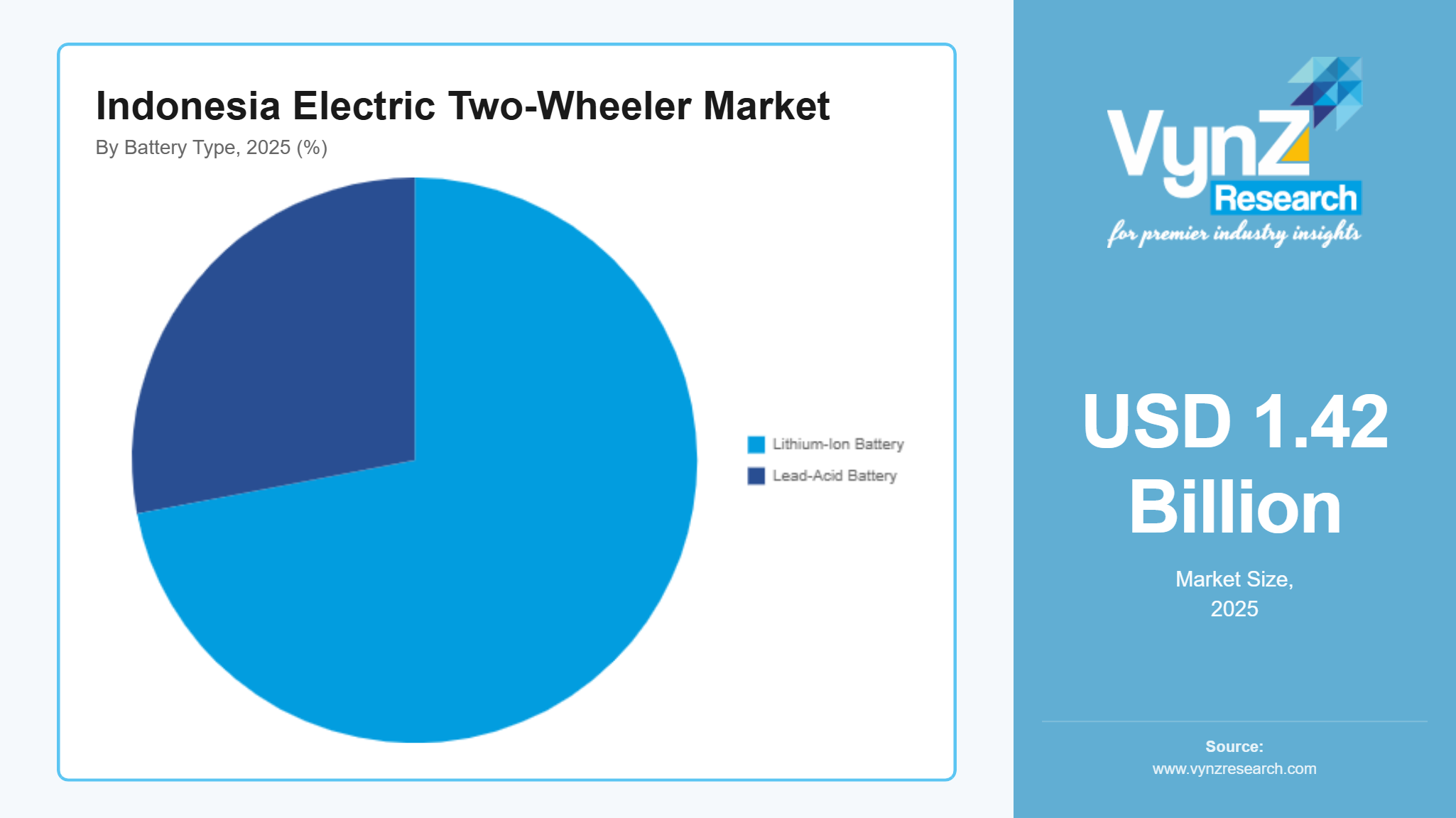
Lithium-ion battery electric two-wheelers contributed around 72% of the market share in 2025 because they are widely adopted, use less energy and are cheaper. Manufacturers are using battery systems to improve performance and range and the government prioritizes battery technology for mobility.
Lead-acid battery electric two-wheelers will grow at 17.8% during the forecast period every year as these batteries are widely available and cheaper.
By Battery Technology
Removable battery electric two-wheelers held around 58% of the market in 2025 due to growing preference for battery swapping and wider charging networks build to support this technology for mobility.
Non-removable battery technologies will grow at 19.1% during the projected period as charging infrastructure is improving and batteries are getting better.
By Voltage
Electric two-wheelers with 48V–60V batteries represented around 47% of the market in 2025 due to their perfect balance between affordability and performance and higher focus by the manufacturers on making these vehicles for mass-market consumers.
Electric two-wheelers with over 60V batteries will grow the fastest at 22.4% each year during the forecast period due to higher preference for range, speed and performance among users. These vehicles are also very popular among premium buyers and commercial fleets due to higher vehicle efficiency and better battery performance.
Regional Insights
Java
Java contributed around 47% of the market in 2025 because many people are moving to cities like Jakarta, Bandung and Surabaya have money to spend and are choosing electric vehicles for cost-effective transportation and ride-hailing services. The government is supporting two-wheelers with rules like Presidential Regulation No. 55/2019 and incentives to buy electric vehicles. Java has better charging and battery-swapping facilities and is expected to grow at 20.7% each year until 2035.
Sumatra
Sumatra made up around 21% of the market in 2025 due to expansion of cities, improved transportation and growing preference among people for affordable mobility solutions in cities like Medan, Palembang and Pekanbaru. The government has plans like the National Energy General Plan (RUEN) to support the growth of the market because low-emission transportation will play a role in the region’s economic development.
Kalimantan
Kalimantan represented about 14% of the market in 2025 and is growing because of strong infrastructure, industrial development and higher preference for sustainable transportation among people. The government is supporting transportation infrastructure with National Electric Mobility initiatives.
Rest of Indonesia
The rest of Indonesia, which includes Sulawesi, Bali, Nusa Tenggara, Papua, Maluku and other provinces made up about 18% of the market in 2025 due to better electricity programs, more tourists and easier access to electric vehicle charging. People like these vehicles because they use fuel and are good for the environment, save fuel and the government helps the market with plans like the Indonesia Net Zero Emissions 2060 Roadmap and programs to develop the electric vehicle ecosystem.
Competitive Landscape / Company Insights
The market is moderately competitive with local car makers, electric vehicle startups and international companies trying to make better products, set good prices and expand their market share. They invest a lot in research and development of battery-swapping systems platforms for mobility and improving local manufacturing. The Ministry of Industry and the Ministry of Energy and Mineral Resources have initiatives that promote electric vehicle production under Presidential Regulation No. 55/2019 and the National Energy General Plan. They encourage investments in electric vehicle production, battery value chains and charging infrastructure development.
Mini Profiles
Alessa Motors Nusantara focuses on electric vehicle manufacturing and sustainable mobility solutions, supported by local production capabilities, growing distribution networks, and increasing participation in Indonesia's expanding electric mobility ecosystem.
Electrum operates in the electric mobility segment, emphasizing battery-swapping services, fleet electrification solutions, and integrated transportation platforms designed to improve convenience, efficiency, and vehicle accessibility.
GESITS leverages local manufacturing expertise and strategic industry partnerships to expand market presence, offering domestically developed electric two-wheelers aligned with Indonesia's vehicle electrification objectives.
MAKA Motors focuses on performance-oriented electric motorcycles, supported by product innovation, advanced engineering capabilities, and increasing brand recognition among Indonesia's emerging electric vehicle consumers.
Volta Indonesia specializes in electric scooters and battery-swapping solutions, supported by an expanding service network, cost-efficient mobility offerings, and partnerships across Indonesia's transportation sector.
Key Players
- Alessa Motors Nusantara
- Electrum
- GESITS
- Ilectra
- Motor Group
- MAKA Motors
- Oyika
- Selis
- Smoot Motor Indonesia
- Terra Motors Indonesia
- Volta Indonesia
Recent Developments
In January 2025, MAKA Motors officially launched the MAKA Cavalry, its first locally designed electric motorcycle developed specifically for Indonesian riders and road conditions. The launch strengthened the company's position in the domestic electric two-wheeler segment while supporting Indonesia's electric mobility ecosystem expansion.
In November 2025, Selis expanded its electric mobility portfolio and dealer presence to support rising demand for electric two-wheelers across Indonesia. The company also increased its focus on affordable electric transportation solutions aligned with national vehicle electrification objectives.
In August 2025, Terra Motors Indonesia benefited from growing adoption of electric motorcycles and commercial electric mobility solutions as Indonesia accelerated electric vehicle deployment programs. The company continued strengthening its presence in the country's urban mobility and fleet transportation segments.
In September 2025, Oyika expanded its battery-swapping ecosystem and electric mobility services to improve accessibility for electric two-wheeler users in Indonesia. The initiative supported faster charging alternatives and reduced operational costs for commercial riders and urban commuters.
In January 2026, Ilectra Motor Group continued evaluating opportunities within Indonesia's rapidly growing electric two-wheeler landscape, supported by increasing government incentives and expanding consumer interest in electric mobility solutions. Market growth remained supported by broader electrification initiatives and infrastructure investments across the country.