India Tourism Market Overview
The India tourism market size was estimated at about USD 19.2 billion in 2025 and is expected to reach around USD 20.8 billion in 2026, rising to roughly USD 32.3 billion by 2035, growing at approximately 8.5% CAGR from 2026 to 2035.
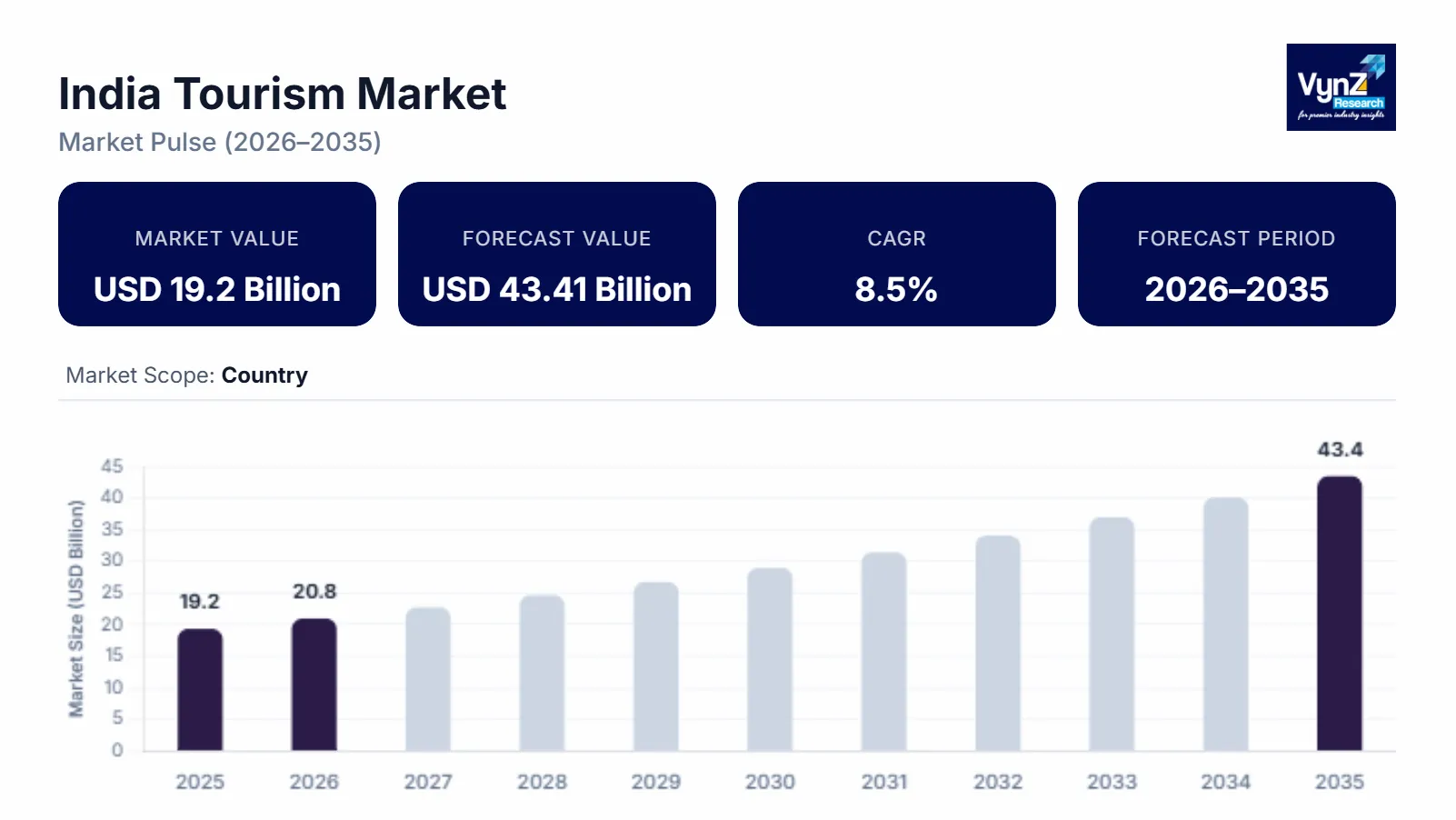
Research Highlights
- Leisure tourism accounted for 46.8% share in 2025, supported by rising domestic travel.
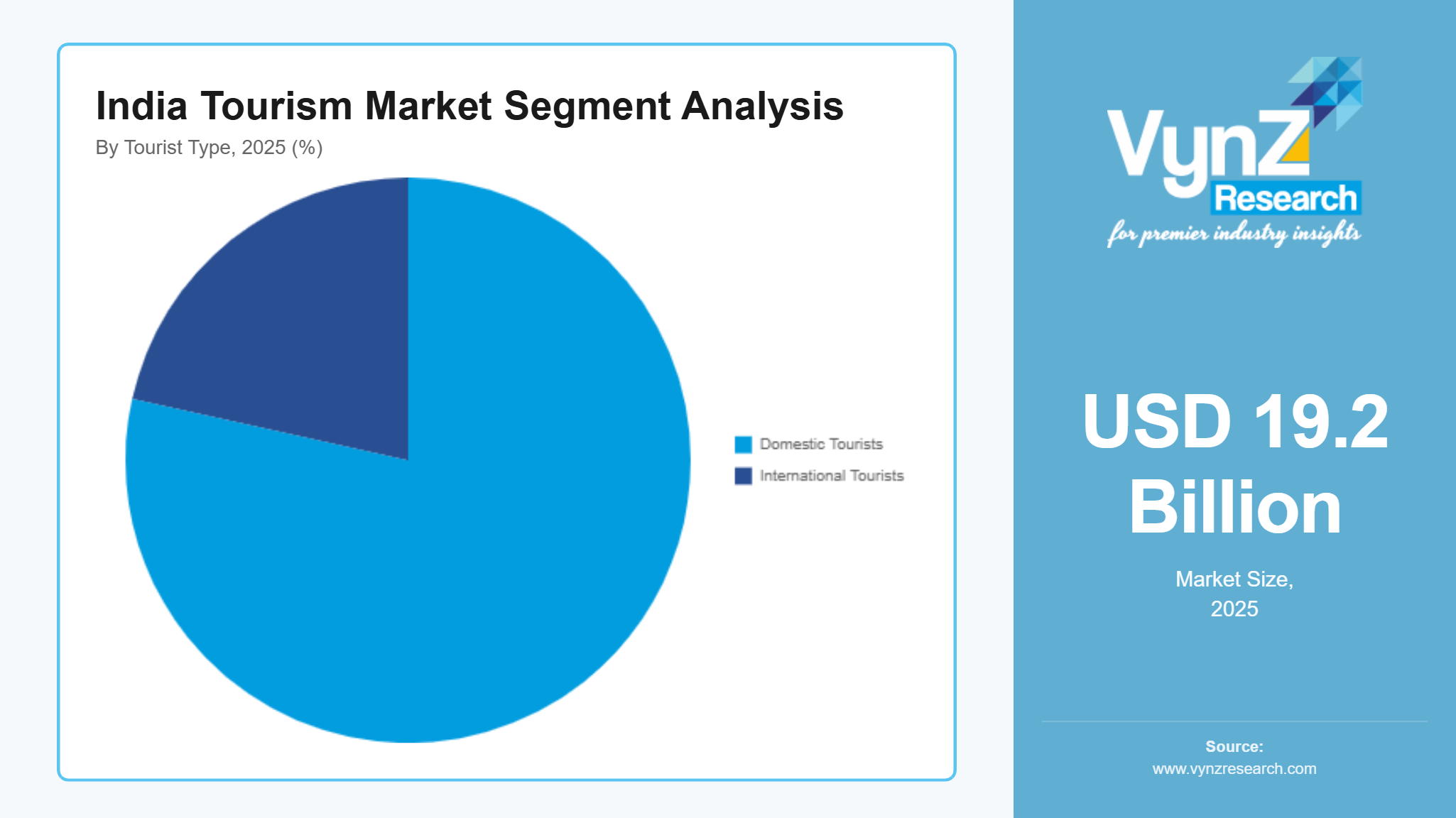
- Domestic tourists held 78.5% share in 2025, driven by increasing regional tourism.
- Travelers aged 25 to 40 accounted for 39.6% of the share in 2025, reflecting higher spending.
- International tourists are likely to grow at a CAGR of 9.4% due to improved visa policies.
- North India held 28.4% market share in 2025, supported by heritage tourism.
Market growth is pushed forward by higher domestic travel spending, improved air and rail networks and development of tourism infrastructure. Higher usage of digital platforms for travel booking, growing preference for personalized travel experience, higher demand for leisure tourism and cultural exploration and short time holiday trips push the market further. This momentum is supported by Swadesh Darshan and PRASHAD Scheme along with other effort to develop tourism by the Ministry of Tourism increasing tourists in Rajasthan, Kerala and Maharashtra.
India Tourism Market Dynamics
Market Trends
The market is changing because people today favor experiential, wellness and green tourism rather than usual sightseeing. Tourists today prefer cultural immersion, heritage encounters and ecofriendly travel. The Ministry of Tourism initiatives to push rural tourism, destination and heritage circuits increase engagement in a noticeable way. Another trend is the move towards mobile booking apps, digital travel platforms and AI driven travel planning, facilitated by better internet access and promotion of digital payments. The Ministry of Electronics and Information Technology states that there is a growth in digital services and the Ministry of Tourism points at the higher adoption of online travel services by domestic and foreign tourists.
Growth Drivers
Transportation infrastructure growth is probably the biggest growth driver of the market with higher investments in highways, airports, railway and local connectivity projects. This improves connectivity to remote places. The Ministry of Civil Aviation says that regional air connectivity has improved significantly under the UDAN scheme encouraging tourism development in novel destinations. Also, higher disposable incomes, demand for domestic travel, preference for leisure trips and shorter getaways are creating more demand and growth. The Ministry of Tourism points out at the strong upsurge in local tourist visits which is improving economic conditions and making tourism more affordable.
Market Restraints / Challenges
Despite such positive momentum, the market faces growth challenges due to infrastructural gaps, seasonal swings, lower tourism facilities in remote areas and overcrowding in the popular destinations causing frustration among tourists. According to the Ministry of Tourism, competition can only increase and tourism can spread if infrastructural development is a priority. Environmental concerns limits using sustainable local resources and the Ministry of Environment, Forest and Climate Change emphasizes following tourism practices that promotes environmental conservation objectives.
Market Opportunities
There are strong opportunities in rural, wellness and heritage tourism mainly because travelers are changing their preferences and looking authentic experiences. Businesses that design personalized travel packages, community-based tourism plans and wellness-centered packages will make the most out of such changing interests. The Ministry of Tourism supports rural location development and thematic tourism through several tourism promotion programs. Another opportunity in digital tourism is offered due to growing investment in smart tourism solutions, customized travel platforms and upgraded hospitality infrastructure to offer higher value and better customer engagement. The India Brand Equity Foundation and the Ministry of Tourism both suggest that consistent investment in destination marketing and tourism infrastructure will back long-term growth and increase domestic and international visitors.
India Tourism Market Report Coverage
|
Report Metric
|
Details
|
|
Historical Period
|
2020 - 2024
|
|
Base Year Considered
|
2025
|
|
Forecast Period
|
2026 - 2035
|
|
Market Size in 2025
|
U.S.D. 19.2 Billion
|
|
Revenue Forecast in 2035
|
U.S.D. 32.3 Billion
|
|
Growth Rate
|
8.5%
|
|
Segments Covered in the Report
|
By Tourism Type, By Tourist Type, By Age Group, By Purpose
|
|
Report Scope
|
Market Trends, Drivers, and Restraints; Revenue Estimation and Forecast; Segmentation Analysis; Companies’ Strategic Developments; Market Share Analysis of Key Players; Company Profiling
|
|
Regions Covered in the Report
|
North India, South India, Western India, Rest of India
|
India Tourism Market Segmentation
By Tourism Type
Leisure tourism held the largest market share at about 46.8% in 2025 supported by higher domestic travel spending, growing preference for short trips and increased interest in cultural and heritage tourism. The Ministry of Tourism states that domestic tourism is growing consistently promoting leisure travel.
Medical tourism is expected to grow the fastest with a projected CAGR of about 10.2% during the forecast period due to cost-effective treatments, skilled doctors and developed infrastructure drawing international tourists.
By Tourist Type
In 2025, domestic tourists dominated the market with a share of almost 78.5% in 2025 mainly because of higher disposable incomes, stronger preference for local tourism and more dependable transportation networks. As the Ministry of Tourism put it domestic tourism contributes the largest share and is therefore the leading segment.
The international visitors segment is expected to grow at a CAGR of about 9.4% over the forecast period supported by updated visa policies, growing awareness of India as a cultural, heritage and wellness destination and solid air connectivity. Better destination marketing efforts by the Ministry of Tourism along with support from the Ministry of Civil Aviation are also helping the segment gain momentum.
By Age Group
The 25 to 40 years group accounted for the highest market share at nearly 39.6% in 2025 due to higher travel frequency, adoption of online booking platforms and improved spending capabilities. The younger professionals make up the majority of domestic and worldwide travel demand, according to the Ministry of Tourism.
The above 60 years segment is likely to register the fastest growth at around 9.3% CAGR during the forecast period due to higher life expectancy, higher retirement income, and growing interest in religious, wellness and leisure tourism.
Regional Insights
North India
North India held about 30% of the market share in 2025 as Delhi, Agra, Jaipur, Varanasi and Jammu & Kashmir draw more visitors for heritage, religious and leisure destinations. The government is doing a lot to help tourism, in North India. They are spending money to develop tourism infrastructure conserve heritage and improve hospitality and travel services. They are also expanding airports. Modernizing highways. All these things are bringing visitors to North India. North India is really benefiting from these government initiatives.
South India
South India held about 24% share of the market in 2025 especially in Kerala, Tamil Nadu, Karnataka, and Andhra Pradesh due to higher demand for medical, cultural and coastal tourism from both local and foreign tourists. The Ministry of Tourism notes that higher investments in hospitality infrastructure, transportation connectivity and destination promotion will help this region grow further.
Western India
Western India represented nearly 21% of the market in 2025 supported by growing interest across Goa, Maharashtra and Gujarat for leisure, business, cultural and seaside experience. According to the Ministry of Civil Aviation development in airport infrastructure and connectivity is offering easier accessibility and growing investment in accommodation services and destination marketing is offering long-term growth prospects for market participants.
Rest of India
The rest of India accounted for roughly 25% of the market share spread across eastern, central and north eastern states due to higher tourism promotion initiatives, better transportation infrastructure and growing preference for nature-centered, cultural, and adventure tourism. The Ministry of Tourism says that specific investments under the Swadesh Darshan and PRASHAD schemes are helping growth and upgrading tourism infrastructure in areas. People are traveling more within India and hotels are investing money. The Ministry is also promoting tourism on platforms in a targeted way, which is helping to increase the momentum.
Competitive Landscape / Company Insights
The market is moderately competitive as established hospitality providers, travel operators and online travel platforms focus on service innovation, destination expansion and customer experience improvement. They are putting more money into strengthening digital capabilities, crafting tailored travel packages and using technology backed booking platforms to step into new markets. As per the Ministry of Tourism and the India Brand Equity Foundation, steady push for tourism infrastructure investments, digital tourism and destination promotion is getting even stronger and it is intensifying competition across the whole tourism industry.
Mini Profiles
Club Mahindra Holidays focuses on vacation ownership, family holidays, and resort-based travel experiences, supported by strong brand recognition, an extensive resort network, and a loyal membership base across India.
Cox & Kings operates in premium and customized travel segments, emphasizing curated holiday packages, international tours, and destination expertise to serve leisure, corporate, and group travelers.
EaseMyTrip leverages digital reach and technology driven booking platforms to expand market presence, offering flight reservations, hotel bookings, and travel services through a cost efficient model.
MakeMyTrip Limited focuses on online travel booking solutions, supported by strong digital capabilities, extensive supplier partnerships, and a broad portfolio covering transportation, accommodation, and holiday packages.
Thomas Cook (India) Limited specializes in travel management, foreign exchange, and holiday services, supported by an established distribution network, diversified offerings, and a strong presence across domestic and international markets.
Key Players
- Club Mahindra Holidays
- Cox & Kings
- EaseMyTrip
- Indian Railway Catering and Tourism Corporation (IRCTC)
- MakeMyTrip Limited
- SOTC Travel Limited
- Sterling Holiday Resorts
- TBO Tek Limited (Travel Boutique Online)
- Thomas Cook (India) Limited
- Yatra Online Limited
Recent Developments
In July 2025, Yatra Online Limited received approval from the National Company Law Tribunal for the amalgamation of six wholly owned subsidiaries. The development was aimed at streamlining operations, improving efficiency, and strengthening its travel services platform.
In May 2025, TBO Tek Limited reported a 26% year on year increase in quarterly profit following strong growth across its travel distribution business. The performance reflected rising demand for digital travel booking and global travel services.
In June 2025, Indian Railway Catering and Tourism Corporation (IRCTC) expanded its tourism portfolio through multiple Bharat Gaurav and pilgrimage focused rail tour packages. The initiative supported growing demand for religious and experiential tourism across India.
In November 2025, SOTC Travel Limited expanded its curated holiday offerings focused on international destinations and premium travel experiences. The move was intended to capitalize on rising outbound travel demand from Indian consumers.
In February 2026, Sterling Holiday Resorts continued strengthening its resort portfolio and destination presence to support increasing domestic leisure travel demand. The expansion aligned with the company's long term strategy of enhancing vacation and hospitality offerings across key tourism locations.