U.S. Beauty Devices Market Overview
The U.S. beauty devices market which was valued at approximately USD 17 billion in 2025 and is estimated to rise further up to almost USD 18.9 billion by 2026, is projected to reach around USD 48.27 billion in 2035, expanding at a CAGR of about 11% during the forecast period of 2026 to 2035. Market growth is driven by rising disposable income, increasing geriatric population, and growing consumer preference for non-invasive skincare solutions, along with increasing adoption of at-home beauty devices and advanced LED, hair removal, and acne treatment technologies.
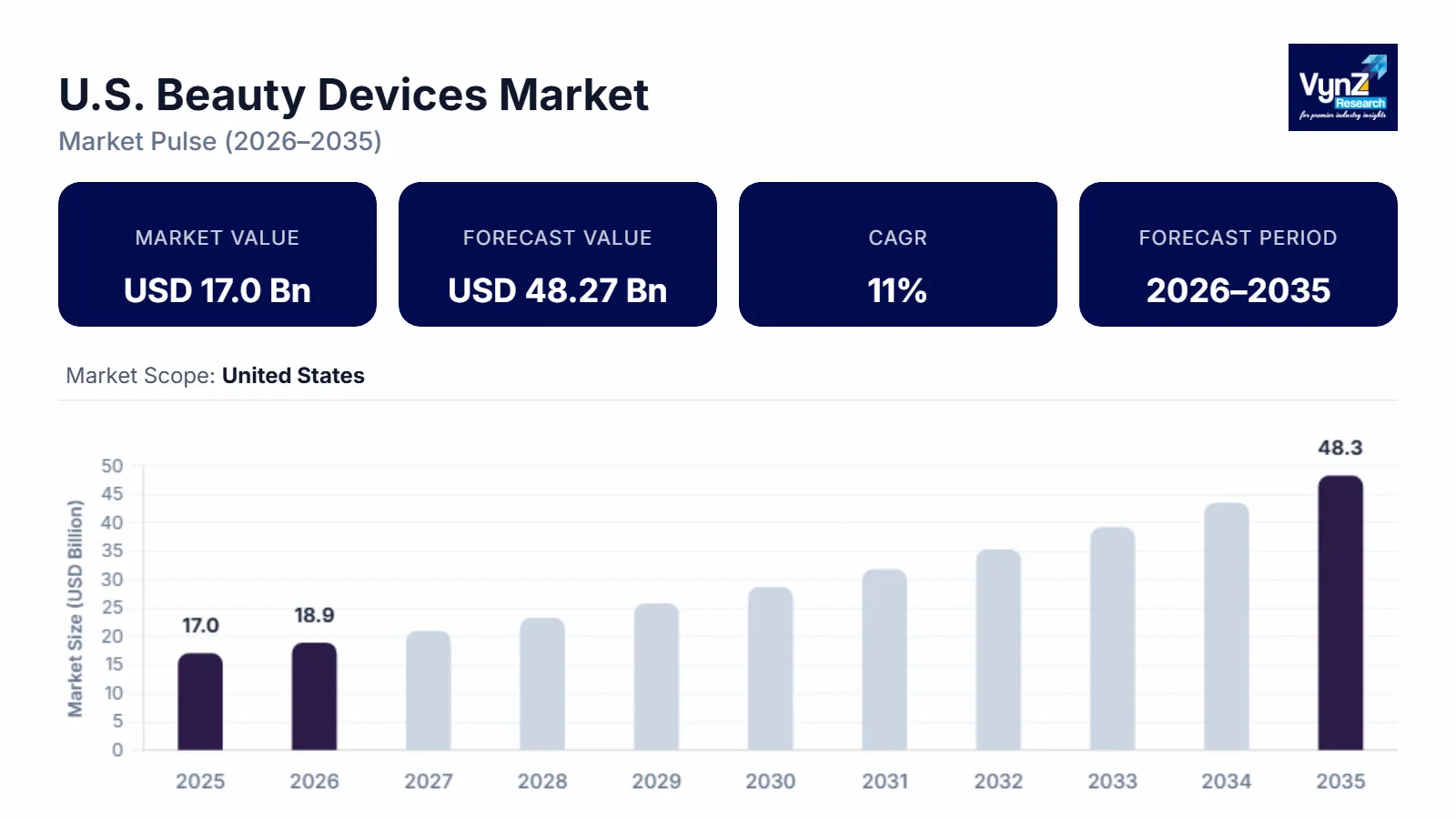
Rising demand for home-based cosmetic procedures and ongoing investments in public health and wellness programs, supported by data from the U.S. Bureau of Labor Statistics and the American Academy of Dermatology, are further supporting market expansion across major regions including California, New York, and Texas.
U.S. Beauty Devices Market Dynamics
Market Trends
The industry is witnessing notable shifts in technology adoption, consumer behavior, and design preferences. One of the key trends shaping the market is the growing preference for at-home non-invasive skincare and cosmetic devices, reflecting increasing consumer focus on convenience, personalization, and safety. Another emerging trend is the integration of smart and AI-enabled devices, driven by technological innovation and digital penetration, influencing product offerings and encouraging companies to focus on differentiated features and connected solutions. These developments are redefining competitive dynamics within the market, supported by reports from the U.S. Bureau of Labor Statistics and American Academy of Dermatology on rising adoption of home-use dermatological devices.
Growth Drivers
The growth of the market is largely supported by rising disposable income and lifestyle-driven demand for aesthetic wellness, which continues to generate consistent adoption across premium and mid-tier consumer segments. Increasing investments in technological innovation, product R&D, and distribution infrastructure are further accelerating market expansion. Additionally, growing consumer awareness regarding skin health and non-invasive cosmetic procedures is playing a crucial role in boosting adoption, as U.S. consumers prioritize efficiency, safety, and convenience in personal care routines. Government-supported wellness initiatives and public health reports highlighting preventive skin care and dermatological awareness further underpin demand.
Market Restraints / Challenges
Despite favorable growth prospects, the market faces challenges that may limit its expansion. High product costs and price sensitivity among emerging consumer segments continue to affect market penetration and profitability. Furthermore, dependence on imported electronic components and advanced materials can lead to supply chain vulnerabilities, cost pressures, and potential delivery delays, impacting overall performance during periods of economic uncertainty. Regulatory compliance requirements from the U.S. Food and Drug Administration (FDA) for device safety and efficacy add an additional operational layer, particularly for new entrants.
Market Opportunities
The market presents significant opportunities in expanding at-home and personalized skincare solutions, driven by rising demand for safe, convenient, and effective non-invasive devices. Companies offering smart, AI-enabled, and customizable devices are well-positioned to capture incremental demand from health-conscious and tech-savvy consumers. Another key opportunity lies in premium and professional-grade beauty devices, where rising investments in clinical and spa-grade solutions create avenues for higher margins and long-term consumer loyalty. Digital tools, smart device integration, and tele-dermatology platforms are also expected to enhance customer engagement and improve adoption, supported by U.S. public health initiatives promoting skin health awareness and wellness programs.
U.S. Beauty Devices Market Report Coverage
|
Report Metric
|
Details
|
|
Historical Period
|
2020 - 2024
|
|
Base Year Considered
|
2025
|
|
Forecast Period
|
2026 - 2035
|
|
Market Size in 2025
|
U.S.D. 17 Billion
|
|
Revenue Forecast in 2035
|
U.S.D. 48.27 Billion
|
|
Growth Rate
|
11%
|
|
Segments Covered in the Report
|
By Type, By End User
|
|
Report Scope
|
Market Trends, Drivers, and Restraints; Revenue Estimation and Forecast; Segmentation Analysis; Companies’ Strategic Developments; Market Share Analysis of Key Players; Company Profiling
|
|
Regions Covered in the Report
|
East, West, Central, South, Other Regions
|
U.S. Beauty Devices Market Segmentation
By Type
Hair removal devices accounted for the largest share of the market in 2025, representing approximately 28% of total revenue. Their dominance is supported by high usage frequency, broad consumer applicability, steady replacement cycles, and regulatory compliance with U.S. FDA safety standards. Consumer awareness campaigns and dermatology-backed educational programs by the American Academy of Dermatology further reinforce adoption across professional clinics and at-home users.
Light/LED therapy and photo rejuvenation devices are expected to register the fastest growth during the forecast period, with an estimated CAGR of 12% from 2026 to 2035. Growth is driven by technological innovation, non-invasive home treatment adoption, and government-backed wellness initiatives promoting preventive dermatological care.
Cleansing devices, acne devices, skin dermal rollers, oxygen and steamer devices, hair growth devices, cellulite reduction devices, and other devices are witnessing steady adoption, with an estimated CAGR of 10% during the forecast period of 2026 to 2035. Rising consumer focus on preventive skin care, digital engagement, and public health-backed skincare awareness programs continue to support segment-level expansion.
By End User
Beauty clinics accounted for the largest share in 2025, representing approximately 42% of total market revenue. Their dominance is driven by structured clinical procedures, professional trust, certified training programs, and regulatory frameworks ensuring safety and efficacy. Expansion of professional training programs and dermatology association guidance continues to reinforce clinic-level adoption across urban regions such as California, New York, and Texas.
At-home users are expected to register the fastest growth, with an estimated CAGR of 13% during the period. Rising disposable income, compact and user-friendly devices, lifestyle trends favoring convenience, and government-backed public health campaigns promoting safe at-home skincare solutions are key growth factors supporting adoption.
Spas and salons accounted for approximately 30% of revenue in 2025 and are witnessing moderate growth, with an estimated CAGR of 9% during 2026–2035. This growth is driven by infrastructure investments, increasing urbanization, integration of advanced beauty devices to enhance client experience, and adherence to professional certification programs, contributing to sustained segment-level demand.
Other end-users, including gyms and wellness centers, are observing gradual adoption, supported by premium service offerings, targeted marketing initiatives, and growing awareness of non-invasive aesthetic solutions. Estimated CAGR for this segment is approximately 8% during the forecast period, reflecting steady but slower expansion compared to clinics and home users.
Regional Insights
East
The East accounted for approximately 30% of the market in 2025, driven by high disposable incomes, dense urban populations, and widespread adoption of professional aesthetic clinics. Cities such as New York, Boston, and Washington, D.C., continue to witness strong demand for hair removal, LED therapy, and anti-aging devices.
Government-backed public health campaigns and dermatology association guidelines promoting safe skincare, combined with rising consumer awareness of at-home and clinic-based treatments, are encouraging investments in advanced beauty devices. Expansion of online retail platforms further strengthens regional performance and consumer reach.
West
The West represented approximately 28% of the market in 2025, fueled by strong consumer interest in innovative beauty devices, high penetration of professional aesthetic clinics, and lifestyle trends favoring at-home and non-invasive treatments. Key cities such as Los Angeles, San Francisco, and Seattle are major hubs for hair removal, skincare, and body contouring devices.
State-level regulations, certification programs for professional clinics, and public campaigns on safe skincare adoption are supporting market expansion. The growing presence of e-commerce and digital consultation platforms is further enhancing regional device accessibility.
Central
The Central region accounted for around 15% of the market in 2025. Growth is supported by increasing urbanization, rising disposable incomes, and the gradual adoption of home-use and professional beauty devices in cities such as Chicago, Dallas, and Houston.
Regional dermatology associations and wellness initiatives promoting safe device use, combined with investments in aesthetic clinics and spas, are contributing to sustained demand. Infrastructure development in suburban and urban hubs continues to drive moderate growth in this region.
South
The South represented approximately 12% of the market in 2025, with increasing adoption of at-home skincare, light-based therapy devices, and hair removal products. Urban centers including Miami, Atlanta, and Houston are experiencing rising consumer interest, supported by lifestyle trends and professional clinic expansion.
State-level wellness programs and public awareness campaigns on safe cosmetic procedures are encouraging adoption. Retail expansion and digital sales channels are also contributing to steady regional growth.
Other Regions
The remaining 15% of the market in 2025 is covered by smaller urban and rural regions not specifically listed above. These areas are gradually adopting beauty devices, supported by rising disposable incomes, awareness of non-invasive treatments, and increasing accessibility through online and retail distribution networks.
Competitive Landscape / Company Insights
The market is moderately to highly competitive, with global and regional players focusing on product innovation, pricing strategies, and geographic expansion. Key companies are investing in advanced home-use and professional-grade devices, digital-enabled solutions, and R&D to improve efficacy and user experience. Market growth is reinforced by government-backed initiatives, including consumer safety regulations enforced by the U.S. Food and Drug Administration (FDA), public health awareness campaigns, and standards for cosmetic device approvals, which collectively encourage companies to strengthen their market position and expand distribution networks.
Mini Profiles
Alma Lasers Ltd. focuses on advanced aesthetic and medical devices, supported by strong U.S. distribution, brand recognition, and innovative product development enhancing consumer and professional adoption.
Beauty Bioscience Inc. operates in premium and home-use beauty device segments, emphasizing performance, customization, and scientifically validated formulations that enhance user experience and device efficacy.
Carol Cole Company Inc. leverages strategic partnerships and digital reach to expand market presence, offering a broad portfolio of skincare and beauty devices through online and professional channels.
Dr. Dennis Gross Skincare LLC focuses on innovative beauty devices and professional skincare solutions, supported by R&D, high-quality product performance, and strong digital marketing strategies for U.S. consumers.
FOREO AB operates in premium and mass segments, emphasizing ergonomic design, digital-enabled functionality, and user-centric devices, supported by global brand recognition and extensive online and retail distribution networks.
Key Players
- Alma Lasers Ltd.
- Amorepacific
- Corporation
- Beauty Bioscience Inc.
- Carol Cole Company Inc.
- Candela Corporation
- Conair Corporation
- Dr. Dennis Gross Skincare LLC
- FOREO AB
- Home
- Skinovations Ltd.
- Koninklijke
- Philips N.V.
Recent Developments
Amorepacific Corporation introduced AI-powered skincare diagnostic and device-integrated solutions in January 2026 at CES, focusing on personalized beauty device ecosystems. This strengthens its positioning in smart, connected at-home beauty devices aligned with U.S. consumer demand.
Candela Corporation expanded its portfolio of energy-based aesthetic devices in February 2026, focusing on advanced laser and light-based treatments for dermatology clinics. The development reinforces its presence in professional beauty device segments across the U.S. market.
Conair Corporation launched upgraded at-home grooming and skincare devices in March 2026, emphasizing compact design and multifunctionality. The company continues to align with rising U.S. demand for convenient and cost-effective personal beauty devices.
Home Skinovations Ltd. enhanced its light-based anti-aging and acne treatment devices in January 2026, targeting the growing at-home treatment segment. Its focus on clinically inspired devices supports increasing adoption among U.S. consumers seeking non-invasive solutions.
Koninklijke Philips N.V. advanced its connected beauty device portfolio in February 2026, integrating smart sensors and personalized care features. This supports growing demand in the U.S. for data-driven and technology-enabled personal care devices.