
AI in Sales Market Size & Share - Growth Forecast Report (2026-2035)
Industry Insight by Deployment Mode (Cloud-Based, On-Premises), by Component (Solutions, Services), by Technology (Machine Learning (ML), Natural Language Processing (NLP), Generative AI, Predictive Analytics, Conversational AI), by Application (Lead Scoring & Qualification, Sales Forecasting, Customer Relationship Management (CRM) Enhancement, Sales Automation & Workflow Management, Chatbots & Virtual Assistants, Content Generation & Personalization), by Organization Size (Large Enterprises, Small & Medium Enterprises (SMEs)), by Industry Vertical (BFSI (Banking, Financial Services, and Insurance), IT & Telecommunications, Retail & E-commerce, Healthcare, Manufacturing, Media & Entertainment, Others)
| Status : Published | Published On : Feb, 2026 | Report Code : VRICT5220 | Industry : ICT & Media | Available Format :

|
Page : 181 |
AI in Sales Market Overview
The AI in sales market which was valued at approximately USD 16.8 billion in 2025 and is estimated to reach around USD 22.3 billion in 2026, is projected to reach close to USD 151.5 billion by 2035, expanding at a CAGR of about 23.7% during the forecast period from 2026 to 2035.
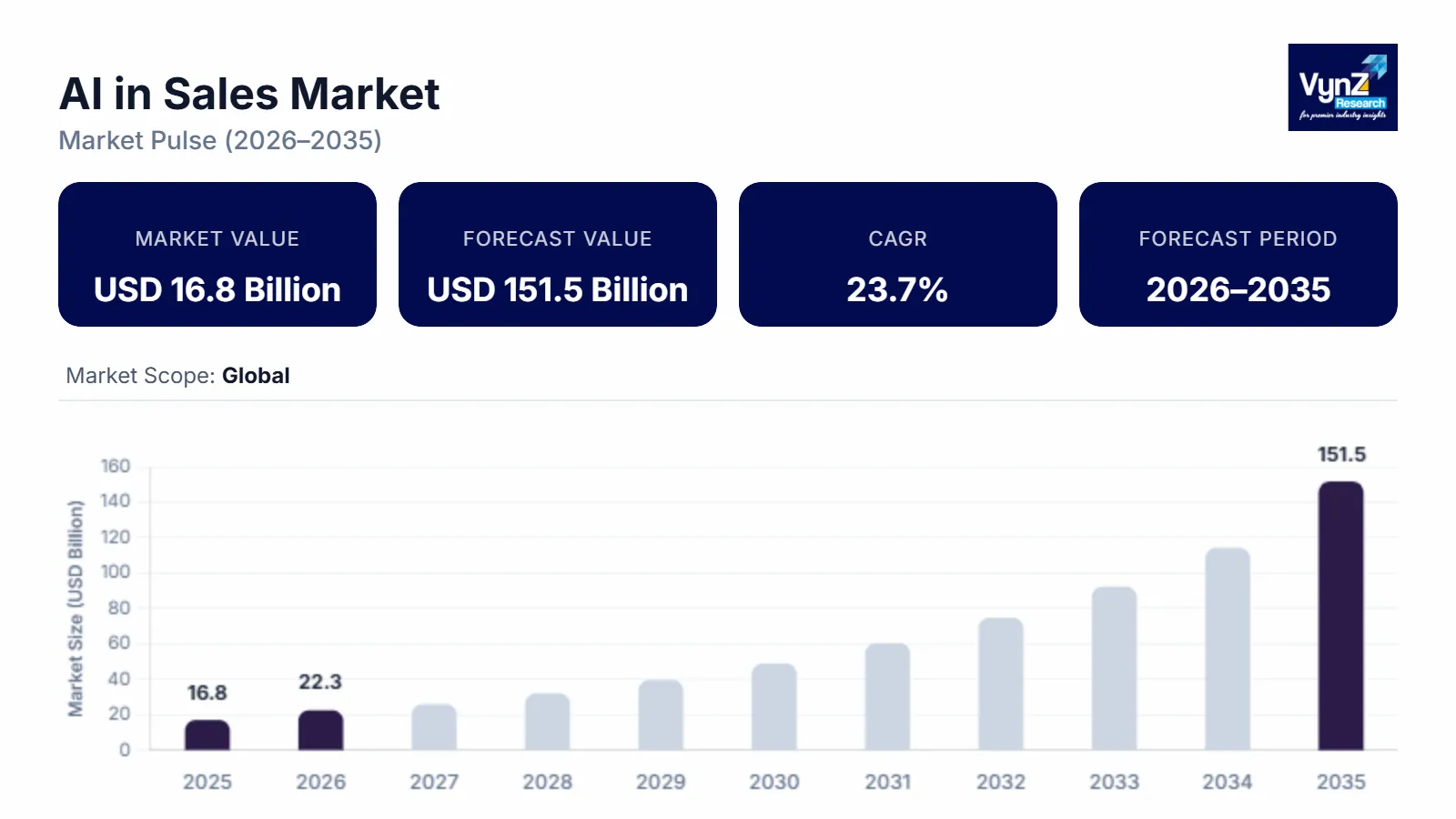
The AI in Sales Market is primarily driven by the growing need for data-driven decision-making and enhanced customer engagement across industries. As businesses generate vast volumes of customer and transactional data, AI-powered tools are increasingly used to analyze buying patterns, predict customer behavior, and optimize sales strategies. Organizations are adopting AI solutions to automate repetitive tasks such as lead scoring, email personalization, and pipeline management, allowing sales teams to focus on high-value activities. The rapid expansion of CRM platforms integrated with AI capabilities is further accelerating market growth. Additionally, rising demand for real-time insights and predictive analytics is enabling companies to improve conversion rates and shorten sales cycles. Increasing competition across sectors is pushing enterprises to adopt intelligent sales automation to gain a competitive edge. Advancements in machine learning, natural language processing, and generative AI are also enhancing virtual assistants and sales chatbots.
AI in Sales Market Dynamics
Market Trends
The expansion of conversational AI and chatbots is a key trend driving the AI in Sales market, as businesses seek to enhance customer engagement and streamline lead management. AI-powered chatbots are increasingly deployed across websites, mobile apps, and messaging platforms to handle customer inquiries in real time. The NITI Aayog's report AI for Viksit Bharat: The Opportunity for Accelerated Economic Growth projects that AI adoption could contribute an additional USD 500–600 billion to India's GDP by 2035. These systems can qualify leads, answer product-related questions, schedule meetings, and guide prospects through the sales funnel without human intervention. Natural language processing (NLP) advancements enable chatbots to understand context, intent, and sentiment, creating more personalized and human-like interactions. Sales teams benefit from automated follow-ups and 24/7 customer support, which improves response time and conversion rates. Additionally, conversational AI integrates with CRM platforms to capture valuable customer data and generate actionable insights. As digital customer touchpoints continue to grow, conversational AI is becoming an essential tool for scalable and efficient sales operations.
Growth Drivers
The rising adoption of CRM and sales automation platforms is a major growth driver of the AI in Sales market, as organizations seek to streamline and optimize their sales processes. Modern CRM systems integrated with AI capabilities enable automated lead scoring, customer segmentation, and pipeline tracking, reducing manual effort and improving efficiency. These platforms analyze historical sales data and customer interactions to provide predictive insights that guide sales strategies. Automation tools also handle repetitive tasks such as follow-up emails, meeting scheduling, and data entry, allowing sales teams to focus on relationship building and closing deals. Integration with marketing automation systems further enhances alignment between sales and marketing functions. Real-time dashboards and performance analytics provide visibility into sales activities and outcomes. Businesses increasingly prioritize productivity and data-driven decision-making, AI-powered CRM and automation platforms continue to gain widespread adoption.
Market Restraints / Challenges
Data privacy and security concerns represent a significant challenge in the AI in Sales market, as AI systems rely heavily on large volumes of sensitive customer and transactional data. Sales platforms often collect personal information, purchasing behavior, communication history, and financial details, making them attractive targets for cyberattacks. Any data breach can lead to reputational damage, financial penalties, and loss of customer trust. Additionally, strict regulations such as GDPR and other data protection laws require companies to ensure transparent data handling and secure storage practices. Compliance with these regulations increases operational complexity and implementation costs. Organizations must invest in robust cybersecurity frameworks, encryption technologies, and access controls to mitigate risks. Concerns around misuse of customer data and unauthorized profiling can also slow adoption of AI-driven sales tools. Data volumes grow, maintaining privacy and security remains a critical priority for market participants.
Market Opportunities
The expansion of generative AI for sales content creation represents a major opportunity in the AI in Sales market, as organizations aim to improve efficiency and personalization at scale. Generative AI tools can automatically create tailored sales emails, product descriptions, proposals, call scripts, and follow-up messages based on customer data and interaction history. This significantly reduces the time sales teams spend on manual content drafting while maintaining high levels of personalization. Advanced language models can adapt tone, messaging style, and value propositions to match specific customer segments. Integration with CRM systems allows real-time content customization aligned with lead status and buying intent. These tools also help ensure consistent brand messaging across multiple sales channels. Competition intensifies and customer expectations for personalized communication grow, generative AI is becoming an essential asset for modern sales organizations.
Global AI in Sales Market Report Coverage
|
Report Metric |
Details |
|
Historical Period |
2020 - 2024 |
|
Base Year Considered |
2025 |
|
Forecast Period |
2026 - 2035 |
|
Market Size in 2025 |
USD 16.8 Billion |
|
Revenue Forecast in 2035 |
USD 151.5 Billion |
|
Growth Rate |
23.7% |
|
Segments Covered in the Report |
Deployment Mode, Component, Technology, Application, Organization Size, Industry Vertical |
|
Report Scope |
Market Trends, Drivers, and Restraints; Revenue Estimation and Forecast; Segmentation Analysis; Companies’ Strategic Developments; Market Share Analysis of Key Players; Company Profiling |
|
Regions Covered in the Report |
North America, Europe, Asia Pacific, Rest of the World |
|
Key Companies |
Salesforce, Inc. (U.S.), Microsoft Corporation (U.S.), Oracle Corporation (U.S.), SAP SE (Germany), Google LLC (U.S.), Amazon Web Services, Inc. (U.S.), HubSpot, Inc. (U.S.), Zoho Corporation (India), Adobe Inc. (U.S.), IBM Corporation (U.S.), Infosys Ltd. (India), Freshworks Inc. (U.S.) |
|
Customization |
Available upon request |
AI in Sales Market Segmentation
By Deployment Mode
Cloud-Based is the largest category with a market share of about 70% in 2025, and it is also the fastest-growing category with a CAGR of 23.9% during the forecast period, this is driven by scalability, cost-efficiency, and rapid deployment capabilities. Cloud platforms allow seamless integration with CRM, marketing automation, and analytics systems. Businesses prefer cloud-based AI tools for their flexibility and lower infrastructure investment requirements. Real-time data access and continuous software updates enhance performance and security. The widespread adoption of SaaS business models further strengthens this segment’s leadership. Cloud ecosystems also enable easy global collaboration across distributed sales teams. The global spending on marketing cloud platforms will likely cross USD 21.9 billion by 2030. The pay-as-you-go pricing structure makes advanced AI tools accessible to smaller businesses. Faster onboarding and minimal IT complexity further accelerate growth. Expanding cloud infrastructure globally continues to support rapid market expansion.
By Component
Solutions is the largest category with a market share of about 65% in 2025, due to the high demand for AI-powered sales platforms that directly enable automation, predictive analytics, and customer intelligence. Organizations prioritize investment in software tools that improve lead scoring, forecasting accuracy, and personalization capabilities. These solutions are deeply integrated into CRM systems and digital sales channels, forming the core revenue-generating layer of AI adoption. As businesses aim to enhance conversion rates and operational efficiency, direct spending on AI solutions remains dominant. Continuous upgrades and feature expansion further sustain this segment’s leadership.
Services is the fastest-growing category during the forecast period, due to increasing demand for consulting, customization, and system integration. Many organizations require expert support to deploy AI models effectively and align them with existing sales workflows. Ongoing optimization, training, and performance monitoring services are also becoming essential. As AI complexity grows, reliance on professional services continues to accelerate.
There Services further classified into followings
- Consulting
- Integration & Deployment
- Support & Maintenance
By Technology
Machine Learning (ML) is the largest category with a market share of about 35% in 2025, due to its foundational role in predictive modeling, customer segmentation, and opportunity scoring. ML algorithms analyze historical sales data to uncover patterns and forecast future outcomes. Sales teams rely on ML-driven insights to prioritize leads and optimize outreach timing. Its proven reliability and widespread integration into CRM systems reinforce its dominance. ML also supports automation in pricing strategies and churn prediction. As per the latest research, the global spending on MLops and autoML could cross USD 29.4 billion by 2032 and USD 15,499.3 million by 2030, respectively.
Generative AI is the fastest-growing category with a CAGR of 24.1% during the forecast period, driven by rapid advancements in natural language generation and automation tools. Generative AI enables dynamic creation of personalized emails, proposals, and customer interactions. Businesses are increasingly using these tools to improve engagement at scale. The ability to adapt tone and messaging in real time enhances customer experience. Integration with conversational AI platforms further boosts growth.
By Application
Lead Scoring & Qualification is the largest category with a market share of about 25% in 2025, because it directly influences revenue generation and pipeline efficiency. AI-driven lead scoring helps sales teams focus on high-probability prospects. This improves resource allocation and shortens sales cycles. Automated qualification reduces manual errors and enhances decision accuracy. Businesses view lead scoring as one of the most impactful AI use cases. Continuous optimization through real-time data further strengthens its importance. Its measurable impact on ROI supports its dominant position.
Content Generation & Personalization is the fastest-growing category with a CAGR of 23.8% during the forecast period, driven by the growing importance of tailored communication. Generative AI tools enable scalable personalization across multiple digital channels. Sales teams can produce customized proposals and marketing messages instantly. Customers expect individualized engagement, adoption continues to rise. Integration with CRM data enhances contextual messaging. The rapid expansion of digital sales channels further accelerates this segment’s growth.
By Organization Size
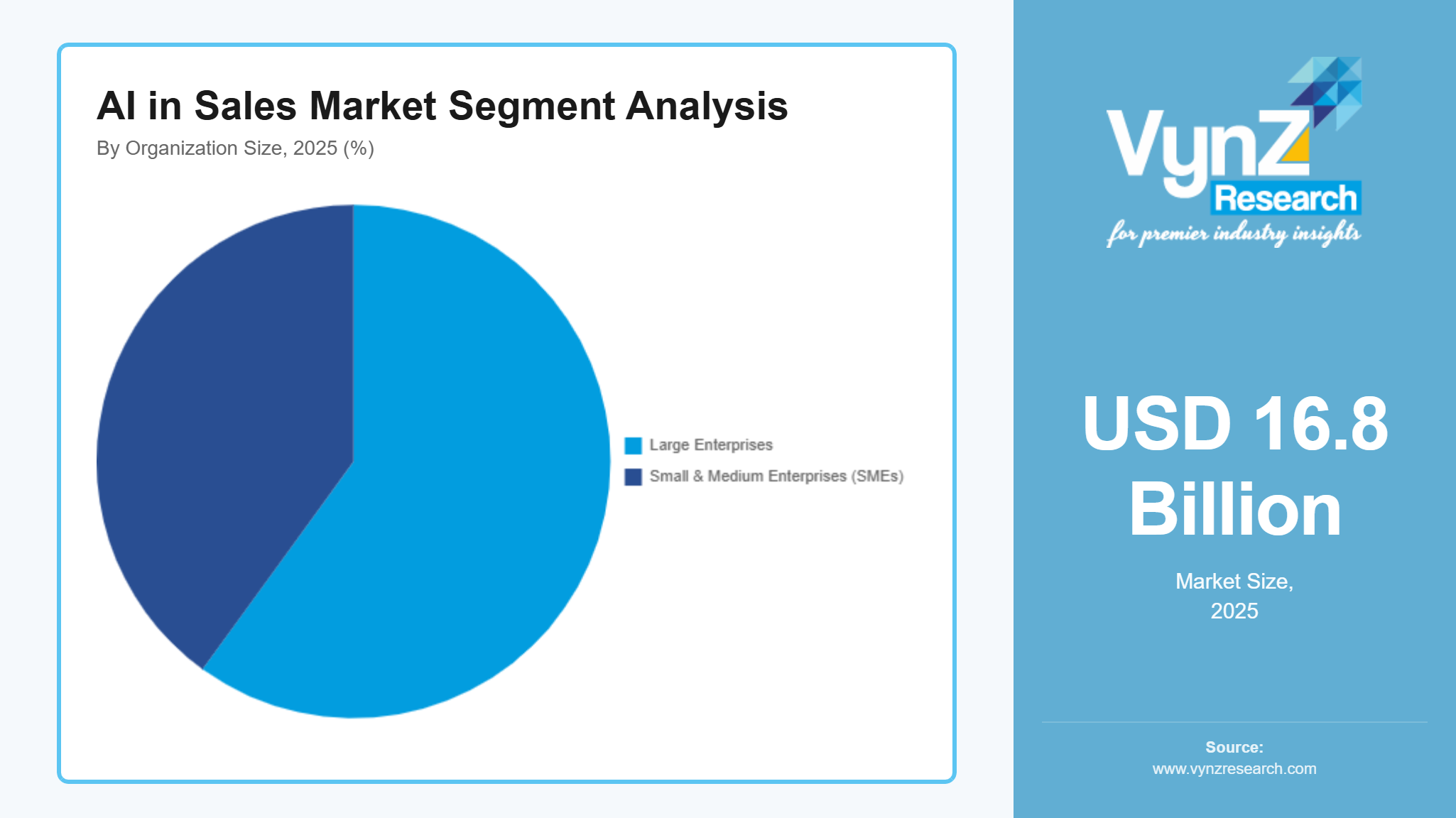
Large Enterprises is the largest category with a market share of about 60% in 2025, due to their complex sales operations and extensive customer data repositories. Large corporations invest heavily in AI to optimize global sales teams. They possess advanced IT infrastructure to support AI deployment at scale. Strong budgets enable integration with multiple enterprise systems. Global competition further motivates AI adoption. Large enterprises often pioneer AI innovation in sales environments.
Small & Medium Enterprises (SMEs) is the fastest-growing category during the forecast period, due to increasing access to affordable cloud-based AI tools. SMEs seek competitive parity with larger firms through automation. Subscription-based pricing lowers adoption barriers. Simplified user interfaces make AI tools easier to implement. Growing digitalization among SMEs supports strong uptake. Rising awareness of productivity benefits further accelerates growth.
By Industry Vertical
IT & Telecommunications is the largest category with a market share of about 25% in 2025, driven by highly digitalized sales ecosystems and strong CRM adoption. The sector generates large volumes of customer data, making AI integration highly valuable. Rapid product innovation cycles require predictive analytics and automation. Competitive intensity further supports AI-driven sales optimization. High IT budgets enable continuous technology upgrades.
Retail & E-commerce is the fastest-growing category during the forecast period, fueled by expanding online sales channels and dynamic customer journeys. AI enables real-time personalization and dynamic pricing. Retailers leverage predictive models to enhance cross-selling and upselling strategies. Growing omnichannel engagement further drives adoption. Increased reliance on digital platforms accelerates AI integration.
Regional Insights
North America
North America is the largest regional market for AI in Sales, driven by early adoption of artificial intelligence technologies and a strong presence of leading software and cloud providers. The United States leads the region with widespread deployment of AI-integrated CRM platforms and advanced sales automation tools across enterprises. Canada’s government established the Pan-Canadian AI Strategy with CAD 190 million to fund AI research centers and innovation hubs. It accelerates the commercialization of AI technologies — including enterprise sales tools — by funding research, talent development, and AI commercialization support. High digital maturity, strong venture capital funding, and a well-established SaaS ecosystem support continuous innovation. Large corporations in sectors such as IT, BFSI, and retail heavily invest in predictive analytics and generative AI for sales optimization. Additionally, strong cloud infrastructure and data availability enable real-time AI-driven decision-making. In September 2025, Hyperbound, a startup offering AI solutions for sales applications, closed a USD 15-million Series A funding round led by Peak XV Partners, with contributions from Y Combinator, Snowflake Ventures, Roble Ventures, and Fellows Fund. The presence of global technology leaders further strengthens regional dominance. Continuous R&D investment and competitive market dynamics sustain North America’s leadership position.
Asia Pacific
Asia-Pacific is the fastest-growing region in the AI in Sales market, fueled by rapid digital transformation and expanding e-commerce ecosystems. Countries such as China, India, Japan, and Southeast Asian nations are witnessing rising adoption of cloud-based CRM and AI-powered sales tools. Growing startup ecosystems and increasing SME digitalization are accelerating AI deployment. The expansion of mobile commerce and omnichannel retail is driving demand for predictive analytics and conversational AI solutions. South Korea has committed KRW 2.2 trillion (~USD 1.8 billion) over several years to build a nationwide AI ecosystem, including AI data infrastructure and enterprise adoption programs. These investments underpin the digital transformation of business processes including sales automation, AI-driven customer analytics, and CRM optimization. Governments are also promoting AI innovation through national digital initiatives. Rising internet penetration and a growing middle-class consumer base further support market growth.
Europe
Europe represents a significant market for AI in Sales, supported by strong enterprise digitalization and regulatory-driven data governance frameworks. The EU Digital Europe Programme allocates €2.1 billion (~$2.3 billion) for investment in artificial intelligence, data analytics, and digital skills through 2027. Germany, the UK, and France are investing in AI-powered CRM systems and sales automation technologies. The region emphasizes ethical AI use and compliance with strict data protection laws, shaping responsible adoption practices. Growing demand for personalized customer engagement across retail, manufacturing, and financial services supports steady growth. European enterprises are increasingly integrating generative AI tools into their sales workflows. Continued digital innovation and cross-border e-commerce expansion reinforce the region’s market presence.
Rest of the World
The rest of the world, including Latin America, the Middle East, and Africa, is experiencing gradual adoption of AI-driven sales technologies. In Latin America, countries such as Brazil and Mexico are investing in digital sales transformation initiatives. The Middle East is witnessing increased AI integration in retail and BFSI sectors aligned with national digital strategies. In Africa, growing internet penetration and mobile commerce adoption are creating new opportunities for AI-based sales tools. Although infrastructure maturity varies, increasing cloud availability and rising SME participation are expected to accelerate regional growth in the coming years.
Competitive Landscape / Company Insights
The AI in Sales market is moderately fragmented, with a mix of global technology giants, CRM platform providers, and specialized AI startups competing across various solution categories. Major players such as Salesforce, Inc., Microsoft Corporation, Oracle Corporation, and SAP SE dominate through integrated CRM ecosystems enhanced with AI-driven analytics and automation features. These companies leverage large customer bases, cloud infrastructure, and continuous R&D investment to maintain competitive advantage.
In addition, cloud and AI leaders such as Google LLC and Amazon Web Services, Inc. support AI model deployment and scalable infrastructure for sales applications. Specialized vendors like HubSpot, Inc. and Zoho Corporation focus on SME-friendly AI-driven CRM and automation solutions. Competitive differentiation is primarily based on predictive accuracy, generative AI capabilities, ease of integration, and data security features. The market is characterized by continuous innovation, strategic partnerships, and frequent feature upgrades aimed at improving personalization and automation. High data dependency, technological expertise, and integration complexity create moderate entry barriers, while rapid AI advancements continue to reshape competitive positioning.
Mini Profiles
Salesforce, Inc. (U.S.) is a leading cloud-based CRM provider that integrates AI capabilities through its Einstein platform to deliver predictive insights, automated lead scoring, and intelligent sales recommendations.
Microsoft Corporation (U.S.) incorporates AI into its Dynamics 365 CRM suite, offering advanced analytics, forecasting, and conversational AI to enhance sales productivity and decision-making.
Oracle Corporation (U.S.) provides an AI-powered sales platform within Oracle CX Cloud, leveraging machine learning and predictive analytics to optimize pipeline management and customer engagement.
SAP SE (Germany) delivers AI-embedded CRM solutions that integrate sales automation, customer insights, and data analytics to improve sales planning and execution.
Google LLC (U.S.) offers AI infrastructure and analytics tools that support sales intelligence, natural language understanding, and predictive modelling for sales applications.
Amazon Web Services, Inc. (U.S.) provides cloud-based AI and machine learning services such as Amazon SageMaker that can be used by enterprises to build and deploy intelligent sales applications.
Key Players
- Salesforce, Inc.
- Microsoft Corporation
- Oracle Corporation
- SAP SE
- Google LLC
- Amazon Web Services Inc.
- HubSpot, Inc.
- Zoho Corporation
- Adobe Inc.
- IBM Corporation
- Infosys Ltd.
- Freshworks Inc.
Recent Developments
January 2026 – Salesforce, Inc. launched a next-generation Einstein AI module that enhances predictive lead scoring and automated content recommendations, improving conversion accuracy for enterprise sales teams.
December 2025 – Microsoft Corporation announced expanded AI capabilities in Dynamics 365, including advanced generative AI suggestions for sales email drafting and customer outreach personalization.
November 2025 – Oracle Corporation introduced an AI-driven sales assistant in Oracle CX Cloud that uses natural language processing to provide real-time recommendations during customer engagement.
October 2025 – SAP SE unveiled enhanced predictive analytics features within its CRM suite, enabling real-time forecasting and AI-based pipeline risk detection.
September 2025 – Google LLC announced partnerships with major CRM vendors to integrate Google’s generative AI and NLP models into sales analytics dashboards.
Global AI in Sales Market Coverage
Deployment Mode Insight and Forecast 2026 - 2035
- Cloud-Based
- On-Premises
Component Insight and Forecast 2026 - 2035
- Solutions
- Services
Technology Insight and Forecast 2026 - 2035
- Machine Learning (ML)
- Natural Language Processing (NLP)
- Generative AI
- Predictive Analytics
- Conversational AI
Application Insight and Forecast 2026 - 2035
- Lead Scoring & Qualification
- Sales Forecasting
- Customer Relationship Management (CRM) Enhancement
- Sales Automation & Workflow Management
- Chatbots & Virtual Assistants
- Content Generation & Personalization
Organization Size Insight and Forecast 2026 - 2035
- Large Enterprises
- Small & Medium Enterprises (SMEs)
Industry Vertical Insight and Forecast 2026 - 2035
- BFSI (Banking
- Financial Services
- and Insurance)
- IT & Telecommunications
- Retail & E-commerce
- Healthcare
- Manufacturing
- Media & Entertainment
- Others
Global AI in Sales Market by Region
- North America
- By Deployment Mode
- By Component
- By Technology
- By Application
- By Organization Size
- By Industry Vertical
- By Country - U.S., Canada, Mexico
- Europe
- By Deployment Mode
- By Component
- By Technology
- By Application
- By Organization Size
- By Industry Vertical
- By Country - Germany, U.K., France, Italy, Spain, Russia, Rest of Europe
- Asia-Pacific (APAC)
- By Deployment Mode
- By Component
- By Technology
- By Application
- By Organization Size
- By Industry Vertical
- By Country - China, Japan, India, South Korea, Vietnam, Thailand, Malaysia, Rest of Asia-Pacific
- Rest of the World (RoW)
- By Deployment Mode
- By Component
- By Technology
- By Application
- By Organization Size
- By Industry Vertical
- By Country - Brazil, Saudi Arabia, South Africa, U.A.E., Other Countries
Table of Contents for AI in Sales Market Report
1. Research Overview
1.1. The Report Offers
1.2. Market Coverage
1.2.1. By
Deployment Mode
1.2.2. By
Component
1.2.3. By
Technology
1.2.4. By
Application
1.2.5. By
Organization Size
1.2.6. By
Industry Vertical
1.3. Research Phases
1.4. Limitations
1.5. Market Methodology
1.5.1. Data Sources
1.5.1.1.
Primary Research
1.5.1.2.
Secondary Research
1.5.2. Methodology
1.5.2.1.
Data Exploration
1.5.2.2.
Forecast Parameters
1.5.2.3.
Data Validation
1.5.2.4.
Assumptions
1.5.3. Study Period & Data Reporting Unit
2. Executive Summary
3. Industry Overview
3.1. Industry Dynamics
3.1.1. Market Growth Drivers
3.1.2. Market Restraints
3.1.3. Key Market Trends
3.1.4. Major Opportunities
3.2. Industry Ecosystem
3.2.1. Porter’s Five Forces Analysis
3.2.2. Recent Development Analysis
3.2.3. Value Chain Analysis
3.3. Competitive Insight
3.3.1. Competitive Position of Industry
Players
3.3.2. Market Attractive Analysis
3.3.3. Market Share Analysis
4. Global Market Estimate and Forecast
4.1. Global Market Overview
4.2. Global Market Estimate and Forecast to 2035
5. Market Segmentation Estimate and Forecast
5.1. By Deployment Mode
5.1.1. Cloud-Based
5.1.1.1. Market Definition
5.1.1.2. Market Estimation and Forecast to 2035
5.1.2. On-Premises
5.1.2.1. Market Definition
5.1.2.2. Market Estimation and Forecast to 2035
5.2. By Component
5.2.1. Solutions
5.2.1.1. Market Definition
5.2.1.2. Market Estimation and Forecast to 2035
5.2.2. Services
5.2.2.1. Market Definition
5.2.2.2. Market Estimation and Forecast to 2035
5.3. By Technology
5.3.1. Machine Learning (ML)
5.3.1.1. Market Definition
5.3.1.2. Market Estimation and Forecast to 2035
5.3.2. Natural Language Processing (NLP)
5.3.2.1. Market Definition
5.3.2.2. Market Estimation and Forecast to 2035
5.3.3. Generative AI
5.3.3.1. Market Definition
5.3.3.2. Market Estimation and Forecast to 2035
5.3.4. Predictive Analytics
5.3.4.1. Market Definition
5.3.4.2. Market Estimation and Forecast to 2035
5.3.5. Conversational AI
5.3.5.1. Market Definition
5.3.5.2. Market Estimation and Forecast to 2035
5.4. By Application
5.4.1. Lead Scoring & Qualification
5.4.1.1. Market Definition
5.4.1.2. Market Estimation and Forecast to 2035
5.4.2. Sales Forecasting
5.4.2.1. Market Definition
5.4.2.2. Market Estimation and Forecast to 2035
5.4.3. Customer Relationship Management (CRM) Enhancement
5.4.3.1. Market Definition
5.4.3.2. Market Estimation and Forecast to 2035
5.4.4. Sales Automation & Workflow Management
5.4.4.1. Market Definition
5.4.4.2. Market Estimation and Forecast to 2035
5.4.5. Chatbots & Virtual Assistants
5.4.5.1. Market Definition
5.4.5.2. Market Estimation and Forecast to 2035
5.4.6. Content Generation & Personalization
5.4.6.1. Market Definition
5.4.6.2. Market Estimation and Forecast to 2035
5.5. By Organization Size
5.5.1. Large Enterprises
5.5.1.1. Market Definition
5.5.1.2. Market Estimation and Forecast to 2035
5.5.2. Small & Medium Enterprises (SMEs)
5.5.2.1. Market Definition
5.5.2.2. Market Estimation and Forecast to 2035
5.6. By Industry Vertical
5.6.1. BFSI (Banking
5.6.1.1. Market Definition
5.6.1.2. Market Estimation and Forecast to 2035
5.6.2. Financial Services
5.6.2.1. Market Definition
5.6.2.2. Market Estimation and Forecast to 2035
5.6.3. and Insurance)
5.6.3.1. Market Definition
5.6.3.2. Market Estimation and Forecast to 2035
5.6.4. IT & Telecommunications
5.6.4.1. Market Definition
5.6.4.2. Market Estimation and Forecast to 2035
5.6.5. Retail & E-commerce
5.6.5.1. Market Definition
5.6.5.2. Market Estimation and Forecast to 2035
5.6.6. Healthcare
5.6.6.1. Market Definition
5.6.6.2. Market Estimation and Forecast to 2035
5.6.7. Manufacturing
5.6.7.1. Market Definition
5.6.7.2. Market Estimation and Forecast to 2035
5.6.8. Media & Entertainment
5.6.8.1. Market Definition
5.6.8.2. Market Estimation and Forecast to 2035
5.6.9. Others
5.6.9.1. Market Definition
5.6.9.2. Market Estimation and Forecast to 2035
6. North America Market Estimate and Forecast
6.1. By
Deployment Mode
6.2. By
Component
6.3. By
Technology
6.4. By
Application
6.5. By
Organization Size
6.6. By
Industry Vertical
6.6.1.
U.S. Market Estimate and Forecast
6.6.2.
Canada Market Estimate and Forecast
6.6.3.
Mexico Market Estimate and Forecast
7. Europe Market Estimate and Forecast
7.1. By
Deployment Mode
7.2. By
Component
7.3. By
Technology
7.4. By
Application
7.5. By
Organization Size
7.6. By
Industry Vertical
7.6.1.
Germany Market Estimate and Forecast
7.6.2.
France Market Estimate and Forecast
7.6.3.
U.K. Market Estimate and Forecast
7.6.4.
Italy Market Estimate and Forecast
7.6.5.
Spain Market Estimate and Forecast
7.6.6.
Russia Market Estimate and Forecast
7.6.7.
Rest of Europe Market Estimate and Forecast
8. Asia-Pacific (APAC) Market Estimate and Forecast
8.1. By
Deployment Mode
8.2. By
Component
8.3. By
Technology
8.4. By
Application
8.5. By
Organization Size
8.6. By
Industry Vertical
8.6.1.
China Market Estimate and Forecast
8.6.2.
Japan Market Estimate and Forecast
8.6.3.
India Market Estimate and Forecast
8.6.4.
South Korea Market Estimate and Forecast
8.6.5.
Rest of Asia-Pacific Market Estimate and Forecast
9. Rest of the World (RoW) Market Estimate and Forecast
9.1. By
Deployment Mode
9.2. By
Component
9.3. By
Technology
9.4. By
Application
9.5. By
Organization Size
9.6. By
Industry Vertical
9.6.1.
Brazil Market Estimate and Forecast
9.6.2.
Saudi Arabia Market Estimate and Forecast
9.6.3.
South Africa Market Estimate and Forecast
9.6.4.
U.A.E. Market Estimate and Forecast
9.6.5.
Other Countries Market Estimate and Forecast
10. Company Profiles
10.1.
Salesforce, Inc.
10.1.1.
Snapshot
10.1.2.
Overview
10.1.3.
Offerings
10.1.4.
Financial
Insight
10.1.5.
Recent
Developments
10.2.
Microsoft Corporation
10.2.1.
Snapshot
10.2.2.
Overview
10.2.3.
Offerings
10.2.4.
Financial
Insight
10.2.5.
Recent
Developments
10.3.
Oracle Corporation
10.3.1.
Snapshot
10.3.2.
Overview
10.3.3.
Offerings
10.3.4.
Financial
Insight
10.3.5.
Recent
Developments
10.4.
SAP SE
10.4.1.
Snapshot
10.4.2.
Overview
10.4.3.
Offerings
10.4.4.
Financial
Insight
10.4.5.
Recent
Developments
10.5.
Google LLC
10.5.1.
Snapshot
10.5.2.
Overview
10.5.3.
Offerings
10.5.4.
Financial
Insight
10.5.5.
Recent
Developments
10.6.
Amazon Web Services Inc.
10.6.1.
Snapshot
10.6.2.
Overview
10.6.3.
Offerings
10.6.4.
Financial
Insight
10.6.5.
Recent
Developments
10.7.
HubSpot, Inc.
10.7.1.
Snapshot
10.7.2.
Overview
10.7.3.
Offerings
10.7.4.
Financial
Insight
10.7.5.
Recent
Developments
10.8.
Zoho Corporation
10.8.1.
Snapshot
10.8.2.
Overview
10.8.3.
Offerings
10.8.4.
Financial
Insight
10.8.5.
Recent
Developments
10.9.
Adobe Inc.
10.9.1.
Snapshot
10.9.2.
Overview
10.9.3.
Offerings
10.9.4.
Financial
Insight
10.9.5.
Recent
Developments
10.10.
IBM Corporation
10.10.1.
Snapshot
10.10.2.
Overview
10.10.3.
Offerings
10.10.4.
Financial
Insight
10.10.5.
Recent
Developments
10.11.
Infosys Ltd.
10.11.1.
Snapshot
10.11.2.
Overview
10.11.3.
Offerings
10.11.4.
Financial
Insight
10.11.5.
Recent
Developments
10.12.
Freshworks Inc.
10.12.1.
Snapshot
10.12.2.
Overview
10.12.3.
Offerings
10.12.4.
Financial
Insight
10.12.5.
Recent
Developments
11. Appendix
11.1. Exchange Rates
11.2. Abbreviations
Note: Financial insight and recent developments of different companies are subject to the availability of information in the secondary domain.
Frequently Asked Questions
Purchase Options
Latest Report
Research Methodology
- Desk Research / Pilot Interviews
- Build Market Size Model
- Research and Analysis
- Final Deliverable
Connect With Our Sales Team
- Toll-Free: +1-888-253-3960
- Phone: +91 9960 288 381
- Email: enquiry@vynzresearch.com
AI in Sales Market