
U.S. Anti-Counterfeit Packaging Market Size & Share Growth Forecast Report (2026-2035)
Industry Insight by Technology (Authentication Technologies, Track and Trace Technologies, Tamper Evident Technologies, Others), by Packaging Feature (Overt Features, Covert Features, Forensic Features, Tamper Evident Packaging), by Material (Plastic, Paper and Paperboard, Glass, Metal, Others), by End User (Pharmaceuticals, Food and Beverages, Consumer Goods, Automotive, Chemicals, Others)
| Status : Published | Published On : Jul, 2026 | Report Code : VRCH2134 | Industry : Chemicals & Materials | Available Format :

|
Page : 132 |
U.S. Anti-Counterfeit Packaging Market Overview
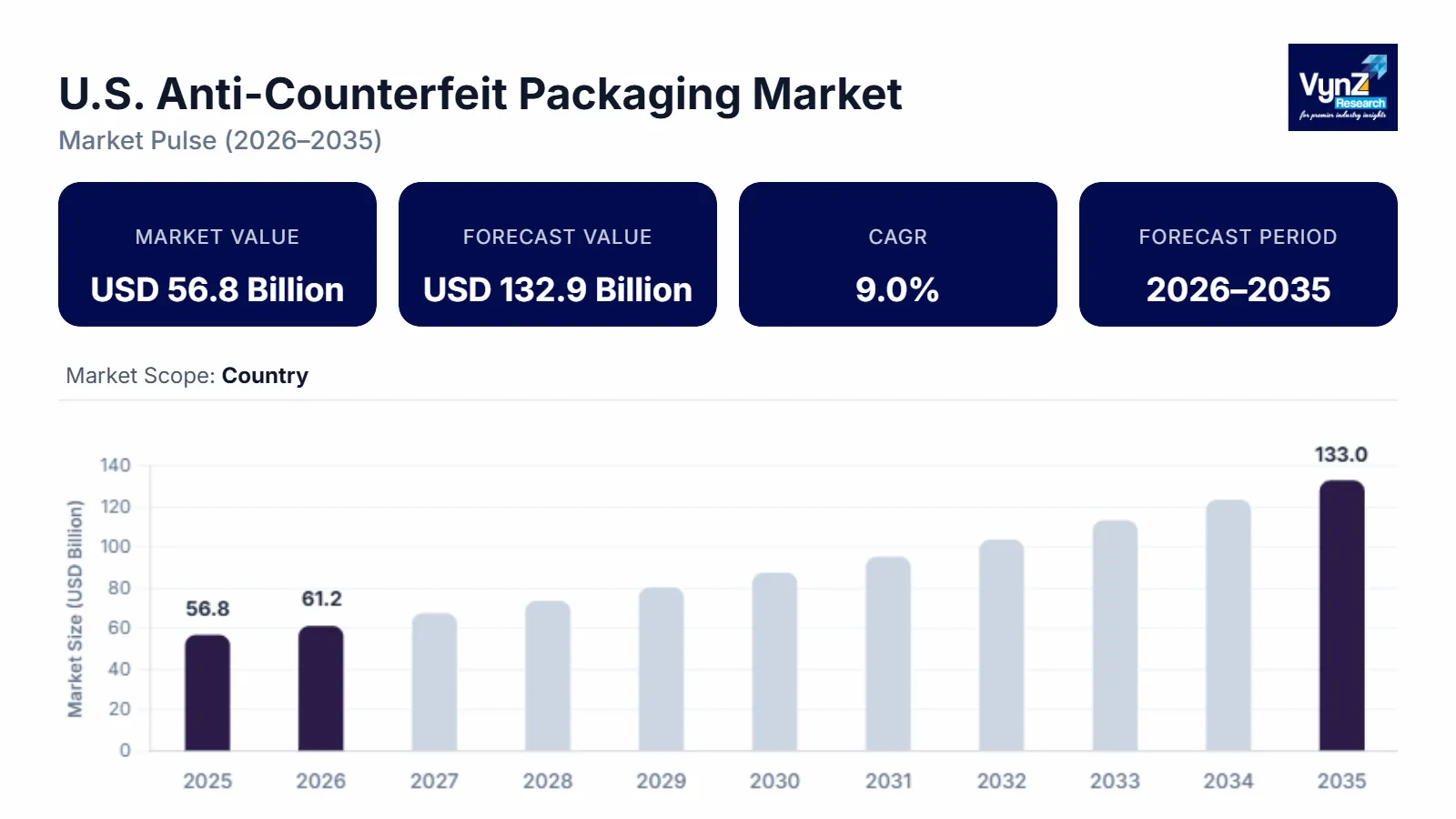
The U.S. anti-counterfeit packaging market size was estimated at USD 56.8 billion in 2025 and is expected to reach around USD 61.2 billion in 2026, rising to roughly USD 132.9 billion by 2035, growing at approximately 9.0% CAGR from 2026 to 2035.
Research Highlights
- Authentication technologies held 38.9% share in 2025 due to pharmaceutical serialization regulations.
- Overt security features captured 34.7% share in 2025 through cost effective authentication.
- Plastic accounted for 43.6% market share in 2025 supporting advanced security integration.
- Track and trace technologies will grow at 10.2% CAGR driven by digitalization.
- Northeast U.S. held 28.4% share in 2025 supported by pharmaceutical manufacturing.
Market growth is being pushed by stringent pharmaceutical serialization rules, more e-commerce product authentication requirements and larger counterfeit prevention investments as well. At the same time, there’s also more adoption of smart packaging technologies. The demand is basically for more secure packaging for both pharmaceuticals and consumer goods, and there are continued investments in supply chain traceability efforts by the U.S. Food and Drug Administration (FDA), under the Drug Supply Chain Security Act, which is being supported by authentication guidance from the National Institute of Standards and Technology (NIST) and by counterfeit enforcement initiatives from U.S. Customs and Border Protection (CBP). Together, these factors are helping the market expand across major regions, like the Northeast, Midwest and West Coast.
U.S. Anti-Counterfeit Packaging Market Dynamics
Market Trends
In the industry, there are some notable moves happening around tech adoption, product verification, and supply chain visibility. It is seen especially with the wider integration of smart packaging, which seems to mirror evolving preferences toward traceability, protection, and regulatory adherence. There is also a newer direction in digital authentication capabilities being taken up more often largely because serialization demands and general digital transformation are pushing it forward. Overall, these changes make firms rely on more advanced security features and packaging systems that work together and they keep pointing to guidance from the U.S. Food and Drug Administration (FDA) and standards set by the National Institute of Standards and Technology (NIST).
Growth Drivers
For growth, the market is mostly carried by rising counterfeiting prevention efforts, which keep generating solid demand across pharmaceuticals, food, and even consumer goods. At the same time, increasing spending on secure manufacturing and supply chain modernization helps speed things up further. On top of that, tougher compliance obligations matter a lot for adoption rates. As producers keep focusing on product fidelity and consumer wellbeing, demand for upgraded authentication tools is expected to stay strong. That support is tied to the U.S. Food and Drug Administration (FDA) and also enforcement actions by U.S. Customs and Border Protection (CBP).
Market Restraints / Challenges
Even with promising expansion signals, the market is still dealing with obstacles that can slow momentum. For example, high setup costs and constantly changing regulatory expectations keep weighing on uptake, most noticeably for small and medium sized manufacturers. Also, relying on specialized verification technologies can create day-to-day friction for suppliers. Integration with legacy production environments is another headache. It may push compliance expenses up and stretch deployment schedules and because the National Institute of Standards and Technology (NIST) keeps adjusting cybersecurity recommendations, teams end up needing continuous technology refreshes, which is not always easy.
Market Opportunities
There are real openings in intelligent packaging and digital product authentication, especially as regulatory progress keeps rolling in and as consumers become more conscious. Vendors that provide strong security performance are likely to grab more of the demand coming from pharma, healthcare, and premium consumer goods players. Another opportunity sits in AI powered traceability platforms, because investments in digital supply chains are turning into longer term growth fuel. Steps meant to improve supply chain resilience from the U.S. Department of Commerce along with serialization guidance from the U.S. Food and Drug Administration (FDA) are expected to push adoption steadily ahead.
U.S. Anti-Counterfeit Packaging Market Report Coverage
|
Report Metric |
Details |
|
Historical Period |
2020 - 2024 |
|
Base Year Considered |
2025 |
|
Forecast Period |
2026 - 2035 |
|
Market Size in 2025 |
USD 56.8 Billion |
|
Revenue Forecast in 2035 |
USD 132.9 Billion |
|
Growth Rate |
9% |
|
Segments Covered in the Report |
Technology, Packaging Feature, Material, End User |
|
Report Scope |
Market Trends, Drivers, and Restraints; Revenue Estimation and Forecast; Segmentation Analysis; Companies’ Strategic Developments; Market Share Analysis of Key Players; Company Profiling |
|
Regions Covered in the Report |
Northeast U.S., Midwest U.S., West U.S., Rest of the U.S. |
|
Key Companies |
3M Company, AlpVision SA, Authentix Inc., Avery Dennison Corporation, CCL Industries Inc., DuPont de Nemours Inc., Honeywell International Inc., SATO Holdings Corporation, SICPA Holding SA, Zebra Technologies Corporation |
|
Customization |
Available upon request |
U.S. Anti-Counterfeit Packaging Market Segmentation
By Technology
Authentication technologies owned the biggest portion of the market, around 38.9%, in 2025 basically because pharma, food, and consumer goods have all been adopting product verification. In these industries, verification is now both regulatory and commercial priority, which is pushing demand. On top of that, ongoing investment in secure packaging infrastructure and product integrity programs has helped keep demand steady, especially after the serialization pushes from the U.S. Food and Drug Administration (FDA).
Track and trace technologies are expected to grow the quickest, reaching roughly a 10.2% CAGR through 2035. More digital identification, cloud-based traceability platforms, and connected packaging solutions are being deployed which really boosts supply chain visibility. Guidance from the National Institute of Standards and Technology (NIST), enforcement actions run by U.S. Customs and Border Protection (CBP) keeps pushing advanced tracking systems into wider use.
By Packaging Feature
Overt security features brought in the largest revenue share, estimated at 34.7% in 2025, and that’s mostly due to visible authentication methods. Those make consumers feel safer and also speed up verification in retail and distribution. They’re also pretty cost effective and easy to roll out, which helps explain why regulated industries keep choosing them.
Tamper evident packaging is expected to show the strongest growth rate, with an estimated 9.8% CAGR during the forecast period. More focus on consumer safety, pharmaceutical compliance, and food quality assurance is nudging manufacturers to add tamper indication mechanisms into the packaging formats. Regulatory guidance from the U.S. Food and Drug Administration (FDA) along with protection packaging recommendations from the National Institute of Standards and Technology (NIST) keeps strengthening the demand for tougher, more protective packaging solutions.
By Material
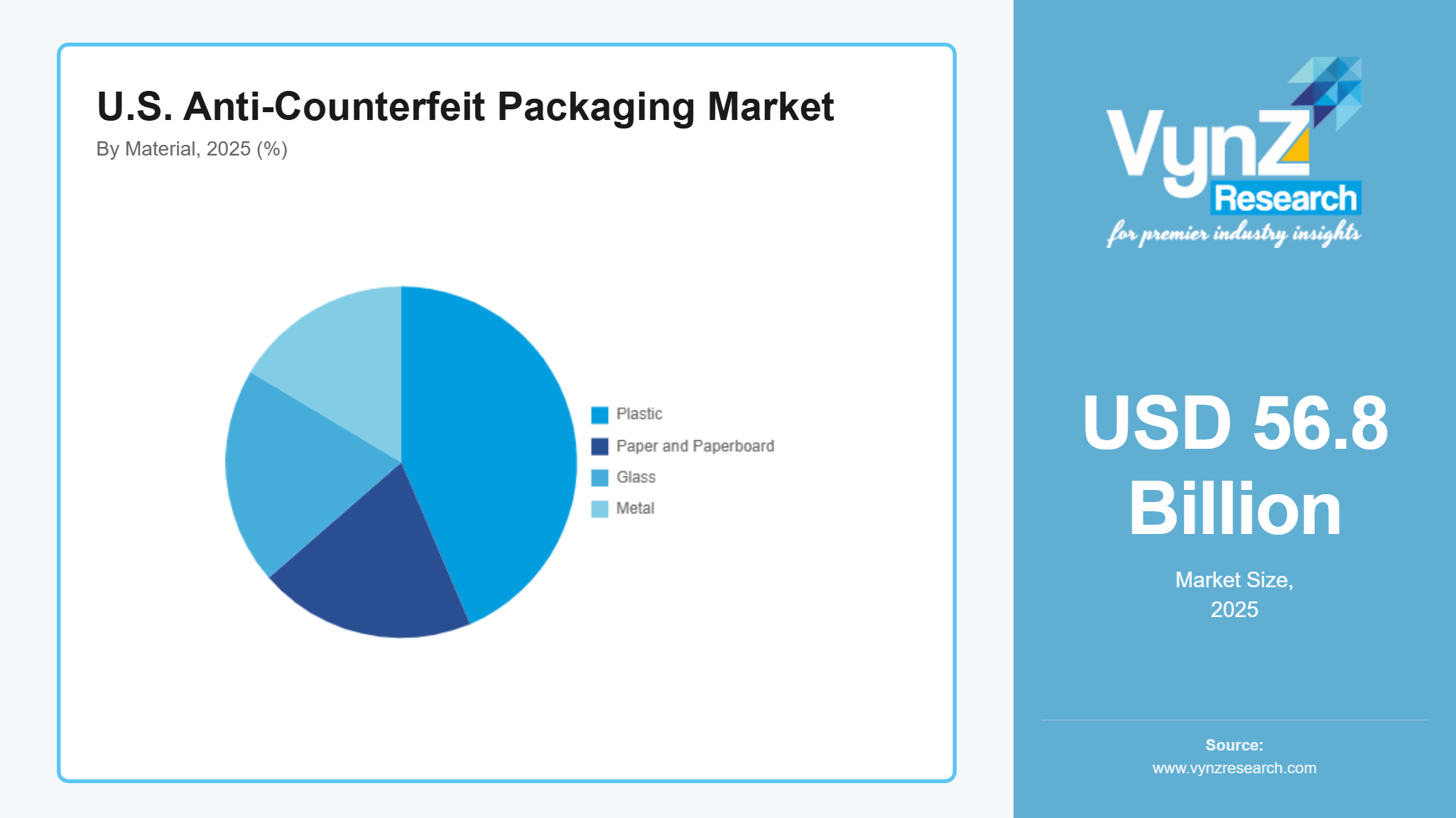
Plastic is still the dominant material segment, sitting at about 43.6% share in 2025. That’s supported by how well plastic works with different authentication technologies, its lightweight nature, and how it fits high volume pharmaceutical and consumer goods packaging needs. Product innovation keeps making it easier to blend security labels, RFID components, and digital authentication features right into plastic packaging formats.
Paper and paperboard, on the other hand, are anticipated to expand the fastest, growing at an estimated 9.5% CAGR through the forecast period. Sustainability commitments and regulatory pressure for environmentally responsible packaging are motivating manufacturers to move toward recyclable security packaging solutions. Sustainability efforts associated with the U.S. Environmental Protection Agency (EPA) along with packaging guidance from the U.S. Department of Commerce are encouraging more investment in secure paper-based packaging technologies.
By End User
The pharmaceutical segment captured the biggest estimated revenue share, around 42.8% in 2025. That’s mainly driven by strict serialization rules, rising worries about counterfeit medicines, and the need for compulsory product traceability across healthcare supply chains. The compliance requirements tied to the Drug Supply Chain Security Act, under the U.S. Food and Drug Administration (FDA), keep reinforcing long term investment in advanced anti counterfeit packaging solutions.
Food and beverages segment is expected to post the fastest growth, roughly 9.6% CAGR over the forecast period. More consumer awareness about authenticity, stronger food safety requirements, and wider digital traceability initiatives are pushing manufacturers to increase packaging security across distribution networks. Food authentication programs managed by the U.S. Department of Agriculture (USDA), plus safety rules enforced by the U.S. Food and Drug Administration (FDA), are likely to sustain demand for secure packaging technologies through the coming decade.
Regional Insights
Northeast U.S.
In 2025, the Northeast roughly held about 28.4% of the U.S. anti-counterfeit packaging market, mainly because it has a pretty solid pharmaceutical manufacturing ecosystem, an advanced healthcare setup, and a lot of regulated packaging plants clustered in the area. The demand from New Jersey Massachusetts, and Pennsylvania keeps helping the market grow, even when things get slow. Also, stricter regulatory follow ups under the U.S. Food and Drug Administration (FDA), and the pharmaceutical manufacturing insights shown in U.S. Census Bureau publications continue to push companies to invest in serialization, verification methods, and more secure packaging approaches across the region.
Midwest U.S.
For the Midwest, the market share in 2025 is estimated at around 24.6%, and that is largely backed by its large manufacturing footprint, along with a food processing sector that is expanding. Anti-counterfeit packaging is being taken up more often in pharmaceutical, food, and industrial use cases, so demand stays steady. Census Bureau manufacturing reports, teamed with authentication and traceability notes from the National Institute of Standards and Technology (NIST) are making it easier for businesses to roll out identity checking and trace and track solutions across much of the Midwest.
West U.S.
The West showed approximately 21.2% of the market in 2025 with momentum coming from ongoing innovation in smart packaging, digital verification, and connected supply chain flows. California, Washington, and nearby technology hubs still bring in investment for advanced packaging used in healthcare and consumer products. Innovation programs backed by the U.S. Department of Commerce and regulatory watchfulness from the U.S. Food and Drug Administration (FDA) are helping intelligent anti counterfeit packaging systems move from pilot stage into real commercial use.
Rest of the U.S.
Meanwhile, the rest of the U.S. took the remaining 25.8% in 2025 and demand looks pretty consistent across Southern states and Mountain areas. This is happening alongside expanded pharmaceutical distribution, consumer goods manufacturing, and food packaging efforts. More money is going into regional logistics infrastructure and that is improving secure supply chain operations, which in turn strengthens market prospects. In addition, supply chain safety initiatives promoted by U.S. Customs and Border Protection (CBP), along with manufacturing and trade information released by the U.S. Census Bureau, keep supporting broader adoption of anti-counterfeit packaging technologies in those parts.
Competitive Landscape / Company Insights
The market seems moderately competitive with global and regional players going hard on product novelty, better authentication tech, and some strategic collaborations to hold onto their position. More money is being pushed into research and development, digital traceability, and smart packaging approaches, so competition keeps getting more intense, especially in regulated sectors. Regulatory direction from the U.S. Food and Drug Administration (FDA), technology benchmarks by the National Institute of Standards and Technology (NIST) and supply chain protection programs from U.S. Customs and Border Protection (CBP), all keep nudging innovation forward and also help sustain long term market strength.
Mini Profiles
AlpVision SA focuses on digital anti counterfeit authentication solutions, supported by proprietary invisible verification technologies, strong pharmaceutical expertise, and expanding partnerships with global brand owners across regulated industries.
CCL Industries Inc. operates in premium and industrial packaging segments, emphasizing high performance security labels, RFID technologies, product authentication solutions, and continuous investment in packaging innovation.
DuPont de Nemours Inc. leverages advanced materials science, extensive research capabilities, and strategic collaborations to develop secure packaging materials that enhance product integrity and counterfeit protection.
Honeywell International Inc. specializes in industrial authentication and track and trace technologies, supported by digital automation expertise, integrated software platforms, and a strong presence across manufacturing sectors.
Zebra Technologies Corporation focuses on intelligent identification and supply chain visibility solutions, supported by barcode, RFID, and real time tracking technologies that strengthen product authentication and operational efficiency.
Key Players
- 3M Company
- AlpVision SA
- Authentix Inc.
- Avery Dennison Corporation
- CCL Industries Inc.
- DuPont de Nemours Inc.
- Honeywell International Inc.
- SATO Holdings Corporation
- SICPA Holding SA
- Zebra Technologies Corporation
Recent Developments
3M Company joined the US-JOINT semiconductor packaging consortium to accelerate the development of advanced packaging materials for next-generation AI computing. The initiative strengthens the company's innovation capabilities in secure, high-performance packaging technologies with applications across regulated industries.
Avery Dennison Corporation launched an intelligent anti-counterfeit packaging solution integrating RFID authentication, serialized QR codes, and cloud-based traceability. The solution enhances supply chain visibility and product protection for pharmaceutical and consumer goods manufacturers.
Crane NXT completed its acquisition of OpSec Security to expand its authentication and brand protection portfolio. The acquisition strengthened its integrated anti-counterfeit packaging and digital verification capabilities for global customers.
Honeywell International Inc. supplied advanced technologies for Vioneo's large-scale fossil-free virgin plastics facility in Antwerp. The project supports the development of sustainable packaging materials that can strengthen future secure packaging applications.
SICPA Holding SA introduced an upgraded digital tax stamp verification platform for excise-regulated products. The enhanced solution improves digital authentication, product verification, and traceability across regulated supply chains.
U.S. Anti-Counterfeit Packaging Market Coverage
Technology Insight and Forecast 2026 - 2035
- Authentication Technologies
- Track and Trace Technologies
- Tamper Evident Technologies
- Others
Packaging Feature Insight and Forecast 2026 - 2035
- Overt Features
- Covert Features
- Forensic Features
- Tamper Evident Packaging
Material Insight and Forecast 2026 - 2035
- Plastic
- Paper and Paperboard
- Glass
- Metal
- Others
End User Insight and Forecast 2026 - 2035
- Pharmaceuticals
- Food and Beverages
- Consumer Goods
- Automotive
- Chemicals
- Others
U.S. Anti-Counterfeit Packaging Market by Region
- Northeast U.S.
- By Technology
- By Packaging Feature
- By Material
- By End User
- Midwest U.S.
- By Technology
- By Packaging Feature
- By Material
- By End User
- West U.S.
- By Technology
- By Packaging Feature
- By Material
- By End User
- Rest of the U.S.
- By Technology
- By Packaging Feature
- By Material
- By End User
Table of Contents for U.S. Anti-Counterfeit Packaging Market Report
1. Research Overview
1.1. The Report Offers
1.2. Market Coverage
1.2.1. By
Technology
1.2.2. By
Packaging Feature
1.2.3. By
Material
1.2.4. By
End User
1.3. Research Phases
1.4. Limitations
1.5. Market Methodology
1.5.1. Data Sources
1.5.1.1.
Primary Research
1.5.1.2.
Secondary Research
1.5.2. Methodology
1.5.2.1.
Data Exploration
1.5.2.2.
Forecast Parameters
1.5.2.3.
Data Validation
1.5.2.4.
Assumptions
1.5.3. Study Period & Data Reporting Unit
2. Executive Summary
3. Industry Overview
3.1. Industry Dynamics
3.1.1. Market Growth Drivers
3.1.2. Market Restraints
3.1.3. Key Market Trends
3.1.4. Major Opportunities
3.2. Industry Ecosystem
3.2.1. Porter’s Five Forces Analysis
3.2.2. Recent Development Analysis
3.2.3. Value Chain Analysis
3.3. Competitive Insight
3.3.1. Competitive Position of Industry
Players
3.3.2. Market Attractive Analysis
3.3.3. Market Share Analysis
4. U.S. Market Estimate and Forecast
4.1. U.S. Market Overview
4.2. U.S. Market Estimate and Forecast to 2035
5. Market Segmentation Estimate and Forecast
5.1. By Technology
5.1.1. Authentication Technologies
5.1.1.1. Market Definition
5.1.1.2. Market Estimation and Forecast to 2035
5.1.2. Track and Trace Technologies
5.1.2.1. Market Definition
5.1.2.2. Market Estimation and Forecast to 2035
5.1.3. Tamper Evident Technologies
5.1.3.1. Market Definition
5.1.3.2. Market Estimation and Forecast to 2035
5.1.4. Others
5.1.4.1. Market Definition
5.1.4.2. Market Estimation and Forecast to 2035
5.2. By Packaging Feature
5.2.1. Overt Features
5.2.1.1. Market Definition
5.2.1.2. Market Estimation and Forecast to 2035
5.2.2. Covert Features
5.2.2.1. Market Definition
5.2.2.2. Market Estimation and Forecast to 2035
5.2.3. Forensic Features
5.2.3.1. Market Definition
5.2.3.2. Market Estimation and Forecast to 2035
5.2.4. Tamper Evident Packaging
5.2.4.1. Market Definition
5.2.4.2. Market Estimation and Forecast to 2035
5.3. By Material
5.3.1. Plastic
5.3.1.1. Market Definition
5.3.1.2. Market Estimation and Forecast to 2035
5.3.2. Paper and Paperboard
5.3.2.1. Market Definition
5.3.2.2. Market Estimation and Forecast to 2035
5.3.3. Glass
5.3.3.1. Market Definition
5.3.3.2. Market Estimation and Forecast to 2035
5.3.4. Metal
5.3.4.1. Market Definition
5.3.4.2. Market Estimation and Forecast to 2035
5.3.5. Others
5.3.5.1. Market Definition
5.3.5.2. Market Estimation and Forecast to 2035
5.4. By End User
5.4.1. Pharmaceuticals
5.4.1.1. Market Definition
5.4.1.2. Market Estimation and Forecast to 2035
5.4.2. Food and Beverages
5.4.2.1. Market Definition
5.4.2.2. Market Estimation and Forecast to 2035
5.4.3. Consumer Goods
5.4.3.1. Market Definition
5.4.3.2. Market Estimation and Forecast to 2035
5.4.4. Automotive
5.4.4.1. Market Definition
5.4.4.2. Market Estimation and Forecast to 2035
5.4.5. Chemicals
5.4.5.1. Market Definition
5.4.5.2. Market Estimation and Forecast to 2035
5.4.6. Others
5.4.6.1. Market Definition
5.4.6.2. Market Estimation and Forecast to 2035
6. Northeast U.S. Market Estimate and Forecast
6.1. By
Technology
6.2. By
Packaging Feature
6.3. By
Material
6.4. By
End User
7. Midwest U.S. Market Estimate and Forecast
7.1. By
Technology
7.2. By
Packaging Feature
7.3. By
Material
7.4. By
End User
8. West U.S. Market Estimate and Forecast
8.1. By
Technology
8.2. By
Packaging Feature
8.3. By
Material
8.4. By
End User
9. Rest of the U.S. Market Estimate and Forecast
9.1. By
Technology
9.2. By
Packaging Feature
9.3. By
Material
9.4. By
End User
10. Company Profiles
10.1.
3M Company
10.1.1.
Snapshot
10.1.2.
Overview
10.1.3.
Offerings
10.1.4.
Financial
Insight
10.1.5.
Recent
Developments
10.2.
AlpVision SA
10.2.1.
Snapshot
10.2.2.
Overview
10.2.3.
Offerings
10.2.4.
Financial
Insight
10.2.5.
Recent
Developments
10.3.
Authentix Inc.
10.3.1.
Snapshot
10.3.2.
Overview
10.3.3.
Offerings
10.3.4.
Financial
Insight
10.3.5.
Recent
Developments
10.4.
Avery Dennison Corporation
10.4.1.
Snapshot
10.4.2.
Overview
10.4.3.
Offerings
10.4.4.
Financial
Insight
10.4.5.
Recent
Developments
10.5.
CCL Industries Inc.
10.5.1.
Snapshot
10.5.2.
Overview
10.5.3.
Offerings
10.5.4.
Financial
Insight
10.5.5.
Recent
Developments
10.6.
DuPont de Nemours Inc.
10.6.1.
Snapshot
10.6.2.
Overview
10.6.3.
Offerings
10.6.4.
Financial
Insight
10.6.5.
Recent
Developments
10.7.
Honeywell International Inc.
10.7.1.
Snapshot
10.7.2.
Overview
10.7.3.
Offerings
10.7.4.
Financial
Insight
10.7.5.
Recent
Developments
10.8.
SATO Holdings Corporation
10.8.1.
Snapshot
10.8.2.
Overview
10.8.3.
Offerings
10.8.4.
Financial
Insight
10.8.5.
Recent
Developments
10.9.
SICPA Holding SA
10.9.1.
Snapshot
10.9.2.
Overview
10.9.3.
Offerings
10.9.4.
Financial
Insight
10.9.5.
Recent
Developments
10.10.
Zebra Technologies Corporation
10.10.1.
Snapshot
10.10.2.
Overview
10.10.3.
Offerings
10.10.4.
Financial
Insight
10.10.5.
Recent
Developments
11. Appendix
11.1. Exchange Rates
11.2. Abbreviations
Note: Financial insight and recent developments of different companies are subject to the availability of information in the secondary domain.
Frequently Asked Questions
Purchase Options
Latest Report
Research Methodology
- Desk Research / Pilot Interviews
- Build Market Size Model
- Research and Analysis
- Final Deliverable
Connect With Our Sales Team
- Toll-Free: +1-888-253-3960
- Phone: +91 9960 288 381
- Email: enquiry@vynzresearch.com
U.S. Anti-Counterfeit Packaging Market