
TIC Market for Building & Construction Industry Size & Share - Growth Forecast Report (2026-2035)
Industry Insight by Service Type (Testing, Inspection, Certification), by Project Type (Infrastructures, Commercial, Residential), by Sourcing Type (In-House, Outsourced), by Compliance Focus (Structural and Safety, Environmental and Sustainability, Sustainability-related compliance)
| Status : Published | Published On : Feb, 2026 | Report Code : VRSME9188 | Industry : Semiconductor & Electronics | Available Format :

|
Page : 180 |
TIC Market for Building & Construction Industry Overview
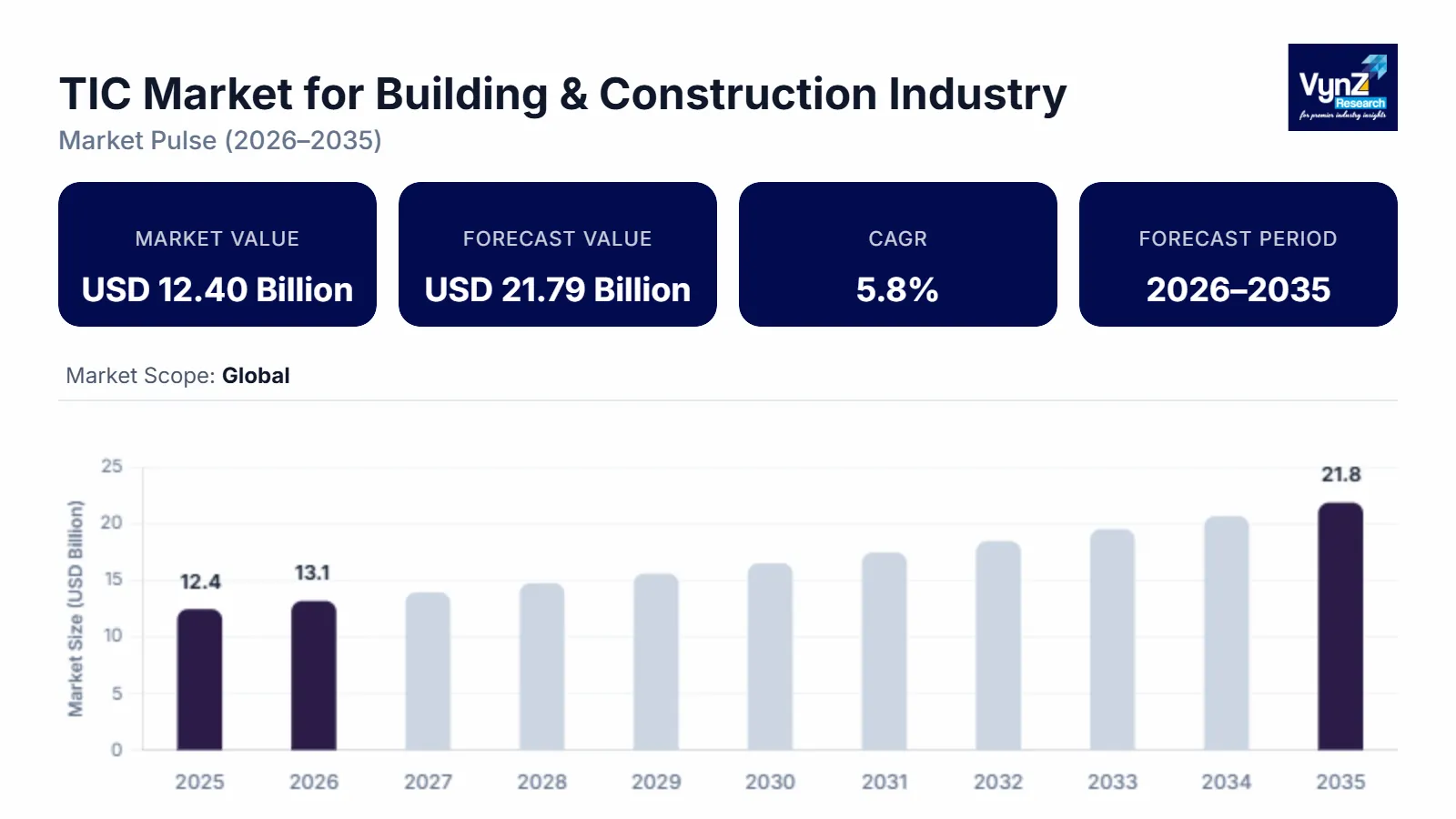
The global building & construction industry testing, inspection, and certification (TIC) market was valued at USD 12.40 billion in 2025 and is expected to reach USD 13.12 billion in 2026. The market is projected to grow steadily, reaching USD 21.79 billion by 2035, with a compound annual growth rate (CAGR) of 5.8% from 2026 to 2035.
The Testing, Inspection, and Certification (TIC) market for the building and construction industry plays a critical role in ensuring structural safety, material quality, regulatory compliance, and sustainability across residential, commercial, and infrastructure projects. TIC services verify that construction materials, components, and systems meet national and international standards throughout the project lifecycle from design and material sourcing to construction, commissioning, and maintenance.
Technological advancements, including digital inspections, Building Information Modeling (BIM), drones, IoT-enabled monitoring, and data analytics, are transforming traditional TIC processes, improving accuracy and reducing project delays. As construction projects become more complex and risk-sensitive, outsourcing TIC services to specialized providers has become a preferred strategy, supporting steady growth of the TIC market within the building and construction industry worldwide.
TIC Market for Building & Construction Industry Dynamics
Market Trends
The Testing, Inspection & Certification (TIC) market for the building and construction industry is undergoing significant transformation driven by regulatory, technological, and sustainability forces. As urbanization accelerates and large infrastructure programs expand globally, construction projects are subject to increasingly stringent safety, quality, and compliance standards, prompting developers and regulators to rely more on independent TIC services to validate materials, workmanship, and structural integrity.
Growth Drivers
Building and construction projects are heavily regulated and overseen at multiple levels. Different layers of supervisory agents are involved in the control of these projects, ranging from their type and location to the stage of the asset’s life cycle the projects are at. Apart from the general regulations imposed by the structural safety codes, fire resistance norms, seismic standards, and material compliance requirements, there is a growing need for independent testing and inspection services. It is estimated that regulatory-driven TIC activities account for about 36-38% of sector demand, with service volumes growing by approximately 6.6% every year as authorities step up enforcement at the time of construction and after completion.
The global construction spending's scale and complexity remain another continuous factor to drive the industry. Public infrastructure programs, commercial real estate development, and big residential projects are examples of activities that need repeated inspection of materials, foundations, structural components, and installed systems. In fact, global construction output exceeded USD 13 trillion in 2023, and TIC services directly linked to construction execution and quality assurance are getting almost 7.2% CAGR higher, thus they are being supported by multi-stage inspection requirements.
Sustainability and lifecycle performance have also become compulsory evaluation points instead of simply being optional considerations. Currently, energy efficiency standards, green building certifications, and environmental impact verification significantly influence getting project approvals and access to financing. The TIC services that are linked to sustainability audits, material traceability, and environmental compliance are advancing more quickly than the traditional testing ones, reaching close to 8% growth in the markets where the green construction mandates are mature.
Market Restraints / Challenges
The testing, inspection, and certification market face certain challenges like trade wars and growth fluctuations, a huge investment for automation and installation of industrial safety systems, and the high cost of TIC owing to diverse standards and regulations globally. Moreover, there are certainly more challenges faced by the building & construction industry such as projects should be completed on schedule, products being safe and having quality standards, costs should not overrun, compliance to CSR, and effective risk management. Moreover, a lack of testing facilities and skilled personnel may hamper the growth of the TIC market.
Market Opportunities
The TIC market for building and construction is poised for long-term growth as the industry demands shift from simple compliance to performance assurance, strategic risk management and sustainability validation. Another high-growth area is sustainability and green building compliance. As legislators, investors, and end users prioritize low-carbon building, energy efficiency, and environmental stewardship, there is an increasing demand for energy performance testing, carbon footprint verification, indoor air quality tests, and green certification. By expanding into environmental assurance and ESG reporting, TIC businesses can create new revenue sources in addition to traditional safety and compliance testing.
Global TIC Market for Building & Construction Industry Report Coverage
|
Report Metric |
Details |
|
Historical Period |
2020 - 2024 |
|
Base Year Considered |
2025 |
|
Forecast Period |
2026 - 2035 |
|
Market Size in 2025 |
USD 12.40 Billion |
|
Revenue Forecast in 2035 |
USD 21.79 Billion |
|
Growth Rate |
5.8% |
|
Segments Covered in the Report |
Service Type, Project Type, Sourcing Type, and Compliance Focus |
|
Report Scope |
Market Trends, Drivers, and Restraints; Revenue Estimation and Forecast; Segmentation Analysis; Companies’ Strategic Developments; Market Share Analysis of Key Players; Company Profiling |
|
Regions Covered in the Report |
North America, Europe, Asia Pacific |
|
Key Companies |
Intertek Group Plc, Bureau Veritas, MISTRAS Group, SGS SA, Eurofins Scientific, TUV Rheinland, TUV SUD, DEKRA SE Applus+, DNV GL, Element Materials Technology, UL Solutions, Lloyd’s Register Group, BSI Group, Cotecna Inspection SA |
|
Customization |
25% available |
TIC Market for Building & Construction Industry Segmentation
By Service Type
Testing services are the major portion of the building and construction industry's TIC revenue with a contribution of approximately 44-46%. The need for the same is created by such works as concrete testing, soil analysis, material strength validation, and fire resistance assessment. Next in line, the Inspection services comprise the 33-35% share and are the fastest-growing service line by nearly 8% CAGR attributed to the on-site structural checks and compliance monitoring. The last pieces of the puzzle are Certification services representing the remaining share.
By Project Type
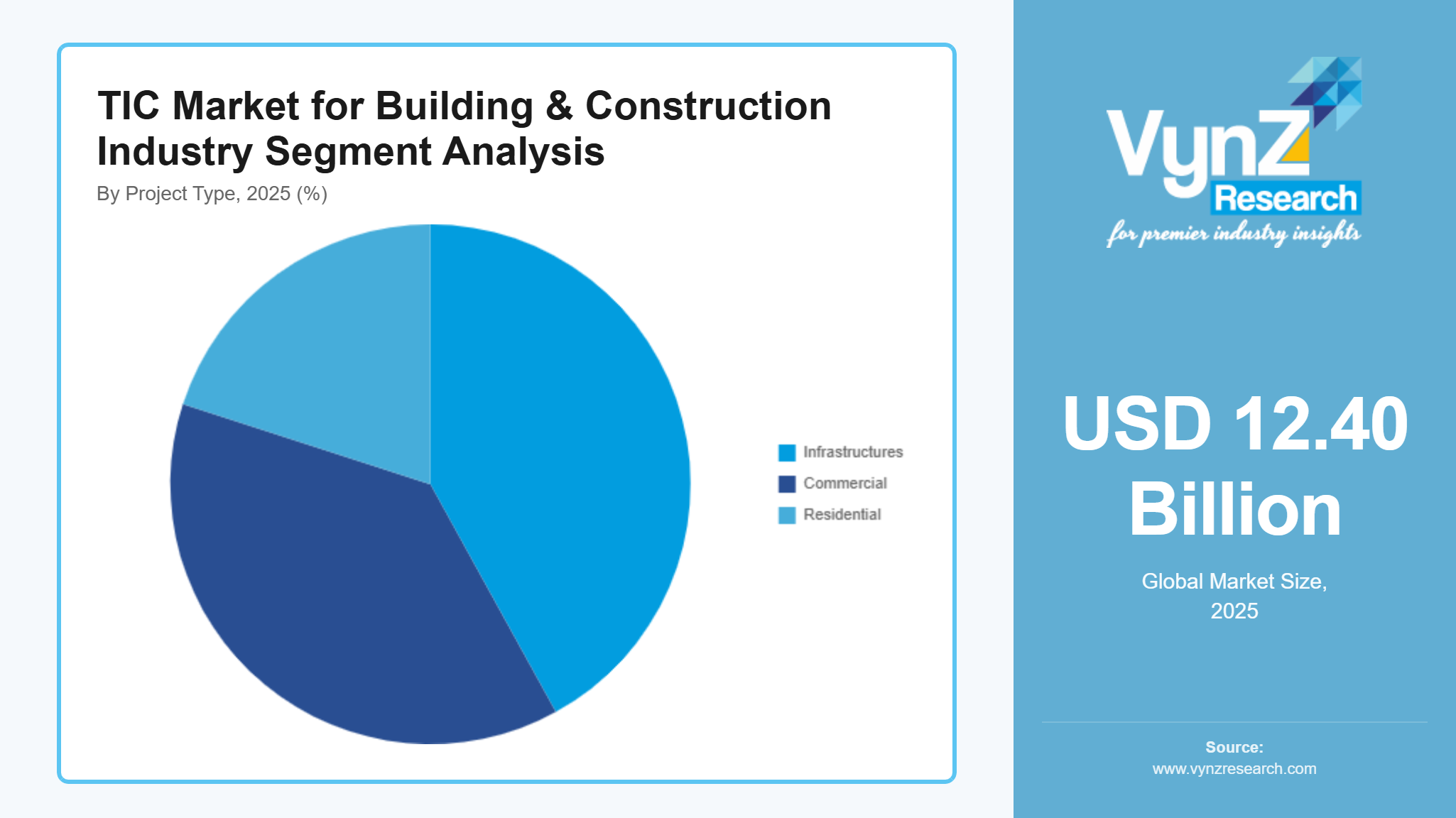
Infrastructures like roads, bridges, railways, and public utilities are the prime sources of demand for TIC services, approximately accounting for 42% of the consumption, due to their magnitude and the regulatory rigor. Commercial construction is responsible for about 34% of the activity volume and is mainly driven by office, retail, and mixed-use developments. The residential sector forms the rest of the demand, however, through safety and occupancy certification, it continues to provide recurring demand.
By Sourcing Type
Most of the TIC operations, almost 67-69%, are carried out through outsourcing which is why construction stakeholders are eager to engage independent third parties as a means for regulatory acceptance and risk mitigation. Outsourced services are on the rise at a rate of about 7.5% CAGR. The rest 31-33% of demand is attributed to the in-house testing and inspection, which are mainly done by large contractors and developers, and their progress, is close to 4.5% but slower than that of outsourced services.
By Compliance Focus
One of the largest focus areas is structural and safety compliance that makes up almost 41% of the TIC demand. Following that, there is environmental and sustainability compliance that makes up around 32%, which is mainly driven by green building norms and emissions oversight. The remaining share is accounted for by fire safety and occupancy certification. Sustainability-related compliance services are growing at the fastest rate, which is more than 8% a year in developed markets.
Regional Insights
North America
North America is responsible for about 30-32% of the world demand for TIC in the building and construction industry. The US is the main driver of the regional activity that results from strict building codes, liability risk, and the enforcement of safety and environmental standards.
The demand for TIC is fueled by the continued infrastructure upgrades, commercial redevelopment, and recurring inspection mandates for existing assets. The services that are related to structural inspection and energy efficiency verification are increasing their turnover by 6.7-7% annually.
The use of green building certifications is further enhanced by the demand for specialized testing and audit services.
Europe
Europe accounts for about 26-28% of the global TIC demand for the construction industry. It is influenced by the harmonized standards and strict enforcement. The main reason for the structural safety norms and sustainability directives compliance is a stable demand for the services.
Environmental and energy performance assessments are becoming more and more present as part of the project approval processes which result in increased demand for sustainability-focused TIC services at nearly 7.4% CAGR.
The modernization of Europe’s old infrastructure as well as the retrofitting of energy-efficient buildings will continue to give rise to long-term TIC needs.
Asia Pacific
Asia Pacific is a rapidly expanding regional market. It is estimated that the market is growing at a CAGR of 8.3-8.8%. China, India, and Southeast Asia are the main drivers of the demand due to their large-scale urban development, transport infrastructure expansion, and industrial construction.
As the components of the regulatory framework get more standardized, the trust to certified third-party TIC providers increases as well. At the same time, it is beneficial for the local industries to have export-driven construction materials and cross-border investment projects which, in turn, increase the need for certification.
The region is undergoing a transition from very basic compliance testing to more thorough, lifecycle-based inspection ones.
Competitive Landscape / Company Insights
The market is moderately to highly competitive, with global and regional players focusing on product innovation, pricing strategies, and geographic expansion. Companies such as Microsoft, IBM, Google, Amazon Web Services, and Oracle are investing heavily in R&D, cloud infrastructure, and AI model optimization. Government-backed initiatives, including NIST AI guidelines, the EU AI Act, and national AI strategies in APAC, support technology adoption and reinforce vendor positioning across enterprise and public sector clients.
Mini Profiles
MISTRAS can perform inspections on single components, or centralize testing and machining aerospace production milestones in a purpose-built facility.
Bureau Veritas provides electrical safety testing and certification services that help gain access to global markets. This certification program test products against recognized safety standards relating to criteria such as electric shock, excessive temperature, radiation, implosion, and mechanical hazards and fire.
Intertek provides a diverse range of both military and civil Aerospace and Defence Services of all aspects of production and performance.
Key Players
- Intertek Group Plc
- Bureau Veritas
- MISTRAS Group
- SGS SA
- Eurofins Scientific
- TUV Rheinland
- TUV SUD
- DEKRA SE
- Applus+
- DNV GL
- Element Materials Technology
- UL Solutions
- Lloyd’s Register Group
- BSI Group
- Cotecna Inspection SA
Recent Developments
In June 2025, UL Solutions launched its new testing and certification service for immersion cooling fluids used in data centers. This offering is designed to help ensure the safety, performance, energy efficiency and reliability of immersion cooling fluids that protect critical IT equipment—especially in high‑demand environments such as AI and high‑performance computing centers.
In May 2025, Sustainable technology firm GoBlu International collaborated with testing specialist Eurofins Sustainability Services to help drive sustainable chemical management and testing in the textile and footwear industries.
In March 2025, Lloyd’s Register has completed a joint development project (JDP) designing ammonia dual-fuel systems on Trafigura's newbuild medium gas carriers (MGCs).
Global TIC Market for Building & Construction Industry Coverage
Service Type Insight and Forecast 2026 - 2035
- Testing
- Inspection
- Certification
Project Type Insight and Forecast 2026 - 2035
- Infrastructures
- Commercial
- Residential
Sourcing Type Insight and Forecast 2026 - 2035
- In-House
- Outsourced
Compliance Focus Insight and Forecast 2026 - 2035
- Structural and Safety
- Environmental and Sustainability
- Sustainability-related compliance
Global TIC Market for Building & Construction Industry by Region
- North America
- By Service Type
- By Project Type
- By Sourcing Type
- By Compliance Focus
- By Country - U.S., Canada, Mexico
- Europe
- By Service Type
- By Project Type
- By Sourcing Type
- By Compliance Focus
- By Country - Germany, U.K., France, Italy, Spain, Russia, Rest of Europe
- Asia-Pacific (APAC)
- By Service Type
- By Project Type
- By Sourcing Type
- By Compliance Focus
- By Country - China, Japan, India, South Korea, Vietnam, Thailand, Malaysia, Rest of Asia-Pacific
- Rest of the World (RoW)
- By Service Type
- By Project Type
- By Sourcing Type
- By Compliance Focus
- By Country - Brazil, Saudi Arabia, South Africa, U.A.E., Other Countries
Table of Contents for TIC Market for Building & Construction Industry Report
1. Research Overview
1.1. The Report Offers
1.2. Market Coverage
1.2.1. By
Service Type
1.2.2. By
Project Type
1.2.3. By
Sourcing Type
1.2.4. By
Compliance Focus
1.3. Research Phases
1.4. Limitations
1.5. Market Methodology
1.5.1. Data Sources
1.5.1.1.
Primary Research
1.5.1.2.
Secondary Research
1.5.2. Methodology
1.5.2.1.
Data Exploration
1.5.2.2.
Forecast Parameters
1.5.2.3.
Data Validation
1.5.2.4.
Assumptions
1.5.3. Study Period & Data Reporting Unit
2. Executive Summary
3. Industry Overview
3.1. Industry Dynamics
3.1.1. Market Growth Drivers
3.1.2. Market Restraints
3.1.3. Key Market Trends
3.1.4. Major Opportunities
3.2. Industry Ecosystem
3.2.1. Porter’s Five Forces Analysis
3.2.2. Recent Development Analysis
3.2.3. Value Chain Analysis
3.3. Competitive Insight
3.3.1. Competitive Position of Industry
Players
3.3.2. Market Attractive Analysis
3.3.3. Market Share Analysis
4. Global Market Estimate and Forecast
4.1. Global Market Overview
4.2. Global Market Estimate and Forecast to 2035
5. Market Segmentation Estimate and Forecast
5.1. By Service Type
5.1.1. Testing
5.1.1.1. Market Definition
5.1.1.2. Market Estimation and Forecast to 2035
5.1.2. Inspection
5.1.2.1. Market Definition
5.1.2.2. Market Estimation and Forecast to 2035
5.1.3. Certification
5.1.3.1. Market Definition
5.1.3.2. Market Estimation and Forecast to 2035
5.2. By Project Type
5.2.1. Infrastructures
5.2.1.1. Market Definition
5.2.1.2. Market Estimation and Forecast to 2035
5.2.2. Commercial
5.2.2.1. Market Definition
5.2.2.2. Market Estimation and Forecast to 2035
5.2.3. Residential
5.2.3.1. Market Definition
5.2.3.2. Market Estimation and Forecast to 2035
5.3. By Sourcing Type
5.3.1. In-House
5.3.1.1. Market Definition
5.3.1.2. Market Estimation and Forecast to 2035
5.3.2. Outsourced
5.3.2.1. Market Definition
5.3.2.2. Market Estimation and Forecast to 2035
5.4. By Compliance Focus
5.4.1. Structural and Safety
5.4.1.1. Market Definition
5.4.1.2. Market Estimation and Forecast to 2035
5.4.2. Environmental and Sustainability
5.4.2.1. Market Definition
5.4.2.2. Market Estimation and Forecast to 2035
5.4.3. Sustainability-related compliance
5.4.3.1. Market Definition
5.4.3.2. Market Estimation and Forecast to 2035
6. North America Market Estimate and Forecast
6.1. By
Service Type
6.2. By
Project Type
6.3. By
Sourcing Type
6.4. By
Compliance Focus
6.4.1.
U.S. Market Estimate and Forecast
6.4.2.
Canada Market Estimate and Forecast
6.4.3.
Mexico Market Estimate and Forecast
7. Europe Market Estimate and Forecast
7.1. By
Service Type
7.2. By
Project Type
7.3. By
Sourcing Type
7.4. By
Compliance Focus
7.4.1.
Germany Market Estimate and Forecast
7.4.2.
France Market Estimate and Forecast
7.4.3.
U.K. Market Estimate and Forecast
7.4.4.
Italy Market Estimate and Forecast
7.4.5.
Spain Market Estimate and Forecast
7.4.6.
Russia Market Estimate and Forecast
7.4.7.
Rest of Europe Market Estimate and Forecast
8. Asia-Pacific (APAC) Market Estimate and Forecast
8.1. By
Service Type
8.2. By
Project Type
8.3. By
Sourcing Type
8.4. By
Compliance Focus
8.4.1.
China Market Estimate and Forecast
8.4.2.
Japan Market Estimate and Forecast
8.4.3.
India Market Estimate and Forecast
8.4.4.
South Korea Market Estimate and Forecast
8.4.5.
Rest of Asia-Pacific Market Estimate and Forecast
9. Rest of the World (RoW) Market Estimate and Forecast
9.1. By
Service Type
9.2. By
Project Type
9.3. By
Sourcing Type
9.4. By
Compliance Focus
9.4.1.
Brazil Market Estimate and Forecast
9.4.2.
Saudi Arabia Market Estimate and Forecast
9.4.3.
South Africa Market Estimate and Forecast
9.4.4.
U.A.E. Market Estimate and Forecast
9.4.5.
Other Countries Market Estimate and Forecast
10. Company Profiles
10.1.
Intertek Group Plc
10.1.1.
Snapshot
10.1.2.
Overview
10.1.3.
Offerings
10.1.4.
Financial
Insight
10.1.5.
Recent
Developments
10.2.
Bureau Veritas
10.2.1.
Snapshot
10.2.2.
Overview
10.2.3.
Offerings
10.2.4.
Financial
Insight
10.2.5.
Recent
Developments
10.3.
MISTRAS Group
10.3.1.
Snapshot
10.3.2.
Overview
10.3.3.
Offerings
10.3.4.
Financial
Insight
10.3.5.
Recent
Developments
10.4.
SGS SA
10.4.1.
Snapshot
10.4.2.
Overview
10.4.3.
Offerings
10.4.4.
Financial
Insight
10.4.5.
Recent
Developments
10.5.
Eurofins Scientific
10.5.1.
Snapshot
10.5.2.
Overview
10.5.3.
Offerings
10.5.4.
Financial
Insight
10.5.5.
Recent
Developments
10.6.
TUV Rheinland
10.6.1.
Snapshot
10.6.2.
Overview
10.6.3.
Offerings
10.6.4.
Financial
Insight
10.6.5.
Recent
Developments
10.7.
TUV SUD
10.7.1.
Snapshot
10.7.2.
Overview
10.7.3.
Offerings
10.7.4.
Financial
Insight
10.7.5.
Recent
Developments
10.8.
DEKRA SE
10.8.1.
Snapshot
10.8.2.
Overview
10.8.3.
Offerings
10.8.4.
Financial
Insight
10.8.5.
Recent
Developments
10.9.
Applus+
10.9.1.
Snapshot
10.9.2.
Overview
10.9.3.
Offerings
10.9.4.
Financial
Insight
10.9.5.
Recent
Developments
10.10.
DNV GL
10.10.1.
Snapshot
10.10.2.
Overview
10.10.3.
Offerings
10.10.4.
Financial
Insight
10.10.5.
Recent
Developments
10.11.
Element Materials Technology
10.11.1.
Snapshot
10.11.2.
Overview
10.11.3.
Offerings
10.11.4.
Financial
Insight
10.11.5.
Recent
Developments
10.12.
UL Solutions
10.12.1.
Snapshot
10.12.2.
Overview
10.12.3.
Offerings
10.12.4.
Financial
Insight
10.12.5.
Recent
Developments
10.13.
Lloyd’s Register Group
10.13.1.
Snapshot
10.13.2.
Overview
10.13.3.
Offerings
10.13.4.
Financial
Insight
10.13.5.
Recent
Developments
10.14.
BSI Group
10.14.1.
Snapshot
10.14.2.
Overview
10.14.3.
Offerings
10.14.4.
Financial
Insight
10.14.5.
Recent
Developments
10.15.
Cotecna Inspection SA
10.15.1.
Snapshot
10.15.2.
Overview
10.15.3.
Offerings
10.15.4.
Financial
Insight
10.15.5.
Recent
Developments
11. Appendix
11.1. Exchange Rates
11.2. Abbreviations
Note: Financial insight and recent developments of different companies are subject to the availability of information in the secondary domain.
Frequently Asked Questions
Purchase Options
Latest Report
Research Methodology
- Desk Research / Pilot Interviews
- Build Market Size Model
- Research and Analysis
- Final Deliverable
Connect With Our Sales Team
- Toll-Free: +1-888-253-3960
- Phone: +91 9960 288 381
- Email: enquiry@vynzresearch.com
TIC Market for Building & Construction Industry